Why Need is “An Idea We Cannot Do Without”
in Economics
By Roger A. McCain
Professor, Department of Economics and International Business, Drexel University,
Philadelphia, PA, 19104; e-mail [email protected]; http://faculty.lebow.drexel.edu/mccainr/ . The author is indebted to Dr. Alison Snow Jones, of the Department of Health Management and Policy, School of Public Health, Drexel University, and participants in the Thirteenth World Congress of Social Economics, Montreal, 2010, for critical comments on the paper.
Why Need is “An Idea We Cannot Do Without”
in Economics
Economists in the neoclassical tradition do their best to avoid using the word “need.” Social economists have traditionally been more open to discussions of need. This essay will argue that need is “a word we cannot do without”1 in economics, and not only in social economics. For neoclassical economics, demand is determined by subjective wants, together with the objective constraints of limited income and resources, so that any concept of “need” may be excluded as superfluous. In neoclassical economics, at the technical level, the word “preference” is usually used in place of “wants,” and this is reasonable up to a point. Since wants are relative, it makes perfectly good sense to say that I want this more than I want that; that is, I prefer this to that. No doubt, wants and preferences are among the furniture of our subjective experience: only adepts in mystical practice would deny it! Nevertheless, this essay will argue that even the narrower purposes of neoclassical economics cannot be achieved without clarifying and using the concept of need, in addition to the more usual motivational assumptions of
neoclassical economics.
a. Philosophy of Need
As Reader (2005) notes, philosophers, too, have avoided and neglected the concept of need, on the whole. “The concept of need plays a significant but still relatively unexplored role in philosophy,” she writes. However, philosophy does provide us with some resources for the discussion of need, including Reader’s collection and the work of Ragnar Ohlsson (1995). Since the philosophers are (in these discussions) primarily concerned with the characterization of need as a moral category, their objectives differ somewhat from the objectives of this essay, but similar conceptual issues arise.
1
The title adapts the title of a paper by David Wiggins in Soran Reader, ed., (2005) The
As Ohlsson observes (p. 93), “There are two concepts expressed by the term ‘need’ -- one referring to certain psychological drives and one referring to certain causal connections between states.” Ohlsson’s reference to “certain psychological drives” could in turn refer to hypotheses of hierarchy of need (Maslow, 1943, e.g.), but it is clear that in common usage, “need” sometimes means no more than a relatively intense want, as in “I really need a latte.” As a result, “needs” often play an invidious role in economic argumentation. I may claim that your want must give way to my need. This claim is always self-seeking and often specious2. Accordingly, neoclassical economists are quite right to be cautious in reasoning about need, but here again, they take it too far in refusing to recognize any such category as need at all. Accordingly, in what follows, this essay will focus on Ohlsson’s second sense, (note also Thomson, 2005, Wiggins, 2005, Wiggins and Derman, 1987) need as referring to causal connections between states. In the remainder of this essay, the word “need” will refer exclusively and consistently to this second sense.
Reference to a Maslovian “hierarchy of needs” will be made in passing and within this context. Ohlsson’s causal interpretation of need can be illustrated by the one “need” concept that is fairly widely recognized in economics: basic need. One instance of a basic need is the need for food. If this need is not satisfied at all, the causal consequence of the failure to meet the need is starvation. If the need for food is not met at some level of adequacy, the causal consequence is malnutrition. Thus we can say that each human individual needs food in order to survive and avoid the impairment of health that would be the consequence of malnutrition. The phrase “in order to” expresses the causal nature of the need. Garrett Thomson (2005, p.175) agrees, writing “Needs are objective because it is a discoverable matter of fact what needs a person has, and yet this fact has a bearing on what one ought to do. The concept is both factual and evaluative.” Similarly Wiggins (2005, p.29) holds that needs are instruments, and that this is the primary sense of the word “need.”
Ohlsson’s discussion seems to give the best foundation for the purposes of this paper. Ohlsson (p. 95) formalizes this sense of need as follows: “A has a need for x in the situation s, if and only if there is a goal y for A and x is a necessary and in s sufficient condition for A to reach y.” In the example of the basic need for food, provision of food at a level of adequacy is both
2
necessary and sufficient (in many situations) to the consequence of avoiding starvation and malnutrition, conditions which are defined by objective medical criteria. But consider instead a person who suffers both from cataracts and from blindness consequent on neurological injury. We cannot say that this person “needs” cataract surgery in order to restore his sight, because cataract surgery is not a sufficient condition for the restoration of his sight, in the situation
created by his neurological injury. We will find that this logical condition is at the center of some of the most troubling controversies over medical care reform in the United States.
Ohlsson’s definition has a number of implications. As Ohlsson writes, “Needs are in a way relative to circumstances. In the climate of Greenland human beings have needs for warm clothing in order to survive, in central Africa this need is not so important.” (p. 98) Moreover, expert knowledge may be necessary to determine needs. “Which specific needs a certain person will be ascribed is left for experts in biology, physiology, and so on to determine.” (p.100) It follows that an individual cannot always know her or his own needs. This also is perhaps best illustrated by medical care. Whether (for example) I need treatment for high blood pressure is a question of fact, and one best judged by an expert in the practice of medicine. I myself am not a good judge of whether or not I need treatment for high blood pressure.
Individual need may not be easily generalized to a group. Consider an example in which 1000 people suffer from a fatal disease that can be cured only by a medicine made from large quantities of a rare tropical plant, so that the available medicine is sufficient only for 100 to be treated. One may correctly say that “any person suffering from the disease needs medical care” but not that “the group of 1000 people suffering from the disease need medical care” since there is no treatment sufficient for the 1000. This may lead to a suggestion of allocation by lot, since the allocation is a constant-sum game, so that all possible allocations are efficient. Moreover, any subgroup of 100 or less of the 1000, however selected, may be said to have need for treatment. In any case, it is clear also that individual need cannot be aggregated; that is, even though each individual in a group has a need, one cannot from that infer that the group have a corresponding need. This will be problematic for public policy.
moral entitlement.3 While our purposes for this essay are different, the philosophers’ caution on this score is appropriate here as well, especially when we turn to public policy.
b. Needs vs. Wants
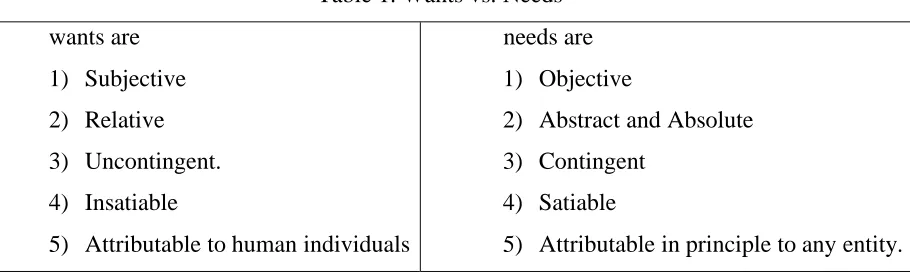
As we have seen, wants and needs are fundamentally different. Wants are subjective, relative and, according to the assumptions of neoclassical economics, insatiable. Needs are absolute, objective, and satiable. It has already been observed that they are objective. The other two claims may want some support. Again, consider the basic need for food. Once adequate nutrition has been assured, this need is satisfied. We cannot altogether exclude as nonsense a relative evaluation of needs, based on a relative evaluation of the objectives for which the need is said to be necessary and sufficient. We can, for example, meaningfully say that the need for food is more urgent than the need for medical care, since a person can benefit from medical care only if she lives and avoids starvation. But, strictly speaking, a starving person has no need for medical care, since medical care will not be sufficient to restore her to health unless food is provided. Thus, the person either does or does not have a need for medical care, depending on the circumstances – and need is absolute in this sense.
We have seen also that needs are contingent. Wants or preferences, by contrast, are uncontingent. (Ohlsson, p. 2-3, refers to intrinsic interests roughly in parallel to the economist’s preferences or ordinary language’s wants.) The example of blood pressure medication illustrates this. One may need treatment in order to lower blood pressure to normal and reduce the
probability of circulatory illness, but this need exists only if the person is indeed subject to high blood pressure. Those who do not suffer from high blood pressure have no such need. Wants are
3
not contingent in any such way. “The heart wants what it wants4.” I want what I want because I want it, and no argument needs to be made in support of a want.
A further difference between needs and wants is that wants can be attributed only to beings capable of subjective experience of sufficient complexity to form wants and intentions, that is, so far as we know, to human beings. By contrast, “Practically any entity can be the subject of a statement about needs. ‘The army needs more money.’ – ‘Plants have a need for light.’ – ‘The theory needs sharpening.’” (Ohlsson, 1995, p. 95) For public policy, the first of these is particularly important: human groups may have needs, and it is meaningful to speak of the needs of the state, an organization, or a community. Methodological individualism is applicable to wants but not to needs.
In summary we can offer a tabular list of the distinctions between wants and needs. This is shown as Table 1.
Table 1. Wants vs. Needs wants are
1) Subjective 2) Relative 3) Uncontingent. 4) Insatiable
5) Attributable to human individuals
needs are 1) Objective
2) Abstract and Absolute 3) Contingent
4) Satiable
5) Attributable in principle to any entity.
c. Basic and Other Needs
This illustrates why (economists to the contrary notwithstanding) need cannot be reduced to want. On the other hand, since needs are contingent on the objectives we hope to attain, we can classify needs according to the objectives that define them. Medical care is a “basic need,” that is, something we need in order to survive with good health. In that category also are needs
4
for food, clothing, and shelter. But the basic need for food can be satisfied with very cheap food: a mid-twentieth century estimate (Stigler 1945) suggested that the cheapest “subsistence” diet would consist largely of oatmeal and peanut butter. (Can we say that there is a need for a diet that is not only adequate for health but also delicious and varied?) The requirement of shelter and clothing for survival and health will be even more difficult to determine, but, again, probably very little.
i. Social Participation Needs
There are also needs that represent things we must have in order to function as members of our society. Let us call these social participation needs. In a modern society, education stands out as such a social participation need, although, again, just how much education is necessary is unclear. In the United States, transportation in some form is essential, and in some localities a person without an automobile is objectively handicapped. Sen (1985) stresses that in some societies, one cannot be a full member of society unless one is well-dressed, that is, “decently” dressed.
ii. Self-Realization Needs
these categories of need, however, is precisely that need is objective, and we need to see the evidence that these conditions are indeed necessary and sufficient to attain the objective of full functioning as a human being, in order to confirm that they are indeed needs. It seems more than fair to say that the evidence for these needs is sketchy.
iii. Public Needs
Yet another category of social needs arises from the state of the society as a whole, rather than the objectives of individuals. These needs will be most apparent in the environmental field: in order to ensure the health of the population of a region, it may be necessary to reduce air pollution. Notice that this is traceable back to the well-being of individuals – the objective in this case is to improve the health of the individuals. Clearly, this category is connected to the
neoclassical category of “public goods.” However, “public goods” are a category of wants. What we have here is an objective condition that can be attained only by the production of a public or quasipublic good, that is, in this instance, a reduction of air pollution. Such a need might be designated by the parallel term “public need.”
The category of public goods, strictly understood, applies to goods that are both nonrival and nonexcludable. There seem to be very few such goods, and one often hears the casual use of the term “public good” where those conditions are not present. Indeed, access to courts of law, often considered as a public good even by those who would limit the scope of government very severely, is neither nonrival nor nonexcludable. If, however, we speak of equal access to courts
of law as one of the conditions for a government of laws, we describe a public good, since the
delivery and libraries would the be correctly described as public needs. This follows also from the fact that equal access to information and communication are public goods.
d. Needs and Policy
As we have noted, philosophers tend to be interested in need as the basis of moral
obligation. This may be asking too much of the concept. Perhaps, however, we may say that it is reasonable to propose that a good public policy should include measures to assure that at least some kinds needs be met. In the neoclassical economics of market economies, goods and services are distributed according to wants. An alternative aspiration is expressed by the phrase “From each according to his ability, to each according to his need.” This phrase is often
associated with Marx (1875), but Marx was relatively dismissive of it (seeing it as relevant only to the distant future realization of communism). The phrase is actually due to Louis Blanc (1839), a French pre-Marx socialist. We recall that in neoclassical economics, wants are expressed as preferences, and the preference concept is associated with the neoclassical
assumption that people are perfectly rational, which is certainly not so. Nevertheless, within the limits of their bounded rationality, people will attempt to satisfy their wants in accordance with their preferences, and an issue for public policy is the balancing of the pursuit of wants against the satisfaction of needs.
i. Income and Need
levels who might, as a consequence, not meet that basic need or might sacrifice other basic needs, such as health care, in order to meet it.
Programs of this sort have been a bit of a puzzle to free market economists, who point out that the best way to make people better off (in terms of their preferences) is to give them
unrestricted purchasing power (Friedman, 1962, Toumanoff, 1986). But these programs can readily be understood as cheaper ways to meet needs. Moreover, the example of medical care illustrates a case in which increases in minimum income cannot plausibly assure that needs will be met, both because of the role of expert knowledge in determining needs and because of the extremely skewed distribution of needs to be met.
ii. Social Participation Needs, Again
Social participation needs may be quite costly, as the example of automobiles and gasoline illustrate. Should public policy aim to assure everyone of access to an automobile? But for needs in this category, there is another approach. Instead of trying to satisfy them, whatever they may be, we might change society in such a way as to reduce the social participation needs. (This seems to have been the idea behind the spectacularly shabby used clothing some of us wore in the counterculture in the 1960’s and 1970’s.) We might argue, for example, for a more
extensive and reliable system of public transportation or for the relocation of jobs, residences, and business districts to reduce the need for transportation and especially for cars. On the other hand, would we consider changing society in such a way as to reduce the social participation need for education? Perhaps we should: extensive schooling is not for everyone. But since a highly efficient, modern economy requires a high level of general education, we probably could not go very far in that direction.
iii. Compulsion
the institutionalization of the mentally ill. Need is objective, and may conflict with subjective want, or may be beyond the knowledge or mental capacity of the person to address. In such a case, do we compel the person to meet her need? If a person needs a medical treatment, such as a blood transfusion, but refuses it due to religious conviction, ought that person’s objections be overridden and she forced to accept the transfusion? Perhaps not. On the other hand, suppose the medical treatment is inoculation for a contagious disease. In this case the objective to be met is
some reduction in the probability that the individual will contract the disease. If the individual
refuses the inoculation, and contracts the disease, he may transmit it to others; thus, his refusal to meet his own need makes it more difficult or impossible for others to meet their own needs. In this case, however, the individual is not required to meet his own need but rather to take action to meet a public need, and one might argue that people should not be compelled to meet (simply) their own needs but may be compelled to take action to meet public needs, as, indeed, the tax system routinely does.
This is not to say that compulsion should never play a role. Perhaps we have gone too far in liberating those who are mentally incapable and consequently homeless. Perhaps
homelessness and mental difficulty should be grounds for some compulsory assistance. In extreme cases, of course, they are and will be so, but how extreme needs the case be to trigger the compulsory assistance? The key point, though, is that it should be a means of meeting the person’s objective need, not keeping an unpleasant problem out of sight, and should be limited so that it does not oppress the liberty of those to whom liberty is meaningful – even if they are easily confused!
iv. Politics of Need
argument should not be accepted hastily but further discussion will have to be beyond the scope of this essay.)
There are “needs” that no society is likely to try to meet. Again, I “need” a personal jet aircraft and personal pilot if I am to travel rapidly and conveniently across the continent. But if I do not have a job that demands such travel of me (such as a high military commander might), then I suspect no-one would suggest that the public authority should be expected to supply that particular need.
This is inherently a political decision. “To each according to his needs” must be taken to mean “To each enough to satisfy his basic and public needs, and such other needs as the
community can supply and jointly determines should be supplied.” Thus, distribution according to need is unavoidably political in a way that distribution according to want is not.
e. Cost and Need
Medical care is at the center of yet another puzzle with respect to need. The puzzle is the “rising cost of medical care.” Over the last generation Americans have consumed increasing quantities of medical care at even more rapidly increasing cost.
i. Need and the “Cost Disease”
There is a possible neoclassical explanation for this. It is due to William Baumol, and it is at least partly true. Baumol argues (1967), that the costs of services generally (like those of the arts in particular, Baumol and Bowen, 1966) tend to rise with general economic progress. Rising average labor productivity in the economy as a whole raises the opportunity cost of labor and consequently raises the relative prices of services. If, in addition, the demand for the service is price and income inelastic then the proportion of all income spent on that service is increased, and this is Baumol’s prediction for medical care. A difficulty is that we seem to observe
increasing demand for medical care, and moreover that this seems to be a consequence of
production possibilities, leading to the substitution of new goods and services for old ones; but the medium for this substitution is decreasing prices. (Computers provide a very good instance of this). In order for technological progress to lead to greater consumption at higher prices, it is necessary that the preferences change as a result of the technological progress. This would mean that preferences are contingent on the technology; but preferences in neoclassical economics are, by assumption, uncontingent. No doubt some neoclassical epicycle can be constructed to model the increasing price and consumption of medical care, perhaps drawing on the Lancaster “new theory of consumer demand;” (1966, 1971, note also McCain 1974) but this is simply a way of blurring the distinction between want and need. Rather than blurring this distinction, the better means of solving the problem is to maintain the distinction by making need explicitly a part of economic reasoning.
We see increasing use of medical care correlated both with rising prices of medical care and improving knowledge of the means of medical care. Can this be a matter of need? Can needs be increased by increasing knowledge? Yes. Ohlsson writes (p100) “… technological and
scientific breakthroughs can turn something into a need which hitherto has not been a need.” Consider a situation s in which a person is suffering from a fatal disease for which there is no treatment. The situation s is then transformed to s’ by the discovery of a new, unique treatment that will cure the condition and prolong the person’s life by many years. In the new situation s’ the treatment is both necessary and sufficient for the person’s survival: by any reasonable interpretation the person has a need for the treatment. However in the situation s the person cannot be said to have a need for medical treatment. He will die, but this will occur regardless of the treatment he is given, since (by assumption) there is no medical treatment that is sufficient to prolong his life. Thus the expansion of medical knowledge has created needs that did not exist before.
This enters into demand because, as we have already noted, people often want or prefer to meet their needs. When the objective of the need is preservation of life or health, the
preference to meet the need seems very common. Thus the progress of medical science increases demand directly rather than increasing quantity demanded via decreased prices, and, even with unchanging supply, medical progress drives the price upward.
will be attained. Before effective treatments for cancer were known, patients cannot be said to have “needed” treatment for cancer. There was the objective of recovered good health as there is now, but no known means to attain it, and thus no need. As effective treatments have been discovered, new needs have been created, for those who suffer from cancer and other illnesses. The increasing need has brought about increasing wants, since most people want to meet survival needs; but it is the objective and contingent character of need that explains what has occurred. It is possible (as in medicine) that the advance of knowledge might increase our needs even more rapidly than it advances our ability to meet them.
ii. Death Panels
The term “death panels” refers to a regrettable and untrue political claim made by some Republicans in the debate of the summer of 2009 on “health care reform.” Suppose, however, that we adopt the neoclassical objective of the optimal allocation of resources. Then treatment would be withheld if the benefits of the treatment are less than the costs. We may recognize that the value of a life for purposes of cost-benefit analysis poses unanswerable questions.
subject to claims of malpractice and public reimbursement would not be made. The claim that such a “panel” would decide the cases of individuals seems to have been an invention of political polemic, that is, in ordinary language, a lie.
The fact remains that efficient allocation of resources would require the denial of treatment to the elderly in some cases determined by expert judgment. For a senior citizen like me, the most comfortable response to this fact is denial, but it cannot reasonably be denied, whether we take the viewpoint of neoclassical economics or of need satisfaction. Recall the example in an earlier section of a medicine effective in treating a fatal disease but that could not be produced in a quantity sufficient for all those who suffer from the disease. One possibility noted then was allocation by lot. What allocation by lot does is to use a relative criterion to select a group whose need is considered (and met). The relative criterion in this case is the individual’s standing in a random ranking. For medical care, there are a number of relative dimensions to be considered. In the treatment of fatal conditions, for example, we may consider the increase in life expectancy that would result from the treatment. If a costly medical procedure would extend an elderly patient’s life expectancy by only ten seconds, we would almost certainly hold that the gain is not sufficient to justify the treatment. Of course, this is a ridiculous extreme, but, as the sexist old joke has it, “We’ve settled the principle. Now we are haggling about the price.” How much extension of the life expectancy will be sufficient? One month? One year? Ten years? This suggests that (for some medical procedures) a guideline might be established that need would be considered (and the meeting of need funded, and legal protections established) only if the
prolongation of life is sufficient. Another relative dimension of medical care is the likelihood of improvement. As a rule, the outcomes of medical procedures may not be certain, and it might be reasonable to consider need only when the probability of (sufficient) improvement is large enough.
groups determined by impersonal category, not the treatment of individuals, and the relative criteria serve to distinguish groups that can meaningfully be said to have need, as groups.
It would be comforting to ask that all needs for medical care be met. To do do, however, might well require infinite resources, or (what is practically the same) such a quantity of
resources that other basic needs, such as food and warmth, could not be met. In such a case it is formally correct to say that there is no need for medical care, since medical care would not be
sufficient to attain the objective of survival in such a case. Unavoidably, some limits will be set
on the circumstances in which needs for health care will be met, whether by expert judgment, lot, or the personal fortune of income and wealth.
f. Summary and Conclusion
References
Baumol, W. J. (1967), “Macroeconomics of Unbalanced Growth: The Anatomy of Urban Crises,” American Economic Review v. 57, no. 3 (Jun).
Baumol, William and William Bowen (1966), The Performing Arts: The Economic Dilemma
(New York: Twentieth Century Fund).
Blanc, Louis (1839), L'Organisation du travail.
Dickenson, Emily (1862), “Mrs. Samuel Bowles,” (Emily Dickenson Tutte le opere, tr. by Giuseppe Ierolli) available at: http://www.emilydickinson.it/l0261-0280.html, as of April 26, 2010.
Fehr, Ernst and Simon Gaechter (2000), “Fairness and Retaliation: The Economics of Reciprocity,” Journal of Economic Perspectives v. 14, pp. 159-181.
Friedman, Milton (1962), Capitalism and Freedom (Chicago: University of Chicago Press). Isaacson, Walter, and Woody Allen (1992), “The Heart Wants What It Wants,” Time Magazine
(Aug 31).
Lancaster, K. (1966), “Change and Innovation in the Technology of Consumption,” American
Economic Review v. 56, no. 2 (May).
Lancaster, K (1971), Consumer Demand (New York: Columbia University Press). Marx, Karl (1875), “Critique of the Gotha Programme,” (Marxists.org) available at: http://www.marxists.org/archive/marx/works/1875/gotha/index.htm, as of April 26, 2010. Maslow, A. H. (1943), “A Theory of Human Motivation,” Psychological Review v. 50, no. 4 pp. 370-396.
McCain, Roger A. (1974), “Induced Bias in Technical Innovation Including Product Innovation in a Model of Economic Growth,” Economic Journal v. 84, (Dec) pp. 959-966.
McCain, Roger A. (1989), “The Hierarchy of Need and Moral Economics,” Presented, Conference of Association for Social Economics, Atlanta, 1989.
Ohlsson, Ragnar (1995), Morals Based on Needs (Lanham, MD: University Press of America). Reader, Soran (2005), “Introduction,” The Philosophy of Need edited by Soran Reader
(Cambridge: Cambridge University Press) pp. 1-24.
Sassi, Franco (2006), “Calculating QALYs, comparing QALY and DALY calculations,” Health
Policy and Planning v. 21, no. 5 (July) pp. 402-408.
Sen, Amartya. (1985), Commodities and Capabilities (Amsterdam: North-Holland). Smith, Adam (2000), The Theory of Moral Sentiments (Prometheus Books).
Stigler, George (1945), “The Cost of Subsistence,” Journal of Farm Economics v. 27, (May) pp. 303-314.
Thomson, Garrett (2005), “Fundamental Needs,” The Philosophy of Need edited by Soran Reader (Cambridge: Cambridge University Press) pp. 175-187.
Toumanoff, P. G. (1986), “Exclusion Costs and the In-Kind Transfer,” Kyklos v. 39, no. 3 pp. 443-447.
Wiggins, David (2005), “An Idea We Cannot Do Without,” The Philosophy of Need edited by Soran Reader (Cambridge: Cambridge University Press) pp. 25-50.