ISSN 2205-0442 JCMin Number 4 (2018)
47
Emotion and Ministry, a Study in Research Methodology
Dr Nigel Pegram ILPM
DMin (Tabor), MTheol (MCD), BTheol (Hons) (Murdoch), DipMin (Hons) (Churches of Christ Theological College)
Lecturer in Ministry, Alphacrucis College Contact: [email protected]
ABSTRACT
This article uses a case study of emotional intelligence research to call for quality interaction with theory and method in ministry-focused research. Emotional Intelligence (EI) has potential to enhance leadership, teamwork and personal resilience. However, the literature concerning EI and ministers is much sparser than research in other professions. In addition, the quality of ministry research is highly variable and frequently open to significant criticism. Results range from a clear understanding of the models and measurement of EI, to an uncritical use of popular EI literature. This paper particularly encourages researchers engaging in cross-disciplinary studies to ensure their work is of benefit both to the wider academic community and to ministry practitioners by focusing on its validity in both theoretical basis and empirical methodology.
ISSN 2205-0442 JCMin Number 4 (2018)
48
This paper examines research which has been done with respect to emotional intelligence and Christian ministry as a case study in multidisciplinary ministry research. First, emotional intelligence (EI) is introduced, then the relative sparsity of research on EI in ministry contexts when compared with other professions is discussed. Following this, the necessary theory concerning emotional intelligence models and measures is introduced which is then used to assess the quality of existing ministry-focused emotional intelligence research. The paper concludes with a challenge to ministry-focused researchers in general. The goal of this analysis is that researchers in ministry fields are challenged to ensure that their work has a solid theoretical foundation and uses appropriate methods, so that their conclusions will have weight, will add to wider academic discourse and will accurately inform good ministry practice.
The concept of emotional intelligence (also abbreviated EQ in the popular literature) first appeared in the 1980s (G.
Matthews, Zeidner, & Roberts 2004, p. 4). Serious research has been done from the early 1990s. The seminal work was Salovey and Mayer (1990).
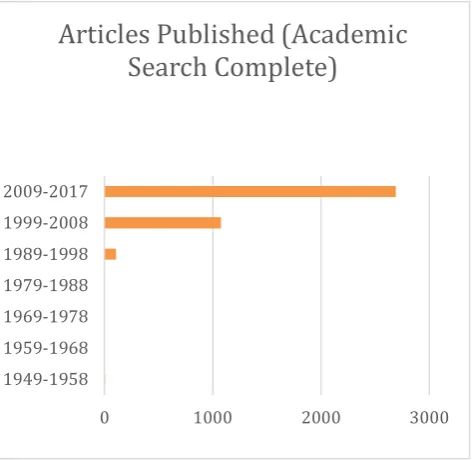
Since that time, EI has gained profile, in both academic and popular literature, with 97% of 3889 articles in “Academic Search Complete” being published from 1999, and 69% being published since 2009 (see Figure 1).1 In the popular sphere, the work of Goleman (2001; 1998, 2006a, 2006b) made a significant impact, with one of his books appearing in the New York Times best-seller list.2
Having briefly introduced the field of emotional intelligence, the literature on EI in ministry will be critiqued from two perspectives, first the
quantity and then the quality of the research done. I will then review relevant psychometric and EI theory, in order to provide a framework on which assessments of ministry research quality can be based. Then the available research will itself be assessed, with particular attention paid to whether the research demonstrates a clear understanding of EI theory and measurement.
This article uses a case study of emotional intelligence research to call for quality interaction with theory and method in ministry-focused research. Emotional Intelligence (EI) has potential to enhance leadership, teamwork and personal resilience. However, the literature concerning EI and ministers is much sparser than research in other professions. In addition, the quality of ministry research is highly variable and frequently
1 Search term “emotional intelligence”.
2 See http://www.nytimes.com/1995/12/10/books/best-sellers-december-10-1995.html.
0 1000 2000 3000
1949-1958 1959-1968 1969-1978 1979-1988 1989-1998 1999-2008 2009-2017
Articles Published (Academic
Search Complete)
ISSN 2205-0442 JCMin Number 4 (2018)
49
open to significant criticism. Results range from a clear understanding of the models and measurement of EI, to an uncritical use of popular EI literature. This paper particularly encourages researchers engaging in cross-disciplinary studies to ensure their work is of benefit both to the wider academic community and to ministry practitioners by focusing on its validity in both theoretical basis and empirical methodology.
The Extent of Research
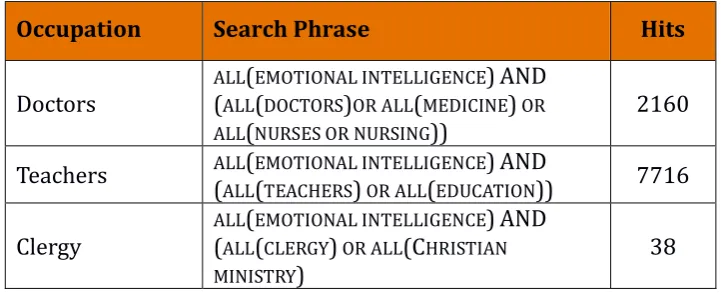
Emotional Intelligence has been researched significantly in a range of professional realms, such as education and medicine. However, the literature concerning EI and ministers is sparse. This can be demonstrated by comparing the frequency of publication of studies concerning EI in other occupations with those specific to Christian ministry. For example, a ProQuest search in January 2017 revealed 10 times as many papers written about EI and doctors and nearly 80 times more about teachers and EI, than about clergy and EI (see table 1).3 Expanding the search parameters simply makes the gap even larger as can be seen in table 2. A similar search of EBSCOhost’s Academic Search Complete revealed 64 times as many articles concerning doctors and 208 times more articles about teachers than the three returned concerning ministers and EI, see table 3. “This lack of [ministry-focused] research interest is somewhat surprising given the diverse range of social and emotional interactions and stressors that clergy encounter.” (Hendron, Irving, & Taylor, 2014, p. 471)
Table 1. ProQuest Articles Concerning Emotional Intelligence
Occupation Search Phrase Hits
Doctors ALL(EMOTIONAL INTELLIGENCE) AND ALL(DOCTORS) 309 Teachers ALL(EMOTIONAL INTELLIGENCE) AND ALL(TEACHERS) 2434 Clergy ALL(EMOTIONAL INTELLIGENCE) AND ALL(CLERGY) 31
Table 2. ProQuest Articles Concerning Emotional Intelligence—Expanded
Occupation Search Phrase Hits
Doctors ALL(EMOTIONAL INTELLIGENCE) AND (ALL(DOCTORS)OR ALL(MEDICINE) OR
ALL(NURSES OR NURSING)) 2160
Teachers ALL(EMOTIONAL INTELLIGENCE) AND (ALL(TEACHERS) OR ALL(EDUCATION)) 7716
Clergy ALL(EMOTIONAL INTELLIGENCE) AND (ALL(CLERGY) OR ALL(CHRISTIAN
MINISTRY) 38
3 All the searches have some false positives. As the differences are quite large, for the purposes of
ISSN 2205-0442 JCMin Number 4 (2018)
50 Table 3. Ebsco Articles Concerning Emotional Intelligence
Occupation Search Phrase Hits
Doctors "EMOTIONAL INTELLIGENCE" AND DOCTORS 193 Teachers "EMOTIONAL INTELLIGENCE" AND TEACHERS 625 Clergy EMOTIONAL INTELLIGENCE AND ((CLERGY OR MINISTRY OR MINISTER) AND CHRISTIAN) 3
So, when comparing research in other professions with research in the ministry field, there is a concerning dearth of EI research in ministry. One result of this lack of ministry-focused EI research is that with little empirical research completed, it is difficult to establish population baselines or norms for ministers as opposed to other professional groups. This means, for example, it is difficult to say with confidence whether ministers display more or less EI than other professionals who work in people-centric vocations such as medicine or teaching. Why might this be important? A lack of understanding of the baseline of ministers’ EI skills means we cannot assess whether sufficient attention has been paid to training in this area or whether ministers are indeed quite skilled. In comparison, when assessing applicants for medicine, the Undergraduate Medicine and Health Sciences Admission Test (UMAT) has around one third of its questions addressing these skills.4 Without a similar body of quality research, it is difficult to contribute to scholarly discourse in the EI field in a meaningful way.
This lack of research in ministry is even more concerning when research in other professions is driven by interest in how EI can contribute to efficacy, health and longevity in those professions. Research is being done to examine how EI can help to prevent dysfunction such as burnout (Alavinia & Ahmadzadeh 2012; Austin, Dore, & O’Donovan 2008; Brackett, Palomera, Mojsa-Kaja, Reyes, & Salovey 2010; Côté & Golden 2006; Wagner & Martin 2012), or to enhance teamwork or leadership skills (Antonakis, Ashkanasy, & Dasborough, 2009; Ginsberg, 2008; Rajah, Song, & Arvey, 2011; Rogalsky, 2012; Schmidt, 2010; Sunindijo, Hadikusumo, & Ogunlana, 2007). At best, an inattention to or ignorance of EI prevents the use of insights from this area of knowledge which may be beneficial for ministry outcomes, for example in the areas of leadership and teamwork. At worst, there is a failure to use a tool which can help prevent significant issues such as burnout and stress in ministry.
Quality of Research
Having examined the quantity of EI research focused on ministry, the question of the quality of ministry-focused EI research will now be examined. In order to complete the analysis, one must understand some of the theory. Emotional intelligence is an extension of the theory of multiple intelligences developed by Howard Gardner (G.
4 UMAT section two, which is concerned with understanding people, contains 44 of the total of 136
ISSN 2205-0442 JCMin Number 4 (2018)
51
Matthews et al. 2004, pp. 59–61; Salovey & Mayer 1990, p. 186).5
Whether or not particular emotional intelligence theories and various models and measures fit with accepted definitions of an intelligence needs to be determined. Gardner had a number of criteria for identifying an intelligence (Gardner 2011, p. 66f.). While Gardner’s criteria are useful when attempting to classify something as an intelligence, Mayer, Caruso, & Salovey (1999, pp. 269–270) are more concise, with only three criteria: conceptual, correlational and developmental. An intelligence must reflect mental performance, the mental performance must relate to a set of closely related, distinct set of mental abilities, and these should develop with age and experience. In order for EI to be considered an intelligence, or for various models of EI to describe an intelligence, these three criteria must be met. One critique levelled at various models and measures is that they do not meet this test. That is, they are concerned with emotion, but not specifically emotional intelligence.
The importance of placing EI within the framework of multiple intelligence theory cannot be overstated. Why? Because this impacts on which methods of measurement are appropriate and which are not. By definition, EI is a mental ability (Mayer et al. 1999, pp. 269–270). It may seem obvious, but it is necessary to emphasise at this point that any instrument which seeks to measure EI as an intelligence, must measure ability, that is, actual skills (Burns, Bastian, & Nettelbeck 2007). The reason this needs to be stated is that, as discussed below, many EI instruments do not in fact do this and as a result, they do not measure emotional intelligence. A skills-based questionnaire might ask respondents to evaluate the emotion displayed in a picture of a person’s face. Alternatively, they might be asked to respond to a scenario, suggesting what emotions might be felt by those described therein.
However, most tools which purport to measure EI are self-report tools (Burns et al. 2007). Self-report tools ask the respondent to report on what they might do or have done in the past. For example, “I can assess the emotional tone in a room”, or “I can manage my emotions in a highly-charged situation”. Such questions do not measure ability. Self-report questions assess the individual’s own assessment of their ability, that is, their self-perception of their skills (Petrides 2011, p. 657). If a self-self-perception is being measured, then one is measuring an aspect of personality (Pérez, Petrides, & Furnham 2005; Petrides, Pita, & Kokkinaki 2007). Therefore, self-report tools can inform personality-focused studies of EI, however, they cannot assess EI as an intelligence, that is, as a set of skills. The measuring of EI without clear distinctions between ability and self-report constructs has caused confusion in the field (MacCann & Roberts 2008, p. 540). Researchers, therefore, should be clear whether they are examining EI as a part of personality or as a skill, and use the appropriate form of tool in their methodology.
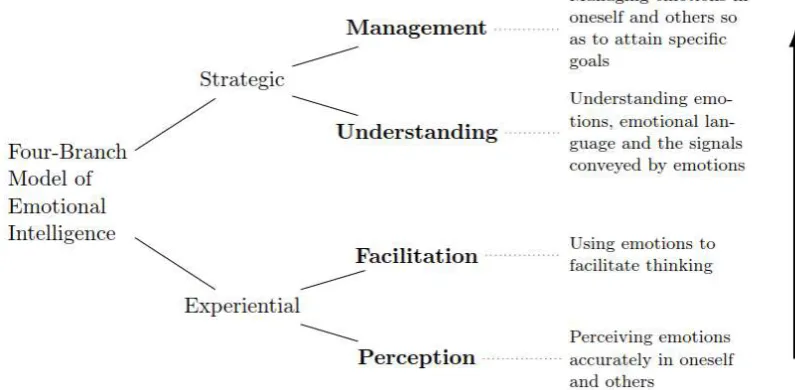
Related to the question of measurement is the presence of multiple models of EI which researchers can use as a theoretical basis for their study. Early in the development of EI two broad categories of models existed, the ability model of Salovey & Mayer (1990), and various mixed models (Zeidner, Matthews, & Roberts 2009, pp. 51, 56). Salovey and Mayer’s model is often called the “Four-Branch Model” of EI, as it classifies the range of EI skills into four categories: perceiving emotions, using emotions to facilitate thinking,
5 Gardner’s theory is not the only multiple approach to intelligence, although it is the best known
ISSN 2205-0442 JCMin Number 4 (2018)
52
understanding emotions, and managing emotions to achieve goals. (See Figure 2 below). Mixed models are described as such since they extend beyond ability. Examples of elements which do not fit the strict definition of intelligence are items which include value judgments, like “social responsibility” and “interacting smoothly with others”. In addition, these constructs normally use a self-report methodology in their assessment tools, which as noted above do not assess skills. In more recent years, some positive development in this area can be observed in the placement of trait-EI (self-perceived EI) within personality discourse, with a clear division between it and ability models of EI (Petrides et al. 2007). Unfortunately, the distinction between EI as an ability and self-perceived EI as an aspect of personality is not always observed either in theory or in research.
Figure 2. The Four-Branch Model of Emotional Intelligence
In summary, one must choose both a theoretical foundation and a measurement instrument which matches the construct the researcher wishes to examine. At present, while there are a multitude of self-report EI measures, there is only one comprehensive EI ability measure, the MSCEIT.6 There is ongoing research into new ability measures (Orchard et al. 2010). When attempting EI research, the researcher needs to decide whether they are examining an aspect of personality or an ability. The use of self-report tools is only valid for assessing personality factors.
Assessing Emotional Intelligence Research in Ministry
In addition to the dearth of research concerning EI in the context of Christian ministry, of great concern is the quality of much of the work to date. Twenty-one academic papers discovered using ProQuest7 and other sources are examined below. When
6 The Meyer-Salovey-Caruso Emotional Intelligence Test (MSCEIT), currently in version 2, is
based on the four-branch model of EI. It presents a range of tasks for the respondent. Each of these tasks is targetted at assessing skills in one of the branches of the model. The respondent received branch, area and composite EI scores. Scoring is completed using both an expert and a consensus method. See https://tap.mhs.com/MSCEIT.aspx for further information.
7 Eleven of the ProQuest results may be dismissed as false positives not relevant to the question
ISSN 2205-0442 JCMin Number 4 (2018)
53
assessing the research, a number of criteria are used. Is an understanding of multiple intelligence and EI theory demonstrated? Then does this clear understanding of theory result in a subsequent critical use of the available measurement tools? In particular an appreciation of the difference between ability and self-report measures should be demonstrated. The studies should also show conclusions which can be supported from the theory and evidence displayed in the research.
When considering the author’s understanding of EI theory, a number of factors are assessed. One criterion is the literature accessed. One needs to assess whether the authors make use of high-quality research and academic-quality publications, or do they tend toward more popular works? In summary eleven of the 21 papers examined make good use of the academic literature (Boyatzis, Brizz, & Godwin 2011; Gambill 2008; Hendron et al. 2014; Higley 2007; Miller-Clarkson 2013; Oney 2010; Paek 2006; Palser 2005; Randall 2013; Roth 2011; Samples 2009). Puls, Ludden, & Freemyer use a limited selection of
literature (Puls, Ludden, & Freemyer 2014), two are biased toward popular works8
(Francis, Ryland, & Robbins 2011; Kanne 2005), while four have both a limited number of references in the area and are based on popular literature (Billard, Greer, Sneck, Sheers, & Merrick 2005; Hagiya 2011; Smit 2015; Tourville 2008). Some of these assessments are rather complex. For example, Francis, et al. (2011) make use of some quality research literature while at the same time referring to popular literature like Goleman without critiquing Goleman’s mixed method approach. An author’s decision to use both popular and academic EI literature led their work to being assessed by this author as of being of a lower theoretical quality.
Rivera (2012, p. 37) is something of a mixed case. He makes broad use of the literature, but misunderstands key concepts. For example, Rivera notes the difference between mixed-model (trait) and ability EI, but then criticises ability measures for their lack of correlation with personality. Intelligence theory says that a low level of correlation should be expected since intelligence is not an aspect of personality (Orchard et al. 2010, p. 322). In summary, the majority of researchers used a suitable range of literature, however, the proportion who did not, approximately 40% of papers, is of concern.
Another important question to ask is whether the researchers then appropriately apply theory to the selection of a measurement instrument. Rather than citing a theoretical basis for their selection of instrument, some of the papers studied chose instruments based on brevity (Barfoot 2007; Hendron et al. 2014; Randall 2013). While brevity of instrument can make it more appealing to respondents and result in higher response rates, this should not be a primary or indeed the sole consideration. Another rationale for instrument choice was price (Randall 2013). Lower cost makes an instrument more appealing to researchers, but it should not result in the choice of an inappropriate instrument. Some used both brevity and cost as their rationale (Hendron et al. 2014; Randall 2013).
A basic principle of research is that an instrument should be selected on the basis that it seeks to measure the construct which the researcher is interested in. Therefore,
8 This assessment is rather complex, as some like Francis, et al. (2011) make use of some quality
ISSN 2205-0442 JCMin Number 4 (2018)
54
when selecting a measurement instrument, one has to have both construct and content validity. With respect to EI instruments, validity is particularly relevant; as will be outlined below, a common failing seems to be insufficient attention to these matters. For example, while a self-report measure may be valid as a measure of personality, it is not valid with respect to measuring ability. Therefore, a researcher should first determine whether the study is concerned with EI as an ability or as an aspect of personality. If the research is concerned with EI as an ability, then one needs to use an ability instrument. The best EI ability measure, the MSCEIT, (see Orchard et al. 2010, p. 306) is both expensive9 and complex10, while more simple and cheaper, self-report measures by their nature assess EI as an aspect of personality. If the respondents are reporting on their own EI, then it measures their self-assessment of their EI skills. If the respondent is a third party, then it measures their evaluation of the subject’s EI ability. In neither case does it actually measure the respondent’s own EI ability.
A number of researchers unwisely chose self-report tools for brevity and low-cost reasons, even though they sought to measure skills (For example, Boyatzis et al. 2011). Other researchers provided little evidence to support their choice (Hagiya 2011; Higley 2007). Billard, Greer, Sneck, Sheers and Merrick (2005), used the instrument author’s own assertions concerning the validity of his EQ-i measure. Rivera (2012) uses similar reasoning. One should seek endorsement from a less self-interested party than an instrument’s creator when evaluating its suitability. The best instruments should have an established history of use and wide support in the literature, from both theoretical and empirical bases. Others reviewed EI theory but did not seem to follow through, matching theory with instrument, often seeking to assess EI ability with a self-report methodology (Francis et al. 2011; Oney 2010; Roth 2011). Roth (2011), also based his choice on the instrument’s popularity and internal psychometric consistency. In doing so, Roth (2011) canvasses the literature well, but then chooses an instrument based on correlation with the construct he wants to measure, rather than addressing whether he is measuring an intelligence or an aspect of personality. While the psychometric properties he discusses are important, of greater significance are the above-mentioned theoretical concerns, where model and measure should correspond.
In summary, only a few of the papers studied chose an ability measure appropriate to assessing EI as a skill (Kanne 2005; Palser 2005; Samples 2009), or used a self-report measure only to assess EI as an aspect of personality (Miller-Clarkson 2013; Paek 2006). It appears that concerns other than an attention to appropriate theory and measurement have driven the choice of instrument by many researchers. This has the unfortunate result of rendering much of their evidence invalid, particularly with respect to what they were purporting to measure.
One additional area where researchers can fall into error is drawing conclusions which extend beyond the evidence they have collected. This may include overgeneralising in the face of limited sample size or demographic issues, or extending beyond the theoretical limits of the instruments used or data gathered. Given that a number of the
9 As of April 2018, the price on the provider’s web site is US$70 per booklet.
(https://www.mhs.com/MHS-Talent?prodname=msceit)
10 It is quite long, containing 141 questions and takes approximately 30-45 minutes to complete
ISSN 2205-0442 JCMin Number 4 (2018)
55
ministry researchers had a limited understanding of appropriate theory, it is not surprising that the majority incorrectly read self-report EI data as assessing the respondents’ EI skills, either in whole or in part (Billard et al. 2005; Boyatzis et al. 2011; Francis et al. 2011; Hagiya 2011; Hendron et al. 2014; Higley 2007; Johnson 2005; Miller-Clarkson 2013; Oney 2010; Randall 2013). For example, Billard et al. (2005, p. 52) read the results of the self-report EQ-i instrument as “indicating that overall the sample group was about average and had an adequate level of emotional functioning”. However, the data only allows them to conclude that the sample perceived their own EI as being above average. Others seem to be unclear concerning whether their results assessed skills or aspects of personality (Barfoot 2007; Roth 2011). Roth, (2011, p. 44ff.) for example, also using the EQ-i, legitimately compares the scores of two groups of pastors. However, he interprets the differences as being in ability, describing them as competencies (2011, p. 70). There were those who did draw conclusions appropriately in both personality (Rivera 2012) and ability domains (Gambill 2008; Kanne 2005; Paek 2006, mostly; Palser 2005; Samples 2009), consistently describing the results in line with the focus and limitations of their chosen instruments. For example, Palser (2005) and Samples (2009) both seek to measure EI as an ability, use the MSCEIT ability measure and discuss their results as measurements of ability. Similarly Paek (2006), seeks to understand the “perceived emotional intelligence” of her sample, and so uses a self-report instrument, even noting that a limitation of her study is that “findings … can be understood only in terms of self-perceived EI” (p. 488). However, studies with such consistency were in the minority.11
Conclusions
This paper has examined research concerning emotional intelligence and Christian ministry as a case study of cross-disciplinary research. The above review raises significant concerns about the quality of research in ministry. Overall, only three of the twenty-one studies discussed above display a good theoretical basis concerning the models and measurement of emotional intelligence which is then applied to their selection of measurement instrument and then transferred into their conclusions (Paek 2006; Palser 2005; Samples 2009). The common issue seems to be an inadequate grounding in theory, which then causes errors to propagate. In this study, for example, not only does one need to understand the models and measures used in the study of emotional intelligence, but one also needs to understand the theory of multiple intelligences and the essentials of psychometrics, as it is this more fundamental theory which forms the key criteria for evaluation and application of EI research.
While the desire to contribute to the wider academic discussion on Emotional Intelligence is commendable, and while EI offers benefit to those involved in Christian ministry, flawed research benefits few. First, research which has significant flaws does little to add to quality empirical data concerning EI and ministry. For example, without well-founded research we cannot confidently state whether ministers display a level of EI with is average or above or below the norm. With the appropriate research we could evaluate and argue for the implementation of various practices and training which will increase the longevity and effectiveness of ministers.
11 While there were other areas in which the above research could be critiqued, such as
ISSN 2205-0442 JCMin Number 4 (2018)
56
Cross-disciplinary studies can bring insights from a range of areas such of study, such as anthropology, education, psychology and sociology. Thoughtfully framed, theoretically grounded, carefully executed research can test the efficacy of current ministry practice and investigate new ideas and paradigms. The benefits can be immense. This type of research can help extend the longevity of those in ministry. It can increase the effectiveness of teamwork and leader-follower relationships. It can investigate factors which might improve congregational vibrancy and pastoral practice. And these are only investigations which use emotional intelligence as a basis. While cross-disciplinary research does add to the theoretical and methodological complexity of research, there are good reasons to engage in it. However, for this to happen one needs to obtain valid results. It is incumbent on researchers to maintain their diligence in these areas. 12
References
Alavinia, P., & Ahmadzadeh, T. (2012). Toward a Reappraisal of the Bonds between Emotional Intelligence and Burnout. English Language Teaching, 5(4), 37–50. https://doi.org/10.5539/elt.v5n4p37
Antonakis, J., Ashkanasy, N. M., & Dasborough, M. T. (2009). Does leadership need emotional intelligence? The Leadership Quarterly, 20(2), 247–261.
https://doi.org/10.1016/j.leaqua.2009.01.006
Austin, E. J., Dore, T. C. P., & O’Donovan, K. M. (2008). Associations of Personality and Emotional Intelligence with Display Rule Perceptions and Emotional Labour.
Personality & Individual Differences, 44(3), 677–686.
Barfoot, D. S. (2007). Antecedents of leader-follower trust in a christian church
organization (Doctoral dissertation). Regent University. Retrieved from http://0-search.proquest.com.prospero.murdoch.edu.au/docview/621727897/accountid =12629
Billard, A., Greer, J. M., Sneck, W., Sheers, N., & Merrick, M. (2005). Relationships between spiritual transcendence and emotional intelligence among older Catholic nuns. In R. L. Piedmont (Ed.), Research in the social scientific study of religion (Vol. 16, pp. 41–61). Leiden, Netherlands: Brill.
Boyatzis, R. E., Brizz, T., & Godwin, L. N. (2011). The effect of religious leaders’ emotional and social competencies on improving parish vibrancy. Journal of Leadership & Organizational Studies, 18(2), 192–206.
Brackett, M. A., Palomera, R., Mojsa-Kaja, J., Reyes, M. R., & Salovey, P. (2010). Emotion-regulation ability, burnout, and job satisfaction among British secondary-school teachers. Psychology in the Schools, 47(4), 406–417.
12 It is important to note that not all the above research projects were conducted by ministry
ISSN 2205-0442 JCMin Number 4 (2018)
57
Burns, N. R., Bastian, V. A., & Nettelbeck, T. (2007). Emotional Intelligence: More than Personality and Cognitive Ability? In Gerald Matthews, M. Zeidner, & R. D. Roberts (Eds.), The Science of Emotional Intelligence: Knowns and Unknowns (pp. 167– 196). New York: Oxford University Press.
Carr, S. E. (2009). Emotional intelligence in medical students: does it correlate with selection measures? Medical Education, 43(11), 1069–1077.
https://doi.org/10.1111/j.1365-2923.2009.03496.x
Côté, S., & Golden, B. R. (2006). Emotional Intelligence and Managerial Burnout. In
Exploring the role of emotion in leadership. G. A. van Kleef, A C. Homan, & N. M. Ashkanasy (chairs), meeting of the Academy of Management, Atlanta, GA. Davis, K., Christodoulou, J. A., Seider, S., & Gardner, H. (2011). The Theory of Multiple
Intelligences. In R. J. Sternberg & S. B. Kaufman (Eds.), Cambridge Handbook of Intelligence (pp. 485–503). New York: Cambridge University Press.
Francis, L. J., Ryland, A., & Robbins, M. (2011). Emotional Intelligence Among Church Leaders: Applying the Schutte Emotional Intelligence Scale within Newfrontiers. In S. Boag & N. Tiliopoulos (Eds.), Personality and Individual Differences : Theory, Assessment, and Application. (pp. 141–149). New York: Nova Science. Retrieved from
http://search.ebscohost.com/login.aspx?direct=true&db=e000xww&AN=36775 1&site=ehost-live
Gambill, C. R. (2008). Emotional Intelligence And Conflict Management Style Among Christian Clergy. Capella University. Retrieved from
http://0-search.proquest.com.prospero.murdoch.edu.au/docview/621733529?accountid= 12629
Gardner, H. (2011). Frames of Mind: The Theory of Multiple Intelligences. New York: Basic. Ginsberg, R. (2008). Being Boss Is Hard:The Emotional Side of Being in Charge. Phi Delta
Kappan, 90(4), 292–297.
Goleman, D., MacCoby, M., Davenport, T., Beck, J. C., & Dan, C. (2001). Harvard Business Review on What Makes a Leader. Boston: Harvard Business Press. Retrieved from http://books.google.com.au/books?id=062ZmEc3dmAC
Goleman, Daniel. (1998). Working with Emotional Intelligence. New York: Bantam. Goleman, Daniel. (2006a). Emotional Intelligence: Why it can Matter More Than IQ. New
York: Bantam.
Goleman, Daniel. (2006b). Social Intelligence: The new science of human relationships. London: Hutchinson.
Hagiya, G. J. (2011). Significant Traits, Characteristics, and Qualities of High Effective United Methodist Church Clergy (D.Ed.). Pepperdine University Graduate School of Education and Psychology.
Hendron, J. A., Irving, P., & Taylor, B. J. (2014). The emotionally intelligent ministry: why it matters. Mental Health, Religion & Culture, 17(5), 470.
ISSN 2205-0442 JCMin Number 4 (2018)
58
Higley, W. J. (2007). The Relationship Between the Lead Pastor’s Emotional Intelligence and Pastoral Leadership Team Effectiveness. Southern Baptist Theological Seminary. Retrieved from
http://0-search.proquest.com.prospero.murdoch.edu.au/docview/304805370?accountid= 12629
Johnson, C. D. (2005). Emotional Intelligence: The Core of the Church Leader for Missional Living in the Emerging Culture. George Fox Evangelical Seminary. Retrieved from
http://0-search.proquest.com.prospero.murdoch.edu.au/docview/305380054?accountid= 12629
Kanne, D. W. (2005). Emotional Intelligence and the Transformational Learning Journey of 30 Senior Pastors who Participated in LEAD. Regent University.
MacCann, C., & Roberts, R. D. (2008). New Paradigms for Assessing Emotional Intelligence: Theory and Data. Emotion, 8(4), 540–551.
Matthews, G., Zeidner, M., & Roberts, R. D. (2004). Emotional Intelligence: Science and Myth. Cambridge MA: MIT.
Mayer, J. D., Caruso, D. R., & Salovey, P. (1999). Emotional Intelligence Meets Traditional Standards for an Intelligence. Intelligence, 27(4), 267–298.
Miller-Clarkson, J. (2013). Examining the Relationships of Emotional Intelligence and Performance-Based Self-Esteem with Burnout among Pastors. Walden University. Retrieved from
http://0-search.proquest.com.prospero.murdoch.edu.au/docview/1399591397?accountid =12629
Oney, R. M. (2010). Exploring the Causal Relationship of Emotional Intelligence to Clergy Leadership Effectiveness. Regent University. Retrieved from
http://0-search.proquest.com.prospero.murdoch.edu.au/docview/755397465?accountid= 12629
Orchard, B., MacCann, C., Schulze, R., Matthews, G., Zeidner, M., & Roberts, R. D. (2010). New Directions and Alternative Approaches to the Measurement of Emotional Intelligence. In C. Stough, D. H. Saklofske, & J. D. A. Parker (Eds.), Assessing
Emotional Intelligence: Theory, Research, and Applications (pp. 321–344). Boston, MA: Springer.
Paek, E. (2006). Religiosity and Perceived Emotional Intelligence Among Christians.
Personality and Individual Differences, 41(3), 479–490. https://doi.org/10.1016/j.paid.2006.01.016
Palser, S. J. (2005). The Relationship Between Occupational Burnout and Emotional Intelligence Among Clergy or Professional Ministry Workers (Ph.D.). Walden University.
Pérez, J. C., Petrides, K. V., & Furnham, A. (2005). Measuring Trait Emotional Intelligence. In R. Schulze & R. D. Roberts (Eds.), International Handbook of Emotional
Intelligence (pp. 123–143). Cambridge, MA: Hogrefe and Huber.
ISSN 2205-0442 JCMin Number 4 (2018)
59
A. Furnham, & S. von Stumm (Eds.), The Blackwell-Wiley Handbook of Individual Differences (pp. 656–678). New York: Wiley.
Petrides, K. V., Pita, R., & Kokkinaki, F. (2007). The Location of Trait Emotional
Intelligence in Personality Factor Space. British Journal of Psychology, 98(2), 273– 289.
Puddey, I. B., Mercer, A., Andrich, D., & Styles, I. (2014). Practice effects in medical school entrance testing with the undergraduate medicine and health sciences admission test (UMAT). BMC Medical Education; London, 14, 48.
http://0-dx.doi.org.catalogue.slwa.wa.gov.au/10.1186/1472-6920-14-48
Puls, T. R., Ludden, L. L., & Freemyer, J. (2014). Authentic Leadership and Its Relationship to Ministerial Effectiveness. The Journal of Applied Christian Leadership, 8(1), 55– 75.
Rajah, R., Song, Z., & Arvey, R. D. (2011). Emotionality and Leadership: Taking Stock of The Past Decade of Research. Leadership Quarterly, 22(6), 1107–1119.
Randall, K. J. (2013). Emotional Intelligence: What is it, and do Anglican Clergy have it?
Mental Health, Religion & Culture, 1–9.
https://doi.org/10.1080/13674676.2013.796916
Rivera, J. J. (2012). An Exploration of Emotional Intelligence and its Relationship to Catholic Clergy in The Archdiocese of Agaña, Guam (Ph.D.). Retrieved from
http://0-search.proquest.com.prospero.murdoch.edu.au/docview/1024140296?accountid =12629
Rogalsky, D. (2012). Leaders Counselled to be Emotionally Smart. Canadian Mennonite,
16(6), 19.
Roth, J. (2011). The Relationship Between Emotional Intelligence and Pastor Leadership in Turnaround Churches. Pepperdine University Graduate School of Education and Psychology. Retrieved from
http://0-search.proquest.com.prospero.murdoch.edu.au/docview/913502336?accountid= 12629
Salovey, P., & Mayer, J. D. (1990). Emotional Intelligence. Imagination, Cognition and Personality, 9(3), 185–211.
Samples, G. M. (2009). Emotional Intelligence and Academic Success Among Bible College Students. Regent University. Retrieved from
http://0-search.proquest.com.prospero.murdoch.edu.au/docview/305136243?accountid= 12629
Schmidt, M. J. (2010). Is There a Place for Emotions within Leadership Preparation Programmes? Journal of Educational Administration, 48(5), 626–641.
Smit, G. H. (2015). Pastoral ministry in a missional age: Towards a practical theological understanding of missional pastoral care. Verbum et Ecclesia, 36(1), 1–8.
https://doi.org/10.4102/ve.v36i1.1382
ISSN 2205-0442 JCMin Number 4 (2018)
60
241). New York, NY: Springer.
Sunindijo, R. Y., Hadikusumo, B. H. W., & Ogunlana, S. (2007). Emotional Intelligence and Leadership Styles in Construction Project Management. Journal of Management in Engineering, 23(4), 166–170.
Tourville, S. R. (2008). Training Pastors in Emotional Intelligence and Situational
Leadership Skills. Assemblies of God Theological Seminary, Springfield, Missouri. Retrieved from
http://0-search.proquest.com.prospero.murdoch.edu.au/docview/304833677?accountid= 12629
Wagner, S. L., & Martin, C. A. (2012). Can Firefighters’ Mental Health be Predicted by Emotional Intelligence and Proactive Coping? Journal of Loss and Trauma, 17(1), 56–72.