BOOK REVIEW
Can the science of Prosocial be a part
of evolution education?
Dustin Eirdosh
*and Susan Hanisch
Abstract
We provide a brief overview of Prosocial: Using Evolutionary Science to Build Productive, Equitable, and Collabora-tive Groups by Paul Atkins, David Sloan Wilson, and Steven Hayes. The book offers a range of promising content for evolution education, and yet also highlights core conceptual challenges in modern evolution science discourse that educators and researchers aiming to improve evolution education may find beneficial to strategically engage with as a scientific community. We discuss these challenges and opportunities with a view towards implications for evolution education research and practice.
Keywords: Human evolution, Cultural evolution, Multilevel selection theory, Tragedy of the commons, Cooperation
© The Author(s) 2020. This article is licensed under a Creative Commons Attribution 4.0 International License, which permits use, sharing, adaptation, distribution and reproduction in any medium or format, as long as you give appropriate credit to the original author(s) and the source, provide a link to the Creative Commons licence, and indicate if changes were made. The images or other third party material in this article are included in the article’s Creative Commons licence, unless indicated otherwise in a credit line to the material. If material is not included in the article’s Creative Commons licence and your intended use is not permitted by statutory regulation or exceeds the permitted use, you will need to obtain permission directly from the copyright holder. To view a copy of this licence, visit http://creat iveco mmons .org/licen ses/by/4.0/. The Creative Commons Public Domain Dedication waiver (http://creat iveco mmons .org/publi cdoma in/ zero/1.0/) applies to the data made available in this article, unless otherwise stated in a credit line to the data.
Introduction
Evolutionary anthropologists often describe humans as an ultra-social primate, a highly cooperative species with elaborated capacities to work together at scales of social organization beyond our direct genetic relatives. Despite this scientific perspective, we face the practical real-ity that many of the modern world’s greatest challenges, from climate change to sustaining global democracies, are the result of a failure to cooperate across multiple levels of societal organization. The book Prosocial: Using Evolutionary Science to Build Productive, Equitable,
and Collaborative Groups by Atkins et al. (2019) offers
a unique mix of evolutionary theory combined with practical tools for strengthening cooperation in groups, offering a perspective that may have relevance to the teaching of evolution in general education. This review provides a brief overview of the content of this recent work, and frames some considerations of the challenges and opportunities it presents to the evolution education community.
A note on terminology used in this review: the term “prosocial” refers to a highly general concept in the
evolution and human behavioral sciences. In this review the capitalized term Prosocial refers to the conceptual framework and applied research processes outlined the the book of the same name. This is to say, Prosocial is more than a book, it is also an applied research program and research community that builds on foundational per-spectives from evolutionary theory. The Prosocial book is merely the latest form of communication to emerge from these efforts, and for these reasons we will use the term
Prosocial somewhat interchangeably to refer to both the
content of the book and conceptual framework it seeks to communicate.
The Prosocial book is divided into two parts. Part one
offers a conceptual clarification of how evolutionary theory relates to the everyday cooperation dynamics that modern humans live within. Part two then provides more detailed insights into a set of practical tools and princi-ples for the analysis and influence of cooperation within modern human groups. The aim of this review, more than providing a short summary of the content, is to reflect on the potential relevance of the conceptualization of evolu-tion science for evoluevolu-tion educaevolu-tion. Thus, the following content summaries are intended only to contextualize the broader review.
Open Access
*Correspondence: [email protected]
Part 1: Concepts and principles
The first part of the book provides a very readable over-view of the historical and conceptual issues that underpin the Prosocial methods. As will be discussed further in the concluding section of this review, the theoretical basis of Prosocial offers some unique challenges and opportuni-ties for the evolution education community. The sum-mary here will provide a roadmap to the relevant issues discussed further below in the section on relevance to evolution education.
Multilevel and multidimensional evolution
The authors have adopted and articulated a very specific conception of evolution that may require some transla-tion and reflectransla-tion for many in the field of evolutransla-tion education. Drawing on diverse yet interrelated fields of evolutionary anthropology, organizational psychology, and contextual behavioral sciences, Prosocial integrates current theoretical developments in both biological evo-lution and cultural evoevo-lution. This is framed as a multi-level and multidimensional approach to evolutionary analysis (Atkins et al. 2019, p. 10).
By multilevel, the authors mean that evolutionary pro-cesses occur at multiple scales of biological and socio-cultural organization, from the genome to multi-group populations. This perspective suggests that evolutionary analyses must therefore include tools for identifying and weighing which levels are most relevant within a par-ticular context. This perspective is mostly derived from David Sloan Wilson’s work advancing Multilevel Selec-tion Theory as a particular accounting scheme for pre-vious conceptions of group selection, kin selection, and related approaches that aim, among others, to explain the existence of altruistic or prosocial behaviors in the biological world (Atkins et al. 2019, p. 12). Evolution educators familiar with the group selection controversy may find this book lacking an extensively detailed discus-sion of the conceptual issues underlying such on-going discourse. However, the authors do include an accurate if concise narrative of the history of such thinking from Darwin through today’s formalized models, and use research examples to accessibly illustrate this otherwise complex theoretical construct of key importance to evo-lutionary theory.
Where multilevel evolution expands our conception of selection, the authors argue that a multidimensional per-spective can expand our notions of inheritance. Often in evolution education we make a sharp dichotomy between gene and environment, with heritable genetic informa-tion being selected by environmental condiinforma-tions. This is not inaccurate, but only incomplete (Atkins et al. 2019, p. 16). Building on work from evolutionary biologists within the broader discourse on the Extended Evolutionary
Synthesis (c.f. Jabłonka and Lamb 2006; Uller and Laland
2019), the authors argue that well-rounded evolutionary analyses should account for the interactions among mul-tiple streams of inheritance; genetic and epigenetic, as well as individual and cultural learning. The authors take aim at more traditional gene-centric models of evolu-tionary change in which evoluevolu-tionary change is reduced to change in gene frequency, rather than trait frequency. This is a potentially contentious stance for the evolution education community which we take up in the conclud-ing section of this review.
Homo economicus and the tragedy of the commons Shifting from foundational biological sciences into more interdisciplinary thinking about socio-economic organi-zation of human societies, the authors bring in several core concepts that are equally contentious in mainstream social science discourse and yet are likely to be of central importance for teachers and students wishing to develop a coherent conception of how our understanding of the human condition relates to how we shape our societies and cultures.
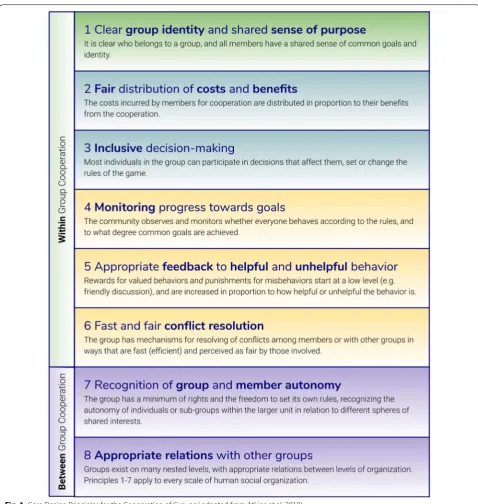
In chapter two, the story of Elinor Ostrom, the first woman to win the Nobel Prize in economics, is presented with the broader history of the Tragedy of the Commons and economic models of human behavior. Through cross-cultural studies and a multiple methods approach (see Poteete et al. 2010), Ostrom and colleagues demon-strated that humans do have the capacity for sustainable, democratic governance of shared natural resources (i.e. common-pool resources), but only under certain condi-tions. Ostrom’s model revealed eight Core Design Princi-ples (see Fig. 1) for which groups that are successful in managing shared resources tend to have developed effec-tive mechanisms for their implementation.
The authors reflect on Ostrom’s work in comparison with the out of date economic model of human behavior often called Homo economicus, describing the rational
economic man, as if he were a species in his own right
(Atkins et al. 2019, p. 26). Homo economicus is ested and calculates his behavior around this self-inter-est, whereas Homo sapiens, it is pointed out, acts much more like the actors within the common-pool resource contexts that Ostrom studied. The implications of these two models of human behavior is significant in current human science discourse, and may be equally signifi-cant for the aims and concepts framed under evolution education.
Evolution and behavioral sciences
“behaviorism” as an outdated science focused on coer-cive manipulation of rats in cages, the section offers a novel and more nuanced view into current thinking in the behavioral sciences. Far from coercive, the authors frame the emerging perspectives from the ‘third wave’ of behavioral science as a view of humans firmly grounded in evolutionary anthropology and focused on our spe-cies’ elaborated capacity for enlarging the scale of social
cooperation through psychological flexibility in rela-tion to identified values, at both the individual and small group levels of organization.
Part 2: Prosocial methods
and collaborative design of the social dynamics in their own groups.
Tools for psychological flexibility
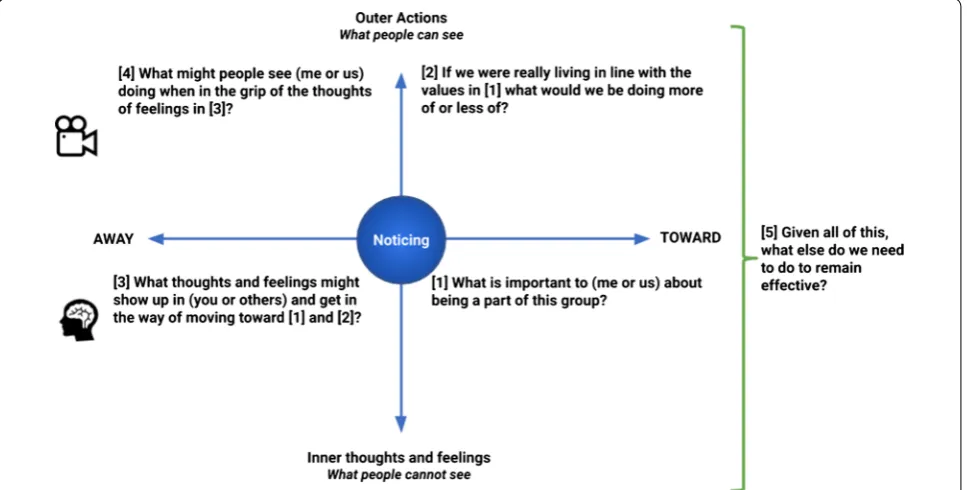
The section begins by going into depth on the practical use of the Prosocial Matrix (Fig. 2), a tool for individu-als and groups to notice and reflect on values and the behavioral variations that move us toward or away from these identified values. Importantly, this tool is grounded in foundational perspectives on the evolutionary ori-gins of organismal behavior (see LeDoux 2019 for a cur-rent discussion from a congruent perspective), as well as the evolution of humans as a species with an elaborated capacity for symbolic verbal behaviors (Polk et al 2016). As the authors describe, “All animals will move toward food, warmth, and other experiences that sustain life and away from experiences of danger and pain that threaten life. Humans are no different in that respect, except that language and cognition make these toward and away pro-cesses much more complex” (Atkins et al. 2019, p. 74). The Prosocial Matrix is a tool that helps individuals and groups to reflect on their everyday experience in light of that complexity. The Prosocial Matrix is a tool that is in use in social-emotional learning programs in schools around the world, yet students are unlikely to get aca-demic instruction on the evolution science that under-pins this tool for cultivating psychological flexibility.
As will be discussed in the final section of this review, whether evolution educators will agree on exactly how evolution science provides a scientific foundation for the Prosocial Matrix remains a very open question.
Evolving effective core design principles
Having outlined the basic toolkit for cultivating psycho-logical flexibility, the authors take a deeper dive into each of the eight Core Design Principles generalized from the work of Elinor Ostrom. These sections include a wealth of interdisciplinary research in the human sciences that inform the relationship between the human universal aspects of the core design principles, and the expected cultural diversity found in communities around the world. This relationship between what may be universal to humans, and where healthy diversity can be expected in human behavior, cognition, and culture, is key to understanding the evolution of humans as an ultra-social primate. In this way, the explorations of each princi-ple provide a well-rounded overview of key aspects of human behavior, cognition, and culture that have been important drivers over our phylogenetic history and are equally relevant for our everyday lives in modern society.
A better world is possible?
Some in the evolution education world may bristle at the notion of using evolutionary theory to strengthen
cooperation within and between communities, yet many may still appreciate the concluding call to action from the authors for moving towards “the more beautiful world our hearts know is possible” (Eisenstein 2013). Here, the authors sketch the future of the Prosocial research program and invite the readers to take an active role in using the science and practices outlined in the book to strengthen the communities we care most about. Whether evolution science ultimately can contribute making the world a better place is the question we argue evolution education should better engage with.
Considerations for evolution educators and education researchers
As Leigh Jr. (2019) points out in his review of David Sloan Wilson’s other recent book, This View of Life:
Complet-ing the Darwinian Revolution, some of Wilson’s language
and claims regarding the causes and future of human cooperation may strike some readers as unhelpful or even incorrect. Leigh’s criticisms are well founded, and indeed Wilson has a strong contingent of both support-ers and detractors across evolutionary biology and the human sciences. Our point here is not to take sides for or against Wilson’s view of evolution, simply to advocate that the existence of controversy at the level of respected scientific communities should not block the potential for productive discourse around the core conceptual claims as they pertain to evolution education. A full treatment of the educational implications of Prosocial is beyond the scope of this short review. Instead, we wish to highlight two questions we see as central to the value this work could offer educators and researchers in our field.
We argue that Prosocial opens questions that are cur-rently under-addressed within evolution education dis-course, and that working to engage current scientific discourse in these areas could strengthen the capacity to teach evolution as an interdisciplinary science relevant to the lives of students and school communities more glob-ally. Specifically, engaging Prosocial within the evolution classroom requires addressing questions about the multi-level and multidimensional models of evolution utilized in this research program. Secondly, evolution education requires further clarification as to the appropriateness and the role of human behavior as subject matter within the evolution curriculum. Here, we do not intend to pro-vide answers, rather only to frame questions for further exploration.
What is at the center of evolutionary analysis?
The multilevel and multidimensional view of evolution offered within Prosocial reflects a particular line of think-ing steeped in historical debates about causation in biol-ogy and the relationship between biolbiol-ogy, cognition, and
culture in the causes of human behavior. Again, it is far beyond the scope of this article to resolve or even explore with any depth the nuances of this discourse, rather we aim to offer a frame for the potential value of deeper dis-cussion within the evolution education community on these issues.
Prosocial frames a clear contrast between
gene-cen-tered individualistic views of evolution and the multilevel multidimensional model adopted by the authors. While these models remain the subject of debate among the evolution and human sciences, they are not fringe theo-ries, and their relative prominence at the level of scien-tific discourse (c.f. Jabłonka and Lamb 2006; Uller and Laland 2019) compared with evolution education dis-course (c.f. Deniz and Borgerding 2018) is worth noting. Put simply, these concepts reflect a significant scientific discourse in evolutionary biology and anthropology that is barely, if at all, engaged within the evolution education community.
The implications of this disconnect are not merely theoretical, but also practical. While it could seem rea-sonable to believe we should ‘start with the basics’ and therefore, “teach genetics first” (Mead et al. 2017), in fact the evidence is less than clear on this (c.f. Buchan et al.
2019), especially given the curriculum level directive to teach evolution early and often (c.f. Kelemen et al 2014; EvoKids 2015), and the science behind Prosocial may sug-gest other logical possibilities. Prosocial has been used in school professional development efforts in Australia, including among primary school educators adapting the core design principles into democratic classroom man-agement tools for students. Such early work suggests the appropriateness of engaging students in reflecting on the behavioral and cultural variation that pervades their eve-ryday lives, and provides a logical developmental path-way for conceptual understanding of more complex and evolutionary causal models of such everyday experiences. Our own efforts in international teacher development and curriculum design have offered early suggestions for Design-Based Implementation Research in this direc-tion (Hanisch and Eirdosh 2019), but far more work is needed. Engaging the details of both conceptual clarifica-tion and teaching materials development will first require more clarity within the evolution education community on the role of human behavior as subject matter within the evolution curriculum.
Is human behavior a practical focus for evolution education?
drivers of evolutionary change over our phylogenetic history. How students develop an understanding of the diversity of the human condition and our relative capacities of open-ended flexible adaptation to novel conditions is likely to be influential on their broader views of social organization and public policies affect-ing the sustainability of our species and the planet as we know it. The relevance of engaging students in scientific perspectives on human behavior is not so much in doubt, as much as there is simply a dearth of well-designed teaching tools or communities of prac-tice focused on doing so within the context of evolu-tion educaevolu-tion (c.f. Eirdosh and Hanisch 2019; Hanisch and Eirdosh 2019). This is, in part, due to the complex historical, and current, sociology of scientific under-standings or beliefs about the theoretical space for integrating evolutionary biology and human behavior (Wilson 2015). Prosocial situates itself within a very specific part of this theoretical space, as a knowledge synthesis project bridging evolutionary anthropol-ogy and multiple fields of applied behavioral sciences (Atkins et al. 2019). For some, this direction may appear highly problematic given the history of so-called “social darwinism” and popular conceptions of behav-ioral science as a tool of top-down or coercive control. In contrast, Prosocial is oriented around a reflection on human values from the individual to global levels and focuses on resolving potential conflicts between indi-vidual and collective interest at each level of organiza-tion. As Leigh Jr. (2019) points out, readers may view Wilson’s core metaphor of a “multicellular society” as implying that individuals should become mere cogs in a larger machine, yet Prosocial makes clear that the intended transfer from this metaphor is the relative scope of lower level autonomy and higher level coordi-nation around multiple spheres of shared interests. It is precisely this apparent conflict, between autonomy and coordination, individual and collective interests, that Prosocial provides tools for resolving and reflect-ing upon within a coherent body of evolutionary the-ory that is informed by current perspectives across the human sciences. For example, the notion that coopera-tion necessarily must come at the expense of individual interests and autonomy can be seen to imply a zero-sum mindset, rather than an understanding that social inter-actions can be, and for humans often are, non-zero-sum in nature (see e.g. Wright 2000), whereby the fate and interests of individuals in a group are aligned rather than opposed to each other. Against this view, the Wil-sonian metaphor of a ‘multicellular society’ is about the need and potential to resolve these dialectical tensions
rather than a suggestion to make individual interests wholly subservient to the society.
Conclusion
We suggest that while legitimate theoretical differences exist between gene-centered individualistic accounts of evolutionary change and the multilevel multidimensional accounts of Prosocial, the relevance to students’ every-day lives and potential for productive clarification of core concepts in the evolution science curriculum indicate a strong potential for valuable engagement with these models of social change.
Prosocial is not a panacea for all the world’s problems, but it does offer a range of practical tools grounded in a uniquely structured theoretical framework that aims to bridge current discourse in evolutionary biology and interdisciplinary human sciences. For this aim, the authors have done a laudable job at clearly communicat-ing both the theory and practice of this applied research program. If and how the evolution education community can engage this work remains a very open question, yet we suggest there may be significant opportunity in doing so.
Acknowledgements
We thank the members of the Prosocial research network for the develop-ment of a novel method for improving human cooperation rooted in evolu-tion science.
Authors’ contributions
The first author took the lead in the development of the manuscript, the second author provided substantive revisions and conceptual improvements. All authors read and approved the final manuscript.
Funding
The authors received no funding for the classroom interventions reported in this manuscript nor for the preparation of the manuscript.
Availability of data and materials
Not applicable.
Competing interests
The authors declare that they have no competing interests.
Received: 11 February 2020 Accepted: 6 March 2020
References
Atkins PW, Wilson DS, Hayes SC. Prosocial: using evolutionary science to build productive, equitable, and collaborative groups. Oakland: New Harbinger Publications; 2019.
Buchan LL, Hejmadi MV, Hurst LD. Evidence for the success of a quantitative assessment instrument for teaching evolution in primary schools in England. Evolution Education Re-considered. New York: Springer; 2019. p. 21–40.
Deniz H, Borgerding LA, editors. Evolution education around the globe. Springer: New York; 2018.
•fast, convenient online submission
•
thorough peer review by experienced researchers in your field
• rapid publication on acceptance
• support for research data, including large and complex data types
•
gold Open Access which fosters wider collaboration and increased citations maximum visibility for your research: over 100M website views per year
•
At BMC, research is always in progress.
Learn more biomedcentral.com/submissions
Ready to submit your research? Choose BMC and benefit from:
Eirdosh D, Hanisch S. The role of evolutionary studies in education for sustain-able development. In Darwin’s roadmap to the curriculum: evolutionary studies in higher education. Oxford University Press; 2019. p. 249–72. EvoKids. Resolution on "Teaching evolution at primary school". In: Graf D,
Schmidt-Salomon M, editors. Evolution in der Grundschule: Teaching Materials for the Classroom. Berlin: EvoKids press; 2015.
Hanisch S, Eirdosh D (2019) A teacher’s guide to evolution, behavior, and sustainability science
Jabłonka E, Lamb M. Evolution in four dimensions. MIT Press; 2016. Kelemen D, Emmons NA, Seston Schillaci R, Ganea PA. Young children can be
taught basic natural selection using a picture-storybook intervention. Psychol Sci. 2014;25(4):893–902.
LeDoux J. The Deep History of Ourselves: The Four-Billion-Year Story of How We Got Conscious Brains. New York: Viking; 2019.
Leigh Jr. EG. 2019. Can the morality of a group whose members are interde-pendent be extended to all humanity and beyond?. Evolution Education Outreach.
Mead R, Hejmadi M, Hurst LD. Teaching genetics prior to teaching evolu-tion improves evoluevolu-tion understanding but not acceptance. PLoSBiol. 2017;15(5):e2002255. https ://doi.org/10.1371/journ al.pbio.20022 55
Polk KL, Schoendorff B, Webster M, Olaz FO. The essential guide to the ACT matrix: a step-by-step approach to using the ACT matrix model in clinical practice. Oakland: New Harbinger Publications; 2016.
Poteete AR, Janssen MA, Ostrom E. Working together: collective action, the commons, and multiple methods in practice. Princeton University Press: Princeton; 2010.
Uller T, Laland KN. Evolutionary causation: biological and philosophical reflec-tions. Cambridge: MIT Press; 2019.
Wilson DS. Does altruism exist?: Culture, genes, and the welfare of others. New Haven: Yale University Press; 2015.
Wright R. Nonzero. The Logic of Human Destiny: New York, Vintage Books; 2000.
Publisher’s Note