Meeting Report: BioSharing at ISMB 2010
Dawn Field1*, Susanna Sansone2, Edward F. DeLong3, Peter Sterk1, Iddo Friedberg4,5, Pascale
Gaudet6, Susanna Lewis7, Renzo Kottmann8, Lynette Hirschman9, George Garrity10, Guy
Cochrane11, John Wooley12, Folker Meyer13, Sarah Hunter11, Owen White14, Brian
Bramlett15, Susan Gregurick16, Hilmar Lapp17, Sandra Orchard11, Philippe Rocca-Serra2, Alan
Ruttenberg18, Nigam Shah19, Chris Taylor11, Anne Thessen20
1 Centre for Ecology & Hydrology, Maclean Building, Benson Lane, Crowmarsh Gifford,
Wallingford, Oxfordshire, OX10 8BB, UK
2 University of Oxford, Oxford e-Research Centre, Oxford, UK
3 Department of Biological Engineering, Massachusetts Institue of Technology, Cambridge,
MA 02138, USA
4 Department of Microbiology, Miami University, Oxford OH 45056, USA
5 Department of Computer Science and Software Engineering, Miami University, Oxford
OH 45056, USA
6Swiss Institute of Bioinformatics, CMU - 1, rue Michel Servet, CH-1211 Geneva 4,
Switzerland
7 Lawrence Berkeley National Laboratory, One Cyclotron Road, Berkeley, CA, USA 8 Microbial Genomics Group, Max Planck Institute for Marine Microbiology & Jacobs
University Bremen, D-28359 Bremen, Germany
9 Information Technology Center, The MITRE Corporation, 202 Burlington Road, Bedford,
MA 01730, USA
10 Department of Microbiology and Molecular Genetics, Michigan State University, East
Lansing, Michigan 48824, USA
11 European Molecular Biology Laboratory (EMBL) Outstation, European Bioinformatics
Institute (EBI), Wellcome Trust Genome Campus, Hinxton, Cambridge CB10 1SD, UK
12 University of California San Diego, 9500 Gilman Drive, La Jolla, CA 92093, USA 13Argonne National Laboratory, 9700 South Cass Avenue, Argonne, IL 60439, USA 14 Institute for Genome Sciences, University of Maryland School of Medicine, Baltimore,
MD 21201, USA
15 Lux Bio Group, 121 SW Morrison Street, Suite 1550, Portland, Oregon 97204, USA 16 Department of Energy, Biological Systems Science Division, 1000 Independence Ave.,
Washington, DC 20585, USA
17 National Evolutionary Synthesis Center (NESCent), Durham, NC 27705, USA
18Science Commons, c/o Massachusetts Institute of Technology Computer Science and
Artificial Intelligence Laboratory, Building 32-386D, 32 Vassar Street, Cambridge, MA 02139, USA
19Stanford Center for Biomedical Informatics Research, Medical School Office Building
X-215, 251 Campus Drive, Stanford, CA 94305, USA
20 Marine Biological Laboratory, 7 MBL Street, Woods Hole, MA 02543, USA *Corresponding Author: [email protected]
Introduction
The M3 & Biosharing special interest group (SIG) hosted by the Genomic Standards Consortium (GSC, [1]) at the Intelligent Systems in Molecular Biology (ISMB) 2010 conference explored the lat-est concepts, informatics resources, and standards that are being developed to cope with the analysis of vast quantities of metagenomic data [2]. As part of the outreach of the GSC to other data-sharing communities, the second day of the SIG served as the inaugural meeting of the BioSharing initiative [3]. During this day-long meeting of communities interested in data-sharing, the focus shifted to ad-dressing the wider issue of how to increase en-gagement between funding agencies and re-searchers to build better data policies to promote real-world data sharing through the use of stan-dards.
An increased focus on ‘omics data sharing
Data sharing policies are emerging in response to increased funding for high-throughput approaches in major bioscience domains [4], including genom-ics and functional genomgenom-ics. But despite their commonalities, the policies are heterogeneous by nature, given the different types of communities served and the data types they cover. In parallel, an escalating number of community-developed standards (minimal requirements checklists [5], ontologies [6], and file-formats) operate to sup-port the harmonization of the resup-porting process, so that different experiments can be compared or integrated. The proliferation of these standardiza-tion efforts is a positive sign of community en-gagement, but it also brings with it new sociologi-cal and technologisociologi-cal challenges - creating intero-perability and avoiding unnecessary overlap and duplication of effort that hampers their wider up-take.
The BioSharing initiative [3] seeks to facilitate a broader dialogue among funders, journals, stan-dards developers, technology developers and re-searchers on the critical issue of data sharing within the metagenomics community and beyond. To help encourage this dialogue, 14 community leaders were invited to come together to present overviews of their community-level efforts and discussion how to move forward. This report briefly summarizes the presentations and discus-sions of this BioSharing day.
BioSharing - Towards real-world data
sharing
The agenda of the day was designed to focus on the intersections of science, standards, and policy. Dawn Field and Susanna Sansone, founding mem-bers of BioSharing, described how the concept of a BioSharing community stemmed from their recent article Omics data sharing, written in collaboration
with a large number of funders developing and maintaining data sharing policies [4]. The purpose of this BioSharing day was to bring together, for the first time, representatives of a variety of these communities to kick-start cross-community inte-ractions and achieve agreement on how to move forward.
The BioSharing Plenary Talk - Strong Data
Policies from Funding Agencies
The day opened with a plenary talk from Susan Gregurick, a co-author of the ‘Omics data sharing
paper [4] and representative of the Department of Energy (DOE [7]), which maintains a strong
data sharing policy within its Genomes to Life (GTL) program. Dr. Gregurick gave an overview of the mission of the DOE and its strong commitment to data sharing. To help set the stage for the dis-cussion at this meeting, she also announced that the National Science Foundation (NSF,[8]) would be implementing a new approach to data steward-ship through the ‘Data Management Plan’ re-quirement in future grants. This approach will likely be rolled out to other federal funding agen-cies. This will require researchers to be increa-singly familiar with existing and planned data sharing solutions for their particular area of re-search.
Community Introductions
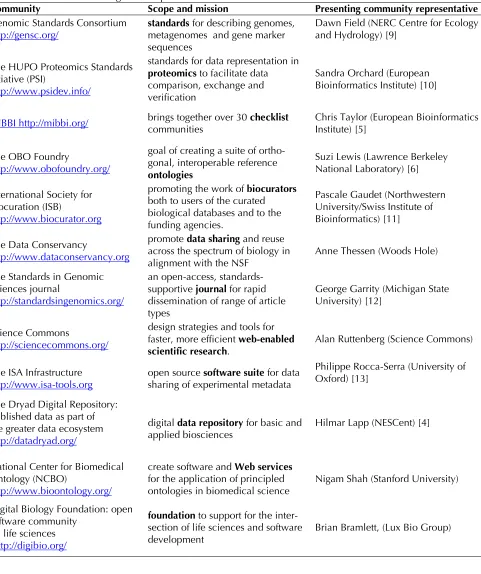
col-tion, there were talks to represent the general ‘da-tabase’ and ‘natural language processing (BioNLP) communities from Guy Cochrane (EBI) and Ly-nette Hirschman (MITRE). Combined, this group covered a wide range of expertise and projects.
The need to ‘close the virtuous cycle’, through in-creased collaboration at the intersections of these communities, was a common theme. All presenta-tions are available online from the BioSharing website.
Table 1. List of communities, their missions, and community representative, in the order in which they were presented at the first BioSharing workshop.
Community Scope and mission Presenting community representative
Genomic Standards Consortium
standardsmetagenomes and gene marker for describing genomes, sequences
Dawn Field (NERC Centre for Ecology and Hydrology) [9]
The HUPO Proteomics Standards Intiative (PSI)
standards for data representation in proteomics to facilitate data comparison, exchange and verification
Sandra Orchard (European Bioinformatics Institute) [10]
MIBBI http://mibbi.org/ brings together over 30 communities checklist Chris Taylor (European Bioinformatics Institute) [5]
The OBO Foundry
goal of creating a suite of ortho-gonal, interoperable reference ontologies
Suzi Lewis (Lawrence Berkeley National Laboratory) [6]
International Society for Biocuration (ISB)
promoting the work of biocurators both to users of the curated biological databases and to the funding agencies.
Pascale Gaudet (Northwestern University/Swiss Institute of Bioinformatics) [11]
The Data Conservancy
promote data sharing and reuse across the spectrum of biology in alignment with the NSF
Anne Thessen (Woods Hole)
The Standards in Genomic Sciences journal
an open-access, standards-supportive journal for rapid dissemination of range of article types
George Garrity (Michigan State University) [12]
Science Commons
design strategies and tools for faster, more efficient web-enabled
scientific research. Alan Ruttenberg (Science Commons) The ISA Infrastructure
open source sharing of experimental metadata software suite for data
Philippe Rocca-Serra (University of Oxford) [13]
The Dryad Digital Repository: Published data as part of the greater data ecosystem
digital data repository for basic and
applied biosciences Hilmar Lapp (NESCent) [4]
National Center for Biomedical Ontology (NCBO)
create software and Web services for the application of principled
ontologies in biomedical science Nigam Shah (Stanford University) Digital Biology Foundation: open
software community in life sciences
foundation to support for the inter-section of life sciences and software
Panel Discussion:
developing a vision for the future
Chaired by Dawn Field and Susanna Sansone, the Panel discussion at the end of the day included all speakers. This was the first time many of these community leaders had met in person and all agreed on the importance of this meeting as the first step in working together. All agreed to move forward as a group to build linkages through a Bi-oSharing effort. There was strong interest in a fol-low up meeting. To support further activities, it was agreed that the BioSharing forum will have a combination of targeted and open-attendance meetings, normally as part of larger meetings so as to reach as broad an audience as possible, espe-cially potential grant awardees and therefore fu-ture users of standards. The forum will utilize all possible means to disseminate information (such as RSS feeds, position papers, presentations). Fol-lowing this successful meeting, a statement of purpose was formulated. It can be found in full on the BioSharing website [3]. Also, as a result of the meeting Pascale Gaudet took forward the devel-opment of a minimum information checklist for describing databases, BioDBCore as a BioSharing project led by her community, the International Society of Biocuration (ISB) [14].
BioSharing Forum Statement of Purpose
The BioSharing community will work at the global level to build stable linkages between funders, im-plementing data sharing policies, and well-constituted standardization efforts in the bios-ciences domain, to expedite the communication and the production of an integrated standards-based framework for the capture and sharing of high-throughput genomics and functional genomic bioscience data.
This overall objective has several components,
each of which can be further decomposed:
• Web site to centralize bioscience data
policies, reporting standards and links
to other related portals
o Providing a “one-stop shop” for
those seeking data sharing policy
documents and information about
the standards and technologies that
support them.
driven standardization efforts and
link to their reporting standards
(checklists, ontologies and
file-formats), documentation, training
material, news and contact point.
o Linking to existing portals or new
resources (to be developed
colla-boratively with other groups and
initiatives) for those seeking
in-formation on systems serving or
implementing the standards.
• Communication forum for funders and
leaders of the standardization efforts to
achieve harmonization and mutual
support
o Lobbying for intra-harmonization
within these two groups to
pro-mote:
- exchange of ideas and policy
components among public and
private funders, and between
funders and finding recipients,
to ensure that the difference
among the policies (such as the
reporting standards that may be
supported) ultimately do not
impede seamless
interopera-bility of the data.
- collaboration among the
stan-dardization efforts to create
in-teroperable reporting standards
and to avoid unnecessary
over-lap, duplication of effort and
incompatible tools.
o Identifying a mutual support
sys-tem between the two stakeholder
groups to ensure:
main-- when communitymain--developed
standards are mature and
ap-propriate standards-compliant
systems become available these
are channeled to the
appropri-ate funding agencies, which in
turn endorse them in agency
data sharing policies, thus
achieving wider harmonization
of the data.
Acknowledgements
Many thanks to invited and selected speakers and eve-ryone that participated in this SIG meeting. We grate-fully acknowledge the support from the US National
Science Foundation grant (NSF) RCN4GSC, DBI-0840989.
References
1. Genomic Standards Consortium.
http://gensc.org/gc_wiki/index.php/Main_Page 2. Metagenomics versus Moore's law. Nat Methods
2009; 6:623
3. The biosharing website. http://biosharing.org/ 4. Field D, Sansone SA, Collis A, Booth T, Dukes P,
Gregurick SK, Kennedy KL, Kolar P, Kolker E, Maxon M, et al. 'Omics Data Sharing. Science 2009; 326:234-236
5. Taylor CF, Field D, Sansone SA, Aerts J, Apweiler R, Ashburner M, Ball CA, Binz PA, Bogue M, Booth T, et al. Promoting coherent minimum re-porting guidelines for biological and biomedical investigations: the MIBBI project. Nat Biotechnol 2008; 26:889-896
6. Smith B, Ashburner M, Rosse C, Bard J, Bug W, Ceusters W, Goldberg LJ, Eilbeck K, Ireland A, Mungall CJ, et al. The OBO Foundry: coordinated evolution of ontologies to support biomedical da-ta integration. Nat Biotechnol 2007; 25
:1251-1255
7. Department of Energy. http://www.energy.gov 8. National Science Foundation.
9. Field D, Garrity G, Gray T, Morrison N, Selengut J, Sterk P, Tatusova T, Thomson N, Allen MJ, An-giuoli SV, et al. The minimum information about a genome sequence (MIGS) specification. Nat Biotechnol 2008; 26:541-547
10. Taylor CF, Hermjakob H, Julian RK, Jr., Garavelli JS, Aebersold R, Apweiler R. The work of the
Human Proteome Organisation's Proteomics Standards Initiative (HUPO PSI). OMICS 2006; 10:145-151
11. Howe D, Costanzo M, Fey P, Gojobori T, Han-nick L, Hide W, Hill DP, Kania R, Schaeffer M, St Pierre S, et al. Big data: The future of biocuration.
Nature 2008; 455:47-50
12. Garrity GM, Field D, Kyrpides N, Hirschman L, Sansone SA, Angiuoli S, Cole JR, Glockner FO, Kolker E, Kowalchuk G, et al. Toward a stan-dards-compliant genomic and metagenomic pub-lication record. OMICS 2008; 12:157-160
13. Rocca-Serra P, Brandizi M, Maguire E, Sklyar N, Taylor C, Begley K, Field D, Harris S, Hide W, Hofmann O, et al. ISA software suite: supporting standards-compliant experimental annotation and enabling curation at the community level. Bioin-formatics 2010; 26:2354-2356
14. Gaudet P, Bairoch A, Field D, Sansone SA, Taylor C, Attwood TK, Bateman A, Blake JA, Bult CJ, Cherry JM, et al. Towards BioDBcore: a commu-nity-defined information specification for biologi-cal databases. Nucleic Acids Res 2010.
15. Wooley JC, Godzik A, Friedberg I. A primer on metagenomics. PLOS Comput Biol 2010; 6:e1000667
16. Vision TJ. Open Data and the Social Contract of Scientific Publishing. Bioscience 2010; 60