September, 2016 AgricEngInt: CIGR Journal Open access at http://www.cigrjournal.org Vol. 18, No. 3 245
Evaluation of thermo-physical properties and drying kinetics of
carrots in a convective hot air drying system
Raquel P. F. Guiné
1,2,3*, João Carlos Gonçalves
1,2, Ana Rita P. Calado
1,
Paula M. R. Correia
1,2(1. Dep. Food Industry, Agrarian School of Viseu, Portugal; 2. CI&DETS, Polytechnic Institute of Viseu, Portugal;
3. CERNAS, Polytechnic Institute of Coimbra, Portugal)
Abstract: This paper presents an experimental study on the evolution of carrot properties along convective drying by hot air at different temperatures (50ºC, 60ºC and 70ºC). The thermo-physical properties calculated were: specific heat, thermal conductivity, diffusivity, enthalpy, heat and mass transfer coefficients. Furthermore, the data of drying kinetics were treated and adjusted according to the three empirical models: Page, Henderson & Pabis and Logarithmic. The sorption isotherms were also determined and fitted using the GAB model. The results showed that, generally, the thermo-physical properties presented a decline during the drying process, and the decrease was faster for the temperature of 70ºC. It was possible to verify that the Page model presented the best prediction ability for the representation of kinetics of the drying process. The GAB model used to fit the sorption isotherms showed a good prediction capacity and, at a given water activity, despite some variations, the amount of water sorbed increased with the decrease of drying temperature.
Keywords: kinetic model, mass transfer coefficient, enthalpy, thermal conductivity, diffusivity, heat transfer coefficient
Citation: Guiné, R. P. F., J. C. Gonçalves, A. R. P. Calado, and P. M. R. Correia. 2016. Evaluation of thermo-physiscal properties and drying kinetics of carrots in a convective hot air drying system. Agricultural Engineering International: CIGR Journal, 18(3):245-257.
1 Introduction
1Carrots are considered a functional food, rich in plant nutrients, and responsible for different functions in the organism, depending on the chemical component, and when consumed in the diet, can promote health and may reduce the risk of disease (Moretti and Mattos 2007). Carrots also have a soft texture and a nice taste, and can be consumed fresh, or used as raw material for food processing industries, and retailed in minimally processed form (baby carrots, diced, grated, sliced), such as baby food and instant soups (Lima et al. 2004; Spagnol et al.
2006). Carrot feedstock is used in both pharmaceutical and the food industry, and may also be utilized in vitamin
Received date: 2016-01-28 Accepted date: 2016-05-22
*Corresponding author: Professor Raquel P. F. Guiné, Quinta da Alagoa. Estrada de Nelas. Ranhados. 3500-606 Viseu. Portugal. Tel: +351-232-446641 Fax: +351-232-426536, E-mail: [email protected]
supplements for both child and elderly people, since it is an excellent source of vitamins and minerals (Araújo and Menezes 2005).
Carrots can be used in fresh or preserved. Although they have a reasonable shelf life in fresh, they can be preserved for a longer time by using edible coatings, such as demonstrated by the work of Panwar et al. (2015) who evaluated the physical characteristics of peeled carrots during storage at room and refrigerated temperatures, for carrots with aloe vera based composite edible coatings.
Air drying is a method used to preserve foods for millenniums, and is based on the water removal from food in the form of water vapor to the unsaturated air. This method has been studied and improved to obtain higher quality products and lower processing time (Akpinar, Bicer, and Yildiz 2003). Water removal causes a reduction of the water activity (aw) of the food, thus
inhibiting the growth of microorganisms and delaying the deterioration. Since most fruits and vegetables present more than 80% to 90% of water, the drying process involves a great reduction in the costs of transportation and handling of the product, besides being a method that allows to extend considerably the shelf life (Fellows 2006).
The increase in diversity of food products requires modernization and technological improvement, and also higher quality for industries. Compliance with these requirements will only happen with more scientific information on the thermo-physical properties of foods, enabling efficient design calculations and savings on processing operations involving heat transfer. The design of the equipment used in food processing, especially involving heat transfer, require the precise data of thermal properties of products, such as: thermal conductivity, thermal diffusivity, specific heat and density, and how these properties behave during process, according to the temperature and to the changes undergone in the materials as they dry. Failures in equipment or process design can be attributed to the lack of information when selecting values of thermo-physical properties used in the initial analysis of the systems under study (Bergman et al. 2011; Moura et al. 2005).It is important to determine the amount of energy to be added or removed in heating and cooling process. The specific heat gives an indication of the energy spend, which in a continuous process, tends to influence the size of the equipment. The specific heat of the food is significantly affected by the amount of water and physical status. For example, the frozen food with high water content, may have values for the specific heat
approximately half to the corresponding values in a fresh state (Lewis 1993). The thermal conductivity of food and its relation to the water content is one of the most important transport properties required for modeling processes involving mass and energy exchanges (Pinheiro 2004). Thermal conductivity is considered one of the most influential properties during processing that involves the transfer of heat (Carson 2006), and is highly dependent on the composition and temperature of the food. Thermal diffusivity measures the ability of a material to conduct thermal energy relatively to its storage ability (Bergman et al. 2011). Materials with a high value of thermal diffusivity respond quickly to temperature changes, while materials with low values of diffusivity respond more slowly, taking more time to reach a new steady state (Bergman et al. 2011).
The aims of the present work were, on one hand, to study the thermo-physical properties of carrots for the convective drying with hot air at different temperatures, as well as to model the desorption isotherms and the drying kinetics along drying.
2 Mathematical modeling
2.1 Thermo-physical properties
According to Bergman et al. (2011), the heat transfer coefficient can be expressed by:
(1)
The Nusselt number, used in Equation (1), is obtained through an empirical correlation between Nusselt (Nu) and the Reynolds number (Re), that can be
expressed by:
(2)
The Reynolds number is obtained by the Equation (3), as follows:
(3)
The mass transfer coefficient (hm) was determined
according to the following Equation (Holman 1986):
( )
September, 2016 Evaluation of thermo-physical properties and drying kinetics of carrots Vol. 18, No. 3 247
Where αair is calculated by:
(5)
In the Equations above (1) to (5), Kair is the
conductivity of the air, ddryer is the diameter of the drier air and air, are the
density and viscosity of the drying air, vair is the air flow
rate, hc is the coefficient of heat transfer and Cp air is the
specific heat of the air.
Among the different methods to obtain the thermo-physical properties (Perussello et al. 2014), the method employed in the study is based on the influence of each constituent of the food (moisture, protein, ash, crude fiber, total carbohydrates). To calculate the referred carrot properties (thermal conductivity and diffusivity, specific heat and enthalpy) the COSTHERM software was used (developed by the Food Properties Awareness Club, Aberdeen, United Kingdom). The determination of the mass fractions of the carrot constituents was determined by the following Equation:
(6)
The mass fractions of the constituents of carrot along the drying process were measured every hour, in triplicate and over 27 samples.
According to Guiné( 2005) porosity, can be expressed by:
(7)
b is the bulk density (includes the material and p is the density of the particles
(including the material, water and excluding gaps) and that can be expressed in terms of W according to:
(8)
(9)
(10)
These equations require the knowledge of four
b0 (b
s (solid density)
w (density of water inside the food). For the b0
for the variations along drying for moisture and specific volume (defined as the total volume per unit mass of dry solids), according to:
(11)
s was experimentally determined and w was determined from the following
E b0
(12)
In the software, the mass fractions, apparent density, porosity and temperature of drying air were the inputs, and the outputs were the thermo-physical properties (specific heat, thermal conductivity, diffusivity and enthalpy).
For the calculation of the carrot thermo-physical properties, the air properties were determined according to the temperature, by interpolation, as described in the work by Calado (2014).
2.2 Drying kinetics
In order to design new drying equipment, or to improve existing ones, or to allow the control of drying operations, simulation models are very useful (Baini and Langrish 2007; Chong et al. 2008; Fadhel et al. 2005; Lahsasni et al. 2004; Roberts, Kidd, and Padilla-Zakour 2008). The drying kinetics can be described in terms of the transport properties of the substance, as well as drying air (Guiné et al. 2009). In this study the drying kinetics was assessed by quantifying the moisture of carrots along drying, and the data were expressed as the moisture ratio (MR), which is a dimensionless variable given by(Mota et al. 2010):
R (13)
Where, W represents the moisture content at a generic instant t, We the equilibrium moisture content, and W0 the
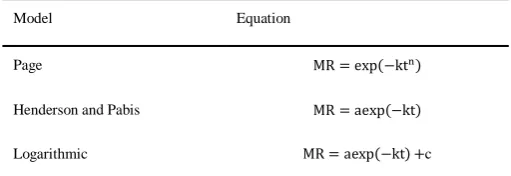
To model the drying kinetics, the points (MR, t) were fitted to different empirical models, shown in Table 1, as used by several authors (Baini and Langrish 2007; Guiné et al. 2009; Guiné and Fernandes 2006; Mota et al. 2010). For fitting the experimental data to the models the Sigma Plot Software, version11.0 (Systat Software, Inc.) was used, and the prediction quality of each model was evaluated through the Determination Coefficient (R2).
Table 1 Empirical models to fit the drying kinetics
(cited by Guiné et al. 2009)
Legend: MR = moisture ratio; k = drying constant; a, c and n are model constants
without a specific name.
2.3 Sorption isotherms
Isotherms are curves depicting the relationship between the moisture content and water activity of the food, at a constant temperature and pressure. The precise form of the isotherms depends of the physical structure, chemical composition and amount of water-bound of the food, which makes each food presents a particular set of sorption isotherms for each temperature (Fellows 2006; Guiné 2009). The sorption isotherm comprises the adsorption and desorption curves, corresponding respectively to the gain or loss of water. During drying the food is exposed to high temperature to evaporate the water, aw also changes. Hence, the knowledge of sorption
isotherms is very important, since they give information about the equilibrium relationship between the product and the surrounding atmosphere(Guiné 2011; Guiné 2009).
Among the wide diversity of models described in the literature to represent the desorption isotherms
(Viswanathan et al. 2003), in the present work, the GAB model was chosen and can be expressed by:
m( - )( - ) (14)
Where Wm is the moisture content of the monolayer,
which in this model does not explicitly depend from temperature, and C and K are explicit functions of temperature, given by:
T ( ) ( ) (14a)
T ( ) ( ) (14b)
3 Experimental procedure
3.1 Drying procedure
Fresh carrot (Daucuscarota L.) of Nantes cultivar were peeled, washed and cut into slices with one cm thickness and 3 cm diameter. The sliced carrots were distributed on net trays and dried in a convective drying chamber (WTB Binder) with air flowing at 0.2 m/s with 70% relative humidity. The drying temperatures tested were 50°C, 60°C and 70°C, and the process was terminated when the samples reached moisture content under 5%. The temperatures chosen include a range that could be economically interesting, giving place to lower drying times, but not too excessive that could cause the deterioration of the products and major changes in the products properties.
3.2 Chemical analyses
The analyses performed were: moisture content, water activity (aw), ash, protein, crude fibre and the
carbohydrates were calculated by difference. The moisture content was measured using a Halogen Moisture Analyser; model HG53, from Mettler Toledo(Guiné and Barroca 2011).The water activity was determined by an electric hygrometer (Rotronic Hygroskop BT-RS1), which measures the relative humidity of the atmosphere surrounding the sample, after establishing equilibrium conditions(Guiné 2009). Protein was determined using
Model Equation
Page ( )
Henderson and Pabis ( )
September, 2016 Evaluation of thermo-physical properties and drying kinetics of carrots Vol. 18, No. 3 249
the Kjeldahl method, which involves mineralization and distillation, and the catalyst used was a saturated solution of copper sulphate. The ashes were determined by calcination at 550°C for one hour (Henriques et al. 2012). For the determination of crude fibera cellulose extractor apparatus was used (Dosi-Fiber; model 4000623, from Selecta) comprising successive treatments with acid (H2SO4, 1.25%) and basic (NaOH, 1.25%) solutions, and
then washing with acetone(Henriques et al. 2012).
3.3 Physical analyses
The apparent density was estimated using the method of mass and volume, by measuring the liquid displacement caused by a previously weighed sample(Guiné 2006). The porosity was determined by the experimental measurement of certain properties of the food and with the estimation of other parameters according to Equations (7) to (12). The masses were measured in a precision laboratory balance.
4 Results and discussion
4.1 Moisture content
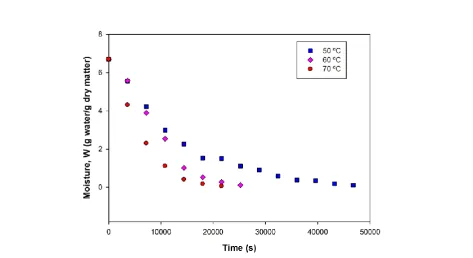
Figure 1 shows the variation along drying time of the moisture content of carrots for the different temperatures studied expressed in dry basis. As expected, it was found that the drying rate is greater for higher drying temperatures. It was verified that the drying takes approximately 13 h, 7 h and 6 h, for the temperatures of 50°C, 60°C and 70°C, respectively. Doymaz(2004) studied the drying kinetics for the convective drying of carrot cubes with size 2 cm in a range of temperatures also from 50°C to 70 ºC and found drying times of 16 h, 12 h and 8 h, respectively. Wang and Xi (2005) investigated the effect of sample thickness on the hot air drying and rehydration of carrot slices and found an inverse relation between drying rate and sample thickness, so that thinner samples showed a higher degree of moisture loss.
4.2 Desorption isotherms
The desorption isotherms were determined by estimating the parameters of the GAB Equation (Equation (14)). According to Prado et al.(1999), GAB model has the advantage of being a relatively simple model, the parameters involved have a physical definition, and also
gathers the ability to represent the experimental data in the range of water activity of most practical interest in food (0.10 to 0.90). Table 2 presents the parameters of the GAB model, obtained by fitting of the experimental data obtained for the different temperatures evaluated: 50°C, 60°C and 70ºC.
The GAB model is based on the concept of the moisture content in the monolayer of the material (Wm)
that is considered safe moisture content to preserve dehydrated foods. The moisture content in the monolayer is the amount of water that is strongly adsorbed onto specific places on the food surface, which is considered important to ensure the stability of such products. According to the results in Table 2, it was observed that the moisture content of the monomolecular layer of GAB model did not exhibit a constant trend in the temperature range studied. Prado et al.(1999) reported that the value of Wm strongly decreased with temperature increase, which
can be due to the reduction of the number of active zones as a result of physical and/or chemical changes induced by temperature. In the present work this effect was observed with the increase in temperature from 60°C to 70ºC.
Table 2, also shows the determination coefficient (R2), that represents the quality of the model adjustment.
According to the obtained results, the model accurately describes the desorption isotherms for all temperatures, with values higher than 0.9. Still, at 50°C and 70°C, there was a higher precision, with determination coefficients of 0.9872 and 0.9992 respectively. For the temperature of 60°C, a lower but also acceptable coefficient was obtained (0.9372). It was also observed that data obtained experimentally passed the normality test for the three temperatures. Lahsasni et al.(2004) and Medeiros et al.(2006) obtained a good fit of the GAB model for isotherms of pear, cocoa and cupuassu.
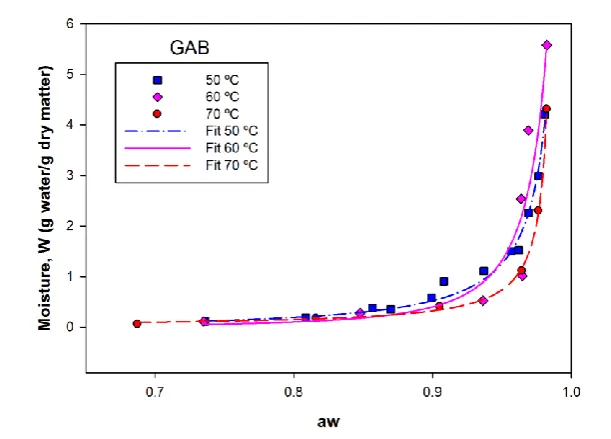
Figure 2 presents the desorption isotherms of carrot in terms of experimental points and fitting curves. The results show that the amount of water sorbed, at a certain water activity, increased with decreasing temperature. On the other hand,the increase in temperature also resulted in an increase of water activity, for the same moisture content.
Table 2 Fitting results of GAB model for the three different drying temperatures
Parameters Temperature
50ºC 60ºC 70ºC
Wm(±sd) 0.0680(±0.0150) 0.2376(±5.0015) 0.0297(±0.0018)
C(±sd) 0.3214(±0.3528) 0.0249(±0.6108) 2.0000(±5.4384)
K(±sd) 1.0033(±0.0029) 0.9955(±0.1425) 1.0110(±0.0004)
Statistics
R2 0.9872 0.8783 0.9992
Normality test (Shapiro-Wilk) Pass (p=0.6728) Pass (p=0.7923) Pass (p=0.9795)
W-statistic (Significance <0.0001) 0.9524 0.9570 0.9867
September, 2016 Evaluation of nutritional characteristics of corn stored in metallic silos Vol. 18, No. 3 251
Similar results were also observed by Adam et al.(2000) for the sorption isotherms of onion. This model has been widely used to describe the behavior of food isotherms by several researchers: Kiranoudis et al.(1997) adjusted the sorption isotherms of apple, pear, kiwi and banana to the GAB model. Unadi et al. (1998) found that the GAB model was the most satisfactory to predict tomato desorption isotherms. Kechaou & Maalej (1999) found that GAB model satisfactorily represented the desorption isotherms of banana for temperatures of 35°C, 50°C and 70°C and water activity values from 0 to 0.90. Telis et al. (2000) obtained a good GAB fit data to the experimental isotherms of grape pulp to temperatures of 20°C to 70 °C and water activity between 0.02 and 0.85.
4.3 Drying kinetics
In order to improve the control of drying operations, it is important to have accurate models to predict the
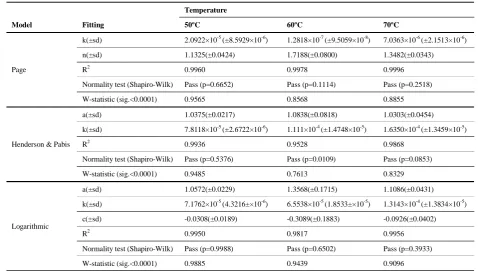
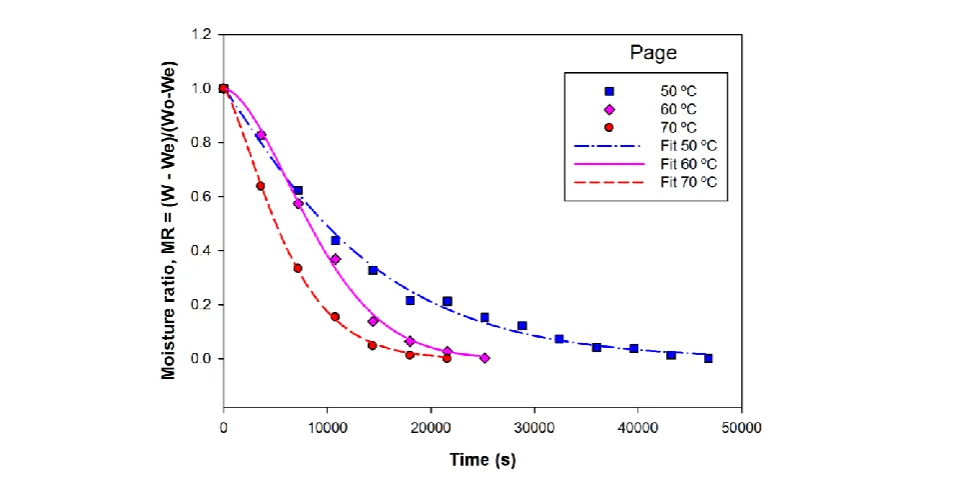
drying curves under different conditions. The drying kinetics data were obtained for the three temperatures studied (50°C, 60°C and 70°C) and the results were fitted to the three model equations (Page, Henderson & Pabis and Logarithmic) as shown in Table 1. The adjustment results (Table 3) showed a good agreement between the mathematical models and the experimental data for all temperatures. The Page model exhibited exceptionally good performance, with the highest value of R2 occurring for the data at 70°C (R2=0.9996) and the lowest at 50ºC (R2=0.9960), but still very high. The Henderson & Pabis model showed just slightly lower values of R2, varying from 0.9528at 60ºC to 0.9936at 50ºC.With the logarithmic model the fits were also very good, with R2 varying from 0.9817 at 60ºC to 0.9956 at 70ºC. Among all the three models, the best fittings were observed with the Page model, corresponding to the highest values of R2.
The values of the drying constant in the present work varied according to the model and the temperature. The value stood in the range from 1.282×10⁻⁷ to 1.635×10⁻⁴ s-1, being the average values around 1×10⁻⁵ s-1. Prakash et al.(2004) evaluated the drying kinetics of
carrot dried in fluidized bed and found values of the drying constant (k) varying from 0.045 to 0.060 min-1, corresponding to 7.5×10⁻⁴ to 1×20-3 s-1, as the temperature increased in the range from 50°C to 60ºC, by modeling with the diffusion equation.
Table 3 Results of the fitting to models Page, Henderson & Pabis and Logarithmic
Temperature
Model Fitting 50ºC 60ºC 70ºC
Page
k(±sd) 2.0922×10⁻⁵ (±8.5929×10⁻⁶) 1.2818×10⁻⁷ (±9.5059×10⁻⁸) 7.0363×10⁻⁶ (±2.1513×10⁻⁶)
n(±sd) 1.1325(±0.0424) 1.7188(±0.0800) 1.3482(±0.0343)
R2 0.9960 0.9978 0.9996
Normality test (Shapiro-Wilk) Pass (p=0.6652) Pass (p=0.1114) Pass (p=0.2518)
W-statistic (sig.<0.0001) 0.9565 0.8568 0.8855
Henderson & Pabis
a(±sd) 1.0375(±0.0217) 1.0838(±0.0818) 1.0303(±0.0454)
k(±sd) 7.8118×10⁻⁵ (±2.6722×10⁻⁶) 1.111×10⁻⁴ (±1.4748×10⁻⁵) 1.6350×10⁻⁴ (±1.3459×10⁻⁵)
R2 0.9936 0.9528 0.9868
Normality test (Shapiro-Wilk) Pass (p=0.5376) Pass (p=0.0109) Pass (p=0.0853)
W-statistic (sig.<0.0001) 0.9485 0.7613 0.8329
Logarithmic
a(±sd) 1.0572(±0.0229) 1.3568(±0.1715) 1.1086(±0.0431)
k(±sd) 7.1762×10⁻⁵ (4.3216±×10-6) 6.5538×10⁻⁵ (1.8533±×10-5) 1.3143×10⁻⁴ (±1.3834×10⁻⁵)
c(±sd) -0.0308(±0.0189) -0.3089(±0.1883) -0.0926(±0.0402)
R2 0.9950 0.9817 0.9956
Normality test (Shapiro-Wilk) Pass (p=0.9988) Pass (p=0.6502) Pass (p=0.3933)
Figure 3 represents the experimental points for the carrot drying curves at the three temperatures and the fittings obtained with the Page model, seen as the best among the three tested. The results confirm the good
prediction capacity of this model for all drying temperatures. The results also confirmed that the drying rate was greater for higher drying temperatures.
4.4 Thermo-physical properties
The values of the air properties considered are presented in Table 4. The air density decreased with increasing temperature, contrary to the air viscosity, which increased. The conductivity, the specific heat and the thermal diffusivity increased, as the temperature was raised.
Table 4 Properties of the drying air at the different
temperatures tested
T, ºC
ρar,
Kg/m3 μar
,N.s/m2 kar
,W/(m.K) cp
,J/(Kg.K) αar
,m2/s
Dm
,m2/s 50ºC 1095.2 2.25×10⁻⁴ 0.0278 1006.7 2.52×10⁻⁸ 2.00×10⁻⁵
60ºC 1063.2 2.30×10⁻⁴ 0.0285 1007.7 2.66×10⁻⁸ 2.00×10⁻⁵
70ºC 1031.2 2.35×10⁻⁴ 0.0292 1008.7 2.81×10⁻⁸ 2.00×10⁻⁵
The Nusselt and Reynolds numbers were determined by Equations (2) and (3), respectively. The determination of the Reynolds number requires the knowledge of the dryer diameter and the air velocity, which in this case were: ddryer = 0.6 m and Vair = 0.2 m/s. Then, heat transfer
coefficient (hc) and mass transfer coefficient (hm) were
calculated using Equations (1) and (4) respectively. The results obtained for these coefficients are presented in Table 5. The heat transfer coefficients were about 49W/(m2·K) while the mass transfer coefficients were around 0.004 Kg/(m2s).
Table 5 Calculation of the heat and mass transfer
coefficients at different temperatures
T,ºC Re Nu hc,W/(m2.K) hm,Kg/(m2.s)
50ºC 5.84×10⁵ 1.07×10³ 49.42 3.84×10⁻³
60ºC 5.55×10⁵ 1.03×10³ 49.12 3.79×10⁻³
70ºC 5.26×10⁵ 1.00×10³ 48.78 3.74×10⁻³
September, 2016 Evaluation of thermo-physical properties and drying kinetics of carrots Vol. 18, No. 3 253
al.(2009) reported convective mass transfer coefficients for the 12 and 8 mm diameter carrot samples of about 0.14 kg/(m2·s), which were also higher when compared to the values found in the present work.
Table 6 presents the thermo-physical properties of carrot calculated using the Costherm software, for the fresh carrot as well as for the samples at the end of drying at the different temperatures. It was found that the specific heat (cp) of the fresh carrot (3.90 kJ/(kg·K))
was very similar to that found by Srikiatden and Roberts (2008) (3.792 kJ/(kg·K)). After drying, the specific heat decreased, but no significant influence of temperature was observed, since the values for the carrots dried at the different temperatures were very similar.
Table 6 Thermo-physical properties in nature and at
different drying temperatures
Sample cp kJ/(kg·K)
K W/(m·K)
Diffusivity m2/s
Enthalpy ,J/kg Fresh 3.90 0.5243 1.50×10⁻⁷ 233
50ºC 2.02 0.2829 1.09×10⁻⁷ 97
60ºC 2.06 0.2889 1.09×10⁻⁷ 118
70ºC 1.99 0.2782 1.06×10⁻⁷ 130
A similar trend was observed for the thermal conductivity (K). Regarding the diffusivity, this parameter presented close values for fresh and dried carrot, although a slight decrease was observed with drying. Pacheco-Aguirre et al.(2014) reported values of moisture diffusivity in carrot cylinders dried at 80°C with an air velocity of 2 m/s of about0.53–2.93×10⁻⁹ m2/s,
which are lower than those obtained in the present work (1.06–1.09×10⁻⁷ m2/s).
The enthalpy of the dried carrots presented small values for all drying temperatures as compared to the value of 233 kJ/kg of the fresh sample. Hence, the results showed that drying decreased enthalpy, but it was further observed that the enthalpy increased with increasing drying temperature.
The time evolution of specific heat is shown in Figure 4, and allowed verifying that during drying the specific heat has decreased, i.e., as the moisture content decreased the specific heat also decreased. The carrots presented a higher value of specific heat for the samples with the higher moisture content, which agrees with several authors, namely Choi and Okos (1986) for tomato juice, Simões (1997) for mango pulp and Silva (1997) for pineapple pulp. In spite of the specific heat decrease, the final values are similar for all drying temperatures.
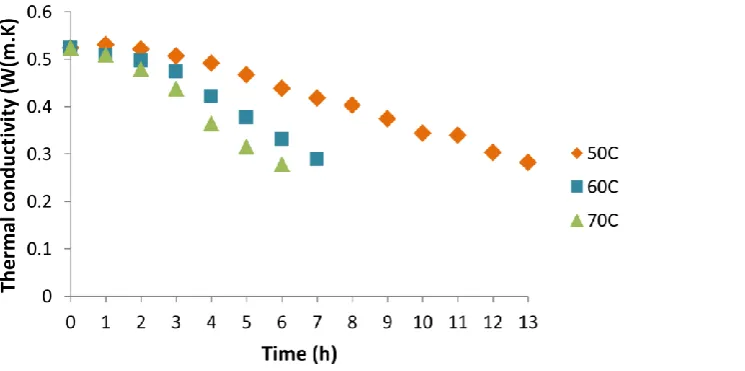
The variation of thermal conductivity is presented in Figure 5 as the drying time passes. The thermal conductivity also decreased along drying, and the temperature which caused a faster decrease was 70°C whereas the temperature of 50°C caused a slower decrease. This is forcefully related to the rate of moisture loss in each case, being faster at 70ºC. Nevertheless, similar final values were achieved. A similar diminishing trend was reported by Perussello et al.(2014) for the drying of Okara.
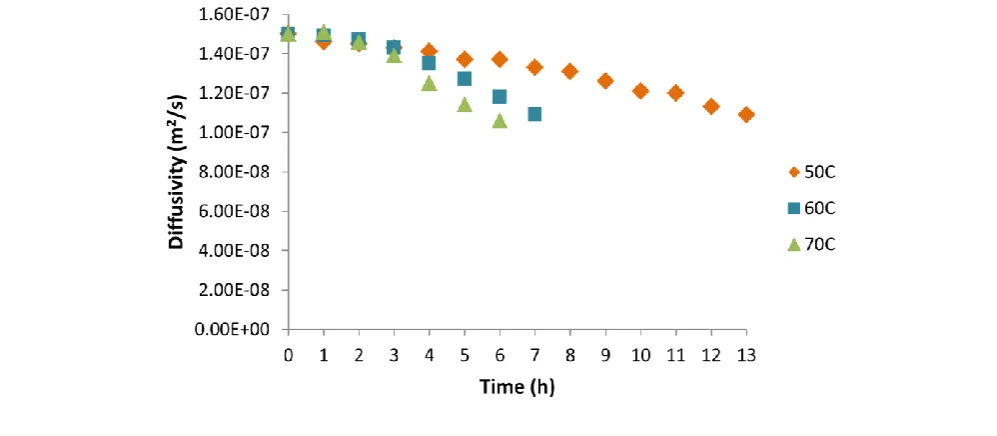
The variation of diffusivity along drying time is reported in Figure 6. Once again a similar trend was observed as previously reported for specific heat and
thermal conductivity. The same decrease trend was observed by Perussello et al.(2014) for the drying of Okara.
The variation of enthalpy for the different drying temperatures is shown in Figure 7. In this case the trend is slightly different than that observed for the other properties, since the variations for 60ºC and 70ºC are very similar and only differ from those at 50ºC. Still, a
decreasing trend is present although the final values of enthalpy differ according to the drying temperature used. Also Perussello et al. (2014) for the drying of Okara observed a decrease in enthalpy.
Figure 6 Time evolution of diffusivity along drying at different temperatures
September, 2016 Evaluation of nutritional characteristics of corn stored in metallic silos Vol. 18, No. 3 255
5 Conclusions
The GAB model used to adjust the experimental data for the desorption isotherms showed a good fitting ability for all temperatures, as seen by the values of the determination coefficient close to 1.The three equations used to model the drying kinetics showed good adequacy for all temperatures, and the Page model revealed the best predicting capacity, with values of R2very close to 1. The values of the drying constant varied according to the model and the temperature, but stood in the range 1.282×10⁻⁷ to 1.635×10⁻⁴ s-1.
The heat transfer coefficients were approximately 49 W/(m2·K) while the mass transfer coefficients were about 0.004 kg/(m2·s). The specific heat of the fresh carrot was 3.90 kJ/(kg·K)but decreased just slightly along drying. Also the thermal conductivity, diffusivity and enthalpy diminished along drying. The diffusivity of the carrots varied between 1.06×10⁻⁷ and 1.50×10⁻⁷ m2/s.
References
Ad m, E., . ühlb ucr, A. Esper, . olf, nd . Spieβ. 2000. Effect of Temperature on Water Sorption Equilibrium of Onion (Allium Cepa L). Drying Technology, 18(9): 2117–2129.
Akpinar, E. K., Y.Bicer, and C.Yildiz. 2003. Thin Layer Drying of Red Pepper. Journal of Food Engineering, 59(1): 99– 104.
Araújo, E.M., and H.C. Menezes. 2005. Composição centesimal, lisina disponível e digestibilidade in vitro de proteínas de fórmulas para nutrição oral ou enteral. Ciência e Tecnologia de Alimentos, 25(4): 768–771.
Baini, R., and T. A. G. Langrish. 2007. Choosing an Appropriate Drying Model for Intermittent and Continuous Drying of Bananas. Journal of Food Engineering, 79(1): 330–343. Bergman, T.L., A.S. Lavine, F.P. Incropera, and D.P. DeWitt. 2011.
Fundamentals of Heat and Mass Transfer. 7th Edition. Chichester: Wiley.
Calado, A. R. P. 2014. Variação Da Composição Nutricional E Propriedades de Cenouras Durante a Secagem.
Disertação de Mestrado Em Qualidade E Tecnologia Alimentar. Viseu, Portugal: Escola Superior Agrária de Viseu.
Calado, A. R. P., J. C. Goncalves, P. M. R. Correia, and R. P F Guiné. n.a. Time Evolution of Physicochemical Properties of Carrots during the Drying Process, Current Biochemical Engineering (in press).
Carson, J. K. 2006. Review of Effective Thermal Conductivity Models for Foods. International Journal of Refrigeration, 29(6): 958–967.
Chong, C. H., C. L. Law, M. Cloke, C. L. Hii, L. C. Abdullah, and W. R. W. D ud. 2008. .“Drying inetics nd Product Qu lity of Dried hemped k..” Journal of Food Engineering, 88(4): 522–527.
Choy, Y., and M. R. Okos. 1986. Effects of Temperature and Composition on the Thermal Properties of the Foods. Transport Phenomenon, 1:93–101.
Doymaz, I. 2004. Convective Air Drying Characteristics of Thin Layer Carrots. Journal of Food Engineering, 61(3): 359– 364.
Fadhel, A., S. Kooli, A. Farhat, and A. Bellghith. 2005. Study of the Solar Drying of Grapes by Three Different Processes. Desalination, 185(1–3): 535–541.
Fellows, P. J. 2006. Tecnologia Do Processamento de Alimentos. 2a ed. Porto Alegre: Artmed - Bookman.
Martínez-Hernández, B. M., M. L. Amodio; and G. Colelli. 2016. Potential use of microwave treatment on fresh-cut carrots: physical, chemical and microbiological aspects, Journal of the Science of Food and Agriculture, 96(6): 2063– 2072.
Guiné, R.. 2011. Drying of Pears. Experimental Study and Process Simulation. LAP Lambert Academic Publishing GmbH & Co. Germany.
Guiné, R.P. F. 2009. Sorption Isotherms of Pears Using Different Models. International Journal of Fruit Science, 9(1): 11– 22.
Guiné, R.P.F., and R.M.C. Fernandes. 2006. Analysis of the Drying Kinetics of Chestnuts.Journal of Food Engineering, 76(3): 460–467. d
Guiné, R.P.F., S. Pinho, and M. J. Barroca. 2011. Study of the Convective Drying of Pumpkin (Cucurbita maxima). Food and Bioproducts Processing, 89(4): 422–428. Guiné, R. P.F. 2006. Influence of Drying Method on Density and
Porosity of Pears. Food and Bioproducts Processing, 84 (3): 179–185.
Guiné, R. P. F. 2005. Variation of Density and Porosity During the Drying of Pears and Pear Halves.Brazilian Journal of Food Technology, 8(1): 252–255.
L.). International Journal of Academic Research, 1(1): 46–52.
Henriques, F., R. Guiné, and M. J. Barroca. 2012. Chemical Properties of Pumpkin Dried by Different Methods. Croatian Journal of Food Technology, Biotechnology and Nutrition, 7(1-2): 98–105.
Hernández-Santos, B., C. E. Martínez-Sánchez, J. G. Torruco-Uco, J. Rodríguez-Miranda, I. I. Ruiz-López, E. S. Vajando-Anaya, R. Carmona-García, and E. Herman-Lara. n.a. 2016. Evaluation of Physical and Chemical Properties of Carrots Dried by Refractance Window Drying. Drying Technology (in press).
Holman, J. P. 1986. Heat Transfer. New York: McGraw-Hill. Kechaou, N., and M. Maalej. 1999. Desorption Isotherms of
Imported Banana Application of Th E Gab Theory. Drying Technology, 17(6): 1201–1213.
Kiranoudis, C. T., E. Tsami, Z. B. Maroulis, and D. Marinos-Kouris. 1997. Drying Kinetics of Some Fruits. Drying Technology, 15(5): 1399–1418.
Lahsasni, S., M. Kouhila, M. Mahrouz, and J. T. Jaouhari. 2004. Drying Kinetics of Prickly Pear Fruit (Opuntia Ficus Indica). Journal of Food Engineering, 61(2): 173–179. Lewis, M. J. 1993. Propriedades de Los Alimentos Y de Los
Sistemas de Procesado. Zaragosa: Abribia.
Lima, K.S. Cople, A.L. S. Lima, L.C. Freitas, R.C. Della-Modesta, and R.L. O. Godoy. 2004. Effect of Low Doses of Irradiation on the Carotenoids in Read-to-Eat Carrots. Food Science and Technology (Campinas), 24(2): 183– 193.
Medeiros, M. L., A. M. I. B. Ayrosa, R. N. M. Pitombo, and S. C. S. Lannes. 2006. Sorption Isotherms of Cocoa and Cupuassu Products. Journal of Food Engineering, 73(4): 402–406.
Moretti, C. L., and L. M. Mattos. 2007. Processamento Mínimo de Minicenoura. In Manual de Processamento Mínimo de Frutas E Hortaliças, 399–413. Brasília: Sebrae.
Mota, C.L., C. Luciano, A. Dias, M.J. Barroca, and R.P.F. Guiné. 2010. Convective Drying of Onion: Kinetics and Nutritional Evaluation. Food and Bioproducts Processing, 88(2–3): 115–123.
Moura, S. C. S.Rolim, V. C. L.França, and A. M. C. B.Leal. 2005. Thermophysical Properties of Model Solutions Similar to Juice: Part II. Food Science and Technology (Campinas), 25(3): 454–459.
Pacheco-Aguirre, F. M., A. Ladrón-González, H. Ruiz-Espinosa, M. A. García-Alvarado, and I. I. Ruiz-López. 2013. A Method to Estimate Anisotropic Diffusion Coefficients for Cylindrical Solids: Application to the Drying of Carrot. Journal of Food Engineering, 125(3): 24–33.
Panwar, S., B. Mishra. 2015. Effect of Aloe vera based composite edible coatings on physical characteristics of peeled carrots during storage at room and refrigerated temperatures, International Journal of Agriculture Sciences, 7(3): 460-464.
Perussello, C. A., V. C.Mariani, and A. C.C. Amarante. 2014. Thermophysical Properties of Okara During Drying. International Journal of Food Properties, 17(4): 891– 907.
Pinheiro, G. S.. 2004. Propriedades Físicas, Termofísicas E Físico-Químicas de Purê de Banana Adicionados de
Açúcar. Tese Doutorado Em Ciência Dos Alimentos. Lavras, Brasil: Universidade Federal de Lavras.
Prado, M.E. T., L. F. T. Alonso, A.F. Sales, and K.J. Park. 1999. Dates Sorption Isotherms: Experimental Determination and Mathematics Models Evaluation. Food Science and Technology (Campinas), 19(1): 143–146.
Prakash, S., S. K. Jha, and N. Datta. 2004. Performance Evaluation of Blanched Carrots Dried by Three Different Driers. Journal of Food Engineering, 62(3): 305–313.
Roberts, J.S., D.R. Kidd, and O.Padilla-Zakour. 2008. Drying Kinetics of Grape Seeds. Journal of Food Engineering, 89(4): 460–465.
Silva, S. B. 1997. Propriedades Termofísicas de Polpa de Abacaxi. Dissertação de Mestrado Em Engenharia de Alimentos. Campinas, Brasil: Universidade Estadual de Campinas. Simões, M. R. 1997. Propriedades Termofísicas de Polpa de
Manga. Dissertação Mestrado Em Engenharia de Alimentos. Campinas, Brasil: Universidade Estadual de Campinas.
Souraki, B. A., A. Andrés, and D. Mowla. 2009. Mathematical Modeling of Microwave-Assisted Inert Medium Fluidized Bed Drying of Cylindrical Carrot Samples. Chemical Engineering and Processing: Process
Intensification, 48(1): 296–305.
Spagnol, W. A., K. J.Park, and J. M. M.Sigrist. 2006. Respiration Rate of Storage Processed Carrots at Different Temperatures. Food Science and Technology (Campinas), 26(3): 550–554.
Srikiatden, J., and J.S. Roberts. 2008. Predicting Moisture Profiles in Potato and Carrot during Convective Hot Air Drying Using Isothermally Measured Effective Diffusivity. Journal of Food Engineering, 84(4): 516–525.
September, 2016 Evaluation of thermo-physical properties and drying kinetics of carrots Vol. 18, No. 3 257 Unadi, A., R. J. Fuller, and R. H. Macmillan. 1998. Prediction of
the Equilibrium Moisture Content of Tomatoes. Food Australia, 50(4): 200–203.
Viswanathan, R, D. S Jayas, and R. B Hulasare. 2003. Sorption Isotherms of Tomato Slices and Onion Shreds. Biosystems Engineering, 86(4): 465–472.
Wang, J., and Y. S. Xi. 2005. Drying Characteristics and Drying Quality of Carrot Using a Two-Stage Microwave Process. Journal of Food Engineering, 68(4): 505–511.
Nomenclature
aw Water activity [dimensionless]
cp Specific heat [kJ/(kg·K)]
d Diameter [m] h Enthalpy [J/kg] H Enthalpy [J]
hc Heat transfer coefficient [W/(m 2
·K)] hm Mass transfer coefficient [Kg/(m
2
·s)] K Thermal conductivity [W/(m·K)]
m Mass [kg]
MR Moisture ratio [dimensionless] Nu Nusselt number [dimensionless]
R Gas constant (R = 8,314 (J/mol·K)) [J/(mol·K)] Re Reynolds number [dimensionless]
T Temperature [ºC] t Time [s] v Velocity [m/s]
W Moisture content [g/g dry matter]
Wm Monolayer moisture content [g/g dry matter]
Thermal diffusivity [m2/s]
Coefficient of volumetric shrinkage [dimensionless]
Porosity [dimensionless]
Viscosity [N·s/m2]
Specific mass (density) [kg/m3]
b Bulk density [kg/m3]
s Solids density [kg/m 3
]
w Water density [kg/m 3