Current Order and Inventory Models in Manufacturing
Environments: A Review from 2008 to 2018
https://doi.org/10.3991/ijoe.v14i06.8055
Zohreh Momeni
!!", Amir Azizi
Islamic Azad University, Tehran, Iran
Abstract—
One of the issues of designing supply chain network is "Supply
chain ordering management ". Extra costs are the most important factors in the
survival of an organization and have a significant impact on company
competi-tiveness. However, holding inventory, order accepting, and functional risks are
factors that have not been studied simultaneously. The purpose of this paper is
to provide a review on order and inventory and use of Activity based costing
approach in regard to supply chain management and costs managing. This paper
selected and reviewed 56 published articles in a decade of 32 important journals
related to order and inventory of supply chain manufacturing industries which
chosen from the “Science direct and Scopus” databases and in this regard, the
applications of the Artificial Neural Network method which called “ANN”, ant
colony algorithm and queue theory have been proposed. All published articles
were categorized based on the author number, The first author name,
publica-tion year, problems, factors, type of manufacturing industries, research methods
and results and findings. Finally, International Journal of production Economics
was ranked the first. Results of this paper acknowledge that order management
and inventory control can help decision makers in solving some problems under
uncertainties situations of demands in environmental manufacturing industries
and this approach have seen increasing interest among previous researchers to
use this approach in various steps of supply chain management.
Keywords—
order management, inventory control, operational risk,
activity-based cost
1
Introduction
the total annual costs. With growing up in the number of replenishment, the cost of
the system will enhance. Due to gained costs in order to unnecessary redistribution, a
significant leap in costs occurs. Furthermore, by increasing maintenance costs and
reducing deficiency cost, the total inventory at the end of the periods is reduced. Haji
and et al. studied queueing Inventory System in a Two-level Supply Chain with
One-for-One Ordering Policy. In this study, the integrated services system was used in a
two-level supply chain in which it was located. Retailer only was a vendor and
look-ing for a stock-based stock policy. Inventory system total cost by retailer is much
lower than without a retailer system [4]. Tat and et al. developed
Economic-Order-Quantity (EOQ) model with instantaneous deteriorating items for a vendor-managed
inventory (VMI) system. In this survey, they studied the EOQ model for deteriorating
items in two cases (with and without shortages) to evaluate how VMI affects supply
chain. They considered two-level supply chain (single supplier and a single retailer)
with one instantaneous deteriorating item. The results show that VMI works better
and provides lower costs in all circumstances of traditional supply chain [10]. Zhang
and et al. probed in Multi-objective optimization for sustainable supply chain network
design considering multiple distribution channels. The Multi Distribution Centre
Supply Chain Network (MDCSCN) model is more innovative and pioneered as it
meets the latest requirements and outperforms the conventional Supply Chain
Net-work (SCN). Realization of the paradigm changing of traditional SCN to the new one
with multiple distribution channels and the complexity of information analysis, can
assist management to schedule with importance of optimizing MDCSCN multiple
goals by taking into account efficiency and the capacity of facilities and transportation
[22]. Kumar and et al. surveyed in developing of a Novel Lot-sizing Model with
Var-iable Lead Time in Supply Chain Environment. The main point of their results is, as
the time of purchasing growth, the amount of economic order will rise too [39]. The
study of literature shows that there are several types of inventory control models in
multi-product environments. The total cost consists of two components:
1. Cost of preparation or ordering costs: includes the cost of adjusting machinery and
facility before production in manufacturing sectors. The cost for products provided
through the manufacturer consists of the cost of preparing and receiving orders and
the cost of transporting goods.
2. Maintenance cost: includes the cost of maintaining the parts in the warehouse.
The cost of ordering items is also composed of two components:
a)
the cost of ordering which is independent of the order quantity.
b)
Variable order costs that depend on the order of the various products.
Costs are generally classified into four groups:
1. Cost of product unit operations: these costs proportional the number of goods
pro-duced, like the cost of machining time, material costs and direct wages.
3. Cost of specific product-related activities: such as design cost, process engineering,
etc.
4. The cost of maintenance activities and management of facilities and equipment:
such as rent, utilization, reparation and maintenance costs.
This review paper aims to provide review of current order and inventory models
due to costs problems. A wide variety of previous studies reviewed the order
man-agement or inventory control in supply chain problems such as inventory control
problem of logistical systems but there are several studies that survey in service
sys-tems for instance bank as case study. The remainder of this paper is organized as
follows. Section 1 provides an overview of literature of current surveys in order and
inventory. Section 2 several critical factors of the researches were highlighted.
Sec-tion 3 of this paper attempted to discuss on the obtain findings and results and SecSec-tion
4 provides some conclude remarks, limitations of this study, and suggestions for
fu-ture researches.
2
Literature review
In literature review section, we highlight some important factors that are as
fol-lows:
•
Extra buffer stock required to eliminate stock out
•
Unit cost of time
•
Cost of carrying inventory in percentage per year
•
Ordering cost in per order
•
Demand in lead time
•
Number of stock units demanded in time period
•
Distribution of demand in lead time
•
Procurement lead time
•
Minimum stock in any time period
•
Number of order per year
•
Order quantity
•
Economic order quantity
•
Re-order point
•
Total lead time
•
Loss per unit inventory if there is no demand
•
Probability of stock out in a cycle (order) [39].
•
Set-up cost for supplier to produce component
•
Set-up cost for plant to produce product
•
Set-up cost for Distribution Centre (DC) to deliver product
•
Capacity of plant to design product
•
Capacity of supplier to design component
•
Unit production cost of product at plant
•
Unit cost of throughput
•
Maximum production capacity of supplier for component
•
Maximum production capacity of plant for product
•
Total production capacity of plant
•
Minimum throughput
•
Quantity of component used in one unit of product
•
Service level of supplier
•
Service level of plant
•
Service level of DC
•
Volume of product produced at plant
•
Volume of product received at DC
•
Volume of component provided by supplier
•
Volume of product transferred from plant to DC
•
Volume of component transferred from supplier to plant [19].
•
Major operation costs share in general operation costs
•
Number of identified activity segments
•
Share of supply costs in general operation costs [23].
In addition, some critical problems that we mention that are as follows:
Investigating internal interrelationships and provide insights into the operational
dynamics of single supply chain enterprises. To better focusing risk monitoring and
risk management in the automotive industry supply chains on risks in order to
en-hance decision making in the upstream supply chain [17]. Taking into consideration
the uncertainty of demand, cost of production, allocation of the transportation cost,
shortage loss, tax rates and limitation of markdown rates [29]. Cost calculation for
more accurate cost information than the traditional volume-based costing (VBC).
using ABC approach with two stages to allocate and calculate the manufacturing cost
which is based on resources expired of process activities [33]. Sustainable supplier
selection and order allocation problem under operational and disruption risk [42],
considering different shortage situations [45], minimizing the average total inventory
cost [48], risk assessment of existing production units considering availability and
human safety criteria [50], deciding the logistics service integrator regarding the
loca-tion of the customer order decoupling point [52], analyzing the benefits of horizontal
collaboration related to perishability, from transportation operations and logistics
costs in the Inventory Routing Problem (IRP) with multiple suppliers and customers
by developing a decision support model that can address these concerns [55],
design-ing a resilient hub network under operational and disruption risks [56].
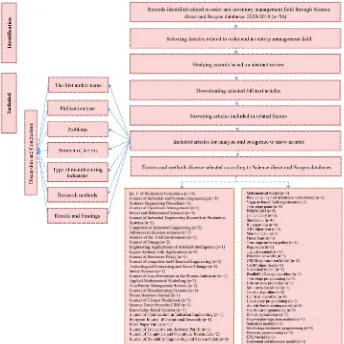
methods that are used more than others encompass mathematical model, simulation
and heuristic algorithm. Study flowchart for the identification and included of articles
that are surveyed is shown in Fig. 1. In addition, more information about articles that
are investigated in details is exhibited in Table 1.
Ta
b
le
1
.
De
ta
il
s
of
r
es
ea
rc
he
s
ba
se
d
on
e
ig
ht
c
at
eg
or
ie
s.
Author No. The first authorname Publication year Problems Number of factors Type of manufactu r-ing indu s-tries Research methods
Results and findings
[1]
Berling 2008
They consider the problem of choosing the holding cost in inventory models. In the present work, they present a more general model of the cost of holding inventory based on a microeconomic framework.
14
Theory
Numerical model
The suggested method works well in the considered numerical examples (maxi
-mum and
average cost increase is 1.78% resp. 0.08%). There exist situations where the traditional a
p-proach, setting unit h as a percentage of the product value, gives rise to a significant cost increase (415%).
[2]
Charles and Hansen
2008
This study develops a theoretical product cost
framework
independent of cost assignment concepts.
7
Theory
Cooperative game
theory
Cooperative game theory provides rational, non
-arbitrary criteria for assigning joint benefits and
defines two possible constructs; the set of imputations and the core. Using these two constructs to define accuracy, along with an operational measure of product diversity developed in the study, formal conditions are identified where activity
-based costing (ABC) is theoretically closer
to the true product cost than functional-based costing (FBC. Their results, therefore, provide a theoretical foundation for ABC.
[3]
Askarany and et al. 2010
Current study first identifies different types of improvements which ABC can offer to SCM and the performance of the organizations, then it examines the extent of association between business size as well as business industry affecting the adoption of ABC in New Zealand (NZ) through using a survey questionnaire and targeting NZ qualified CIMA members.
8
Chartered Institute of Management acc
ountants
(Business industry) in
New Zealand
Activity-based costing model To summarize the above statistical tests, the findings of current study support their stated proposition that larger firms are more likely to adopt ABC than smaller firms. However, w
hen
the adoption decision was made, there is no significant difference between larger firms and smaller firms in terms of proceed-ing towards a higher level of adoption of ABC (e.g. from activity analysis level to allocation of costs to products level).
[4]
Haji and et al. 2011
Achieving supplier and retailer inventory optimum policy (retailers search for basic stock inventory policy. On the other hand, supplier has to satisfy retailer orders).
13
Theory
Mathematical
model
In this study, the integrated services system is used in a two-level supply chain in which it is located. Retailer only is a vendor and is looking for a stock
-based stock policy. Inventory system
total cost by retailer is much lower than without a retailer system.
[5]
Feng-gea and Ping 2012
This study'
s aim is the Empirical Analysis of Operational Risk
Measurements Based on CVaR
(Conditional-Value-at
-Risk).
9
Commercial banks in
China
Peak Value Method of
Extreme Value
Theo-ry
The CVaR measurement method can obtain a relatively precise operational loss value, by which economic capital can be allocated accordingly. However, as the capital ratio of most commercial banks in China is relatively low that is to cover expected operational loss
es by risk reserves, to
Author No. The first author
name Publication year Problems Number of factors Type of manufactu r-ing indu s-tries Research methods
Results and findings
[6]
Schulze and et al. 2012
Several activity-based costing models for inter-firm cost accoun
t-ing have been proposed. Evaluatt-ing these models, a conceptual framework for activity-based costing in a supply chain has been developed. This also forms the basis for a single case study conducted at Europe'
s largest company for façade components.
3 Europe' s larg-est company for facade components
activity-based costing model
The model was tested in a case study. The case study revealed that standardized cost info
r-mation. An activity-based costing tool implemented at all supply chain
members, can support
related supply chain decisions. Through standardization of cost information activities, processes can be assessed regarding an effective overall design and an efficient performance. Summing up, the model and case revealed that inter
-co
mpany cost accounting along the supply chain can
foster strategic decisions.
[7]
Hora and Klassen 2013
Firms should improve their own operations by observing prob- lems that occur in others’ process
-es, significant operational risks
appear to be ignored and similar losses recur. They tested the influence of organization-level factors on knowledge acquisition.
12
Managers from two chemical industries Vignette-based field experiment
They find that both organization-level factors were positively related to the
degree of knowledge
acquisition. Moreover, operational similarity moderated the influence of market leadership on knowledge acquisition (However, results found no differ-ence in knowledge acquisition of the observing firm based on market leadership when operational similarity is high. These results support the notion that similarity is a critical key criterion triggering knowledge acquisition, regardless of market leader-ship.)
[8]
Alinezhad and et al. 2013
In this survey, the researchers are going to intro-duce a new generation of costing entitled: "Fuzzy time driven activity based costing (FADABC)" to estimate the time more accurately and reduce error coefficient as a cost driver by using fuzzy logic.
8
Theory
Fuzzy logic
Time driven activity based co
sting system is broadly relying on time estimations and it is
principally abstract. If the least error occurs in estimating the key time activities, this system will result in damaging effects which are sometimes broader than the negative effects of not us
ing
this system. Thus, we should try to use fuzzy logic in order to minimize errors in time estim
a-tions and managers should make decisions with higher assurance levels.
[9]
Wei and et al. 2013
They study a two-stage game problem on pricing, ordering and allocation in a service supply chain, where one supplier sells a product with a fixed capacity to customers via two retailers under wholesale price contracts.
10
Theory
Two
-stage game
They find that under the leader of the supplier the competition between
the two retailers is
eliminated and each retailer just orders its optimal quantity. So, the retailers'
behavior in the
game is not influenced by the supplier'
s allocation rule. Furthermore, with pricing power, the
supplier can get higher profit but the retailers would not necessarily.
[10]
Tat and et al. 2014
In this research, the problem of a single instanta-neous deteriora
t-ing product under VMI policy is studied.
22
Theory
EOQ model development
They developed EOQ model with instantaneous deteriorating
items for a vendor-managed
Author No. The first author
name Publication year Problems Number of factors Type of manufactu r-ing indu s-tries Research methods
Results and findings
[11]
Baradaran Kazemza-deh and et
al. 2014
They analyze a network design problem for a closed
-loop supply
chain that integrates the collection of the used products with the distribu-tion of the new products.
14
The carpet manu- facturing facility at Izmir, ,Turkey Mixed integer nonlinear pro- gramming & Heuristic
algo-rithm
They observe that their heuristics perform pretty well in general. They observe that all their heuristics can find the optimal solution in their trials when there are N = 10 customer loca
-tions
and the percentage deviation of the p
rofits obtained by the heuristics from the upper bound are
less than 5% for N = 200 customer zones. They also analyze the effects of the parameters on the system. Their computational study shows that TSVNS gives better results than SAVNS and GAVNS in terms of the profits obtained.
[12] Noorai e and Mellat Parast 2014
This survey investigates the relationship among supply chain visibility (SCV), supply chain risk (SCR), and supply chain cost of new and seasonal products.
14
Theory
Heuristic
algo-rithm
The results show that more visibility is desirable, because it increases effi
-ciency in a supply
chain and decreases both cost and risk.
[13]
Xiao and Chen 2014
This probe develops a game theoretic model of a one
-manufacturer and one-retailer supply chain facing an outside integrated chain (manufacturer) to study the price and lead
-time
competition and investigate coordination of the supply chain, where the
make-to
-order production mode is employed and
consumers are sensitive to retail price and lead time.
10
Theory
Game theory
They find that decentralization of the supply chain increases its lead time while decreases the rival'
s lead time; and the decentralization increases the retail prices. The existence of the outside
competitor raises the lead time. A
higher reservation price or brand differentiation increases the
retail prices but decreases the lead times. They find that the sequence of decisions affects the validity of the all-unit quantity discount scheme in coordinating the supply chain.
[14]
Molamoham-adi and et al.
2014
This article investigates the
ef
fects of the latter policy, two-level
trade credit, on a retailer'
s optimal ordering decisions within the
econom-ic order quantity framework and allowable shortages.
14
Theory
Genetic algorithm
Numerical examples demonstrate the profitability of the developed two
-level supply chain with
backorder. For matching the real world inventory systems, this research extends the model proposed by Teng et al. Comparing the results of this survey with that o
f Teng et al demonstrates
that it can be more profitable when backorder cost is smaller than or equal to a specific value. comparing with the traditional inventory system with backorder, the trade credit, both the model of Teng et al and the one proposed in this survey, would increase the profit of the retailer.
[15]
Bieda and et al.
2014
The purpose of the article is to present the results of application of stochastic approach based on Monte Carlo (MC) simulation for life cycle inventory (LCI) data of
Mittal Steel Poland (MSP)
complex in Krakow, Poland.
7
Mittal Steel Poland (MSP) com- plex in Kra- kow, Poland
Stochastic
approach based on Monte Carlo (MC)
simulation
This article is concluded that the stochastic approach is a powerful method for quantifyin
g
parameter uncertainty in LCA/ LCI studies and it can be applied to any steel industry. The results obtained from this study can help practitioners and decision
-makers in the steel production
Author No. The first author
name Publication year Problems Number of factors Type of manufactu r-ing indu s-tries Research methods
Results and findings
[16]
Mohammad dust and et al.
2015
This article investigates how organization should design their supply chains (SCs) and use risk mitigation strategies to meet different performance objectives. To do this, they develop two mixed integer nonlinear (MINL).
46 A large automotive SC Robust optimiz
a-tion (Two mixed integer nonlinear
(MINL))
Considering several risk mitigation strategies opens the hand of the designer to select the least costly combination of these strategies to neutralize the negative effects of the risks. The i
m-portance of considering several risk mitigation strategies increases when the costs of imposing these strategies are different in the SC'
s facilities. They show that this approach can be used to
simultaneously model disruptions in the SC'
s both facilities and connecting links by defini
ng a
single scenario set.
[17]
Guertler and Spinler
2015
Their article investigates internal interrelationships and provides insights into the operational dynamics of single supply chain enterprises. This survey aims to better focus risk monitoring and risk management in the automotive industry supply chains on the right risks in order to enhance decision making in the upstream supply chain.
16
Automobile industry
System Dynamics
Simulation
Their first finding is that supply risk managers need to place g
reater emphasis on the risks that
exist within each single supply chain enterprise. Second, they present a system dynamics model that makes it possible to capture and to further analyze these internal dynamics. Third, they show by means of scenario analysis that a highly interrelated risk is much more likely to tip the system by its occurrence than a weakly interrelated risk.
[18]
Mortaza-vi and et al. 2015
the challenging issues in supply chain man-agement is the coordination of ordering pro-cesses, especially in dynamic situations.
7
Theory
Reinforcement learn-ing (RL) algorithm and Simulation-based optimization
Result shows that there is only 1% of risk that customers'
wait more than 16 h for their order
delivery. This result implies that the consid
ered supply chain is quite responsive with high
service level. For conditional risk evaluation of the supply chain with a given customer waiting time, the conditional distribution function is needed.
[19]
Zhang and et al. 2015
Designing multi product chain to responsiveness customer various requirements; recognition of purveyor'
s priorities is a leading
factor. the general decisions are related to the selection of supply chain facilities and the allocation of loading.
24
Bicycle
Manufactur- ing
Compa-ny
Artificial bee
colony algorithm
Their model involves three major supply chain stages, including procurement, production, distribution and their interactions. they develop an approach based on an artificial bee colony (ABC) algorithm. Their result can help system experts of supply chain in general
[20]
Jiang and et al. 2015
The deterioration of the inventory affects decision
-making and
increases losses. Block replacement and periodic review inventory policies were in this article used to evaluate a joint
optimization
prob-lem for multi-unit systems in the presence of inventory deterioration.
33
Spare parts of electric locomotives in Slovenian Railways The deterministic deteriorating invento-ry (DDI) model & stochastic deteriorat-ing inventory (SDI)
model
The deterministic deteriorating inventory (DDI) model was used to describe deterio
-rating
inventory when deteriorating inventory data were available and the stochastic deteriorating inventory (SDI) model was used when they were not. This work proved the existence of the optimal maximum inventory level and gave the unique
-ness condition under the DDI model.
Author No. The first author
name Publication year Problems Number of factors Type of manufactu r-ing indu s-tries Research methods
Results and findings
[21] Dheg-ihan and et al. 2016
Minimizing whole costs of location, shipping and inventory; Model should be drowning up to deter-mine location and allocate inventory refill proper-ly.
12
Theory
Markov chain and nonlinear mixed integer progra
m-ming
This study extends a mathematical model that integrates the location, allocation, inventory replenishment and routing decisions simultaneously that the prop
osed algorithm could achieve
good-quality solutions within reasonable times.
[22]
Zhang and et al.
2016
Designing network with The least shipping and functional cost, with maximum consumer'
s cover-age, in order to providing
organized services.
14
Theory
Multi-objective
modified Artificial
bee colony algorithm This model will reduce economic costs of companies supply chain of and increase flexibility. In addition, it can significantly decrease the computational complexity.
[23] Na-wrocki and Jonek- Kow-alska 2016
This article aims to assess and compare operational risk in coal mining enterprises in Central and Eastern Europe.
34
Coal mining enterprises in Central and Eastern
Europe
Fuzzy logic
The main external reason for increasing the level of operational
risk in the examined enterprises
and in the entire sector in Europe was the lowering demand for coal caused by decarburization and the development of alternative energy sources. This was strengthened by the variability and decrease in coal prices in world markets. Additionally, the examined enterprises are used to government protection and state aid, which reduce vigilance and cause risk ignorance.
[24]
Yousefi Baba-dia and et al.
2016
This probe shows a multi-objectives mixed-integer non-linear programming (MINLP) model for a petrochemical supply chain under uncertainty environments, namely disruption risks and less knowledge of parameters. The aims are to mini-mize the average tardiness to deliver products, total cost and transportation cost.
65
Nylon plas
tic
manufactur-ing
Multi-objectives mixed-integer non- linear progra
m-ming (MINLP) and recy-cling centers The developed model specifies the optimal locations for new DC, collection center and disposal center and optimal allocation of customer zones to DC for
each. A feasible case study in Iran
showed the valuable performance of the developed model in modifying the efficiency of petrochemical SCs.
[25]
Zhang and et al.
2016
They propose a two-stage optimization model to charac-terize
a
retailer'
s ordering policy in a supply chain with demand and
supply uncertainties sequentially realized, where the advance payment could be conducted before the selling season to stable the supplier'
s capacity.
15
Theory
Two
-stage order- ing policy
The results show that in the retailer'
s optimal decision, the advance payment is increased along
with the supply risk and is significantly influenced by the retailing price and the supply rate; the results also give the structure of the supplier'
s the optimal p
ricing strategy for the retailer'
s
Author No. The first author
name Publication year
Problems
Number of factors
Type of
manufactu
r-ing indu
s-tries
Research methods
Results and findings
[26]
Zhao and et al. 2016
This study, First, listed companies improving their social respo
n-sibili-ties fulfillment face significantly lower operational risk. Second, listed companies publishing independent social respons
i-bility reports face significantly increased operational risk. Third, high risk companies improving social responsibility fulfillment can significantly reduce their operational risk. Finally, low risk companies improving their social responsibilities fulfillment and publishing independent social responsibility reports experience changes in operational risk.
14
Chinese A- share listed companies from 2007 to
2009
Regression (Sta- tistical analysis) They show that companies that improve their social responsibilities fulfillment significantly reduce operational risk; the better CSR fulfill-ment, the lower is operational risk. Further, high risk companies improv-ing their social responsibility performance can significantly decrease their operational risk, while the independent social responsibility report leads to significantly increased operational risk.
[27]
Yang and Hauge
n 2016
Operational planning decisions, have received little attention in risk and safety research in offshore oil and gas industry. The overarching objective of the article is to find out how to provide good risk information for such decisions.
9
Gas industry (Theory) (Firefighting system) Typical example of an operational planning decision
scenario
The discussion starts from description of what good risk information is, followed by a proposal to use Activity consequence risk (ACR), Activity performance risk (APR), and Period risk (PR). The main conclusion is that current practices in the industry lack the accuracy and ca
pability to
provide such a risk picture.
[28]
Barua and et al. 2016
Their study aims to take proper initiatives to minimize/ remove hazards and risks. This study proposes a risk assessment method- ology for dynamic systems based on Bayesian network, which represents the dependencies among variables graphically and captures the changes of variables over time by the dynamic Bayesian network. This study proposes to develop dynamic fault tree for a chemical process system/sub-system.
7
A TANK HOLD
-UP
PROBLEM (Chemical process)
Bayesian
net-works
Bayesian network can combine the expert judgment and quantitative knowledge to estimate risk. Also, it demonstrates changes of variables with time through the reasoning process. Application of Bayesian network is very much helpful for the area where the availability of data is limited. Controller failure in this case study is more critical than other equipment/components failures in the system as its failure probability is much higher than others.
[29]
Zhang and et al. 2016
Taking into consideration the uncertainty of demand, cost of production, allocation of the transportation cost, shortage loss, tax rates and limitation of markdown rates, are problems that this survey wants to solve them with an optimization model.
25
Two
manufac- turer case
GSCM
optimiza-tion model
The corporations of supply chain should pay great attention to the limitation from the gover
n-ments on the bounds of markdown rates. The range of the bounds often has a significant impact on the optimal retail prices, transfer prices, order quantities, after
-tax profit and allocation of the
profit. Demand uncertainty has a significant effect on the optimal retail price than the transfer price. Tax rates, production cost, and losses due to shortages are three I
mportant factors for the
optimal decisions of the corporation. In addition, market demand is important too.
[30]
Wang and et al. 2016
They study a decentralized supply chain in which a manufacturer supplies a newsvendor-type item to a retailer in a
stock-dependent
demand market, considering temporary and permanent inventory shrinkages.
12
Theory
Newsvendor-type item method & Numerical
exam-ples
The result shows, in the price-only contract, the inventory shrinkage effect urges the retailer to place more quantity to cover the missing products; the large order. The manufacturer is the winner in this invento-ry shrinkage game. A much cheaper negotiated wholesale price is needed to entice the retailer to discover inventory errors and share with the manufac
Author No. The first author
name Publication year Problems Number of factors Type of manufactu r-ing indu s-tries Research methods
Results and findings
[31]
Elsayedn and Wahba
2016
Existing evidence regarding inventory
-performance relation-ship
is inconclusive. A perspective that this survey stresses in consider- ing this relationship is that it might depend on organizational life cycle stage.
10
The most active firms trading on
the Egyp-tian
Stock
Exchange
Statistical model
The results show that while inventory to sales ratio affects organization perfor
-mance negatively
in the initial growth stage and the maturity stage, it exerts a positive and s
ignificant coefficient
on performance in either the rapid growth stage or the revival stage.
[32]
Cui and et
al. 2017
The supply chain network design is a strategic decision problem which is aimed to decide number of different facili
-ties required to
make in the network. facility location prob
-lem in close loop
supply chain network is important too.
31
Theory
Artificial bee colony genetic algorithm Results indicate that proposed GABC outperforms standard ABC and GA in different scenarios to give smaller value of the total cost of network and gives more robust results to give smaller variations in the total cost of network due to uncertain variations in the demand, as compared to original ABC and GA.
[33]
Lu and et al. 2017
This article explores cost calculation methodology for more accurate cost information than the traditional volume
-based
costing (VBC). The survey uses Activity-Based Costing (ABC) approach with two stages to allocate and calculate the manufactu
r-ing cost which is based on resources expired of process activities.
6
Bicycle parts industry Activity-Based Costing system & Volume-Based Costing (VBC) (Com-pare) By comparing the cost information between VBC and ABC approach, the research findings indicate that current VBC approach distorts cost structure because of single cost drive had been chosen, therefore, cross-subsidization among manufacturing cost structure among variant product. Secondly, ABC approach provides more accurate cost information that will help to set the competitive price strategy of the product that is great contribution to increase enterprise'
s
profitability and competitive power.
[34]
Fattahi and et al.
2017
They address a multi-period supply chain (SC) network design where demands of customers depend on facilities
serving them
based on their delivery lead-times They develop a multi-stage stochastic program, and model disruption'
s effect on facilities'
capacity. The SC responsiveness risk is limited.
27
Iranian glass company
Multi-stage
stochastic pro- gramming Their computational results highlighted the fact that the customer behavior with respect to the delivery lead-time of products has substantial influence on the design decisions of SC networks. In this regard, as the customer'
s sensitivity to the deliv
-ery
lead-ti
me of products increases, the
facilities that supply these customers should be located closer to them and hence, the design costs of SC increases.
[35]
Pacheco and et al. 2017
The planning of a supply chain (SC) subject to market de-mand uncertainty is challenging in regards to defining update mech
a-nisms that deal with demand variations. Also, proposes a new reorder point update procedure for
order-up-to
-level (OUTL)
policies in continuous review systems.
14
Brazilian company discrete event simulation The proposed approach is based on absorption inventory, a new concept that modifies both the reorder point and lot size according to demand variations. Result shows that the proposed order policy provides better performance, particularly in t
erms of bullwhip effect reduction and
improved service level.
[36]
Xu and et al. 2017
This survey studies the production and pricing problems in MTO
(make-to
-order) supply chain containing an upstream manufactu
r-er who produces two products based on MTO production and a downstream retailer.
10
Theory
Numerical model
They investigate the production and pricing problems in MTO supply chain consisting of two risk-neutral firms, an upstream manufacturer who produces two products based on MTO production and a downstream retailer. They assume that the emission trading prices are exog
e-nous. It is possible that the emission trading prices varies with the cap allocated by the gover
n-ment agencies because the amount of the cap will affect the emission permits'
supply
and
Author No. The first author
name Publication year
Problems
Number of factors
Type of
manufactu
r-ing indu
s-tries
Research methods
Results and findings
[37]
Nematollahia and et al.
2017
Regarding globalization growing trend and sustaina-bility concerns, the need for paying attention to the issues of corporate social responsibility (CSR) not only applies to individual
firms,
but also extends to the whole supply chain (SC) networks.
12
Newsvendor
setting
Mathematical
model
Result shows that numerical experiments indicate that, under some circum
-stances, alongside the
increment of SC profits, more CSR investment and better CSR performance level will be achieved through the collaborative model than other decision
-making structures.
[38]
Li and et al. 2017
In this probe, cluster supply chains are introduced to avoid the operational risk via across
-chain coopera-tion. The framework of
order selection in cluster supply chain is presented based on four order catego-ries (direct, reserve, across
-chain, and rejected
order).
10
Industrial firms operating in cluster supply chains context in China (produc-tion flexibility)
Parallel Lagrange
algorithm
A parallel LaGrange heuristic algorithm is devised to solve the Mixed
-Integer Non-linear
Program (MINLP) problem. The result proves the parallel Lagrange heuristic algorithm outpe
r-forms Benders approach, the former can efficiently solve
large-scale
-data problem instances at
relatively short time. The outcomes also reveal that, by designing the different combination of the factor of rejected order and that of a cross
-chain order, it can be better trade-off between
order due-date and cost while better aligning with the long
-term business strategy in cluster
supply chains.
[39]
Kumar and et al. 2017
Cost'
s factors and its impact on segmental emission, dynamic lot
-sizing, considering the problem of determining production lot sizes
when demand is deterministic.
23
Unit of Power Transformer Manufactur- ing Company
in India
Mathematical model based on
probable collapse
theory
The results indicate that the amount of economic order will increase with time going up. Large changes in standard deviations of demand rates have little effect on EOQ, ROP. With increasing demand speed, they have achieved more favorable optimum points. If the procurement time grow, ROP rise too.
[40]
Govindan and et al. 2017
The aim of this probe is to provide a comprehensive review of studies in the fields of SCND and reverse logistics network design under uncertainty. For this aim, the real-life case studies are divided into five major types, including agricultural, bi
o-mass/biofuel, gas/hydrogen, pharmaceutical,
and oil SCs. (A
review)
28
A supply chain for glass industry Stochastic pro- gramming The last conclusion that can be drawn from this survey article is while there are many research studies for SCND problem under uncertainty, this research area still needs
more studies presen
Author No. The first author
name Publication year
Problems
Number of factors
Type of
manufactu
r-ing indu
s-tries
Research methods
Results and findings
[41]
Arampantzi and et al. 2017
They study the role of Sustainability in Supply Chain Network Design (SSCND), they propose a new Multi-Objective Mixed Integer Linear Programming (MMILP) model. To solve the proposed model, they employ both goal programming and the
ε
-constraint method to achieve efficient trade
-offs among the three
objectives.
66
A large case study of an existing
global
manufacturer of commer- cial
refrig-er
ators
Linear Program- ming (MMILP)
model
The goal programming method results in both economic and environmental cost improvements, while maintaining social costs under control. The
ε
-constraint method provides the opportunity
to regulate the expenditures related to environmental and social strategies. Despite its high complexity, the case study results validate the ability of the proposed model and method to (re)design high performing sustainable supply chains.
[42]
Vahidi and et al. 2018
This study proposes a novel bi-objective two-stage mixed possibility-stochastic programming model to address sustainable supplier selection and order allocation problem under operational and disruption risk.
20
Automotive company (Iranian and French automobile makers)
Two
-stage mixed
possibility-stochastic pro- gramming The sustainability and resilience aspects of candidate suppliers were investigated. In this article to shed light on the fact that an aggregated s
ustainability-resilience objective function would
produce better overall results when these two concepts are taken into account. It indicates that there is a possibility to decrease the total supply cost of parts in this firm up to 14% by maintai
n-ing the level of sustainability resilience score of suppliers at the current state or even improve the total score up to 30% in comparison with the current state.
[43]
Wanke and et al.
2017
This article proposes a decision-support system that makes use of fuzzy logic to consider inventory carrying, shortage and ordering costs as well as transportation costs.
18
Theory
Fuzzy systems
In this context, the Revised Decision-making System for Stock Allocation model showed good results in relation to the total costs incurred in the allocation of items in simulated distribution systems. In some of the cases that were presented, the total costs involved in the activity were about 8% lower than those of their comparison models.
[44]
Abbou and et al. 2017
This research deals with the inventory controller design for constrained production systems subject to uncertainties on the customer demands. The case study focuses on the inventory regulation problem in production systems where contain perish
a-ble finite products.
7
Case study on inventory control problem of
logis-tical
systems for perishable finite products
D-invariance
properties (predic- tor based feedback
structure) &
Geometric
inter-pretation
In result of this survey, before investing and choosing the production and
storage units, someone
Author No. The first author
name Publication year
Problems
Number of factors
Type of
manufactu
r-ing indu
s-tries
Research methods
Results and findings
[45]
Li and Wang 2017
They investigate a replenishment and production control problems for a multiple machines and multiple product
-types produ
c-tion/inventory system with inventory inaccu-racy. The objective is to minimize the average production cost, including the inventory holding cost and the backlog penalty. In addition, lead time unreliability of machines are considered.
27
Theory
Dynamic pro- gramming
The results of the experiments show that the proposed conditional expectation
-based policy (i.e.,
the Robust Policy) usually outperforms the simplified replenishment and production control policy (i.e., the Robust Policy). The results of experiments show that the proposed cond
itional
expectation-based policy outperforms the simplified replenishment and production control policy under the variation of system parame-ters.
[46]
Moser and et al. 2017
In this context, inventory management is increasingly viewed as an essential lever for creating a sustainable competitive advantage. This research explores how seven fundamental characteristics of process indus-tries drive inventory performance.
11
Four process industries and four peer industries (Comp stat
North
America)
Seemingly Unre- lated Regression (SUR) equations
model
Their results show that capital intensity, capital costs, transportation costs, delivery time, price volatility, demand uncertainty and gross margin directly affect a compa
-ny'
s degree of freedom
in terms of inventory management and illustrate that invento
-ry management in process indu
s-tries follows different dynamics. This study en-hanced the understanding of inventory drivers and gives practitioners a tool to guide future improvement efforts.
[47]
Marand and et al. 2017
This study addresses joint inventory control and pricing decisions for a service-inventory system. In such a system both an on-hand inventory item and a positive service time are required to fulfill customer demands. They compare the
solutions of the models
both with and without fill-rate and service-reliability constraints and report the main interest-ing managerial insights.
9
Theory
Mathematical formulation
They observe that at a high fill rate, the optimal order quantity can be inc
reasing in the reorder
point. Moreover, for an active fill-rate constraint, reducing the mean replenishment lead time results in more customers lost on average. Although the model studied in this research is a simplified version of real world cases, it gives useful managerial insights about more complex systems and can be used as a starting point for more elaborated settings.
[48]
Daia and et al. 2017
This research proposes multi-echelon inventory models with three types of demand. The stakeholders consist of a retailer, a plant and a number of middlemen also, develops and solves three multi
-echelon inventory models with partial backlogging and three types of demand, which are ramp-type time dependent demand, reverse type time dependent demand and trapezoid
al
-type time dependent
demand. The objective is to minimize the average total inventory cost for three models.
39
Theory
Multi-echelon inventory with
ramp-type demand
model
This study extends one-echelon inventory model to multi-echelon inventory model and studies a new type of demand, say reverse ramp-type demand. By studying the results of two sensitivity analyses, the following insights can be derived. They find that most results of these two sensitiv
i-ty analyses are the same, which indicates that the re
lationship between parameters and optimal
Author No. The first author
name Publication year Problems Number of factors Type of manufactu r-ing indu s-tries Research methods
Results and findings
[49]
Taleizadeh and et al.
2018
In this survey, they develop four new sustainable economic production quantity models that consider different shortage situations. They solve four inde-pendent profit maximization problems for four different situations in which shortages are not allowed, and when shortages are allowed, the lost sale, full backordering.
37
Theory
Sustainable Eco- nomic Production Quantity Models
These results show that the sustainable economic production quantity with partial backorder
-ing
model is a general and more realistic model that can be used in many real cases with a reason
a-ble profit amount, compared with the three other proposed models. These new models may be useful for companies seeking environmentally conscious production systems because of their applicable and straightforward computational procedures. The EPQ (SEPQ) models cover all of main shortage situations with regard to both economic and environmental cons
iderations.
[50]
Sykora and et al.
2018
The contribution provides an integrated frame
-work for probabi
l-istic reliability and risk as
-sessment of existing energy production
units considering availability and human safety criteria.
7
Energy pro- duction units
Bayesian networks
Bayesian networks represent an effective tool for the risk and availability analysis of devices of power station production units. The uncertainty analysis reveals that availability is associated with considerable scatter due to th
e uncertainty in input failure rates. For important performance
indicators, the expert estimates of the failure rates could be enhanced by a more comprehensive search in technical reports.
[51]
Rafie-Majd and et al.
2018
In this article a three-echelon supply chain, consisting of a supplier, a number of distribution centers (DCs), and a number of retailers (cus-tomers) is modeled in form of the integrated inventory- location – routing problem (ILRP).
35
Theory
Mathematical
model & Lagrangi- an Relaxation
algorithm &
heuris-tic
algo-rithm
The retailer'
s demand is stochastic and the transportation fleet is assumed heteroge
-neous
Lagrangian Relaxation Method is used to solve the resulted model and deter
-mine the lower
bound; and a heuristic algorithm is provided to feasibilize the result of the Lagrangian Relax
a-tion Algorithm and determine the upper bound. the results suggest that using the Lagrangian Relaxation Algorithm and the heuristic algorithm contributes to saving a considerable time.
[52]
Liu and et al. 2018
They explore how a new inserted order affects the logistics service integrator (LSIs) decision regarding the location of the customer order decoupling point (CODP).
37
Baoyun
Logis-tics
company
Genetic algorithm
The results show that the CODP moves earlier with the increase of the volume of new order. As the new order'
s similarity coefficient increases or the new order'
s completion time requirement is
relaxed, the CODP moves later in the LSSC. With a given similarity coefficient or time patienc
e
variance related to the new order, the maximum insertion volume decreases and the CODP moves later in the LSSC.
[53]
Kara and Dogan
2018
In this study, they deal with the inventory management system of perishable products under the random demand and
deterministic
lead time in order to minimize the total cost of a retailer.
4
Theory
Reinforcement
Learning & Simu- lation-based
opti-mization
The experiments demonstrated that the ordering policy which takes into account the age info
Author No. The first author
name Publication year
Problems
Number of factors
Type of
manufactu
r-ing indu
s-tries
Research methods
Results and findings
[54]
Crawford and et al. 2018
This research provides an overview of the different hybrid life cycle inventory (LCI) methods currently in use in an attempt to pro-vide greater clarity around how each method is applied and their specific strengths and weak-nesses. It is a review f
rom 2010
to 2015.
--
---
---
The result of this review shows that there has been increasing metho
dological work on
develop-ing suitable hybrid LCI methods in the past two decades, but their use is still limited in compar
i-son to conventional process LCI. There are a number of reai-sons for this slow uptake. The first is a lack of standardization in the methods used and second reason is a lack of tools and sof
tware
allowing the general use of hybrid methods by LCA practitioners. Complex methods such as the PXC method would greatly benefit (from a model) capable of more efficiently integrating process.
[55]
Soysal and et al. 2018
Their interest in this study is to analyze the benefits of horizontal collaboration related to perishability, energy use from transport
a-tion operaa-tions and logistics costs in the Inventory Routing Problem (IRP) with multiple suppliers and customers by develop- ing a decision support model that can address these concerns.
34
A case study
on the
distribution operations (One produces figs another produces cherries)
Horizontal
collabora-tion
model
Table 2.
Distribution of researches based on the name of journals.
No.
The name of Journals
Frequency of Articles
are Published
Percent-
age
1 Systems Engineering Procedia
1
2%
2 Journal of Operations Management
1
2%
3 Social and Behavioral Sciences
1
2%
4 Journal of Industrial Engineering Research in Production Sys-
tems
1
2%
5 Advances in decision sciences
1
2%
6 Science of The Total Environment
1
2%
7 Engineering Applications of Artificial Intelligence
1
2%
8 Journal of Resources Policy
1
2%
9 Technological Forecasting and Social Change
1
2%
10 Safety Science
1
2%
11 Journal of Loss Prevention in the Process Industries
1
2%
12 Asia Pacific Management Review
1
2%
13 Journal of Manufacturing Systems
1
2%
14 Future Business Journal
1
2%
15 Science Direct Procedia CIRP
1
2%
16 Knowledge-Based Systems
1
2%
17 Journal of Optimization in Industrial Engineering
1
2%
18 European Journal of Operational Research
1
2%
19 IFAC Paper Online
1
2%
20 Journal of Reliability Engineering and System Safety
1
2%
21 Computers & Industrial Engineering
2
4%
22 Journal of Omega
2
4%
23 Journal of computers and Chemical Engineering
2
4%
24 Applied Mathematical Modelling
2
4%
25 Journal of Computers and Operations Research
2
4%
26 Journal of Industrial and Systems Engineering
3
5%
27 Journal of Transportation Research Part E
3
5%
28 Expert Systems with Applications
4
6%
29 Journal of Cleaner Production
5
9%
30 Int. J. of Production Economics
11
20%
Total
56
100%
Table 3.
Distribution of researches based on the countries.
No.
The name of the Country
Percentage
1
Spain
1%
2
Italy
1%
3
Poland
1%
4
Norway
1%
6
Netherland
1%
7
Australia
1%
8
Denmark
1%
9
Minnesota
1%
10
New Zealand
1%
11
France
3%
12
Turkey
3%
13
Switzerland
3%
14
Sweden
3%
15
India
3%
16
Germany
4%
17
Brazil
4%
18
Malaysia
4%
19
UK
4%
20
US
14%
21
Iran
17%
22
China
24%
Total
100%
Table 4.
Distribution of researches based on the methods.
No.
The name of methods
Methods frequency
Methods percentage
1
Peak value method of extreme value theory
1
2%
2
Vignette-based field experiment
1
2%
3
Two-stage game
1
2%
4
EOQ Model
1
2%
5
RL algorithm
1
2%
6
Markov chain
1
2%
7
Two-stage ordering policy
1
2%
8
Typical example
1
2%
9
GSCM optimization Model
1
2%
10 GABC algorithm
1
2%
11 Parallel LaGrange algorithm
1
2%
12 Two-stage programming
1
2%
13 D-invariance properties
1
2%
14 Multi-echelon Model
1
2%
15 Uncertainty programming
1
2%
16 Robust optimization
1
2%
17 Newsvendor-type item method
1
2%
18 Statistical model
1
2%
19 Dynamic programming
1
2%
20 EPQ Model
1
2%
21 Horizontal collaboration model
1
2%
23 ABC algorithm
2
4%
24 Regression
2
4%
25 Bayesian networks
2
4%
26 Numerical Model
2
4%
27 Genetic algorithm
2
4%
28 Activity based costing model
2
4%
29 Fuzzy logic
3
5%
30 Non-linear programming
3
5%
31 Multi-stage stochastic programming
3
5%
32 Mathematical Model
4
7%
33 Simulation
4
7%
34 Heuristic algorithm
4
7%
Total
56
100%
Table 5.
Distribution of researches based on the regions
The name of the regions
Number
Percentage
Australia
2
8%
Asia
4
17%
America
7
29%
Europe
11
46%
Total
24
100%
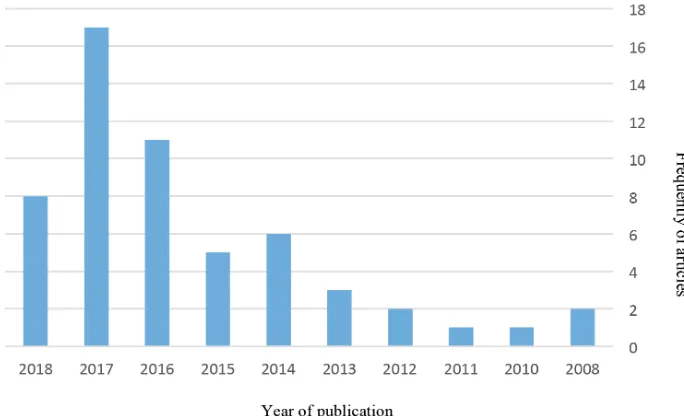
Fig. 3.
Distribution of researches based on year of publication.
3
Discussion
4
Conclusion & Recommendation
This review paper aimed to review previous studies that applied order management
and inventory control during 2008 until 2018 in 32 international scholarly journals
which are indexed in Science direct and Scopus databases. In addition, this review
paper classifies published articles into 8 main areas: the author number, The first
author name, publication year, problems, factors, type of manufacturing industries,
research methods and results and findings. As a result of probing 56 articles, 6 articles
have implemented ABC approaches, nevertheless, the need for further research is felt
in setting of inventory and order of the means of production that not considered
syn-chronously. Moreover, a number of factors for instance product innovation, reduced
collection demands and documentary credits are important too that have not surveyed
yet. Based on review findings, research methods for instance the applications of
arti-ficial neural networks, ant colony algorithm and queue theory have not studied also,
we recommended them for future researches. This review paper classified the selected
articles into 8 fields of order management and inventory control, it is suggested that
future researches can review and classify articles in different areas and sub-areas. This
review paper checks out articles that are published in Science direct and Scopus
data-bases, thus, future review researches can peruse other databases. In addition; our
re-view paper only focused on English scholarly journals rather than other languages,
therefore; future review surveys can consider and focus on other languages. Because
of the importance and necessity of researching in order and inventory, it is
recom-mended that in the fields of operational risk, the collection of demands and
documen-tary credits along with ABC approach come to future studies. It is also suggested that
a combination model of these four items will be presented. These fields mentioned
above are critical to answer the needs and orders of all customers as well as the
sur-vival of an organization, which if ignored, the organization will face with a lack of
funds and, in consequence, a bankruptcy and elimination of the competition cycle
completely will come about. Moreover, it is recommended that further researches will
be done in the fields mentioned with different state of multi-product, single-product or
perishable products and green supply chain, also their costs or the closed-loop supply
chain with two forward and backward flows to help managers in costs managing of
their supply and demand and organization's survival.
5
References
[1] Berling, P. (2008). Holding cost determination: An activity-based cost approach. Int. J. of
Production Economics, 112: 829-840
https://doi.org/10.1016/j.ijpe.2005.10.010
[2] Charles, S. L. and Hansen, D. R. (2008). An evaluation of activity-based costing and
func-tional-based costing: A game-theoretic approach. Int. J. of Production Economics, 113:
282-296
https://doi.org/10.1016/j.ijpe.2007.08.008
[3] Askarany, D., Yazdifar, H. and Askary, S. (2010). Supply chain management,
activity-based costing and organizational factors. Int. J. Production Economics, 127: 238-248
[4] Haji, R., Haji, A. and Safari, M. (2011). Queuing Inventory System in a Two-level Supply
Chain with One-for-One Ordering Policy. Journal of Industrial and Systems Engineering,
5: 52-62
[5] Feng-gea, Y. and Ping, Z. (2012). The Measurement of Operational Risk Based on CVaR:
A Decision Engineering Technique. Systems Engineering Procedia, 4: 438-447
https://doi.org/10.1016/j.sepro.2012.01.008
[6] Schulze, M., Seuring, S. and Ewering, C. (2012). Applying activity-based costing in a
sup-ply chain environment. Int. J. Production Economics, 135: 716-725
https://doi.org/10.1016/j.ijpe.2011.10.005
[7] Hora, M. and Klassen, R. D. (2013). Learning from others’ misfortune: Factors influencing
knowledge acquisition to reduce operational risk. Journal of Operations Management, 31:
52-61
https://doi.org/10.1016/j.jom.2012.06.004
[8] Alinezhad Sarokolaei, M., Saviz, M., Fathi Moradloo, M. and Soleimani Dahajd, N.
(2013). Time Driven Activity based Costing by Using Fuzzy Logics. Social and
Behavior-al Sciences, 75: 338-345
https://doi.org/10.1016/j.sbspro.2013.04.038
[9] Wei, Y., Hu, Q. and Xu, C. (2013). Ordering, pricing and allocation in a service supply
chain. Int. J. Production Economics, 144: 590-598
https://doi.org/10.1016/j.ijpe.2013
.04.022
[10] Tat, R., Ismaili, M. and Taleizadeh, A. (2014). Developing EOQ model with instantaneous
deteriorating items for a vendor-managed inventory (VMI) system. Journal of Industrial
and Systems Engineering, 7: 21-42
[11] Baradaran Kazemzadeh, R., Kaheh, Z. and Masehian, E. (2014). A Mixed Integer
Nonlin-ear Programming Model for Order Replenishment and a Heuristic Algorithm for its
Solu-tion. Journal of Industrial Engineering Research in Production Systems, 2: 63-75
[12] Nooraie, S. and Mellat Parast, M. (2014). A Multi-Objective Approach to Supply Chain
Risk Management: Integrating Visibility with Supply and Demand Risk. Int. J. of
Produc-tion Economics: Manufacturing Systems, Strategy & Design, 161: 192-200
https://doi.org/10.1016/j.ijpe.2014.12.024
[13] Xiao, T., Shi, J. and Chen, G. (2014). Price and lead time competition, and coordination
for make-to-order supply chains. Computers & Industrial Engineering, 68: 23-34
https://doi.org/10.1016/j.cie.2013.11.015
[14] Molamohamadi, Z., Arshizadeh, R., Ismail, N. and Azizi, A. (2014). An Economic Order
Quantity Model with Completely Backordering and No Decreasing Demand under
Two-Level Trade Credit. Advances in decision sciences, SCOPUS, 2014: 1-11
https://doi.org/10.1155/2014/340135
[15] Bieda, B. (2014). Application of stochastic approach based on Monte Carlo (MC)
simula-tion for life cycle inventory (LCI) to the steel process chain: Case study. Science of The
Total Environment, 481: 649-655
https://doi.org/10.1016/j.scitotenv.2013.10.123
[16] Mohammad dust, F., Reza pour, S., Zanjirani Farahani, R., Mofidfar, M. and Hill, A.
(2015). Developing lean and responsive supply chains: A robust model for alternative risk
mitigation strategies in supply chain designs. Int. J. of Production Economics:
Manufactur-ing Systems, Strategy & Design, 183: 21-59
[17] Guertler, B. and Spinler, S. (2015). When does Operational Risk Cause Supply Chain
En-terprises to Tip? A Simulation of Intra-Organizational Dynamics. Journal of Omega, 57:
54-69
https://doi.org/10.1016/j.omega.2015.03.005
[19] Zhang, L., Lee, C. and Zhang, S. (2015). An Integrated Model for Strategic Supply Chain
Design: Formulation and ABC-based Solution Approach. Expert Systems with
Applica-tions, 52: 12-36
[20] Jiang, Y., Chen, M. and Zhou, D. (2015). Joint optimization of preventive maintenance
and inventory policies for multi-unit systems subject to deteriorating spare part inventory.
Journal of Manufacturing Systems, 35: 191-205
https://doi.org/10.1016/j.jmsy.2015.
01.002
[21] Dhegihan, E., Behfar, N. and Jabalameli, M. (2016). Optimizing location, routing and
in-ventory decisions in an integrated supply chain network under uncertainty. Journal of
In-dustrial and Systems Engineering, 9: 93-111
[22] Zhang, S., Lee, C., Wu, K. and Choy, K. (2016). Multi-objective optimization for
sustain-able supply chain network design considering multiple distribution channels. Expert
Sys-tems with Applications, 65: 87-99
https://doi.org/10.1016/j.eswa.2016.08.037
[23] Nawrocki, T. L. and Jonek-Kowalska, I. (2016). Assessing operational risk in coal mining
enterprises – Internal, industrial and international perspectives. Journal of Resources
Poli-cy, 48: 50-67
https://doi.org/10.1016/j.resourpol.2016.02.008
[24] Yousefi Babadia, A., Tavakkoli Moghaddam, R., Bozorgi Amiria, A. and Saiph, S. (2016).
Designing a Reliable Multi-Objective Queuing Model of a Petrochemical Supply Chain
Network under Uncertainty: A Case Study. Journal of computers and Chemical
Engineer-ing, 100: 1-61
[25] Zhang, Q., Zhang, D., Tsao, Y. and Luo, J. (2016). Optimal ordering policy in a two-stage
supply chain with advance payment for stable supply capacity. Int. J. Production