Modeling drying of seed maize using super absorbent hydrogel
under hermetic conditions
Kiburi F.G.
1*, Kanali C.L.
1, and Mbuge D.O.
2(1. Biomechanical and Environmental Engineering Department, College of Engineering and Technology, Jomo Kenyatta University of Agriculture and Technology, P.O. Box 62000-00200, Nairobi, Kenya;
2. Department of Environmental and Bio-systems Engineering, University of Nairobi, P.O. Box 30197-00100 Nairobi, Kenya)
Abstract: The objective of this study was to establish the feasibility of applying the Page, Two term exponential, Newton, Logarithmic and Henderson and Pabis mathematical drying models for predicting the drying kinetics of seed maize using super absorbent hydrogel under hermetic conditions. To achieve this, the study was conducted using hydrogel to seed maize ratios by weight of 0:1, 1:5, 1:10 and 1:15 at four different drying temperature levels of 25oC, 30oC, 35oC and 40oC at different initial seed maize moisture contents of 16%, 28% and 53% (dry basis). The moisture data obtained were fitted into the five drying models using non-linear regression analysis (MS Excel 2003TM) based on the minimization of sum of squares by adjusting the model constants. The coefficient of determination (R2), root mean square error (RMSE) and chi-square (X2) were criteria for selecting the best model. High values of coefficient of determination (R2 > 0.95) were obtained for all th e five drying models while the corresponding values of X2 and RMSE were in the range of (0.0016-0.0141) and (0.0400-0.3045) respectively. As a result Logarithmic model was the best fitted model with R2 (0.9749-0.9876) and the weakest values of X2 (0.0016-0.0036) and RMSE (0.04-0.128).
Keywords: drying model, seed maize, hydrogel, Logarithmic model
Citation: Kiburi, F.G., C. L. Kanali, and D. O. Mbuge. 2015. Modeling drying of seed maize using super absorbent hydrogel under hermetic conditions. Agric Eng Int: CIGR Journal, 17(4):257-264.
1 Introduction
1Maize (Zea mays L.) is one of the most important
cereal crops in the world. It is a staple food to most
developing countries (Wambugu et al., 2009). Primary
processing of maize involves harvesting, threshing or
shelling, drying, treatment and storage. All these
processes are dependent on the moisture content of maize.
Maize with high moisture content is susceptible to
deterioration due to microbial activities, insect damage
and germination (Uluko et al., 2006; Chakraverty et al.,
2003). For safe storage at temperature up to 27oC, it is
critical to reduce the moisture content of maize to 13.5%
(db) (Hayma, 2003).
Received date: 2015-04-30 Accepted date: 2015-09-10 *Corresponding author: Kiburi F.G., Biomechanical and Environmental Engineering Department, College of Engineering and Technology, Jomo Kenyatta University of Agriculture and Technology, P.O. Box 62000-00200, Nairobi, Kenya. Phone: +254720382991. Email: [email protected]
Various drying methods are available for maize such
as thin layer drying, batch drying, sun drying and in-store
drying. These drying methods are energy-intensive;
thus, the efficiency of a drying operation in terms of
energy and time has direct economic consequences for
commercial viability (Chakraverty et al., 2003). More
also each drying methods has its merits and demerits.
Very common is the sun drying that is freely available
and can be harnessed at relatively low cost. On the
other hand, sun drying is labor intensive and exposes the
seeds to contamination from dust, foreign materials,
insect infestation, rodents and bird droppings (Jewell et
al.,1995; Golobet al., 2002).
In forced air drying, the drying rate of the maize is
determined by the inlet air conditions. Thus inlet air at
low relative humidity and high temperature has a higher
moisture removal rate and vice versa. After bulk drying,
maize is stored in structures such as metal silos. These
the stored maize experiences moisture migration when
hot and cold. This results into condensation of the moisture in the structure leading to formation of ‘hot spots’ which are the initial stages in maize deterioration.
To reduce these problems moisture in the rising air
should be arrested before condensing. Drying systems
using dehumidifier equipped with desiccants have been
studied before. More also the relationship between air
humidity, temperature and air velocity in a cold store
have been studied in reference to temperature and
moisture content of product as a function of time
(Catalano et al., 2008).
Desiccant drying is always termed as low-cost
technology. Various desiccant materials have been
studied in the past by various scholars as highlighted by
Kiburi et al., 2014. Hdrogels or superabsorbent
polymers (SAPs) are polymers that can absorb and retain
extremely large amounts of a liquid relative to their own
mass (Horie et al., 2004). Based on hydrogel properties,
they have potentials to be incorporated as a desiccant in
maize drying systems to reduce the relative humidity of
the inlet air. More also they can be used in maize
storage structures such as silo and export containers to
keep the relative humidity low and reduce chances of
deterioration. In previous works by Kiburi et al., 2014,
it was found that hydrogels can be used as potential
desiccants. However, use of hydrogels in grain drying
has not been fully exploited and documented. The
information obtained from this study is useful for further
studies.
Mathematical drying models are used to estimate
drying periods in agricultural materials. They are used
to generalize the drying curves (Doungporn et al.,2012).
Thus modeling allows engineers to choose the most
suitable and appropriate drying conditions.
Experimenting with the actual system is usually costly
and disruptive. Some of the frequently used
mathematical models include Page, Two term exponential,
Newton, Logarithmic and Henderson and Pabis drying
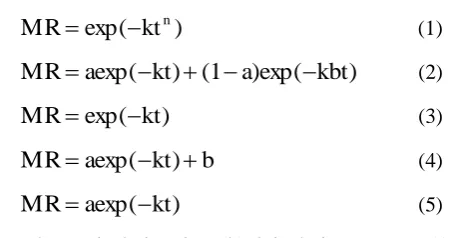
models (Corrêaet al., 2009). These models are given by
Equations (1)-(5) respectively.
)
kt
exp(
MR
n(1)
kbt)
a)exp(
(1
kt)
aexp(
MR
(2)kt)
exp(
MR
(3)b
kt)
aexp(
MR
(4)kt)
aexp(
MR
(5)Where, t is drying time (h); k is drying constant (1/h);
a, b, c, g, η are model’s parameters, dimensionless.
Moisture ratio term for the models is computed using
Equation (6) (Erenturket al., 2004).
e o e i
M
M
M
M
M R
(6)Where, Mi is the moisture content (% dry basis) at
drying time t (hours), Me is the equilibrium moisture
content (% dry basis), and Mo (initial moisture content, %
dry basis) at t= 0.
The objective of this study was to develop a drying
equation for predicting the drying of seed maize using
hydrogels under hermetic conditions. The study was
conducted by varying drying temperature and percentage
initial moisture content of the seed maize.
2 Materials and methods
2.1 Experimental set up
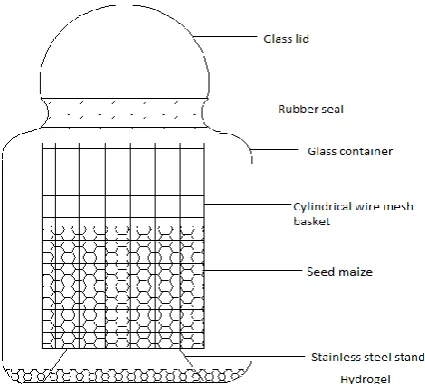
Figure 1 shows the schematic of the hermetic drying
and storage system that was used in this study. The
system consisted of an air tight glass container with lid,
wire mesh basket and a stand. The air tight glass
container cylindrical in nature fitted with a lid will form
the hermetic system and was purchased from glass ware
supplier. This air tight glass container had capacity of
750 ml with a height of 110 mm to the neck and a base
diameter of 90 mm. The container and lid were made of
glass that had uniform thickness of 3 mm. The container
lid had an outside diameter of 67 mm. To ensure that the
system was air tight a rubber seal was fitted between the
container neck and the lid. The rubber seal had a
system there was a cylindrical stainless steel wire mesh
basket that was used to hold the grains. The wire basket
was placed on a stainless steel stand so that the sample was
not in direct contact with the hydrogel. The cylindrical
wire mesh basket was fabricated from a 4 by 4 mm hole
opening wire mesh and had a height of 90 mm and
diameter of 65 mm. The baskets helped in containment
of the seed for ease of weighing. The stands were
fabricated from rods with height of 15 mm and 60 mm
base ring diameter. Both the wire basket and base stand
were fabricated at the Biomechanical and Environmental
Engineering department workshop, Jomo Kenyatta
University of Agriculture and Technology.
Figure 1 Schematic diagram of the hermetic drying and
storage system that was used in this study
2.2 Sample preparation
The materials used for this study included unprocessed
seed maize and super absorbent hydrogel. The seed
maize (KH 600- 15A) was obtained from East African
Seed Company limited, Nairobi while the super absorbent
hydrogel, which is Poly-acrylic acid, sodium salt and
lightly cross-linked, was purchased from Sigma Aldrich®.
The hydrogel was dried in an oven at 40o C to remove
moisture before using it in drying the seed maize.
Since the seed maize samples had moisture content less
than the experimental requirements of 16, 28 and 53% (dry
basis), the seeds were conditioned in batches of 16, 28 and
53% moisture contents (dry basis). Seed conditioning
was done by soaking them in distilled water at 4oC for a
range of 6 to 24 hours. Soaking ensured uniform water
access to seed maize for uniform moisture distribution
(Chemperek and Rydzak, 2006) while keeping the soaked
sample at 4o C (Doungporn et al.,2012; Tabatabeeet al.,
2004) in a refrigerator helped in preventing mould growth.
A colander was used to drain water from seed maize.
Excess water on the surface of the seed maize was further
removed using paper towels (Maskan, 2002). Once the
water was completely drained from seed maize surface the
seeds were left at room temperature overnight. This
allowed the seeds to reach room temperature resulting in
reduction of thermal stress during drying.
2.3 Data collection procedure
The modeling of drying characteristics of seed maize
using super absorbent hydrogel under hermetic conditions
required determination of seed maize equilibrium
moisture content. Three treatments consisting of 1:5,
1:10 and 1:15 hydrogel to seed maize ratio by weight
under different temperatures of 25oC, 30oC, 35oC and
40oC, and moisture content of 16, 28 and 53% (dry basis)
were used to evaluate the performance of the super
absorbent hydrogel in drying seed maize. A control that
did not utilize hydrogel was used. The highest constant
temperature used in the tests was 40oC as seeds should
not be dried under temperature exceeding this value
(Hayma, 2003). The moisture contents were selected
such that they represented the minimum, intermediate and
the maximum possible moisture contents during seed
harvesting. For the 40oC a total of thirty six samples of
120 g seed maize (12 samples for each of the three
moisture contents namely 16, 28 and 53% dry basis) were
weighed in wire baskets of known weight using analytical
mass balance (Mettler Toledo PB8001) with
measurement precision of ±0.01 g. Based on 120 g of
seed maize nine samples of 24, 12 and 8 g of hydrogel
were weighed to attain 1:5, 1:10 and 1:15 hydrogel to
The samples were left to equilibrate in environments
of different relative humidity created by the different
hydrogel ratios at temperature of 25oC, 30oC, 35oCand
40oC. Moisture content of seed maize was monitored
and recorded at three hour intervals for the first day from
8:00 a.m to 5:00 p.m. The three hour interval helped in
monitoring the moisture removal rate as most drying of
biological products occurs during the falling-rate period
(Srikiatden et al., 2007). Thereafter, moisture data was
recorded at 12 hour intervals until no further change in
moisture content was be observed. The interval was
increased to 12 hours because the drying rate in the
second falling rate period is extremely slow (Srikiatden et
al., 2007). At any sampling time during drying the
weight of the seed maize was determined and recorded as
W2.
Control involved drying seed maize under similar
hermetic conditions without using the super absorbent
hydrogel which is equivalent to a ratio of 0:1 hydrogel to
seed maize ratio by weight. This control ran in tandem
with other treatment. The same procedure was repeated
for other drying temperatures (i.e., 25oC, 30oC and 35oC).
2.4 Data process and analysis
The moisture content of the seed maize Mt at time t
was calculated using initial weight of the seed maize W1
and initial moisture content dry basis, Mo,Equation (7)
(FAO, 2011).
)
W
M
100
(
W
100
M
2 o 1
t
(7)
In order to demonstrate that existing drying models
described in Section 1.0 can be used to predict the drying
of seed maize using hydrogel under hermetic conditions,
several assumptions were made. It was assumed that
during drying the heat of hydration was negligible and
that drying was based on static desiccant drying system.
It was further assumed that drying took place in three
stages which included moisture movement from seed
maize into the air and surrounding the seeds, moisture
adsorption by the hydrogel from the air and a change in
relative humidity of the air due to the resultant moisture
content of the seed maize and hydrogel.
The moisture ratio values obtained using Equation (6)
were fitted to the five chosen models using non-linear
regression analysis (MS Excel 2003TM) based on the
minimization of sum of squares by adjusting the model
constants. The analysis were performed in order to
select the best model to describe the drying curve of seed
maize drying under hermetic conditions using hydrogel.
The coefficient of determination (R2), the root mean
square error (RMSE) and the chi-square (X2) were used
to evaluate the goodness of fit of the established drying
models to the measured data (Doungporn et al., 2012;
Ronoh et al., 2009; Tabatabee et al., 2004). The best
model was selected based on the highest values of the R2,
the lowest values of X2 and RMSE (Doymaz et al.,2006;
Demir et al.,2007; Doungporn et al., 2012).
3 Results and discussion
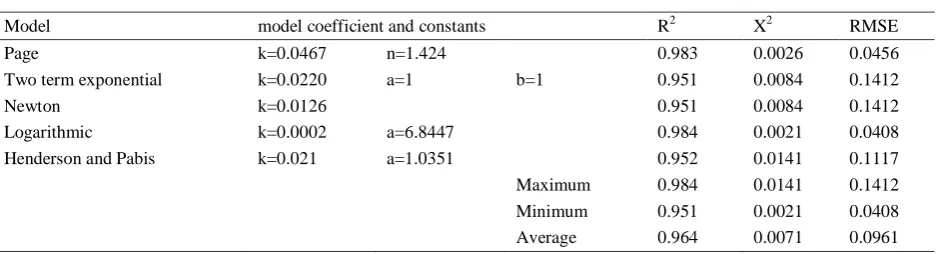
Tables 1-4 present the established drying parameters
and the performance of the models at different drying
temperatures. It is noticeable from the results that high
values of coefficient of determination (R2 > 0.95) were
obtained for all the five drying models. The
corresponding values of X2 and RMSE were in the range
of (0.0016-0.0141) and (0.0400-0.3045) respectively.
However, the Logarithmic model had the highest values
for R2 and the weakest values of X2 and RMSE. The
high values of R2 indicates how well the model fits the
data (Doungporn et al.,2012; Ronoh et al.,2009; Saeed et
al., 2008; Tabatabee et al., 2004). On the other hand,
least values of RMSE signified less noise in the data whiles least values of χ2
showed there was less deviations
between the experimental and calculated moisture levels
(Doungporn et al.,2012; Ronoh et al.,2009; Tabatabeeet
al.,2004).
The comparison of the five models shows that
Logarithmic model produced the highest values for R2
(0.975-0.988) and the lowest values of X2 (0.0016-0.0036)
lowest value of RMSE at 40oC of 0.0534 as compared to
0.128 of Logarithmic model. However, comparing the
values of coefficient of determination (R2), Chi-square
(X2) and root mean square error (RMSE), the
Logarithmic model satisfactorily predicted drying of seed
maize using hydrogel under hermetic conditions. The
results were in agreement with previous studies
conducted by Sungcome et al. (2013) that showed
Logarithmic model best described drying of tomato F1
hybrid seed by desiccant material with R2 of (0.93-0.99).
Table 1 Established drying parameters and performance of different models at 25oC
Model model coefficient and constants R2 X2 RMSE
Page k=0.0467 n=1.424 0.983 0.0026 0.0456
Two term exponential k=0.0220 a=1 b=1 0.951 0.0084 0.1412
Newton k=0.0126 0.951 0.0084 0.1412
Logarithmic k=0.0002 a=6.8447 0.984 0.0021 0.0408
Henderson and Pabis k=0.021 a=1.0351 0.952 0.0141 0.1117
Maximum 0.984 0.0141 0.1412 Minimum 0.951 0.0021 0.0408 Average 0.964 0.0071 0.0961
Table 2 Established drying parameters and performance of different models at 30oC
Model model co-efficient and constants R2 X2 RMSE
Page k=0.0168 n=1.0487 0.976 0.0033 0.0506
Two term exponential k=0.0145 a=1 b=1 0.968 0.0055 0.0613
Newton k=0.0142 0.968 0.0055 0.3046
Logarithmic k=0.0108 a=2.2182 b=-4.2644 0.988 0.0016 0.0335
Henderson and Pabis k=0.0135 a=1.0244 0.969 0.0045 0.1127
Maximum 0.988 0.0055 0.3046 Minimum 0.968 0.0016 0.0335 Average 0.974 0.0041 0.1125
Table 3 Established drying parameters and performance of different models at 35oC
Model model co-efficient and constants R2 X2 RMSE
Page k=0.0057 n=1.3336 0.976 0.0043 0.0591
Two term exponential k=0.012 a=1 b=1 0.965 0.0054 0.0632
Newton k=0.0138 0.965 0.0150 0.0641
Logarithmic k=0.0068 a=1.8254 b=-0.8386 0.985 0.0019 0.0400
Henderson and Pabis k=0.0142 a=1.0233 0.964 0.0051 0.0652
Maximum 0.985 0.0150 0.0652 Minimum 0.964 0.0019 0.0400 Average 0.971 0.0063 0.0583
Table 4 Established drying parameters and performance of different models at 40oC
Model model co-efficient and constants R2 X2 RMSE
Page k=0.0038 n=1.6024 0.975 0.0040 0.0534
Two term exponential k=0.0173 a=1 b=1 0.943 0.0105 0.0783
Newton k=0.0143 0.942 0.0101 0.0828
Logarithmic k=0.0157 a=5.5013 b=-4.1376 0.975 0.0036 0.1280
Henderson and Pabis k=0.0150 a=1.0516 0.946 0.0092 0.1212
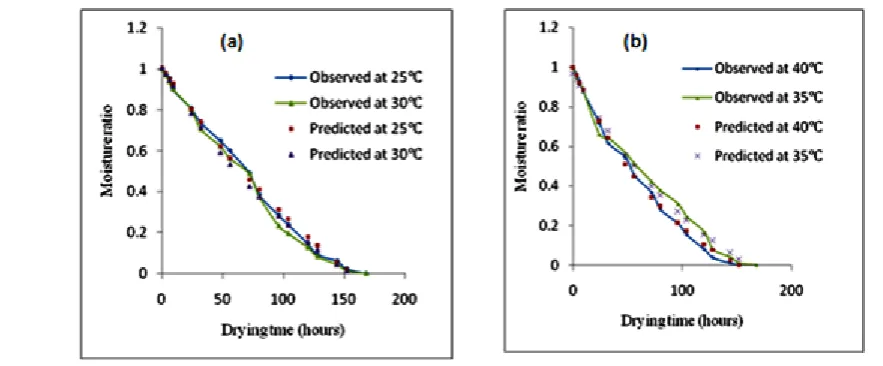
The results comparing measured and predicted
moisture ratios using the Logarithmic model are shown in
Figure 1. The low values of χ2 and RMSE exhibited by
Logarithmic model together with results in Figure 1 show
that there was indistinct difference between the observed
and predicted moisture ratio by the model. This
observation further confirms that Logarithmic model is
suitable for modeling seed maize drying using
superabsorbent hydrogel under hermetic conditions.
4 Conclusions and recommendations
All the five models considered had high values of
coefficient of determination (R2 > 0.95) with corresponding values of χ2
and RMSE in the range of
(0.0016 - 0.0141) and (0.0400 - 0.3045), respectively.
Logarithmic model was found to be the best fitted model
to predict seed maize drying using hydrogel under
hermetic conditions with R2 (0.9749 - 0.9876) and the
weakest values of χ2 (0.0016 - 0.0036) and RMSE (0.04 -
0.128).
The results of this study can be used as basis of
further studies on use of hydrogel in storage structures
such as silos to reduce condensations and in export
containers during shipping to keep the maize dry and
reduce deteriorations. It is also important to carry out
further test on use of hydrogel as a dehumidifier in a
forced air drying system.
Acknowledgement
The authors wish to acknowledge funding from
National Council of Science and Technology and Jomo
Kenyatta University of Agriculture and Technology.
The authors further extend their sincere gratitude to East
African Seed Company for the supply of seed maize used
in this study
References
Catalano, P., F. Fucci, F. Giametta, and G. La Fianza. 2008. A system for food drying using humidity control and low temperature. Agricultural Engineering International: the CIGR Ejournal. Manuscript Manuscript FP 07 012. Vol. X.
Chakraverty, A., A. S. Mujumdar, G. S. V. Raghavan, and H. S. Ramasawamy. 2003. Handbook of Postharvest Technology. Marcel Dekker Inc. New York, USA, ISBN: 0-8247-0514-9
Chemperek, P., and L. Rydzak. 2006. Vacuum wetting of soybean seeds and maize grains at different temperature and time conditions. Teka Kom. Energy Rollin, 6(A), 24-31.
Corrêa, P. C., F. M. Botelho, G. H. H. Oliveira, A. L. D. Goneli, O. Resende, and S. C. Campos. 2009. Mathematical modeling of the drying process of corn ears. DO1: 10.4025/actasciagron.v33i4.7079.
Demir, V., T. Gunhan, and A. K. Yagcioglu. 2007. Mathematical modelling of convection drying of green table olives. Biosystem Engineering, 98(1): 47–53. Doungporn, S., N. Poomsa-ad, and L.Wiset. 2012. Drying
equations of Thai Hom Mali paddy by using hot air,
carbon dioxide and nitrogen gases as drying media.
Food Bioproduction Process, 90(2): 187–198.
Doymaz, ˙I., N. Tu˘ grul, and M. Pala. 2006. Drying characteristics of dill and parsley leaves. Journal of Food Engineering, 77(3): 559–565.
Erenturk, S., M. S. Gulaboglu, and, S. Gultekin. 2004. The thin-layer drying characteristics of rosehip. Biosystem Engineering, 89(2): 159–166.
Golob, P., G. Farrel, and J. Orchard. 2002. Crop post-harvest: science and technology. Vol 1, Principles and practice. Blackwell science limited. ISBN 0-632-05723-8. Hayma, J. 2003. The storage of tropical agricultural products.
4th edition, Agromisa Foundation, Wageningen, ISBN 90-77073-60-4.
Horie, K., M. Báron, R. B. Fox, J. He, M. Hess, J. Kahovec, T. Kitayama, P. Kubisa, E. Maréchal, W. Mormann, R. F. T. Stepto, D. Tabak, J. Vohlídal, E. S. Wilks, and W. J. Work. 2004. Definitions of terms relating to reactions of polymers and to functional polymeric materials (IUPAC Recommendations 2003). Pure and Applied Chemistry, 76(4): 889–906.
Jewell, D. C., S. R. Waddington, J. K. Ransom, and K.V. Pixley. (eds). 1995. Maize research for stress environments. Proceedings of the fourth Eastern and Southern Africa regional maize conference, held at Harare, Zimbambwe, 28 March- 1 April 1994. Mexico D.F. ISBN 968-6923-51-9.
Kiburi, F. G., C. L. Kanali, and D. O. Mbuge. 2014. Evaluating the performance of super absorbent hydrogel in drying of seed maize under hermetic conditions. Proceedings of 2014 International Conference on Sustainable Research and Innovation, Volume 5, 7th-9th May 2014
Maskan, M. 2002. Effect of processing on hydration kinetics of three wheat products of the same variety. Journal of Food Engineering, 52(4), 337–341.
Ronoh, E. K., C. L. Kanali, J. T. Mailutha, and D. Shitanda. 2009. Modeling thin layer drying of amaranth seeds under open sun and natural convection solar tent dryer. Agricultural Engineering International: the CIGR Ejournal. Manuscript 1420. 11.
Srikiatden, J., and J. S. Roberts. 2007. Moisture transfer in solid food materials: a review of mechanisms, models, and measurements. International Journal of Food Properties, 10(4): 739–777.
Sungcome, K., S. Photchanachai, and S. Prachayawarakorn. 2013. Drying behavior and quality of tomato f1 hybrid seed by desiccant materials. Acta Hort. (ISHS), 989: 383-388. Tabatabee, R., D. S. Jayas, and N. D. G. White. 2004.
Thin-layer drying and rewetting characteristics of
buckwheat. Canadian Biosystems Engineering/Le génie des biosystèmes au Canada, 46(3): 19-3.24.
Uluko, H., C. L. Kanali, J. T. Mailutha, and D. Shitanda. 2006. A finite element model for the analysis of temperature and moisture distribution in a solar grain dryer. The Kenya Journal of Mechanical Engineering, Fimen Publishers, Nairobi, Kenya 2(1), 47–56.
Wambugu, P. W., Mathenge P. W., E. O. Auma, and Rheenen H. A. 2009. Efficacy of traditional maize (Zea mays L.) seed storage methods in western Kenya. Aljfand online Journal. Vol 9 No. 4.
Alvarez-Martinez, L., K.P. Kondury and J.M. Harper. 1988. A general model for expansion of extruded products.
Journal of Food Science, 53(8): 609-615.
Anderson, R.A., H.F. Conway, V.F. Pfeifer and E.L. Griffin, Jr. 1969. Gelatinization of
corn grits by roll and extrusion cooking. Cereal Science Today,
14(1): 4-12.
AOAC. 1995. Official Methods of Analysis. In Association of Official Analytical Chemists, 15th Ed. Washington, D.C.
Association of American Grain Growers (AAGG). 2010. Sorghum Handbook. In Association of American Grain Growers Annual Report, 4th Ed. Iowa, USA.
Chakraborty, S.K., D.S. Singh, B.K. Kumbhar and S. Chakraborty. 2011. Millet-legume blended extrudates characteristics and process optimization using RSM. Food and Bioproducts Processing, 89(4): 492-499.
Hseih, F., H.E. Huff and I.C. Peng. 1990. Studies of whole cottonseed processing with a twin screw extruder.
Journal of Food Engineering, 12(4): 293-306.
Hwang, M.P and K.I. Hayakawa. 1980. Bulk density of cookies undergoing commercial baking processes. Journal of Food Science, 45(6): 1400-1410.
Mahasukhonthachat, K., P.A. Sopade and M.J. Gidley. 2010. Kinetics of starch digestion and functional properties of twin-screw extruded sorghum. Journal of Cereal Science, 51(3):392-401.
Matlab Computer Software (2012). 10th Version
Mkandawire, N.L., S.A. Weier, C.L. Weller, D.S. Jackson and D.J. Rose. 2015. Composition, in vitro digestibility and sensory evaluation of extruded whole grain sorghum breakfast cereals. Food Science and Technology, 62(1): 662-667.
Myat, L. and G.H. Ryu. 2014. Characteristics of destarched corn fiber extrudates for ethanol production. Journal of Cereal Science, 60(2): 289-296.
Myer, R.H. 1971. Response Surface Methodology. Allyn and Bacon, Boston, USA.