●
●
www.ajbssit.net.au
BSSIT
202
Demand Seasonality and Mitigation of Its Impact on Customised Production System:
Exploring Aggregate Planning and Mutual-Outsourcing for a New Zealand Company
Ram Roy
School of Business, Eastern Institute of Technology, New Zealand
Abstract
The seasonality of demand of XYZ Company places a significant strain on its human resources
and production capability. It results in overcapacity during the 1st half, while it limits its capacity during the 2nd half of the year. This paper explores how XYZ can smooth its existing seasonal demand or the sales pattern. This paper has examined various aggregate planning techniques, but
some of them have been discarded by the company based on various local factors. From
discussions with the company’s Operations Manager and General Manager, a potential solution
is identified for further investigation including undertaking work outsourced from other
manufacturers to fill XYZ’s unutilised capacity during low demand season. Research is conducted into the aspects of outsourcing to identify the drivers behind the other companies’
outsourcing activities and how XYZ could go about securing those outsourced jobs to maintain a
stable workforce within its operations. The paper recommends that XYZ should pursue
mutual-outsourcing to mitigate the impact of its seasonal demand pattern. Further, a marketing brochure
and a common website should be developed and promoted to bodies such as Chamber of
Commerce, Manufacturers’ Associations, and other businesses to help identify the type of jobs
XYZ business is capable of doing. In support of the brochure, a statement of evidence of
previous jobs should be included to encourage negotiations between the prospective
collaborative companies for mutual-outsourcing.
Keywords: Aggregate Planning; Mutual-Outsourcing; Seasonality; Customised Product
1. Introduction
XYZ is founded as a small joinery factory in the beginning and is now considered an
203
solutions are sold all over the world and the company has partnered with global brands like
McDonald’s, BP and Coca Cola as well as domestic companies like New World and
Countdown. The company has complete design and manufacturing capacity and specialises in
customised retail food display solutions. It positions itself as an innovative, customer focused
organisation producing the highest quality product by utilising state of the art engineering and
information technology. The innovative culture of the company is based on the strong values of
its founder including a passion and drive for excellence, loyalty and long-term relationships with
key partners.
1.1 The Problems and Issues
Approximately 120 people are employed by the company, which is managed by a
Board comprising both internal and external directors. In addition to the CEO, the day to day
operations are overseen by the General Manager. XYZ faces a strong seasonal demand pattern
resulting in high sales from the second half of the year (July to Dec), representing approximately
65% of the company’s annual sales. However, the first six month (Jan-June) is a lean period in
which production and human capacity is underutilised due to low sales of the products. A major
attempt to smooth out the seasonal sales pattern by increasing sales into Europe and the UK met
with limited success as a similar sales pattern is experienced by them. A smoothing technique
has already been applied which involves production employees in the low season to work 4 days
and get paid for 5 days, while in the high season they work for 6 days and are paid for 5 days.
Despite this technique, the number of production employees is still required to increase from 80
to 100 from the low to the high season. The problem with the recruitment of these additional
employees is compounded by the lack of available skilled staff, a 3 month training period, and
the seasonal employment which is not attractive to the potential employees.
It is obvious that the company can operate at full capacity in the high season as this is
where the majority of the company’s profitability is generated, while maintaining the ability to minimise the wage bill in the low season, where trading performance is close to break-even only.
As a result of the difficulty in recruiting skilled workforce, an ideal solution for the company is
to maintain a stable workforce throughout the year. In the light of this situation, the company is
interested in exploring other alternatives and recommendations.
204
manufacture of customised products for the global corporate customers, where XYZ is able to
differentiate itself from its competitors who primarily manufacture mass standardised products.
According to Vonderembse and White (2004), for a company to remain in business, it needs to
be able to compete in the marketplace and win orders from their customers based on
order-winning criteria such as: ability to meet customers specifications, price, quality, delivery speed,
delivery reliability, and flexibility (range of products provided).
1.2 Objectives and Approach of the Research
The objective of this paper is to analyse and mitigate the long-term capacity related
problems for the company with seasonal sales pattern by providing a range of potential
alternative solutions. The paper will investigate into various aggregate planning techniques and
will recommend a potential planning strategy to minimise the costs, while still enabling the
company to retain or have access to a constant pool of skilled workforce throughout the year
irrespective of seasonality in demand.
2. Literature Review
Aggregate planning is the process of determining the company’s production, inventory,
and personnel levels for 3 to 12 months ahead. It typically focuses on manipulating several
aspects of operations viz. aggregate production, inventory, and personnel levels to minimise the
costs over the planning horizon (Martinich, 1997). Organisations that have substantial
investment in capital equipment require high percentage of capacity utilization to be successful
in the global market, which means that effective aggregate planning combined with other factors
including tight scheduling, efficient employees, and appropriate facility scheduling are critical
(Heizer & Render, 2011).
Vonderembse and White (2004) have found that planning is a manager’s most
important job and more specifically planning in relation to the development of a competitive
strategy.
According to Stevenson (2012), a competitive strategy related to effective capacity
planning must achieve a match between the organisations long-term supply capabilities and its
expected level of long-term demand.
205
able to maximise utilisation, and the second is to match production output with market demand.
Additionally, Buxey (2005) observes that most businesses follow chase strategy as they
subscribe to ‘just-in-time’ approach. Managers do not look for a perfect solution, rather strive to
eliminate or reduce the most significant marginal costs.
Stevenson (2012) has found forecasts to be the basis for many decisions and essential
tool for matching supply and demand. An operations strategy must be formulated to support the
overall business strategic plan and should focus on the specific capability of the operation to
maintain its competitive edge or competitive priorities which Reid and Sanders (2003) list as
cost, quality, time and flexibility. Capacity planning requires knowledge of the organisation’s
current capacity of various processes and the level of utilisation often expressed by equation (1)
as a percentage (Krajewski & Ritzman, 2005):
% 𝑢𝑡𝑖𝑙𝑖𝑠𝑎𝑡𝑖𝑜𝑛 =𝑎𝑣𝑒𝑟𝑎𝑔𝑒 𝑜𝑢𝑡𝑝𝑢𝑡 𝑟𝑎𝑡𝑒
𝑚𝑎𝑥𝑖𝑚𝑢𝑚 𝑐𝑎𝑝𝑎𝑐𝑖𝑡𝑦 𝑥100 (1)
3. Potential Planning Alternatives
There are various planning options for organisations to choose from in order to utilise
its plant capacity optimally while at the same time meet the demands of its customers. The two
popular alternatives are: (a) chase demand strategy, and (b) level workforce strategy.
A chase demand strategy is used when an organisation adjusts its production rate to
meet the fluctuating customer demand. It is chosen when a company produces made-to-order
products that are one off or any product which is deemed highly perishable or prone to
obsolescence. Disadvantages with this strategy is that capacity needs are constantly changing,
resulting in either under- or over-capacity. Over-capacity results in operating costs being too
high, while under-capacity often results in lost customers and strained resources (Stevenson,
2012). This strategy may involve costs of hiring and training new employees, costs of firing (for
example: unemployment insurance, severance pay), and productivity losses from low morale and
loyalty of employees.
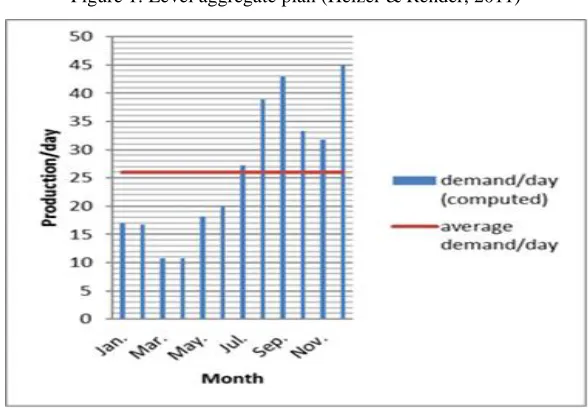
The level workforce strategy (Figure 1) sets production output to meet the average
demand over a set period (Reid & Saunders, 2003). The firm can maintain a steady output that
builds inventory during periods of low demand that can be used during periods of high demand,
206
Table 1: Summary of data
Month Expected Demand Production Days Demand/Day (Computed) Average Demand
Per Day
Jan. 375 22 17 26
Feb. 300 18 17 26
Mar. 225 21 11 26
Apr. 225 21 11 26
May. 400 22 18 26
Jun. 400 20 20 26
Jul. 600 22 27 26
Aug. 700 18 39 26
Sep. 900 21 43 26
Oct. 700 21 33 26
Nov. 700 22 32 26
Dec. 900 20 45 26
Taking into account the pros and cons of above two strategies, many organisations seek
to adjust their aggregate planning by introducing a hybrid aggregate plan that introduces a
number of options such as: scheduling overtime or back-ordering to smooth out the fluctuating
demand (Reid & Saunders, 2003).
207
Vonderembse and White (2004) have stated that an organisation can adopt either a
proactive or a reactive strategy when developing its aggregate plan to meet uncertain demand.
They suggest the following strategies under two categories: (i) Proactive: producing goods that
are seasonally complementary; offering discounts to increase demand during low periods;
increasing advertising and promotions when demand is low. (ii) Reactive: varying the workforce
through firing or hiring; scheduling of overtime or additional shifts, or reducing work hours;
scheduling holidays or complete plant shutdowns; build-up of inventory; subcontract work out at
peak periods; and build-up order backlogs.
Similarly, other researchers (Reid & Saunders, 2002; Schroeder, 1993) maintain that
customers can choose between demand based options which are similar to the proactive strategy
and capacity based options which are similar to the reactive strategy. Depending on the industry,
some options do not represent a viable alternative, for example, companies that produce
perishable or customised type products cannot build up inventory, while companies that require
skilled and trained staff are not able to easily vary their workforce (Reid & Saunders, 2002).
3.1 Various Alternative Strategies and Related Issues
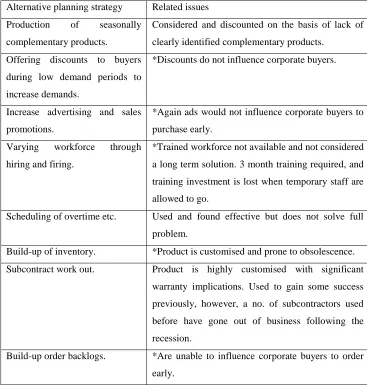
According to the GM of XYZ, the company has explored various reactive and proactive
strategies in an attempt to even out its demand and has implemented workforce scheduling
through the use of 4 day weeks during the lean season and 6 days weeks during peak season (but
paying for 5 days per week only for both the seasons). However, this does not fully solve the
long-term issues. GM states that many unique issues apply to the company that do not make
many of the proactive or reactive strategies feasible for effective aggregate planning. Some of
the issues are: the lack of availability of locally trained workforce, 3 month time needed to train
them, highly customised products manufactured with warranty implications, and majority of
sales coming from a few large corporations which are not influenced by discount sales
promotions. Various alternatives are listed in Table 1, but GM feels that *marked alternatives are
infeasible for various reasons. While the company has used limited subcontracting which does
impact on profitability but it does nothing to fully utilise the company’s manufacturing capacity
in the lean season.
The remaining option is to identify and produce seasonally complementary products
using the same facility and workforce. Seasonally complementary products have counter-cyclic
208
for another product. For example, lawn mowers and snow blowers are two products which can
be made by using the same facility. However, for XYZ Company, the temperature controlled
food display cabinets are not the seasonal products in the traditional sense. It is the ordering
pattern of their corporate buyers which make the demand and production fall in the second half
of the year.
Table 2: Alternative strategies and related issues
Alternative planning strategy Related issues
Production of seasonally
complementary products.
Considered and discounted on the basis of lack of
clearly identified complementary products.
Offering discounts to buyers
during low demand periods to
increase demands.
*Discounts do not influence corporate buyers.
Increase advertising and sales
promotions.
*Again ads would not influence corporate buyers to
purchase early.
Varying workforce through
hiring and firing.
*Trained workforce not available and not considered
a long term solution. 3 month training required, and
training investment is lost when temporary staff are
allowed to go.
Scheduling of overtime etc. Used and found effective but does not solve full
problem.
Build-up of inventory. *Product is customised and prone to obsolescence.
Subcontract work out. Product is highly customised with significant
warranty implications. Used to gain some success
previously, however, a no. of subcontractors used
before have gone out of business following the
recession.
Build-up order backlogs. *Are unable to influence corporate buyers to order
early.
3.2 Exploring More Alternatives
209
to deal with the decline in activities. However, Hubbard and O’Brien (2010) suggest that
organisation must also plan to deal with the growth that will follow the recession. Typically
during recession investments on capital goods (e.g., new factories, additional machinery and
equipment) decline, staff laid off, and production rates fall. Conversely, even during recession,
some businesses will continue to prosper and push ahead in anticipation of the end of the
recession and the lack of activities of their competitors (Hubbard & O’Brien, 2010). Taking a clue from the above research report, a potential solution for XYZ is to maximise the utilisation
of its capacity and to maintain a stable workforce is to undertake subcontracted jobs from other
manufacturers who do not wish to commit to capital investment.
3.3 Outsourcing and Offshoring Strategies
Outsourcing is the use of production facilities of other firms to meet the production
target as opposed to using the existing in-house facilities (Ehie, 2001). Chung’s (2007) defines
outsourcing as ‘purchasing immediate goods or contracting business activities that were previously performed within firms to outside providers’. It is also commonly known as the ‘make or buy decision’ and is typically divided between material and non-material outsourcing.
Chung makes distinction between outsourcing and offshoring. The primary purpose of
off-shoring is to move ‘processes to low cost regions’ while control may or may not be relinquished whereas with outsourcing, control is always handed over to the third party. Rubin (2007) adds
that outsourcing has evolved from both a low cost labour saving measure and generic parts
manufacturing to a strategy of producing high end finished components.
Outsourcing gains: Outsourcing firms are able to provide a range of cost saving
techniques by taking advantage of economies of scale, access to a skilled workforce, smooth out
unpredictable workflow patterns, core competence, and the learning curve, while the client
benefits from high quality and just-in- time delivery (Rubin, 2007). Ehie (2001) looked at how
outsourcing enables a firm convert a range of fixed costs into variable costs, to gain access to the
invention and innovation attributes of suppliers, plus faster new product development by
focusing key resources on the firm’s core competencies. However, there is no gain without some
risks as outlined in the next section.
Outsourcing risks: The main strategic risk in outsourcing is the potential for losing key
210
to Ehie (2001), outsourcing often did not live up to client’s expectations because of two main
reasons: (a) putting emphasis only on cost cutting, and (b) many contracts were viewed as
combative rather than cooperative. Ehie and Vanarase (2007) found that many outsourcing
contracts were undertaken solely to achieve lower costs, and therefore outsourcing failed to
realise or match the clients’ expectations. Barthelemy and Adsit (as cited in Vanarase, 2007)
listed seven mistakes of outsourcing as: outsourcing the wrong process; choosing the wrong
outsourcing partner; writing the wrong type of contract; the actual effect of outsourcing on their
people; lost control of the activity; failure to take into account all costs associated; and failure to
include an exit strategy into the contract.
3.3.1 Selection Criteria for Outsourcing Partners
Chung (2007) revealed that the outsourcing decision should include the effects of both
production cost and transaction cost. He suggested that where production cost is to be lowered
by more than the transaction cost and then outsourcing should be considered. However, cost
should not be the sole basis of selection rather the decision should be determined by partner’s
ability to improve overall competitiveness, through provision of increased manufacturing
flexibility, lowering inventory levels, and ability to respond and adapt to changes in the market
environment (Ehie, 2001). Choy and Lee (2003) suggest the factors to be considered when
selecting an outsourcing partner as: price, quality, and service. However, other factors that
should be included are: having a similar culture, ability to share development and innovation
ideas, trust and communication. Choy and Lee grouped these attributes under three generic
headings: (a) Technical capability: delivery, capability and price; (b) Quality assessment:
commitment, development, quality and assurance; and (c) Organisation profile: culture, financial
status, achievements, etc.
3.4 Mutual Outsourcing Approach
Mutual outsourcing approach is common in the service sector. For example, in 2005,
Norwegian IT Service Provider (EDB) entered into a mutual outsourcing agreement for 5 years
with the Norwegian HR Services group (Bluegarden) to provide IT operating services. In return,
Bluegarden would provide payroll services to EDB. However, no research is found where
211
firms get when they become part of a clustering group to share their best practices and gain
access to a more informed labour pool as promoted by Michael Porter. Figure 2 shows how the
movement of outsourced work flows between XYZ Company and another Company A. During
XYZ’s lean period outsourced work is obtained from Company A, while during the peak period,
XYZ could look to outsource its work to Company A. This will help both companies mutually in
improving the percentage capacity utilisation. Once the model is established and potential issues
have been sorted, there is no reason why this could not be extended with more companies as in
Figure 3.
Figure 2: Mutual outsourcing between XYZ and Company A
Figure 3: Mutual outsourcing between XYZ and other companies
3.5 Information sharing for mutual outsourcing
212
could be developed similar to what is used in the tourism industry by travel agents for booking
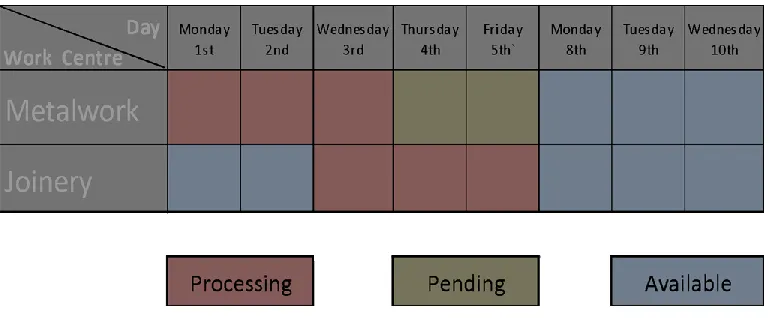
seats with airlines, or rooms in hotels. Using a spreadsheet as shown in Figure 4, the
participating manufacturing companies could share information about their capacities which can
help scheduling the various activities conveniently and transparently. This way, companies can
also share their schedules of production to let others know when they can mutually outsource
their jobs to utilise each other’s extra capacities.
Figure 4: A spreadsheet template for capacity related information sharing
4. Conclusions and Discussions
XYZ Company is faced with the recurring seasonal demand pattern of its products for a
number of years and despite investigating a range of aggregate planning techniques it is yet
needed to identify one plan that could fully provide a workable long term solution. Varying the
workforce through hiring and firing would provide the best solution, but this option is not
feasible as a long term measure and is further complicated due to the lack of availability of
skilled manpower in the Hawke’s Bay region and the high cost of training for potential new
employees.
XYZ has positioned itself as a leading manufacturer of highly customised products.
Leaving the customised product side of the business in favour of a standardised product has also
been discounted by the company’s senior management team. Alternative solutions are further
complicated by the type of customers XYZ has, which are primarily large global businesses and
as such are not able to be influenced by proactive strategies such as offering discounts and
213
Despite all this, XYZ is able to partially smooth the workflow by reactive measures
such as the use of scheduling overtime during the peak periods of demand, and reduction in
work hours during lean period. However, this technique does not go far enough to solve the
significant over and under capacity problem experienced by XYZ.
Of the remaining eight planning strategies identified in Table 1 to smooth demand, only
two are considered to have merit for further consideration, and they are: (i) to produce a product
that is seasonally complementary, and (ii) to subcontract work during the peak periods.
Identification of a seasonally complementary product is partially explored by the senior
management team. Since the products of XYZ Company are not seasonal products, there is not
really an easily identifiable complementary product. Subcontracting at peak periods does go to
some extent to solve the capacity issues; the cost of this solution would significantly impact the
profitability. Recently the closure of local joinery factories (which were used as subcontractors)
caused by the recession in the economy has further complicated this solution.
This leaves a choice of hybrid of the above two solutions to be considered further:
outsourcing work-in during the company’s lean period (Jan to June), and outsourcing work-out
in the peak season. Manufacturing outsourcing is a major business strategy undertaken in global
markets and initially outsourcing is seen as a strategy only to lower the operations costs.
However, outsourcing has evolved primarily based on the advantages vendors can provide due to
their competitive positioning through specialisation and core competence. It also helps the
company to concentrate on improving their core competencies creating even greater levels of
competitiveness.
XYZ has skilled employees and a range of manufacturing equipment and technology
that could be more fully utilised to capacity, if a suitable outsourced product from other
companies could be identified to be manufactured during the January to June period.
Additionally, because XYZ is primarily looking to cover the overhead costs of maintaining full
capacity of a productive workforce then it is well placed to be cost competitive in addition to
taking advantage of its skilled workforce and infrastructure. The timing of XYZ looking to
market itself may also be advantageous, given the uncertainty many businesses are facing
regarding growth along with expansion and as such do not wish to commit to additional capital
214 5. Recommendations
1. Mutual-outsourcing should be pursued by XYZ Company to address the company’s
seasonal demand pattern.
2. XYZ should prepare a brochure highlighting its capability to manufacture a range of
products that are in peak demand during January to June period.
3. The company should prepare a draft statement of works addressing the issues
identified in this paper to support the type of negotiations required.
4. A company representative should be assigned the job to call on prospective
businesses within the North Island including Manufacturers Associations and Chambers
of Commerce to identify potential partners for mutual-outsourcing.
5. Once a partner is identified to be mutually beneficial, a common website should be
developed to facilitate the outsourcing process more effectively.
6. Once the above processes have been sorted, more partners could be invited and
added to the group for extended mutual-outsourcing of work flows.
References
Brown, S., Lamming, R., Bessant, J., & Jones, P. (2005). Strategic operations management (2nd ed). Burlington, MA: Elsevier.
Buxey, G. (2005). Aggregate planning for seasonal demand: reconciling theory with practice.
Choy, K. L., & Lee, W . (2003). A generic supplier agreement tool for outsourcing
manufacturing. Supply Chain Management: An International Journal, 8(2), 140-154.
Chung, W.T. (2007). Outsourcing, firm performance and market exit. (Doctoral dissertation).
Ehie, I. C. (2001). Determinants of success in manufacturing outsourcing decisions: A survey
study. Production and Inventory Management Journal, 42(1), 31-39.
Evidence from Japan. Journal of Operations Management, 25, 885-900.
Heizer, J. H., & Render, B. (2011). Operations management. Boston, MA: Pearson Education.
Hubbard, R. G., & O'Brien, A. P. (2013). Economics. Boston: Pearson.
International Journal of Operations & Production Management; 25(11), 1083.
Jiang, B., Belohlav, J., & Young, S. (2007). Outsourcing impact on manufacturing firm’s value:
Krajewski, L. J., Ritzman, L. P., & Malhotra, M. K. (2007). Operations management. Upper
215
Leavy, B. (2004). Outsourcing strategies: Opportunities and risks. Strategy & Leadership, 32(6),
20-25.
Martinich, J.S. (1997). Production and Operations Management: An applied modern approach.
John Wiley & Sons, Inc. Canada.
Reid, R. D., & Saunders, N. R. (2002). Operations management: An integrated approach.
Hoboken, NJ: John Wiley.
Rubin, H. (2007). Supply-side/manufacturing outsourcing-strategies and negotiations.
Georgetown Journal of International Law, 38(3), 713-714.
Schroeder, R. G. (1993). Operations management: Decision making in the operations function
(4th ed). New York, NY: McGraw-Hill.
Stevenson, W. J. (2012). Operations management (11th ed). New York, NY: McGraw-Hill Irwin. Vanarase, V. A. (2007). Total value-based outsourcing. (Doctoral dissertation).
Vonderembse, M. A., & White, G. P. (2004). Operations management: Concepts, methods, and