On the Design of High Precision Factory Temperature
Control System Based on Wireless Sensor
https://doi.org/10.3991/ijoe.v13i03.6859
Xiaodong Hu
Hunan Institute of Engineering, Xiangtan, China
Abstract—Based on the investigation and analysis of the current status of pharmaceutical cold chain at home and abroad, this paper comes up with a solu-tion for pharmaceutical cold chain temperature monitoring, develops an intelli-gent temperature recorder based on wireless sensor network technology, and makes a detailed introduction to the software and hardware implementation of the wireless sensor nodes of the recorder and the monitoring terminal. Besides, the author tests the performance of the recorder multiple times. The results show that the design basically fulfils the expected goals.
Keywords—wireless sensor, temperature detection, temperature control sys-tem, network node
1
Introduction
The ambient temperature of temperatusensitive products has to meet certain re-quirements all the way from production to transportation. Otherwise, the quality of the products may be affected by the environment [1]. This gives rise to the “cold chain” a low-temperature system tool. The cold storage temperature varies from product to product [2]. For some rare pharmaceuticals, the temperature should be lower than -86°C, far below that for fresh agricultural products. In China, many high-grade biological agents are imported from foreign countries. If the cold chain does not support cold storage, the agents are very likely to degenerate, which causes great threats to the life safety of patients [3-4]. For example, in 2010, a vaccine “exposure accident” broke out in Shanxi Province. Caused by poorly controlled cold storage temperature, the accident killed or disabled several children. Therefore, it is very necessary to guarantee the quality of drugs by setting up a reliable pharmaceutical cold chain. This has become a research hotspot in recent years [5].
of management [9]. Related statistical studies have also found that temperature moni-toring equipment has not been applied to most of cold chain transports in China. Tra-ditionally, the cold chain temperature is mainly monitored manually. The manual approach is low in efficiency and prone to human errors. With the rapid expansion of China’s pharmaceutical consumer market, the pharmaceutical industry has an increas-ingly great demand of pharmaceutical cold chains. As a result, it is of great necessity to improve the existing monitoring system, and establish an automated cold chain temperature monitoring system [10].
In view of the above analysis, this paper explores the features and defects of the existing pharmaceutical cold chain monitoring systems, and develops a set of wireless intelligent temperature recorder in consideration of the temperature monitoring re-quirements [11]. The operation of the instrument depends on the wireless sensor net-work (WSN), which is extensively used in military, environmental monitoring, mete-orology and warehousing. According to the actual use, the WSN can meet the temper-ature control requirements of pharmaceutical cold chain, and give full play to the function of the wireless intelligent temperature recorder. Designed for unmanned monitoring, the proposed temperature recorded is capable of effectively monitoring the operation of pharmaceutical cold chain equipment and the temperature within the cold chain [12-14]. Actual application indicates that the proposed temperature record-er plays a positive role in preventing cold chain equipment failures and oprecord-erational errors, and ensuring the cold storage of vaccines. The specific design and production of the recorder are explained as follows.
2
The overall design plan for the temperature recorder
The structure of the temperature recorder is relatively simple. It mainly consists of several sensor nodes and an intelligent monitoring terminal. Figure 1 illustrates its specific structure. The figure also displays the use of wireless temperature collection nodes in the whole process of the production and transport of the refrigerated drugs. The temperature recorder gathers and processes the temperature signals of the refrig-eration and mobile transport equipment, and sends the processed signals to the detec-tion terminal. After processing the received data, the terminal issues a high/low tem-perature alarm message so that the supervisor can implement control measures based on the message he/she receives.
Often deployed in refrigeration houses and cars, wireless sensor nodes are mainly targeted at collecting and processing temperature signals, and sending the processed signals to the monitoring terminal. The data is sent through the radio frequency mode.
Wireless sensor network
The supervision and administration
Call the police
The monitoring center Production
workshop, storage warehouse
use the site
Fig. 1. The overall design of pharmaceutical cold-chain temperature recorder
3
The hardware design of the temperature recorder
3.1 The hardware design of the recorder
As mentioned previously, the structure of the temperature recorder is relatively simple. It mainly consists of several sensor nodes and an intelligent monitoring termi-nal. The temperature information collected by the sensor nodes are displayed on a LCD interface (Figure 2).
Each of the wireless temperature nodes is further divided into four parts: commu-nication, power supply, sensor and control unit. The communication unit mainly sends the information gathered by the acquisition module to the monitoring unit, the sensor is used to collect the temperature signals in the monitoring area, while the control module controls and manages the workflow of the whole node. The power supply has two parallel alkaline batteries. With a very compact hardware composition, the recorder achieves the requirements of miniaturization, low power consumption, and high efficiency.
node crystal display LCD liquid (LCD)
The antenna
High precision temperature measurement
Main control
chip The wireless module
Booster circuit
The battery
The antenna Touch screen Detection of Detection ofterminalterminal
The wireless
module Main control chip moduleAlarm
Booster circuit
The power supply
3.2 Device selection
Temperature sensor: There are many types of temperature sensors. The common ones are the diode type, thermocouple type, and resistance type. Platinum resistance temperature sensor boasts high temperature measurement accuracy, high stability, and wide measurement range. Currently, it is known as a typical high performance tem-perature sensor. However, it is applied to a very limited area, mainly precision-demanding temperature measurement, because of its high cost and low response. To meet the precision requirements for temperature measurement in this paper, the author selects the platinum resistance temperature sensor Pt100, which has high stability and measurement precision.
Communication module: The type of this module has a significant influence on the stability and reliability of the wireless network. This paper chooses to use the JTT-4432 wireless transceiver module, which is very small and easily embedded in the integrated circuit board. The module uses a standard 1.27DIP interface, which oper-ates at the voltage of 1.8V- and consumes low power. There are many operating modes that can be selected as needed. In the standby mode, the operating current is 15mA, while in the transmission mode, the operating current is 30mA. With a sensi-tivity of -118dBm, it supports one-to-many communication, and realizes the pro-gramming function of all registers with “burst” data transmission. The communication module satisfies the working requirements of the temperature sensor as it employs high precision peripheral components, can work in a very complex environment, and features low power consumption.
3.3 Touch screen
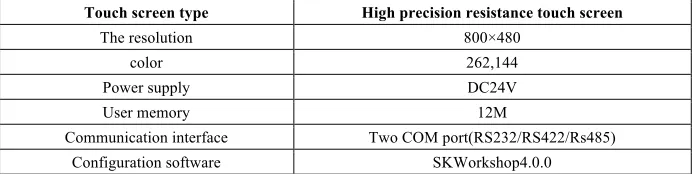
In this paper, SK070AE is selected as the touch screen. Mainly used for human-computer interaction, the touch screen integrates a number of units, including the display unit, memory unit, input and output unit, control unit, etc. The performance of the touch screen is illustrated in Table 1.
Samkoon SK has a high compatibility with various communication interfaces. Be-sides, it is connectable to most of the current PLC communication equipment, and in support of the MODBUS protocol. Thus, it can easily exchange data with SCM. One can configure the drive settings and achieve some control requirements with the con-figuration software.
Table 1. Introduction to the performance of SK070AE touch screen
Touch screen type High precision resistance touch screen The resolution 800!480
color 262,144
Power supply DC24V
User memory 12M
3.4 Alarm unit
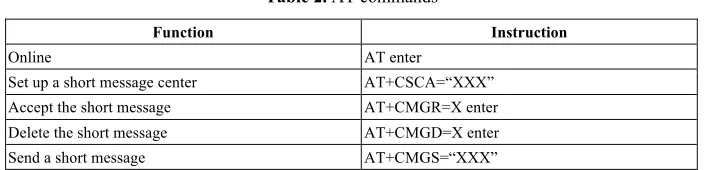
Embedded with a communication interface, the wireless communication GSM module TC35 can transmit data with personal computers and MCU. It is highly effi-cient in data transmission and voice communication. TC35 supports multi-band op-eration and consumes very small current and total power in the standby mode. The user can send data with the AT commands. According to the design plan, the alarm unit is mainly used to send alarm messages. The commands used to send alarm infor-mation are displayed in details in Table 2.
Table 2. AT commands
Function Instruction
Online AT enter
Set up a short message center AT+CSCA=“XXX” Accept the short message AT+CMGR=X enter Delete the short message AT+CMGD=X enter Send a short message AT+CMGS=“XXX”
4
The software design of the temperature recorder
4.1 The software design of the nodes
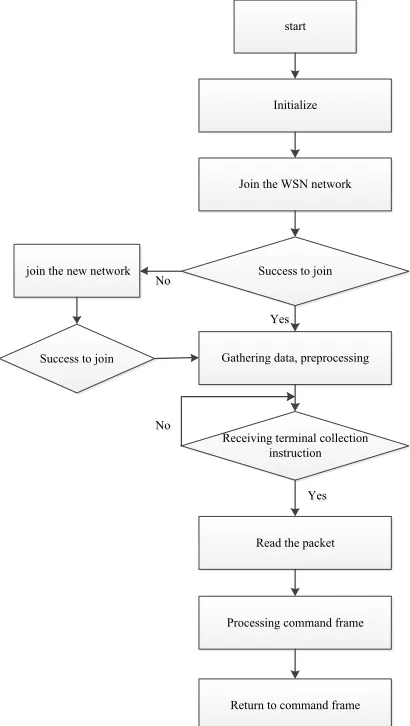
The software composition of each node is rather complex. There are parts like the main program, display and temperature acquisition subprogram, radio frequency sub-program, etc. During the operation, the master node initializes JTT4432 and sets the signal acquisition frequency; then, it starts to collect temperature signals, preprocesses the data at the same time, and displays the results on the interface. The monitoring terminal sends the signals to the control terminal. Figure 3 depicts the workflow of the main program.
4.2 RF transceiver subprogram
The subprogram configures the JTT4432 module via the 4-wire SPI-compatible in-terface. In this case, the module is in a passive state. Before starting the RF transceiv-er subprogram, one has to initialize SPI, RF, etc. and sets the registtransceiv-er. When the RF module starts sending data, it writes the data to the send buffer and then sends it au-tomatically. After receiving data via RF, the subprogram generates an interruption signal to notify MCU or reads the received data.
start
Initialize
Join the WSN network
Gathering data, preprocessing
Read the packet
Processing command frame
Return to command frame Success to join
Receiving terminal collection instruction Success to join
join the new network
Yes
Yes
Yes
Yes
No
No
No
No
Fig. 3. The software flowchart of wireless sensor node
Table 3a. The format of the data format sent by RF
Data head Command code Node address …… End-of-string identifier
0xaa 0xxx addr 0000 0xbb
Table 3b. The format of the data format received by RF
Data head Command code Data Node address 0xaa 0xxx PlayloadData addr
4.3 The software design of the terminal
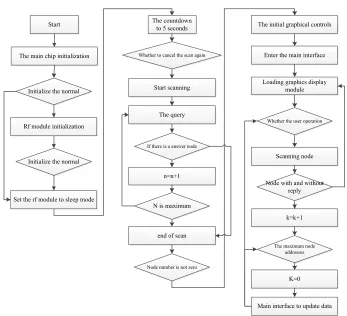
The terminal software mainly consists of the main program, the RF transceiver subprogram, the touch screen communication subprogram and others. Under terminal control, the master and slave control mode is selected and the data is transmitted via the MODBUS protocol. The touch screen triggers the SCM for a certain period of time, sends the acquisition command to the acquisition unit, and stores the received data in the set address for data processing. In the meantime, it analyzes the data re-turned from the nodes. In the case of failure, the touch screen serves as a protection and sends the alarm information to the monitoring center. See Figure 4 for the specific workflow of the terminal.
Start
The main chip initialization
Initialize the normal
Rf module initialization
Initialize the normal
Set the rf module to sleep mode
The countdown to 5 seconds
Whether to cancel the scan again
If there is a answer node
N is maximum
Node number is not zero
Start scanning
The query
n=n+1
end of scan
The initial graphical controls
Enter the main interface
Loading graphics display module
Whether the user operation
Scanning node
Node with and without reply
k=k+1
The maximum node addresses
K=0
Main interface to update data
Fig. 4. The flowchart of the terminal program
4.4 SD card drive subprogram
SD card, adjust the signal transmission frequency to a higher level, and send a certain number of clock signals, and write the command at the same time. In this way, the SD card is put into the SPI mode.
Then, read the information on the identification code of the SD card by the card reading sub-function. The card has a unique identification code.
To read and write on the SD card, it is also necessary to read and write the sectors. The sectors of the card contain 215 bytes. Each reading and writing handles 512 bytes simultaneously.
5
Complete debugging and performance analysis
5.1 Barrier-free communication test
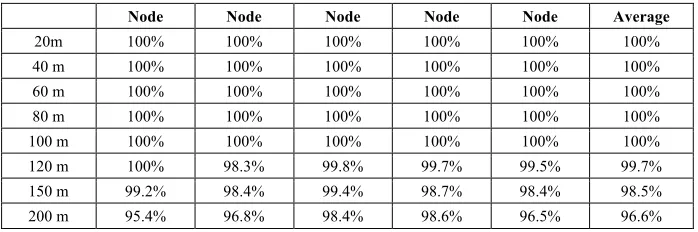
Appropriate test environment should be chosen to ensure the accuracy of the re-sults. Normally, the test is carried out in an open space outdoors. The tester should select a certain number of nodes, which have the same straight-line distance from the terminal, and carries out the test at the straight-line distance of 20m, 40m, 60m, 80m, 100m, 120m, 150m, and 200m. The nodes at each distance should be set into a group. Each group of nodes should be tested continuously for 3h and measured three times. The measured results should be averaged and the loss of data packets should be summed up. Table 4 displays the final results.
Table 4. The data loss rate of the barrier-free communication test
Node Node Node Node Node Average 20m 100% 100% 100% 100% 100% 100% 40 m 100% 100% 100% 100% 100% 100% 60 m 100% 100% 100% 100% 100% 100% 80 m 100% 100% 100% 100% 100% 100% 100 m 100% 100% 100% 100% 100% 100% 120 m 100% 98.3% 99.8% 99.7% 99.5% 99.7% 150 m 99.2% 98.4% 99.4% 98.7% 98.4% 98.5% 200 m 95.4% 96.8% 98.4% 98.6% 96.5% 96.6%
5.2 Barrier communication test
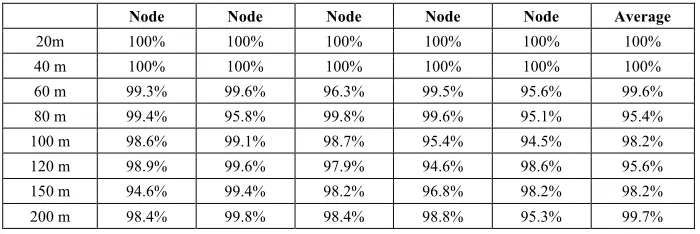
After that, the tester should conduct an indoor test. The conditions should remain the same except for a wall built in the middle. See Table 5 for the data loss rate.
blood and vaccines. The recorder can also be used to verify the performance of cold chain storage and transportation. Besides, it is capable of improving the cold chain temperature monitoring efficiency, satisfying the requirements on temperature control accuracy, and reducing the labor intensity. According to the actual use, the recorder can positively prevent the errors in manual operation. Featuring all-weather monitor-ing and recordmonitor-ing faults and abnormal information of the cold chain, the proposed temperature recorder has a great significance for the realization of the online monitor-ing function of the cold chain and the improvement of monitormonitor-ing efficiency of phar-maceutical storage and transport. Coupled with high monitoring stability, the pro-posed recorder has very broad application prospects.
Table 5. The data loss rate of the barrier communication test
Node Node Node Node Node Average 20m 100% 100% 100% 100% 100% 100% 40 m 100% 100% 100% 100% 100% 100% 60 m 99.3% 99.6% 96.3% 99.5% 95.6% 99.6% 80 m 99.4% 95.8% 99.8% 99.6% 95.1% 95.4% 100 m 98.6% 99.1% 98.7% 95.4% 94.5% 98.2% 120 m 98.9% 99.6% 97.9% 94.6% 98.6% 95.6% 150 m 94.6% 99.4% 98.2% 96.8% 98.2% 98.2% 200 m 98.4% 99.8% 98.4% 98.8% 95.3% 99.7%
6
Conclusion
This paper studies and designs a set of intelligent temperature recorder. The author reviews the current status of pharmaceutical cold chains at home and aboard, offers a solution for temperature monitoring of pharmaceutical cold chains in reference to the relevant literature, and designs a temperature recorder applicable to cold chain transport. It consists of such two parts as wireless sensor nodes and the monitoring terminal. The author makes specific designs for the hardware and software of the two components, and tests the performance of the recorder in two test environments. The results show that the design basically realizes the expected goals. This paper mainly deals with the following:
1.Make a brief discussion on the current status of pharmaceutical cold chain tem-perature monitoring at home and aboard, and present a new design plan for phar-maceutical cold chain monitoring on the basis of relevant research results.
2.Give a detailed introduction to the wireless sensor network equipment, and select the appropriate network communication hardware.
4.Encapsulate the nodes and the terminal, make the specific design of the software flowchart, and prepare the programs so that each module can achieve its function. 5.Carry out the man-machine interface design, realize the data transmission between
the touch screen and the SCM through programming, and display graphics via the man-machine interface.
6.Test the performance of the temperature recorder after completing the design. Veri-fy the communication performance under different environmental conditions, ana-lyze the test results, and draw the conclusions.
7
References
[1]Zhou P., Huang G., Li Z. (2014). Demand-based temperature control of large-scale rooms aided by wireless sensor network: energy saving potential analysis. Energy & Buildings, 68(314), 532-540. https://doi.org/10.1016/j.enbuild.2013.10.005
[2]Mon Y. J., Lin C. M., Rudas I. J. (2012). Wireless sensor network (wsn) control for indoor temperature monitoring. Acta Polytechnica Hungarica,9(6), 17-28.
[3]Zhao Z. (2006). Temperature adjustment and control systems based on wireless sensor networks and confidence interval calculation for broadcast equipment rooms. Computer Engineering & Applications,47(30), 219-223.
[4]Liu Y., Zhang C., & Zhu P. (2011). The temperature humidity monitoring system of soil based on wireless sensor networks, 1850-1853.
[5]Stojkoska B. R., Avramova A. P., Chatzimisios P. (2016). Application of wireless sensor networks for indoor temperature regulation. International Journal of Distributed Sensor Networks,2014(1), 975-978.
[6]Abbaspour R. (2010). A practical approach to powering wireless sensor nodes by harvest-ing energy from heat flow in room temperature. International Congress on Ultra Modern Telecommunications and Control Systems and Workshops, 178-181.
https://doi.org/10.1109/ICUMT.2010.5676640
[7]Cannistraro M., Lorenzini E. (2016). The applications of the new technologies “e-sensing”
in hospitals, International Journal of Heat and Technology, 34(4), 551-557.
https://doi.org/10.18280/ijht.340401
[8]Cannistraro G., Cannistraro M. (2016). Hypothermia risk, monitoring and environment control in operating rooms, International Journal of Heat and Technology, 34(2), 165-171.
https://doi.org/10.18280/ijht.340202
[9]Zhang X., Wang F. Y. (2008). Key Technologies of Passive Wireless Sensor Networks Based on Surface Acoustic Wave Resonators. IEEE International Conference on Network-ing, Sensing and Control, 1253-1258. https://doi.org/10.1109/icnsc.2008.4525409
[10]Booranawong A., Teerapabkajorndet W., Limsakul C. (2013). Energy consumption and control response evaluations of aodv routing in wsans for building-temperature control.
Sensors,13(7), 8303-8330. https://doi.org/10.3390/s130708303
[11]Zhang Y., Chen Q., Liu G., Shen W., Wang G. (2016). Environment parameters control based on wireless sensor network in livestock buildings. International Journal of Distrib-uted Sensor Networks,2016(5), 1-7. https://doi.org/10.1155/2016/9079748
[13]Kassim M., Sulaiman N. A., Razali M. S. Y. (2012). Fan speed control on heat detector technique using zigbex wireless sensor network. Advanced Materials Research,622-623, 1484-1491. https://doi.org/10.4028/www.scientific.net/AMR.622-623.1484
[14]Zhao S.Y., Chen C., Zhan N.Y. (2015). Research on the influences of insulation technolo-gy by plastic greenhouses on working temperature in aeration tanks in cold areas in winter,
International Journal of Heat and Technology, 33(1), 181-186. https://doi.org/10.18280/ ijht.330125
8
Authors
Xiaodong Hu is a lecturer with College of Electrical & Information Engineering, Hunan Institute of Engineering, Xiangtan 411101, China. She is mainly engaged in the study of Electronic communication ([email protected]).