EMBEDDED AUTONOMY
S T A T E S A N D I N D U S T R I A L
T R A N S F O R M A T I O N
Peter Evans
Published by Princeton University Press, 41 William Street, Princeton, New Jersey 08540
In the United Kingdom: Princeton University Press, Chichester, West Sussex All Rights Reserved
Library of Congress Cataloging-in-Publication Data
Evans, Peter B., 1944–
Embedded autonomy : states and industrial transformation / Peter Evans. p. cm.
Includes bibliographical references and index. ISBN 0-691-03737-X (CL) ISBN 0-691-03736-1 (PBK)
1. Computer industry—Government policy—Brazil. 2. Computer industry—Government policy—India. 3. Computer industry—
Government policy—Korea (South) 4. Industries—Government policy— Brazil. 5. Industries—Government policy—India. 6. Industries— Government policy—Korea (South) I. Title.
HD9696.C63B7345 1995 338.4’7004—dc20 94-31963
This book has been composed in Sabon
Princeton University Press books are printed on acid-free paper and meet the guidelines for permanence and durability of the Committee on Production Guidelines for Book Longevity of the Council on Library Resources
Printed in the United States of America
10 9 8 7 6 5 4 3 2 1
(Pbk.)
Contents
List of Tables ix
Acknowledgments xi
List of Abbreviations and Acronyms xvii
1. States and Industrial Transformation 3
2. A Comparative Institutional Approach 21
3. States 43
4. Roles and Sectors 74
5. Promotion and Policing 99
6. State Firms and High-Tech Husbandry 128
7. The Rise of Local Firms 155
8. The New Internationalization 181
9. Lessons from Informatics 207
10. Rethinking Embedded Autonomy 227
Notes 251
References 287
Tables
6.1 Cross-Country Comparisons of R&D Effort 148
7.1 Growth of Informatics Revenues in Brazil, 1980–1989 162
7.2 University-Trained Employment in the Brazilian
Informatics Industry, 1979–1989 162
7.3 Top Ten Brazilian Computer Firms, 1986 162
7.4 Major Brazilian Electronics Groups, 1987 164
7.5 Indian Computer and Software Production/Exports, 1984–1988 169
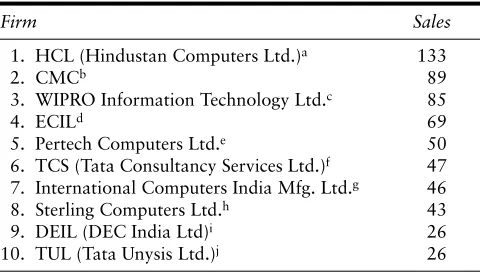
7.6 Top Ten Indian Informatics Firms, 1990 169
7.7 Sales by Korean Participants in the Computer Industry, 1986 175
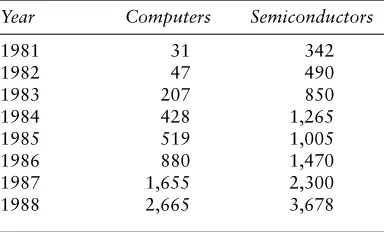
7.8 Growth of Korean Computer and Semiconductor Production 175
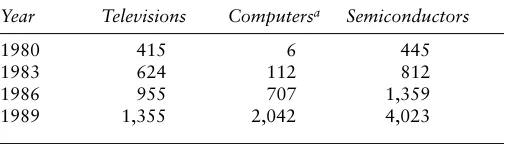
7.9 Korean Exports of Televisions, Computers,
and Semiconductors, 1980–1989 176
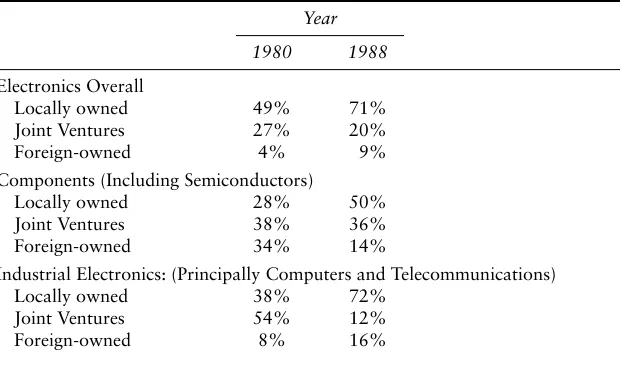
8.1 Foreign Firms in the Korean Electronics Industry: Share of
Acknowledgments
BOOKS AREcurious products. To begin with, they take too long to write, much too long if the final product is the only reward. If an author is lucky the process is sufficiently rewarding in itself to make up for the distant and eventual character of the product. I was among the lucky. By looking at information technology, I gave myself an impeccably serious excuse for exploring new milieus and acquiring arcane knowledge. I found com-puter companies fascinating; state bureaucracies were equally mysterious in their own way. Eventually I had to relinquish the process and make sure that there was a product, but it was still the process that made the project worthwhile.
Just as the assumption that research and writing are simply a means of producing a book misrepresents reality, the conventional equation of au-thorship and ownership is a convenient fiction at best. In my case, I relied throughout on the insights and generosity of people who understood both computers and states much better than I did. Ideally, they should be the “owners” of this book. Instead, like any book, this one illustrates the extent to which intellectual proprietorship is akin to theft. Most of those who contributed the ideas and insights had no control over the final shape of the manuscript. Many would disagree fundamentally with the way that I have interpreted their reality. Even acknowledging their help impli-cates them in an outcome for which I am the only responsible party.
Acknowledging collaborators who are part of the academic world is easier. The references and notes that pepper the text are a start, and I will try to complement them here. Nevertheless, the most careful set of ac-knowledgments would still fail to reflect the true etiology of the ideas that went into this book. Even if the question of origins is arbitrarily limited to the decade during which I was actually working on the book, many contributors would be missing from the best list I could construct: col-leagues and students whose casual hallway conversations sparked a new way of tackling a problem, unknown questioners at seminars who raised points I had not thought of before, antagonists whose views reshaped my own without my realizing it.
own-ership. The best I can do here is to flesh out the footnotes and references with a brief record of some of the contributions, diffuse and specific, that stick in my mind.
Recording the contributions is complicated by the fact that this book is only the latest reincarnation of my efforts to look at states and industrial transformation. Many of the ideas it contains have been tried out before as articles and tempered by the critiques and comments that those articles generated. More specifically, chapters 2 and 3 draw on my 1989 and 1992 articles on the state (Evans 1989b, 1992b). I hope I have tightened and clarified these earlier formulations. Chapters 5 through 7 draw on a series of articles on the computer industries of Brazil, India, and Korea published from 1986 to 1992 (Evans 1986a, 1989a, 1989c, 1992a; Evans and Tigre, 1989a, 1989b). Some of the detail presented in the articles is condensed in this version and the argument is more focused, but the basic analysis is the same. The numerous editors and reviewers of those articles and the even more numerous colleagues and practitioners who read and commented on them all played a role in shaping this book.
Diffuse intellectual influences are the hardest to capture, but I can say that the Committee on States and Social Structures played an important role in the genesis of this book. Housed first in the Social Science Research Council and later in the Russell Sage Foundation, the committee incu-bated my ideas about how states connect to societies for several years before I thought of researching the information technology industry. While all of its members have influenced my thinking, Albert Hirschman deserves special mention. His elegant and insightful analysis of institu-tional factors in economic development has been a model for me since my days as an undergraduate.
structure were formulated during a very rewarding and enjoyable year at the Center for the Advanced Study in the Behavioral Sciences in Stanford. Financial support from National Science Foundation Grant BNS87– 00864 and the John Simon Guggenheim Memorial Foundation made this year possible.
While institutions and colleagues in the United States played an essen-tial role, the bulk of my debts are held abroad—in Brazil, India, and Korea. Like much of my intellectual life, this book began in Brazil. In 1984 a fellowship from the Centro Brasileiro de Análise e Planejamento (CEBRAP) gave me the chance to become fascinated with the informatics industry. It also gave me the chance to meet Paulo Tigre, who became my most important collaborator. The Tinker Foundation provided the re-sources that enabled Paulo and me to continue our collaboration. Anto-nio Botelho was an important contributor to this project. A later grant from the Tinker Foundation brought us together with Claudio Frischtak, whose astute analysis of high-technology industry is drawn on repeatedly in chapters 5 through 8. Over the course of the ten years that followed my stay at CEBRAP, I got to know actors on all sides of the drama that was the Brazilian informatics industry. Everyone, from the original barbudin-hosto owners of local firms to executives in IBM and the other major multinationals to the hard-pressed staff of SEI to local politicians, spent time they did not have to spare explaining to a naïve North American what was going on in the complex world of the Brazilian informatics industry. Some did so repeatedly. Mario Dias Ripper not only allowed me to take advantage of his original thinking on how the information tech-nology industry was evolving, but even read and commented on the manuscript. Ivan da Costa Marques kept reappearing in different roles: first as owner of a small private firm, then as president of COBRA, then as a historian of the Brazilian informatics experience. His willingness to share his insights was a constant. Many others, including Simón Schvartzman, whose story introduces chapter 7, were equally generous.
I owe my initial interest in the Korean case to two students who worked with me at Brown University—Eun Mee Kim and Myong Soo Kim. During my stay in Korea, the Institute for Far Eastern Studies at Kyungnam University in Seoul was my home, literally as well as intellec-tually while I did fieldwork. The researchers and staff of the institute not only made me feel welcome and comfortable but also tolerated my inept lack of Ping Pong skills. A special debt is owed to Lee Su-hoon, who made my stay in Korea possible.
Park) Mi Kyoung and Lew Soek-jin. A number of Korean colleagues, including Choi Byung Sun, Choi Jang Jip, Kim Byung Kook, Kim Doo-sub, Lim Hyun-Chin, and Moon Chung-in, not only were generous hosts but helped shaped my understanding of state-society relations in Korea. I am particularly indebted to Kim Kwang Woong of Seoul National Uni-versity, without whose aid the fieldwork could not have been successfully completed. After my return, excellent research by Kang Mungu, Sang In-jun, and Jon Hae-ja enabled me to analyze and update the material.
My fieldwork in India was made possible by a grant from the Indo-American Fellowship program of the Indo-U.S. Subcommission on Edu-cation and Culture. The American Institute for Indian Studies offered me invaluable support during my stay in Delhi. Indian colleagues Mrinal Datta-Chaudhuri, Ashok Desai, Vijay Kelkar, and Kuldeep Mathur were extremely helpful, not just in giving me a sense of the complexities of their country, but also in helping me connect these complexities to more gen-eral theoretical issues. In addition, I had the good fortune to make contact with researchers like Eswaran Sridharan and C. R. Subramanian, whose extensive work on the information technology industry already encom-passed much of the research I had in mind. For a third time I was amazed at the willingness of busy entrepreneurs and equally dedicated state man-agers to share their time and expertise with me. I am also especially grate-ful to Ashok Parthasarathi for his thorough critique of my first write-up of the Indian material.
Once my work moved from the field to the word processor, an embar-rassingly large number of readers critiqued and reshaped the manuscript. Dietrich Rueschemeyer’s ever-sound judgment helped me avoid a number of obvious errors. The final manuscript also benefited from Theda Skocpol’s perspicacious reading of an early draft. The advice of Evelyne Huber and John Stephens was crucial in reshaping successive drafts of the introduction and conclusion. Peter Katzenstein worked hard to get me to improve the arguments connecting states and computers. Barbara Stall-ings provided both encouragement throughout the project and a clear-headed critique of the results. Michael Burawoy went far beyond the call of collegial duty, reading successive drafts, providing extensive com-ments, and using all the skills he has acquired as a veteran thesis adviser to prod me into getting the job done.
Often I succeeded in resisting my friends’ advice, but to the extent that they prevailed, readers of this book have every reason to be grateful.
Abbreviations and Acronyms
ABICOMP Association of the Brazilian Computer and Peripherals
Industries (Brazil)
ACER Taiwanese computer manufacturer
APPD Association of Data Processing Professionals (Brazil)
ASIC application-specific integrated circuit
AT&T American Telephone and Telegraph (United States)
BARC Bhabha Atomic Research Center (India)
BEL Bharat Electronics Ltd. (India)
BNDE National Economic Development Bank (Brazil)
BNDES National Bank for Economic and Social Development
(Brazil) (same as BNDE except for name change)
CAD computer-aided design
CAM computer-aided manufacture
CAPRE Commission for the Coordination of Electronic
Process-ing Activities (Brazil)
C-DOT Centre for the Development of Telematics (India)
CEPD Council on Economic Planning and Development
(Taiwan)
CMC Computer Maintenance Corporation (India)
COBRA Computadores e Sistemas Brasileiros SA (Brazil)
CONCEX Foreign Trade Council (Brazil)
COSL Citicorp Overseas Software Ltd. (India)
CPqD Telebrás’ Center of Research and Development (Brazil)
CSN Compania Siderúgica Nacional (Brazil)
CTI Centro Technológica para Informática (Brazil)
CVRD Brazil’s state-owned iron exporter
DACOM Korean data communications company owned by KTA
together with private stockholders
DASP Department of Public Administration (Brazil)
DCM Delhi Cloth Mills (India)
DEC Digital Equipment Corporation, second largest U.S.
computer firm
DEPIN Departamento de Política de Informática e Automação
(Brazil)
DG Data General, U.S. computer firm
DISNET NIC system for information on India’s districts
DOE Department of Electronics (India)
dynamic random access memory (semiconductor mem-DRAM
ory chip)
Electronic Corporation of India Ltd. ECIL
Electronics Industry Association of Korea EIAK
Economic Planning Board (Korea) EPB
electronic private branch automatic exchange EPBAX
European Strategic Program for Research and Develop-ESPRIT
ment in Information Technologies electronic switching system
ESS
Electronics and Telecommunications Research Institute ETRI
(Korea)
Foreign Exchange Regulation Act (India) FERA
Federation of Korean Industries FKI
Federation of Korean Trade Unions FKTU
Grupo Executivo para Indústria Automobilística GEIA
(Brazil)
Grupo de Trabalho Especial-111 (Brazil) GTE-111
Hindustan Computers Ltd., largest local firm in India HCL
Hewlett-Packard (United States) HP
Indian Administrative Service IAS
integrated circuit IC
International Computers Limited (England) ICL
Indian Civil Service ICS
Industrial Development Bureau (Taiwan) IDB
Indian computer company acquired by HCL IDM
Indian Iron and Steel Company IISCO
Indian Institutes of Technology IIT
Indian railway reservation system designed by CMC IMPRESS
leading U.S. manufacturer of microprocessors INTEL
integrated service digital network ISDN
import-substituting industrialization ISI
information technology IT
Air Force Institute of Technology (Brazil) ITA
Indian Telephone Industries, state-owned telephone ITI
producer
Korean Institute of Science and Technology KIST
Korea Institute of Technology KIT
Kuomintang; Nationalist party (Taiwan) KMT
Korean Telecommunications Authority KTA
Japan Development Bank JDB
Japan Electronic Computer Corporation JECC
Liberal Democratic party (Japan) LDP
Ministry of Telecommunications (Brazil) Minicom
Ministry of International Trade and Industry (Japan) MITI
Ministry of Communications (Korea) MOC
Ministry of Science and Technology (Korea) MOST
Ministry of Trade and Industry (Korea) MTI
National Administrative Information System (Korea) NAIS
National Advanced Systems, manufacturer of main-NAS
frames (United States)
National Computerization Coordination Committee NCCC
(Korea)
National Informatics Centre (India) NIC
newly industrializing countries NICs
NIC’satellite-based communications system (India) NICNET
National Institute of Information Technology (India) NIIT
National Resources Commission (Taiwan) NRC
Japan’s state-owned telecommunications monopoly NTT
original equipment manufacture; equipment made for OEM
another company to sell under its own brand name Austrian Trade Union Federation
ÖGB
on-line transaction processing OLTP
Oil and Natural Gas Corporation (India) ONGC
People’s party (Austria) ÖVP
personal computer PC
Brazilian development plan by General Geisel PNDII
Pohang Iron and Steel Company Ltd. (Korea) POSCO
subsidiary of POSCO providing value-added network POSDATA
services to other businesses standardized version of UNIX POSIX
Pohang Institute of Technology (Korea) POSTEC
Brazilian computer firm PROCOMP
Indian computer firm PSI
rural automatic exchange designed by C-DOT (India) RAX
communications network provided for Indian steel SAILNET
authority
Brazilian Computation Society SBC
Semiconductor Complex Ltd. (India) SCL
Brazilian computer firm SCOPUS
Seminars on Computation at the University (Brazil) SECOMU
Secretaria Especial de Informática (Brazil) SEI
Brazilian informatics firm SID
holding company in charge of Brazil’s state-owned steel
SIDERBRdS
companies
early Brazilian-designed operating system SOD
state-owned enterprise SOE
Brazilian clone of UNIX SOX
Sun brand name for chips and work stations (United SPARC
States)
Socialist party (Austria) SPÖ
National Intelligence Service (Brazil) SNI
Superindencia for Amazonia (Brazil) SUFRAMA
Tata Consultancy Systems (India) TCS
ETRI’s electronic switching system (Korea) TDX
Korean supermini TICOM
Telecommunications, Instrumentation, and Telecontrol TITAN
in an Automated Network; automated monitoring system for Indian oil and natural gas wells
transnational corporation TNC
Tata Unisys Ltd. (India) TUL
software operating system designed and owned by UNIX
AT&T U.S. Steel USX
value-added network VAN
DEC minicomputer VAX
very large scale integrated circuits VLSI
Federation of Austrian Industrialists VÖI
Indian business group; includes WIPRO Information WIPRO
Technology Ltd., a large local producers of comput-ers, and WIPRO Systems Ltd., a software specialist consortium of American and European companies X-OPEN
founded in 1986 to establish international UNIX standards
1
States and Industrial Transformation
APERENNIALLYpopular Brazilian joke about two lions evokes one way of seeing the state. Escapees from the zoo, the two lions take different paths. One goes to a wooded park and is apprehended as soon as he gets hungry and eats a passerby. The second remains at large for months. Finally cap-tured, he returns to the zoo sleek and fat. His companion inquires with great interest, “Where did you find such a great hiding place?” “In one of the ministries” is the successful escapee’s answer. “Every three days I ate a bureaucrat and no one noticed.” “So how did you get caught?” “I ate the man who served coffee for the morning break,” comes the sad reply. The moral is clear: bureaucrats do nothing and are never missed; even other bureaucrats care more about their morning coffee than about any-thing their colleagues do. The joke is popular because it affirms the con-viction that Third World states deliver little of value. It is also popular because it converts bureaucrats from predators to prey. Identifying with the lion, listeners reverse their usual self-perception as victims of the state. For those with less sense of humor, the quotidian power of the state over their individual lives can take on disturbing proportions. As Anita Desai (1991, 3–4) puts it, “In the present time, in which the laws and whims of politicians and bureaucrats are as pervasive and powerful as those of the gods, not only must a minister be propitiated before he will issue a license, allot a house, or award a pension, but so must every clerk through whose hands the relevant file passes.” This is not a lament about dictatorship or authoritarian repression, it is a complaint about how the Third World state conducts “business as usual” in relation to ordinary citizens.
to individual interests. We need something beyond caveat emptor to sus-tain the process of exchange. We need “collective goods” like sewage systems, roads, and schools.
Attempts to dismantle the state or make it wither away risk perverse consequences. Communist revolutionaries who fought to install a system that would lead to the state’s “withering away” ended up constructing state apparatuses more powerfully repressive than those of the age of absolutism. Fervent calls for the dismantling of the state by late-twenti-eth-century capitalist free-marketeers served to derail the state’s ability to act as an instrument of distributive justice, but not to reduce its overall importance.
From the poorest countries of the Third World to the most advanced exemplars of welfare capitalism, one of the few universals in the history of the twentieth century is the increasingly pervasive influence of the state as an institution and social actor.1None of which is to say that the
exist-ing states give us what we need. Too often we stand in line in vain. The contradiction between the ineradicable necessity of the state in contempo-rary social life and the grating imperfection with which states perform is a fundamental source of frustration. Dreams of cannibalizing bureaucrats are one response. Analyzing what makes some states more effective than others offers less immediate satisfaction but should be more useful in the long run.
Since analyzing states entails almost as much hubris as pretending to run them, it is important to place some boundaries on the endeavor. My boundaries are narrow and clear. I have focused on only one of the state’s tasks—promoting industrial growth. The empirical discussion is even more specific—the growth of local information technology (IT) indus-tries. In addition, I am primarily concerned with a particular set of states—newly industrializing countries (NICs). Within this set, the em-pirical narrative draws primarily on the experiences of Brazil, India, and Korea during the 1970s and 1980s. Despite the boundaries, the hu-bris remains. The underlying aim is to understand state structures and roles, relations between state and society, and how states contribute to development.
States and Economic Transformation
States remain, as Weber defined them, “compulsory associations claiming control over territories and the people within them,”2but Weber’s
defini-tion does not reduce the complexities of analyzing what states do. The first step in making analysis manageable is separating out the different roles that states perform. Making war and ensuring internal order are the classic tasks. In the contemporary world, fostering economic transfor-mation and guaranteeing minimal levels of welfare are not far behind.
“Realists” tell us that, as sovereign entities in an anarchic world, states must concern themselves above all with the conditions of military sur-vival.3Gilpin (1987, 85) puts it succinctly: “The modern nation-state is
first and foremost a war-making machine that is the product of the exi-gencies of group survival in the condition of international anarchy.” His-torical analysis makes it clear that the task of war making, more than any other, drove the construction of the modern state.4War making is also
the task that allows the state most easily to portray itself as the universal agent of societal interests.
War making is one justification for the state’s monopoly on violence; avoiding Hobbesian chaos internally is the other. Here again the state projects itself as an agent of the universal interests of society. What hap-pens when a state disintegrates demonstrates that the claim is at least partially valid, as the citizens of contemporary Somalia can bitterly attest. Yet the claim also masks other aspects of the state’s role.
When it defends sovereignty and internal order, the state is also, as Charles Tilly (1985) puts it, running a “protection racket” on its own behalf. Classic Marxist analysis reminds us that states are instruments for dominating the societies they serve. State actions reflect and enforce dis-parities of social power on behalf of the privileged. When the state exer-cises its monopoly on violence internally, its identification with the inter-ests of the nation is no longer automatic. All states would like to portray themselves as carrying out a project that benefits society as a whole,5but
sustaining this image requires continuous effort.6
means to accomplishing the classic goals of military survival and internal order.
Being involved in economic transformation has two different facets. First of all, it means becoming implicated in the process of capital accu-mulation. Wealth creation is no longer considered just a function of na-ture and markets; effective statecraft is involved as well. Eliciting en-trepreneurship and facilitating the creation of new productive capacities require a more complicated involvement in the affairs of the citizenry than simply eliciting loyalty and enforcing good behavior. The capacity required for what I will call the state’s “transformative role” is corre-spondingly greater.
Once the state is implicated in the process of capital accumulation, responsibility for economic hardship is less easily shifted to nature or markets. If the inegalitarian outcomes of market relations cannot be dis-missed as “natural,” the state becomes responsible for deprivation as well as oppression. Its involvement in conflicts over distribution and welfare is more explicit.7
Welfare and growth easily become entangled. Fostering growth is often portrayed as a substitute for addressing distributional issues. Equat-ing the overall accumulation of productive capacity with the national in-terest makes it easier to claim the role of universal agent. Better a smaller share of an expanding pie than a larger piece of a shrinking one, the argument goes. In reality, of course, pieces often shrink faster than pies grow, and losers ask whose interests transformation serves. Nonetheless, growth remains a prerequisite to delivering welfare in the long term. Finding new ways to generate growth is a preoccupation even for welfare states.
As they become increasingly involved in economic transformation, states increasingly look at the international system not just as a system of sovereign political entities but also as a division of labor.8The connection
between internal accomplishment and external context becomes intimate and direct. The very possibilities and criteria of economic transformation depend on the international division of labor. Transformation is inescap-ably defined in global terms.
The Global Context
each nation’s place in production for global markets has powerful impli-cations for its politics and the welfare of its citizens.9
Like any kind of differentiation, the international division of labor can be seen as a basis of enhanced welfare or as a hierarchy. The arguments for enhanced welfare are enshrined in the theory of comparative advan-tage: all countries will be better off if each concentrates on what it does best.10Compatibility with resource and factor endowments defines the
activity most rewarding for each country. Trying to produce goods that other countries can deliver more efficiently will only lower everybody’s welfare.
Poorer countries have always been suspicious of this argument. From Alexander Hamilton11 to Friedrich List12to Raul Prebisch,13 there has
been the suspicion that position in the international division of labor was a cause of development, not just a result.14
No one denies that an interdependent global economy is an improve-ment over a system of autarky, even for those that occupy less desirable niches. Nor does anyone deny that countries should do what they do best, just as the theory of comparative advantage argues. Yet contemporary theorizing offers support for persistent convictions that trying to get into more desirable niches is an important part of the struggle to develop.
Recent developments in trade theory suggest that profit rates can differ systematically and persistently across sectors. As Paul Krugman (1987, 230) puts it, “with imperfect competition sustained by economies of scale and entry barriers, some industries may be able to generate persistent excess returns.” Differential profit rates are, however, only part of what is at stake.
As Albert Hirschman (1977) has argued persuasively, filling a particu-lar niche in the international division of labor has dynamic implications as well as static ones. Some sectors create a “multidimensional conspir-acy” in favor of development, inducing entrepreneurial energies, creating positive spillovers in the rest of the economy, and molding political inter-est groups into a developmental coalition (Hirschman 1977, 96). Niches in the international division of labor are desirable not just because they may entail higher profits and more rapid accumulation of capital, but also because they facilitate the achievement of the social and welfare goals associated with “development” in the broadest sense of the term.
Ability to generate a “multidimensional conspiracy” in favor of devel-opment is not inherent in a product itself. It depends on how the product fits into a global array of sectoral possibilities. As such theorists of the “product cycle” as Vernon and Wells have shown, products also have developmental trajectories.15The country that catches them on their
downswing. Textiles offered eighteenth-century England a “multidimen-sional conspiracy,” but they are unlikely to do the same for late-twenti-eth-century India. Autos and steel supported a “multidimensional con-spiracy” in the United States during the first half of this century, but not in Brazil during the second half. One era’s multidimensional conspiracy may become another’s “lagging sector.”
From this perspective, “development” is no longer just a local trajec-tory of transformation. It is also defined by the relation between local productive capacity and a changing global array of sectors. The countries that fill the most rewarding and dynamic sectoral niches are “developed.” Being relegated to niches that are less rewarding or filling less desirable links in a “commodity chain” reduces the prospect of progressive change.16 Insofar as the international division of labor is a hierarchy,
worrying about development means worrying about your place in the hierarchy.
Accepting national development as enmeshed in a global economy in which some positions are more dynamic and rewarding than others forces us to ask another question: Are positions in the international divi-sion of labor structurally determined or is there room for agency? Put more simply, can countries deliberately change the position they fill in the international division of labor?
Traditional renditions of the theory of comparative advantage are ada-mantly on the side of structure. Countries that attempt activities other than those most compatible with their productive endowments simply saddle themselves with wasteful output and lose potential gains from trade. If you are sitting on copper deposits, you are stupid not to sell copper. If your climate allows you to grow superior coffee, you should take advantage of it. Whether these are privileged or disadvantaged sec-tors in the global economy is neither here nor there. Countries must do what they do best. To do otherwise is self-destructive. The international division of labor presents itself as a structural imperative.
Traditional renditions make most sense in a world where international trade consists of unprocessed raw materials. In a world where manufac-tures dominate global trade and even services are increasingly considered “tradables,” choices about what to make and sell cannot be deduced from a simple reading of natural endowments. Constructing comparative advantage is no less plausible than taking it as given. In William Cline’s formulation, “increasingly, trade in manufactures appears to reflect an exchange of goods in which one nation could be just as likely as an-other . . . to develop comparative advantage..”17 In a globalized
The idea of constructing comparative advantage is, in some ways, a natural extension of traditional theory. The original Ricardian version emphasized given natural endowments. Hecksher and Ohlin’s refine-ments emphasized relative domestic scarcities of labor and capital that were themselves products of development rather than inherent features of a given national territory. The idea of constructing comparative advan-tage brings in social and institutional factors that are even more clearly consequences of the developmental process. Cline does not really mean that “one nation could be just as likely as another” to develop compara-tive advantage in a particular good. He means that a simple assessment of natural resource endowments or the relative scarcity of different factors of production cannot tell us who will have a competitive advantage in chemicals or computers or designer jeans. Social and political institutions must be analyzed as well.
Michael Porter’s work makes the point more explicitly. Why should Switzerland specialize in textile equipment while Italy gains comparative advantage in machinery for injection molding? Why should Denmark be a leader in pharmaceutical exports while Sweden has a comparative ad-vantage in heavy trucks (Porter 1990, 1, 149, 162, 314)? With hindsight, these specializations might be traced back to historical differences in en-dowments, but emergence of advantage depends on a complex evolution of competitive and cooperative ties among local firms, on government policies, and on a host of other social and political institutions.
Sociologists and historians have long postulated such connections be-tween social and institutional endowments and subsequent positions in the international division of labor. Robert Brenner’s (1976) classic analy-sis of the divergent roles taken by Eastern and Western Europe in the early modern period is a case in point. For Brenner, Eastern Europe’s specialization in the production of commodity grains depended on the inability of the Eastern European peasantry to defend itself against the imposition of repressive labor control, while the more politically power-ful peasantry of Western Europe forced agriculture into products that lent themselves to productivity-enhancing technological change. Maurice Zeitlin (1984) focuses more on the state and politics to explain Chile’s relegation to the role of a producer of raw materials over the course of the first third of the twentieth century, but the argument is similar.18Dieter
Senghaas’s (1985) analysis of the evolution of Denmark’s position in the international division of labor over the course of the nineteenth and twen-tieth centuries stresses how social and political factors facilitate state strategies, which in turn allow reconstruction of the country’s niche in the global system.
State involvement must be taken as one of the sociopolitical determinants of what niche a country ends up occupying in the international division of labor.
States with transformative aspirations are, almost by definition, look-ing for ways to participate in “leadlook-ing” sectors and shed “lagglook-ing” ones. Gilpin (1987, 99) argues that “every state, rightly or wrongly, wants to be as close as possible to the innovative end of ‘the product cycle’ where, it is believed, the highest ‘value-added’ is located.” These states are not just hoping to generate domestic sectors with higher profit rates. They are also hoping to generate the occupational and social structures associated with “high-technology industry.” They are hoping to generate a multidimen-sional conspiracy in favor of development.
Even if states are committed to changing their positions in the interna-tional division of labor as Gilpin suggests, desire and capability have to be sharply separated. Constructing new kinds of comparative advantage may be possible, but it is not likely to be easy. If not immutable, the structure of the global hierarchy is certainly obdurate.20Explicit attempts
to move within it are likely to be ineffective or even counterproductive. Aspiration without the requisite state capacity can lead to bungling that undercuts even the existing bases of comparative advantage. Efforts to reshape participation in the global economy are interesting, not just be-cause they might succeed, but also bebe-cause they reveal the limits of what states can do.
If institutional endowments and the exercise of agency can reshape the kinds of products a country produces, and if producing different kinds of products has broad implications for development, arguments about how and whether states might facilitate the local emergence of new sectors become centrally important to understanding states, national develop-ment, and ultimately the international division of labor itself. Laying out one such argument is the purpose of this book.
The Argument
Sterile debates about “how much” states intervene have to be replaced with arguments about different kinds of involvement and their effects. Contrasts between “dirigiste” and “liberal” or “interventionist” and “noninterventionist” states focus attention on degrees of departure from ideal-typical competitive markets. They confuse the basic issue. In the contemporary world, withdrawal and involvement are not the alterna-tives. State involvement is a given. The appropriate question is not “how much” but “what kind.”
historical examination of particular states. I chose the set of states for which the challenge of industrial transformation is most salient. This study focuses on “newly industrializing countries” (NICs), defined, not narrowly as the four East Asia tigers,21but broadly to include those
de-veloping countries large enough or advanced enough to support a full range of industrial production. NICs are particularly good cases because they are less thoroughly constrained than peripheral raw materials ex-porters and more desperate to achieve transformation than advanced in-dustrial countries.
Within this group I focused on Brazil, India, and Korea. At first glance this is an unlikely threesome. At the beginning of the 1970s, Brazil was the archetype of “dependent development,” a country whose rapid indus-trialization was propelled by a combination of investment by transna-tional corporations and the demand for consumer durables that de-pended on rising inequality. India was a “multinational subcontinent” of three-quarters of a billion people, the vast majority of whom still de-pended on peasant agriculture, renowned for its penchant for autarky. In Korea, peasants were no longer the majority, and export orientation was considered the only sound basis for industrial growth. Yet all three are countries where state involvement in industrial transformation is undeni-able. For understanding why it is more important to ask “what kind” of state involvement rather than “how much,” they are an excellent triplet. Variations in state involvement must also be situated in specific arenas. I chose to look at the evolution of the information technology (IT) sector in each of these countries during the 1970s and 1980s.22The IT sector
(also known as “informatics” or the computer industry) is of obvious interest because it is the sector most likely to spark a twenty-first-century conspiracy in favor of development. It is a particularly good case because it provides an exceptionally strong test of the proposition that state in-volvement can affect a country’s place in the international division of labor.
The information technology sector is fascinating in itself, but the pur-pose of a sectoral lens is to allow the concrete investigation of general concepts. The aim of this project is not to theorize the IT sector but rather to sharpen general ideas about state structures, state-society relations, and how they shape possibilities for industrial transformation.
How should we characterize variations in state structure and state-society relations? My strategy was to start by constructing two histori-cally grounded ideal types: predatory and developmental states. The basic characteristics of these two types are laid out in chapter 3. Predatory states extract at the expense of society, undercutting development even in the narrow sense of capital accumulation. Developmental states not only have presided over industrial transformation but can be plausibly argued to have played a role in making it happen.
Associating different kinds of states with different outcomes is a start, but if the two ideal types consisted only in attaching appropriate labels to divergent outcomes, they would not get us very far. The trick is to estab-lish a connection between developmental impact and the structural char-acteristics of states—their internal organization and relation to society. Fortunately, there are clear structural differences between predatory and developmental states.
Predatory states lack the ability to prevent individual incumbents from pursuing their own goals. Personal ties are the only source of cohesion, and individual maximization takes precedence over pursuit of collective goals. Ties to society are ties to individual incumbents, not connections between constituencies and the state as an organization. Predatory states are, in short, characterized by a dearth of bureaucracy as Weber defined it. The internal organization of developmental states comes much closer to approximating a Weberian bureaucracy. Highly selective meritocratic recruitment and long-term career rewards create commitment and a sense of corporate coherence. Corporate coherence gives these apparatuses a certain kind of “autonomy.” They are not, however, insulated from so-ciety as Weber suggested they should be. To the contrary, they are em-bedded in a concrete set of social ties that binds the state to society and provides institutionalized channels for the continual negotiation and re-negotiation of goals and policies. Either side of the combination by itself would not work. A state that was only autonomous would lack both sources of intelligence and the ability to rely on decentralized private im-plementation. Dense connecting networks without a robust internal structure would leave the state incapable of resolving “collective action” problems, of transcending the individual interests of its private counter-parts. Only when embeddedness and autonomy are joined together can a state be called developmental.
definitely intermediate cases, exhibiting partial and imperfect approxima-tions of embedded autonomy. Their structures do not categorically pre-clude effective involvement, but they do not predict it either.
Structures confer potential for involvement, but potential has to be translated into action for states to have an effect. I talk about patterns of state involvement in terms of “roles.” To convey what Brazil, Korea, and India were doing in the information technology industry, I needed some new terminology. Traditional ways of labeling the state roles make it too easy to slip back into the comfortable feeling that the parameters of state involvement are known and we need only worry about “how much.” New words are flags, recurring reminders that the question should be “what kind.” I ended up with four rubrics, which are explained in more detail in chapter 4. The first two, “custodian” and “demiurge,” represent variations on the conventional roles of regulator and producer. The sec-ond pair, which I call “midwifery” and “husbandry,” focus more on the relation between state agencies and private entrepreneurial groups.
The role of custodian highlights one aspect of the conventional role of regulator. All states formulate and enforce rules, but the thrust of rule-making varies. Some rules are primarily promotional, aimed at providing stimulus and incentives. Other regulatory schemas take the opposite tack, aiming to prevent or restrict the initiatives of private actors. The ru-bric “custodial” identifies regulatory efforts that privilege policing over promotion.
Just as being a custodian is one way of playing out the more generic role of regulator, the demiurge23 is a specific way of playing the more
generic role of producer. All states play the role of producer, taking direct responsibility for delivering certain types of goods. At the very least, states assume this role in relation to infrastructural goods assumed to have a collective or public character, like roads, bridges, and communica-tions nets. The role of demiurge is based on a stronger assumption about the limitations of private capital. It presumes that private capital is inca-pable of successfully sustaining the developmentally necessary gamut of commodity production. Consequently, the state becomes a “demiurge,” establishing enterprises that compete in markets for normal “private” goods.
Provid-ing subsidies and incentives is another. HelpProvid-ing local entrepreneurs bar-gain with transnational capital or even just signaling that a particular sector is considered important are other possibilities. Regardless of the specific technique, promotion rather than policing is the dominant mode of relating to private capital.
Even if private entrepreneurial groups are induced to tackle promising sectors, global changes will continually challenge local firms. Husbandry consists of cajoling and assisting private entrepreneurial groups in hopes of meeting these challenges. Like midwifery, it can take a variety of forms, from simple signaling to something as complex as setting up state organi-zations to take over risky complementary tasks, such as research and de-velopment. The techniques of husbandry overlap with those of mid-wifery.
Most states combine several roles in the same sector. Sectoral out-comes depend on how roles are combined. My expectations for the infor-matics sector are obvious from the descriptions of the roles themselves. Neither trying to replace private capital nor fixating on preventing it from doing undesirable things should work as well as trying to create synergis-tic promotional relations with entrepreneurs or potential entrepreneurs. Combining midwifery and husbandry should work better than combina-tions that rely more heavily on custodian or demiurge.
The evolution of information technology sectors in Brazil, India, and Korea provides a nice illustrative confirmation of this basic contention. The blend of roles varied across countries. The variations grew, at least in part, out of differences in state structure and state-society relations. Dif-ferent role combinations were associated with difDif-ferential effectiveness in the expected way.
As chapters 5 and 6 show, the principal difference between Korea and the other two countries was that Korea was able to build on a base of firms with a broad range of related industrial prowess, fostered by prior midwifery. This allowed the state to shift easily to the combination of prodding and supporting that I have called husbandry. Brazil and India made less thorough-going use of midwifery, got bogged down in restric-tive rule-making, and invested heavily in direct production of informa-tion technology goods by state-owned enterprises. Their efforts to play custodian and demiurge were politically costly and absorbed scarce state capacity, leaving them in a poor position to embark on a program of husbandry that would help sustain the local industries they had helped create.
pro-duction who managed to find positions of leverage within the state appa-ratus. Their ideas were eventually turned into policies and institutions designed to bring forth local production. Initial state policies in all three countries began with “greenhouses,” which provided space for local en-trepreneurs to experiment protected from transnational competition. The greenhouses were a fundamental part of playing the role of midwife. Mid-wifery bore fruits in all three. The local industrial panorama in the mid-to late 1980s represented an impressive transformation of the scenery that had been in place two decades earlier, as chapter 7 shows.
By the end of the 1980s, Korea’s industry was the largest and most robust, but local producers could claim significant successes in all three countries. Brazil had put together a new set of diversified informatics cor-porations that were significant actors on the local industrial scene. They presided over what had become a multibillion-dollar local industry. Local entrepreneurs commanded experienced organizations that employed thousands of technically trained professionals. Localtécnicos24had
dem-onstrated their technological bravura and even managed to turn their tal-ents into internationally competitive products in the financial automation sector. India could boast early design successes by local hardware firms and the prospect of growing participation in international markets for certain kinds of software engineering. In Korea, production of informa-tion technology products had become a cornerstone of the country’s over-all industrial strategy. Thechaebol25 were going head to head with the
world’s leading firms in memory chips and had succeeded, at least for a time, in becoming a force in the world personal computer (PC) market.
All three industries had serious weaknesses, but they did demonstrate that developing countries could be producers as well as consumers of information technology goods. Overall, it was an impressive set of ac-complishments for three countries that conventional analysis at the end of the 1960s would have categorically excluded from a chance at real partic-ipation in the globe’s leading sector.
If I had stopped following my three information technology sectors in 1986 or 1987, this would have been the story—complicated in its details, but still relatively straightforward in its overall lessons. Some states and some roles were definitely more effective than others, but states could make a difference, even in what was universally judged an extremely diffi-cult sector to crack.
by IBM’s new joint venture in India.26This was accompanied by a new
emphasis on connectedness to the global economy, in terms of both in-creased openness to imports and inin-creased concern with exports.
The easy interpretation would have been that this was a case of “the empire strikes back,”27of maverick nationalist aspirations being brought
back under the discipline of the global economy. In fact, the new interna-tionalization was not simply the negation of earlier nationalist policies. In some ways it was a vindication. IBM provides the emblematic case. Its expansion in the 1990s was increasingly based on alliances with locally owned firms. This was in part because the nature of the industry had changed globally, but it was also because local greenhouses had produced Brazilian, Indian, and Korean firms whose organizational strength, human capital, and experience made them legitimate partners. The new internationalization was in part the product of successful midwifery.
What was most interesting about this change, from the point of view of my argument, was its contradictory implications for relations between the state and the industrial constituency it had helped create. Local en-trepreneurial groups had been at first tempted entrants, then grateful cli-ents, and eventually actors strong enough to attract transnational allies. It was the state’s opposition to foreign entry that gave local capital its trump card in negotiating the initial alliances, but once alliances had been negotiated, relations between firms and states changed again. The state’s leverage was undercut. Firms had, in effect, traded the rents associated with state protection of the local market for those associated with their transnational corporate allies’ proprietary technology and global market power. The new alliance of local entrepreneurs and transnational corpo-rations make it harder to sustain the old alliance between local capital and the state.
If shrinking political support for state action corresponded neatly to the increasing developmental irrelevance of state action, the equation would be balanced, but that is not what analysis of the new international-ization suggested. New alliances were prone to devolve back into de facto subsidiaries. New exports, like software from India or PC clones from Korea, opened avenues for mobility in the global division of labor, but they also had the potential to turn into low-return dead ends. Continued husbandry was crucial, but in a sector populated with firms more be-holden to transnational alliances than to state support, the political via-bility of past patterns of state involvement was in doubt.
in-volvement would produce an economically stagnant, politically stable symbiosis between officials with the capacity to create rents and private actors anxious to take advantage of them. I had found the opposite. State involvement was associated with economic dynamism, and the result was political contestation, not symbiosis.
The argument at the sectoral level, which is summarized in chapter 9, ends up combining a vision of how state initiatives might produce indus-trial transformation with ideas about how state-induced indusindus-trial trans-formation redefines the political possibilities for future state action. This sectoral argument in turn raises obvious questions for my societal-level analysis of state structures and state-society relations. If successfully fos-tering new entrepreneurial groups in a particular sector generates a new political relation between the state and the constituency it has helped cre-ate, should not the same logic hold more generally?
Reexamination of the evolution of state-society relations in chapter 10 suggests that the same basic dynamic does apply more generally. There is evidence to suggest that the transformative project advanced under the aegis of embedded autonomy in Korea may have undercut its own politi-cal foundations. If this is true, future state involvement will require some sort of reconstruction of state-society relations.
In the original formulation, embedded autonomy implied dense links not with society in general but specifically with industrial capital. From the point of view of other social groups, it was an exclusionary arrange-ment. Could embeddedness be built around ties to multiple social groups? Comparative evidence suggests that sometimes it can be. One way of re-constructing state-society relations would be to include links with other social groups, like labor. Chapter 10 explores this possibility by looking at some quite different cases, namely, agrarian communism in Kerala and European social democracy in Austria. These cases suggest that a broadly defined embeddedness may offer a more robust basis for transformation in the long run. This suggestive evidence argues for further exploration of potential variations in embedded autonomy.
The essential outline of the argument can be recapitulated in three points. First, developmental outcomes depend on both the general char-acter of state structures and the roles that states pursue. Second, state involvement can be associated with transformation even in a sector like information technology where conventional wisdom would suggest little chance of success. Finally, an analysis of states and industrial transfor-mation cannot stop with the emergence of a new industrial landscape. Successful transformation changes the nature of the state’s private coun-terparts, making effective future state involvement dependent on the re-construction of state-society ties.
Its eventual plausibility depends on how well it fits the details of the cases. The way the cases are depicted depends in turn on the way in which the research was conceived and conducted. An explicit discussion of how I went about my investigation is in order.
Research Strategy
This study uses what I call a “comparative institutional approach”: in-stitutional because it looks for explanations that go beyond the utilitar-ian calculations of individuals to the enduring pattern of relationships within with such calculations are immersed; comparative because it fo-cuses on concrete variations across historical cases rather than on generic explanations.28
Taking a comparative institutional approach to the state entails reject-ing reductionism. The state cannot be reduced to an aggregation of the interests of individual office holders, the vector sum of political forces, or the condensed expression of some logic of economic necessity. States are the historical products of their societies, but that does not make them pawns in the social games of other actors. They must be dealt with as institutions and social actors in their own right, influencing the course of economic and social change even as they are shaped by it.29In chapter 2
I try to set out the distinctive features of the comparative institutional approach by contrasting it to what I call the “neo-utilitarian” approach, which dominated new work on the state in the late 1970s and the 1980s but now seems on the wane.
In the comparative institutional approach, the state is seen as a histori-cally rooted institution, not simply a collection of strategic individuals. The interaction of state and society is constrained by institutionalized sets of relations. Economic outcomes are the products of social and political institutions, not just responses to prevailing market conditions. Under-standing diverse outcomes is the aim, not forcing cases into a generic mold or onto a one-dimensional scale.
Having become fashionable again, “institutionalism” has also become a term with many meanings,30but in the analysis of the state’s role in the
economic development the “comparative institutional approach” can be defined concretely. It is grounded in a long tradition of work that runs from Weber through economic historians like Polanyi (1944), Ger-schenkron, (1962), and Hirschman (1958, 1973, 1977, 1981) to contem-porary work by political economists like Johnson (1982), Bardhan (1984), Bates (1989), Amsden (1989), and Wade (1990)31and
A comparative institutional approach implies a strategy of gathering evidence. Obviously, one central aim is to collect evidence that will locate specific state policies and societal responses in the larger institutional con-text that produces them, showing how that concon-text helps define interests, aspirations, and strategies. At the same time, demonstrating variation across cases requires delving into specifics. Whether the focus is on soci-ety or within the state, the central methodological precept of a compara-tive institutional approach is to ground assertions of institutional effects in the analysis of the actions of specific groups and organizations. Above all, a comparative institutional approach must avoid treating the state as a reified monolith.
This chapter is full of statements like “the state can” or “the state wants.” Other chapters share the same language. Such formulations have to be taken as metaphorical shorthand. The purpose of doing research is to figure out what lies behind them. In practice “the state wants” because some group of individuals within the state apparatus has a project. This does not mean the project is merely a reflection of their personal biogra-phies or individual maximizing strategies. It does mean that their project may well be opposed by others elsewhere in the state and that the defini-tion of what the state “wants” is the result of internal political conflict and flux. An investigation of state policy involves probing specific sources and supports, not attributing results to some sort of unitary volition.
Taking the state seriously as an institution without reifying it requires putting together a variety of evidence. I began my research with “secon-dary evidence,” scholarly accounts of state and society in Brazil, India, Korea, and other countries that offered comparative perspectives on these three. Analyses by researchers working for organizations like the World Bank were also valuable sources. The secondary literature was supple-mented by a variety of government documents and statistical evidence. Most important, however, were what are known among specialists in sociological methodology as “key informant interviews.”
On the ground, “state structures” and “state-society relations” be-come relations among state agencies and organizations, relations between these agencies and individual firms, historical patterns of ties among indi-viduals—all things that can only be appreciated by talking to individual state managers and private executives.
offer theories as well. Juxtaposing the theories that emanate from one position in the bureaucracy with those proffered in another is one of the best ways to get a sense of how roles emerge and decline.
Avoiding reification is also important when looking at society. States are connected to “economic elites” or “the capitalist class” via ties to particular firms and individuals. The success or failure of transformative projects depends on how they jibe with the strategies of particular firms. An investigation of the consequences of state policy, especially one that focuses on a particular sector, must look at individual firms and how their strategies resonate with state actions.
Understanding the information technology sector meant beginning with the daunting literature on the global evolution of the sector as a whole. There is also, surprising as it may seem, a large scholarly literature that focuses specifically on the evolution of informatics policies in Brazil, India, and Korea. In addition, each country’s regulatory agencies and in-dustry associations collect and publish data on the sector’s evolution. The specialized business press reports day-to-day changes in the fortunes of individual firms and products. The annual reports and occasional publi-cations of individual firms provide further detail.
In understanding society, as in understanding the state, the most useful sources of information were discussions with individuals. Executives’ de-scriptions of the competitive problems facing their firms and the way in which state policy affected their strategies were the crucial complement to the perspectives of state managers in constructing chapters 5 and 6 and the matrix for my interpretations in chapters 7 and 8. Like government officials, executives offer theories and interpretations of how state and industry work. While no less biased and self-interested, their theories pro-vide valuable perspectives on the sector’s evolution.
2
A Comparative Institutional Approach
IN THE FALLof 1991, at the annual meeting of the World Bank/Interna-tional Monetary Fund, Attila Karaosmanoglu, vice president and manag-ing director of the World Bank, made a surprismanag-ing statement. He said, “The East Asian NICs and their successful emulators are a powerful argu-ment that a more activist, positive governargu-mental role can be a decisive factor in rapid industrial growth. . . . What is replicable and transferable must be brought to light and shared with others.”1
What was surprising about Karaosmanoglu’s statement was not its content; the same point had been made before by a variety of social scien-tists and knowledgeable observers of East Asia. What was surprising was the institutional source of the opinion. For more than a decade the upper echelons of the World Bank had been one of the most influential promul-gators of the idea that developing countries should “get their prices right,” return to reliance on markets, and dismantle existing machinery of state intervention. Acknowledging that an “activist, positive governmen-tal role” could be a “decisive factor in rapid industrial growth” was a surprising about face, an important signal that the bank was aware of a general shift in perspectives on the state’s role in development.
Among practitioners and policymakers there was growing disillusion-ment with “getting prices right” as a developdisillusion-mental panacea. At the same time Karaosmanoglu was making his speech, one of the bank’s “major partners” in development lending was suggesting that the bank was stressing market mechanisms too much. A memo from Japan’s Overseas Economic Cooperation Fund (1991, 10) argued, “As there are inherent limits of the market mechanism itself, the market mechanism cannot han-dle various issues properly. Government intervention in these areas, as result, is indispensable.”
The “neoliberal” attack on the state had passed its zenith. The political hegemony of “neoliberalism” and the theoretical hegemony of the “neo-utilitarian” vision, which provided its intellectual underpinnings, were on the wane. Together they had dominated the terms of debate from the end of the 1970s through most of the 1980s, but by the end of the 1980s it was clear that something new was needed.
institutional economists like Polanyi, Gerschenkron, and Hirschman is the place to start. Polanyi provides a keen sense of the degree to which markets depend on state action. Weber offers a powerful hypothesis as to what kind of internal organization is likely to give states the capacity to construct markets and promote growth. Gerschenkron and Hirschman make it clear that state-society relations, particularly those that link states and entrepreneurial elites, are as important as internal structures.
A variety of contemporary insights must be added to this recuperation of earlier traditions, including insights offered by revisionist offshoots of neo-utilitarian theorizing. Work stimulated by the extraordinary devel-opmental success of the East Asian NICs has been particularly important in the contemporary revival of institutionalist perspectives. Amsden (1989) and Wade (1990) are excellent examples. A synthetic combination of recent research with the durable insights of earlier work can provide the basis for a comparative institutional approach of great heuristic promise. Two things need underlining from the beginning. First, I want to ex-plicitly disavow sympathy for “statism” in the sense of utopian faith in the generic beneficence and efficacy of the state. A revival of open-ended faith in the state as a solution to the problem of underdevelopment is neither possible nor desirable. Naive statism was, after all, a faith based on a number of dubious premises. The feats of allocative foresight that states would have needed to live up to this vision were implausible. The implied freedom from entanglements with parochial interests was no less so. States can sometimes act on behalf of developmental goals, but they are always imperfect instruments.
Second, it would be foolish to deny the contributions of the neo-utili-tarian perspective to contemporary understanding of the state. Ironically, the neoliberal attack focused attention on the state as an actor and thereby helped stimulate a variety of work that would eventually provide the basis of a new approach. In retrospect, neo-utilitarian analytics may well have been a precondition for the resurgence of a comparative institu-tional political economy. By wiping out the possibility of naïve faith in a naturally competent and benevolent state with such elegance and vitriol, neo-utilitarians forced everyone to take a closer look at what states did and why. Analysis of the neo-utilitarian vision is, therefore, a good start-ing point for understandstart-ing the roots of the new comparative institu-tional synthesis.
The Neo-Utilitarian Vision
most states on the continent.2Bloated state apparatuses were equally
ob-vious targets for Latin Americans trying to understand the roots of the crisis-ridden stagnation that confronted them.3 Unfortunately, rather
than trying to separate what states might be able to do from what they were unlikely to be able to do and then focusing on institutional changes that would improve state performance, critics simply demonized the state.
Rapacious politicians and bureaucrats were only by-products. The real culprit was the state itself. Government bureaucracies were either stran-gling entrepreneurship or diverting it into unproductive “rent-seeking” activities. Getting rid of them was the first step on the developmental agenda. Abandoning the state as a possible agent of development left un-relieved pessimism or “uncritical faith in the market” as the main alterna-tives. Not surprisingly, the market became the answer. The ideological doctrine that became popularly known as “neoliberalism” coalesced around a series of policies designed to place full reliance on market forces. Neoliberalism was hardly an intellectual innovation. In part it was simply a return to older canons of faith in the market. The contemporary version, however, was supported by an analytical apparatus that repre-sented a significant modernization of previous justifications for relying on the market.
Neoclassical economics had always recognized that “the existence of a state is essential for economic growth” (North 1981, 20), but the essen-tial state was a minimal state. In its minimal neoclassical form, the state was treated as an exogenous “black box” whose internal functionings were not a proper or worthy subject for economic analysis. Neo-utilitar-ian political economists, however, became convinced that the negative economic consequences of state action were too important to leave the black box closed. To unravel its workings, they applied the “standard tools of individual optimization” to the analysis of the state itself (Srini-vasan 1985, 41). Economists like James Buchanan turned their consider-able analytic talents to developing a “neo-utilitarian” model of the state that made it seem illogical for incumbents to behave in ways that were consistent with the common good.4