15
INTERNATIONAL JOURNAL OF ADVANCES IN ENGINEERING RESEARCH
GREEN SYNTHESIS OF SILVER NANOPARTICLES
USING PLANT LEAF EXTRACT IN SEWAGE WATER
TREATMENT
S.Sharmila1 and Dr.A.Sirajunnisha2
1Department of Environmental Engineering, PeriyarManiammai Institute of Science & Technology, Vallam,
Thanjavur, India.
2Associate professor, Department of Chemistry, PeriyarManiammai Institute of Science &Technology, Vallam,
Thanjavur, India.
ABSTRACT
Water treatment became the most worried topic all over the world. The main source of water pollution is sewage water. Therefore it is necessary to purify and recycle the sewage waste water. In the study is aimed at finding suitable as low cost adsorbent for removal of contamination in sewage water.A green approach to the synthesis of silver nanoparticles (Ag NPs) using plant extract are low cost and more efficient than standard methods of synthesis.The prepared silver NPs were characterized using ultraviolet–visible spectroscopy. UV-visible spectrum of the aqueous medium containing silver nanoparticles showed absorption peak at 280 to 320 nm.The results indicate that the size of the silver NPs varied as the plant extract concentration increased. In this project carried on batch study method to treat the waste water. The reaction between PLE with Ag NPs reduce the excess impurities in the sewage water such as pH, TDS, Total Hardness (TH), Biochemical oxygen demand (BOD), Chemical oxygen demand (COD) for waste waterat Laboratory scale.From the results obtained in this research, milletapinnata and justicaadhatodacan play an important role in the bioreduction and stabilization of silver ions to Ag-NPs. Finally comparison of biosynthesis of AgNPs with leaves extract, the milletapinnata is up to reduced 40% of TDS, 16% TH and 30% BOD from sewage water. In this article, report a simple and eco-friendly method for the synthesis of silver NPs using an aqueous solution of plant leaves extract as an effective bioreductant for sewage water treatment.
Key words: sewage water, Biosynthesis, silver nanoparticles, Milletapinnata, justicaadhatoda
1.
INTRODUCTION
16
INTERNATIONAL JOURNAL OF ADVANCES IN ENGINEERING RESEARCH
in developing countries (United Nations). So,it is essential to treat the sewage water is very important to everyone.
Silver in the form of nanoparticles that release silver ions more effectively has a better bactericidalactivity. Silver nanoparticles can be easily deposited on solid materials for the removing of microorganisms and other contamination in water treatment. In the case of drinking-water treatment, various forms of silver nanoparticles coated on materials/substrates have been used. The combination silver ions used in waste treatment is very effectively such asAg/sand, Ag/zeolite and Ag/fiberglass (Lizzy Mpenyana-Monyatsi et.al 2012). Silver nanoparticles have proved to be most effective as it has good antimicrobial activity against bacteria, viruses and other eukaryotic microorganisms ( M.Balamurugan et.al 2014).In future, combination of both silver nanoparticle and natural adsorbent may be the best option for treatment of waste water (Dhermendra K et.al 2008).Synthesis silver nanoparticles (Ag NPs) using aqueous plant leaf extractthe reducing and capping agent. The use of plant extracts for synthesis of nanoparticlesis potentially advantageous over low operation cost, energy cost, and reduce chemical usage of water treatment. Gold and silver nanoparticles have been synthesized using various plant extracts.
The proposed work is concern with the reduced the contamination of waste water by using synthesis of Ag nanoparticles of low cost adsorbent. The other treatment process basically requires land, energy which increases overall cost of treatment process. So naturally available adsorbents were used to reduce the treatment cost. It is aims to evaluate the use of plant leaves powder as adsorbents with Ag nanoparticles as well as for reduced pH, TDS, Total hardness, BOD, COD and reports an environmental benefits and it can be used for purification of waste water from domestic sources in rural areas (Dhruva R et. al 2016).
17
INTERNATIONAL JOURNAL OF ADVANCES IN ENGINEERING RESEARCH
The leaves milletapinnata and justicaadhatoda were obtained from Panayakkottai, Thanjavur District and were washed number of times with tape water and distilled water to remove dust and soluble impurities and were dried in room temperature till the leaves became crisp, which were then crushed into a fine powder in a domestic grinder. The powder was stored in airtight bottles for use as an adsorbent. (parineetapandhram et.al 2013)
The sewage water sample were collected from PeriyarManiammaiInstitute of Science & Technology at vallam, Thanjavur. The collected water sample was stored in proper container for further experimental studies.
2.
BIO-SYNTHESIS OF SILVER NANOPARTICLES
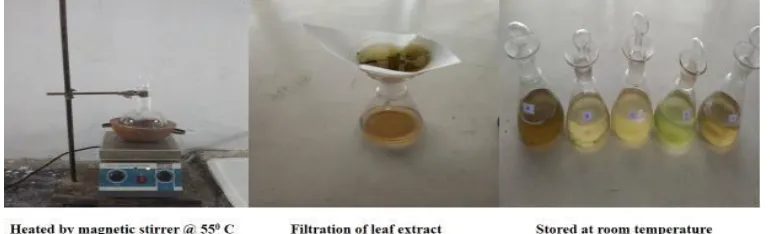
The leaf extract of Milletapinnata(10mg) was weighed and taken in a 250 ml beaker along with 150 ml of Distilled water was added to it and then boiling the mixture for 60minutes by magnetic stirrer at 550ºC. Further the extract was filtered with Whatman No. 1 filter paper and stored at room temperature and used for further experiments (Kesarla Mohan Kumar et.al 2012).
Figure 1. Plant extract preparation
18
INTERNATIONAL JOURNAL OF ADVANCES IN ENGINEERING RESEARCH
Figure 2. Bio synthesis of Ag nanoparticles
UV- Visible spectroscopy
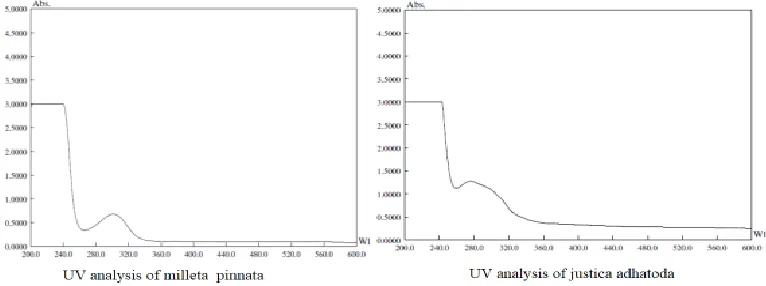
UV-Visible spectroscopy is utilized to analyze the size and shape of nanoparticles in aqueous suspensions and the UV-Visible spectra was recorded after few hour incubation of the synthesized silver nanoparticles in dark place. The absorption spectra of the AgNPs have an absorbance peak at 300 nm, and a broadening of the peak indicates that the particles were poly dispersed shown in figure 3.
4. SEWAGE WATER TREATMENT USING AG NANOPARTICLES
The experiments were carried out using batch studies method. The synthesized leaf extract and waste water were taken 250 ml in round-bottom flask. The pre-prepared Ag nanoparticles added into this with a dosage rate of 5 ml and waste water dosage is taken around 10 ml in the round bottom flask. The flask were initially stirred with a pellets for mixing the sample and heated up to 45 minutes using water bath at 7000 C. After heating, the sample were drawn at regular intervals and checked for pH, TDS, Total hardness, BOD, COD as per APHA standards. All the tests are done in triplicate and the concordant values were taken for the results comparison.
5. RESULT AND DISCUSSION
In the experiment, the batch adsorption study was conducted to find out suitability of bio-adsorbents for reducing contamination in sewage water.A preliminary analysis was carried out to determine the preliminary characteristics of sewage water for examining the efficiency of theleaves extractas a adsorbent were synthesized Ag nanoparticles. The initial characteristics of raw sewage water pH, TDS, TH, BOD3, and COD were presented in Table.1 After treatment, the
19
INTERNATIONAL JOURNAL OF ADVANCES IN ENGINEERING RESEARCH Characterization of Ag nanoparticles using UV spectroscopy
UV–vis spectra of the reaction mixture of silver nitrate solution with fresh leafextracts that were exposed with different concentration such as 3ml, 6ml, 9ml, 12 ml. The UV–Visible spectra of this solution was recorded in spectra 50 ANALYTIKJENA Spectrophotometer, from 200 to 600nm with a resolution of 1 nm. (D. Bharathi et.al 2015). Therefore, the aqueous bioreduction of Ag+ ions can be effectively monitored by a UV-Vis spectrophotometer. The effects of the plant extract concentration on the synthesis of Ag NPs were also evaluated using UV-Vis spectroscopy. The absorption spectra of Ag NPs prepared using different concentrations of plant
extract. All experiments were carried out by varying the concentration
ofmilletapinnataandjusticaadhatodaleavesextract, keeping other conditions constant (using
0.1MAgNO3) at 70°C.
This is also reflected by the color change of the diluted pure Ag NP solution from light to dark brown as the plant extract concentration increased. comparative study was also carried out to investigate the effects of AgNO3 concentration 3ml, 6ml, 9ml, 12ml respectively) on preparation of Ag NPs.
Figure 3. UV analysis of natural adsorbent
During the current study, treatment with leaf extract with Ag nanoparticles 5ml was added to sewage waste water samples in the dosage of 10 ml. The pH of the sample after treatment was 7.4 and 7.2. The recommended acceptable range of pH for sewage water is 6.5 to 9.0. Finally the study revealed that both analysis give good result for reducing pH with in the permissible limit. The accepted level of TDS was 3500 mg/l in sewage waste water. During the analysis
milletapinnatagave best result for reduce TDS 4000 mg/l and COD 228 mg/l.
Justicaadhatodawas reduce the BOD3 251 mg/l. The maximum absorption efficiency of
20
INTERNATIONAL JOURNAL OF ADVANCES IN ENGINEERING RESEARCH Table 1. Characteristics of sewage water before treatment
Characteristics of water
Sewage water
Standard Limits
pH 8.4 6.5 to 9.0
Temperature 180 C -
Total Dissolved solids (mg/l)
6850 3500
Total Hardness (mg/l) 600 300
BOD3(mg/l) 400 30
COD (mg/l) 248 250
Table 2. Characteristics of sewage water after treatment
Characteristics of waste water
Milletapinnata Justicaadhatoda
pH 7.4 7.2
TDS (mg/l) 4000 6350
Total Hardness (mg/l) 400 500
BOD3 (mg/l) 356 384
COD (mg/l) 228.8 251.2
6. CONCLUSION
In this study, the batch adsorption study was conducted to find out suitability of bio-adsorbents for removing contamination in sewage water. it is a green approach for the synthesis of silver nanoparticles using low cost leaves extract. The leaves extracts of milletapinnata and justicaadhatodaacts as an natural adsorbent for the treatment of sewage water. Applying this method, Ag NPs were prepared at ambient conditions without using any harmful reducing or capping agents.UV analysis method, nanoparticlesformed around 320 nm. The ability of bio adsorbents with Ag nanoparticles in different concentration is allowed to react with sewage water and monitored the parameters like pH, TDS, TH, BOD, COD.From the result it is observed
21
INTERNATIONAL JOURNAL OF ADVANCES IN ENGINEERING RESEARCH
It is justified that the green synthesis of bio adsorbent nanoparticles is a better alternative to chemical synthesis, since this green synthesis is pollutant-free and eco-friendly.
REFERENCES
(1) Kesarla Mohan Kumaret.al, Green synthesis of silver nanoparticles using
Terminaliachebula extract at room temperature and their antimicrobial studies, SpectrochimicaActa Part A: Molecular and Biomolecular Spectroscopy (2012)
(2) Dhermendra K. Tiwari et.al, Application of Nanoparticles in Waste Water Treatment, World Applied Sciences (2008).
(3) D. Bharathi et.al, Biological synthesis of silver nanoparticles by using leaf extract of
Justiciaadhatoda, Der Pharmacia Lettre (2015).
(4) Shamina.SEt.Al, Green Synthesis Of Silver Nanoparticles And Effect Of
CoriandrumSativumIn Cadmium Chloride Induced White Molly Fishes, World Journal
Of Pharmacy And Pharmaceutical Sciences (2015)
(5) M.Balamurugan, Characterization of Coriander Sativum Mediated Silver Nanoparticles and Evaluation of Its Antimicrobial and Wound Healing Activity, IOSR Journal of Polymer and Textile Engineering (2014).
(6) Lizzy Mpenyana-Monyatsi et.al Cost-Effective Filter Materials Coated with Silver Nanoparticles for the Removal of Pathogenic Bacteria in Groundwater International Journal of Environmental Research and Public Health (2012).
(7) ParineetaPandhramEt.Al, Adsorption Of Chromium from Industrial Waste Water
(8) By Using Neem leaves as a Low Cost Adsorbent, International Journal Of Chemical And Physical Sciences (2013)