Evaluation of the MSU-IIT College of Nursing Enhancement
Program Using the ABCD Model As a Framework
Abdullah Junior S. Mangarun
Mindanao State University, Iligan Institute of Technology Iligan City, Philippines, 9200
Date Submitted: September 19, 2014 Originality: 91%
Date Revised: December 20, 2014 Plagiarism Detection: Passed
ABSTRACT
The primary objective of the Mindanao State University – Iligan Institute of Technology College of Nursing Enhancement Program (MSU-IIT CON-EP) is to prepare nursing graduates for the Philippine Nursing Licensure Exam (PNLE) by enhancing their critical thinking ability and test-taking strategies using Lecture–Mastery Drills Exam –Rationalization Cycle. However, with the present Competency Appraisal (CA) that is proven to be dysfunctional and the misconceptions that marred the operations of the program, the administrators decided to shutdown the program. Hence, this study revisits the CON-EP using Ochave’s ABCD Model by reviewing four components such as students, program implementation, efficiency and social impact through survey and key informant interviews. One hundred ninety one (191) respondents from Batch 2008-2014 perceived the efficiency of the program as very good. The respondents believed that the program equipped them to pass the PNLE and in practicing the nursing profession. Secondary data gathered showed that the program has produced five topnotchers in the PNLE 2008, 2009, 2010 and 2014 and made the school as the second best performing nursing school twice. Results from the interviews documented show that the operations of program is purposely driven to keep MSU-IIT as the flagship bearer of the best performing nursing school in Mindanao. With the common efforts and interest of the stakeholders to resurrect the program, several salient points were brought up in this study. Once comprehensively reviewed, the program should be planned with the institute administrators, so as to prevent misconceptions. Furthermore, 100% support by the administrators could provide a ‘win-win’ solution for both the operators and the administrators that could be beneficial to the graduates, the school and the community.
Keywords: ABCD model, enhancement program, colleg of nursing
INTRODUCTION
Filipino nurses have been perceived as the epitome of nurse practitioners
amongst expatriate nurses in the
international arena. Even the curriculum was enhanced in response to the recommendations made by the Philippine Overseas Employment Administration to the global demands for Filipino nurses. Hence, the Bachelor of Science in Nursing (BSN) curriculum was regularly redesigned and refined towards developing skills, attitude and knowledge crafted to have a better edge in the international labor
compromised the quality of nursing practice. There has been escalation of programs and mushrooming of schools which suggest ballooning of nursing students in the country. According to the New Zealand Nursing Council, as many Filipinos take nursing as a secondary tertiary qualification and finish the course faster, the council feels as if they have not been trained enough (Tan, 2009). The Commission on Higher Education has been releasing series of orders for closure of low performing nursing schools.
In response to the recent trends in the nursing exam results and the aggressiveness of the CHED’s response to close low performing schools or colleges, the Mindanao State University- Iligan Institute of Technology- College of Nursing
formulated and intensified the
Enhancement Program with the initiative of the head administrators of the college and the university. The program is designed to suit the learning needs of the senior nursing students who are about to take the PNLE. However, the efficacy of the program has not been empirically studied. Hence, this study aims to evaluate the program using the ABCD Model as a framework which could serve as basis in refining their operations and actualizing their goals.
Theoretical- Conceptual Framework
Anchored to Ochave’s (2003) ABCD Model, the study conceptualizes the plight
of the stakeholders in the program from being an enrolee, experiencer, evaluator and source of testimonies on the success of the program (see Figure 1). The proposed model is widely used in evaluating trainings or a curricular endeavour wherein the stakeholders are involved in the process. As presented in Figure 1, the model has five main components- the beneficiaries or enrolees (A), the evaluation program (B), efficiency of the program (C), and the social impact (D).
Component A refers to the BSN graduates enrolled in the enhancement program. The college and university
administrators of the enhancement
program usually have in mind the standard participants for the entire duration of the lecture-practice exam series; however, the actual enrolees may not always coincide with the intent. Component B is the MSU-IIT
Enhancement Program including its
implementation and operations which evaluates preparedness of the enrolees to pass PNLE. This has several aspects and the program can choose and define specific aspects within the limits of its operations, implementation and available data. The indicators of component B include the set of intended goals and objectives by the administrators, teaching and learning strategies used by the teachers, facilities and materials utilized throughout the duration of the program, and the perceived strengths and weaknesses.
Figure 1. Conceptual Framework of the Study
A
•Students
B
CON Enhancement Program
C
Efficiency
Component C includes the evaluation of the efficiency of the enhancement program. These are the changes experienced by the BSN graduates enrolled in the evaluation. Stated objectives are intents for this component which aim changes that transform beneficiaries to become more competent PNLE-based exam takers and better critical thinkers. Indicators of this component include perceived efficiency by the enrolees and the results of the PNLE. Intended effects include high passing rate and high rank in PNLE. Component D is the social impact of the through, though not always, the enrolees of the program. Obviously it is remote and is “in the future” but is probably significant and lasting. While this may not yet be discretely collected by evaluators but the intended impact may be spelled out. Impact in the community includes those feasibly traceable to the evaluation of enrolees to social welfare and community betterment. In this study Component D include the vision of the enhancement program, current job of the enrolees, and review on medical missions and implementation of the other healthcare programs by which enrolees were involved or registered.
Based on the model, direction and colour of the arrows from one component to the other have meanings. Gray arrows pointed to the next component suggest straightforward connection whereas white arrows suggest indirectness. The gray arrow from B to C components means that perceived efficiency and the PNLE results are the direct results of the implementation and operations of the MSU-IIT Enhancement Program. The white arrow from B to C components means that impact is distant in time and may interact with other factors including socio-political context. The white arrow from the A to C components means
that the quality of effects is indirectly dependent on the quality of the enrolees. The components ABCD of the Model are sequential. This is parallel to the actual events in an educational or training evaluation. This simple attribute of the Model contributes to its intuitive appeal to the users. In traditional evaluation, descriptions of the evaluator are enough. Some call this assessment as it is limited to descriptions. Even at present there are evaluation reports of training seminars and workshops that perform only at the descriptive level. Data for some of these are on the training evaluation. Thus, the reporting on the “observations” which are actually descriptive has been considered important. Actual happenings in an evaluation have value when they are judged against standards or expectations. The proposed model includes observations and actual happenings and is part of the descriptive dimension which is herein called “actualities”. The advantage of the model is the inclusion of the dimension on “intents”. This addition must not be trivialized for it is here where educators seem to be negligent for some unknown reasons.
Statement of the Problem
The primary aim of this study is to evaluate the efficiency and performance of the College of Nursing’s Enhancement Program of MSU-IIT based on the ABCD Model of Ochave (2003).
accepted were explored as part of Component A of the model.
The operations are also explored including the goal and objectives, teaching and learning strategies, facilities and
materials, and the strengths and
weaknesses of the program since its initiation in 2008 until 2014. These indicators describe the program as perceived by the implementers and administrators qualitatively and serve as the elements of Component B.
The study also determines the efficiency of the program based on the perceived efficiency by the students and the Philippine Nursing Licensure Exam Results or PNLE from 2008-2014. Specifically gathered are the percentage of passers, failed takers, rank among the top performing schools and the rank among the top performing students from secondary data released by the Professional Regulation Commission or PRC. These indicators constitute the Component C of the model. Lastly, the presence of health care facilities or business and the
opportunities for work comprises
component D of the model. Hence, the current job of the stakeholders, review on medical missions and implementation of the other healthcare programs with the involvement of the stakeholders, now licensed, were researched and treated as indicators. The comprehensive review of this component is remote by nature and is “in the future” but is probably significant and lasting. While this may not yet be
collected comprehensively by the
evaluators, intended impact was spelled out by the above indicators added with the data on the vision of the program.
METHODOLOGY
Locale of the Study
The respondents of the study were BSN graduates officially enrolled in enhancement program from 2008-2014 based from secondary data released by MSU-IIT CON. The survey was conducted at the CON Conference Hall of MSU-IIT, where the enhancement program is typically held. Other respondents received e-mails with the consent and the research instrument.
Research Design
The study is an applied research which utilized descriptive method. The descriptive research design was adapted to analyze and interpret data on the efficiency of the program and the rest of the objectives. Data of components B, C and D were collected from secondary data released by the said program and
Professional Regulation Commission
through data mining. Retrospective data were reviewed to describe the operations of the program, the PNLE results and the success of the students after completing the program. Qualitative data was also utilized
in extracting information on the
components of the program from key informants who are directly involved in the operations.
The Instrument and Its Validity
A standard questionnaire by the ESL Regional Trainings was modified and utilized focusing on the perceived efficiency of the enhancement program by the enrolees. It comprises 11 questions and uses 5 point Likert Scale. The tool was pilot tested with 10 respondents and treated with reliability test and content validity. Cronbach’s alpha showed 0.74 which means that the modified questionnaire is reliable for the final conduct of the study (Component C).
Structured interview guide was used in gathering data on the operations and components of the program through key informant interview. Key informants were directly involved in the operations of the enhancement program (Component B). Secondary data for component D was based on the current job and health-related advocacy programs in which enrolees from 2008-2014 are actively involved. Secondary data were taken from the respondents themselves and the compilation of accreditation files of CON.
The Respondents and Sampling Procedure
Respondents of the study were BSN graduates and are officially enrolled in the CON Enhancement Program. They were included among those students who took the assessment exam before considered as
eligible respondents. Key informant
interviews were also conducted in order to explore the operations and components of
the program. Key informants included were the dean of the college, the review system program coordinator and several reviewers. Slovin’s formula was used in determining the sample size. A total of 191 respondents from batch 2008-2014 participated in answering the questionnaire.
Data Gathering Procedure and Statistical Analysis
Letters of approval from the dean and the review systems coordinator were secured before the conduct of the study. Informed consent was attached to the survey questionnaire that was distributed to the respondents either through e-mails or personal contact.
The data was collected, tabulated and analyzed using the Average Weighted Mean. This was used in the analysis of the perceived efficiency of the program by the respondents.
RESULTS AND DISCUSSION
Table 1. Respondents’ perceived efficiency of the .CON enhancement program
Legend: E (excellent) VG (Very Good)
Statements AWM I
1. The topics covered were relevant to the enhancement program 2. The reviewer was knowledgeable
about his/her topics.
3. The meeting room and facilities were adequate and comfortable. 4. Participation and interaction were
encouraged.
5. The enhancement program was useful to me in preparation for the board exam.
6. The reviewer was well prepared. 7. The objectives of the CON
enhancement program were clearly defined.
8. The materials distributed were helpful.
9. The CON enhancement program objectives were met.
10.The content was organized and easy to follow.
11. The time allotted for the CON enhancement program was sufficient.
4.82
4.69
4.67
4.58
4.52
4.49 4.49
4.39 4.36
4.29
4.10 E
E
E
E
E
VG VG
VG VG
VG
VG
Weighted Mean
The efficiency of the CON enhancement program based on the perception of the students is reflected in table 1 below. Generally, the students rated the program as “very good” with 4.49 AWM. The students perceived the program as excellent in encouraging participation and interaction (4.58), covering relevant topics (4.82), and enhancing preparedness (4.52) to take the board exam. They perceived the reviewers as excellently knowledgeable (4.69) about the concepts that they are lecturing in the review classes.
However, the program was rated very good for materials and methods (4.39), defining (4.49) and attaining objectives (4.36), time allocation for the review classes (4.10), preparedness of the reviewers (4.49) and when following the content of the lecture (4.29).
This means that the respondents believed that the CON enhancement program’s efficiency was very good in helping them prepare for nursing board examination. It goes well when the respondents are optimistic about the effect of the enhancement program.
Table 2.1 showed through
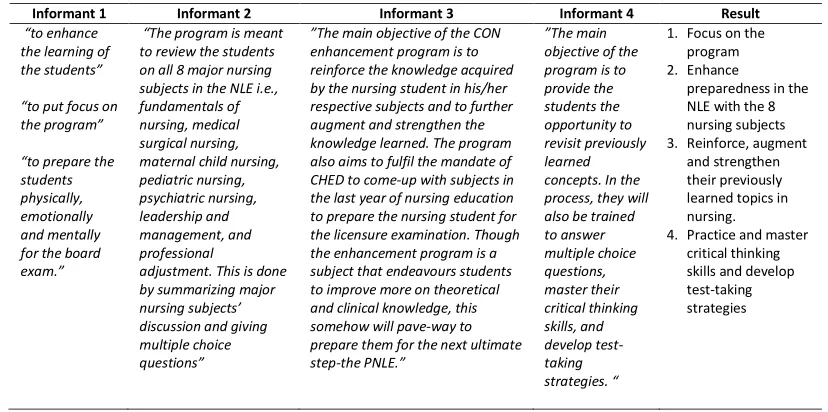
thematic analysis that there were four main objectives of the program. These objectives included (1) keeping the students focused in the upcoming board exam, (2) enhancing preparedness, (3) reinforcing and strengthening previously learned fundamentals and concepts in nursing, and (4) practice and develop critical thinking skills and test-taking strategies. These objectives are said to be the ingredients that every reviewer must install to their students for them to succeed and for the programs to consider their goals as met.
Table 2.1. The objective/s of the CON Enhancement Program Question 1: What are the objectives of the program?
Informant 1 Informant 2 Informant 3 Informant 4 Result
“to enhance the learning of the students”
“to put focus on the program”
“to prepare the students physically, emotionally and mentally for the board exam.”
“The program is meant to review the students on all 8 major nursing subjects in the NLE i.e., fundamentals of nursing, medical surgical nursing, maternal child nursing, pediatric nursing, psychiatric nursing, leadership and management, and professional
adjustment. This is done by summarizing major nursing subjects’ discussion and giving multiple choice questions”
”The main objective of the CON enhancement program is to reinforce the knowledge acquired by the nursing student in his/her respective subjects and to further augment and strengthen the knowledge learned. The program also aims to fulfil the mandate of CHED to come-up with subjects in the last year of nursing education to prepare the nursing student for the licensure examination. Though the enhancement program is a subject that endeavours students to improve more on theoretical and clinical knowledge, this somehow will pave-way to prepare them for the next ultimate step-the PNLE.”
”The main objective of the program is to provide the students the opportunity to revisit previously learned concepts. In the process, they will also be trained to answer multiple choice questions, master their critical thinking skills, and develop test-taking strategies. “
1. Focus on the program 2. Enhance
preparedness in the NLE with the 8 nursing subjects 3. Reinforce, augment
and strengthen their previously learned topics in nursing.
4. Practice and master critical thinking skills and develop test-taking strategies
Table2.2. shows that the administrators and the reviewers like to be
the tension for the upcoming board exam, taking series of nursing board type questions, and giving the students that fair chance of reviewing and relearning the previously taught concepts are what the key
informants love about becoming part of the program. They are also able to assess the weakness of the students and provide focused teaching in order to cater their learning needs.
Table 2.2. The advantage/s of being part of the CON Enhancement Program Question 2: What do you like most about the enhancement program?
Informant 1 Informant 2 Informant 3 Informant 4 Result
-“students are more focused, gold driven knowing that they are to become professional nurses”
-“to experience how it is to take the board exam -to lessen the tension”
“It gave me as review
coordinator much leeway and freedom with how I wanted the program to be done. I could decide which subject I want to review first based on what I feel the students need most.”
“As a past reviewer of the said program (Leadership & Management, Nsg Jurisprudence), it somehow challenged me to study my area of specialty and update myself (not only the students) for the latest trends and issues concerning nursing. Aside from the professional challenge, there is also that passion and drive to inculcate to the students pertinent knowledge that could somehow help in their licensure examination and the drive to try to help them excel during and after their board exam.”
“What I like most about the program is it gives all the students a fair chance of re-learning everything. Since students already have background knowledge on the concept, they are more eager to learn because they find it more meaningful. The enhancement program also gives the reviewers the chance to highlight more important aspects of a concept. I consider it as a 2-way process. The lecturers impart more knowledge while the students contribute more questions to make a concept clearer and easier. “
1.For the students to try how it is to take the board exam
2.Freedom to choose on what to discuss basing on the needs of the students
3.It helped lessen the tension of the students
4.Able to update self about the latest trends and issues
5.Fair chance of re-learning the topics
There’s no such thing as an absolutely perfect system. Table 2.3 shows the areas of the programs that need to be enhanced based on the answers of the five key informants. Though there was attendance and performance monitoring, the key informants think that this needs to be strictly done. The methods of supervising should be refined. The selection of reviewers should also be revisited since it plays a vital role in keeping up the students’ interest to adhere to the program. It should be based on expertise or field of specialization, experience and educational attainment. Hence, lecturers should not be limited to
Table 2.3. Aspects of the CON Enhancement Program that needs improvement Question 3. What aspects of the enhancement program should be improved?
Informant 1 Informant 2 Informant 3 Informant 4 Result
“programming”
“to get different lecturers not from MSU-IIT”
“to inform the lecturers ahead of time about the enhancement program”
“Definitely, it needs to be RETURNED. As of now, it has been closed down and replaced with a dysfunctional 1 unit per C.I-Competency appraisal. May be then, the passing rate of MSU-IIT CON would be more than 90% again.”
“Support and encouragement from the administrators; and diligence and discipline from students. The program itself has good intensions but marred by misinterpretation as of its main aim. The program was really effective but because of some misconceptions, the goal of the said program was doubted by ‘some’ people regardless of the raving feedback from previous batches that enjoyed the same program. Evidence is the board exam rating that did not fall down to 95% from the first takers. It is a sad fact and the current students are suffering because of this situation. Because of this, they feel like they are being
discriminated in a way. It should be returned.”
“The program was satisfying for me but there are still a lot of areas to be improved. I think one in particular would be the standardization of the assessments and the areas it measures. Another thing is the choice of Lecturers or Reviewers. A lecturer or reviewer plays a very big factor in the successful outcome of the program. I also find monitoring of student’s performance and attendance needing to be improved. “
1.Programming 2.Support from the
administrators 3.Choice of lecturers 4.Strict attendance
and monitoring of students performance
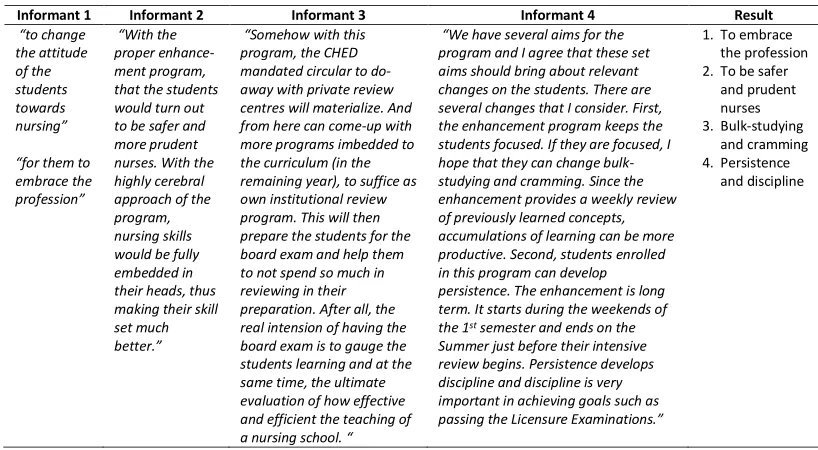
Table 2.4 .Aim of the key informants to change the students practice in nursing through the CON Enhancement Program
Question 4. How do you improve the nursing skills of students throughout the program?
Informant 1 Informant 2 Informant 3 Informant 4 Result
“to change the attitude of the students towards nursing”
“for them to embrace the profession”
“With the proper enhance-ment program, that the students would turn out to be safer and more prudent nurses. With the highly cerebral approach of the program, nursing skills would be fully embedded in their heads, thus making their skill set much better.”
“Somehow with this program, the CHED mandated circular to do-away with private review centres will materialize. And from here can come-up with more programs imbedded to the curriculum (in the remaining year), to suffice as own institutional review program. This will then prepare the students for the board exam and help them to not spend so much in reviewing in their preparation. After all, the real intension of having the board exam is to gauge the students learning and at the same time, the ultimate evaluation of how effective and efficient the teaching of a nursing school. “
“We have several aims for the program and I agree that these set aims should bring about relevant changes on the students. There are several changes that I consider. First, the enhancement program keeps the students focused. If they are focused, I hope that they can change bulk-studying and cramming. Since the enhancement provides a weekly review of previously learned concepts, accumulations of learning can be more productive. Second, students enrolled in this program can develop persistence. The enhancement is long term. It starts during the weekends of the 1st semester and ends on the Summer just before their intensive review begins. Persistence develops discipline and discipline is very important in achieving goals such as passing the Licensure Examinations.”
1.To embrace the profession 2.To be safer
and prudent nurses 3.Bulk-studying and cramming 4.Persistence and discipline
The program does not only focus on the results of the nursing licensure exam but also in enhancing their practice as nurses in the future. Students are molded
towards embracing the profession.
enhancing preparedness to take the board exam.
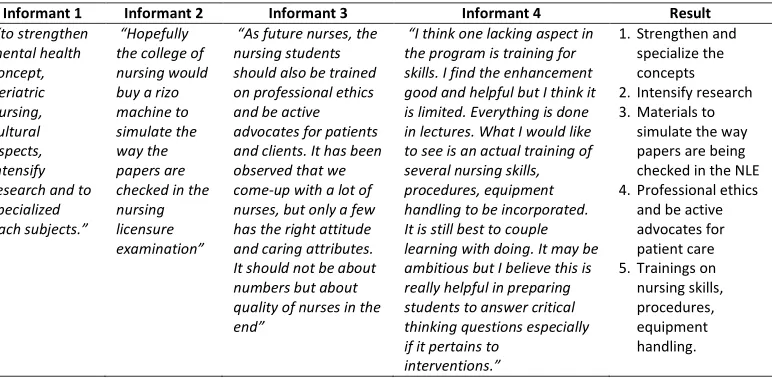
To advance and perform its role as a training program for future nurses, the key informants propose that the following should included: (1) specializing the
nursing concepts, (2) more emphasis on
LMR which include leadership,
management, ethics and research, and (3) utilizing materials and equipment that will enhance nursing skills and quick retrieval of test score.
.
Table 2.5. Trainings and services that the key informants want to be added in the Program Question 5. What trainings and services would you like to be added in the program?
Informant 1 Informant 2 Informant 3 Informant 4 Result
“to strengthen mental health concept, geriatric nursing, cultural aspects, intensify research and to specialized each subjects.”
“Hopefully the college of nursing would buy a rizo machine to simulate the way the papers are checked in the nursing licensure examination”
“As future nurses, the nursing students should also be trained on professional ethics and be active advocates for patients and clients. It has been observed that we come-up with a lot of nurses, but only a few has the right attitude and caring attributes. It should not be about numbers but about quality of nurses in the end”
“I think one lacking aspect in the program is training for skills. I find the enhancement good and helpful but I think it is limited. Everything is done in lectures. What I would like to see is an actual training of several nursing skills, procedures, equipment handling to be incorporated. It is still best to couple learning with doing. It may be ambitious but I believe this is really helpful in preparing students to answer critical thinking questions especially if it pertains to
interventions.”
1.Strengthen and specialize the concepts 2.Intensify research 3.Materials to
simulate the way papers are being checked in the NLE 4.Professional ethics
and be active advocates for patient care 5.Trainings on
nursing skills, procedures, equipment handling.
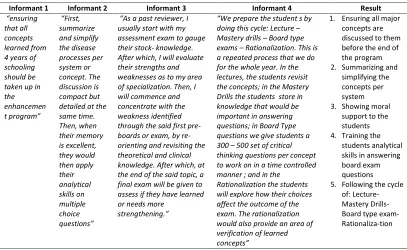
The key ingredient of the programs on enhancing the preparedness of the students is by following the cycle of
Lecture–Mastery Drills
Exam-Rationalization (see Table 2.6). The lectures are done by the reviewer ensuring that all major concepts were covered before the end of the program. All concepts are summarized and simplified focusing on the must-knows and less on the nice-to-know information.
Table 2.6 . How the key informants prepare the students for the board exam through this program Question 6. How do you prepare students for the board exam through this program?
Informant 1 Informant 2 Informant 3 Informant 4 Result
“ensuring that all concepts learned from 4 years of schooling should be taken up in the enhancemen t program” “First, summarize and simplify the disease processes per system or concept. The discussion is compact but detailed at the same time. Then, when their memory is excellent, they would then apply their analytical skills on multiple choice questions”
“As a past reviewer, I usually start with my assessment exam to gauge their stock- knowledge. After which, I will evaluate their strengths and weaknesses as to my area of specialization. Then, I will commence and concentrate with the weakness identified through the said first pboards or exam, by re-orienting and revisiting the theoretical and clinical knowledge. After which, at the end of the said topic, a final exam will be given to assess if they have learned or needs more
strengthening.”
“We prepare the student s by doing this cycle: Lecture – Mastery drills – Board type exams – Rationalization. This is a repeated process that we do for the whole year. In the lectures, the students revisit the concepts; in the Mastery Drills the students store in knowledge that would be important in answering questions; in Board Type questions we give students a 300 – 500 set of critical thinking questions per concept to work on in a time controlled manner ; and in the
Rationalization the students will explore how their choices affect the outcome of the exam. The rationalization would also provide an area of verification of learned concepts”
1. Ensuring all major concepts are discussed to them before the end of the program 2. Summarizing and
simplifying the concepts per system 3. Showing moral
support to the students 4. Training the
students analytical skills in answering board exam questions 5. Following the cycle
of: Lecture-Mastery Drills-Board type exam- Rationaliza-tion
The retrospective-data started 2008 since the pioneering batch started taking the board exam on that same year. It is evident that the performance of the previous takers was overwhelming with almost 100% passing rate. It was in June 2010 that the passing rate peaks at 99.98% and lowest on June 2013 which is 88.80 %.
Table 3.1. Performance of the students in the nursing board exam from 2008- 2014 based on the passing rate
Source: Philippine Regulation Commission
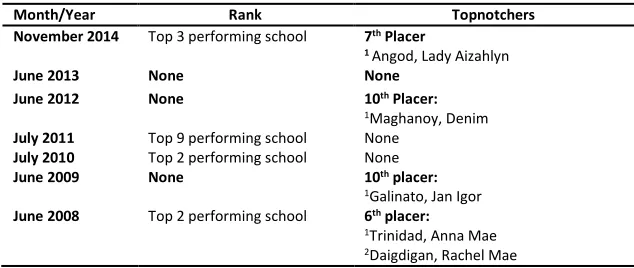
The performance of the students in the Nursing Board Exam from 2008-2013 based on Rank and Number of Topnotchers are shown in Table 3.2. The pioneering batch 2008 earned two
topnotchers landing both in 6th place. This
high rate of passers made the school as the top two performing school in the Philippines. The next set of graduates who took the board exam in 2009 earned one topnotcher, ranked 10th, who happened to be the only topnotcher in the whole Mindanao. After 3 years of waiting, another student of the enhancement program joined the cluster of topnotchers
ranked 10th. 7th spot was garnered by one
of the program’s enrollees in the November 2014 PNLE.
June 2010 nursing board exam result ranked the school again as second among performing schools in the
Philippines. Another topnotcher, 10th
Month/Year Passing Percentage
November 2014 97.41%
June 2013 88.80%
June 2012 96%
July 2011 97.92%
July 2010 98.98%
June 2009 98.15%
placer, joined the ranks during the June 2012 Nursing Board Examination. Because
of this, MSU-IIT was duly recognized for its high standards of quality education. .
Table 3.2. Performance of the students in the nursing board exam from 2008-2014 based on Rank and # of Topnotchers
Month/Year Rank Topnotchers
November 2014 Top 3 performing school 7th Placer
1 Angod, Lady Aizahlyn
June 2013 None None
June 2012 None 10th Placer: 1Maghanoy, Denim
July 2011 Top 9 performing school None
July 2010 Top 2 performing school None
June 2009 None 10th placer: 1Galinato, Jan Igor
June 2008 Top 2 performing school 6th placer: 1Trinidad, Anna Mae 2Daigdigan, Rachel Mae
Source: Philippine Regulation Commission, 2008-2013
Table 3.3. Performance of the students in the Nursing Board Exam from 2008-2014 based on Total number of Passers and non-passers
Month/Year Takers Passers Percentage of Passers
November 2014 116 113 97.41%
June 2013 125 111 88.80%
June 2012 100 96 96%
July 2011 96 94 97.92%
July 2010 98 97 98.98%
June 2009 108 106 98.15%
June 2008 88 86 97.73%
Table 3.3 shows the performance of the students in the nursing board examination from 2008-2014 in terms of total number of passers and non-passers. Results showed that the highest number of students who failed in the exam was in June 2013 with 13 non-passers and the lowest number of failed takers was in July 2010 with only 1 passer. Thenumber of non-passers seems to increase recently. The CON enhancement program should be revisited. The deficits may be recognized,
materials and methods should be
enhanced, and there should be active involvement of the plan with the students, reviewers and the college and university
Table 4.1. Employability of the graduates after taking or passing the board exam
Batch Hospital Nurse
Indeterminate Call center Medical students
Clinical Instructor
Others
2008 50 17 8 5 2 8
2009 50 40 4 12 2 4
2010 59 15 8 9 2 14
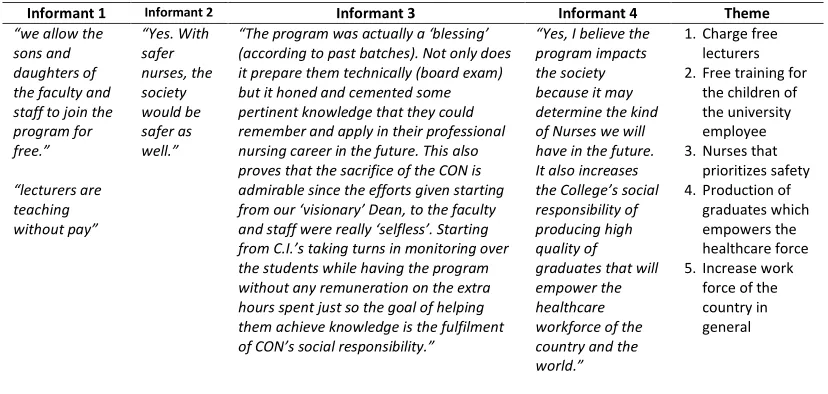
Based on the interview from key
informants, The CON enhancement
programs do not only prepare the students to take and pass the board exam but it recognizes its responsibility to the society. By sharpening the theoretical foundations and enhancing skills in the review, the kind
of nurses that the society will be having is definitely favoured. Through training, these future nurses would ensure safety and quality services hence the society would be safer as well. Producing newly licensed nurses increases the workforce of the country in general.
Table 4.2. The social impact of the CON enhancement program
Does the program impact the society?
Informant 1 Informant 2 Informant 3 Informant 4 Theme
“we allow the sons and daughters of the faculty and staff to join the program for free.”
“lecturers are teaching without pay”
“Yes. With safer nurses, the society would be safer as well.”
“The program was actually a ‘blessing’ (according to past batches). Not only does it prepare them technically (board exam) but it honed and cemented some pertinent knowledge that they could remember and apply in their professional nursing career in the future. This also proves that the sacrifice of the CON is admirable since the efforts given starting from our ‘visionary’ Dean, to the faculty and staff were really ‘selfless’. Starting from C.I.’s taking turns in monitoring over the students while having the program without any remuneration on the extra hours spent just so the goal of helping them achieve knowledge is the fulfilment of CON’s social responsibility.”
“Yes, I believe the program impacts the society because it may determine the kind of Nurses we will have in the future. It also increases the College’s social responsibility of producing high quality of graduates that will empower the healthcare workforce of the country and the world.”
1.Charge free lecturers 2.Free training for
the children of the university employee 3.Nurses that
prioritizes safety 4.Production of
graduates which empowers the healthcare force 5.Increase work
force of the country in general
CONCLUSION
Based on the findings of the study, the following conclusions were drawn: 1. there are two important constructs used in the proposed model which include the intents of the MSU-IIT Enhancement Program, and the actualities or observation; 2. the proposed model has four components, ABCD which are the trainees or BSN graduates enrolled in the program
(A), MSU-IIT Enhancement Program’
The MSU-IIT CON-EP was documented to be very good based on the perceptions of the enrolees and the retrospective data from PRC showing high passing rate and either by grabbing ranks as takers or as best performing school in the Philippines Nursing Licensure Exam. Hence, the actualities justify the intent of the program. The recognition that the school is getting based on the PRC results can somehow be also attributed to the program. The employability of the enrolees is high despite the crisis experienced by most licensed and non-licensed nurses nowadays.
Principles of organizational learning may be applied in the evaluation exercise wherein stakeholders, the enrolees of the program, are involved. This includes teamwork, dialogue, reflection, consensus building, reality creation and testing, questioning, and the like. With stakeholders actively participating in the exercise it may be agreed that an otherwise routine evaluation exercise can contribute to the development of a learning organization and innovative model.
RECOMMENDATIONS
The CON-EP started with one goal in mind and that is to produce well equipped nursing graduates and Registered Nurses. The program has been recently obscured
out of misconceptions despite the
recognition it gave to the university. Unfortunately, the closure cautions the students’ benefits and the schools pride which is presently at stake.
The program should be planned well, to include the institute administrators, so as to correct misconceptions and gain 100% support by the administrators in coming-up with a ‘win-win’ solution for
both the implementer’s and the
administrators. The program has already has the backbone, there is just an urgent need to remodel and revisit its operations. The results of the study using Ochave’s Model could be a good start-up. This model may be further tested regularly and utilized as basis in resurrecting the program. A team leader with a record keeper must serve as pivotal point in the evaluation and strategies may be adopted to enable the team of stakeholders to document and chart their perceived actualities from the intents. With stakeholders actively participating in the exercise it may be agreed that an otherwise routine evaluation exercise can contribute
to the development of a more systematic
operation and standardized implementation of procedures. Employment and community activity involvement of the members of Batch 2010 to 2014 must be reviewed to provide a clearer picture on the social impact of the graduates of the program since several gaps of these data were found out throughout the course of the study.
REFERENCES
Agatun, A., Alfonso, A.L., & Libut J.E. ( 2014, August 22). Higher education plagued by
endemic poor board results.
Varsitarian.net. Retrieved from
http://www.varsitarian.net/ special_reports.
Castaneda, J. (2013, June 17). CHED orders closure of 218 nursing schools.
Abs-cbnnews.com. Retrieved from
http://www.abs-cbnnews.com/nation
Manila Bulletin (2013, March 23). 83 nursing
schools closed. Yahoo.com.
Ochave, J.A. (2003). Towards the Development of a Blueprint for a Stakeholder-Friendly Evaluation Model
for Training and Education Programmes.
Journal of Southeast Asian Studies, 4 (2), 25-44. Retrieved from Google
search.
Tan, K.J. (2009, February 18). Stronger curriculum urged to give “edge” to Filipino nurses. Gmanetwork. com.
Retrieved from http://www.