20
China and its development model: a broad
outline from a different perspective
Arturo Oropeza García
Professor and Researcher, Legal Research Institute at the National Autonomous
University of Mexico
SUMMARY
:
I. Abstract. II. Introduction. III. Economic development as a state priority. IV. The law as leverage for development. V. Evaluation and conclusion. VI. Bibliography.I. Abstract
China’s economic success from 1978 to 2011 is truly surprising, for example the growth rate of its GDP (an
average of 10% a year for thirty years, second place in the world in 2011, 14 times its GDP from 1978 to
2007). However, we could also add that China’s economic history is very far from being over, and in the
future it will continue surprising us with its innovations, which it will have to keep in mind if it wants to
have a close idea of the most successful development strategy of recent decades.
II. Introduction
The reform in China is a great experiment that is not found in books. DENG Xiaoping
Despite its success and widespread diffusion of its results, China’s economic reform from 1978 onward is
still a topic that is difficult for the Western world to interpret. From its inception, the creator of the
model, Deng Xiaoping, warned that reforming modern China was a “great experiment” based on a broad
outline and subject to trial and error. While Deng pointed this out in 1985, a trusting, overestimating
Western world has not yet completely understood this unilateral declaration from the main author of
Chinese success. From the beginning, it told the world that a new China was embarking on the
adventure of traveling through unknown paths towards development despite the economic failure of its
previous experience (the Maoist Period 1949-1976) and the urgent need to feed around 900 million people
21
In the Western world, however, different development theories continue to compete between the
prevalence of politics over economics and/or vice versa. In a never-ending search for predominance,
analysis is frequently complicated, more than clarified, by forgetting that a healthy relationship between
politics and economics is inherent to successful economic development. There have been many disputes
within economic development theories regarding the different visions that have tried to be imposed
throughout the 20th century in search of sustained development. This has occurred in spite of the fact that, as
Douglass North points out, “…the similarity in the performance of the economies and the persistence of
disparate economies throughout time has not been satisfactorily explained by the development economists,
despite immense efforts carried out for 63 years. The simple fact is that the theory used is not up to the
task.”1
Despite the various formal economic development theories that have appeared since 1943 (Paul
Rosenstein-Rodán), the new political group that began to re-think China’s growth did not directly
incorporate contemporary theories (Clark, Nurkse, Lewis, Rostov, etc.) when instrumenting their initial
changes. China was well aware of its enormous economic limitations at the time: limited resources,
overpopulation, widespread poverty, a lack of savings, an economy in arrears, ineffectual industry, a lack of
infrastructure, limited external trade, an abundant but unqualified workforce, a lack of modern technology
and a political crisis, among others. Its failure to fully adopt an earlier model (the Soviet model) led it to
believe that reductionism was not the best way to attain successful development. As Oded Shenkar
points out:
The first 27 years (1949-1976) of the communist phase will continue being object of discussion;
although little by little the apologists from the period of Mao Zedong are decreasing. However,
regarding the economy and politics, there are no absolutes, and although the general results from the period are negative and at times were chaotic, such as the famine that presented itself in the
middle of the period, it can be said that within it some lessons were generated for the Chinese model that were greatly useful in its new boom, from 1978 onward. The first theory among them that can be highlighted is the one that detaches from the Great Leap Forward and the Cultural
Revolution, which consisted of pointing out the fact that the forcing the ideology of the economy
produces catastrophic results, that concrete results for development must be oriented toward this theory. At the very time that it was impossible to continue with the Russian model of investing and
creating infrastructure in the whole territory in such a big country with so few resources, the advisable thing to do was to focus the effort on the areas with the greatest potential, in order to later disseminate the results, an experience that has been one of the most important points of
22
the new development model, and finally, that the viability of the political project necessarily requires economic success2.
Thus, talking about China’s new development model is not an easy task. Its political environment from
preceding years was imbued with intense nationalist sentiment. Its idiosyncrasy and its multilayered past
intertwine and confuse observers with their various settings. Its political-economic platform derives from a
centralized model and it has recently implemented a market economy. In view of their different natures, all
these aspects continue to distort the opinion of a Western world accustomed to dichotomous economic
models (Communism-Capitalism) and that as early as 1989 thought could be synthesized into a single model
after the fall of the former Soviet Union. In an attempt to analyze certain qualities of the current Chinese
development model, it is useful to follow Deng Xiaoping’s advice and heed his warning: starting
from the premise that it is a “great experiment” that has not been deciphered in important economic
treaties. It is an experiment thought out and executed by a group of engineers and it must be seen as
something outside familiar paradigms within the framework of the new global order.
The three sections of this paper are as follows: II. Economic Development as a State Priority; III.
The Law as Leverage for Development and IV. Evaluation and Conclusion, in order to outline the new
development model of the People’s Republic of China.
III. Economic development as a state priority
Development by any means, without altering social stability. DENG Xiaoping
In the political crisis of the late seventies, China’s immediate challenge was to grow at any cost to meet the
urgent demands of its people. The previous economic model had already failed and outside China, future
growth wavered between the “success” of developed Western economies and an early prospect of
globalization that was starting to outline a new order for international development. Thus, the starting point
for the first reforms was clearly the need to implement an outward-oriented political-economic system. Deng
used all the State’s power to design a new development model that centered on increased foreign trade. For
this purpose, pertinent parts of Taiwan’s economic model were analyzed. It was noted that between 1960
and 1965 its GDP had grown an average of 9.5% while China was unable to go beyond 4.7%. Between 1965
and 1972, when the Chinese GDP rose only 1%, Taiwan’s grew at a rate of 10.1%. Consequently, the
Taiwanese example served as a starting point for the economic plan that Deng called “the four
23
modernizations” to attain “economic development by any means.” Various trade missions were sent to
northern Mexico at that time to see the assembly plant model first-hand. These visits also played an
important part in devising the new Chinese model.
1. A Broad Outline of Deng Xiaoping’s Economic Theories behind the Chinese
Development Model
In the early stages of reform, Deng Xiaoping would say,
Once we are certain that something has to be done, we should dare to experiment, to break out,
and to mark new paths with it. This is the important lesson that we should learn from Shenzhen. If we do not have a pioneering spirit, if we are afraid to take risks, if we do not have energy and
direction, we cannot break out and mark a new path, a good path, or do something new… No one can be 100% sure from the beginning that what he is doing is right. I have never been so sure. Every year, the leaders should review what they have done, continue with the measures that have
proven adequate, act immediately to change those that have proven wrong, and face up to new
problems as soon as they are identified.
Deng’s own life (1904-1997) falls within one of the most chaotic eras of Chinese history. He lived
through the end of the Empire (1912), as well as through various revolutionary movements (1912-1949) and
the Japanese invasion (1931-1945). During the Maoist Period (1949-1976), he met with different
movements, like the Cultural Revolution (CR, 1966-1976), which made him the target of strong political
attacks from the more conservative groups.
After the triumph of the Revolution and confronted with different social challenges, Deng’s
discourse was marked by starting from the current situation in order to find new that would take China out
of poverty, a course which clashed against the central power’s triumph list and dogmatic discourse. In
1957, he pointed out that “Seeing everything through rose-colored glasses and too simplistically is manifest
in our propaganda, idealizing the current situation of our country as if there were no longer any difficulties
and we only need to enjoy the amenities.” He added, “our main task from now on is building, which will be
somewhat more difficult, or at least not easier, than the Revolution…” In the face of the challenges of his
time he spoke of “learning, of course, from all the advanced experiences of the world, learning how much
24
they have advanced in different parts of the world, including the United States.” Although in the fifties,
he naturally put the Soviet Union in first place. He likewise recognized that “in China, many national
capitalists opened their paths in the midst of arduous struggles, and they know more than we do about
business management.” This opinion, which grew out of building up a new framework for growth, led to his
having multiple enemies and posed serious threats to him during President Mao’s orthodox and distinctive
“school of thought” for using his discourse and work in the Party to incite the country to follow the capitalist
path.
In spite of the opposition, he rose to power upon Mao’s death. Deng then had the
opportunity to put his ideas into practice, which basically stemmed from bringing together three factors:
development, structural reforms and political stability. As to this, he pointed out, “the solution to all of
China’s problems depends on economic development,” because “development is the absolute foundation and
in order to achieve it, it is necessary to insist again and again on the reforms that make it possible.” In 1985,
he added, “all our reforms are aligned with a single objective, which is to remove the obstacles that limit
or inhibit the development of productive forces, which, in turn, should be directed toward creating a
technological basis for development.” Deng’s theory always regarded the link between reform and
development as something perfectible with time and subject to trial and error; the reform to be applied
should aim for the best possible development. Reforms are like permanent public policies that correct
everything that does not contribute to development. However, he always maintained that these two premises
would not be possible without the stability in the country brought about through social and political balance
among its participants. On this topic, Deng Xiaoping declared, “If there is no stability, brought on by
political disparities, it will be impossible for us to move toward social construction.”
This simple reform-development-stability trilogy forms the theoretical basis of Deng’s development
model. Its main challenge was to achieve a balance of the concepts in time, so that their combined effect
would translate into benefits and improvements for the different social classes. Regarding this, Deng
explained, “the basic expression of the superiority of our socialist system is found in the possibility that the
productive forces of our society can grow rapidly, at rates never before seen in the old China, and
gradually give us the satisfaction of the cultural and material improvement that our people need.”
While various reforms for economic and commercial growth were being built around this
development strategy, the long-term vision of the project emerged: the knowledge of knowing what is
desired and what is possible, and the certainty of knowing in which direction to go. In 1978, Deng
Xiaoping said, “the essence of the reforms is to build the foundations for sustained development for the
25
next decade and the first fifty years of the next century.” He devised a strategy with a view towards the
future that he called “the three steps.” “In this century, we will take two steps, which represent the solution to
the problems of an adequate supply of food and clothing for our people. In the next century, we will
spend another 30 or 50 years to achieve the goal of another step, which is to reach the level moderately
developed countries of the world have.”
Deng was a visionary with a great capacity not only to adapt to the new political period his country
was entering after living practically walled in, but also to understand the great global transformation the
world was experiencing in the late 1970s and to lead China to take advantage of this situation. In 1987, he
said “currently, there are two models of productive development. Insofar as each one of them serves our
purposes, we will make use of it. If socialism is useful to us, the measures will be socialist; if capitalism is
useful to us, the measures will be capitalist.” In an unusual approach, he pragmatically pointed out,
there are no fundamental contradictions between socialism and the market economy… The experience that we have gained throughout recent years has demonstrated to us that we could not develop productive forces in a rigid economic structure. It is for this reason that we have been
implementing some useful capitalist measures. It is clear now that the correct approach for opening
oneself to the world is combining a planned economy with a market economy, to which structural reforms are implemented.
This combination of concepts gave way to what we now know as “market socialism.”
“Surely the affirmation that the market economy only exists in capitalist society, that there is only
a capitalist market economy, is incorrect. Why can’t socialism practice the market economy?” This
stance defined and revolutionized the paradigm of his central planning model and the theory of the capitalist
model was met in the same way. After all was said and done, what stood out was the pragmatic and
utilitarian intention of transforming economic models from ends to means. It did not matter whether the cat
was black or white, Deng said paraphrasing an old Chinese proverb, what mattered was that it caught mice.
He added, “there is no fundamental contradiction between socialism and a market economy, ‘both are
means.’” Even today, both (capitalist and socialist) theories continue to seek answers that clearly explain
this new model, which has validated itself through the success of its results.
On the topic of structural reforms, Deng indicated in the eighties that “without development,
reforms don’t mean anything.” To that, he added, “to reform was to remove the production relationships
and the superstructures that weren’t driving the development of productive forces.”
26
development, development-reform, this new learning curve drew from successful experiences in the world,
a learning process that compared the challenge to crossing an unknown river leading to development that
would benefit the people. Therefore, “one should proceed with caution, feeling the stones.” To do this,
every reform and every development had to comply with three objectives (the three “favorables”) to be
considered viable and thus be approved. The criterion focused on a) whether it promotes the growth of
productive forces, b) whether it increased the strength of the Socialist State, and c) whether it raised people’s living standards. A clear understanding of a globalization in its initial stages more than a quarter of a century
ago and the implementation of a winning strategy to participate in it contrasts with the lack of direction a
number of economies present today.
2.
A General Outline of the Economic Model
The combination of public policies the new Chinese model adopted, regardless of their origin, has
led to a pragmatism that breaks with traditional methods of analysis and enhances China’s economic results.
After the fall of the Berlin Wall, the West consolidated its idea of a victorious free market model that was
positioned well above the central planning strategy implemented by the former Soviet Union, which had
clearly demonstrated its incompetence when compared to its Western counterparts. In the face of failure,
both China (1978) and the former Soviet Union (1989) opened their borders and emerged into the world. The
most foreseeable conclusion was that they had to put the neoliberal model into practice and wait their turn in
a predetermined economic order. With the difference of only a decade, Russia followed a shock therapy
strategy using the IMF model and established an open privatization plan (laissez faire) that was abruptly
carried out under the 500-Day Program. It resulted in the massive closing of businesses and the loss of an
important number of strategic State assets. This model instigated the full opening of its market and the
free exchange of its currency, which brought about enormous debt and a financial crisis that entailed the
loss of 4.2 times its gross national product (GNP) between 1992 and 1996. This strategy also led to a drop in
income for 60% of the population while levels of extreme poverty rose to 40%. Moreover, only 10% of the
population had access to higher levels of wealth and the development of Russian economy was
thrown back twenty years. In contrast, the gradual progression, selective openness and comprehensive
strategy the Chinese State implemented in its economic development model produced completely
different results.
One aspect stands out from among the different paths of learning gathered from the new Chinese
development model: its caution in not impetuously giving over to the offer of free market models, as
Russia and most Latin American countries have done. In addition to “feeling the stones of the new river,”
27
there is the wisdom of putting national interest and reality ahead of the different strategies being
implemented without deterring them from inventing new, unproven formulas in the midst of a new free
market dogmatism that worshipped the invisible hand of development. Some authors point out that, “it is
precisely the success of the Asian nations that allows current free market theorists, especially civil servants
in the World Bank and the International Monetary Fund, to highlight the goodness of the free market,
and, given its importance in the adjustment and stabilization programs, brings about the resurgence of the
neoclassic paradigm.” As far as China is concerned, this idea is not wedded to a socialist market model
that benefits from all kinds of strategies, regardless of their origin. The only requirement is that they
contribute to its development.
At the 15th Congress of the Chinese Communist Party (CCP), China defined its model as follows:
to build a socialist economy with Chinese characteristics means developing the market economy
under conditions of socialism and constantly emancipating and developing productive forces. We should maintain and improve distribution models based on the dominant work, allowing certain people and certain areas to be prosperous in the beginning so that they can later help others and
thus achieve prosperity step by step.
The new Chinese model is defined, first of all, by its awareness of historic change: that of facing a
decision that if it succeeds, it would require its people’s effort for around 100 years. It was also conceived as
a gradual transition from an illiterate rural country to an industrialized one with high levels in science,
technology, education and culture. It would merge its economic future with the favorable aspects of a market
economy. It was seen as a historical period in which the free market would not affect its strong socialist
system upon which they would build a socialist regime with Chinese characteristics, a socialist economic
system and a socialist democratic political system. This last point is the most difficult for Western observers
to understand since they forget that throughout the different stages of China’s economic development,
the State has never stopped taking direct responsibility for the different policies made and this is seen at
every step of its burgeoning private sector’s contact with Western economy. China never accepted the
simplistic concept of the “invisible hand of the market,” but has opposed the “visible hand of the State” since
its opening. This reflects its commitment and direct responsibility over the success of its sectors,
businesses and businesspeople, and is one of the distinctive fundamental elements of the Chinese
model.
3.
Instrumenting a Selective Opening Policy
28
Development requires getting rid of all the notions that hinder it; changing all the practices
and regulations that prevent it, and liberating itself from economic burdens.
JIANG Zemin
The biggest challenge in 1978 was development by any means and at any cost. The direct
struggle among internal forces over the opening and the corresponding adjustments were not yet settled and
the open door policy had to be handled progressively. Above all, as Deng Xiaoping used to say, it was still
necessary to decide on which front the fight would take place against the “flies” entering the open windows
of the foreign market, without losing sight of the fact that the name of the game was development,
development and more development. China bore in mind the teachings of Sun Tzu to face this challenge: an
army that wants to fight a battle throughout an entire territory is doomed to failure; it cannot be strong in
everything. Therefore, they launched a policy for each geographic region (Pacific, Central and Western) and
decided to allocate greater emphasis and resources to the first region due to its attributes with respect to the
Western market. The strategy also enlarged its focus and defined the priority sectors that would receive State
support. Thus, the Chinese again adopted the words of Sun Tzu in that, “the place of battle must not be made
known to the enemy. If it is not known, then the enemy must prepare to defend many places. If he prepares
to defend many places, then the forces will be few in number.” In an initial attempt to give a
hierarchical structure to the sectors, Deng started from a broad idea called the “Four
Modernizations,” which included: liberalizing agriculture, attracting foreign investment, implementing
an aggressive export policy and creating special zones. Subsequently, in1981, priority sectors were
established under the National Program of Science and Technology: agriculture, energy, new materials,
computer science, space technology, genetic engineering, physical engineering and laser technology.
This focus on developing fields of priority economic action is very different from Latin America’s
strategy in general, and the Mexican one in particular. These countries opened their economies and trade in
all aspects of their economic chains, losing strength and the concentration of resources in the process. When
deciding the battles to be fought, competitive advantage can be gained by concentrating financial, material
and human resources in the fields of development selected as the frontrunners of the global competition,
keeping in mind that opening all sectors in haste weakens public and private lines of support and
disperses State resources and attention. One example of this is the Chinese automotive industry.
Designated a priority sector, this industry drew on the State’s strengths (subsidies, research, development,
education, raw materials, costs, etc.) to become a winning sector, taking it from 200 thousand units in
1995 to over 5 million in 2004 and nearly 10 million by 2010 (CSM WorldWide). This growth logically
29
led to increased vehicle sales (sales increased 75% from 2002 to 2003) and greater growth in its supply
chains (in recent years, the demand for steel has grown an average of 20% a year). This policy of preferences
has also led to an industrial integration of 70% in the automotive sector; that is, only 30% of foreign supplies
is required to produce vehicles. This level of integration is higher in other sectors, such as the electronics,
textile and shoe industries, which have gone from 90% to 100%.
By establishing development as the State’s comprehensive policy, geographic areas as the
wise choice for managing its opening and globalization, and a hierarchical structure of sectors as clear
objectives for national growth, Chinese development has gained strategic advantage.
4. The Creation of Special Economic Zones
The birth of Special Economic Areas (SEAs) is the most important event within the opening
policy and China’s reform and the most evident sign of its change toward the outside world. Through the last shining fifteen years, an enormous amount of information derived from the SEAs, which have been considered a miracle by their great number of observers, has been accumulated.
CHI Fulin
In the late seventies, the Chinese model created different kinds of territories or privileged economic areas to
concentrate public support in strategic points of its territory while providing them with a differential
competitive value that could be identified by foreign investment without being tainted by the huge social,
economic and productive inequality in the rest of the country. Therefore, it launched a regional
development policy that established Special Economic Zones (SEZs) with the highest concentrations of
foreign investment. SEZs included: Economic and Technological Development Zones (ETDZ), Free Trade
Zones (FTZ), High-Tech Industry Development Zones, Border Economic Cooperation Zones and Export
Processing Zones (EPZ). These international competition zones-regions continue to grant all kinds of
facilities and support for the entry and exit of products, especially for technology-oriented ones.
From 1978 to 1985, the first five SEZs were set up in the provinces of Guangdong (Shenzhen,
Zhuhai, and Shantou), Fujian (Xiamen), and Hainan. By offering a wide range of public stimuli, new
undertakings were encouraged in these areas. An extensive promotional campaign targeting foreign
entrepreneurs was carried out so they could form joint ventures with Chinese businesses. In this same period,
another six Priority Investment Areas were opened and Economic and Technological Development Zones
were established in fourteen cities on the eastern coast. With this policy of focusing and concentrating
resources, three “Development Triangles” were instituted to accelerate economic growth in the Pearl River
Delta. In the 7th Five-Year Plan (1985-1990), the decision was made to enlarge the SEZs and the ETDZs in
30
(Shanghai) District, which received SEZ treatment, boosting its development with the creation of 15
duty-free areas, 54 Economic and Technological Development Zones, and 53 High and New Technology Industry
Development Zones. The support policy for capitals and provinces in the interior was expanded at this time
to implement a strategy to gradually incorporate the central area into the thriving development of the
Pacific coast, which would continue to remain under the special support public policy. Most notably, this
special support policy to attract foreign capital was expanded to include the area of the three gorges
(Chengdu and Chongqing). Given the success of this strategy, the 10th Five-Year Plan determined the
opening of the central and eastern zones (Tibet, Hubei and Mongolia) to FDI. Fishing villages on the east
coast and marginalized agricultural towns in the central part of the country have been transformed into global
production and technological research cities, in ten to twenty years.
This policy of focusing resources and forming value chains, along with segmenting geographic
areas, defining priority sectors and creating special economic areas, has yielded a high level of
competitiveness from Chinese producers, who have easily surpassed those from other countries. This
concentration of strategic assets can be clearly appreciated in cities like Shang Yang and Nanchong which
manufacture around 8 billion pairs of socks a year; Xiamen, 225 million pairs of jeans; and Suzhou, 300
million of ties. On the other hand, businesses like Hon Hai Precision Industry Co., the main contract
exporting company of electronic appliances in the world, are true manufacturing units with nearly 500,000
employees.
The idea of a countrywide boom in such a large territory with an overwhelming marginal population
would have led to the failure of any development plan opted for “all together, at the same time” growth.
Criticism of the Chinese model’s privileging certain areas at the expense of others overlook this. This
development model, which begun on the East Coast for its geographic location and facilities for exporting,
has extended over time to the central and western areas. In view of its success, migration from rural areas to
urban areas has become a permanent labor phenomenon with the more than 300 million jobs the model had
created by 2006. For Deng Xiaoping, economic advancement would be progressive and the wealth and
development in the Eastern-Pacific area would spill over to the central and western areas,
representing one of today’s greatest challenges to China’s political-economic stability. To guarantee
the institutionalization of this policy, the “Law on the Promotion of Development in the Western Area” was
passed for the 11th Five-Year Plan of the National People’s Congress. These 50- and 100-year regional
government investment strategies have already started by prioritizing 50% of the industrial value of
state-owned businesses in 2002 (20% more than in the Eastern Zone), and 53% of their fixed-asset
investment for that same year (14% more than in the East). A specialized financial policy for the area
(banking, loans, development funds, etc.) has been added, as well as more aggressive social policies.
31
With China’s entry into the World Trade Organization (WTO) in 2001, preferential treatment to the
different kinds of strategic zones has been losing the impact given to the first SEZs. Even then, China
continues granting SEZs preferential treatment in its public policy, especially seen in the different facilities
given to central and western provinces. In an atmosphere of free competition, these facilities rival in their
offering of qualified personnel, technical innovation, and a business environment, among others.
On the other hand, international pressure and the institutional commitments signed in this century
have made China’s latitude with SEZs more difficult. However, China will clearly not stop using this
strategy although with some adjustments along the way. As Jiang Zemin pointed out, “SEZs should be
developed during the entire course of the construction of modern socialism,” that is, for at least 100 years.
Chi Fulin, one of the main economists and ideologists behind the Chinese model, has also stated that the
experience gained from SEZs will be of great help and exemplary importance in future reforms to the model,
which are quickly turning toward a market economy. However, he adds, it will be necessary and even
obligatory for the SEZ economic policy to continue as intact as possible. The dynamic changes in the
Chinese economy unravel within this frame of reference: compliance with international commitments
(WTO) and internal advancement toward Rule of Law on one hand, and the challenge of upholding an
economic model that has maintained and privileged direct State participation in different economic stages
and processes for 30 years on the other. This has given it an edge over competition from other
countries, such as those in Latin America that began their extreme withdrawal from State models in 1980. In
this Statemarket challenge, despite China’s important legal advancement in economic development, direct
State participation in economic processes does not entirely disappear. On the contrary, it continues to steer
the model toward the center and west of the country by sustaining SEZs and special policies that motivate
and support sustainability in the eastern area and new development in the center and west. Company
classifications (“encouraged,” “restricted” and “to be eliminated”) are still in effect to determine the financial
and tax support that allow them to develop and compete internationally. The State continues to hold direct
shareholdings in “strategic industrial” sectors (military industry, power generation, petroleum,
telecommunications, etc.) and in so-called “basic industry” areas (machinery, automotive, technology, etc.).
It also has reduced and slowly “corporatized” their participation in state-owned enterprises (SOEs), or
maintained certain prices under State control (approximately
4%), or continued to keep the price of utilities (water, electricity, gas, etc.) below normal to support local or
strategic businesses. Furthermore, it has sustained tax rates and development policies for companies in
certain geographic regions or sectors that are still considered of national importance, such as those in
32
research and development. These are only some examples of a China that advances in compliance with its
international relations and another China that continues to privilege growth strategies that give added
value to economic development, though not entirely in line with global business regulations.
One of the main virtues of the Chinese model is that it changes at all times. Its flexibility
and ability to adapt to new challenges place it at the forefront of the world economic scene. The 1980
Chinese model, weighed down with cheap manufacturing, is very different from the model of the
1990s with its intense electronics and technology exports. The 21st century model already shows a very solid
outline, both in the strength of its exports and in the emergence of an internal market that did not exist in
1980.
Priorities have also undergone changes. The model has now shifted its strategy toward the center
and west of the country, combining new and old formulas aimed at giving China more stable and
homogenous growth. Both the new Corporate Income Tax Law (2008) and the Contract Labor Law (2008)
have further strengthened workers’ regulations. Both regulations form part of an economic development
reorientation strategy, since the eastern area has started to reach the same levels of tax and work
environments as the Western market. By discontinuing some of the attractive tax and labor benefits from the
eastern area, companies and investments are encouraged to move to the central and western areas of the
country, which are a waiting to take part in China’s economic success. This is a significant change since, for
example, nearly 80% of the manufacturing companies located in the Pearl River Delta are based on a
low-cost business model. With these measures, companies will either survive with low profits, shut down or
move to more advantageous areas with cheap labor, as they did 30 years ago in the same Delta region. As to
this, the vice-president of the Taiwan Business Association in Dongguan pointed out, “no one wants to leave,
but we are forced to move due to the vertiginous growth of costs.” In spreading out businesses as a result
of the adjustments made to the model’s inherent strategy (along with a devaluating exchange rate,
international pressure from the WTO and the very success of Chinese trade), the Federation of Hong Kong
Industries, one of the main participants in the area, estimates that 37% of its 80,000 companies have
planned to move some or part of their operations outside the Delta. The Asian Footwear Association
says that about 50% of its manufacturing centers will move to interior provinces while 25% have
chosen another Asian country and the remaining 25% will wait and see. Authorities anticipate that
technology manufacturing plants in the eastern area will prompt the sustainability of cleaner and more
advanced industries in the fields of technology or research and development. Bearing in mind the experience
and success attained in the Pacific, they expect to reproduce the 1980 and 1990 models in the central
33
Given its enormous success in China, this policy of preferential customs duties, meticulously applied
in the 20th century and selectively applied in the 21st century, has brought about changes in global
public tax policies and has even put pressure on tax application strategies in some European countries,
which in recent years have seen the advantage of lowering income tax rates to maintain a level of
competitiveness to in turn attract international capital. For example, in May 2004, France and Germany
decided to reduce their corporate taxes to stimulate employment. In Mexico, global competition has
compelled it to implement an income tax reduction policy, which went from 35% in 2000 to 28% in 2008.
However, both in Europe and in Mexico, the measures applied correspond to a general economic inertia that
makes no distinction between sectors, products or regions, as the Chinese model does. In consequence, the
effectiveness of the measure decreases its application levels, its focus and its precision.
Since 2001, China has suffered international pressure to stop applying this kind of special support,
commonly known as “tax dumping.” Although China passed a new Corporate Income Tax Law in 2008 that
already considers to progressively homologate company rates by 25%, this same law still includes a
series of special discounts, such as 20% of applicable tax for small businesses with low profits, 15% for
high-tech businesses, tax exemption for environmental protection businesses and “lower duties in general,”
which is completely discretional for venture capital businesses in State-motivated investments. Businesses
with agricultural projects or in the central and western areas will continue to receive preferential
customs duties for both income tax and sales tax, which may be fully extended in these cases (17%)
(Annual sales tax evasion in China is estimated at 45% of the total collectible amount).
The current strategy of raising China’s Foreign Direct Investment (FDI) is not the same as the one
instrumented in the two previous decades. The National Commission for Development and Reform and the
11th Five-Year Plan 2006-2010 have pointed out that the priorities have changed from quantity to
quality, giving precedence to high technology, research and development and high added-value sectors,
which are advised not to resort to intellectual property rights arguments to frustrate China’s pursuit of
innovation; that is, that they be willing to share technology. Services within strategic and national security
sectors have been opened up to FDI, closely watching the impact wholly foreign-owned enterprises
(WFOE) might have on China’s economic security and particularly on its industry.
Investments in China’s central, western and northeastern regions are encouraged and an expected
80% of the new FDI is destined to these areas. Foreign investments with low technological content, high
natural resource consumption or highly contaminating activities are prohibited. In summary, China has
gone from giving many facilities in the 1980s and 1990s in the early days of FDI in China (1978, scant FDI
34
elitist FDI centered on technological value and the region where it will be used. Despite these limitations, the
amounts obtained have not decreased with 75 billion dollars recorded for 2007 (World Bank). The recent
legal changes in the eastern area, along with new FDI criteria for entry into China, come together in a
clear strategic line, demonstrating that after 30 years the “Deng” model with Chinese characteristics is still
applied.
5.
Long-Term Vision
China already knows what it wants for the year 2020 and has a plan to achieve it. According to its
Economic Development Plan for 2020, its goals are to quadruple its GDP, grow at an annual rate of 7% and
reach a GDP per capita of US$4,000 to US$5,000 for roughly 1.5 billion people. It foresees 50% of its
exports being made up of high tech goods. Finally, it contemplates implementing an internationalization
program to position 50 transnational companies, 500 medium-sized companies and 5,000 SMEs in the
world market by the year 2015. In 1953, China began its long-term programs with its 1st Five-Year Plan,
drawn up under the guidance of the then Soviet Union and privileging heavy industry and the agricultural
sector. To date, China has continued to plan ahead, as evidenced by its 11th Five-Year Program (2006-2010),
which stresses the importance and responsibility of civil servants. This program will be evaluated not
only on the country’s success in economic growth, but also on the progress made in social development,
education, environmental protection and job creation. This general and systematic policy of working
towards long term goals is enhanced by special plans for specific topics, such as technology, income
distribution, poverty reduction, etc., based on the State’s development strategy. China has reached the point
of planning 50 or 100 years into the future, as in the case of development in the western area.
The use of time and space is an intrinsic part of Asian culture in general, and to China in particular.
Incorporating these variants into the development model and its business strategy has given China a
competitive advantage over most developing economies. Most Latin American countries —Mexico
included— do not have an economic objective for 2020, just as they lack clear strategies or specific plans to
achieve it. There is still a notable absence of planning that lays down a public and private policy derived
from each country’s strengths and aptitudes that could be successful within the framework of global
competition. The only discernible route taken into consideration is generally found in the commitments
established at the Millennium Summit for 2015. During this summit, goals to reach for certain rates of
human development and social improvement were set. To date, China is the only country that has attained
them. In Mexico, however, the political power struggle (executive vs. legislative) along with short-term
out-dated government criteria have brought development expectations to an immediacy that is not
35
compatible with a policy for a project that evolves, like that needed in the technology sector, for
example. China already knows which technological products it will incorporate next into its export
platform, just as it has already defined what will be produced in given regions or areas of the country and
when it should be achieved. Comprehensive long-term vision is a lesson that could be of great use in Latin
American public policy.
6.
State-Owned Enterprises
In 1980, state-owned enterprises (SOEs) made up approximately 99% of China’s productive sector, a
logical result of a central government. Under its various connotations, this sector had lessened its
participation in enterprises to 8% by 2007. Given that it provided 18 million jobs in 2006 its strategic
importance in the industrial sector is far from diminishing. This important diminution of State ownership,
especially in the last two decades, was the result of adopting the new economic model, which coincided with
the arrival of foreign capital that gradually replaced state-owned companies. At the same time, the State
privatized its public companies locally, mostly from 1990 to 2000, by offering executives and
workers from medium and small enterprises the facility to acquire these companies.
The strategy the Chinese State implemented has followed a gradualist policy since its
inception. Hence, it has privileged privatization, activities that produce increased exports or yield an
apprenticeship in technology or some other area that gives added value over non-strategic sectors. Within
this process, the State always assumed the role of referee for the different interests involved and balanced out
privatization, foreign investment, strategic sectors and the strength of the development model. In contrast,
there was no gradualism in Latin America and Mexico. On the contrary, most Latin American countries
established a competition to see who could liquidate their public assets first. The different results of the two
strategies are obvious. China emerges as a modern State with considerable economic power and large
public enterprises, in addition to a private sector that has been converted into the basic force behind
exports, technological change and the implementation of best management practices. In other words, by
privatizing and opening up to trade, China consolidated a growth strategy that has positioned it today as one
of the most successful countries, setting the pace and new paradigms for the entire world.
Latin America in general displays weak states in terms of its industrial chain, having lost
important public assets whose proceeds were used for dead-end developmentalism or an increase in
current spending. Between 1990 and 2000, most Latin American countries handled their privatization
processes anarchically, without any strategic orientation that would allow them to select the goods to be
privatized beforehand based on a long-term development plan that would strengthen their economic model.
36
Although there are a few exceptions like the oil and electric industry in Mexico, the sale of public assets,
which included industrial, banking, services, or electric industry companies, transpired under a formula
of international demand and not a systematic offer from the State (a process that was not exempt
from acts of corruption). Unlike China, State privatization in Latin America did not promote the political
or economic growth of the participants. On the contrary, because of its deficient implementation, Latin
American nations are now less able to fulfill the task of promoting economic growth, social development and
the preservation of public order.
Privatizing millions of enterprises or going from a central planning economy to a mixed market
economy has not been easy for China. The State has confronted many problems and contradictions during
the process of implementing “Market Socialism” without any historical reference at all. Which enterprises
are non-strategic? How can national interest be safeguarded? How are the resulting monopolies to be
administrated? How can corruption be prevented? How can a SOE legally be on the same level as a private
enterprise? How can local SOEs be transformed without resistance from the provinces?
Today, the process is far along, but it is a long way off from the finish line. To begin with, a
countless number of company categories still exist in China. However, according to Ministry of Industry and
Commerce statistics, in 2006, there were already close to 5 million private enterprises in the various
categories employing 52 million people, which represents 57% of the companies in the country.
Despite the importance of privatizing, the Chinese strategy clearly indicates that progress made in the market
economy or in the privatization of its assets is secondary to national economic interest. For example, the
2007 assessment report on the reforms carried out by China indicates that, “…experience has shown that
in the context of economic globalization, a passive resistance to foreign investments turns out to be
counter-productive…” adding that, “in the current situation, the excessive relaxation as far as an irrational
placement of the State’s assets in the productive sectors should be halted,” to such a degree that, even
with privatization, State-owned enterprises continue to have very strong participation in strategic sectors,
such as gas and oil, where the State controls almost 100% of the area, 100% of the basic telecommunications
services, 55% of electric energy generation, 82% of civil aviation, 89% of water, 50% of automotive
production, 60% of the steel industry, 70% of the hydroelectric industry, etc. At the same time, SOEs have
increased productivity over time, quickly adapting to more intense free market competition, drastically
increasing its annual profits from 1.46 trillion Yuan in 1998, to 19.50 trillion Yuan in 2006.
7.
Industrial Policy
37
The strategy of low prices on finished industrial products within the Chinese domestic market inevitably has been spread to the international market. This can provoke phenomena associated with
the current industrialization stage in China, such as antidumping lawsuits, a large-scale trade
surplus, reevaluation pressures for the RMB (Ren Min Bi, currency of the People’s Republic of China), as well as a hollowing out of the industry in some developed countries and neighboring
countries as a result of the industrial transference. Fundamentally, these phenomena turn out to be imbalances in the economic trade relations, caused by the irrationality of the world economic order. They are also manifestations of the competitiveness of the Chinese finished industrial products,
which have been moderated by the market competition between the ‘good and the cheap.’
In 1978, internal credit in China’s State banking sector represented 51% of the GDP. In 1985, it rose to 67%;
in 1990, to 87%; and to more than 100% in 2000. Although the significant increase in these flows put an end
to most of the corruption that had arisen from granting loans arbitrarily and fraudulently, its main aim
was to transform an obese, inefficient industrial sector. The goal was fully reached when its participation in
the economy rose from 40% to 50% over a period of twenty years. However, what was more important was
the financial facilitation of the cost of its learning period, and later that of its industrial reconversion period
and the development of a modern, efficient platform of goods and capital that today sustains the priority
sectors. Such is the case of the automotive sector, in which 50% of the machines and numerical control
instruments used in these factories are already produced by Chinese companies. In addition to preferential,
there was also a tariff subsidy and duty-free benefit strategy that opened up machinery and capital goods
imports exempt from any payment whatsoever to cover part of the learning stage. To date, the machinery for
high technology sectors or priority sectors are still exempt from import tariffs or restraints. Moreover,
strategic industrial lines were backed by monopoly policies in the internal market and access to
international financial markets were established. SOEs were given priority treatment in the metallurgic,
transportation equipment and chemical industry sectors, as was foreign investment in textile and
manufacturing, electronics and telecommunications exports with the opening of the market.
When one speaks of the “world factory,” one thinks of the 30 or 50 cents on the dollar per hour paid
to the Chinese workforce. Although this cost is a strength (both for China and all developing economies), a
comprehensive public strategy that transforms a weak manufacturing position into an internationally
competitive productive activity is required to make it possible for this workforce to give added value. This
change can be clearly seen in the composition of the Chinese industrial sector, in which
manufacturing-assembly lines went from representing 90% of it in 1978 to 70% in 2002, despite a significant increase in the
industrial sector’s GDP for the same period. Just as in-bond assembly and the agricultural sector lived
38
through the Asian development boom, the trade surplus generated by mature 100% Chinese
manufacturing branches, such as the textile and clothing, toy, sports, footwear and furniture
industries currently provides for the new technological sectors that have yet to generate surplus
balances, such as electronic, medical-surgical, electrical material and photographic equipment sectors,
etc., or lack supplies like fuels, minerals or steel.
Industrial policies in China and Latin America (including Mexico) have followed different patterns.
With mercantilist pragmatism, the Chinese model first focused on opening by exporting manufactured
goods made by its ample workforce and then went on to flexible specialization with strong state investment.
This led to setting up labor intensive industries such as textiles, clothing and electronics, and later
moving on to heavy industries (steel, petrochemistry, vehicles, aeronautics) and now to high
technology. This process was accompanied by a strong boost to infrastructure for development and important
resources in innovation and technological development with high rates of internal savings and investment.
This model followed a gradual and progressive path that made it possible for them to learn from
their own experiences.
The Latin American industrial model, however, came about with an almost complete trade opening
without possessing the experience to administrate it properly, and with an extreme lack of State involvement.
This left the national production chain at the mercy of free market forces. Jin Bei points out that
“[t]he most powerful driver of the market economy is competition, which generates efficiency, promotes
growth, and creates well-being.” However, he adds,
this market mechanism does not intrinsically have the ability to reach balance, security, and
automatic innovation, and it is not in itself a mechanism that distributes the fruits of industrialization to all its participants. On the contrary, the competition of an imperfect market will
always generate great disparities, even chaos, crisis, and polarization, creating an undesirable situation that is contrary to the accepted human values and that goes against long-term national interest and its basic values…
Which is why, “[i]n summary, the industrial development strategy of a country will always be based
on rational and national factors that include factors such as nationalism, ethics, and many other cultural
values.” National interest is precisely what some Latin American countries have lost on their way to the
free market. It is also marks the big difference with the Chinese model, which is based on the basic principle
of regarding national interest as a priority. Therefore, China has always been on the side of its companies and
39
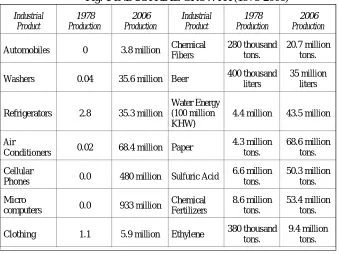
Industrial Product 1978 Production 2006 Production Industrial Product 1978 Production 2006 ProductionAutomobiles 0 3.8 million Chemical
Fibers
280 thousand tons.
20.7 million tons.
Washers 0.04 35.6 million Beer 400 thousand
liters
35 million liters
Refrigerators 2.8 35.3 million
Water Energy (100 million KHW)
4.4 million 43.5 million
Air
Conditioners 0.02 68.4 million Paper
4.3 million tons.
68.6 million tons.
Cellular
Phones 0.0 480 million Sulfuric Acid
6.6 million tons.
50.3 million tons.
Micro
computers 0.0 933 million
Chemical Fertilizers 8.6 million tons. 53.4 million tons.
Clothing 1.1 5.9 million Ethylene 380 thousand
tons.
9.4 million tons.
industrial projects in both its internal market where it has successfully increased the production of products
selected every five years and in its external market where its participation in world exports was only 0.8%, in
1980 but reached 5.3% by 2001 to be surpassed in 2007 with 6%.
Fig. 1 INDUSTRIAL GROWTH (1978-2006)
Fig. 2 INDUSTRIAL GROWTH (1978-2006) (continuation...)
SOURCE: CHINA STATISTICS YEARBOOK 2007.
Industrial Product 197 8 Production 200 6 Production Industrial Product 197 8 Production 200 6 Production
Color TV 0.38 83 million Cement 65.2
million tons. 1236.7 million tons. Tractors 110 thousan d units 190 thousan d units
Crude Iron 31.7 million tons. 419.1 million tons. Motor Vehicles 140 thousan d units
7.2 million Pig Iron 34.7 million tons.
40
In the last 30 years, China has never stopped its industrial process nor has it allowed it to eliminate
its weak and inefficient industry of 1978 in the interests of a “free market.” On the contrary, by using the free
market, it has established continuous improvement and strengthened the greater part of its manufacturing
sector. As Meza Lora points out,
the convergence of the market and the State in the industrial sector in
China is an expression of an unquestionable fact: recognition that the rules
of the game should be governed by the market and the necessary State intervention given the weakness of this Institution. A socialist market economy with Chinese characteristics does not
assume the antagonism between the State and the market. On the contrary, it understands that the
market and the State can play a complementary role in industrial coordination activities. If the market is deficient in solving coordination problems, an explicit industrial policy is justified as a
coordination mechanism ex ante that does not come from the market.
Within this general framework of joint State-market work, the following actions that the Chinese
government has implemented in its industrial policy stand out:
• Direct investment in infrastructure projects; financial and budgetary assistance in projects from
regions lagging behind.
• Administrative intervention from the central authority in its enterprises to conclude and establish
joint ventures, mergers, etc.
• Price control over basic supplies (for example, energy and water supply).
• Direct and long-term financing for key companies; preferential capital allocation to companies
by way of the capital market, especially for new companies or those seeking to increase their
technological development.
• Tariffs and duty-free measures, import quotas, licenses and local restraints on imports.
• The prohibition for foreign companies to distribute products not produced in China or for
controlling their own distribution networks.
• Low interest rates in State banks and selective loans to different industries.
• Tax incentives to companies oriented toward industry.
• Reduced tax rates for high-tech companies in the field of industrial technological
development.
• Zero taxes for companies of “urgent need for the State” (fixed capital investments for agriculture,
water conservation, transportation, postal service, telecommunications, certain medical projects and
machinery and electronics, etc.).
41
• State enactment of a Direct Foreign Investment Guide that specifies the projects that are
encouraged, allowed, restricted and prohibited, etc.
IV. Bibliography
[1]
González García, J. (2006). Perfiles recientes del desarrollo económico de China. Mexico: Universidad de Colima-UAM.
[2]
Deng Xiaoping (1994). Selected Works, Vol. I. & Vol. III.
[3]
Deng Long (2002). Deng Xiaoping & the Cultural Revolution. Beijing: Foreign Languages Press.
[4]
Wang Mengkui (2003). China’s Economic Transformation over 20 years. Beijing: Foreign Languages Press.
DENG LONG, DENG XIAOPING AND THE CULTURAL REVOLUTION 35 (Foreign Languages Press, Beijing, 2002).
Id.
Id.
Id. at 40.
DENG XIAOPING, SELECTED WORKS, Vol. II, 266 (2nd ed. 1995).
Mengkui,
supra
note 8, at 38
.
Id. at 19.
Mengkui, supra note 8, at 23.
SUN TZU, EL ARTE DE LA GUERRA 52 (Mercado, 1999).
CHI FULIN, THE THRESHOLD 178 (Foreign Languages Press, Beijing, 2006).
GAO SHANGYUAN & CHI FULIN, NEW PROGRESS IN CHINA’S SPECIAL ECONOMIC ZONES 9, 41 (Foreign Languages Press, Beijing, 1997).
CHI FULIN, PRESSING TASKS OF CHINA’S ECONOMIC TRANSITION 261 (Foreign Languages Press, Beijing, 1996).
United States International Trade Commission: China Description of Selected Government Practices and Policies Affecting Decision-Making in the Economy, 2007.
42
Interchina Insight, ¿Dónde estará el próximo Dongguan? 3, March 2008, available at:
www.interchinaconsulting.com.
United States International Trade Commission supra note 21, at 67-69.
Interchina Insight, La actitud china hacia la inversión extranjera está cambiando, November 2006, available at: www.interchinaconsulting.com
Id.
ARTURO OROPEZA GARCÍA, CHINA ENTRE EL RETO Y LA OPORTUNIDAD 290 (IIJ-UNAM, 2006).
CHINA STATISTICAL YEAR BOOK 520 (2007).
2007 EVALUATION REPORT ON CHINA’S REFORM 83 (Chi Fulin ed., Foreign Languages Press, Beijing, 2007).
Jin Bei & Li Gang, Chinese Industrial Enterprises, in CHINA ECONOMIST 55 (2008).
JIN BEI, THE INDUSTRIAL COMPETITIVENESS OF CHINESE INDUSTRY 32 (Foreign Languages Press, Beijing, 2007).
Oropeza, supra note 26, at 308.
JIN BEI, THE INDUSTRIAL COMPETITIVENESS OF CHINESE INDUSTRY 155 (For- eign Languages Press, Beijing, 2007).
José Salvador Meza Lora, El Rol De Las Instituciones Con Las Grandes
Transformaciones Del Sector Industrial En China Durante La Reforma Económica 285 (Porrúa, 2006).