IRPMS | VOL-3 | No. 2 | APR-JUN | 2017 41 A STUDY OF SPECTRUM OF MALARIA WITH SPECIFIC REFERENCE TO
PLASMODIUM VIVAX
1NARESH KR MIDHA, 1CHHABRA V, 2SHARMA R, 3CHAUDHARY M, 4MAHAVAR S 1Senior Resident,Department of General Medicine, AIIMS Jodhpur, 2Senior Professor, Department of
General Medicine SMS Medical College Jaipur, 3Senior Resident, Department of Paediatrics Dr. S.N.Medical College, Jodhpur, 4 Assistant Professor, Department of General Medicine SMS Medical
College Jaipur, Rajasthan.
ABSTRACT
INTRODUCTION: Malaria is one of the most common infectious diseases and a great public health problem worldwide, particularly in Africa and south Asia. P.falciparum is well known for severe complicated malaria while P. vivax malaria (benign tertian malaria) so far, was considered to have a benign course that causes disease resulting in lower case-fatality rates. Plasmodium vivax is now recognized as a cause of severe and fatal malaria. In this study the clinical profile of patients with malaria with regards to demographic, clinical and biochemical profile and its complications was done with specific reference to vivax malaria.
AIMS AND OBJECTIVES: The aim of our study was to present the clinical features, hematological and biochemical profile of malaria with specific reference to Plasmodium vivax and to present the comparative study of complications and outcome of P. vivax, P.falciparum and mixed infection (vivax + falciparum).
MATERIALS AND METHODS: This was a prospective observational study done at a tertiary care hospital in Jaipur over 12 Months period. All diagnosed cases of malaria, including P.vivax, P.falciparum and mixed infections were studied and their demographic profile, complications and course of disease were noted. Data was analyzed using appropriate statistical tests.
RESULTS: 210 cases of malaria were included in the study and out of them 120 were infected with P.vivax and 63 with P. falciparum. Severe disease was present in 18 (15%) cases of vivax malaria and 33 cases (52%) of falciparum malaria. A mixed infection was found in 27 cases and out of them 14 were of severe category (52%). The complications seen in vivax malaria were: thrombocytopenia (75.7%), ARDS (1.61%), malarial hepatitis (14.28%), acute renal failure (13.8%), cerebral malaria (11%) and the mortality in vivax and falciparum malaria cases was 1.75% and 3.64% respectively.
CONCLUSIONS: Plasmodium vivaxis a cause of severe and fatal malaria despite its low parasite biomass. The incidence of ARDS, thrombocytopenia, leukocytopenia, in P.vivax malaria was as higher as compared to P.falciparum or mixed infection, while renal, hepatic, lung and cerebral involvement were seen with increasing frequency in falciparum malaria and mixed malaria cases.
IRPMS | VOL-3 | No. 2 | APR-JUN | 2017 42
Corresponding author: Dr. Naresh Kumar Midha, Department of General Medicine, All
India Institute of Medical Sciences Jodhpur. Email: [email protected]
INTRODUCTION
Malaria is one of the most common infectious diseases. India contributes 77% of the total malaria in Southeast Asia. In India about 2-3 million confirmed malaria cases and 1,000 deaths are reported annually.1 Of the 4 most common species that infect humans, P.vivax and P.falciparum cause 95% of infections.1,2 P.falciparum is well known for severe complicated malaria, while P. vivax malaria (benign tertian malaria) so far, was considered to have a benign course that causes disease resulting in a lower case-fatality rates. However, recently there have been many reports of vivax malaria with various complications. The pathogenesis of severe vivax malaria is quite intriguing. Taking these things into consideration, we plan to study the manifestations of various malarial sub-types with specific reference to vivax malaria and its complications.
METHODS AND MATERIALS
The study was hospital based comparative type of observational study conducted in an upgraded department of medicine at SMS Hospital, Jaipur where the study was approved by the hospital ethics committee. The diagnosed cases of malaria (malarial parasite in PBF and antigen detection assay) including adult patients with P.vivax, P.falciparum or mixed infections were included. A total of 210 patients with malaria were enrolled in the study during the study period. Routine haematological and biochemical investigations were
carried out. The patients were evaluated for malaria by peripheral blood smear and Rapid Antigen test (OptiMAL test and histidine rich protein 2 detections). Malaria cases were divided into three groups: Group-A (P.vivax malaria), Group-B (P.falciparum malaria), Group-C comprised of mixed infection (vivax+falciparum).
Statistical Analysis: All the data obtained were presented as Mean±SD. Any difference in parameters between groups was tested for significance by ANOVA test. The p-value less than 0.05 was considered statistically significant and Chi square test was used for comparing proportions. All the statistical analyses were performed with SPSS for Microsoft windows version 20.
RESULTS
IRPMS | VOL-3 | No. 2 | APR-JUN | 2017 43 infection was severe in 52% cases (33 out
of 63) and mixed infection was also found severe in 52% cases (14 out of 27).
Clinical Features- No significant difference was observed in the clinical features in different groups except edema and icterus. Edema was more in Group B (7.93%) and Group C (7.41%), p value=0.05, icterus was more common in group C (25.93%). The maximum numbers of the patients having hepatosplenomegaly were observed in Group B. Hepatomegaly was seen in 15.8% patients (10 out of 63) and splenomegaly was observed in 42.85% patients (27 out of 63) (Table 1).
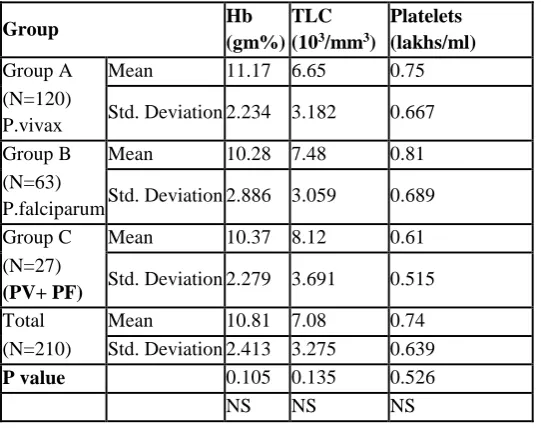
Hematological parameters- The overall mean hemoglobin was 10.81±2.413 gm% and it was lowest in Group B (P. falciparum) 10.28 ± 2.886 gm%, followed by Group C 10.37 ± 2.279 gm%. The mean TLC of the study group was 7.08±3.275 (103/mm3). The maximum number of the patients with leukocytopenia were seen in Group A 17.5% (21 out of 120). Thrombocytopenia was observed in 80.7% of P.vivax cases (Group A) and 72.73% of P.falciparum (Group B).(Table 2)
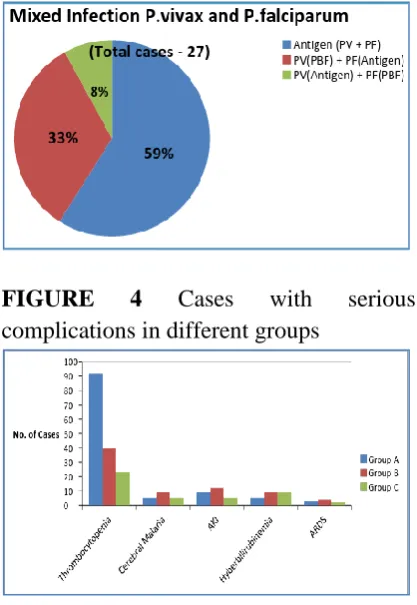
Complications - No significant difference was observed in the complications of different groups except hyperbilirubinemia, ARDS and cerebral malaria. Hyperbilirubinemia was more common in Group C (33.33%) as compared to the group A (4.39%) and group B (16.36%), (p value = <0.001). Out of total 210 cases, 08 (3.81%) cases showed ARDS and the majority of the patients with ARDS were found in Group C (7.4%) as compared to the Group B (6.39%), Group A (1.66%) (p value=<0.001) and the difference among
different groups was statistically significant.
Cerebral malaria was more in group B (15.8%) as compared to group A (4.16%) and in group C (7.4%), p value=0.007 (figure 4). The mortality in P.vivax was 1.75% and 3.64% in P.falciparum. The highest mortality (3.7%) was observed in Group C including mixed infections. No Significant difference was observed according to mortality in different groups of malaria patients.
DISCUSSION
IRPMS | VOL-3 | No. 2 | APR-JUN | 2017 44 in 27 cases out of which 14 were severe
(52%). The overall mean hemoglobin was 10.81±2.413 gm% and it was lowest in Group B (P. falciparum) 10.28 ± 2.886 gm%, followed by Group C 10.37 ± 2.279 gm%. The mean TLC of the study group was 7.08±3.275 (103/mm3). The maximum number of the patients with leukocytopenia were seen in Group A 17.5% (21 out of 120), The results of our study were in accordance with the study conducted by Charulata S Limaye et al in which total leukocyte count was low (<4000/cmm) in 66 (19.53%) cases of P.vivax, 38 (18.45%) of P.falciparum and 26 (19.12%) of mixed Infection.4 The incidence of anemia in our patients (3%) was considerably less than that reported in studies by Tjitra et al in Southeast Asia (19%). Thrombocytopenia was the most common finding in all groups5 and it was found in 159 cases (75.71%). Thrombocytopenia was observed in 80.70% of P.vivax cases (Group A) and 72.73 % of P.falciparum (Group B), which is consistent with the study conducted by Milind Y Nadkar et al.3 Many cases of severe thrombocytopenia caused by vivax malaria have been reported in the literature.3,4
The incidence of malarial hepatitis was 4.16% (5 out of 120) in P.vivax, whereas it was 14.28% (9 out of 63) in P.falciparum. Malarial hepatitis due to microvascular sequestration of parasitized red cells causes a significant rise in serum bilirubin concentration, mild elevations of AST and ALT and prolongation of prothrombin time.6 Out of total 210 cases, 29 (13.8%) patients showed Serum Creatinine more than 3 mg/dl and it was significantly more common in P.falciparum,12 out of 63 (19%) patients. The frequency of renal failure was 32% in severe P.vivax malaria
and 55% in severe P.falciparum malaria in the study conducted by Milind Y Nadkar et al.3
Many cases of ARDS in vivax malaria have been reported from India and abroad.7-12 Lung injury was associated with the inflammatory increase in alveolar capillary membrane permeability.13 Out of total 210 cases, 08 (3.81%) cases showed ARDS. Maximum no. of patients with ARDS were found in Group C (7.4%) as compared to Group B (6.39%), Group A (1.66%) (p value=<0.001) and the difference among different groups was statistically significant. Our results are similar to the study conducted by Charulata S Limaye, et al.4 Out of total 210 cases 17 (8.0%) cases showed evidence of cerebral malaria and it was more in group B (15.8%) as compared to group A (4.16%) and in group C (7.4%), p value=0.007 and the difference among different groups was statistically significant. The complications of vivax malaria observed by Sharma et al14 in a study from Delhi were thrombocytopenia, hepatic dysfunction, renal failure, ARDS and hemolysis. Severe anemia and respiratory distress were also noted as complications of vivax malaria by Genton et al.15 Mortality in P.vivax cases was 1.75% and 3.64% in P.falciparum. The highest mortality was in Group C, which comprised of mixed infection (3.7%). No Significant difference was observed according to mortality in different groups of malaria patients.
CONCLUSION
IRPMS | VOL-3 | No. 2 | APR-JUN | 2017 45 presumed that the severe disease with vivax
infection is actually caused by coinfection of vivax and falciparum species, but severe vivax malaria is now very common with increasing mortality. In our study the maximum number of the patients with thrombocytopenia (80.70%) and severe thrombocytopenia 14.9% were seen in P.vivax malaria reflecting increased frequency and severity of this complication with P.vivax infection which was previously considered benign. The incidence of ARDS, thrombocytopenia, leukocytopenia, in P.vivax malaria was as higher as in P.falciparum or mixed malaria, while renal, hepatic, lung and cerebral involvement were seen with increasing frequency in mixed malaria cases.
Conflicts of Interest : Nil. Source of Funding : None.
REFERENCES
1. Das A, Anvikar AR, Cator LJ, Dhiman RC, Eapen A, Mishra N, B. Nagpal N, Nanda N; Malaria in India: The Center for the Study of Complex Malaria in India. Acta Trop. 2012 Mar;121(3):267-73.
2. Lal S, Sonal GS, Phukan PK. Status of malaria in India. J Indian Acad Clin Med 2000; 5(1): 19–23.
3. Milind Y Nadkar, Abhinay M Huchche, Raminder Singh, Amar R Pazare. Clinical Profile of Severe Plasmodium vivax Malaria in a Tertiary Care Centre in Mumbai from June 2010-January 2011. JAPI October 2012; 60: 11-13. 4. Charulata S Limaye, Vikram A
Londhey, ST Nabar. The study of complications of Vivax Malaria in Comparison with Falciparum Malaria
in Mumbai:JAPI,October 2012; 60: 15-18.
5. Tjitra E, Anstey NM, Sugiarto P, Warikar N, Kenangalem E, Karyana M, Lampah DA, Price RN. Multidrug resistant Plasmodium vivax associated with severe and fatal malaria: A prospective study in Papua, Indonesia. PLoS Med 2008; 5 (6): e128.
6. Kochar DK, Singh P, Agarwal P, Kochar SK, Pokharna R, Malarial Hepatitis JAPI, November 2003; 51: 1069-107
7. Gera C and J. Dhanoa, “Vivax-induced ARDS: report of two cases JAPI, January 2010; 58: 1-4.
8. Tan LK, Yakoub S, Scott S, Bhagani S, Jacob M. Acute lung injury and other serious complications of Plasmodium vivax malaria. Lancet Infect Dis 2008; 8: 449-54.
9. Sarkar S, Saha K, Das CS. Three cases of ARDS: An emerging complication of Plasmodium vivax malaria (Case report). Lung India 2010;27:154-7. 10.Agarwal R, Nath A, Gupta D.
Noninvasive ventilation in Plasmodium vivax related acute lung injury or ARDS. Intern Med 2007; 46: 2007-11. 11.Kumar S, Melzer M, Dodds P, Watson J, Ord RP. Vivax malaria complicated by shock and ARDS (Case report). Scand J Infect Dis 2007; 39: 255-56. 12.Price L, Planche T, Rayner C, Krishna
S. Acute respiratory distress syndrome in Plasmodium vivax malaria: Case report and review of literature. Trans R Soc Trop Med Hyg 2007; 101: 655-59. 13.Price RN, Tjitra E, Guerra CA. Vivax
IRPMS | VOL-3 | No. 2 | APR-JUN | 2017 46 14.Sharma A, Khanduri U. How benign is
benign tertian malaria? J Vector Borne Dis 2009; 46: 141-44.
15.Genton B, D’Acremont V, Rare L. Plasmodium vivax and mixed infections are associated with severe malaria in children. A prospective cohort study from Papua New Guinea. PLoS Med 2008; 5: e127.
16.Picot S, Bienvenu AL. Plasmodium vivax infection: not so benign. Med Sci (Paris) 2009; 25: 622-6.
FIGURES AND TABLES
FIGURE 1 Cases (%) of Plasmodium vivax
FIGURE 2 Plasmodium falciparum with its diagnostic tests
FIGURE 3
FIGURE 4 Cases with serious complications in different groups
TABLE 1 : shows the clinical feature of different groups
Features
Group A (N=120 )
Group B (N=63)
Group C (N=27)
Tota l
P Valu e
N
o %
N
o %
N
o % No
Pallor 9 7.5 8 12.6 4 14.8
1 21
0.65 NS
Edema 1 0.8
3 5 7.93 2 7.41 8
0.05 S
Icterus 5 4.1
6 5 7.93 7
25.9
3 17
0.006 S Hepatomega
ly 12
10.
0 10
15.8
7 2 7.41 24
0.511 NS Splenomegal
y 47
39.
1 27
42.8
5 11
40.7
4 85
IRPMS | VOL-3 | No. 2 | APR-JUN | 2017 47 TABLE 2: shows the statistical analysis of
hematological parameters in different groups
Group Hb
(gm%) TLC
(103/mm3)
Platelets (lakhs/ml)
Group A Mean 11.17 6.65 0.75
(N=120)
P.vivax Std. Deviation 2.234 3.182 0.667
Group B Mean 10.28 7.48 0.81
(N=63)
P.falciparum Std. Deviation 2.886 3.059 0.689
Group C Mean 10.37 8.12 0.61
(N=27)
(PV+ PF) Std. Deviation 2.279 3.691 0.515
Total Mean 10.81 7.08 0.74
(N=210) Std. Deviation 2.413 3.275 0.639
P value 0.105 0.135 0.526