I n t e r n a t i o n a l J o u r n a l o f E n g i n e e r i n g R e s e a r c h a n d S p o r t s S c i e n c e Page1
Sudhakara Babu Mande
Research Scholars, University College of Physical Education &Sports Sciences, A.N.U
Dr.P.P.S.Paul Kumar Principal, University College of Physical Education &Sports Sciences, A.N.U
ABSTRACT
“Sports” is a popular spectacle and a mass social movement of contemporary times. In the process of historical development sports has occupied a prominent place both in the moral culture of a society. Its social significance continues to soar. In the modern days ‘sports for all’ become a very popular slogan. Participation in sports will yield optimum physical fitness and positive health for all. In the hurry scenario of modern life people need more exercise to keep their body and mind fit to execute the day-to-day activities effectively. In the modern days, sports and game have got much more relevance in the context of men and women getting physical exercise and thereby keeping oneself fit and occupying the leisure time in a fruitful manner. Therefore, it shall be an Endeavour for agencies in the society to strive optimally to make available adequate facilities and sound programme of sports and games at every premise like schools and college, factories and business establishments, companies and departs corporations and agencies in rural and urban areas. So people of all ages choose some games or sports events for participation.
__________________________________________________________________________________________________________
I. INTRODUCTION
COMPLEX TRAINING:
Complex training is one of the most advance forms of sports training. Integrates resistance training, plyometric, and sports-specific movement. It consists of an intense resistance exercise followed by a plyometric exercise. Complex training activates and works the nervous system and fast twitch muscles fiber simultaneously. The resistance exercise activates the fast twitch muscles fibers. The plyometric movement stress those muscles fibers that have activated by the resistance training movement. During this activated state, the muscles have a tremendous ability to adapt. This form of intense training can teach slow twitch muscles fibers to perform like twitch fibers.
YOGIC PRACTISE:
Yoga is a ancient Indian philosophy based on diverse breathing, stretching and meditation exercises. The “Physical” part of yoga (Hatha) consists of several stretching and strength-building exercises of varying degree of difficulty called asanas. In complementary alternative medicine, Hatha yoga has proved to reduce stress and pain. Yoga sutra difines asana as that which is comfortable and easy, as well as firm. It is adynamic position, in which the practitioner is perfectly poised between activity and non-activity, being doing and “being done by” the posture. A corresponding mental balance exists between movement and stillness. Yoga teaches that each posture reflects a mental attitude, whether that attitude be one of surrender, as in a forward bending asana, or the strengthening of the will, through backward bending postures, or the creation of physical prayer or meditation with body, as in the practice of pasdmasana (Lotus posture).
II. THE OBJECTIVE OF THE STUDY
1. To determine the influence of complex training on selected motor fitness and playing ability among Kabaddi men players.
2. To determine the impact of complex training along with yogic practices on selected motor fitness variables and playing ability among Kabaddi men players.
STSTEMENT OF THE PROBLEM:
The purpose of this study was to find out the “effect of complex training programme with yogic practices on selected motor fitness variables and playing ability among kabaddi men players”.
HYPOTHESIS:
It was hypothesized that complex training would significantly improve the motor fitness variables and playing ability of kabaddi players. It was hypothesized that complex training with yogic practices would significantly improve the motor fitness variables and playing ability of kabaddi players. It was hypothesized that complex training with yogic practices would significantly improve the motor fitness and playing ability than the complex training and control group. It was hypothesized that complex training would significantly improve the motor fitness and playing ability performance than the control group.
DELIMITATION:
The present study was delimited in the following aspects. The present study was confined to men kabaddi player at inter-collegiate level. The total number of subjects for the present study was 60. They were divided into three groups. Each
PRACTICES ON SELECTED MOTAR FITNESS
VARIBALES AND PLAYING ABILITY AMONG
THE KABADDI MEN PLAYERS
I n t e r n a t i o n a l J o u r n a l o f E n g i n e e r i n g R e s e a r c h a n d S p o r t s S c i e n c e Page2
group consisting of 20 subjects. The training period was delimited to 12 weeks. The data were collected prior and after 12 weeks of training programme. The level of significance was fixed at 0.05 levels,
LIMITATION:
Heredity and environmental factor which contribute to psychological, physiological and sociological factors have not been controlled. No special motivation techniques were used during the test. Therefore the differences that might have occurred in the test due to lack of motivation was recognized as a limitation for this study. Previous physical training in sports and games were not taken into consideration. Since the subjects were non-hostellers, the investigator did not take any effort to control and assess the quality and quantity of food taken by everyone. No effort was put in order to find out the effect of environmental changes during pre and post tests and the training period. Though the subjects were motivated verbally, no attempt was made to differentiate their motivation level during the testing and training period.
III. REVIEW OF RELATED STUDY
The study of relevant literature is an essential step to get a clear idea of what has been done with regard to the problem under study. Such a review brings about a deep and clear perspective of the overall field. A serious and scholarly attempt has been review of the study related to the present problem is described in this chapter. The literature in any field forms the foundation upon which all feature work will be built. If we fail to build up on the foundation of knowledge provided by the review of literature, the researcher might miss some works already done on the same topic.
IV. METHODOLOG SELECTION OF SUBJECTS:
The purpose of the study is to find out the effect of Complex training with yogic practices on selected motor fitness variables and playing ability among men Kabaddi players. To achieve this purpose of the study sixty male Kabaddi players were selected at random from in and around the Guntur district of Andhra Pradesh. The age, height and weight of selected subjected were ranged from 18 to 25 years, 165 to 170 cm and 55 to 65 kilogram respectively. The selected subjects were divided into three groups of twenty each at random. Group ‘A’ underwent complex training, Group ‘B’ underwent complex training with yogic practices for four session per week and Group ‘C’ acted as control group in which they did not undergo any special training programme apart from their regular programme of the curriculum. All the entire subject gave a written constant and no compulsion was made to take part in the training programme. A qualified physician examined the subjects and declared that they were medically and physically fit to participate in the training programme.
EXPERIMENTAL DESIGNS:
The purpose of this study was to determine the effect of complex training and complex training with yogic practices on selected motor fitness variables and playing ability of kabaddi
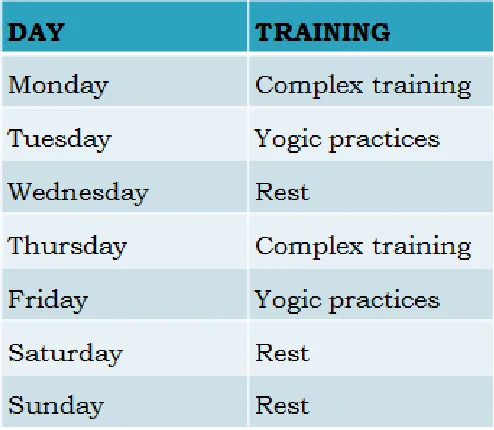
players. For This purpose sixty inter-collegiate kabbaddi players were selected at random as subjects. They were divided into three groups namely Group ‘A’ underwent complex training, Group ‘B’ underwent complex training with selected yogic exercises and Group ‘C’ acted as control group this group not involve any specific training programme other than their regular physical activities programme as per their college curriculum. The training were given four days per week for a period of 12 weeks. The data were obtained before the training periods (pre test) and after the 12 weeks of the training period (post test)
SELECTION VARIABLES: Speed Agility Flexibility Explosive power Muscular endurance Co ordination CRETERION MEASURE:
Table I: Selection of the test and variables
TRAINING PROTOCOL:
I n t e r n a t i o n a l J o u r n a l o f E n g i n e e r i n g R e s e a r c h a n d S p o r t s S c i e n c e Page3 COLLECTION DATA:
At the end of the treatment period, as post test, the subjects belong to the treatment groups namely complex training group (CTG), Combination of complex training and yogic practices training group (CYTG) and control group (CG) were tested on criterion variables (Speed, agility, flexibility, explosive power, muscular endurance, coordination and playing ability) as such in the pre-test of the same. The collected data were processed with appropriate statistical tool and the detailed procedure of the same in the given below.
TRAINING PROGRAM:
During the training period, the experimental group ‘A’ underwent complex training and group ‘B’ underwent complex training with yogic practices. The training four days per week and group ‘C’ acted as control group who were not participated any special training apart from the regular curricular activates.
Table IV: Training Programme For Complex Training Group ‘A’ (Resistance Training Followed By Plyometric Training)
Table V: Exercise Prescription for the Complex Training
Table VI: Training Programme For Complex Training With Yogic Practices Group ‘B’
I n t e r n a t i o n a l J o u r n a l o f E n g i n e e r i n g R e s e a r c h a n d S p o r t s S c i e n c e Page4
V. STATISTICAL PROCEDURES
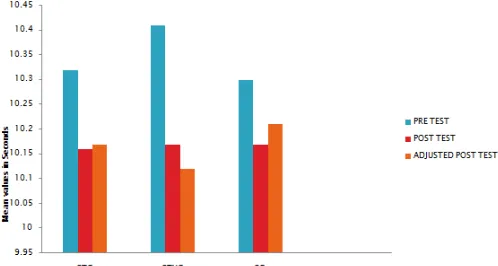
The data collected from experimental group ‘A’, group ‘B’ and control group prior to and after completion of the training period were statistically analysed for significant difference if any, by applying analysis of covariance (ANCOVA). The pre-test and post-pre-test means of experimental group ‘A’, group ‘B’ and control groups were tested for significance by applying analysis of variance (ANOVA). After eliminating the influence of pretest, the adjusted post-test mean of experimental groups and the control groups were tested for significance by using analysis of covariance (ANCOVA). All the data were analysed using computer with SPSS statistical package. The level of confidence was fixed at 0.05 level, for significant as the number of subjects were limited and also because, the selected variables might fluctuate due to various extraneous factor as mentioned in the limitations. In addition to this Scheffe’s post-hoc test was employed, when the F-ratio of the adjusted post test mean was significant to find out the paired men difference, if any among the groups for each variables separately.
Table-VIII: Analysis of covariance for pre test and post test Data on speed of experimental groups and control group
Significant at 0.05 level (The table value required for significance at 0.05 level with df 2 and 57 and 2and 56 are 3.925
Table-IX: The Scheffe’s Test for the Differences Between Paired Mean of Groups on Speed
Figure1: Bar diagram showing the pre test, post test and adjusted post test mean of complex training group, complex training with yogic practice group and control group on Speed.
Table-X: Analysis of covariance for pre test and post test Data on agility of experimental groups and control group
Table-XI: The Scheffe’s Test for the Differences Between Paired Mean of Groups on Agility
Figure II: Bar diagram showing the pre test, post test
and adjusted
post test mean of complex training group, complex training with yogic practice group and control group on agility.
I n t e r n a t i o n a l J o u r n a l o f E n g i n e e r i n g R e s e a r c h a n d S p o r t s S c i e n c e Page5
*Significant at 0.05 level (The table value required for significant at 0.05 level with df 2 and 57 and 2and 56 are 3.925)
Table-XIII: The Scheffe’s Test for the Differences Between Paired Mean of Groups on Flexibility
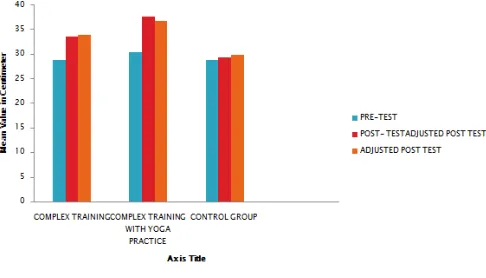
Figure III: Bar diagram showing the pre test, post test and adjusted post test mean of complex training group, complex training with yogic practice group and control group on flexibility.
VI .RESULTS
The complex training improves the motor fitness variables on speed, agility, flexibility, explosive power, muscular endurance and coordination of kabaddi men players. The complex training improves the overall playing ability of Kabaddi men players. The complex training with yogic practices group improves the motor fitness variables on speed, agility, flexibility, explosive power, muscular endurance and coordination of kabaddi men players. The complex training with yogic practices group improves the overall playing ability of Kabaddi men players.
CONCLUSION
Based on the result of the study the following conclusion are drawn The complex training group has significantly improved on speed, agility, flexibility, explosive power, muscular endurance, coordination and playing ability when compared with control group. The complex training with yogic practices groups have significantly improved on speed, agility, flexibility, explosive power, muscular endurance, coordination and playing ability when compared with control group. When compare between complex training and complex training with yogic practices. The complex training with yoga practice groups is better than complex training in relation to speed, agility, flexibility, explosive power, muscular endurance, coordination and playing ability
RECOMMENDATIONS
The result of the study clearly indicates that the complex training with yogic practice group could enhance the selected motor fitness variables and playing ability. Hence, it is recommended that the coaches and other trainers could follow the complex training with yoga practices programme to enhance their playing ability. A similar study may conduct at different levels of players and genders. Complex training with yoga practices might be one of the training methods to improvement performance. Complex training with yoga practice might be recommended to different age group also. The coaches may concentrate on complex training with yoga practice will enhance the performance of an athletes.
REFERENCES
[1] Bevan HR, Owen NJ, Cunningham DJ, Kingsley MI, Kilduff LP Complex training in professional rugby players: influence of recovery time on upper-body power output.J Strength Cond Res. 2009 Sep; 23(6):1780-5. doi: 10.1519/JSC.0b013e3181b3f269.
[2] Comyns TM, Harrison AJ, Hennessy LK. (2010) Effect of squatting on sprinting performance and repeated exposure to complex training in male rugby players. J Strength Cond Res. 2010 Mar; 24(3):610-8. doi: 10.1519/JSC.0b013e3181c7c3fc.
[3] Croucher, Paul E et al., (2010) Effects of an assisted jump training stimulus on explosive performance. Master’s thesis, Wintec. [4] Daniel Juárez, José M. González-Ravé, Fernando Navarro1 (2009). Effects of complex vs. non complex training programs on lower body maximum strength and power Sport Training Laboratory, Faculty of Sport Sciences, University of Castilla La Mancha, Toledo, Spain.
[5] Daniel W. Robbins, Warren B. Young, David G. Behm & Warren R. Payne (2009) Effects of agonist–antagonist complex resistance training on upper body strength and power development. Version of record first published: 04 Dec 2009.
[6] Eduardo J.A.M. Santos, Manuel A. A. S. Janeira (2008) Effects of Complex Training on explosive strength in adolescent male basketball players. Journal of strength and conditioning research: the research journal of the NSCA,