Please cite this article as: A. Shahriari, N. Jahantigh, F. Rakani, Providing an Analytical Model in Determining Nanofluids, International Journal of Engineering (IJE), TRANSACTIONS C: Aspects Vol. 30, No. 12, (December 2017) 1919-1924
International Journal of Engineering
J o u r n a l H o m e p a g e : w w w . i j e . i r
Providing an Analytical Model in Determining Nanofluids
A. Shahriaria, N. Jahantigh*a, F. Rakanib
a Department of Mechanical Engineering, University of Zabol, Zabol, Iran
b Department of Computer Sciences, University of Sistan & Baluchestan, Zahedan, Iran
P A P E R I N F O
Paper history:
Received 26 May 2017
Received in revised form 30 June 2017 Accepted 08 September 2017
Keywords: Effective Viscosity Mean Nanoparticle Diameter Nanofluid
Thermophysical Properties Volume Concentration
A B S T R A C T
The influence of temperature, mean nanoparticle size and the nanoparticle concentration on the dynamic viscosities of nanofluids are investigated in an analytical method followed by introduction of modified equations for calculating the nanofluids’ viscosities. A new correlation is developed for effective viscosity based on the previous model where the Brownian movement of the nanoparticles is considered as the key mechanism. In previous studies, the proposed models were not appropriate for nanoparticles larger than 36 nm. They were also focused on low concentrations of nanoparticles up to 5%. The possibility of homogeneous dispersion of the nanoparticles and the Stokes law are observed here. This new model is explained in terms of temperature, mean nanoparticle diameter, nanoparticle volume concentration and both the nanoparticle and base fluid thermophysical characteristics for the effective viscosity of nanofluids. A combined correction factor is introduced to take into account the simplification for a free stream boundary condition outside the boundary layer. A good agreement is observed between the effective viscosity obtained in this new model and those of recorded experiments conducted for different nanofluids. The results show that the present model is valid for large volume concentration (0% < φ <11%), mean nanoparticle size (13 nm < dp < 95 nm), temperature variations
(290 K <T < 350 K) and various types of nanoparticles.
doi: 10.5829/ije.2017.30.12c.14
1. INTRODUCTION1
Heat transfer is an essential phenomenon in mechanical engineering and industry in general due to its frequency of occurrence in various engineering applications like furnaces, double pane windows, heat exchangers, heating of buildings, solar technology, electronic equipment cooling, etc. In the last few decades, studies were carried out and are being conducted on simulating natural convection heat transfer in various geometries with different fluids in extensive experimental, numerical and analytical methods [1-3].
The low thermal conductivity of basic fluids like water, oil and ethylene glycol is a major restriction in enhancing the performance and the compactness of such systems. Typically, solids have a higher thermal conductivity compared to liquids. More than a century ago, numerous studies on suspensions containing solid particles were conducted by Maxwell’s theoretical approaches [4]. He showed the possibility of increasing
*Corresponding Author’s Email: [email protected](N. Jahantigh)
the thermal conductivity of a fluid–solid mixture by greater volume fraction of micro and mill sized solid particles. Particles with millimeter or even micrometer dimensions may cause sedimentation, clogging and erosion in the systems. Choi and Eastman [5] are among the pioneers who proposed an innovative and new technique for the improvement of heat transfer by applying nanoscale solid particles (usually less than 100 nm in size) dispersed in a base fluid known as nanofluid.
The mixture of the base fluid and nanoparticles have unique physical and chemical properties like high thermal conductivity, high stability with low sedimentation compared to millimeter or micrometer sized particles and not causing any clogging in micro-channels. Moreover, some engineering advantages like reduction in pumping power, long term stability, homogeneity, design of small heat exchanger systems and little or no pressure drop when flowing through the passages makes nanofluids an intriguing research area in heat transfer enhancement [6-8].
researchers for calculating the nanofluid effective viscosity as a function of one or more variables. The variables consist of volume fraction, nanoparticle mean diameter, nanofluid temperature, thermophysical properties of the base fluid and the solid nanoparticles. Various models can be classified by number of variables used in the model in two general categories:
i) Most models in the literature exclusively depend on the volume concentration of nanoparticles regarding effective viscosity. In the case of very low concentrations of fine spherical particles, Einstein [9] was the first one who introduced a simple equation for estimating the viscosity of particle suspensions as following:
) 5 . 2 1
(
eff f (1)
where, is the volume fraction (or volume concentration) and subscripts f and eff represent the property for base fluid and nanofluid, respectively. Equation (1) is applicable in very low volume concentration (0.02) and when there is no interaction between the particles. Brinkman [10] presented a viscosity correlation that extended Einstein’s formula to be applicable at higher concentrations as follows:
5 . 2
) 1
(
f
eff (2)
Likewise, Lundgren [11] proposed the following equation based on a Taylor series expansion for the higher concentration:
)) 0( + 6.25 + 2.5 + (1 ) 2.5 -(1
3
f
f
eff (3)
Batchelor [12] in his theoretical examination considered the effect of the Brownian motion and the interaction between rigid and spherical particles for isotropic structure of suspension, the formula which was developed by Lundgren [11] as follows:
) 2 . 6 5 . 2 1
( 2
eff f (4)
Chandrasekar et al. [13] considered the effects caused by both the electromagnetic and mechanical– geometrical aspects on Al2O3-water nanofluid with a
nominal diameter of 43 nm and adopted the following model:
n f
eff b )
1 ( 1 (
(5)
where, b and n were calculated as 1631 and 2.8, respectively.
ii) The second model, determines the effective viscosity of nanofluids as a function of all main parameters: temperature, concentration of nanoparticle, the mean nanoparticle diameter and both the nanoparticle and
base fluid thermophysical properties. Masoumi et al. [14] proposed the following equation based on the Brownian motion of particles and the determination correction factor by validation for Al2O3-water
nanofluids.
C d
VB P
P f eff
72
2
(6)
where C is assumed as the correction factor, calculated by:
1 2 3 4
1
c d c c d c
C f P P
(7)
where c1, c2, c3 and c4 are determined as:
393 000 0.000 -= c , 090 000 0.000 = c
771 002 0.000 -= c 133, 001 0.000 -= c
4 3
2 1
(8)
Although the effect of all important parameters are considered in Masoumi et al. model [14], however it should be noted that this model is not accurate for particles larger than 100 nm, and the nanoparticle concentration should be less than 5%.
By using various experimental data available in the literature, a general correlation was developed by Khanafer et al. [15] as a function of volume fraction, nanoparticles diameter, and temperature as follows:
131nm d
nm ,13 70 C) T( 20 , 9% 1%
3.0185
-23.498 + 2354.735
-0.0132 + 23.053
+ 0.1634 -0.574 + T 28.837 + -0.4491
p 0
2 3
2 2 3
3 2
2
2
P
P eff
d
d T
T (9)
The model proposed by Khanafer et al. [15] consisted of all major parameters’ effects for calculating the viscosity with temperature variation to a certain degree. However, this model can be merely adopted for Al2O3
-water nanofluid. Furthermore, analyzing the variations of the volume fraction in ambient temperature does not predict accurate behavior for different diameters. Therefore, an analytical model for calculation of nanofluid viscosity, based on the Masoumi et al. [14] model is presented in this article where the effective viscosity is explained in terms of temperature, mean nanoparticle diameter, the nanoparticle concentration and thermophysical characteristics of nanoparticle and the base fluid. There exists a good agreement between the results obtained from the equation’ developed in this article for effective viscosity and those reported experimentally regarding different nanofluids.
2. DERIVING MODEL
viscosity of nanofluid where the effects of temperature, mean nanoparticles diameter and volume fraction of nanoparticles are considered. For this purpose, the experimental data available in the published articles are applied.
Here, the relative viscosity (r) is defined as:
pr f
eff
r
1 (10)
Although the produced viscosity ( pr
) is established due to the presence of nanoparticles, it is assumed that the viscosity of the base fluid is effective in these term as well.
The Brownian motion is the random movement of microscopic particles suspended in a liquid or gas, due to collision of molecules with the surrounding medium. It is found that the Brownian motion of nanoparticles in molecular and nanoscale level constitute a key factor governing the nanofluid properties [16].
The Brownian velocity (VB) is presented by [17]:
P P b P P b B d T k d m T k V 18 1 3 (11)
where Equation (11) is calculated and for spherical
particles and
m
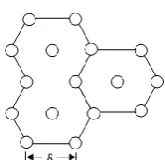
P is the particle mass.In the Masoumi et al. model [14] for each particle a cubic space is assumed. However, it is reasonable to consider that all particles are distributed uniformly in the fluid and the space between particles is almost equal in all directions relative to each other (see Figure 1). Here, each particle is considered in a hexagonal space where the length of each side is equal to delta letter (). According to the definition given for the nanoparticles’ concentration, the distance between the nanoparticles’ centers is obtained as Equation (12). In this equation, instead of the spherical space the hexagonal space is approximated. Here, delta is the covered distance where the kinetic energy of the Brownian velocity is dissipated due to friction.
P
d
3 4
(12)
Figure 1. Distribution of particles in the fluid relative to each other
Thus according to the first law of thermodynamics the following equation can be expressed as:
P D B B m F V
V 2 2
1 2
2 (13)
where, D
F is the drag force. The Brownian-Reynolds number (
B
Re ), based on the Brownian velocity, is
defined as [18]:
P P b f B d T k 18 1
Re (14)
where, ( f
) is the kinematic viscosity of the liquid. Thus, for 10 nm Al2O3 nanoparticle for example, ReB =
0.029, which is much less than one and the Stokes flow conditions is sensible. The drag force for the stokes regime can be expressed as follows:
B P B f P
D d V d CV
F 3 3 Pr (15)
where, C is the correction factor applied in simplifying the flow boundary conditions. The following equation is derived from combining and simplifying Equations (5) and (6) for viscous product.
C d
VB P P
36
2
Pr (16)
By inserting Equations (16) and (12) into Equation (10), the following equations are obtained:
3 4 18 36 1 P P b P r d T k C (17)
After rearranging Equation (17), this equation will be reduced to: T d V B
A B P P
r 36 1 2 (18)
where, A and B are defined as Equations (19) and (20).
4446 2507 488774 1 + d 10 5.8860 -d 10 2.0250 d 10 2.404 -d 10 9.193 36 p P 7 2 P 15 3 P 22 4 P 28 2 3 1 P P Bd V T A (19) 291360 3575 327327 2 d 10 804 . 1 d 10 492 . 9 d 10 2.16 d 10 2.212 d 10 344 . 8 P P 8 2 P 15 3 P 23 4 P 30 5 P 36 B (20)3. RESULTS AND DISCUSSION
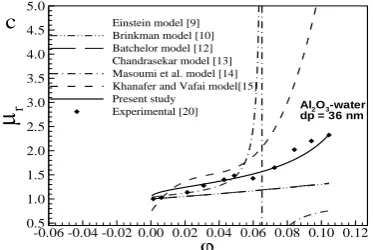
between this newly introduced model with the experimental results and other theoretical models regarding the mean nanoparticle diameter indicated that this developed model could well predict the viscosity of effective nanofluid at different volume fractions. Moreover, this model provides a more realistic and accurate behavior than that of the Masoumi et al. model [14]. A comparison between the effective viscosity obtained in the new model and other analytical and available experimental results based on low to medium mean nanoparticle diameter, i.e. dp =13, 28 and 47 nm
for Al2O3-water nanofluids, is shown in Figure 2.
As observed in Figure 2a, with respect to Al2O3
-water nanofluid with low volume fraction of (φ<0.05) and dp=13 nm, some of the presented models [9, 10, 12,
13] fail to show the correct behavior of the viscosity changes; this problem is for dp=28 nm. The behavior
that has been presented in the work of Khanafer et al. [15] is more accurate than previous models, while the behavior introduced by Masoumi et al. model [14] and this model have better functionality. Among the previous models, Masoumi et al. model [14] is the only appropriate model, while the model introduced here regarding the mean nanoparticle diameter of 28 nm is slightly better (Figure 2b). A good agreement is found in the literature [14] for dp = 13 and 28 nm, however it
is clearly observed that this model is not valid when the diameter or volume fraction of nanoparticles is increased (Figure. 2c).
A comparison of this new theoretical model and the available models are illustrated in Figure 3.
Figure 2. Comparison between the results based on new correlation and experimental data and other theoretical models for the Al2O3–water: (a) dp = 13 nm, (b) dp = 28 nm and (c) dp = 36 nm
Figure 3. Comparison between the results based on new correlation and experimental data and other theoretical models for the Al2O3–water: (a) dp = 47 nm, (b) dp = 80 nm and (c) dp = 95 nm
Al2O3- water
dp = 13 nm
a a
r0.010 0.015 0.020 0.025 0.030
1.0 1.5 2.0 2.5 3.0 3.5
Einstein model [9] Brinkman model [10] Batchelor model [12] Chandrasekar model [13] Masoumi et al. model [14] Khanafer and Vafai model [15] Present study
Experimental [19]
a
Al2O3-water
dp = 28 nm
b
r0.00 0.01 0.02 0.03 0.04 0.05 0.06 1.0
1.5 2.0 2.5
Einstein model [9] Brinkman model [10] Batchelor model [12] Chandrasekar model [13] Masoumi et al. model [14] Khanafer and Vafai model [15] Present study
Experimental [19]
b
r-0.06 -0.04 -0.02 0.00 0.02 0.04 0.06 0.08 0.10 0.12 0.5
1.0 1.5 2.0 2.5 3.0 3.5 4.0 4.5 5.0
Einstein model [9] Brinkman model [10] Batchelor model [12] Chandrasekar model [13] Masoumi et al. model [14] Khanafer and Vafai model[15] Present study
Experimental [20] Al2O3-water
dp = 36 nm
c
Al2O3-water
dp = 47 nm
r
0.5 1.0 1.5 2.0 2.5 3.0 3.5 4.0 4.5 5.0
Einstein model [9] Brinkman model [10] Batchelor model [12] Chandrasekar model [13] Masoumi et al. model [14] Khanafer and Vafai model[15] Present study
Experimental [20]
a
r
Einstein model [9]
Brinkman model [10] Batchelor model [12] Chandrasekar model [13] Masoumi et al. model [14] Khanafer and Vafai model [15] Present study
Experimental [21]
Al2O3-water
dp = 80 nm
b
r
Einstein model [9]
Brinkman model [10] Batchelor model [12] Chandrasekar model [13] Masoumi et al. model [14] Khanafer and Vafai model [15] Present study
Experimental [22]
Al2O3-water
dp = 95 nm
This comparison is made on a wide range of volume fractions and nanoparticles with larger diameters. Other models cannot behave accurate for large diameter or high volume fraction, but this model has a good potential for such conditions.
While most models are limited to one type of nanofluids, a comparison is made between this model and the experimental results for the viscosity of CuO-water. According to Figurre 4 a good agreement is observed between this presented model and the experimental data.
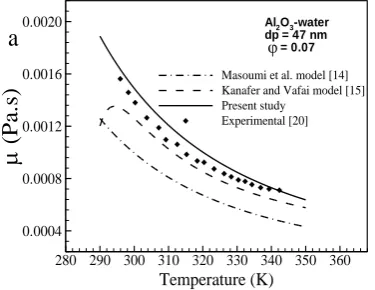
It is observed that, although the model is reviewed at room temperature, according to the experimental data, the new coefficients are obtained and by inserting these coefficients in Equation (18), the current model will be adopted for temperature variation. The validity of the new correlation (Equation (18)) for temperature variation is illustrated in Figure 5. As can be seen in Figure 5, the model could well predict the influence of the temperature variations on nanofluid viscosity at different mean diameters and volume fractions.
Figure 4. Comparison between the results based on new correlation and experimental data and other theoretical models for the Cu-water (29 nm)
Figure 5. Comparison between the results based on new correlation and experimental data and other theoretical models for the Cu-water and Al2O3-water.
4. CONCLUSION
An analytical study of the variants within the effective viscosity of nanofluids is conducted in this study. A new correlation for nanofluids viscosity is developed based on the Masoumi et al. equation [14]. The equation for effective viscosity is developed in terms of temperature, mean nanoparticle diameter, the nanoparticle concentration and both the nanoparticle and base fluid thermophysical characteristics.
A comparison between this model and other available models indicate that the available models were subjected to at least one of the following restrictions:
Valid only for a very small volume concentration, as Brinkman models and the Einstein’s formula. Moreover it is found that these models are not appropriate for nanofluid viscosity, particularly for intermediate to high particle volume fractions and mean nanoparticle diameter
Reliable only for a small volume fraction (less than 5%) as Masoumi et al. model [14]
A valid model for low- and medium –diameter nanoparticle, for example, Masoumi et al. model [14]
The correlations are true only for one type of nanoparticle, as Chandrasekar model [13] and Khanafer et al. model [15]
According to the results obtained here, it can be claimed that all the above-mentioned problems can be solved through this proposed model.
This study clearly demonstrates that this model is applicable for effective viscosity of nanofluid with higher accuracy and precision.
5. REFERENCES
1. Hannani, S.K., Sadeghipour, M. and Nazaktabar, M., "Natural convection heat transfer from horizontal cylinders in a vertical array confined between parallel walls", International Journal of Engineering, Vol. 15, No. 3, (2002), 293-302.
r0.00 0.01 0.02 0.03 0.04 0.05
0.8 1.0 1.2 1.4 1.6 1.8 2.0 2.2 2.4 2.6
Einstein model [9] Brinkman model [10] Batchelor model [12] Masoumi et al. model [14] Present study Experimental [20]
CuO-water dp = 29 nm
Temperature (K)
(P
a
.s
)
280 290 300 310 320 330 340 350 360 0.0004
0.0008 0.0012 0.0016 0.0020
Masoumi et al. model [14] Kanafer and Vafai model [15] Present study
Experimental [20] Al2O3-water dp = 47 nm = 0.07
a
Temperature (K)
(P
a.
s)
280 290 300 310 320 330 340 350 360 0.0004
0.0008 0.0012 0.0016 0.0020 0.0024
Masoumi et al. model [14] Present study Experimental [20]
CuO-water dp = 29 nm = 0.045
2. Sheikhzadeh, G., Babaei, M., Rahmany, V. and Mehrabian, M., "The effects of an imposed magnetic field on natural convection in a tilted cavity with partially active vertical walls: Numerical approach", International Journal of Engineering-Transactions A: Basics, Vol. 23, No. 1, (2009), 65-78.
3. Ziapour, B. and Rahimi, F., "Numerical study of natural convection heat transfer in a horizontal wavy absorber solar collector based on the second law analysis", International Journal of Engineering-Transactions A: Basics, Vol. 29, No. 1, (2016), 109-117.
4. Maxwell, J.C., A treatise on electricity end magnetism (1873), clarendon press (1891). 1954, Dover.
5. Choi, S.U. and Eastman, J.A., Enhancing thermal conductivity of fluids with nanoparticles. 1995, Argonne National Lab., IL (United States).
6. Ashorynejad, H., Sheikholeslami, M. and Fattahi, E., "Lattice boltzmann simulation of nanofluids natural convection heat transfer in concentric annulus", International Journal of Engineering-Transactions B: Applications, Vol. 26, No. 8, (2013), 895-904.
7. Shahriari, A., Jafari, S., Rahnama, M. and Behzadmehr, A., "Effect of nanofluid variable properties on natural convection in a square cavity using lattice boltzmann method", International Review of Mechanical Engineering (IREME), Vol. 7, No. 3, (2013), 442-452.
8. Davarnejad, R. and Kheiri, M., "Numerical comparison of turbulent heat transfer and flow characteristics of sio2/water nanofluid within helically corrugated tubes and plain tube",
International Journal of Engineering-Transactions A: Basics, Vol. 28, No. 10, (2015), 1408-1414.
9. Einstein, A., "Eine neue bestimmung der molekuldimensionen",
Annalen der Physik, Vol. 324, No. 2, (1906), 289-306.
10. Brinkman, H., "The viscosity of concentrated suspensions and solutions", The Journal of Chemical Physics, Vol. 20, No. 4, (1952), 571-571.
11. Lundgren, T.S., "Slow flow through stationary random beds and suspensions of spheres", Journal of Fluid Mechanics, Vol. 51, No. 2, (1972), 273-299.
12. Batchelor, G., "The effect of brownian motion on the bulk stress in a suspension of spherical particles", Journal of Fluid Mechanics, Vol. 83, No. 1, (1977), 97-117.
13. Chandrasekar, M., Suresh, S. and Bose, A.C., "Experimental investigations and theoretical determination of thermal conductivity and viscosity of Al2O3/water nanofluid",
Experimental Thermal and Fluid Science, Vol. 34, No. 2, (2010), 210-216.
14. Masoumi, N., Sohrabi, N. and Behzadmehr, A., "A new model for calculating the effective viscosity of nanofluids", Journal of Physics D: Applied Physics, Vol. 42, No. 5, (2009), 055501. 15. Khanafer, K., Vafai, K. and Lightstone, M., "Buoyancy-driven
heat transfer enhancement in a two-dimensional enclosure utilizing nanofluids", International Journal of Heat and Mass Transfer, Vol. 46, No. 19, (2003), 3639-3653.
16. Jang, S.P. and Choi, S.U., "Role of brownian motion in the enhanced thermal conductivity of nanofluids", Applied Physics LetterS, Vol. 84, No. 21, (2004), 4316-4318.
17. Prasher, R., Bhattacharya, P. and Phelan, P.E., "Thermal conductivity of nanoscale colloidal solutions (nanofluids)",
Physical Review Letters, Vol. 94, No. 2, (2005), 025901. 18. Koo, J. and Kleinstreuer, C., "A new thermal conductivity model
for nanofluids", Journal of Nanoparticle Research, Vol. 6, No. 6, (2004), 577-588.
Providing an Analytical Model in Determining Nanofluids
A. Shahriaria, N. Jahantigha, F. Rakanib
a Department of Mechanical Engineering, University of Zabol, Zabol, Iran
b Department of Computer Sciences, University of Sistan & Baluchestan, Zahedan, Iran
P A P E R I N F O
Paper history:
Received 26 May 2017
Received in revised form 30 June 2017 Accepted 08 September 2017
Keywords: Effective Viscosity Mean Nanoparticle Diameter Nanofluid
Thermophysical Properties Volume Concentration
ديكچ ه
تسا هدش یسررب لایسونان یکیمانید هتیزوکسیو یور هرذونان تظلغ و هرذونان طسوتم هزادنا ،ترارح هجرد یاهریغتم ریثأت رضاح راک رد تلاداعم یلیلحت شور کی رب هک حلاصا
هدش تلااسونان هتیزوکسیو لدم ساسا رب دیدج لدم .تسا ینتبم
ینوارب تکرح رثا هک یلبق یاه
هب ار اپ کی ناونع یم رارق رظندم یدیلک رتمار .تسا هتفای هعسوت ،دنداد
زا هدافتسا هک داد ناشن جیاتن لدم
اه تارذونان یارب یلبق ی گرزب
رت
زا
36
مه .تسین بسانم رتمونان نینچ
ات تارذونان مک یرسک مجح رد اهنت یلبق تاعلاطم
5%
تسا هدش زکرمتم
.
ناکما رضاح راک رد
ق و تارذونان نگمه یگدنکارپ هرذونان تظلغ ،تارذونان طسوتم رطق ،امد رثا دیدج لدم رد .تسا هدش ظاحل تارذونان یارب سکوتسا نونا
زین و و ی گژ ی اه هتیزوکسیو یارب هیاپ لایس و هرذونان یکیزیفومرت ی رثؤم
.تسا هدش هتفرگ رظن رد لایسونان یبیکرت حیحصت بیرض کی
ندرک ظاحل یارب هداس
زاس ازآ نایرج یزرم طرش ی یزرم هیلا زا جراخ رد د
هتیزوکسیو نیب جیاتن بوخ قفاوت .تسا هدش یفرعم رثؤم
هب تسد هدمآ تسا هدش هدهاشم فلتخم تلاایسونان یارب یهاگشیامزآ جیاتن و دیدج لدم زا
.
یم ناشن جیاتن یارب رضاح لدم هک دهد
یمجح رسک زا یعیسو هدودحم
(0% < φ <11%)
تارذونان طسوتم هزادنا ،
(13 nm < dp < 95 nm)
، یامد تارییغت لایسونان ی
(290 K < T < 350 K)
تسا ربتعم تارذونان زا یفلتخم عاونا و