Please cite this article as: M. Jamshidi, M. Osanloo, Multiple Destination Influence on Production Scheduling in Multi-element Mines,International Journal of Engineering (IJE),IJE TRANSACTIONS A: Basics Vol. 31, No. 1, (January 2018) 173-180
International Journal of Engineering
J o u r n a l H o m e p a g e : w w w . i j e . i rMultiple Destination Influence on Production Scheduling in Multi-element Mines
M. Jamshidi, M. Osanloo*
Department of Mining and Metallurgical Engineering, Amirkabir University of Technology, Tehran, Iran
P A P E R I N F O
Paper history:
Received 12November2017
Received in revised form 28November2017 Accepted 30November2017
Keywords:
Iron Ore Blending Multiple Product Production Scheduling Mixed Integer Programming
A B S T R A C T
In multi-element deposits, different blocks are blended together to create a product with a predetermined quality. Generally, blending aims to obtain a special quality and quantity based on determining the processing plant or customer needs. However, blending causes different products based on the deposit properties. Thus, a block is blended with others to create one of many possible products. The present study aims to develop a mixed integer programming model for the production scheduling of iron ore mines. The model can consider different destinations for mine blocks. Each destination has its own specifications for the main element (Fe) and other existing elements such as sulfur and phosphorous. For this purpose, ten different scenarios were evaluated to investigate the effect of multiple products on production scheduling and Net Present Value (NPV) of the related project. Among the four selected scenarios, the mine was scheduled based on single product while multiple products were considered in scheduling in other scenarios. Based on the results, the maximum NPV in scenarios with multiple products is approximately 15% higher than that of the single product scenarios.
doi: 10.5829/ije.2018.31.01a.23
1. INTRODUCTION1
Production scheduling in mines is regarded as a management problem involved in finding the best time to extract and determine the appropriate destination to send the material. The mine planner has faced with some constraints such as available ore reserve, mining and processing capacities, slope and access constraint. In most mining operations, especially in multi-element deposits, another constraint which should be emphasized is the specified quality of the mine product. Thus, blocks with different characteristics should be blended to meet the required quality. All these constraints are essential for achieving the best production schedule. These constraints play a significant role in production scheduling. However, the main question raised here is the possibility of optimizing mine products. In multi-element deposits, blending different blocks allows to produce multiple products instead of a single product.
Several attempts have been made in mine production scheduling based on blending constraints. Peng [1] used
*Corresponding Author’s Email: [email protected] (M. Osanloo)
linear programming (LP) for production scheduling in coal mines in order to minimize the production costs. Fytas and Calder [2] introduced a combination of simulation for long-term production and LP for short-term production planning for the purpose of maximizing profit to meet certain productivity. White and Olson [3] implemented an LP model to optimize fleet dispatching in an open-pit mines in line with blending constraints. Sundar and Temeng [4, 5] applied LP to optimize production schedule by considering blending constraints. Osanloo et al. [6] used mixed integer programming (MIP) for production scheduling based on grade uncertainty. The grade distribution function in each block was implemented as a stochastic input in the model. Smith [7] applied stochastic programming for production scheduling in a uranium mine. Rahman and Asad [8] presented a model for short-term production scheduling in a limestone mine in order to decrease production costs.
multi-objective simulated annealing optimization for short-term production scheduling in mines. Samanta et al. [13] implemented a meta-heuristic approach for planning grade control in a bauxite deposit. Souza et al. [14] introduced a heuristic model for short- term production scheduling in open-pit mines based on blending requirements. Asad [15] used a heuristic approach for planning the long- term production of a cement quarry by considering blending constraints. In addition, some utilized heuristic and meta-heuristic approaches for production scheduling in open-pit mines based on blending constraints [16-18]. Rahmanpour and Osanloo [19] used stimulation methods to production planning with the objective of controlling quantity and quality of the factory input, in addition to decrease distraction of the mine’s short-term production planning from the objectives of the long-term plan.
Kakaei and Ataei [20] represented a new approach for determining the optimum cut-off grade in multi-product open pit mines through using the imperialist competitive algorithm.
Kakha and Monjezi [21] represent a model to determine the pushbacks in two-element deposits, considering the effect of two elements in the block economic value.
By considering all the above-mentioned studies, the effect of having multiple products instead of a single product has been less emphasized for studying the effect of the existing elements. Therefore, the present study aimed to develop a new mathematical model to investigate the effect of involving more than one destination in production planning, where each destination has its own specification. The current model can optimize the production planning based on the requirements of each destination for maximizing NPV based on blending demands in each destination.
2. MULTI-ELEMENT DEPOSITS
In multi-element deposits, the quality of mine product relies on different elements which may exist in the orebody. Thus, the cut-off grade is not regarded as the only criterion which determines the destination of blocks. The quality of these minerals in mine product is a function of grades of different existing elements. In this situation, different blocks with various characteristics are blended so that the resulting mixture can satisfy the required quantity and quality of the consumable product. Therefore, the effect of the associated elements on the product quality should be emphasized. Iron ore, coal, phosphate, and bauxite are regarded as some example of these minerals.
Based on the genesis of the orebody, some elements such as phosphorus (P), silica (SiO2), alumina (Al2O3)
and sulfur (S) influencing the production quality could be accompanied with iron (Fe) in Iron ore mines. Ash,
sulfur, and BTU (British Thermal Unit) content are effective in coal. In addition, phosphate based product quality relies on the percentage of phosphate, clay and a variety of rare elements.
In this paper, the calculations were done for iron ore mines while the relations could be modified and used for other multi-element deposits. The payment for the product is based on a consistent grade in iron ore mines in its iron content as well as the content of other elements which are divided into the following groups:
- Useful minerals: In this group, the main components include lime and manganese compounds. Lime causes a reduction in the flux (a material which removes unwanted materials or cleans another material is called a flux) requirement which can decrease cost and energy consumption. Manganese increases the economic value of the ore, removes sulfur, and prevents the steel from cracking. In addition, manganese enters the cast iron or steel compounds and improves their quality.
- Undesirable minerals: The elements related to this group cause penalties when they exceed the acceptable limits. There are two kinds of impurities in this group. The first is related to those which enter the steel compound and compromise the quality of the final product such as copper (Cu), tin (Sn), chromium (Cr), vanadium (V) and molybdenum (Mo). These impurities lead to a reduction in mechanical properties and the fluidity.
The second group includes zinc (Zn), lead (Pb), titanium dioxide (TiO2), sodium oxide (Na2O),
potassium oxide (K2O), arsenic (As), phosphorus (P),
sulfur (S), chlorine (Cl) and fluorine (F), which creates some trouble in the steel production process or have emissions which are related to environmental pollution
.
The value of the produced material depends on the grade of Fe and other elements which are obtained based on the destination or customer requirements.
Steel factories are the main consumer of the iron ore and about 98% of world iron ore production is used to make iron in the form of steel. According to the design criteria, each factory requires iron ore based on the determined characteristics. The homogeneity of the feed is important for steel factories because of the efficiency on the chemical and physical properties of the feed. Sometimes, the customers' contracts heavily penalize the material found to include an excessive amount of the deleterious elements and the existence of useful elements has some benefits for mine production.
3. PRODUCTION SCHEDULING MODEL
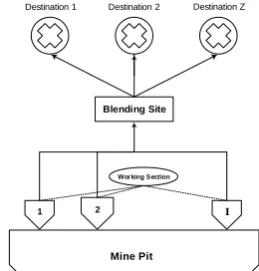
In this model, it is possible to have multiple destinations to send the mine raw material instead of single destination. In order to have more than one destination for mine product, the number of blending plans should be related to the number of destinations. Each extracted block is controlled by the blending plans. If the quality of the block can satisfy only one of plans, the revenue of mentioned block is calculated and accordingly the destination and time of block extraction are declared. However, the destination which maximizes the income is declared if the block can be used in several blending plans. Figure 1 illustrates the schematic path of ore blocks. The extracted blocks can participate in the blending plan of each destination, within the possible plans, the model selects the extraction period and destination which creates the maximum benefit.
In this model, a procedure was defined to achieve the required blending requirements based on the production of an iron ore mine. The model determines the best destination/customer for all extracted blocks in each period. The objective function of the model (Equation (1)) is defined as the maximization of the discounted profits in order to minimize the deviation between the produced blend and requested blend in all destinations, along the mining periods.
𝑀𝑎𝑥𝑖𝑚𝑖𝑧𝑒 𝑍 = ∑ ∑ ∑𝐷 [( 𝑥𝑏𝑦𝑑 × 𝐼𝑏𝑦𝑑) −
𝑑=1 𝐵 𝑏=1 𝑌 𝑦=1
( 𝑥𝑏𝑦𝑑× 𝐶𝑏𝑦𝑑)] (1)
where, Z represents the total NPV of the project ($), Y indicates a set of mining periods, B is a set of potential ore blocks, D shows a set of destinations, b is regarded as block identifier, y means the period identifier, and d displays the destination identifier,𝑥𝑏𝑦𝑑is the decision variable of block b (if extracted in period y for destination d, it is equal to 1, otherwise it is 0), 𝐼𝑏𝑦𝑑is considered as the income of block b when it is extracted in period y and sent to destination d ($/ton), and 𝐶𝑏𝑦𝑑
presents the related cost of block b if extracted in period y and sent to destination d ($/ton).
1 2 I
Blending Site
Mine Pit
Wor king Section
Destination 1 Destination 2 Destination Z
Figure 1. The schematic path of blocks in the model
The constraints related to this model include mining and destination capacity, slope constraint and maximum/minimum eligible grade of the elements.
Each destination includes a criterion to accept the Fe in the minimum grade. If the Fe content of the mine product fails to satisfy the criterion, the customer has the right for rejection. Therefore, it should be checked whether the mine product can meet the minimum acceptable grade of the destination. This constraint is given in Equation (2).
∑𝑏∈𝐵𝑥𝑏𝑦𝑑(𝑔𝑏𝐹𝑒− 𝑔𝑚𝑖𝑛𝐹𝑒 ) ≥ 0 ∀ 𝑑 ∈ 𝐷 𝑎𝑛𝑑 𝑦 ∈ 𝑌 (2)
where𝑔𝑏𝐹𝑒 represents Fe grade in block b (%) and
𝑔𝑚𝑖𝑛𝐹𝑒 indicates the minimum acceptable grade of Fe (%). In addition, the maximum grade of Fe should be checked due to the limitation in the contract of selling the raw material and the saving opportunity to blend the high and low grade material to obtain more valuable product. The maximum grade of product which should not exceed the acceptable limits in the contract is checked by Equation (3). In this equation 𝑔𝑚𝑎𝑥𝐹𝑒 is the maximum acceptable grade of Fe (%).
∑𝑏∈𝐵𝑥𝑏𝑦𝑑(𝑔𝑀𝑎𝑥𝐹𝑒 − 𝑔𝑏𝐹𝑒) ≥ 0 ∀𝑑 ∈ 𝐷 𝑎𝑛𝑑 𝑦 ∈ 𝑌 (3)
Equations (4) and (5) control the maximum acceptable grades of S and P. The existence of the undesirable elements if the limit is exceeded can imposesome penalties. Thus, it is important to check the grade of these elements in the mine product and maintain them as low as possible with respect tothe acceptable limits. ∑𝑏∈𝐵𝑥𝑏𝑦𝑑(𝑔𝑀𝑎𝑥𝑆 − 𝑔𝑏𝑆) ≥ 0 ∀ 𝑑 ∈ 𝐷 𝑎𝑛𝑑 𝑦 ∈ 𝑌 (4)
∑ 𝑏∈𝐵𝑥𝑏𝑦𝑑(𝑔𝑀𝑎𝑥𝑃 − 𝑔𝑏𝑃) ≥ 0 ∀ 𝑑 ∈ 𝐷 𝑎𝑛𝑑 𝑦 ∈ 𝑌 (5)
where 𝑔𝑏𝑆represents the S gradein block b (%), 𝑔𝑏𝑃 indicates the P grade in block b (%), 𝑔𝑚𝑎𝑥𝑆 means the maximum acceptable grade of S (%), and 𝑔𝑚𝑎𝑥𝑃 is regarded as the maximum acceptable grade of P (%).
Based on Equation (6), an extracted block is used only for a particular destination in production periods and each block is extracted once. The block is used in the production scheduling several times without considering the constraint. Therefore, some constraints are required to assure that the block has been extracted once.
∑𝑦∈𝑌∑𝑑∈𝐷𝑥𝑏𝑦𝑑= 1 ∀𝑏 ∈ 𝐵 (6)
The mining capacity is regarded as another constraint which may influence the production scheduling. During mining planning, it is worth noting that the production in each period should not exceed the maximum capacity of the mine. This criterion is represented in Equation (7).
{∑ ∑ (𝑥𝑏 𝑦𝑑
× 𝑋𝑏) 𝑑∈𝐷
where𝑋𝑏 indicates the weight of block b (ton) and
𝑀𝐶 represents the mining capacity (tons/year).
The destination capacity is another constraint by which the total block material sent to each destination in different periods should not exceed the destination capacity. This constraint is displayed by Equation (8). ∑𝑏∈𝐵(𝑥𝑏𝑦𝑑× 𝑂𝑏𝑦𝑑) ≤𝐷𝑐 ∀𝑑 ∈ 𝐷 𝑎𝑛𝑑 𝑦 ∈ 𝑌 (8)
where,𝑂𝑏𝑦𝑑representsore tonnage of block b extracted in period t and sent to destination d and 𝐷𝐶 indicates the destination capacity (tons/year)
In each period, the upper blocks should be extracted before the planned blocks. Therefore, Equation 9 is related to the slope and priority constraints which allow underlying blocks to be mined only after the blocks on the top.
∑𝑑∈𝐷𝑥𝑏𝑦𝑑≤ ∑𝑡≤𝑡́ ∑𝑑∈𝐷𝑥𝑏𝑦́𝑑′ ∀𝑏 ∈ 𝐵 𝑎𝑛𝑑 𝑦 ∈ 𝑌 (9)
In this equation b’ and y’ are the block and period identifier respectively.
4. RESULT AND DISCUSSION
The block model starts with the input data of different elements including main mineral and the inter-correlated elements such as S and P. Since the quality of mine product is important in short-term planning, the block model is divided into some pushbacks, and the presented model is implemented on the push back 2 including 3000 blocks with the dimension of 10×10×15 meters. Each block involves information about the content of P, S and Fe. Figure 2 illustrates the model procedure. The input data of the model includes block model of the deposit and the required blending specifications of each destination. The destinations need some determined characteristics of the material at a specific price.
The block properties are evaluated based on the destination criteria. In this regard, the economic value of each block is calculated for each destination and is checked to see which destination requirements meet the block blending. For the blocks that are possible to use only in one blending plan, other constraints such as slope and capacity constraint are checked and the destination and extraction period is demonstrated if the block meets the constraints. However, the destination maximizing the NPV is selected as the final destination for ore block if the block characteristics allow to use it in some of the blending plans.
Figures 3-5 represent the ton-grade curve of the deposit for Fe, S and P. As shown in Figure 3, the deposit consists of a high amount of Fe which makes it possible to find some quotations compatible to the average grade of the deposit.
The block model is fed into NPV scheduler to determine the final pit limit and pushbacks. In this case, 6 push backs are determined (Figure 6). Each push back contains about 18 Mt of ore. In the present study, the push back 2 is selected for production planning in order to determine the destination of blocks based on the proposed model.
Quotes for Iranian iron ores in April 2017 were considered to determine the destination for mine product. There are different requests according to Fe and other elements content based on the declared quotes for iron ore.
Input Data (Block Model + Destination
Specification)
Create Economic Block Model for each destination
Generate MIP model considering all constrains
Solve MIP model
Report mine schedul
Figure 2.The procedure of the MIP model
Figure 3.Ton-grade curve of Fe
Figure 4.Ton-grade curve of P
55 56 57 58 59 60 61 62 63 64
0 5000 10000 15000 20000
40 42 44 46 48 50 52 54 56 58 60 62
%
Tho
us
an
ds
T
o
n
Fe COG
Tonnage Ave Fe
0.05 0.052 0.054 0.056 0.058 0.06
0 2000 4000 6000 8000 10000 12000 14000 16000 18000 20000
40 42 44 46 48 50 52 54 56 58 60 62
%
Tho
us
an
ds
T
o
n
Fe COG
Figure 5.Ton-grade curve of S
Figure 6. Six push backs of the mine
Each destination searches for a specified raw material based on its own design specification or lack of feed material in a certain grade. A set of these quotes are declared in the international markets, among which some are used as a destination for mine product. Table 1 represents the possible quotes which should be considered as a destination for the iron ore deposit in the present study.
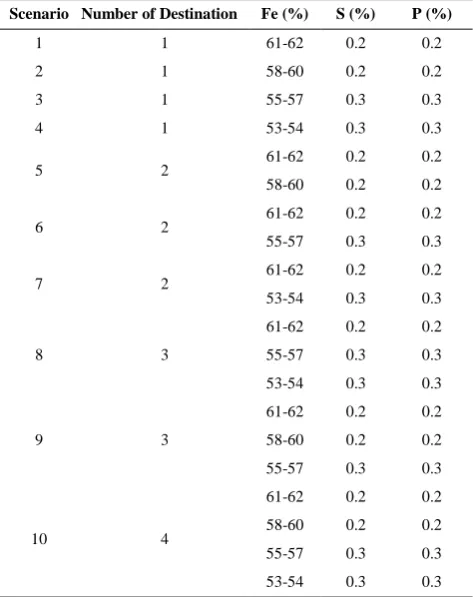
Table 2 displays the optimization parameters. The total prices in Table 1 are used for delivery at the same port. Thus, the shipping cost of all the destinations/customers assumed to be the same. In the present study, a 3-year scheduling period was considered. The annual ore production is about 6,000,000 tons. The production scheduling of the mine was conducted in ten different scenarios. Only one destination was considered in the scenarios 1-4. Two destinations were regarded for the mine product among the scenarios 5-7.
TABLE 1. Blending specification of the destinations [23]
Parameter Unit Destination
No. 1 No. 2 No. 3 No. 4
Max grade of Fe % 62 60 57 54
Min Fe % 61 58 55 53
Max P % 0.2 0.2 0.3 0.3
Max S % 0.2 0.2 0.3 0.3
Price ($/ton) 54.7 48.4 38 29.3
TABLE 2. Costs and recovery
Item Unit Value
Mining costs $/ton 4.5
Crushing and grinding costs $/ton 1.9
Environmental costs $/ton 0.01
Engineering costs $/ton 0.1
Blending costs $/ton 0.1
Royalties and government taxes $/ton 0.005
Waste Removal Cost $/ton 2.8
Freight cost of ore $/ton 10
Mining Recovery % 95
Three destinations were considered in scenarios 8 and 9 while four destinations were selected in scenario 10. Table 3 indicates a summary of these scenarios.
The production scheduling of the considered push backs was performed for all the scenarios. Table 4 represents the results. Among the single destination scenarios (1-4), the maximum NPV is related to scenario 2 in which the grade of Fe is about 58-60%. Thus, it is important to find the most appropriate destination for mine product by the production scheduling where a single destination is regarded as the target of production.
TABLE 3. The scenarios of production scheduling
Scenario Number of Destination Fe (%) S (%) P (%)
1 1 61-62 0.2 0.2
2 1 58-60 0.2 0.2
3 1 55-57 0.3 0.3
4 1 53-54 0.3 0.3
5 2 61-62 0.2 0.2
58-60 0.2 0.2
6 2 61-62 0.2 0.2
55-57 0.3 0.3
7 2 61-62 0.2 0.2
53-54 0.3 0.3
8 3
61-62 0.2 0.2
55-57 0.3 0.3
53-54 0.3 0.3
9 3
61-62 0.2 0.2
58-60 0.2 0.2
55-57 0.3 0.3
10 4
61-62 0.2 0.2
58-60 0.2 0.2
55-57 0.3 0.3
53-54 0.3 0.3
0.4 0.45 0.5 0.55 0.6
0 5000 10000 15000 20000
40 42 44 46 48 50 52 54 56 58 60 62
%
Tho
us
an
ds
T
o
n
Fe COG
TABLE 4. The result of production scheduling scenarios
Scenario NPV ($)
1 361,489,771
2 395,995,433
3 164,900,748
4 38,055,320
5 414,163,252
6 404,685,062
7 247,136,415
8 310,508,066
9 457,297,638
10 396,649,745
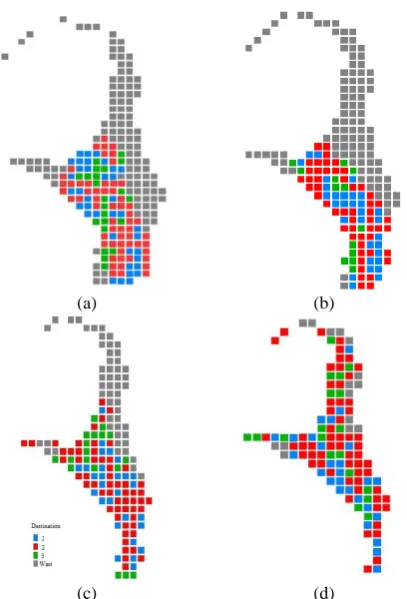
The NPV of the project improved significantly in most cases among the scenarios with multiple destinations and accordingly multiple blending plans. The NPV in scenario 9 is about 15% higher than NPV in scenario 2. Therefore, it is important to use the opportunities to make a plan not just for a single destination, but for blending different blocks in order to produce multiple products. Figure 7 illustrates a cross-sectional view of the excavation patterns resulting from scenario 9. In addition, the destination of each block determined by the model is demonstrated in Figure 7.
(a) (b)
(c) (d)
Figure 7.A schematic plan of the block destination for scenario 9 at different levels , (a) 1925, (b) 1900, (c) 1875, and (d) 1850
More selling opportunities can contribute to more options in production scheduling which makes possible to use more material in the mine products. Further, the mine planner involves a wider range of products in cases where more selling opportunities are taken into consideration. Furthermore, a mine planner with more flexibility can manage blending different blocks in order to produce a range of profitable products.
5. CONCLUSION
Generally, production scheduling aims to maximize the NPV related to the project. Production scheduling can determine which blocks should be extracted in each period by considering the related constraints. Regarding some ore minerals such as iron ore, coal, and cement manufacture feed material, there is an inherent task of blending different materials to provide a product which meets the customers’ requirements, along with some common constraints. Blending is essential for maintaining the mine output as close as possible to the consumer’s inquiries.
In this study, the modeling and scheduling optimization for iron ore blending was conducted by considering different scenarios in production scheduling in order to investigate the effect of having multiple destinations instead of a single destination for mine product.
To this aim, a mixed integer programming model was developed for production scheduling of a mine when the destination number for the mine products exceeds one. The model was implemented to maximize net present value (NPV) in each period of production. Blending constraints were considered, along with common constraints involved in production scheduling. Regarding the production of multiple destinations, maintaining the quality of each product as close as the specified characteristics of each customer/destination should be emphasized. In the developed model, the mine blocks are blended together in order to select the best destination for each block which can maximize the NPV. In this case, the destination of the block is not separately selected but different blending cases are examined, among which the best is selected for sending the blocks.
which is about 15% more than the maximum NPV in single destination scenarios.
Based on the proposed model, it is possible to construct a plan, not just for a single product, but for multiple products, by considering that the blocks can be blended together. In conclusion, the planner can select the best alternative among destinations and send the block to the destination which can provide more benefit and consequently maximum NPV for mine project.
The model can consider all the existing elements in the block model and represent a production scheduling that in addition to maximizing the NPV, blend the blocks in a manner that the required specifications of all the destination to be met.
6. REFERENCES
1. Peng, F., Walters, A., Geer, M. and Leonard, J., "Evaluation and prediction of optimum cleaning results", Coal Preparation, 4th
edn., AIME, New York, (1979), 101-110.
2. Fytas, K. and Calder, P.N., "A computerized model of open pit short and long range production scheduling", in 19th APCOM Symposium. (1986), 109-119.
3. White, J. and Olson, J., "Computer-based dispatching in mines with concurrent operating objectives", Min. Eng.(Littleton, Colo.);(United States), Vol. 38, No. 11, (1986).
4. Sundar, D.K. and Acharya, D., "Blast schedule planning and shiftwise production scheduling of an opencast iron ore mine",
Computers &Industrial Engineering, Vol. 28, No. 4, (1995),
927-935.
5. Temeng, V.A., Otuonye, F.O. and Frendewey Jr, J.O., "Real-time truck dispatching using a transportation algorithm",
International Journal of Surface Mining, Reclamation and
Environment, Vol. 11, No. 4, (1997), 203-207.
6. Gholamnejad, J., Osanloo, M. and Khorram, E., "A chance constrained integer programming model for open pit long-term production planning", International Journal of Engineering
Transactions A: Basics, Vol. 4, No. 21, (2008), 407-418.
7. Smith, M.L., "Integrating conditional simulation and stochastic programming: An application in production scheduling",
Computer Application in the Materials Industries,. (2001),
203-208.
8. Rehman, S.U. and Asad, M.W.A., "A mixed-integer linear programming (milp) model for short-range production scheduling of cement quarry operations", Asia-Pacific Journal
of Operational Research, Vol. 27, No. 03, (2010), 315-333.
9. Zuckerberg, M., Van der Riet, J., Malajczuk, W. and Stone, P., "Optimal life-of-mine scheduling for a bauxite mine", Journal
of Mining Science, Vol. 47, No. 2, (2011), 158-165.
10. Askari-Nasab, H., Eivazy, H., Tabesh, M. and Badiozamani, M., "A mathematical programming model for open pit short-term production scheduling", in SME Annual Meeting, Denver, Colorado, USA SME. (2011), 1-8.
11. Rahmanpour, M. and Osanloo, M., "Pit limit determination considering blending requirements", in in Proceeding MPES., (2012), 564-575.
12. Kumral, M. and Dowd, P., "Short-term mine production scheduling for industrial minerals using multi-objective simulated annealing", in APCOM 2002: 30 th International Symposium on the Application of Computers and Operations Research in the Mineral Industry., (2002), 731-741.
13. Samanta, B., Bhattacherjee, A. and Ganguli, R., "A genetic algorithms approach for grade control planning in a bauxite deposit", in Proceedings of the 32nd International Symposium on Applications of Computers and Operations Research in the Mineral Industry, (2005), 337-342.
14. Souza, M.J., Coelho, I.M., Ribas, S., Santos, H.G. and Merschmann, L.H.d.C., "A hybrid heuristic algorithm for the open-pit-mining operational planning problem", European
Journal of Operational Research, Vol. 207, No. 2, (2010),
1041-1051.
15. Asad, M.W.A., "A heuristic approach to long-range production planning of cement quarry operations", Production Planning &
Control, Vol. 22, No. 4, (2011), 353-364.
16. Sari, Y.A. and Kumral, M., "Mine production scheduling for poly-metallic mineral deposits: Extension to multiple processes",
International Journal of Planning and Scheduling, Vol. 2,
No. 2, (2015), 134-153.
17. Goodfellow, R.C. and Dimitrakopoulos, R., "Global optimization of open pit mining complexes with uncertainty",
Applied Soft Computing, Vol. 40, (2016), 292-304.
18. Jélvez, E., Morales, N., Nancel-Penard, P., Peypouquet, J. and Reyes, P., "Aggregation heuristic for the open-pit block scheduling problem", European Journal of Operational
Research, Vol. 249, No. 3, (2016), 1169-1177.
19. Mohammadi, S., Kakaie, R., Ataei, M. and Pourzamani, E., "Determination of the optimum cut-off grades and production scheduling in multi-product open pit mines using imperialist competitive algorithm (ICA)", Resources Policy, Vol. 51, (2017), 39-48.
20. Rahmanpour, M. and Osanloo, M., "Resilient decision making in open pit short-term production planning in presence of geologic uncertainty", International Journal of Engineering
Transactions A: Basics, Vol. 29, No. 7, (2016), 1022-1028.
21. Kakha, G., G. and Monjezi, M., "Push back design in two-element deposits incorporating grade uncertainty", International
Journal of Engineering-Transactions B: Applications, Vol.
Multiple Destination Influence on Production Scheduling in Multi-element Mines
M. Jamshidi, M. Osanloo
Department of Mining and Metallurgical Engineering, Amirkabir University of Technology, Tehran, Iran
P A P E R I N F O
Paper history:
Received 12November 2017
Received in revised form 28November 2017 Accepted 30November 2017
Keywords: Iron Ore Blending Multiple Product Production Scheduling MIP ديكچ ه رد رصنع دنچ نداعم ی ، کولب ¬ یاه اب فلتخم ی دک ی رگ م طولخم ی ¬ دنوش ات ی ک ک اب لوصحم ی ف ی ت روط هب .دوش لصاح صخشم
کولب طلاتخا ،لومعم
¬ یسرفدهاباه ند هب ی ک ک ی ف ی ت مک و ی ت عت یی ن ن ساسا رب هک هدش ی
زا روآرف هناخراک یی ا ن ی اهزا ی فرصم ¬ یمماجناتساناگدننک ¬ دوش ا . ی ن لاح رد ی ک تسا ه م طلاتخا ماجنا اب ی
¬
ناوت صوصخ هب هجوت اب ی تا خذ ی ،هر تلاوصحم فلتخم ی لوت ی د کرت و دومن یب ی ک کولب اب کولب
¬ یاه د ی رگ م ی ¬ دناوت عونتم تلاوصحم ی
امن مهارف ار ی د ا رد . ی ن ،هلاقم ی ک لدم همانرب ¬ یر ز ی حص ددع ی ح ارب طلتخم ی نهآ گنس نداعم فلتخم دصاقم نآ رد هک تسا هدش هئارا
ی رب ا ی کولب و تلاوصحم
¬
یاه
ندعم هدام ی م هتفرگ رظن رد ی ¬ دوش ره . ی ک ا زا ی ن اراد دصاقم ی رعت تاصخشم ی ف هدش -ا ی ارب ی لصا رصنع ی اس و )نهآ( ی ر
ظن هارمه رصانع ی
ر ارب .دنتسه رفسف و درگوگ ی
ا ی ن رانس هد ،روظنم ی
و ی ات هدش هتفرگ رظن رد فلتخم ثات
ی ر رد هناگدنچ دصاقم
همانرب ¬ یر ز ی لوت ی لعف صلاخ شزرا و د ی
سررب ،هژورپ ی رانس راهچ رد .دوش ی ،و اهنت ی ک ارب دصقم ی ندعم تلاوصحم ی رظن رد
رانس شش رد و هدش هتفرگ ی
،و همانرب رد هناگدنچ دصاقم
¬ یر ز ی لوت ی د اتن ساسا رب .تسا هدش دراو ی
ج لعف صلاخ شزرا ،لصاح ی بی ش ی هن دصاقم رد % دودح ،هناگدنچ 15 ب زا ی ش ی هن صلاخ شزرا لعف ی لوصحم کت تلااح رد ی ب ی رتش تسا .