VOLUME NO.6(2016),ISSUE NO.08(AUGUST) ISSN 2231-5756
A Monthly Double-Blind Peer Reviewed (Refereed/Juried) Open Access International e-Journal - Included in the International Serial Directories Indexed & Listed at:
Ulrich's Periodicals Directory ©, ProQuest, U.S.A., EBSCO Publishing, U.S.A., Cabell’s Directories of Publishing Opportunities, U.S.A., Google Scholar, Open J-Gage, India [link of the same is duly available at Inflibnet of University Grants Commission (U.G.C.)],
VOLUME NO.6(2016),ISSUE NO.08(AUGUST) ISSN 2231-5756
CONTENTS
Sr.
No.
TITLE & NAME OF THE AUTHOR (S)
Page
No.
1
.
A STUDY OF OPERATIONAL PROCESS AT LEATHER TANNING INDUSTRY
KANAKA B & M. JEYARATHANAM
1
2
.
NEED FOR TEACHING WELL- BEING THROUGH POSITIVE PSYCHOLOGY IN EDUCATIONAL INSTITUTIONS
JAYASHREE SANGHANI, DR. SAROJ ARYA, SOWMYA MARE & BRIG. JAGJIT AHUJA
5
3
.
CORPORATE SOCIAL RESPONSIBILITY
SUMAIYA FATHIMA
11
4
.
ANALYSIS OF FINANCIAL STATEMENT OF ROURKELA STEEL PLANT BY USING THE TECHNIQUE OF RATIO
ANALYSIS
DR. ASHOK KUMAR RATH
13
5
.
INTELLECTUAL CAPITAL AS A TALENT POOL CREATES ORGANISATIONAL EXCELLENCE
DR. UPPUGUNDURI PADMAVATHI
21
6
.
THE INFLUENCE OF CONSUMER MINDSET ON THE INTENTION TO PURCHASE FAIR TRADE GOODS IN
ETHNIC CHINESE SOCIETY: THE MEDIATING ROLE OF MORAL IDENTITY
GHI-FENG YEN, RU-YU WANG & HSIN-TI YANG
24
7
.
CUSTOMERS’ PERCEPTION OF SIDBI IN TAMIL NADU
DR. T. RENUHA & DR. P. AMIRTHA GOWRI
30
8
.
PSYCHOLOGICAL CONTRACT AND ITS CONTENTS: A STUDY WITH REFERENCE TO GOAN IT COMPANIES
DR. K G SANKARANARAYANAN & PARESH LINGADKAR
34
9
.
INTERMEDIARY LIABILITIES: COMPARATIVE STUDY OF VARIOUS JURISDICTIONS
ASTITWA BHARGAVA & DR. MANMEETA SAXENA
37
10
.
AWARENESS ON SUSTAINABILITY BASED EDUCATION FOR TEACHERS OF HIGHER EDUCATIONAL
INSTITUTIONS: A CONCEPTUAL ANALYSIS
DR. A. SENTHILKUMAR
45
11
.
HIGHER EDUCATION IN INDIA: EMERGING ISSUES, CHALLENGES AND SUGGESTIONS
ASHA RANI.K
48
12
.
A STUDY ON FINANCIAL HEALTH OF DHAMPUR SUGAR MILLS LTD, UTTAR PRADESH
A. ROJAMMAL & DR. S. BABU
52
13
.
A STUDY ON QUALITY OF WORK LIFE OF THE EMPLOYEES OF SELECTED COMPANIES IN NANJANGUDU
INDUSTRIAL AREA, MYSURU DISTRICT
NISHIRIYANARGEES & B. GURUDATT KAMATH
56
14
.
EFFECTIVENESS OF RTI ACT, 2005 IN PROVIDING INFORMATION: AN EMPIRICAL STUDY OF LUDHIANA CITY
DR. POOJA CHATLEY & MANNAT SABBHARWAL
61
15
.
MECHANISM OF SOCIAL MEDIA TO BOOST INTERNATIONAL ENTREPRENEURSHIP
MUSIBAU AKINTUNDE AJAGBE, NKAM MICHAEL CHO, MERCY ISIAVWE OGBARI & EKANEM EDEM UDO UDO
65
16
.
USAGE OF TECHNOLOGY ENABLED BANKING SERVICES IN INDIA: A STUDY AMONG SELECTED BANK
CUSTOMERS IN MYSURU CITY, KARNATAKA
SUMA P & VIDYA D AVADHANI
73
17
.
PLANNING FOR TRIBAL DEVELOPMENT IN HIMACHAL PRADESH
ANJU SHARMA
77
18
.
HIGHER EDUCATION IN INDIA: CHALLENGES AND SUGGESTIONS
GOPAL SINGH
85
19
.
GLOBAL PERSPECTIVES OF CORPORATE SOCIAL RESPONSIBILITY
PUNEET KAUR
87
20
.
EMPLOYEE ATTITUDE TOWARDS PROFESSIONAL COMMUNICATIONS AT WORK FAMILY NEXUS: A STUDY
IN SELECT IT ORGANIZATIONS IN HYDERABAD
SREEKANTH.YERRAMILLI & K. L. REVATHI
94
VOLUME NO.6(2016),ISSUE NO.08(AUGUST) ISSN 2231-5756
INTERNATIONAL JOURNAL OF RESEARCH IN COMMERCE, IT & MANAGEMENT
CHIEF PATRON
PROF. K. K. AGGARWAL
Chairman, Malaviya National Institute of Technology, Jaipur
(An institute of National Importance & fully funded by Ministry of Human Resource Development, Government of India)
Chancellor, K. R. Mangalam University, Gurgaon
Chancellor, Lingaya’s University, Faridabad
Founder Vice-Chancellor (1998-2008), Guru Gobind Singh Indraprastha University, Delhi
Ex. Pro Vice-Chancellor, Guru Jambheshwar University, Hisar
FOUNDER PATRON
LATE SH. RAM BHAJAN AGGARWAL
Former State Minister for Home & Tourism, Government of Haryana
Former Vice-President, Dadri Education Society, Charkhi Dadri
Former President, Chinar Syntex Ltd. (Textile Mills), Bhiwani
FORMER CO-ORDINATOR
DR. S. GARG
Faculty, Shree Ram Institute of Business & Management, Urjani
ADVISORS
PROF. M. S. SENAM RAJU
Director A. C. D., School of Management Studies, I.G.N.O.U., New Delhi
PROF. M. N. SHARMA
Chairman, M.B.A., Haryana College of Technology & Management, Kaithal
PROF. S. L. MAHANDRU
Principal (Retd.), Maharaja Agrasen College, Jagadhri
EDITOR
PROF. R. K. SHARMA
Professor, Bharti Vidyapeeth University Institute of Management & Research, New Delhi
CO-EDITOR
DR. BHAVET
Faculty, Shree Ram Institute of Engineering & Technology, Urjani
EDITORIAL ADVISORY BOARD
DR. RAJESH MODI
Faculty, Yanbu Industrial College, Kingdom of Saudi Arabia
PROF. SANJIV MITTAL
University School of Management Studies, Guru Gobind Singh I. P. University, Delhi
PROF. ANIL K. SAINI
Chairperson (CRC), Guru Gobind Singh I. P. University, Delhi
DR. SAMBHAVNA
VOLUME NO.6(2016),ISSUE NO.08(AUGUST) ISSN 2231-5756
DR. MOHENDER KUMAR GUPTA
Associate Professor, P. J. L. N. Government College, Faridabad
DR. SHIVAKUMAR DEENE
Asst. Professor, Dept. of Commerce, School of Business Studies, Central University of Karnataka, Gulbarga
ASSOCIATE EDITORS
PROF. NAWAB ALI KHAN
Department of Commerce, Aligarh Muslim University, Aligarh, U.P.
PROF. ABHAY BANSAL
Head, Department of I.T., Amity School of Engineering & Technology, Amity University, Noida
PROF. A. SURYANARAYANA
Department of Business Management, Osmania University, Hyderabad
PROF. V. SELVAM
SSL, VIT University, Vellore
DR. PARDEEP AHLAWAT
Associate Professor, Institute of Management Studies & Research, Maharshi Dayanand University, Rohtak
DR. S. TABASSUM SULTANA
Associate Professor, Department of Business Management, Matrusri Institute of P.G. Studies, Hyderabad
SURJEET SINGH
Asst. Professor, Department of Computer Science, G. M. N. (P.G.) College, Ambala Cantt.
FORMER TECHNICAL ADVISOR
AMITA
Faculty, Government M. S., Mohali
FINANCIAL ADVISORS
DICKIN GOYAL
Advocate & Tax Adviser, Panchkula
NEENA
Investment Consultant, Chambaghat, Solan, Himachal Pradesh
LEGAL ADVISORS
JITENDER S. CHAHAL
Advocate, Punjab & Haryana High Court, Chandigarh U.T.
CHANDER BHUSHAN SHARMA
Advocate & Consultant, District Courts, Yamunanagar at Jagadhri
SUPERINTENDENT
VOLUME NO.6(2016),ISSUE NO.08(AUGUST) ISSN 2231-5756
INTERNATIONAL JOURNAL OF RESEARCH IN COMMERCE, IT & MANAGEMENT
CALL FOR MANUSCRIPTS
We invite unpublished novel, original, empirical and high quality research work pertaining to the recent developments & practices in the areas of Com-puter Science & Applications; Commerce; Business; Finance; Marketing; Human Resource Management; General Management; Banking; Economics; Tourism Administration & Management; Education; Law; Library & Information Science; Defence & Strategic Studies; Electronic Science; Corporate Gov-ernance; Industrial Relations; and emerging paradigms in allied subjects like Accounting; Accounting Information Systems; Accounting Theory & Practice; Auditing; Behavioral Accounting; Behavioral Economics; Corporate Finance; Cost Accounting; Econometrics; Economic Development; Economic History; Financial Institutions & Markets; Financial Services; Fiscal Policy; Government & Non Profit Accounting; Industrial Organization; International Economics & Trade; International Finance; Macro Economics; Micro Economics; Rural Economics; Co-operation; Demography: Development Planning; Development Studies; Applied Economics; Development Economics; Business Economics; Monetary Policy; Public Policy Economics; Real Estate; Regional Economics; Political Science; Continuing Education; Labour Welfare; Philosophy; Psychology; Sociology; Tax Accounting; Advertising & Promotion Management; Management Information Systems (MIS); Business Law; Public Responsibility & Ethics; Communication; Direct Marketing; E-Commerce; Global Business; Health Care Administration; Labour Relations & Human Resource Management; Marketing Research; Marketing Theory & Applications; Non-Profit Or-ganizations; Office Administration/Management; Operations Research/Statistics; Organizational Behavior & Theory; Organizational Development; Pro-duction/Operations; International Relations; Human Rights & Duties; Public Administration; Population Studies; Purchasing/Materials Management; Re-tailing; Sales/Selling; Services; Small Business Entrepreneurship; Strategic Management Policy; Technology/Innovation; Tourism & Hospitality; Transpor-tation Distribution; Algorithms; Artificial Intelligence; Compilers & Translation; Computer Aided Design (CAD); Computer Aided Manufacturing; Computer Graphics; Computer Organization & Architecture; Database Structures & Systems; Discrete Structures; Internet; Management Information Systems; Mod-eling & Simulation; Neural Systems/Neural Networks; Numerical Analysis/Scientific Computing; Object Oriented Programming; Operating Systems; Pro-gramming Languages; Robotics; Symbolic & Formal Logic; Web Design and emerging paradigms in allied subjects.
Anybody can submit the soft copy of unpublished novel; original; empirical and high quality research work/manuscriptanytime in M.S. Word format
after preparing the same as per our GUIDELINES FOR SUBMISSION; at our email address i.e. [email protected] or online by clicking the link online submission as given on our website (FOR ONLINE SUBMISSION, CLICK HERE).
GUIDELINES FOR SUBMISSION OF MANUSCRIPT
1. COVERING LETTER FOR SUBMISSION:
DATED: _____________
THE EDITOR
IJRCM
Subject: SUBMISSION OF MANUSCRIPT IN THE AREA OF .
(e.g. Finance/Mkt./HRM/General Mgt./Engineering/Economics/Computer/IT/ Education/Psychology/Law/Math/other, please specify)
DEAR SIR/MADAM
Please find my submission of manuscript titled ‘___________________________________________’ for likely publication in one of your journals.
I hereby affirm that the contents of this manuscript are original. Furthermore, it has neither been published anywhere in any language fully or partly, nor it is under review for publication elsewhere.
I affirm that all the co-authors of this manuscript have seen the submitted version of the manuscript and have agreed to inclusion of their names as co-authors.
Also, if my/our manuscript is accepted, I agree to comply with the formalities as given on the website of the journal. The Journal has discretion to publish our contribution in any of its journals.
NAME OF CORRESPONDING AUTHOR :
Designation/Post* :
Institution/College/University with full address & Pin Code :
Residential address with Pin Code :
Mobile Number (s) with country ISD code :
Is WhatsApp or Viber active on your above noted Mobile Number (Yes/No) : Landline Number (s) with country ISD code :
E-mail Address :
Alternate E-mail Address :
Nationality :
* i.e. Alumnus (Male Alumni), Alumna (Female Alumni), Student, Research Scholar (M. Phil), Research Scholar (Ph. D.), JRF, Research Assistant, Assistant Lecturer, Lecturer, Senior Lecturer, Junior Assistant Professor, Assistant Professor, Senior Assistant Professor, Co-ordinator, Reader, Associate Profes-sor, ProfesProfes-sor, Head, Vice-Principal, Dy. Director, Principal, Director, Dean, President, Vice Chancellor, Industry Designation etc. The qualification of
VOLUME NO.6(2016),ISSUE NO.08(AUGUST) ISSN 2231-5756 NOTES:
a) The whole manuscript has to be in ONE MS WORD FILE only, which will start from the covering letter, inside the manuscript. pdf.
version is liable to be rejected without any consideration.
b) The sender is required to mention the following in the SUBJECT COLUMNof the mail:
New Manuscript for Review in the area of (e.g. Finance/Marketing/HRM/General Mgt./Engineering/Economics/Computer/IT/ Education/Psychology/Law/Math/other, please specify)
c) There is no need to give any text in the body of the mail, except the cases where the author wishes to give any specific message w.r.t. to the manuscript.
d) The total size of the file containing the manuscript is expected to be below 1000 KB.
e) Only the Abstract will not be considered for review and the author is required to submit the complete manuscript in the first instance.
f) The journal gives acknowledgement w.r.t. the receipt of every email within twenty-four hours and in case of non-receipt of
acknowledgment from the journal, w.r.t. the submission of the manuscript, within two days of its submission, the corresponding author is required to demand for the same by sending a separate mail to the journal.
g) The author (s) name or details should not appear anywhere on the body of the manuscript, except on the covering letter and the cover page of the manuscript, in the manner as mentioned in the guidelines.
2. MANUSCRIPT TITLE: The title of the paper should be typed in bold letters, centeredand fully capitalised.
3. AUTHOR NAME (S) & AFFILIATIONS: Author (s) name, designation, affiliation (s), address, mobile/landline number (s), and email/al-ternate email address should be given underneath the title.
4. ACKNOWLEDGMENTS: Acknowledgements can be given to reviewers, guides, funding institutions, etc., if any.
5. ABSTRACT: Abstract should be in fully Italic printing, ranging between 150 to 300 words. The abstract must be informative and eluci-dating the background, aims, methods, results & conclusion in a SINGLE PARA. Abbreviations must be mentioned in full.
6. KEYWORDS: Abstract must be followed by a list of keywords, subject to the maximum of five. These should be arranged in alphabetic order separated by commas and full stop at the end. All words of the keywords, including the first one should be in small letters, except special words e.g. name of the Countries, abbreviations etc.
7. JEL CODE: Provide the appropriate Journal of Economic Literature Classification System code (s). JEL codes are available at www.aea-web.org/econlit/jelCodes.php. However, mentioning of JEL Code is not mandatory.
8. MANUSCRIPT: Manuscript must be in BRITISH ENGLISH prepared on a standard A4 size PORTRAIT SETTING PAPER. It should be free from any errors i.e. grammatical, spelling or punctuation. It must be thoroughly edited at your end.
9. HEADINGS: All the headings must be bold-faced, aligned left and fully capitalised. Leave a blank line before each heading.
10. SUB-HEADINGS: All the sub-headings must be bold-faced, aligned left and fully capitalised.
11. MAIN TEXT:
THE MAIN TEXT SHOULD FOLLOW THE FOLLOWING SEQUENCE:
INTRODUCTION
REVIEW OF LITERATURE
NEED/IMPORTANCE OF THE STUDY
STATEMENT OF THE PROBLEM
OBJECTIVES
HYPOTHESIS (ES)
RESEARCH METHODOLOGY
RESULTS & DISCUSSION
FINDINGS
RECOMMENDATIONS/SUGGESTIONS
CONCLUSIONS
LIMITATIONS
SCOPE FOR FURTHER RESEARCH
REFERENCES
APPENDIX/ANNEXURE
VOLUME NO.6(2016),ISSUE NO.08(AUGUST) ISSN 2231-5756
INTERNATIONAL JOURNAL OF RESEARCH IN COMMERCE, IT & MANAGEMENT
12. FIGURES & TABLES: These should be simple, crystal CLEAR, centered, separately numbered & self-explained, and the titles must be above the table/figure. Sources of data should be mentioned below the table/figure. It should be ensured that the tables/figures are referred to from the main text.
13. EQUATIONS/FORMULAE: These should be consecutively numbered in parenthesis, left aligned with equation/formulae number placed at the right. The equation editor provided with standard versions of Microsoft Word may be utilised. If any other equation editor is utilised, author must confirm that these equations may be viewed and edited in versions of Microsoft Office that does not have the editor.
14. ACRONYMS: These should not be used in the abstract. The use of acronyms is elsewhere is acceptable. Acronyms should be defined on its first use in each section e.g. Reserve Bank of India (RBI). Acronyms should be redefined on first use in subsequent sections.
15. REFERENCES: The list of all references should be alphabetically arranged. The author (s) should mention only the actually utilised
references in the preparation of manuscript and they may follow Harvard Style of Referencing. Also check to ensure that everything
that you are including in the reference section is duly cited in the paper. The author (s) are supposed to follow the references as per the following:
•
All works cited in the text (including sources for tables and figures) should be listed alphabetically.•
Use (ed.) for one editor, and (ed.s) for multiple editors.•
When listing two or more works by one author, use --- (20xx), such as after Kohl (1997), use --- (2001), etc., in chronologically ascending order.•
Indicate (opening and closing) page numbers for articles in journals and for chapters in books.•
The title of books and journals should be in italic printing. Double quotation marks are used for titles of journal articles, book chapters, dissertations, reports, working papers, unpublished material, etc.•
For titles in a language other than English, provide an English translation in parenthesis.•
Headers, footers, endnotes and footnotes should not be used in the document. However, you can mention short notes to elucidatesome specific point, which may be placed in number orders before the references.
PLEASE USE THE FOLLOWING FOR STYLE AND PUNCTUATION IN REFERENCES:
BOOKS
•
Bowersox, Donald J., Closs, David J., (1996), "Logistical Management." Tata McGraw, Hill, New Delhi.•
Hunker, H.L. and A.J. Wright (1963), "Factors of Industrial Location in Ohio" Ohio State University, Nigeria. CONTRIBUTIONS TO BOOKS•
Sharma T., Kwatra, G. (2008) Effectiveness of Social Advertising: A Study of Selected Campaigns, Corporate Social Responsibility, Edited by David Crowther & Nicholas Capaldi, Ashgate Research Companion to Corporate Social Responsibility, Chapter 15, pp 287-303.JOURNAL AND OTHER ARTICLES
•
Schemenner, R.W., Huber, J.C. and Cook, R.L. (1987), "Geographic Differences and the Location of New Manufacturing Facilities," Jour-nal of Urban Economics, Vol. 21, No. 1, pp. 83-104.CONFERENCE PAPERS
•
Garg, Sambhav (2011): "Business Ethics" Paper presented at the Annual International Conference for the All India Management Asso-ciation, New Delhi, India, 19–23UNPUBLISHED DISSERTATIONS
•
Kumar S. (2011): "Customer Value: A Comparative Study of Rural and Urban Customers," Thesis, Kurukshetra University, Kurukshetra. ONLINE RESOURCES•
Always indicate the date that the source was accessed, as online resources are frequently updated or removed. WEBSITESVOLUME NO.6(2016),ISSUE NO.08(AUGUST) ISSN 2231-5756
A STUDY OF OPERATIONAL PROCESS AT LEATHER TANNING INDUSTRY
KANAKA B
ASST. PROFESSOR
CHETANA’S INSTITUTE OF MANAGEMENT & RESEARCH
MUMBAI
M. JEYARATHANAM
EMERITUS PROFESSOR
BHARATHIAR UNIVERSITY
COIMBATORE
ABSTRACT
The global demand for leather and leather products increase day by day, since the global population and the standard of living of people increase rapidly every year. The leather and leather products sector now represents one of the most important industrial sectors in India, significantly contributing to the national econ-omy. Tanning is an integral part of the process of converting raw hides and skins into finished leather. The condition of leather tanneries is indicated by many operational aspects. The present study analyses different aspects of tanneries operations of the leather tanneries at Vellore district in Tamilnadu, India. To evaluate the variance and relativity between the prevailing condition in tanneries operations and the impact of the variable on the operations of tanneries relevant ratios and statistical tools like mean, standard deviation, t-test were used. The present study concludes that the important operational aspect of leather tanning industry at Vellore district are that the process and power outages are associated with existing condition of this industry.
KEYWORDS
operational process, leather industry, tanneries, clean technology.
JEL CODE
M11.1.
INTRODUCTION
ith the growth in the purchasing power of people, there is always an increased demand for inexpensive leather. In developing countries, leather industry suffers from economic constraints. They suffer the inordinately high cost of capital or inflation rates. The leather processing industry is going through change due to global environmental regulations. In leather manufacturing, the most outstanding process is tanning. The production of fin-ished leather from raw hides and skins can be grouped under three major operations, namely beam house operations; tanning operations; and, post- tanning operations.
Leather from Tamil Nadu is of superior quality and rich in global markets. In Tamil Nadu, tanneries are mostly concentrated in Vellore District. Major reasons attributed to this situation are availability of natural tanning materials from the forest of Javadu and Chittoor, sunny climate prevailing throughout the year is conducive for drying, and presence of Palar River to meet water intensive tanning processes. There is availability of good quality water in this District. The tanned leather has to be dried uniformly before it is exported. This prevents the formation of fungus on tanned leather. The presence of ‘uniformly hot climate’ provides a comparative cost advantage to the tanners, because they do not incur any expenditure on drying the tanned leather.
There are five main tannery clusters, all situated in Vellore District. These clusters are located in and around the towns of Vaniyambadi, Ambur, Pernambattu, Melvisharam and Ranipet (Loraine Kennedy 1999). Most of the productions in the tanneries of Vellore District are for the purpose of export. The tanneries in Vellore District are located on the banks of the river Palar in the long stretch from Ranipet to Vaniyambadi. Thus, a large number of tanneries were established on the banks of the river Palar, which contains sub-soil water. With the concentration of tanneries in Vellore District, Chennai served mainly as the outlet for tanned products, more or less a centre for collecting the leather and its shipment.
A small tannery turning out 1,000 tanned skins per day needs 10,000 litres of water every day. On the other hand, a large tannery tanning 10,000 skins per day requires 2,00,000 liters of water per day. However, the quality of water plays a very important role here. The tanneries in Vellore, Ambur, Pernambut, Ranipet and Wallajapet belt of the Vellore District process more than 700 tons of leather every day, accounting for 80 per cent of the leather produced in Tamil Nadu; and 40 per cent of the country. They earned more than Rs. 2,000 crores by way of foreign exchange annually (Report 1976).
2.
OPERATIONAL PROBLEMS
Vellore district is one of the areas that contribute better part in the tanneries in Tamil Nadu. But, recently it faces several problems in its operations, such as infrastructure bottlenecks power failure and supply logistics which blocks the outcome of the leather industry (Shweta Singh & S. Rajamani 2011).
The process originally employed for tanning was a harmless vegetable process, which takes 40 - 45 days to complete. Pollution from tanneries became a problem when the tanneries switched over from Vegetable Tanning to the Chrome Tanning from the early seventies. Chrome Tanning requires a lot of water and yields waste water that requires treatment (Directory of Tanneries in India 2007). Tannery is a water intensive industry requiring enormous quantities of fresh water. Every 100 kilo grams of skin tanned use 32,000 litres of fresh water. The untreated effluents from tanneries are discharged on open lands or into the water sources thereby affecting the soil and groundwater as well as surface water causing serious environmental problems.
The tanning industry is linked to the functioning of sufficient environmental measures such as the setting up of primary and secondary water treatment plants. Cleaner Production is positive aspect to motivate factories toward seeking a joint solution to pollution control and increasing profitability (Ramjeawon 2004). In reality, expensive water treatment plants are commonly installed at huge supplier plants in the developing country but they have a tendency not to be used as they are costly to run due to high electricity and other maintenance costs.
The use of inefficient technology is largely responsible for the wasteful use of water and chemicals, high load of effluent pollutants and low productivity of the tanning industry. Whereas 80% of the industry is reserved for SMEs in the tanning sector from raw to semi-finished leathers with processing capacity of less than 1 to 2 tons per day Singh, Shweta and S., Rajamani (2007).
The leather sector is well known for its effluent problems. Treatment technologies in effect reduce pollutants in the liquid form and convert them into semi-solid or solid forms sludge can affect the quality of soil and groundwater, it is understandable that local authorities and governments should be concerned that the disposal of sludge to soils and dry wastes to landfill should not affect. Sequential washing is preferred instead of continuous washing to conserve water. This will lead to significant water saving and to a much reduced hydraulic load for the effluent treatment plant (Javed Ahmad Chattha and M. Mobeen Shaukat 2010). A consequence of production expansion in some developing countries is that tannery input demands have outstripped locally available supplies and imports from the developed countries have become essential. It also motivates to augment raw material base, to enhance capacity, to address environmental concerns, human
VOLUME NO.6(2016),ISSUE NO.08(AUGUST) ISSN 2231-5756
INTERNATIONAL JOURNAL OF RESEARCH IN COMMERCE, IT & MANAGEMENT
resource development, to attract investment, to use modern technology and market of leathers globally (Satya Sundaram 2011). Global competition, e-business, the Internet, and advances in technology require flexibility and responsiveness.
3.
OBJECTIVES OF THE STUDY
The study has the following objectives:1. To study the existing situation of tanneries in Vellore district.
2. To study the respondents’ attitude towards operational process of tanneries in the Vellore district. 3. To give suitable suggestions to improve the operations of tanneries in Vellore district.
4.
RESEARCH METHODOLOGY
The study is an empirical research based on the survey method which involves both primary and secondary data. The primary data are collected directly from the tannery owners, managers and staffs. The data regarding the operations of tanneries were collected with the help of a questionnaire designed for this purpose. The present study is confined to leather tanning industry of the Vellore district. The tanneries from Ranipet, Melvisharam, Ambur, Vaniyambadi and Vellore formed the universe of the study. The population of this study was the 449 leather tanning industries at Vellore district. Totally 114 questionnaires are properly filled by respondents (Tannery owners’) and was taken for analysis.
5.
RESULTS AND DISCUSSION
Some of the operational problems faced by tanneries taken up for study are related to availability and purchase of raw material, improving product quality, policy initiatives by the government, recycling of industrial waste, proper storage, clean technology, scanning RFID, usage of process sludge, sequential washing, network service and adequate power for manufacturing process.
5.1 THE EXISTING SITUATION OF TANNERIES IN VELLORE DISTRICT
The tanneries in Vellore district are involved in producing raw leather; semi-finished leather and finished leather. It is observed that 15.8 per cent of tanneries in Vellore district produce raw leather, 20.8 per cent of tanneries produce semi finished leather and 47.3 per cent of tanneries produce finished leather and 16.7 per cent of tanneries produce semi-finished and finished leather. It is concluded that most of the tanneries in Vellore district undertake finished leather production. Though India boasts of the largest livestock population in the world, it still imports raw hides and skins and finished leather due to poor quality, high local costs and inadequate availability. For the cattle hides, Arrah, Aurangabad, Dhanbad and Patna are major markets and for cow calf skins, Muzaffarpur, Pabai and Patna are famous markets. A few well known Tamilnadu tanners have their own collection agents for hides and skins in important markets in Bihar.
The raw hides and skins are purchased from India and aboard for the tanneries. It is observed that 65.0 per cent of tanneries purchased raw hides and skins from India and 20.1 per cent of tanneries purchased raw hides and skins from only from foreign countries (Austria, Germany, Italy, Argentina, Singapore, and China) and 14.9 per cent of tanneries bought from both India and foreign countries. It is concluded that most of the tanneries are purchasing raw hides and skins from India only.
To compete effectively in the global market, tanneries have to cut down production costs and improve product quality by technological upgradation and by using better chemicals. The technological move towards chrome processing came at a time when market demand in industrial countries shifted toward the chrome and semi-chrome processed leather. The government has announced certain concessions on imported specified machinery and chemicals for the purpose of improving the quality of leather products. It is inferred that 53.5 per cent of the respondents have considered technological upgradation will cut down unit production costs/improve product quality to enable them to compete effectively in the global markets. 31.6 per cent of tanneries have considered chemicals will improve the quality and for 14.9 per cent of tanneries both technological upgradation and chemicals will improve the product quality.
The government has announced certain concessions on imported specified machinery and chemicals for the purpose of improving the quality of leather products. The government has withdrawn duty on export of raw hides and skins, semi-finished leather, and leather products to make the leather industry more competitive. The tanneries need policy initiatives to tackle the problems of uneconomic units, technological obsolence and environmental compliance. It is understood that 11.4 per cent of respondents need policy initiatives to tackle the problems of uneconomic units, 67.5 per cent of respondents require for technological obsolence and 21.1 per cent of tannery owners’ need policy initiatives for environmental compliance.
Precaution in handling and storage of chemicals is necessary to prevent from release in to the air and spillage onto the ground, which will contaminate the soil and groundwater. Good administration will avoid storage of material for a long time. It is found that 100 per cent of respondents have knowledge about proper storage and handling of particularly hazardous chemicals.
Implementation of Cleaner Production (CP) options in tanneries includes the use of the most viable cleaner technologies for at-source pollution abatement and waste management. It is observed that 100 per cent of respondent agree that clean technology standards and the development and implementation of cleaner technologies rely on the idea that prevention is better than cure.
Hide are coded in the scanning sequence allowing the Radio Frequency Identification (RFID) number to match hide stamp. This provides tractability from the tannery and traceability of hides to the producer. It is found that 100 per cent of respondent had not used RFID and they do not agree that Scanning RFID and using the hide stamper proved is an effective method of hide identification.
The wastewater produced during tanning activities and excess sludge from biological treatment is called tannery sludge. The disposal of this sludge is one of the challenging problems for wastewater treatment plants. The foremost solution of tannery sludge disposal is landfills. It is revealed that 21.1 per cent of respondent said that tannery sludge is processed for composting / agriculture after appropriate assessment for contaminants and potential impacts to soil and groundwater and 78.9 per cent of respondents’ have a contrary view in this regard.
It is observed that 93 per cent of respondents observed that sequential washing has been used instead of continuous washing to conserve water and 7 per cent of respondents disagree with it.
The leather industry network would comprise of the following: livestock (Cattle, Buffalo, Goat), slaughterhouses, raw Hide/Skin collection, tanning Industry, leather Industry, other allied Industries and export market. It is understood that network service is not adequate for 77.2 per cent of respondents. However, 22.8 per cent of respondents are of the opinion that the network service is adequate at leather tanneries.
Tannery owners opined that unhygienic working conditions lead to health hazards for the workforce; the information sources about tanneries were the buyers, the CLRI, the CLE Website and leather magazines; vegetable-based tanning solutions can be substituted for chrome; institution of SIDO, SISI is helping tanneries to revive; tanneries are treated as priority sector by the government to help them financially; reservation of certain products for tanneries avoids competition from large-scale industries; technical tannery assistance is given to tanneries by the Government to increase production and state tanneries corporations ought to rationally distribute the raw materials during scarcity.
5.2 LEVELS OF ATTITUDE OF RESPONDENTS TOWARDS OPERATIONAL PROCESS OF LEATHER TANNERIES AT VELLORE DISTRICT
The respondents’ attitude to operational process of prevailing situation, process, power outages and government policies is studied and presented by using para-metric one sample t- test. The level of attitude of respondents towards operational management is measured by applying Likert type five-point scale.
5.2.1ATTITUDE TO PREVAILING CONDITION OF TANNERIES AT VELLORE DISTRICT
VOLUME NO.6(2016),ISSUE NO.08(AUGUST) ISSN 2231-5756
TABLE 1: ATTITUDE OF RESPONDENTS TO PREVAILING CONDITIONS
Sl.
No. Attitude of Respondents to Prevailing Conditions N Mean
Std. Devia-tion
Std. Error
Mean
t-Value
Signifi cance
1 Tanneries have availability of skilled labour force. 114 3.5614 1.27630 .11954 4.697 .000
2 All tanneries need large amount of water for processing leather and depend on
ground water sources for their daily requirements. 114 3.9912 .92646 .08677 11.423 .000
3 Government should be a facilitator to improve the quality of domestic
environ-ment by trade liberalization. 114 3.0789 1.28397 .12025 .657 .513
4 Sufficient facilities are available for treatment and disposal of hazardous wastes. 114 3.4386 1.02219 .09574 4.581 .000 5 Unhygienic working conditions lead to health hazards for the workforce. 114 4.3070 .63979 .05992 21.812 .000
6 Facilities for quality testing are sufficient. 114 3.9912 .87740 .08218 12.062 .000
7 Training centres are utilized by tannery employees. 114 3.5526 1.20539 .11289 4.895 .000
8 Modernization of tanneries with increased capacity would be cost effective. 114 3.6754 .90716 .08496 7.950 .000
9 The information sources about tanneries were buyers, the CLRI, the CLE website
and leather magazines. 114 4.0789 .91347 .08555 12.611 .000
10 Tannery industry is capable of increasing its capacity. 114 3.5088 1.48887 .13945 3.649 .000
It is observed from the table above that the mean value of the prevailing condition of tanneries ranges from 3.0789 to 4.3070 with consistent and varying standard deviation. The t-value of 10 variables are 4.697, 11.423,.657, 4.581, 21.812, 12.062, 4.895, 7.950, 12.611, 3.649. The t- values are statistically significant at 5 per cent level for all variables except the t-value for the variable ‘Government should be a facilitator to improve the quality of domestic environment by trade liberali-zation’ is not significant.
The respondents strongly agree with the variables ‘Unhygienic working conditions lead to health hazards for the workforce’; ‘The information sources about tan-neries were the buyers, the CLRI, the CLE Website and leather magazines’.
5.2.2. RESPONDENTS’ ATTITUDE TO OPERATION PROCESS OF TANNERIES AT VELLORE DISTRICT
The present study has made an attempt to analyze respondents’ attitude to operation process of the tanneries by using one sample t-test. The tannery owners’ view related to price variation of raw material, absolute scarcity of raw materials, poor quality raw materials, government agencies regarding raw material supply, open market purchase of raw materials, improper design and maintenance practices, efficient chemical, use for modular production, value chain efficiencies, chrome tanning, online process control mechanism, efficiencies in usage of energy, chemicals and water capacity were taken.
The results of respondents’ attitude to operation process of the tanneries are given in the table 2 which shows the mean value and parametric t-value of the operation process of tanneries in Vellore district.
TABLE 2: ATTITUDE OF RESPONDENTS TO OPERATION PROCESS
Sl. No.
Attitude of respondents on operation process N Mean Std.
Devi-ation
Std. Error Mean
t-value
Signifi-cance
1 Price variation of raw material very often affects the performance of Tanneries. 114 2.8158 1.19413 .11184 -1.647 .102
2 The absolute scarcity of raw materials leads to closure of industry. 114 3.1842 1.29373 .12117 1.520 .131
3 Poor quality raw materials affect the image of the products produced. 114 3.2719 1.35206 .12663 2.147 .034 4 There is no special staff to deal with Government agencies regarding raw material
supply.
114 2.9386 1.35206 .12663 -.485 .629
5 Open market purchase of raw materials increases the production cost. 114 3.2807 1.34696 .12615 2.225 .028
6 Improper design and poor maintenance practices result in exposure to high levels of noise.
114 2.7368 1.24838 .11692 -2.251 .026
7 More efficient chemical use can both lower production costs and reduce pollution. 114 3.3684 1.38426 .12965 2.842 .005 8 For modular production, CAD/CAM and computer applications, aimed basically at
achieving lower work in progress and shorter lead times.
114 3.2632 1.13709 .10650 2.471 .015
9 Vegetable-based tanning solutions can be substituted for chrome. 114 3.8684 .84679 .07931 10.950 .000
10 Cost competitiveness can be improved through value chain efficiencies. 114 4.0000 .77574 .07265 13.764 .000 11 Chrome tanning requires less processing time than traditional vegetable tanning. 114 4.1228 .85332 .07992 14.049 .000 12 There is need to emphasise product consistency through online process control
mechanism which involves modernisation of all interfacing systems, efficiencies in usage of energy, chemicals and water capacity.
114 3.4474 1.09780 .10282 4.351 .000
It is understood from table 2 that the mean value of the respondents’ attitude to operation process of tanneries ranges from 2.7368 to 4.1228 with consistent and varying standard deviations. The t-value of 12 variables are -1.647, 1.520, 2.147, -.485, 2.225, -2.251, 2.842, 2.471, 10.950, 13.764, 14.049, 4.351. The t-values are statistically significant at 5 per cent level except the variables ‘Price variation of raw material very often affects the performance of Tanneries’; ‘The absolute scarcity of raw materials leads to closure of industry’; and ‘There are no special staff to deal with Government agencies regarding raw material supply’. The respondents strongly agree with the statements ‘Chrome tanning requires less processing time than traditional vegetable tanning’ and ‘Cost competitiveness can be improved through value chain efficiencies’.
5.2.3 RESPONDENTS’ ATTITUDE TO POWER OUTAGES OF TANNERIES AT VELLORE DISTRICT
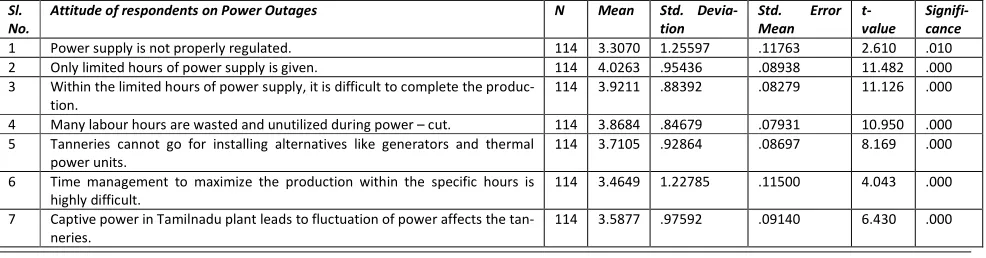
The present study attempts to analyze respondents’ attitude to power outages of the tanneries. The tanneries’ owner’s views about power supply, installing alternatives like generators and thermal power units were considered. Table 3 explains the parametric t-value for the respondents’ attitude to power outages of tanneries in Vellore district.
TABLE 3: ATTITUDE OF RESPONDENTS TO POWER OUTAGES
Sl. No.
Attitude of respondents on Power Outages N Mean Std.
Devia-tion
Std. Error
Mean
t-value
Signifi-cance
1 Power supply is not properly regulated. 114 3.3070 1.25597 .11763 2.610 .010
2 Only limited hours of power supply is given. 114 4.0263 .95436 .08938 11.482 .000
3 Within the limited hours of power supply, it is difficult to complete the produc-tion.
114 3.9211 .88392 .08279 11.126 .000
4 Many labour hours are wasted and unutilized during power – cut. 114 3.8684 .84679 .07931 10.950 .000
5 Tanneries cannot go for installing alternatives like generators and thermal power units.
114 3.7105 .92864 .08697 8.169 .000
6 Time management to maximize the production within the specific hours is highly difficult.
114 3.4649 1.22785 .11500 4.043 .000
7 Captive power in Tamilnadu plant leads to fluctuation of power affects the tan-neries.
VOLUME NO.6(2016),ISSUE NO.08(AUGUST) ISSN 2231-5756
INTERNATIONAL JOURNAL OF RESEARCH IN COMMERCE, IT & MANAGEMENT
It is observed from table 3 that the mean values of the respondents’ attitude to power outages of tanneries range from 3.3070 to 4.0263 with consistent and varying standard deviations. The t-value of 7 variables are 2.610, 11.482, 11.126, 10.950, 8.169, 4.043, 6.430 showed that all the 7 variables are statistically significant at 5 per cent. The respondents strongly agree with the variable ‘Only limited hours of power supply are given’.
5.3 BASED ON THE FINDINGS OF THE STUDY THE RESEARCHER HAS DRAWN THE FOLLOWING RECOMMENDATIONS
Scanning RFID and using the hide stamper can be an effective method of hide identification, even though it interrupted the workflow significantly. Proper design and maintenance procedure may reduce high levels of noise. Clean technology standards can be implemented, which relies on the idea that preventing is better than reusing. Modernization of tanneries with increased capacity would be cost effective. Tanneries can go for installing alternatives like generators and thermal power units to overcome power outrages. Government should be a facilitator to improve the quality of domestic environment by trade liberalization. Tanneries can be encouraged to be private limited. Its innovative technologies are essential for protecting the leather tanning industry from consequences. Another area of study identified was on the excellence of process improvement in leather tanning industry.
REFERENCES
1. Directory of Tanneries in India, State Pollution Control Board, Chennai, 2007.
2. Javed Ahmad Chattha and M. Mobeen Shaukat, March 2010, “An Assessment of Environmental Concerns in the Leather Industry and Proposed Remedies: A Case Study of Pakistan”, Viewed on April 25, 2016 http://www.environmental-expert.com/Files/0/articles/2226/2045.pdf.
3. Loraine Kennedy (1999), “Cooperating for Survival: Tannery Pollution and Joint Action in the Palar Valley (India)”, World Development Vol. 27, No. 9, pp. 1673±1691, Elsevier Science Ltd.
4. Ramjeawon (2004), “A case Study of Cleaner Production Opportunities in Small and Medium Enterprises on the island of Mauritius”, Electronic Green Journal, 1 (20).
5. Report on “Leather Industry in Tamil Nadu and Pondicherry,” July 1976, pp. 7.
6. Sarkar, K.T. (1962), Practice of Leather Manufacture, Oxford University Press, London, pp. 33.
7. Satya Sundaram, Leather: Investments Pouring, Investments in India’s leather industry are flowing from countries like Italy, Spain and Portugal through joint ventures, Leather & Leather Products - of Planning Commission,May 23, 2011, http://planningcommission.gov.in/aboutus/committee/wrkgrp12/wg _leath0203.pdf.
8. Shweta Singh & S. Rajamani, (2011), “Environmental compliance and sustainability of small and medium leather tanneries”, Leather News India. 9. Singh, Shweta and S., Rajamani (2007). Sustainability of SMEs on environmental compliance in leather industry in developing countries. In: International
VOLUME NO.6(2016),ISSUE NO.08(AUGUST) ISSN 2231-5756
REQUEST FOR FEEDBACK
Dear Readers
At the very outset, International Journal of Research in Commerce, IT & Management (IJRCM) acknowledges
& appreciates your efforts in showing interest in our present issue under your kind perusal.
I would like to request you to supply your critical comments and suggestions about the material published
in this issue, as well as on the journal as a whole, on our e-mail
for further
improve-ments in the interest of research.
If you have any queries, please feel free to contact us on our e-mail
.
I am sure that your feedback and deliberations would make future issues better – a result of our joint effort.
Looking forward to an appropriate consideration.
With sincere regards
Thanking you profoundly
Academically yours
Sd/-
Co-ordinator
DISCLAIMER
VOLUME NO.6(2016),ISSUE NO.08(AUGUST) ISSN 2231-5756