! ∀#∃
%∀∀& ∋( ) ∗ !
∀&+∀)! ∃ ,,−,.∀/01.22344
,454
6 & #77 87.47
Free Search Towards Multidimensional Optimisation Problems
Kalin Penev
Faculty of Technology, Southampton Solent University, East Park Terrace, Southampton, SO14 0YN, UK
The article presents experimental results achieved from a novel heuristic algorithm for real-value search and optimisation called Free Search (FS). The aim is to clarify the abilities of this method to return optimal solutions from multidimensional search spaces currently resistant to other search techniques.
Keywords: Adaptive Computing, Optimisation, Free Search, Evolutionary Computation, Information Science.
1 I
NTRODUCTIONA novel conceptual model for search and optimisation, different from well-known methods such as Evolutionary Strategies (ES) [27][28], Genetic Algorithms (GA) [15][16], Evolutionary Programming (EP) [14], Particle Swarm Optimisation (PSO) [9][10][11], Ant Colony Algorithms (ACO) [2][4][7], and Differential Evolution (DE) [25][26], is implemented as a computational algorithm called Free Search (FS) [20]. This algorithm can be classified as a heuristic method that relies upon trial and error rather than comprehensive theory [18]. It can be likened to the heuristic behaviour of animals in nature and their day-by-day exploration of the surrounding environment in order to find favourable conditions. During this process they learn via trial and error and refine their behaviour accordingly. The FS model negotiates a continuous landscape in discrete steps [24]. The algorithm modifies all current solutions, which is similar to Evolutionary Programming, Particle Swarm Optimisation and Differential Evolution. It also has similarities with Genetic Algorithms utilising BLX [12], start algorithms, sequential niching algorithms for multi-modal optimisation [3], and modified ant algorithms for continuous space search [2][5][13][19]. In contrast to other population-based Evolutionary Algorithms, Free Search distinguishes between the search agents themselves and the identified solutions. By introducing one individual characteristic called sense, FS attempts to model individual intelligence. The sense plays a central role within the algorithm and its constant variation during the search progression. The population in Free Search can be considered as a team of individuals capable of decision making, which exchange knowledge and experience. This contrasts with the herd behaviour of a swarm or a flock [24].
In order to assess abilities of this algorithm for multidimensional search it is evaluated with so called Bump test problem [17] for 20, 50, 100, 169 and 200 dimensions, with Step test function [6] for 20 dimensions and with Step Sphere test function [1] for 20 dimensions. The Bump problem is hard constraint non-linear problem, which requires precise search. In contrast the Step and Step Sphere functions introduce plateaus to the topology and the search process cannot rely on local correlation of the space, therefore these three test problems are selected for the experiments.
2 S
EARCHM
ETHODA
NDT
ESTP
ROBLEMSThis sections highlights essential characteristic of the evaluated search method. It attempts to clarify how the algorithm processes the information and gives an analytical description of the test functions used for the experiments. Detailed mathematical description of Free Search is published earlier [22][23][24].
2.1
Free Search - Essential Peculiarities
Free Search performs an iterative process of search towards prior defined criteria. This process is based on the condition for minimal restrictions and on the harmonisation of several effective concepts.
A definition of the search problems in FS as a Black Box and utilising the idea for black box search can be considered as the first compulsory condition for its good performance across heterogeneous problems [24]. The explored problems are defined within a unified procedure. For input the number of the individual, the number of its step and the number of dimensions are used to generate the variables values. The output is the corresponding value of the objective function. So that variety of problems can be explored from FS without changes of the algorithm. The algorithm requires prior definition of the search space boundaries, the number of the dimensions and the possible constraints for any particular problem [23].
is achieved due to the modification strategy [23]. FS can start from one location and can overcome stagnation during the process of search if accidentally or for some reason one or more variables of the explored solutions become equal [24]. The algorithm utilises an unconventional contradiction and relation of the notions exhaustive versus stochastic and exhaustive versus heuristic. It is implemented by the specific peculiarities of Free Search called sense and pheromone marks. Sense in Free Search is a variable, which can by likened as a quantitative indicator of a sensibility. The algorithm tunes the sensibility during the process of search as function of the explored problem. The same algorithm makes different regulations of the sense during the exploration of different problems. This is considered to be a model of adaptation. The sense plays the role of a tool for regulation of divergence and convergence within the search process and a tool for guiding the space exploration. The pheromone marks are quantitative indicators for the quality of the results from previous iterations. The relation between the individual sense and the pheromone marks defines self-adaptive behaviour of the algorithm. To clarify self-regulation of the sensibility three idealised general states of the sensibility distribution within the frame of the populations’ sensibility can be considered. These are – uniform, enhanced and reduced sensibility. They affect the decision-making policy of the whole population. The relationship between uniformly distributed sensibility and pheromone is presented in Fig. 4. In this case individuals with low level of sensibility can select for start position any location marked with pheromone. The individuals with high sensibility can select for start position locations marked with high level of pheromone and will ignore locations marked with low level of pheromone.
Fig. 4. Uniform sensibility Fig. 5. Enhanced sensibility
Within a stochastic environment and during a stochastic process, it is assumed that any deviation could lead to non-uniform changes of the process. The achieved results play a role of deviator.
By enhancement of the sensibility the individual can be forced to search around the area of the best-found solution from all individuals marked with highest amount of pheromone. Adding of a constant or a variable to the minimal sensibility could make an enforced enhancement of the sensibility frame.
Fig. 5 illustrates enhanced sensibility within the frame of possible sensibility. The individuals with enhanced sensibility will select and can differentiate more precisely locations marked with a higher level of pheromone and will ignore locations indicated with lower level of pheromone.
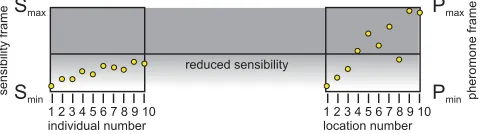
By reducing the sensibility, the individual can be allowed to explore around locations found by other individuals and marked with a low level of pheromone. The individuals can select locations marked with low level of pheromone with high probability, which indirectly will decrease the probability for selection of locations marked with high level of pheromone.
Fig. 6. Reduced sensibility
Fig. 6. illustrates reduced sensibility within the frame of possible sensibility. Subtracting of a constant or a variable from the maximal sensibility could make an enforced reduction of the sensibility frame.
2.2 Test
Functions
One of the used test functions is so called Bump problem proposed by Keane [17]. “The function is non-linear and the global maximum is unknown, but it is lies somewhere near to the origin. It’s a difficult problem that has been studied in the scientific literature and no traditional optimization method has given a satisfactory results.” [18]. The originally proposed test problem [17] is: Maximise:
∑
∏
∑
= = = − = n i i n i i i n ii x x ix
x 1 2 1 2 1 4 / ) ( cos 2 ) ( cos ) f(
for: 0 < xi < 10 and i=1,…,n subject to: , and starting from xi = 5, i =1, …,n,
where xi are the variables (expressed in radians) and n is the number of dimensions.
∏
= > n i i x 1 75 . 0∑
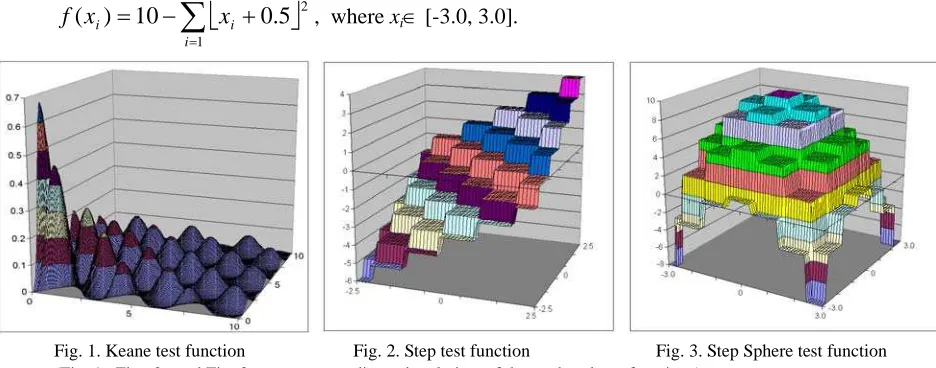
= < n i i n x 1 2 / 15Other experiments are made with twenty dimensional variants of the Step and Step Sphere test functions. Step function is proposed by De Jung [6]. It introduces plateaus to the topology. The search process cannot rely on local correlation of the space. In this study a 20 dimensional variant is used. For the Step function maximal are all locations, which belongs to the plateau xi∈ [2.0, 2.5) and the maximum for 20 dimensions is f max =40 (Figure 2 presents a two dimensional view of the function). Maximise:
⎣ ⎦
∑
==
n i i ix
x
f
1)
(
, where xi∈ [-2.5, 2.5].Step Sphere function is proposed by Bäck [1]. It introduces also plateaus to the topology, and also excludes a local correlation of the space. In this study a 20 dimensional variant is used. The maximal are all locations, which belongs to the plateau xi∈ [-0.5, 0.5). For 20 dimensions the maximum is f max =10 (Figure 3 presents a two dimensional view of the function). Maximise:
⎣
∑
=+
−
=
n i i ix
x
f
1 25
.
0
10
)
(
⎦
, where xi∈ [-3.0, 3.0].Fig. 1. Keane test function Fig. 2. Step test function Fig. 3. Step Sphere test function (Fig. 1., Fig. 2., and Fig. 3 present a two dimensional view of the explored test functions)
The objective of the experiments with Bump test function is to find the best possible and feasible, according to the constraints, result. These experiments demonstrate the level of local exploration and precision, which can be reached by Free Search on multidimensional space.
The objectives of the experiments with Step and Step Sphere test functions are to assess exploration abilities of Free Search. These experiments demonstrate the level of global exploration and divergence, which Free Search can reach within a space without local correlation.
3 E
XPERIMENTALR
ESULTSbest-achieved results for 20 dimensions of Keane test. p = 0.750000000000000111022302463 is the value of the constraint. The same maximal value of the function for twenty dimensions is achieved for several other locations. Other authors publish similar results up to the eight digit after decimal point [8].
The best achieved results for 50 dimensional test is: Fmax50 = 0.83526234835811175. The value of the constraint is p = 0.75000000000000122.
The best achieved results for 100 dimensional test is: Fmax100 = 0.84561213. The value of the constraint is p = 0.75000000437062053.
The best achieved results for 169 dimensional test is: Fmax169 = 0.8496496422. The value of the constraint is p = 0.750000078435
The best achieved results for 200 dimensional test is: Fmax200 = 0.850136. The value of the constraint is p = 0.75000058534824998.
The results for 100, 169 and 200 dimensions are achieved on PC with 1GHz Intel Processor. They can be accepted with limited level of precision up to one thousandth after the decimal point. Better precision requires additional experiments.
For Step and Step Sphere test functions four sets of experiments of 320 evaluations per function are made, respectively with start from stochastic locations and start from one location both limited to 100 and 2000 iterations.
The single initial location is purposefully selected far from the optimum. And it is defined as: x0 = xmin + 0.1(xmax - xmin).
Table 1 presents the number of the successful results from the8 series of 320 experiments conducted.
Table 1. Step and Step Sphere test functions – results. (In the table: Random indicates start form stochastic initial population. Single indicates start from single location. Iterations indicates respectively 100 and 2000 iterations limit)
Start Random Single
Iterations 100 2000 100 2000
Step 1 320 0 320
Step Sphere 92 320 15 320
4 D
ISCUSSIONThe results achieved on Keane test problem illustrate abilities for precise local search within constrained multidimensional space. They show the minimal precise step, which the algorithm can generate in order to find a very thin, sharp, multidimensional peak or a limited by the constraint end of an acclivity.
The results achieved on Step and Step Sphere test functions demonstrate the capacity for global exploration of the algorithm. The experiments limited to 100 and 2000 iterations indicate how fast Free Search can perform successful global exploration of multidimensional, without local correlation space.
The experiments with a start from one location purposefully selected far from the global optimum indicate that stochastic initial population facilitates the success for the first 100 iterations. This success can be explained with random appearance of initial location near to the global optima. After 2000 iterations Free Search overcomes this dependence. The potential to diverge successfully from one location has essential significance during the process of search, when the population converges in one location and when an external adjustment to overcome stagnation is required. The experiments confirm the results published earlier that Free Search has the ability to overcome successfully the stagnation unaided [21][22][24].
5 C
ONCLUSIONThe experimental evaluation presented in the article displays the capabilities of Free Search on optimisation of multidimensional test problems. The results achieved on the Bump problem illustrate good abilities for search within non-linear multidimensional search space with hard constraints. Free Search achieves very good results in comparison to other methods published in the literature [8][17][18]. Therefore it can be concluded that FS could be reliable on optimisation of similar real-world problems.
Future research can focus on acceleration of the search process and evaluation with time dependent problems. A rational direction for future research is exploration of real-world optimisation problems.
REFERENCES
[1] Bäck T., 1996, Evolutionary Algorithms in Theory and Practice, ISBN:0195099710, New York:Oxford Univ. Press. [2] Bilchev G., Parmee I., 1995, The Ant Colony Metaphor for Searching Continuous Design Space, Proceedings of the AISB Workshop on Evolutionary Computation, University of Sheffield, UK, April 3-4.
[3] Beasley D., Bull D., Martin R., 1993, A Sequential Niche Technique for Multimodal Function Optimisation, UWCC COMMA, TR No 93001.
[4] Colorni A., Dorigo M., Maniezzo V., 1991, Distributed Optimization by Ant Colonies, Proceedings of First European Conference of Artificial Life, Varela F., and Bourgine P. editors, Paris, Elsevier, pp 134-142.
[5] Corne D., M. Dorigo, and F. Glover, 1999, New Ideas in Optimisation. ISBN 007 7095065, McGraw-Hill International (UK) Limited.
[6] De Jung K. A., 1975, An Analysis of the Behaviour of a Class of Genetic Adaptive Systems, PhD Thesis, University of Michigan.
[7] Dorigo M. and L. Gambardella, 1997, Ant colony system: A cooperative learning approach to the travelling salesman problem. IEEE Transaction on Evolutionary Computation, 1(1), pp 53-66.
[8] Jiandong Li, Zhuo Kang, Yan Li, Hongqing Cao, Pu Liu, 2001, "Automatic Data Mining by Asynchronous Parallel Evolutionary Algorithms," tools, p. 0099, 39th International Conference and Exhibition on Technology of Object-Oriented Languages and Systems (TOOLS39).
[9] Eberhart R. and J. Kennedy, 1995, Particle Swarm Optimisation, Proceedings of the 1995 IEEE International Conference on Neural Networks., vol. 4, 1942-1948. IEEE Press.
[10] Eberhart R. and Y. Shi, 1998, Comparison between Genetic Algorithms and Particle Swarm Optimisation, The 7-th Annual Conference on Evolutionary Programming, San Diego, USA.
[11] Eberhart R. and Y. Shi, 2000, Comparing inertia weights and construction factors in Particle Swarm Optimisation. Proceedings of the 2000 Congress on Evolutionary Computation, pp 84-89.
[12] Eshelman L. J., and Schaffer J. D., 1993, Real-coded genetic algorithms and interval-schemata, Foundations of Genetic Algorithms 2, Morgan Kaufman Publishers, San Mateo, pp 187-202.
[13] Eiben A.E., J.E. Smith, 2003, Introduction to Evolutionary Computing, Springer-Verlag, ISBN 3-540-40184-9. [14] Fogel D.B., 2000, Evolutionary Computation – Toward a New Philosophy of Machine Intelligence, IEEE Press, ISBN 0-7803-5379-X.
[15] Goldberg D.E., 1989, Genetic Algorithms in Search, Optimisation, and Machine Learning, Addison Wesley Longman Inc. ISBN 0-201-15767-5.
[16] Holland J., 1975, Adaptation In Natural and Artificial Systems, University of Michigan Press.
[17] Keane A. J., 1996, A Brief Comparison of Some Evolutionary Optimization Methods, In V.Rayward-Smith, I. Osman, C.Reeves and G.D.Smith, J.Wiley (Editors), Modern Heuristic Search Methods, ISBN 0471962805 pp 255-272. [18] Michalewicz, Z. and Fogel, D., 2002, How to Solve It: Modern Heuristics, ISBN 3-540-66061-5 Springer-Verlag, Berlin, Heidelberg, New York, p 14.
[19] Parmee I.C., 2001, Evolutionary and adaptive computing in engineering design, ISBN 1852330295, Springer -Verlag London Limited.
[20] Penev, K., and Littlefair, G., 2003, Free Search – a Novel Heuristic Method, Proceedings of PREP 2003, 14-16 April, Exeter, UK, pp 133-134.
[21] Penev K., (2004), Adaptive Computing in Support of Traffic Management, In I.C. Parmee editor, Adaptive Computing in Design and Manufacturing VI, ISBN 1852338296, pp 295-306.
[22] Penev K., and Littlefair G., 2005, Free Search – A Comparative Analysis, Information Sciences Journal, Elsevier, Volume 172, Issues 1-2, pp 173-193.
[23] Penev, K., 2005, Adaptive Search Heuristics Applied to Numerical optimisation, Thesis for a degree of Doctor of Philosophy, The Nottingham Trent University, UK.
[24] Penev K., 2006, Free Search – Extensive Evaluation, In I.C. Parmee editor, Adaptive Computing in Design and Manufacturing VII, ISBN 978-0-9552885-0-0, pp 157-165.
[25] Price K., and R. Storn, 1997, "Differential Evolution", Dr, Dobb's Journal 22 (4), 18-24 (April 1997).
[26] Price K., K Chisholm, J. Lampinen, R. Storn,, I. Zelinka, 1999, Part Two Differential Evolution, in Editors Corne D., M. Dorigo, and F.Glover, New Ideas in Optimisation. ISBN 007 7095065, McGraw-Hill International, pp 77-158. [27] Rechenberg I., 1973, Evolutionarytrategie: Optimierung Technisher Systeme nach Prinzipen des Biologischen Evolution. Fromman-Hozlboog Verlag, Stuttgart.