*Corresponding author: Sachin Kumar ISSN: 0976-3031
Research Article
MICROBIAL FUEL CELL BASED ON WASTEWATER AS A NUTRIENT SOURCE AND
EFFECT OF PERMEABILISER
Sachin Kumar*
1., Aman Kaushik
2., Surbhi Agarwal
3., Dinesh Bhardwaj
4.,
Ramanuj
5., Shridhar Somani
6and Ramandeep
71
Department of Food Engineering, National Institute of Food Technology
Entrepreneurship and Management
2
Department of Basic and Applied Sciences, National Institute of Food Technology
Entrepreneurship and Management
3
Department of Food Science and Technology, National Institute of Food Technology
Entrepreneurship and Management
5,6,7
Carrer Institute of Technology and Management
DOI: http://dx.doi.org/10.24327/ijrsr.2017.0806.0397
ARTICLE INFO ABSTRACT
In Microbial Fuel Cell (MFC) metabolic process within microorganisms helps in the production of voltage due to generation of electrons. When these electrons move across the electrodes they generate a potential difference between electrodes that is the main reason for voltage production. In this study, waste water was used as a nutrient source. A lot of studies are going on the electricity production using organic matter from the wastewater as substrate. Waste biomass is a readily available, cheap source of electrons for microbes that are capable of producing electrical current outside the cell. Waste water was enriched with indigenous microflora of E.coli and E. aerogenes
that was cultured in Nutrient broth. The study was conducted with normal MFC, additional carbon source (D-Glucose (0.5%)) and withadditional nitrogen source (Ammonium chloride (0.01%)). The maximum voltages obtained after 11 days of culturing were 528mV from normal MFC, 167.4mV from additional carbon source and 308mV with additional nitrogen source. MFC is a new upcoming research area for generation of energy source from waste water. Microbial fuel cells (MFCs) gives a completely new long lasting, affordable, accessible and environment friendly approach to waste water treatment with production of sustainable energy.
INTRODUCTION
The increasing urbanization and industrialization has resulted in a very high rate of pollution. Water pollution is a serious challenge because of the hazards it causes to the animals and human race (Angenent et al. 2004). A Microbial Fuel Cell (MFC) based on wastewater can result in voltage production and simultaneous degradation of the organic wastes (Ghangrekar et al. 2006; Zhen He et al. 2006; K. Scott et al., 2007; Byung Hong Kim et al., 2007; The Hai Pham et al., 2008; Bernardino Virdis et al., 2008; Sang-Eun Oh et al., 2005). This is a novel wastewater treatment process with energy recovery from the waste (Byung Hong Kim et al., 2007). Electricity generation from domestic wastewater has recently received attention as a potential method to achieve both power generation and wastewater treatment (Booki Min
et al., 2004; Hyung Sool Lee et al., 2007; Sonal G. Chonde 2014; Bruce E Logan et al., 2006). Efficiency of treatment was dependent on the conductivity of wastewater with an added benefit of electricity generation rather than consumption of power (Liping Huang et al., 2008). This offers opportunity for the development of economical method to clean wastewater with the added benefit of recovering a proportion of the energy required for wastewater treatment. The working of MFC is similar to the chemical fuel cells; having a steady supply of fuel to the anode and oxidant to the cathode, thereby generating electrical power (K. Scott et al., 2007). Electricity generation in a MFC could be interfered by several reasons such as toxicity due to the high concentrations of ammonia in the wastewater or to volatile acids produced during hydrolysis and fermentation of the substrates or activity of the biocatalysts, electron transfer
International Journal of
Recent Scientific
Research
International Journal of Recent Scientific Research
Vol. 8, Issue, 6, pp. 17646-17650, June, 2017
Copyright © Sachin Kumar et al, 2017, this is an open-access article distributed under the terms of the Creative Commons Attribution License, which permits unrestricted use, distribution and reproduction in any medium, provided the original work is properly cited.
DOI: 10.24327/IJRSR CODEN: IJRSFP (USA)
Article History:
Received 15th March, 2017 Received in revised form 25th April, 2017
Accepted 23rd May, 2017 Published online 28th June, 2017
Key Words:
losses both at the anodes and the cathodes, and the internal resistance (B. Min et al. 2005; The Hai Pham et al., 2008).Wastewater collected from Yamuna river provided the nutritional requirements.
Thus, this study was aimed to assess the MFC using wastewater as the nutrient source. Also, MFC’s efficiency under different working conditions was assessed. The wastewater was enriched with microorganisms by inoculating 5% of indigenous microflora to the wastewater. For preparing the culture of indigenous microflora, the wastewater was cultured on Eosine Methylene Blue agar (EMB agar) and the most prominent colonies of E.coli and E. aerogenes were cultured in Nutrient broth. The cultured nutrient broth was used to inoculate the wastewater to speed up the degradation process accompanied with voltage development.
MATERIALS AND METHOD
Materials
For the study an anodic chamber, a cathodic chamber and a salt bridge were made, all of which were connected using connecting wires. Growth media such as nutrient media and EMB agar used were of analytical grade. Nutrient media is very suitable for culturing bacteria thus it was used to culture bacterial colonies isolated from the wastewater sample. Whereas, EMB agar is very selective in nature and allow the culturing of only E.coli and E.aerogenes with these microbes being most prominent in sewage water. Toluene was used as permeabilizer and microorganisms used were E.coli and S.cerevisiae.
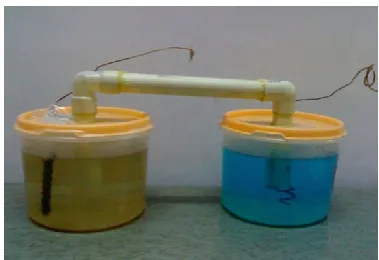
An anodic chamber (containing anode) was prepared by providing anode (Carbon rods) and affixing salt bridge to cover (Korneel Rabaey et al. 2003, K. Scott et al., 2007; Sang-Eun Oh et al., 2005; Peter Aelterman et al., 2008). Anode was wrapped around by copper wire to prevent electrical insulation and all possible zones of leaks were covered. Whereas cathodic chamber (containing cathode) was prepared by providing cathode and affixing salt bridge to cover. Cathode was made by spirally coiling copper wire so as to increase the available surface area. Cathode was wrapped around by copper wire to provide electrical continuation and all possible zones of leaks were covered. Salt Bridge was prepared using 1.2%agar and 1.125%KCl. After pouring in the solution, salt bridge was allowed to solidify.
After setting the apparatus, surface sterilization was provided by a 15 minutes exposure to UV-radiation (Booki Min et al., 2005). Then autoclaved media was poured and inoculation of microorganisms was done. Thereafter, vessels were immediately sealed by using para film in order to maintain anaerobic conditions. CuSO4 solution (0.1M) was added to the
cathodic vessel to complete the set-up. CuSo4.5H2O was used
as oxidizing solution.
Development of MFC’s
Normal/Control MFC
Normal MFC refers to the MFC operating under normal conditions. This MFC contains wastewater obtained directly from source and utilizes it as the nutrient source.
Extra-C MFC
Extra-C MFC contains additional carbon source in the form of D-Glucose. In this MFC, D-Glucose was added at the concentration of 0.5% to the original wastewater (Korneel Rabaey et al. 2003). This was done to assess how the microorganisms isolated from the wastewater behave in presence of higher sugar content.
Extra-N MFC
Extra-N MFC contains additional nitrogen source in the form of Ammonium chloride (Peter Aelterman et al., 2008). In this type of MFC, Ammonium chloride was added at the concentration of 0.01% to the original wastewater. This was done to assess behavior of the microorganisms isolated from the wastewater in the presence of higher nitrogen content.
Effect of permeabilizer on electron transfer
Permeabilizer creates pores in the cell’s outer covering therefore used to increase the free electron availability by enabling the release of those electrons which were present
Figure 1 Normal MFC with wastewater as the nutrient source
Figure 2 Extra-C MFC with wastewater as the nutrient source
inside the cell and could not move out. Effect of Permeabilizer was studied on both microbes. In case of E.coli, effect of higher inoculation and extra aeration at cathodic chamber was also studied.
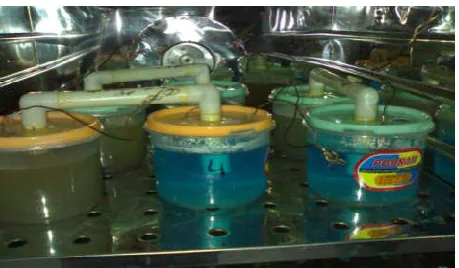
Luria Bertani broth was used to culture E.coli and S.cerevisiae was cultured using Sabourand Dextrose broth. 21 hours old cultures of E.coli and S.cerevisiae were used for inoculating 600ml vessels. The inoculum size was kept at 5% for E.coli grown under normal and extra aeration conditions whereas inoculation density of 10% was used for E.coli (higher inoculation) and S.cerevisiae. All inoculations were done at an interval of 3 minutes. For control MFC with E. coli. 0.001% of permeabilizer was used, 0.005% was used for E.coli MFC with higher inoculation and S. cerevisiae MFC whereas 0.002% permeabilizer was used for E.coli MFC with extra aeration. Permeabilizer was added to respective Microbial Fuel Cells on day8. The MFCs were placed in incubator. The vessels with E.coli were incubated at 37°C and S.cerevisiae at 25°C.
Statistical analysis
All readings were taken in duplicate using multimeter. The data was analyzed using EXCEL and differences were considered significant at a level of p<0.05.
RESULTS AND DISCUSSION
MFC based on wastewater
All the MFCs were placed in incubators (37°C) just after inoculation to provide appropriate environmental conditions.
From the graph it can be seen that the best response was shown by the MFC-Normal. However, the poorest results were shown by MFC-ExtraC. The response of MFC-ExtraN was intermediate to the responses shown by the other two MFCs.
All the 3 types of MFCs had shown an increase in the voltages initially and the pattern was continued for a few days followed by the drop of potential difference. The drop in the voltages can be related to the exhaustion of the substrate contained in the wastewater. It can be significantly noticed that the voltage drop recorded was highest for the Normal MFC and then by the MFC with extra nitrogenous content. MFC with higher sugar content showed a stationary phase with no significant voltage dip as in case of other 2 types. Results showed that voltages obtained after 11 days of culturing were 528mV for normal MFC, 167.4mV for MFC with extra C and 308mV for MFC with extra N.
It is imperative from the results obtained that the best results were obtained with MFC operating under normal conditions and least effective was the MFC with extra carbon content. Thus it can be said that the micro flora isolated from the sewage wastewater was compatible with wastewater with no addition and hence very good results were obtained in case of MFC-Normal.
Presence of extra carbon and nitrogen had negative influence on the microbial culturing and hence the results obtained were not fruitful. Towards the end, MFC-Normal and MFC-Extra N showed drastic decrease in voltage owing to substrate exhaustion. However stationary phase towards end of MFC-Extra C signifies that microbial growth was highly restricted in presence of additional carbon source.
Effect of permeabilizer on MFC operation
It was observed that desired results were obtained from the Microbial Fuel Cells based on E.coli but not from the one based on S.cerevisiae. All the MFCs using E.coli as the microorganism showed a linear growth initially but thereafter reported almost stationary phase untill permeabilizer was added. The growth pattern of S.cerevisiae was the same as before with no significant voltage development. However, addition of permeabilizer has shown somewhat positive response in case of MFCs with E.coli under normal and extra aeration conditions but nothing was clearly obtained in case of MFCs with higher inoculation (E.coli) and S.cerevisiae.
Following were the maximum voltages obtained under different cases after 13s days of culturing:
E.coli (normal) : 688mV
Figure 4 MFCs for permeabilizer effect testing placed in incubator
Graph 1 Effect of waste water based MFC on voltage production
0 100 200 300 400 500 600
Day1 Day2 Day3 Day4 Day5 Day6 Day7 Day8 Day9
V
o
lt
a
g
e
(i
n
m
V
)
Days of culturing
Normal MFC
MFC with extra C
MFC with extra N
Graph 2 Effect of permeabilizer on MFC 0
100 200 300 400 500 600 700 800
V
o
lt
ag
e
(i
n
m
V
)
Days of culturing
E. coli-normal MFC
E. coli-high inoculation MFC
E. coli-extra aeration MFC
E.coli (higher inoculation) : 558mV
E.coli (extra aeration) : 622mV
S.cerevisiae : 193mV
Voltages obtained in case of E.coli (Normal) and E.coli (Extra aeration) were superior.
Permeabilizer was added with an intention of releasing cellular electrons which were thought to be entrapped inside the cell. Permeabilizer concentration used in case of E.coli (normal) and E.coli (extra aeration) was better compared to E.coli (higher inoculation). This might be the reason for no good results obtained in that case. However, MFC based on S.cerevisiae has shown no positive results thus it cannot be effectively used for the purpose of MFC.
CONCLUSION
Wastewater contains various nutrients and could thus be considered as a potential media for MFC. Such water is a threat to environment and thus, its use in MFC would mean that it is used judiciously. Wastewater use in MFC also results in decrease of BOD, COD etc. of the wastewater employed. Thus, this study was based on developing MFC based on waste water. Also effect of different nutrient conditions of waste water on MFC was studied i.e. normal conditions, wastewater with extra carbon content and wastewater with extra nitrogen content. Results have shown that best outcomes were obtained on culturing microorganisms under normal conditions. Under provided nitrogen content growth was better compared to extra-C case. This clearly implies that the bacterial growth is considerably hindered under high sugar concentrations.
Anaerobic culturing of S.cerevisiae didn’t produce significant voltage indicating that for this microbe the electron transport chain doesn’t run in the membrane thus hindering the electron transfer to the surrounding media. So, the numbers of electrons available in free state were very less, thereby, resulting in lower potential difference development across the two electrodes.
Also, the use of permeabilizer such as toluene (a chemical which permeabilizes the cell) can make electrons accessible. Use of permeabilizer after culturing provided positive results with E.coli but didn’t affect S.cerevisiae. Thus, it can be concluded that E.coli can be beneficially exploited for MFC production while use of S.cerevisiae required several other aspects to be covered.
Bibliography
Angenent, L.T.; Karim, K.; Al-Dahhan, M.H.; Wrenn, B.A. and Espinosa, R.D. Production of bioenergy and biochemicals from industrial and agricultural wastewater. TRENDS in Biotechnology. 2004, 22, 478-485.
Aelterman, P.; Versichele, M.; Marzorati, M.; Boon, N.; Verstraete, W. Loading rate and external resistance control the electricity generation of microbial fuel cells with different three-dimensional anodes. Bioresource Technology. 2008, 99, 8895-8802.
Ghangrekar, M.M.; Shinde, V.B. Wastewater Treatment in Microbial Fuel Cell and Electricity Generation: A Sustainable Approach. Paper presented in the 12th international sustainable development research conference. April 6-8, 2006, Hong Kong.
Ghangrekar, M.M.; Shinde, V.B. Microbial Fuel Cell: A new approach of wastewater treatment with power generation.
He, Z.; Shao, H,; Angenent, L.T. Increased power production from a sediment microbial fuel cell with a rotating cathode. Biosensors and Bioelectronics. 2007, 22, 3252-3255.
He, Z.; Angenent, L.T. Application of bacterial biocathodes in microbial fuel cells. Electroanalysis. 2006, 19-20, 2009-2015.
Huang, L.; Logan, B.E. Electricity generation and treatment of paper recycling wastewater using a microbial fuel cell. Appl Microbial Biotechnol. 2008, 80, 349-355.
Kim, B.H.; Chang, I.S.; Gil, G.C.; Park, H.S.; Kim, H.J. Novel BOD(biological oxygen demand) sensor using mediator-less microbial fuel cell. Biotechnology letters. 2003, 25, 541-545.
Kim, B.H.; Chang, I.S.; Gadd, G.M. Challenges in microbial fuel cell development and operation. Appl Microbial biotechnol. 2007, 76, 485-494.
Lee, H.S.; Parameswaran, P.; Kato-Marcus, A.; Torres, C.I.; Rittmann, B.E. Evaluation of energy conversion efficiencies in microbial fuel cells (MFCs) utilizing fermentable and non-fermentable substrates. Water Research. 2007.
Liu, H.; Ramnarayanan, R.; Logan, B.E. Production of electricity during wastewater treatment using a single chamber Microbial Fuel Cell. Environ. Sci. Technol. 2004, 38, 2281-285.
Logan, B.E.; Hamelers, B.; Rozendal,R.; Schroder, U.; Keller, J.; Freguia, S.; Aelterman, P.; Verstraete, W.; Rabaey, K. Microbial Fuel Cells: Methodology and Technology. Environ. Sci & Technol. 2006.
Min, B.; Logan, B.E. Continuous electricity generation from domestic wastewater and organic substrates in a Flat plate Microbial Fuel Cell. Environ. Sci. Technol. 2004, 38, 5809-5814.
Min, B.; Kim, J.R.; Oh, S.E.; Regan, J.M. and Logan, B.E. Electricity generation from swine wastewater using microbial fuel cells. Water research. 2005, 39, 4961-4968.
Mohan, S.V.; Raghavulu, S.V.; Srikanth, S.; Sarma, P.N. Bioelectricity production by mediatorless microbial fuel cell under acidophilic condition using wastewater as substrate: Influence of substrate loading rate. Current science. 2007, 92, 1720-1726.
Oh, S.E.; Logan, B.E. Proton exchange membrane and electrode surface areas as factors that affect power generation in microbial fuel cells. Appl Microbiol Biotechnol. 2006, 70, 162-169.
Pham, T.H.; Boon, N.; Aelterman, P.; Clauwaert, P.; Schamphelaire, L.D.; Vanhaecke, L.; Maeyer, K.D.; Hofte, M.; Verstraete, W. and Rabaey, K. Metabolites produced by Pseudomonas sp. enable a Grampositive bacterium to achieve extracellular electron transfer. Appl Microbial Biotechnol. 2008, 77, 1119-1129.
Rabaey, K.; Lissens, G.; Siciliano, S.D.; Verstraete, W. A microbial fuel cell capable of converting glucose to electricity at high rate and efficiency. Biotechnology letters. 2003, 25, 1531-1535.
Ringeisen, B.R.; Ray, R. and Little, B. A miniature microbial fuel cell operating with an aerobic anode chamber. Journal of power sources. 2007, 165, 591-597.
Rosenbaum, M.; Schroder, U. and Scholz, F. Utilizing the green alga Chlamydomonas reinhardtii for microbial electricity generation: a living solar cell. Appl Microbial Biotechnol. 2005, 68, 753-756.
Schamphelaire, L.D.; Bossche, L.V.D.; Dang, H.S.; Hofte, M.; Boon, N.; Rabaey, K. and Verstraete, W. Microbial Fuel Cells generating electricity from rhizodeposits of rice plants. Environ. Sci. Technol. 2008
Schroder, U. Anodic electron transfer mechanisms in microbial fuel cells and their energy efficiency. Physical Chemistry Chemical Physics. 2007, 9, 2619-2629. Scott, K.; Rimbu, G.A.; Katuri, K.P.; Prasad, K.K.; Head, I.M.
Application of modified carbon anodes in microbial fuel cells. Process Safety and Environmental Protection. 2007, 85(B5), 481-488.
Virdis, B.; Rabaey, K.; Yuan, Z.; Keller, J. Microbial fuel cells for simultaneous carbon and nitrogen removal. Water research. 2008, 42, 3013-3024.
*******
How to cite this article: