Modified Titanium Content in Titanosilicates Mesoporous
Molecular Sieves MCM-41 as Selective Catalyst
for Epoxidation of Alkenes
N. Kazemi and F. Farzaneh
*Department of Chemistry, Faculty of Sciences, University of Alzahra, Tehran, Islamic Republic of Iran
Abstract
Ti-MCM-41 was synthesized at pH 3, 7 and 11. The titanium content was
determined by AAS and found to be 4%, 3.2% and 4.5%, respectively. In order to
increase the titanium content in MCM-41, Ti(IV) ions were grafted onto
Ti-MCM-41 using TiCl4 in toluene and Ti(OBu)4 in ethanol. The incorporation of Ti
was determined to be 28% and 30%, respectively. The oxidation of olefins such as
cyclopentene, cyclohexene, norbornene and trans-2-hexene-1-ol with TBHP in the
presence of Ti-grafted Ti-MCM-41 were carried out in CHCl3. This system
successfully catalized the oxidation of these olefins toward the corresponding
epoxides with 60 to 90% reactivity and 95 to 100% selectivity.
Keywords: Ti-MCM-41; Epoxidation; Alkenes
* E-mail: [email protected]
1. Introduction
Silica-supported titanium discovered by Shell researchers, was the first really heterogeneous epoxida-tion catalyst useful for continuous operaepoxida-tion in the liquid phase [1,2]. Titanium silicalite-1 (TS-1) is very reactive catalyst for selective oxidation reactions in the production of fine chemicals [3-5]. Because of the small pore size of TS-1 and other microporous zeolites, large organic molecules can not be accessed into the cavities and the channels of the zeolites. This limits the uti-lization of microporous titanium containing zeolites to the selective oxidation of small organic compounds [6].
In 1992 Beck and coworkers [7] described a new family of mesoporous silicates designated as M41S. One of the members of M41S family is silicate MCM-41. This material exhibits a hexagonal array of one dimensional mesoporous whose diameter can be tuned
from 15 to 100 Å [8].
Isomorphous substitution of heteroatoms such as B [9], Al [10], V [11], Mn [12], Cr [13], Fe [14] and Ti [15,16] in MCM lattice results in a new class of molecular sieves [17]. In recent years, a series of Ti containing mesoporous molecular sieves, such as HMS [18], MCM-48 [19,20], MSU-1 [21] and Ti-MCM-41 [22] have been synthesized. Titanium-containing mesoporous titanosilicates are important heterogeneous catalysts for oxidation reactions. Catalytic activity of this modified Ti-MCM-41 has been examined in the selective oxidation of substrates such as anthracene [23], crotylalcohol [24], α-ecosanol [6], α -terpens [25], hydroxylation of aromatic hydrocarbons [26] and epoxidation of olefins [22,27,28].
We will show that grafting titanium compounds on Ti-MCM-41 will lead to the incorporation of titanium to the maximum amount on Ti-MCM-41 surfaces. Finally, Ti-MCM-41 and Ti-grafted MCM-41 have been used for the epoxidation of some alkenes.
2. Experimental
2.1. Physical Measurements
Powder XRD patterns were recorded on a diffractometer with Cu Kα radiation, with diffractometer
types, PW1710 (Philips) and Seifert 3003. FT-IR measurements were performed on a FT-IR spectrometer PU 9800 (Philips) KBr self supported pellet technique. The oxidation reactions products were analyzed by GC and GC-Mass using Philips PU 4400 chromatograph (1.5 m 3% OV-17 column) and GC-Mass Agilent Technologies 6890 N-mass selective detector type Agilent 5973N, respectively.
2.2. Preparation of Catalysts
2.2.1. Synthesis of Ti-MCM-41
Ti-MCM-41 was synthesized according to the procedure described previously [29,30]. Titanium tetrabutoxide Ti(OBu)4 solution (0.2 ml) in 2 ml propanol was mixed slowly with 3.7 ml of tetraethylorthosilicate (TEOS) and the mixture was stirred for 30 min. Then 1.2 g of C16H33(CH3)3NBr in 6ml distilled water was added dropwise under vigorous stirring. The pH solution was adjusted to 11 by ammonium hydroxide. After stirring for one day, the resultant gel was transferred into a teflon-lined autoclave and heated at 373 K for 3 d. The composition of the resultant mixture was 1 SiO2: 0.035 TiO2: 0.2 CTABr: 33.7 H2O. For running reaction at pH~3, the same procedure was used and the pH was adjusted by adding 0.1 ml H2SO4 to the reaction mixture.
2.2.2. Synthesis of Ti-grafted Ti-MCM-41
In order to remove any physisorbed water before the grafting procedure, the Ti-MCM-41 was dehydrated at 300°C for 24 h. Then 0.3 g of the Ti-MCM-41 suspen-ded in toluene and 0.1 ml TiCl4 was added to this solu-tion at 0°C. The resulting mixture was stirred at room temperature for several hours under reflux condition, and then filtered and washed with toluene. The grafted material was dried at room temperature. Calcination of the sample was performed at 500°C. This sample is designated as Ti-grafted Ti-MCM-41. The same proce-dure was used for grafting Ti(OBu)4 on Ti-MCM-41.
2.3. Oxidation of Olefins
Oxidation reactions were performed in a stirring round bottom flask fitted with a water-cooled condenser. Reactions were carried out under atmos-pheric pressure at 65°C in different solvents. Typically 0.2 g of Ti-MCM-41 or Ti grafted Ti-MCM-41 catalysts and 20 mmol substrate in 5 ml of solvent was added to the reaction flask with slow stirring. After a few minutes, TBHP (24 mmol) was added to the reaction mixture at room temperature. After 6 h, the reaction mixture was filtered and the filtrate was analyzed by GC and GC-Mass.
3. Results and Discussion
The XRD patterns of calcined samples of MCM-41, Ti-MCM-41 (prepared at pH 3, 7 and 11) and Ti-grafted Ti-MCM-41 are shown in Figure 1. With the exception of sample prepared under acidic conditions, others exhibited a well-defined reflection in their XRD patterns, which is the characteristic sign of hexagonal mesoporous MCM-41 [16,34-36]. In the case of Ti-grafted-Ti-MCM-41, the intensity of d100 peak deteriorated and small peaks of d110 and d210 were disappeared. These results are in good agreement with those reported in literature [22,35-37].
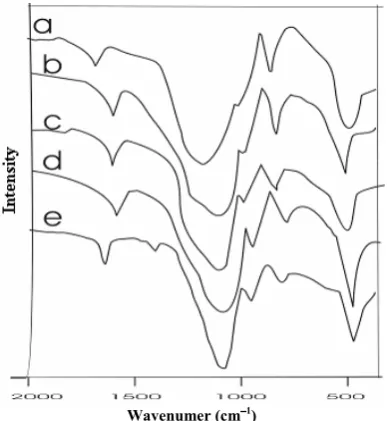
The FTIR spectra of the prepared samples are given in Figure 2. The asymmetric and symmetric stretching vibration bands which appeared at ~1060 and 500-700 cm−1 are consistent with those reported in literature [3], (Fig. 2, a, b). For titanium-containing molecular sieves, the IR absorbtion band at 960 cm−1 has been assigned to the presence of Si-O-Ti and, Si-OH groups in the framework. It was observed that the intensity of the silanol shoulder at 950-970 cm−1 increased with respect to the (Si-O-Si) band when titanium was added to MCM-41 (Fig. 2 a, e). The vibration of grafting titanium Ti-MCM-41 shifted to the lower frequency as well [23, 32,36,37].
The content of incorporated titanium at different pH’s are given in Table 1. Maximum amount of 4.5% Ti has been incorporated at pH=11. In order to increase the amount of Ti in mesoporous framework, the grafting procedure by TiCl4 and Ti(OBu)4 was performed. It was found that grafting Ti by TiCl4 in toluene and Ti(OBu)4 in ethanol at refluxing condition were 28% and 30%, respectively (Table 2).
3.1. Catalytic Epoxidation of Cyclohexene
2θ (degree)
Figure 1. XRD patterns of (a) MCM-41, (b) Ti-MCM-41 (pH=3), (c) Ti-MCM-41 (pH=7), (d) Ti-MCM-41 pH=11), (e) Ti-MCM-41 grafted by TiCl4 and Ti(OBu)4.
Wavenumer (cm⎯1)
Figure 2. FTIR spectra of (a) MCM-41, (b) Ti-MCM-41 (pH=3), (c) Ti-MCM-41 (pH=7), (d) Ti-MCM-41 (pH=11), (e) Ti-MCM-41 grafted by TiCl4 or Ti(OBu)4.
0 10 20 30 40 50 60 70 80
0 2 4 6 8 1
Time(hr)
Co
n
v
e
rs
io
n
(%
)
0
Figure 3. Effect of time on conversion of Trans-2-hexene-1-ol to epoxide in CHCl3 by Ti-grafted-Ti-MCM-41.
refluxing acetonitrile, carbon tetrachloride, methanol and chloroform are shown in Table 3. In the case of CHCl3 as solvent, the reactivity of oxidation was 41% with 92% selectivity toward the formation of cyclohexene epoxide.
Table 4 presents the oxidation results of different olefins with TBHP as oxidant in chloroform in the presence of Ti-grafted-Ti-MCM-41 as catalyst. It was found that although the reactivity of olefins ranged from 62 to 90%, the selectivity of epoxide formation was about 95 to 100%. According to the recent publication of Bekkum and his coworkers [38] the reactivity trend of norbornene epoxidation with H2O2 in methanol in the presence of titanium in different frameworks was observed as Ti-beta-2 > Ti-Al-beta > Ti-MCM-41 > Ts-1. Our results clearly indicate the higher efficiency of our system which led to the formation of norbornene oxide with 100% selectivity and 90% conversion. This might be the key role of Ti-grafted-Ti-MCM-41 as cata-lyst and chloroform as solvent. On the other hand, our result of cyclohexene oxidation to cyclohexene oxide is comparable to those reported by Kumar et al. [11].
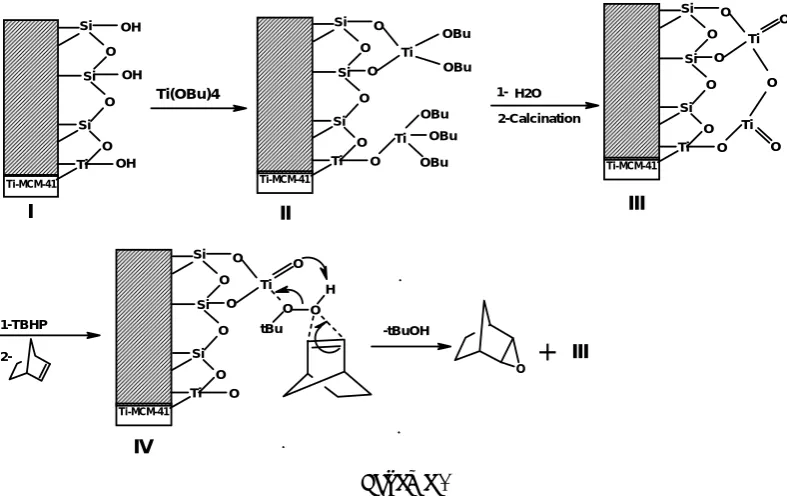
Inspection of the results in Table 4 reveals that with the exception of cyclohexene, the other olefins have exclusively led to the corresponding epoxides as the sole products. Without leaving any telltale of oxidation at allylic positions, one can propose the implication of titanium oxo species as the reactive center of the catalyst. These species would resemble that of peroxycarboxylic acids upon complexation with TBHP (Scheme 1). Since peroxycarboxylic acid epoxidizes the olfins via a concerted eight electrons transition state, the operation of a similar behaviour of the complexed titanium oxo with TBHP coordinated to olefin double bond is expected. When we carried out the oxidation of trans-2-hexene-1-ol, the alkene conversion was 70% with 100% selectivity toward the corresponding epoxide. The operation of a similar mechanism proposed by Sharpless and Sheldon for vanadium and titanium catalyzed epoxidation of allyl alcohols is suggested in this case [39,40].
The dependence of the reaction reactivity on the reaction time indicates that the yield of trans-2-hexene-1-ol epoxide increases with the reaction time and reaches a plateau after 6 h (Fig. 3). When we changed the oxidant to substrate ratio from 1:1 to 1.5:1, the epoxidation yield increased to 80% conversion for trans-2-hexene-1-ol.
Table 1. Ti content of Ti-MCM-41 at different pH’s Table 2. Ti content of Ti-grafted Ti-MCM-41
pH Ti (wt %)
3 4.0 7 3.2 11 4.5
Type Treatment Ti (wt %)
MCM-41 TiCl4 22
MCM-41 Ti(OBu)4 24
Ti-MCM-41 TiCl4 28
Ti-MCM-41 Ti(OBu)4 30
Reaction condition: Si/Ti=28 temperature 100°C
Table 3. Results of cyclohexene oxidation with TBHP over Ti-MCM-41 in different solvents
Type of solvent Conversion of Cyclohexene Product distribution TON
Epoxide others*
MeOH 5 100 – 2.2
CCl4 21 86 14 23.3
CH3CN 58 44 56 64.4
CHCl3 41 92 8 45.5
Reaction conditions: catalyst 0.2 g; CHCl3 5 ml; cyclohexene 20mmol; TBHP 20mmol, reaction temperature 323 K
TON (turn over number): moles of cyclohexene converted per mole of Titanium
* others: mixture of alcohol, ketone and ether
Table 4. Oxidation of various alkenes with TBHP by Ti-grafted-Ti-MCM-41 in CHCl3
Substrate Total conversion Product distribution
Epoxide others*
Cylohexene 70 95 5
Cyclopentene 62 100 –
Norbornene 90 100 –
Trans-2-hexene-1-ol 70 100 –
Reaction conditions: catalyst 0.2; solvent: CHCl3 5 ml; olefin 20 mmol; TBHP 20 mmol, reaction temperature 323 K * others: mixture of alcohol, ketone and ether
OH
OH Si
Si O
O
Ti OH
O Si
O Si
Si O
O
Ti O Si
O Ti
OBu
OBu
O Ti
OBu
OBu OBu
O Si
Si O
O
Ti O Si
O Ti
O Ti
O
O Si
Si O
O
Ti O Si
O Ti
O
O
O
O
O
O O
H
tBu
Ti-MCM-41
Ti(OBu)4
Ti-MCM-41
1- H2O 2-Calcination
Ti-MCM-41
1-TBHP
2-Ti-MCM-41
+
I II III
IV
-tBuOH
III
in catalyst. The reactivity trends of Ti-grafted-Ti-MCM-41 > Ti-MCM-Ti-grafted-Ti-MCM-41 > MCM-Ti-grafted-Ti-MCM-41 is consistent with this hypothesis. Moreover, no desorption was observed during the course of reaction. Compared to the recent published results of oxidation of unsaturated alcohols [24] and epoxidation of cyclohexene [22], the observation of high selectivity in the absence of desorption seems remarkable.
4. Conclusion
Ti-MCM-41 has been synthesized at pH 3, 7 and 11. The maximum content of incorporated titanium was 4.5% at pH=11. In order to increase the titanium content in mesoporous Ti-MCM-41, grafted procedure was performed by TiCl4 in toluene and Ti(OBu)4 in ethanol. The grafted amount of titanium was found to be 28% and 30%, respectively.
The catalytic behavior of Ti-MCM-41 and Ti-grafted Ti-MCM-41 were investigated in liquid phase for epoxidations of some olefins. It was found that the best oxidation solvent is chloroform with simultaneous highest selectivity toward the formation of the corresponding epoxide.
Acknowledgements
We would like to acknowledge the Alzahra University for the financial support.
References
1. Wattimena F. and Wulff H.P. British Patent, 1, 249, 079
(1971).
2. Wulff H.P. U.S. Patent, 3, 923, 843 (1975).
3. Corma A., Navarro M.T., and Peroz-Pariente J. J. Chem. Soc. Chem. Commun., 147 (1994).
4. Arends I.W.C.E., Sheldon R.A., and Wallen M. Angew. Chem., Int. Ed. Engl., 39: 1144 (1997).
5. Dusi M., Malt T., and Baiker A. Catal. Rev-Sci.,
42(1&2): 213 (2000).
6. Kan Q., Bi Y., Ying Z., Wu T., and Zhen K. Micropor. Mesopor. Mater., 44-45: 609 (2001).
7. Beck J.S., Vartuli J.C., Roth W.J., Leonouries M.E., Kresege C.T., Schmitt. K.D., Chu. C.T.W., Dson D.H., Sheppard E.W., McCullen S.B., Higgins J.B., and Schlenke J.L. J. Am. Chem. Soc., 114: 10834 (1992).
8. Kim W.J., Yoo J.C., and Hayhurst D.T. Micropor. Mesopor. Mater., 39: 177 (2000).
9. Oberhagemann U., Kinski I., Dierdorf I., Marter B., and Gies H. J. Noncryst. Solids., 197: 145 (1996).
10. Ryoo R. and Kim J.M. J. Chem. Soc. Chem. Commun.
711 (1995).
11. Laha S.C. and Kumar R. Micropor. Mesopor.Mater., 51:
163 (2002).
12. Zhao D. and Goldfarb D. J. Chem. Soc. Chem. Commun.,
875 (1995).
13. Zhu Z., Chang Z., and Kevan L. J. Phys. Chem. B., 103:
2680 (1999).
14. Yuan Z.Y., Liu S.Q., Chen T.H., Wang J.Z., Li H.X. J. Chem. Soc. Chem. Commun., 973 (1995).
15. Blasco T., Corma A., Navarro M.T., and Parinte J.P. J. Catal., 156: 65 (1995).
16. Luo Y., Lu G.Z., Guo Y.L., and Wang Y.S. Catal. Commun., 3: 129 (2002).
17. Chaudhari K., Bal R., Srinivas D., Chanduadkar A.S., and Sivasanker J. Micropor. Mesopor. Mater., 50: 209 (2001). 18. Tanav P.T., Chibwe M., and Pinnavaia T.J. Nature, 368:
317 (1994).
19. Mary M. and Tuel A. Zeolites, 15: 601 (1995).
20. Koyano K.A. and Tatsumi T. J. Chem. Soc. Chem. Commun., 145 (1996).
21. Bagshaw S.A., Pouzet E., and Pinnavaia T. J. Science,
269: 1242 (1995).
22. Yu J., Feng Z., Xu L., Li M., Xin Q., Liu Z., and Li C.
Chem. Mater., 13: 994 (2001).
23. Srinivas N., Radha Rami V., Kulkarni S.J., and Raghavan K.V. J. Mol. Catal. A: Chemical, 179: 221 (2002).
24. Davies L.J., McMorn P., Bethell D., Page P.C.B., King F., Hancock F.E., and Hutchings G.J. Ibid., 165: 243
(2001).
25. Berlini C., Guidotti M., Moretti G., Psaro R., and Ravasio N. Catal. Today, 60: 219 (2000).
26. He J., Xu W.P., Evans D.G., Duan X., and Li C.Y.
Micropor. Mesopor. Mater., 44-45: 581 (2001).
27. Oldroyd R.D., Sankar G., Thomas J.M., and Ozkaya D. J. Phys. Chem. B, 102: 1849 (1998).
28. Hagen A., Schueler K., and Roessner F. Micropor. Mesopor. Mater., 51: 23 (2002).
29. Miyaji T., Wu P., and Tatsumi T. Catal. Today, 71: 169 (2001).
30. Koyano K.A. and Tatsumi T. Micropor. Mater., 10: 259
(1997).
31. Kresge C.T., Leonowicz M.E., Roth W.J., Vartuli J.C., and Beck J.S. Nature, 710 (1992).
32. Alba M.D., Luan Z., and Klinowski J. J. Phys. Chem.,
100: 2178 (1996).
33. Sayari A. and Hamoudi S. Chem. Mater., 13: 3151.
(2001).
34. Lim M.H. and Stein A. Ibid., 11: 3285 (1999).
35. Aronson B.J., Blanford C.F., and Stein A. Ibid., 9: 2842.
(1997).
36. Chen L., Horiuchi T., Mori T., and Maeda K. J. Phys. Chem. B, 103: 1216 (1999).
37. Sayari A. Chem. Mater., 8: 1840 (1996).
38. Van der Weal J.C., Rigutto M.S., and Van Bekkum H.
Appl.Catal. A: General, 167: 331 (1998).
39. Sharpless K.B. and Verhoeven T.R. Aldrichimica Acta,
12: 63 (1979).