A b s t r a c t. A centrifugal bambara groundnut sheller was designed, constructed and evaluated. The sheller consists of a feed hopper with a flow rate control device, shelling unit, separating unit and power system. Nine different impellers were used for the investigation at three different pod moisture contents. Results of the performance tests were examined using a 3 x 3 x 3 factorial design with moisture content, impeller slot angulations and number of impeller slots as variables. Results showed that moisture content, impeller slot angulations, number of impeller slots and interaction between these variables statistically affected the per-formance indicators (shelling efficiency, percentage of breakage, percentage of partially shelled pods, percentage of unshelled pods and winnowing efficiency) at the significance level of 5%. The forward facing impeller with eight slots gave the best performance of 96% shelling efficiency, 3.4% breakage, 0.6% partially shelled pods. No unshelled pods were recorded, and winnowing efficiency of 97.3% was recorded at an average feed rate of 215.8 kg h-1.
K e y w o r d s: bambara groundnut, centrifugal impeller, pods, winnowing
INTRODUCTION
Bambara groundnut (Vigna subterraneanL.Verdc) is an indigenous African crop grown across the continent from Senegal to Kenya and from the Sahara to South Africa (Atikuet al., 2004). Bambara groundnut is the third most important grain after groundnut and cowpea (Ezeaku, 1994). In separate reports by Ezue (1977) and Atiku (2000) it was noted that in Nigeria bambara groundnut is widely produced in Borno, Anambra, Plateau, Taraba, Sokoto, Bauchi, Benue, Kano, Yobe, Adamawa and Gombe states.
Goli (1997) reported that bambara groundnut contains about 63% carbohydrate, 19% protein, and 6.5% oil and is consumed in different forms. Other reports, by Akaniet al. (2000), Atikuet al.(2004) and Linnemann (1988), stated that the seed of bambara groundnut can be used for baby food, human consumption, industrial products and for
animal feed. Linnemann (1990) reported that bambara groundnut flour has been used in making bread in Zambia, and Broughet al. (1993) noted that the milk prepared from bambara groundnut gave a flavour preferred to that of milks from cowpea, pigeon pea and soybean. According to Atiku (2000) the fresh bambara groundnut seed is cooked before eating. It is used as main food, snacks, relish and medicine, and has a high ceremonial value.
Kay (1979) recommended that after harvesting bambara groundnut is dried in the sun to about 8 to 12% moisture content (w.b.). The dried seed could be taken as snacks after roasting or milled to flour for other food.
Despite these economic importances, no commercial production and no industrial use of the crop take place in Nigeria. According to Akaniet al. (2000) research is con-centrated only on the agronomic aspect, while the proces-sing aspects have been neglected. The pod of bambara groundnut is very hard and the cracking methods are still traditional. These cracking methods vary from locality to locality depending on the quantity produced. Some com-munities use mortar and pestle to crush dry pods. Some beat them with sticks on flat ground, others use stones to crush the pods on flat ground. These methods have the disadvan-tages of damaging the seeds, and are slow and tiresome.
Atikuet al. (2004) evaluated the performance of a bam-bara groundnut sheller working on the principle of rollers and pneumatically separating the shells from the seeds. They got the maximum shelling and winnowing efficiencies of 80 and 79.5%, respectively, at pod moisture content of 5% (w.b.) and feed rate of 93.6 kg h-1. The percentage of dama-ged seed was about 20%, the percentage of partially shelled (broken and unbroken seeds) and percentage of unshelled pods were 10 and 7%, respectively, while the machine loss accounted for 3%.
Development and performance evaluation of impact bambara groundnut sheller
F.A. Oluwole*, A.T. Abdulrahim, and M.B. Oumarou
Department of Mechanical Engineering, University of Maiduguri, Maiduguri, Nigeria
Received June 15, 2007; accepted September 1, 2007
© 2007 Institute of Agrophysics, Polish Academy of Sciences *Corresponding author’s e-mail: [email protected]
A A
Adigun and Oje (1993) reported that nuts whose shells/pods cannot be easily broken by the roller cracker are commonly cracked using a centrifugal cracker. Makanjuola (1975) evaluated some centrifugal impaction devices for shelling melon (egusi)seeds (Citrullus vulgaris) and found that a centrifugal impact method is a good technique for shelling melonseeds. He evaluated three types of impellers (A, B and C) with four slots, eight slots, and two parallel plates, respectively. He concluded that impeller type A was the most effective of all the three types tested. Odigboh (1979) developed and tested a prototype impact melon (Citrullus vulgaris) shelling machine that gave about 96% shelling efficiency and 100% winnowing efficiency. He also evaluated three types of impellers at different vane angulations with four vanes each. Impeller type A had radially positioned vanes, type B vanes positioned at 45°to the radius, while type C vanes at 90° to the radius of the circle. He concluded that impeller type B gave the best combination of higher shelling and low percentage of damage.
Oluwoleet al. (2004) developed and tested a sheanut cracker working on the principle of impaction and pneuma-tically separating the shells from the kernel. They got crack-ing efficiency of 100% and winnowcrack-ing efficiency of 97%. They evaluated three types of impeller, similar to those of Odigboh (1979) but with slight differences in the vanes angulations. Impeller type A had radially positioned vanes; type B and type C had their vanes positioned at 45 and 30°to the radius respectively. They concluded that the radially positioned vanes impeller gave 100% effective cracking efficiency. Akani et al. (2000) determined the optimum impact energy for shelling bambara groundnut at pod moisture content range of 5-8% (w.b.) and found that the impact energy ranged from 0.24 to 0.59 J.
This paper presents the results of applying nine types of impeller (three with radially positioned slots, three with forward facing slots and three with backward facing slots) to project individual bambara groundnuts at three moisture levels against the inner surface of a cylindrical cover crack-ing surface.
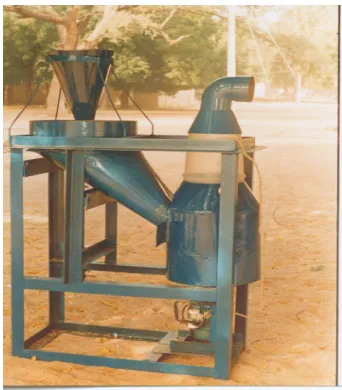
DESCRIPTION OF THE IMPACT SHELLER The machine, similar in principle to Odigboh’s impact melon (Citrullus vulgaris) sheller (Fig. 1), consists of a feed hopper, pod shelling unit separation unit and power unit. Figure 2 shows the assembly details of the machine. The conical shaped hopper is mounted on the tool frame and is held in place by a hopper support frame. The base is connected directly to the shelling unit. A nut flow control device is located between the hopper and the shelling chamber. The shelling unit consists of a 410 mm diameter by 150 mm height cylindrical shell made from 5 mm steel sheet, whose inner surface serves as the cracking surface, and an impeller of 370 mm diameter made of 25 by 50 mm
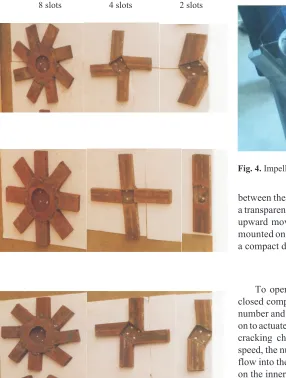
rectangular steel pipe similar to that described by Dicken (1961) as shown in Fig. 3. These impellers were divided into three groups: A – impeller slots positioned at 45° to the tangent at the slots outlet (forward facing) represented with subscript F; B – radially positioned impeller slots (at 90°to tangent at the slots outlet) repre- sented with subscript R; and C – impeller slots positioned at 135°to the tangent at the slots outle (backward facing) represented with subscript B.
Fig. 1.Bambara groundnut sheller.
Each group has impellers with eight, four and two slots. The cylindrical shell is covered with a transparent plastic cover 400 mm diameter of 4 mm thickness with a concentric open-ing (80 mm diameter) at the center (pods inlet). The impeller is concentrically positioned within the cylindrical shell and horizontally mounted on a vertical shaft to give a clearance that is greater than the size of the seed with cracking surface. Figure 4 shows the impeller mounted in operational position. This impeller is driven by a vertical shaft powered by a 0.5 hPa 1920 r.p.m. electric motor through a system of belt and pulley. The separation unit comprises the transition channel (through which the mixture of seed and broken pods from the shelling chamber flows into the separation compartment), the separating chamber (where the seed and pods are separated by air current), the inner funnel shapped wire mesh for seeds collection, and the axial fan mounted directly on the electric motor, which is powered by the elec-tric motor to supply the air stream required for winnowing. At the upper part of the separating unit is the shells outlet. In
between the separating compartment and the shells outlet is a transparent cylindrical plastic column to observe the shells upward movement. These components are assembled and mounted on a rectangular tool frame that gives the machine a compact design and a sturdy outlook.
PRINCIPLE OF OPERATION
To operate the device, the nut flow control device is closed completely. The hopper is then filled with a known number and mass of nuts. The main switch is then switched on to actuate the electric motor which runs the impeller in the cracking chamber. As the impeller reaches its operating speed, the nut flow control device is opened to allow nuts to flow into the impeller eye. The incoming nuts slide and roll on the inner surface of the rectangular pipe, the centrifugal force developed as a result of the rotation of impeller throws the nuts against the cracking surface and causes the nuts to crack. The seeds and the shelled pods flow down through the clearance between the impeller and the cylindrical shell and fall on an inclined transition channel that leads to the separating compartment. Here the shells, which are lower in density than the seeds, are lifted up by the air stream from the axial fan and blown out through the shells outlet. The denser seeds fall through the air stream into the inner wire mesh funnel to the seed collection chute. Figure 4 shows the impeller mounted in the operational position.
PERFORMANCE TESTS
To carry out the performance tests, nine types of impellers were evaluated. Each of these impellers was used to shell bambara groundnut at three different moisture levels in the range of 5.3-12.2% (d.b.). Some quantity of bambara groundnut pods (NT) were randomly selected and weighed. These pods were poured into the hopper while the pods flow control was completely closed. The main control switch was switched on; as the impeller attained the operating speed, the pod flow control was opened to allow the pods to flow into
Fig. 3.Groups of impellers: A, B, and C. A
C B
8 slots 4 slots 2 slots
the eye of the impeller at an average feed rate of 215.8 kg h-1. These pods were carefully collected after going through the impeller, and the number of pods fully shelled without broken seeds (N1), number of pods fully shelled with broken seeds (N2), number of pods partially shelled (N3) and number of unshelled pods (N4) were determined at the end of each run. The quantities of shells winnowed out (MSW) and of those collected with the seeds (MUW) were determined and recorded.
Each of these tests was replicated five times at each of the moisture level and for each of the evaluated impellers. The performance was evaluated on the basis of the following indices (Oluwoleet al, 2007b):
shelling efficiency,
hS =(N1/NT)100 , (1)
percentage of broken seeds,
hb=(N2/NT)100 , (2)
percentage of partially shelled pods,
hp=(N3/NT)100 , (3)
percentage of unshelled pods,
hu=(N4/NT)100 , (4)
winnowing efficiency,
hw=(MSW /MTS )100 , (5)
where:NT– number of pods fed into the impeller:
MTS=MSW+MUW.
These results were statistically analysed using factorial design.
RESULTS AND DISCUSSION
Tables 1 and 2 show the results of the performance tests analyses. Table 1 shows that moisture content (M), number of impeller slots (f) and impeller slot angulations (S) signi-ficantly affect the shelling efficiency (hS), percentage of broken seeds (hb), percentage of partially shelled pods (hp), percentage of unshelled pods (hu) and winnowing effi-ciency (hw) at the significance level of 5%. The interaction between moisture content and number of impeller slots (Mxf) has a significant effect on the shelling efficiency and the per-centage of partially shelled pods at the significance level of 5%, while the interaction between moisture content and im-peller slots angulations (MxS) significantly affects the shel-ling efficiency, the percentage of partially shelled pods and the winnowing efficiency at the significance level of 5%.
Table 2 shows that the forward facing impeller con-sistently gave the best performance. Similar findings were reported by Oluwoleet al. (2004) and Oluwoleet al. (2007a) in performance evaluation of a sheanut cracker and effect of moisture content on crackability of bambara groundnut using a centrifugal cracker, respectively. Table 2 also reveals that the impellers with eight slots consistently gave the best performance. Similar findings were reported by Oluwoleet al. (2007b) in an evaluation of some centrifugal impaction devices for shelling bambara groundnut.
At all the moisture contents employed and for each of the impeller groups the shelling efficiency, percentage of broken seeds and the winnowing efficiency increased with increase in number of impeller slots, while the percentage of partially shelled pods and the percentage of unshelled pods decreased with increase in the number of impeller slots. This is because the higher the number of impeller slots the higher the number of pods that will emerge from the impeller and hit the cracking surface. The forward facing impeller with
Source of variation
Shelling efficiency
hs
Percentage Winnowing
efficiency hw breakage
hb
partially shelled podshp
unshelled pods hu
Main effects Moisture content (M)
Number of slots (f) Impeller angulation (S)
1181.73* 564.37* 148.86*
69.55* 13.01* 7.98*
157.64* 77.93* 3.43*
50.90* 20.22* 11.32*
1189.11* 21.74* 203.05* Two-factor interaction
Mxf MxS Sxf
8.12* 5.21* 2.37
0.814 0.869 0.61
9.06* 10.64* 1.32
0.76 0.09 0.28
0.99 8.34* 0.85 Three-factor interaction
MxfxS 0.88 0.49 1.34 0.16 0.55
*significant at 5% level.
eight slots gave the best shelling efficiency of 96, 77.8 and 62% at moisture contents of 5.3, 9.6 and 12.2% (d.b.), respectively, which is similar to the results of Odigboh (1979) in evaluation of an melon (Citrullus vulgaris) shelling machine. Also the forward facing impellers gave the best winnowing efficiency because the broken shells produced by these impellers are relatively small compared to those produced by the radially positioned slots and the backward facing impellers.
Moisture content of 5.3% (d.b.) gave shelling and win-nowing efficiencies of 96 and 87.3%, respectively, for the forward facing impeller with eight slots, 86.6 and 85.3%, respectively, for the radial impeller with eight slots, and 85 and 83.7%, respectively, for the backward facing impeller
with eight slots. This is because at low moisture level bam-bara groundnut pods are brittle, which makes them suscep-tible to mechanical damage (Oluwole et al. (2007a) and Atikuet al. (2004)).
CONCLUSIONS
1. The moisture content of bambara groundnut affected the machine performance at the significance level of 5%. The machine gave the best performance at moisture content of 5.3% (d.b.).
2. The number of impeller slots affected the machine performance at the significance level of 5% with the eight-slot impellers giving the best performance.
Impeller types* Shelling efficiency hs Percentage Winnowing efficiency hw breakage
hb partially shelled podshp
unshelled pods hu
Moisture content – 5.3% (d.b.) SF8 SF4 SF2 SR8 SR4 SR2 SB8 SB4 SB2 96.0 83.4 74.6 86.6 74.4 64.8 85.0 73.2 63.6 3.4 3.4 2.8 3.6 2.4 2.2 2.4 2.0 2.0 0.6 4.4 8.6 5.6 6.0 11.4 5.4 5.2 12.4 0 8.6 14.0 4.2 17.2 21.6 7.2 19.6 22.0 87.3 82.4 80.9 85.3 79.3 79.1 83.7 78.3 77.6 Moisture content – 9.6% (d.b.)
SF8 SF4 SF2 SR8 SR4 SR2 SB8 SB4 SB2 77.8 67.4 60.2 69.0 60.2 51.4 66.0 61.2 51.0 2.4 2.0 1.2 2.4 1.0 0.8 1.8 0.6 0.6 7.8 11.0 12.8 9.4 11.8 15.4 8.4 12.8 17.4 12.0 19.6 19.8 19.2 27.0 32.4 23.8 25.4 31.0 79.1 72.8 70.0 75.9 67.3 67.9 71.1 70.6 65.7 Moisture content – 12.2% (d.b.)
SF8 SF4 SF2 SR8 SR4 SR2 SB8 SB4 SB2 62.0 55.4 49.4 59.2 52.6 42.0 56.8 52.2 40.4 1.2 0.4 0.4 0.8 0.6 0.2 0.6 0.4 0.2 13.8 15.6 17.2 12.4 12.2 14.4 13.0 13.2 13.6 23.0 28.6 33.0 27.6 34.6 43.4 29.6 34.2 45.8 66.0 61.1 57.7 64.1 57.2 50.3 60.3 57.6 48.2
*SF8=forward facing with 8 slots, SF4=forward facing with 4 slots, SF2=forward facing with 2 slots, SR8=radially positioned with 8 slots, SR4=radially positioned with 4 slots, SR2=radially positioned with 2 slots, SB8=backward facing with 8 slots, SB4=backward facing with 4 slots, SB2=backward facing with 2 slots.
3. While the impeller slots angulations also affected the performance of the machine at the significance level of 5%, the best performance was recorded with the forward facing impellers.
4. The separating unit could be improved upon to increase the winnowing efficiency of the machine.
REFERENCES
Adigun Y.J. and Oje K., 1993.Thevetia fruit processing: energy requirements for cracking the nut. Proc. Nigerian Soc. Agric. Eng., 15, 128-139.
Akani A.O., Ohanwe C.N., and Omoniyi I.O., 2000. Determi-nation of optimum impact for decortication of bambara groundnut. Proc. Nigerian Soc. Agric. Eng., 22, 87-89.
Atiku A.A., 2000.Bambara groundnut processing and storage practices in North Eastern Nigeria. Postgraduate seminar paper, Dept. Agric. Eng., University of Maiduguri, Nigeria.
Atiku A.A., Aviara N.A., and Haque M.A., 2004.Performance evaluation of a bambara groundnut sheller. Agric. Eng. Int.: CIGR J. Sci. Res. Develop., Manuscript P 04002, VI, July, Texas Univ., Houston, USA.
Brough S.H., Azam-Ali S.N., and Taylor A.J., 1993.The poten-tial of bambara groundnut (Vigna subterranean) in vege-table milk production and basic protein functionality systems. Food Chem., 47, 277-283.
Dicken J.W., 1961.Kernel spliter and inspection belt for peanuts. Market Research Report No. 452 AMS – USDA.
Ezeaku C.A., 1994.Fracture characteristics of bambara groundnut in compressive loading. M.Sc. Eng. Thesis, University of Nigeria, Nsukka.
Ezue M.I., 1977.Cultivation and utilization of minor food legu-mes in Nigeria. Tropical Grain Legulegu-mes Bull., 10, 7-12.
Goli A.E., 1997.Bambara groundnut. Bibliographic review. In: Bambara Groundnut(Vigna subterraneaL.Verdc).(Eds J. Heller, F. Begemann, and J. Mushonge). IPGCPR and IPGRI, Rome.
Kay D.E., 1979.Food Legume Crops And Production. Digest 3. Tropical Products Institutes, London, UK.
Linnemann A.R., 1988. Cultivation of bambara groundnut in Northern Nigeria. Tropical Crop Com., 15, 1-14.
Linnemann A.R., 1990.Cultivation of bambara groundnut (Vigna subterraneanL.Verdc) in Western province, Zambia. Report of Field Study of Tropical Crops. Dept. Tropical Crop Sci., Wageningen Agric. Univ. Press, The Netherlands.
Makanjuola G.A., 1975. An evaluation of some centrifugal impaction devices for shelling melon seeds. J. Agric. Eng. Res., 20, 71-77.
Odigboh E.U., 1979.Impact egusi shelling machine. Transactions of the ASAE, 22(6), 1264-1269.
Oje K., 1993. Some engineering properties of thevetia nut. J. Agric. Eng. Technol., 1, 38-45.
Oluwole F.A., Abdulrahim A.T., and Olalere R.K., 2007a.
Effect of moisture content on crackability of bambara groundnut using a centrifugal cracker. Int Agrophysics, 21, 179-184.
Oluwole F.A., Abdulrahim A.T., and Olareke R.K., 2007b. Evaluation of some centrifugal impaction devices for shelling bambara groundnut. Agric. Eng. Int. CIGR J. Sci. Res. Develop., Manuscript PM 07 007, IX, September, Texas Univ., Houston, USA.