Please cite this article as: T. Ghanbari, B. Tousi, Transformer-based Single-source Multilevel Inverter with Reduction in Number of Transformers, International Journal of Engineering (IJE), TRANSACTIONS B: Applications Vol. 29, No. 5, (May 2016) 621-629
International Journal of Engineering
J o u r n a l H o m e p a g e : w w w . i j e . i rTransformer-based Single-source Multilevel Inverter with Reduction in Number of
Transformers
T. Ghanbari, B. Tousi*
Department of Electrical Engineering, Urmia University, Urmia, Iran
P A P E R I N F O
Paper history:
Received 21 February 2015
Received in revised form 29 January 2016 Accepted 04 March 2016
Keywords:
Binary Hybrid Multilevel Inverter Single-source Multilevel Inverter Hybrid Modulation
Cascaded Transformers Multilevel Inverter
A B S T R A C T
Single-source binary hybrid multilevel inverters with cascaded transformers have a bulky transformer connected to their main H-bridge cells in each phase. This bulky transformer has been eliminated in this work without any effect on operation and modulation strategies. The proposed topology has significant advantages from view point of dimensions and number of transformers, design of transformers, modeling and application aspects. Modulation strategy of the proposed inverter is the conventional binary hybrid modulation. Simulation and experimental results demonstrate suitable performance of the proposed topology.
doi: 10.5829/idosi.ije.2016.29.05b.05
NOMENCLATURE
S Semiconductor Switch Q Reactive Power
V Voltage δ Angle
P Active Power X Reactance
1. INTRODUCTION1
Multilevel inverters are the advanced and most popular family of DC to AC converters. In comparison with two-level inverters they have significant advantages such as quasi-sinusoidal output voltage with lower THD, high power and voltage capability, lower switching losses, lower dv/dt and smaller common-mode voltage [1]. Various attractive topologies have been proposed for multilevel inverters. The main topologies are diode-clamped (neutral-clamped), capacitor- clamped (flying capacitors) and cascaded H-bridge cells [1]. However, multilevel inverters have some drawbacks such as the need of many DC sources and capacitors, great number of power semiconductor switches and complexity.
1*Corresponding Author Email: [email protected] (B. Tousi)
cascaded H-bridge cells with binary or trinary asymmetries in voltages of DC supplies [3].
Notwithstanding many advantages, hybrid multilevel inverters have some disadvantages and limitations. Despite reducing the number of DC sources for given number of output voltage levels, yet they require some independent asymmetric DC sources that must be floating, isolated and balanced [7]. Besides, in most of topologies the sources need to be regenerative. For this reason, costly regenerative rectifiers with input transformers or diode rectifiers with dissipative elements have to be implemented [10]. Then the requirement for various DC sources increases complexity, cost, components and bulk of the overall system and reduce efficiency and reliability [10, 11].
Several effective solutions for use of only one DC source in hybrid multilevel inverters such as replacing the dc sources with capacitors [4, 11-15] or reactors [16] have been proposed. However, these topologies require complex balancing and control algorithms and circuit configurations [4, 10]. They need also three independent sources for three phase implementation [17].
Transformer based topologies are the other solutions for using only one DC source in multilevel inverters [5], [17-20]. Isolation nature of transformers is utilized in synthesis of the output voltage waveform. Isolation between DC source and load, reliability and simplicity of topology, modulation and control are the other advantages of these topologies.
However, they have disadvantages such that they use large number of transformers. So, they are heavy and bulky [17]. Also, they cannot operate at frequencies lower than the nominal frequency because of the transformers saturation. Several attractive topologies to solve these problems have been proposed [10, 17-19].
In this paper, transformer based single-source binary hybrid multilevel inverter with small size transformers is proposed. Binary hybrid multilevel inverters present good spectral performance and also do not have power regeneration problem [23]. In conventional binary and trinary topologies, each H-Bridge cell is connected to a low frequency transformer. We have shown that by elimination of one of these transformers no inconvenience would occur in operation and modulation strategies. So, the transformer of the main cell which is much bigger than other auxiliary ones and supplies major part of nominal power, has been eliminated from the system. In the proposed topology the isolation between DC source and load is lost. However, one can install an ordinary sinusoidal transformer at the inverter output if there is need for isolation or stepping up the output voltage. The proposed topology has significant advantages from view point of dimensions, number of transformers, design of transformers, modeling and application aspects, specially in three-phase configuration even with transformer in its output. The
conventional hybrid binary modulation strategy has been used in the proposed topology. Simulation results of a three-phase configuration and also experimental results of a single-phase prototype verify the effectiveness of the proposed arrangement.
2. BASIC TOPOLOGIES AND PRINCIPLES
2. 1. Binary Hybrid Multilevel Inverter Among the multilevel inverter topologies, cascaded H-bridges multilevel inverters (CHB) can be implemented to achieve higher output voltage and power. They also have higher reliability and flexibility due to their modular topology, ease of control and robustness [21].
Hybrid structure of the CHB with n H-Bridge cells which have binary asymmetries is shown in Figure 1. The binary hybrid multilevel inverter presents a good spectral performance and it also has not the power regeneration problem [23].
The key feature of the binary hybrid multilevel inverter is that the ratio of DC link voltage is 1:2:…:2n−1
. The maximum number of synthesized voltage levels is (2n+1– 1) [3]. In a binary hybrid multilevel inverter with three H-Bridge cells per phase, the required DC sources will be as below:
VDC1 = 4E, VDC2 = 2E, VDC3 = E (1)
Hybrid multilevel inverters have a special hybrid modulation strategy. In this strategy the lowest auxiliary cell in Figure 1 operates with PWM. Other cells which operate with higher voltage levels and employ high-voltage semiconductor devices, operate at low frequency [2, 22]. Figure 2 shows output voltages of the cells and overall system and also their respective reference waveforms synthesized by the binary hybrid modulation for the binary hybrid multilevel inverter with three cells per phase. The output waveform has 15 levels. In the binary asymmetry, most of the power is delivered from the highest voltage cell [23]. At nominal operation, 66% of the converter power is managed by the main H-bridge.
2. 2. Single-source Cascaded Transformer
[20-26]. The output voltages of the converters are cascaded through the secondary of the transformers. The amplitude of the output voltage is determined by the input DC voltage source and turn ratio of the transformers.
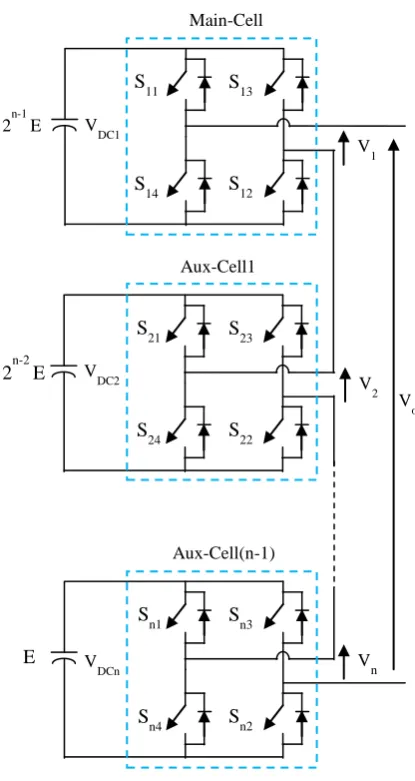
One of the popular topologies from this family of multilevel inverters with H-bridge converters cells is shown in Figure 4. All of the cells operate at the same voltage rating. But, by proper scaling of the transformers turn ratios, the inverter can operate as binary hybrid multilevel inverter. For binary case, the transformers turn ratios are scaled in power of 2. In other words, in the multi-source binary hybrid multilevel inverter the ratio of DC link voltage is binary, but in the single-source cascaded transformers topology the turn ratios of the transformers are binary.
Figure 1. Hybrid structure of CHB with n H-bridge cells and binary asymmetries.
Figure 2. Binary hybrid modulation for the binary hybrid multilevel inverter with three cells per phase.
Figure 3. General topology of single-source cascaded transformers multilevel inverters.
V 2 V1
VDC Converters
Vn Vo V
DC1
2n-1 E
S
11 S13
S14 S12
Main-Cell
V
DC2 2n-2 E
E
S
21 S23
S24 S22
Aux-Cell1
V
DCn E
S
n1 Sn3
S
n4 Sn2
Aux-Cell(n-1)
V
1
V
2
V
n
V
o
Figure 4. Single-source cascaded transformers multilevel inverter with H-bridge cells.
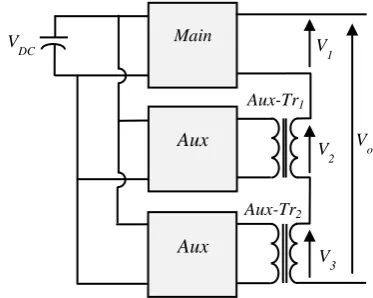
Figure 5. Sum of two AC sources with preservation of isolation (a) By two individual transformers. (b) By a single transformer.
Figure 6. The proposed single-source cascaded transformers binary multilevel inverter with 3 cells per phase.
Modulation strategy for this topology is similar to the binary hybrid modulation discussed above. For this topology with three cells per phase, the output voltages of the cells and overall system are similar to waveforms of Figure 2. As mentioned above, at full reference voltage, 66% of the converter nominal power is
managed by the main H-bridge cell (e.g., Main-Tr). Input voltage of this transformer is a low frequency rectangular voltage. So, it is much bulkier than the auxiliary transformers.
3. PROPOSED SINGLE-SOURCE TRINARY HYBRID MULTILEVEL INVERTER
3. 1. Single-source Cascaded Transformer
Multilevel Inverter To illustrate the performance of the proposed topology, suppose voltages of two AC voltage sources are to be added with preservation of isolation. One solution is series connection of secondary’s of two transformers in which the sources have connected to the primary of transformers according to Figure 5(a). This is the idea behind the conventional single-source cascaded transformers multilevel inverters. Another solution is the series connection of one source and one secondary of a transformer so that the other source has applied to the primary of transformer according to Figure 5(b). As mentioned before, in the single-source cascaded transformers multilevel inverters shown in Figure 3, the main function of the transformers is to make isolation between output terminals of the converters. Therefore, we can eliminate one of these transformers without losing isolation. Figure 6 shows such a structure for the single-source cascaded transformers binary multilevel inverter with 3 cells per phase. In comparison with Figure 4, the Main-Tr has been eliminated in Figure 6.
To keep binary relation between V1, V2 and V3, the turn ratios of the Aux-Tr1 and Aux-Tr2 must be 1:1/2 and 1:1/4 respectively. So:
1 , 2 1 , 3 1
2 4
DC DC DC
V V V V V V (2)
where V1, V2 and V3 are the peak values of V1, V2 and V3, respectively. The hybrid modulation strategy of the binary hybrid multilevel inverter can be used for this topology too. Output voltages of the overall system and the cells are similar with the waveforms shown in Figure 2.
3. 2. Advantages of the Proposed Topology and Comparison with Prior Topologies The proposed topology shown in Figure 6 has only two small transformers more than the binary hybrid multilevel inverter shown in Figure 1, while it requires only single DC source instead of several DC sources. In comparison with the capacitor based topologies, the proposed topology uses small size transformers instead of capacitors, without any complex balancing and control algorithms and circuit configurations. So it can be a suitable replacement for the conventional multi-source binary hybrid multilevel inverter and capacitor based (a)
V 1 V
1
V 2 V
2
(b) V
1
V2 V2
Aux-Tr1
Aux-Tr2
V
2
V
1
Aux
Cell 1
V
DC
Main
Cell
V
3 Aux
Cell 2
V
o Main-Tr
Aux-Tr1
Aux-Tr2 V2 V
1
Aux
Cell 1 V
DC
Main
Cell
V 3 Aux
Cell 2
single-source binary hybrid multilevel inverter in constant frequency applications.
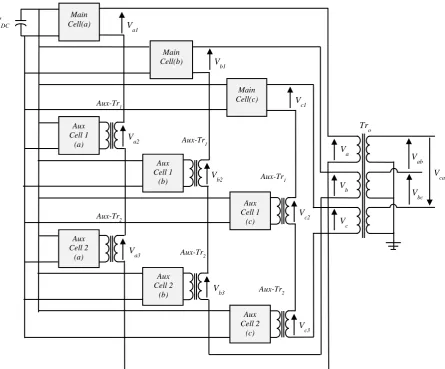
Beside the synthesis of voltage waveform, the transformers in the conventional topology shown in Figure 4 make galvanic isolation between DC source and load. Moreover, their turn ratios specify amplitude of output voltage. To cover advantages of the conventional topology, one can employ a transformer in the output of the proposed inverter. Figure 7 shows three-phase implementation of the proposed single-source inverter with three H-bridge cells per phase and a three-phase transformer at the output.
Three-phase implementation of the conventional inverter shown in Figure 4 with three cells per phase contains three main transformers and six auxiliary transformers.
In the proposed topology the main transformers have been eliminated. Instead, three-phase transformer has been used at the output of overall system. This has the following advantages:
1. The main transformers have rectangular input voltage with specific design considerations, while Tro is an ordinary transformer which has sinusoidal input voltage and its main functions are only making isolation between DC source and load and adjusting amplitude of output voltage. So, there is no need to design and install the Tro along with the inverter. Then, the user can install it if needed.
2. In the three-phase implementation of the conventional topology, the main transformers are three single-phase transformers which supply a major part of whole power with high voltage and low (fundamental) frequency rectangular input voltage while the Tro is a three-phase transformer with sinusoidal input voltage. Therefore, the Tro has lower cost, size and losses and higher efficiency compared to the three main transformers of the conventional topology.
3. In most of grid connected applications, the converters are connected to gird in a shunt or series by a coupling transformer.
Figure 7. The proposed three-phase inverter with three-phase transformer at the output
Aux-Tr2
(c)
Aux-Tr1
(c)
Aux-Tr2
(b)
Aux-Tr2
(a)
Aux-Tr1
(a)
V
ab
V
c
V
b
V
a
Tr
o
V
bc
V
ca
V
a1
V
DC
Main Cell(a)
V
a2
Aux Cell 1
(a)
V
a3
Aux Cell 2
(a)
V
b1
Main Cell(b)
V
b2
Aux-Tr
1
(b) Aux Cell 1
(b)
V
b3
Aux Cell 2
(b)
V
c1
Main Cell(c)
V
c2
Aux Cell 1
(c)
V
c3
Aux Cell 2
Control of power injection between inverter and grid is an important task [27-29]. Exchanging active and reactive powers between converter and grid can be expressed by magnitudes and angles of the network voltage VN0 and the output voltage of the converterVI and reactance (X) of the coupling transformer as follows:
sin( )
I N
V V P
X
(3)
2 cos( )
N I N
V V V
Q
X
(4)
In the conventional topology, modeling of the transformers and calculation of their reactance for use in the above equations is very difficult. The proposed topology is a suitable alternative in grid connected applications because the Tro can be used as the coupling transformer between the converter and power grid. Shunt connection of the proposed topology can be modeled as shown in Figure 8.
Cascaded multilevel inverters employing three-phase transformers and single DC input which reduce number and size of transformers have been proposed in [17-19]. However, the topology proposed in this paper has simpler modulation strategy, higher number of output levels and lower THD owing the hybrid modulation.
4. SIMULATION AND EXPERIMENTAL RESULTS
The three-phase configuration shown in Figure 7 with specifications given in Table 1 was simulated. The auxiliary transformers have been designed for square wave inputs. But, the Tro is an ordinary three-phase transformer with sinusoidal inputs. The secondary windings can be connected in star or delta forms.
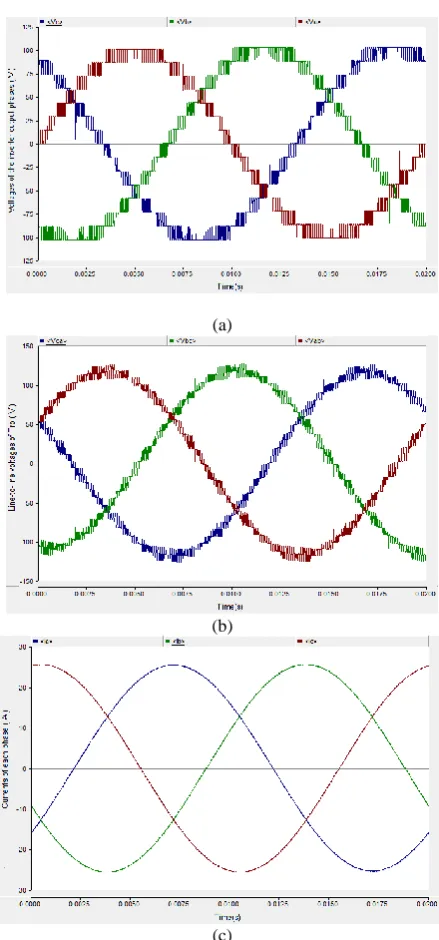
Figure 9 shows voltages of the inverter output phases (Va, Vb and Vc), line-to-line voltages of the Tro (Vab, Vbc and Vca) and currents of each phase ( Ia, Ib and Ic) obtained by the conventional hybrid modulation. In nominal condition, the phase voltages have 15 levels with 7%THD (it is 7.9% for conventional binary hybrid multilevel [23]) and the line voltages have 26 levels with 5.5% THD. Filtering effects of reactance components of the Aux-Tr2 and Tro are sensible in Figure 9 on the voltages of the inverter output phases and the voltages of Tro secondary windings. Figure 10 shows input currents of the H-bridge cells of phase (A). Because of the transformers turn ratio, it is apparent that the currents through the switches of auxiliary cells are relatively much less than that of main cell.
Figure 8. Shunt connection of the proposed topology with power grid
(a)
(b)
(c)
Figure 9. Output waveforms of the simulated proposed topology. (a) The inverter output phases Voltages; (b) Tro
Line-to-line voltages; (c) Currents of each phase. DC/AC
Converter
Grid Tro
VDC
V
Consequently the conduction losses of the switches of auxiliary cells will be very low than corresponding auxiliary cells in multi-source hybrid multilevel inverter. A small size single-phase prototype of the proposed inverter with three H-bridge cells is shown in Figure 11. It has the specifications given in Table 1 as well.
TABLE 1. Specifications of Both the Simulated and Prototype Inverters
Parameters Specifications
VDC 60V
Vo (Peak) in Phase 105V
Nominal Volt-Ampere (Each Phase) 1200VA
Load R=8Ω , L=20 mH
Switches of Main-cell 40V-10A
Switches of Aux-cell1 40V-5A
Switches of Aux-cell2 40V-2.5A
Figure 10. input currents of the H-bridge cells of phase (A) in the simulated proposed topology.
Figure 11. Single-phase prototype of the proposed inverter with three H-bridges.
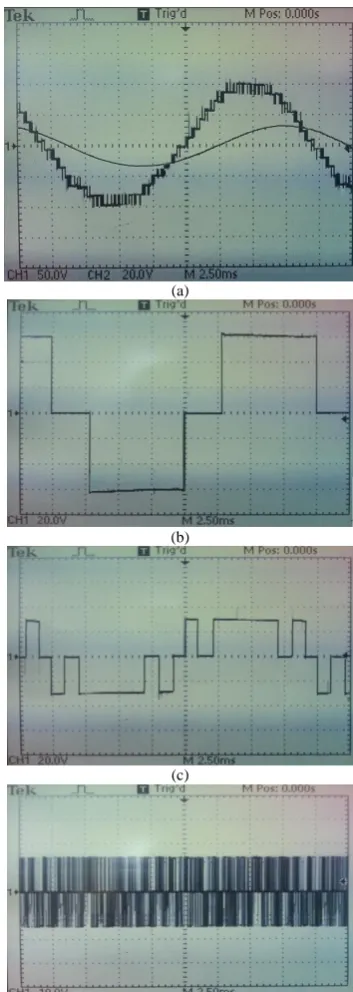
According to Figure 11, the two small transformers are the auxiliary transformers (Aux-Tr1 and Aux-Tr2). As seen, they have not more influence on the system bulk. Figure 12 shows output voltages of the Main-cell, Aux-Tr1, Aux-Tr2 and the overall system obtained by hybrid modulation in full range of reference voltage. Also, Figure 13 shows output voltage of the overall system at 0.3 (pu) reference voltage.
(a)
(b)
(c)
(d)
Despite reduced number of the voltage levels in lower ranges, the binary hybrid topology presents a good spectral performance because of the PWM in the Aux-cell2. Both simulation and experimental results show that by using only two small size transformers in each phase we can establish single DC source binary hybrid multilevel inverter. In other words, by elimination of the Main-Tr in the conventional topology shown in Figure 4 no inconvenience occurs in operation and modulation strategies.
In this paper we studied the binary hybrid multilevel inverter with H-bridge cells. But the proposed method can be applied on some other transformer based single-source topologies of multilevel inverters. The proposed multilevel inverter is suitable for constant frequency applications such as grid connected applications (FACTS, Photovoltaic, etc.), uninterruptable power supply (UPS) systems, etc.
4. CONCLUSION
In this paper a transformer based single-source binary hybrid multilevel inverter with transformers with small sizes and reduced numbers was proposed. In the proposed topology a low frequency transformer has been connected at output terminals of each auxiliary H-bridge. Secondary windings of the transformers have been connected in series with each other and then with output terminals of the main cell. Consequently, output voltages of the auxiliary transformers and main cell made quasi-sinusoidal output voltage. The proposed topology has significant advantages from view point of dimensions, number of transformers, design of transformer, modeling and application aspects specially in three-phase configuration even with transformer in its output. The conventional hybrid modulation strategy of the binary hybrid multilevel inverter has been used in the proposed topology. A three-phase configuration of the proposed inverter with single unidirectional DC source, three H-bridge cells and two small size transformers per phase and a three-phase transformer has been simulated. A single-phase prototype also was built to verify the performance of the proposed arrangement. Experimental and simulation results demonstrate that by using only two small size transformers in each phase we can establish single DC source binary hybrid multilevel inverter.
5. REFERENCES
1. Rodriguez, J., Lai, J.-S. and Peng, F. Z., "Multilevel inverters: A survey of topologies, controls, and applications", Industrial Electronics, IEEE Transactions on, Vol. 49, No. 4, (2002), 724-738.
2. Manjrekar, M. D., Steimer, P. K. and Lipo, T. A., "Hybrid multilevel power conversion system: A competitive solution for high-power applications", Industry Applications, IEEE Transactions on, Vol. 36, No. 3, (2000), 834-841.
3. Luo, F. L. and Ye, H., "Advanced DC/AC inverters", Boca Raton, CRC Press, (2013).
4. Mariethoz, S., "Systematic design of high-performance hybrid cascaded multilevel inverters with active voltage balance and minimum switching losses", Power Electronics, IEEE Transactions on, Vol. 28, No. 7, (2013), 3100-3113.
5. Kang, F.-s., "Modified multilevel inverter employing half-and full-bridge cells with cascade transformer and its extension to photovoltaic power generation", Electric Power Systems Research, Vol. 80, No. 12, (2010), 1437-1445.
6. Liu, Y. and Luo, F., "Trinary hybrid multilevel inverter used in statcom with unbalanced voltages", in Electric Power Applications, IEE Proceedings-, IET, Vol. 152, (2005), 1203-1222.
7. Rotella, M., Penailillo, G., Pereda, J. and Dixon, J., "PWM method to eliminate power sources in a nonredundant 27-level inverter for machine drive applications", Industrial Electronics, IEEE Transactions on, Vol. 56, No. 1, (2009), 194-201. 8. Ortuzar, M. E., Carmi, R. E., Dixon, J. W. and Moran, L.,
"Voltage-source active power filter based on multilevel converter and ultracapacitor dc link", Industrial Electronics, IEEE Transactions on, Vol. 53, No. 2, (2006), 477-485. 9. Dixon, J., Pereda, J., Castillo, C. and Bosch, S., "Asymmetrical
multilevel inverter for traction drives using only one dc supply",
Vehicular Technology, IEEE Transactions on, Vol. 59, No. 8, (2010), 3736-3743.
10. Pereda, J. and Dixon, J., "High-frequency link: A solution for using only one dc source in asymmetric cascaded multilevel inverters", Industrial Electronics, IEEE Transactions on, Vol. 58, No. 9, (2011), 3884-3892.
11. Suresh, Y. and Panda, A. K., "Investigation on hybrid cascaded multilevel inverter with reduced dc sources", Renewable and Sustainable Energy Reviews, Vol. 26, (2013), 49-59.
12. Liao, J., Corzine, K. and Ferdowsi, M., "A new control method for single-DC-source cascaded H-bridge multilevel converters using phase-shift modulation", in Applied Power Electronics Conference and Exposition, APEC 2008,Twenty-Third Annual IEEE, (2008), 886-890.
13. Du, Z., Tolbert, L. M., Ozpineci, B. and Chiasson, J. N., "Fundamental frequency switching strategies of a seven-level hybrid cascaded H-bridge multilevel inverter", Power Electronics, IEEE Transactions on, Vol. 24, No. 1, (2009), 25-33.
14. Vazquez, S., Leon, J. I., Franquelo, L. G., Padilla, J. J. and Carrasco, J. M., "DC-voltage-ratio control strategy for multilevel cascaded converters fed with a single DC source",
Industrial Electronics, IEEE Transactions on, Vol. 56, No. 7, (2009), 2513-2521.
15. Tsang, K. and Chan, W., "27-level DC–AC inverter with single energy source", Energy Conversion and Management, Vol. 53, No. 1, (2012), 99-107.
16. Soto, D., Pena, R., Reyes, L. and Vasquez, M., "A novel cascaded multilevel converter with a single nonisolated DC link", in Power Electronics Specialist Conference, PESC'03. 2003 IEEE 34th Annual, Vol. 4, (2003), 1627-1632.
17. Song, S. G., Kang, F. S. and Park, S.-J., "Cascaded multilevel inverter employing three-phase transformers and single DC input", Industrial Electronics, IEEE Transactions on, Vol. 56, No. 6, (2009), 2005-2014.
hybrid multilevel converter for expanding adjustable output voltage range", Industry Applications, IEEE Transactions on, Vol. 45, No. 2, (2009), 827-835.
19. Panda, A. K. and Suresh, Y., "Research on cascade multilevel inverter with single DC source by using three-phase transformers", International Journal of Electrical Power & Energy Systems, Vol. 40, No. 1, (2012), 9-20.
20. Banaei, M. R., Khounjahan, H. and Salary, E., "Single-source cascaded transformers multilevel inverter with reduced number of switches", Power Electronics, IET, Vol. 5, No. 9, (2012), 1748-1753.
21. Malinowski, M., Gopakumar, K., Rodriguez, J. and Perez, M. A., "A survey on cascaded multilevel inverters", Industrial Electronics, IEEE Transactions on, Vol. 57, No. 7, (2010), 2197-2206.
22. Rech, C. and Pinheiro, J. R., "Hybrid multilevel converters: Unified analysis and design considerations", Industrial Electronics, IEEE Transactions on, Vol. 54, No. 2, (2007), 1092-1104.
23. Rech, C., Pinheiro, H., Grundling, H. A., Hey, H. L. and Pinheiro, J. R., "Analysis and comparison of hybrid multilevel voltage source inverters", in Power Electronics Specialists Conference, IEEE. Vol. 2, (2002), 491-496.
24. Chattopadhyay, S. K., Chakraborty, C. and Pal, B. C., "Cascaded H-bridge & neutral point clamped hybrid asymmetric
multilevel inverter topology for grid interactive transformerless photovoltaic power plant", in IECON 2012-38th Annual Conference on IEEE Industrial Electronics Society, IEEE, (2012), 5074-5079.
25. Khoun Jahan, H., Banaei, M.R. and Talaei Mobaraki, S., "Combined h-bridge cells cascaded transformers multilevel inverter", in Power Electronics, Drive Systems and Technologies Conference (PEDSTC), 2014 5th, IEEE. (2014), 524-528.
26. Gayathri, M. N. and Ganimozhi, T., "New hybrid cascaded multilevel inverter", International Journal of Engineering-Transactions B: Applications, Vol. 26, No. 11, (2013), 1377-1384.
27. Gholizade-Narm, H., "A novel control strategy for a single-phase grid-connected power injection system", International Journal of Engineering-Transactions C: Aspects, Vol. 27, No. 12, (2014), 1841-1849.
28. Hosseini, S., Haque, M. and Mathur, R., "Dynamic compensation of electrical power systems using multilevel voltage source inverter", International Journal of Engineering, Vol. 14, No. 3, (2001), 215-228.
29. Deepa, S. and Rajapandian, S., "Harmonic reduction technique using flying capacitor based Z source inverter for a DVR",
International Journal of Engineering-Transactions C: Aspects, Vol. 26, No. 3, (2012), 309-314.
Transformer-based Single-source Multilevel Inverter with Reduction in Number of
Transformers
T. Ghanbari, B. Tousi
Department of Electrical Engineering, Urmia University, Urmia, Iran
P A P E R I N F O
Paper history:
Received 21 February 2015
Received in revised form 29 January 2016 Accepted 04 March 2016
Keywords:
Binary Hybrid Multilevel Inverter Single-source Multilevel Inverter Hybrid Modulation
Cascaded Transformers Multilevel Inverter
هديكچ
دىچ یاَزترًىیا گرشب داعبا اب رًتامرًفسوازت کی یاراد یراشبآ یاَرًتامرًفسوازت اب یعبىم کت یزىیاب یدیزبیَ یحطس
لپ ٍب ٍک دىتسَ H
یلصا یم لصتم ساف زَ رد ناش ًش
رد یراذگزیثأت چیَ نيدب ،گرشب یاَرًتامرًفسوازت هیا ٍلاقم هیا رد .د
ٌدش فذح ،زترًىیا نًیسلايدم ي دزکلمع یحازط ،اَرًتامرًفسوازت دادعت ،داعبا ظاحل سا یداُىشیپ راتخاس .دوا
،اَرًتامرًفسوازت یساس لدم
یپ زترًىیا نًیسلايدم شير .تسا یُجًت لباق یایاشم یاراد دزبراک ي نًیسلايدم نامَ ،یداُىش
یم ناشو ار یداُىشیپ راتخاس ییاراک ،یبزجت ي یساس ٍیبش جیاتو .تسا ليادتم یزىیاب یدیزبیَ .دىَد