International Journal of Engineering
J o u r n a l H o m e p a g e : w w w . i j e . i rBallistic Performance of Hybrid Armor with Ceramic Inserts and Polymeric Matrix
for Different Threat Levels
S. M. Zahraeea, A. R. Sabet*b
a Department of Industrial Metallurgy and Advanced Processing, Iranian Research Organization for Science and Technology (IROST), Tehran, Iran b Department of composite, Iran Polymer and Petrochemical Institute, Tehran, Iran
P A P E R I N F O
Paper history:
Received 03 October 2013
Received in revised form 23 November 2013 Accepted 12 December 2013
Keywords:
Ballistic Impact Ceramic Inserts Damage Extension Multiple Impacts
A B S T R A C T
Ceramic materials due to their high compressive strength and hardness have been one of prime candidates in armor design in particular when high level threats (impact velocity above 600 m/s) are involved. The aim of this work is to investigate ballistic impact performance for a target plate containing novel ceramic inserts and compare it to ceramic tiles embedded in polyurethane based matrix. Two size 98% alumina (Al2O3)base ceramic inserts with 10 mm diameter and 6 and 10mm in
length were used in the specimen’s preparation. In addition, 6 and 10mm thick ceramic tiles were used to compare the ballistic performance. Smooth bore gas gun was used to carry out high velocity ballistic impact tests in velocity range of 530- 830m/s on both target plates. Results showed outstanding ballistic performance by the target plate with ceramic inserts in term of lower residual velocity for the specimens which experienced perforation and lower damage area compared to totally disintegrated plates containing ceramic tiles. Specimens containing ceramic inserts also showed good ballistic resistance in case of multiple impacts whereas the specimens with ceramic tiles almost totally lost its ballistic potentials. Ability to repair on site (debris removal and new ceramic insert replacement) is among unique advantages of this novel design in the armor application.
doi: 10.5829/idosi.ije.2014.27.06c.13
1. INTRODUCTION1
Problem of impact protection and energy absorption has been the focus of attention in engineering community for long time. The issue is usually subdivided to two main areas i.e. high and low velocity impact. There are numerous reports on these subjects with some recent publications [1-3]. Among them, protection from small fire arms such as handguns, rifles and machine guns, is of paramount importance to military planners and experts. There are also other lethal threats, these include heavy machine gun fire, explosive devices and cannon fire. Ballistic threats involved, range from lead to steel hard core armor piercing bullets with velocities ranging from 274 to 990m/s [4]. One of the best ways to counter such threads is to increase the dwell time a bullet or a fragment has to work on the armor system to defeat it. Ceramic materials are among the best candidates to counter high level ballistic threads. Indeed ceramic
*Corresponding Author Email: [email protected] (A. R. Sabet)
plates comprising of boron carbide (B4C), Alumina
(Al2O3) or Silicon carbide (SiC) have been extensively
used in high thread level armor protections [5]. These ceramic materials are mainly used as plates in most armor systems. Utilization of these materials as plate may include manufacturing damage in form of porosity or can induce damage after impact which can interfere with the ability of the armor to dissipate impact energy and resulting in ceramic shatter and low ballistic performance. There are few research reports on ballistic performance of various ceramic plates [6, 7].
Matchen [8] published a comprehensive review on ceramic armor. Several studies have been performed to determine the material parameters that influence the penetration resistance of monolithic ceramic targets. Goncalves et al. [9] analyzed the impact of projectiles against ceramic/metal armor using a simple one-dimensional model. They also investigated the influence of grain size of the ceramic material on ballistic performance. Rosenberg and Yeshurun [10] showed that the ballistic resistance of a ceramic material could be related to an effective strength parameter defined as an
average of the static and dynamic compressive strength of the ceramic. Sternberg [11] examined the material properties that determine the resistance of a ceramic to high-velocity penetration and indicates that the initial resistance to penetration might be governed by the indentation hardness. He proposed that the ballistic performance of a given ceramic material may increase with an increase in the ceramic toughness. Madhu et al. [12] studied the ballistic performance of 95% and 99.5% alumina ceramic tiles backed by metal plates. Their result showed that the ballistic efficiency factor for a given velocity is observed to decrease in the case of 99.5% grade and increase in the case of 95% grade ceramic. The higher purity alumina (99.5%) showed higher ballistic performance when compared with the 95% alumina.
Medvedovski [13] studied the homogeneous oxide and carbide ceramics and heterogeneous ceramic materials. Composition, structure and main properties of the considered ceramics, which affect ballistic performance, were investigated. Same author [14] in the second part of the article presented results for successful design of lightweight armor systems with adequate ballistic performance, including satisfactory multi-hit performance. One area which ceramic plate suffers from, is the shattering which occurs during high velocity impact, this of course is mainly due to brittle nature of the ceramic materials. In this condition the ceramic plate has no more functional use and must be replaced as whole. If one can replace these plates with small size ceramic inserts, it would be possible to replace the inserts when shattered by ballistic impact. This is possible since damage in ballistic impacts is of localized nature and as the inserts isolate the damage, it will not extend beyond the few inserts. This will eliminate need to total plate replacement.
Our survey shows no report on the ballistic performance study of isolated ceramic insert in a polymer/ceramic armor system.
2. MATERIALS
Two size 98% alumina (Al2O3) base ceramic inserts
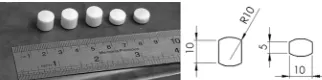
were used for the specimens’ preparation. Ceramic inserts were 10mm in diameter with 10 and 6mm in length with top and bottom surface having torosphrical curvature. Figure 1 presents schematic representation as well as their images. Ceramic inserts were from KMS-96 Martoxid Germany. The ceramic inserts were prepared using ready to press powder and pressed by uniaxial press at 120MPa and then sintered at 1600˚C for 120 min. The sintered density was 3.82 gr/cm3 (96% of its theoretical density).
Two part polyurethane elastomer resin (UR 3558 from Axson, France) was used to cast the ceramic inserts in place. Each specimen was prepared by placing
ceramic inserts in a 100mm×100mm mold and casting the polyurethane resin and allowed to cure for 24h at room temperature. Figure 2 depict molding condition and final specimen. To avoid ceramic insert blank out during high velocity impact a layer of 200g/m2 ballistic
aramid fabric (Twaron fabric, from Tejin Aramid, Amhem/ Netherland) was used as a backup layer. The Twaron fabric used was a plain-woven filament-yarn-based fabrics comprising poly-(paraphenylene terephthalamide) (PPTA) yarns.
In order to assess the significance of ceramic inserts as against ceramic tiles, square shaped ceramic tile specimens of size 8cm×8cm were also prepared using 98% alumina (Al2O3) base ceramics, the tiles were in
two thicknesses of 6 and 10mm. The tiles were casted in place using similar polymeric matrix and procedure (see Figure 3). Table 1 presents properties for the material used in preparing the armor plates.
Figure 1. Schematic representation of two size ceramic inserts.
Figure 2. Target plate preparations consisting of ceramic inserts and polyurethane elastomer
Figure 3. Target plate containing ceramic tiles (A), two size ceramic tiles used as the target plates (B)
TABLE 1. Material properties
Property Al2O3 Polyurethane matrix
Density(g/cm3) 3.82 0.94
3. HIGH VELOCITY IMPACT TEST
High velocity impact tests were carried out using a gas gun (Figure 4). The gas gun consists of 1.75m long smooth barrel with inside diameter of 8.7 mm, a fast acting high pressure release valve, a breech unit, a rupture disk unit, a supply gas vessel, a 500ml gas reservoir for each shot release, a target holder, two velocity measuring units, and ballistic paste to catch the projectile intact. Initial velocity of projectile was measured after it was propelled from the gun barrel using a chronograph F-1 model from Shooting Chrony Co Canada. Due to unpredictable line of flight of projectile after exiting the target, the residual velocity for the projectile which perforated the specimen was recorded using two sets of wide screen aluminum foil panels connected in series via a 1 GHz fast counter. The 100×100mm specimen was clamped at all four edges.
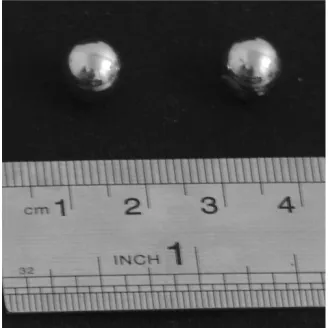
Ballistic limit velocities (V50) were determined using MIL-STD-662F standard. The tests were carried out in velocity range of 530 to 830m/s. The projectile used for all high velocity impact tests was a stainless steel spherical ball hardened (Rc60) with 8.7 mm diameter and 2.3g weight, see Figure 5.
Figure 4. schematic representation of gas gun device
Figure 5. Stainless steel spherical ball projectile used for high velocity impact tests
4. RESULTS AND DISCUSSIONS
Ballistic limit velocity values (impact velocity at which the projectile seizes in the ceramic target), impact velocity versus residual velocity behavior. Back face damage also caused in both target plates were used to assess ballistic potential of the material concern. Figure 6 presents impact velocity versus residual velocity behavior for the two types of specimen tested. The figure indicates better ballistic performance for the specimens containing ceramic inserts by showing lower residual velocity. Further study of the figure reveals more steep linear behavior by specimens with ceramic plate than by specimens containing ceramic inserts.
Ballistic limit velocity (velocity at which the projectile seizes in the target plate) is presented in Figure 7. The figure shows no significant difference in their ballistic limit velocities, i.e. the values for both specimens were approximately at the same level. The figure shows approximately same level of ballistic limit velocity for both type of specimens i.e. 530 and 515m/s for 6mm thickness ceramic plate and ceramic insert containing specimen, respectively. In addition, the ballistic limit velocity for the 10mm thickness ceramic plate and inserted containing specimens showed similar trend with ceramic plate containing specimens attaining average value of 695m/s for its ballistic limit value as against 680 m/s for ceramic insert containing specimen.
Figure 6. Residual velocity versus impact velocity for both target plates tested
5. DAMAGE ASSESSMENT
Damage inflicted during ballistic impact and their performance after impact is among important criteria’s in the armor assessments. Damage extension comparisons were carried out for target plates containing both ceramic inserts and tiles. Damage extension area for all specimens after impact tests were measured using a back face target assessment and extend of bulging on the back face aramid fabric. This was carried out using a back light marking as well as using bulging phenomenon on target plat back face associated with aramid fabric. Damage extension was documented by direct photo scanning of both side for each plate with a flat bed scanner at 300dpi. Damage zones were measured by printing the extend of damage on a paper and cutting out the area and weighing both the cut out corresponding to damge zone and also unit area from the same paper thereby proportionating the damage extension. Results are depicted in Figure 8.
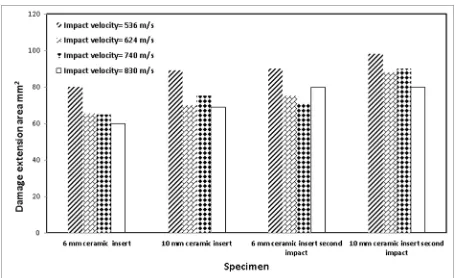
Figure 9 shows front face damage for the two target plates (A) target plate with ceramic tiles (B) target plates with ceramic inserts. Figure 10 presents damage extension for target plates containing both ceramic inserts and plates. The figure shows considrable higher damage extension area for target plates with ceramic tiles as compared to ceramic inserts. Further study of the figure reveals no significant effect on damage extension area for different thicknesses in both target plates. This was consistent in both ceramic tiles and inserts plates .
Figure 8. Back face damage incurred in the target plates with (A)ceramic tiles and (B)ceramic inserts
Figure 9. Front face damage for the two target plates (A) target plate with ceramic tiles (B) target plates with ceramic inserts
Figure 10. Damage extension area for both plates, the number on the bar chart represents impact velocities.
6. MULTIPLE BALLISTIC IMPACT
In order to assess ballistic potential of target plate towards multiple ballistic impact, the target plates were subjected to second ballistic impact at different location on the same specimen. Figure 11 presents impact velocity versus residual velocity for the two types of specimen tested under second impact. The figure clearly shows outstanding performance by the target plate containing ceramic inserts compared to plate with ceramic tile. Figure 11 depicts much higher residual velocity for the target plates containing ceramic tiles, i.e. very poor energy absorbing performance. In order to analysis the loss on ballistic potentials as a result of second impact on both plates, energy absorbed for each specimen was calculated using Equation (1) and depicted in Figure 12.
E=1/2 m(Vi2- Vr2) (1)
where, Vi is the initial impact velocity, Vr is the
projectile residual velocity after perforation and exiting the target and m is the mass of projectile. Study of Figure 12 clearly shows the outstanding performance of the target plates containing ceramic inserts. Comparison of energy absorption level shown in Figure 12 for second impact on the target plates containing ceramic tiles with that of plates with ceramic insert for apporoximately same level of impact velocity reveals significant increase in value for the target plates containing ceramic insert. Damage assessment associated with second impact on target plates with ceramic tiles was unsuccessful due to extensive damage incurred by the specimens.
specimens with ceramic tiles practically offered no resistance in the second impact test as regard to ballistic limit velocity whereas in specimens with ceramic inserts distinct and viable ballistic limit values were obtained in the second impact test (see Figure 14).
The figure shows approximately same level of ballistic limit velocity in second impact test for the target plates with ceramic inserts. The figure also shows considerable reduction in corresponding values for the target plate containing ceramic plates.
Figure 11. Residual velocity versus impact velocity for second impact on both target plates tested
Figure 12. Energy absorption comparisons for second impact test
Figure 13. Damage extension areas for target plates with only ceramic inserts under single and multiple impact tests
Figure 14. Ballistic limit velocity comparison for single and second impact tests
7. CONCLUSION
This work concerns ballistic performance comparison between an armored target plate containing a novel ceramic inserts and a similar plate with ceramic tiles both embedded in a polyurethane matrix. Despite no significant difference in ballistic limit velocities for the two types of ceramic targets under single impact, results showed considerable ballistic performance by the plates containing ceramic inserts in term of same level of ballistic limit and considerable higher energy absorption in second impact. Low damage on the back face in the plates with ceramic inserts is among outstanding features. In addition, ability to resist multiple impacts is regarded as an added advantage. Moreover, ability to locally replace ceramic insert which incurred sever damage during ballistic impact in these target plates also makes these materials more attractive for armor application.
8. REFERENCES
1. Maghami, S., Rezaeepazhand, J. and Yousefsani, S., "Effect of corner bluntness on energy absorbing capability of non-circular metallic tubes subjected to axial impact", International Journal
of Engineering (1025-2495), Vol. 26, No. 8, (2013).
2. Farahani, M., Amanifard, N. and Hosseini, S., "A high-velocity impact simulation using sph-projection method", International
Journal of Engineering, Trans B: Applications, Vol. 22, No.
4, (2009), 359-368.
3. Amanifard, N. and Namini, V. H., "A modified compressible smoothed particle hydrodynamics(MCSPH) method and its application on the numerical simulation of low and high velocity impacts", International Journal of Engineering, Vol. 25, No. 1, (2012), 45-57.
4. Bhatnagar, A., "Lightweight ballistic composites: Military and law-enforcement applications, Woodhead Pub Ltd, (2006). 5. Tracy, C., Slavin, M. and Viechnicki, D., "Ceramic failure
during ballistic impact", Advances in Ceramics, Fractography
of Glasses and Ceramics, Vol. 22, (1988), 295-306.
7. O'Donnell, R., "An investigation of the fragmentation behaviour of impacted ceramics", Journal ofMaterials Science Letters, Vol. 10, No. 12, (1991), 685-688.
8. Matchen, B., "Applications of ceramics in armor products", Key
Engineering Materials, Vol. 122, (1996), 333-344.
9. Goncalves, D., De Melo, F., Klein, A. and Al-Qureshi, H., "Analysis and investigation of ballistic impact on ceramic/metal composite armour", International Journal of Machine Tools
and Manufacture, Vol. 44, No. 2, (2004), 307-316.
10. Rozenberg, Z. and Yeshurun, Y., "The relation between ballastic efficiency and compressive strength of ceramic tiles",
International Journal of Impact Engineering, Vol. 7, No. 3,
(1988), 357-362. 11.
12. Sternberg, J., "Material properties determining the resistance of ceramics to high velocity penetration", Journal of Applied
Physics, Vol ,۶۵ .No. 9, (1989), 3417-3424.
13. Madhu, V., Ramanjaneyulu, K., Balakrishna Bhat, T. and Gupta, N., "An experimental study of penetration resistance of ceramic armour subjected to projectile impact", International Journal of
Impact Engineering, Vol. 32 ,No. 1, (2005), 337-350.
14. Medvedovski, E., "Ballistic performance of armour ceramics: Influence of design and structure. Part 2", Ceramics
International, Vol. 36, No. 7, (2010), 2117-2127.
15. Medvedovski, E., "Ballistic performance of armour ceramics : Influence of design and structure. Part 1", Ceramics
International, Vol. 36, No. 7, (2010), 2103-2115.
Ballistic Performance of Hybrid Armor with Ceramic Inserts and
Polymeric Matrix for Different Threat Levels
TECHNICAL NOTE
S. M. Zahraeea, A. R. Sabetb
a Department of Industrial Metallurgy and Advanced Processing, Iranian Research Organization for Science and Technology (IROST), Tehran, Iran b Department of composite, Iran Polymer and Petrochemical Institute,Tehran, Iran
P A P E R I N F O
Paper history:
Received 03 October 2013
Received in revised form 23 November 2013 Accepted 12 December 2013
Keywords:
Ballistic Impact Ceramic Inserts Damage Extension Multiple Impacts
هﺪﯿﮑﭼ
دراﻮﻣردصﻮﺼﺧﻪﺑﺎﻬﺷﻮﭘهرزﯽﺣاﺮﻃردﯽﻠﺻايﺎﻫﻪﻨﯾﺰﮔزاﻻﺎﺑرﺎﯿﺴﺑﯽﺘﺨﺳويرﺎﺸﻓمﺎﮑﺤﺘﺳاﻞﯿﻟدﻪﺑﯽﮑﯿﻣاﺮﺳداﻮﻣ
ﺪﯾﺪﻬﺗﺢﻄﺳ
ﻻﺎﺑ
)
m/s
600
ﺮﺗﻻﺎﺑو
(
ﺪﻧورﯽﻣرﺎﻤﺷﻪﺑ
.
ياﻪﺤﻔﺻفاﺪﻫاﯽﮑﯿﺘﺴﻟﺎﺑﺖﯿﻓﺮﻇﻪﺴﯾﺎﻘﻣﻖﯿﻘﺤﺗﻦﯾازافﺪﻫ
يﺮﻤﯿﻠﭘﺮﺘﺴﺑردﻪﭼرﺎﭘﮏﯾﯽﮑﯿﻣاﺮﺳيﺎﻫﻪﺤﻔﺻﺎﺑيﺮﻤﯿﻠﭘﺮﻣﻮﺘﺳﻻانﺎﺗرﻮﯾﯽﻠﭘﺮﺘﺴﺑﮏﯾردﯽﮑﯿﻣاﺮﺳيﺎﻫﻪﺘﺴﻫﻪﺑﺢﻠﺴﻣ
ﺪﺷﺎﺑﯽﻣﻪﺑﺎﺸﻣ
.
يﺎﻨﯿﻣﻮﻟآﺲﻨﺟزاﯽﮑﯿﻣاﺮﺳيﺎﻫﻪﺘﺴﻫ
98 %
لﻮﻃودرد
6
و
10
دﺮﺘﻣﯽﻠﯿﻣ
يﺎﻫﻪﺤﻔﺻوﺮﻤﯿﻠﭘﺮﺘﺴﺑر
ﺖﻓﺮﮔراﺮﻗهدﺎﻔﺘﺳادرﻮﻣفﺪﻫناﻮﻨﻌﺑﻪﺑﺎﺸﻣيﺮﻤﯿﻠﭘﺮﺘﺴﺑردﺲﻨﺟنﺎﻤﻫزاﻪﺑﺎﺸﻣﺖﻣﺎﺨﺿﺎﺑﻪﭼرﺎﭘﮏﯾﯽﮑﯿﻣاﺮﺳ
.
نﻮﻣزآ
ﯽﺘﻋﺮﺳهدوﺪﺤﻣردياﻪﻠﺣﺮﻣﮏﺗيزﺎﮔﻪﻠﺤﺳازاهدﺎﻔﺘﺳاﺎﺑﻻﺎﺑﺖﻋﺮﺳﻪﺑﺮﺿيﺎﻫ
m/s
530
ﯽﻟا
830
ياﻪﻧاﻮﺘﺳاﻪﺑﺎﺗﺮﭘﺎﺑ
ﺮﻄﻗﺎﺑ
7/ 8
ﺮﺘﻣﯽﻠﯿﻣ
ﺖﻓﺮﮔترﻮﺻهﺮﮐﻢﯿﻧﯽﮕﻠﮐﺎﺑ
.
ﻪﺑﺢﻠﺴﻣيﺎﻫﻪﻧﻮﻤﻧردﻻﺎﺑرﺎﯿﺴﺑﯽﮑﯿﺘﺴﻟﺎﺑﯽﯾارﺎﮐزاﯽﮐﺎﺣﺞﯾﺎﺘﻧ
ﻪﭼرﺎﭘﮏﯾﮏﯿﻣاﺮﺳﻪﺑﺢﻠﺴﻣيﺎﻫﻪﻧﻮﻤﻧﺎﺑﻪﺴﯾﺎﻘﻣردﯽﮑﯿﻣاﺮﺳيﺎﻫﻪﺘﺴﻫ
دراد
.
وﻢﮐﺐﯿﺳآﻪﯿﺣﺎﻧﺐﻟﺎﻗردﻻﺎﺑﯽﯾارﺎﮐﻦﯾا
وﯽﮑﯿﻣاﺮﺳيﺎﻫﻪﺤﻔﺻيوﺎﺣﻪﻧﻮﻤﻧﺎﺑﻪﺴﯾﺎﻘﻣردﺐﯿﺳآﻞﻤﺤﺗﺖﯿﻓﺮﻇ
دادنﺎﺸﻧاردﻮﺧدﺪﻌﺘﻣﮏﯿﻠﺷﻞﻤﺤﺗﺖﯿﻠﺑﺎﻗ
.
ﺖﯿﻠﺑﺎﻗ يزﺎﺳزﺎﺑ
ﺪﺷﺎﺑﯽﻣﯽﮑﯿﻣاﺮﺳﻪﺘﺴﻫيوﺎﺣيﺎﻫﻪﻧﻮﻤﻧرددﺮﻔﺑﺮﺼﺤﻨﻣيﺎﻬﯿﮔﮋﯾوزاتﺎﯿﻠﻤﻋ رد
.
doi: 10.5829/idosi.ije.2014.27.06c.13