UBIR: University of Bolton Institutional Repository
Games Computing and Creative Technologies:
Conference Papers
School of Games Computing and Creative
Technologies
2005
Towards ontology-based semantic processing for
multimodal active presentation
Weiqiang Ou
University of Bolton
Adel Elsayed
University of Bolton, [email protected]
Roger Hartley
University of Leeds
This Conference Paper is brought to you for free and open access by the School of Games Computing and Creative Technologies at UBIR: University
Digital Commons Citation
Ou, Weiqiang; Elsayed, Adel; and Hartley, Roger. "Towards ontology-based semantic processing for multimodal active presentation." (2005).Games Computing and Creative Technologies: Conference Papers.Paper 6.
Towards Ontology-based Semantic Processing
for Multimodal Active Presentation
Weiqiang Ou *,1, Adel Elsayed 1, and Roger Hartley 2 1
APT Lab, Department of Computing & Electronics, The University of Bolton, UK
2
CBL unit, School of Education, University of Leeds, UK
How to develop a conceptual structure to represent the knowledge encapsulated in text or multimodal presentation is a major challenge for semantic processing. This paper describes an approach based on a mapping process that develops such conceptual structure by projecting the verbal content onto a knowledge domain. However, for the target knowledge domain to support the mapping process, it needs to posses some specific features e.g. to be robust and flexible enough to organize and codify the contextual knowledge which guides the interpretation of presentation contents, and rich enough to incorporate knowledge in the presentation. To fulfil this requirement, the paper proposes an ontology-based knowledge model that satisfies the set of desirable properties. The model contains three layers: ontology layer, qualitative layer and quantitative layer, each of them is associated with the relevant kinds of knowledge. Ontology is developed to capture the conceptual understanding of the domain in which presentation takes place, and provide a semantic basis for grounding the fine-grained knowledge which is represented in the other knowledge layers. The qualitative layer offers significantly qualitative description of the domain, such as low-level feature of physical process and explicit causal process, while the quantitative layer is meant to capture the mathematical properties of the objects. A conceptual structure, generated as an outcome of the semantic processing, will retain the model’s three-layered representation structure.
Keywords knowledge structure; ontology; conceptual understanding; qualitative representation
1. Introduction
It is an established fact that knowledge plays a vital role in the comprehension and production of discourse. The process of interpreting words, sentences, and the whole discourse involves an enormous amount of knowledge which forms our background and contextual awareness. However, how various types of knowledge can be organized in a computer system and applied to the comprehension process is still a major challenge for semantic interpretation systems used in natural language processing.
This paper describes an approach based on a mapping process that develops a conceptual structure to underpin presentational content by projecting the verbal content onto a knowledge domain. For the target knowledge domain to support the mapping process, it needs to posses some specific features e.g. to be robust and flexible enough to organize and codify the contextual knowledge which guides the interpretation process, and rich enough to incorporate knowledge in the presentation. To fulfil this requirement, the paper proposes an ontology-based knowledge model that satisfies the set of desirable properties.
2. Background
The work reported in this paper is within the context of creating a computer model for generating a conceptual structure to underpin Active Multimodal Presentation (AMP) content [1].
*
Semantic information in AMP is carried across three modalities: speech objects, visual objects and an integrating object [2]. In the context of learning, AMP serves as an effective means to deliver knowledge from the teacher (presentation author) to the learner (user). The conceptual structure generated by semantic processing will support learning in two ways. First, the conceptual structure will be conveyed to the learner client, in association with the presentation content, to facilitate the learner’s cognitive processes. Secondly, the conceptual structure will serve as a basis to study how to transform an abstract and formal representation into presentational content. The significance of this approach is that the presentation, when generated out of a conceptual structure, will express the embedded semantic knowledge in a natural human narrative form, and hence achieve effective learning.
3. Approach
One of the characteristics of AMP content is that it deals with the transfer of knowledge in a natural and pedagogically effective manner. Knowledge is encoded in a narrative form and distributed across three modalities: speech objects, visual objects and an integrating object. The semantic processing of content is concerned with how to construct conceptual structure that captures the knowledge embedded in the content. In contrast to a narrative form, the conceptual structure is regarded as a formal level of knowledge representation which is responsible for encoding the semantics underlying the content. Thus, semantic analysis of AMP content can be viewed, in principle, as a process of transformation which takes semantic content from one representation to another.
Conceptual structure, attached to presentational content, provides the basis for supporting learner’s cognitive processes. From this perspective, we expect that the conceptual structure that underpins content should have two fundamental features. First, it should explicitly represent knowledge being transferred. Secondly, it should be able to reflect the expert’s cognitive structure of knowledge.
It is also clear that the knowledge is not something generated from the text or talk, but something possessed by humans that encodes their experiences of the real world. Knowledge exists independently from the way it is transferred. That is, knowledge being carried in a presentation is not the property of the presentation itself. This assumption inspires a neutral thought, and also provides a possibility, to construct a unique conceptual structure to represent the extracted knowledge from a presentation in a way independent from its objective properties. Moreover, since a presentation is often situated into a particular domain, knowledge conveyed through the presentation can be considered as the subset of the knowledge defining a domain. Therefore, it is safe to claim that the interpretation of a presentation contents can be viewed as the knowledge mapping process which projects knowledge embedded within a presentational content onto the relevant part of the knowledge of the corresponding domain.
Based on these observations, we proposed that the automated semantic analysis of presentation content requires two related procedures. First, a knowledge representation model is needed to define a domain of presentation in a formal way. Secondly, we need a mechanism to explicitly show how the knowledge mapping process occurs in the course of interpreting the discourse. This paper reports a three-layered approach to represent domain knowledge for a particular scientific discipline to address the first requirement.
4.
Three-layered Domain Knowledge Model
A domain knowledge model serves as the backbone of a knowledge repository for knowledge mapping. For the mapping process to be reliable, a richer and more flexible structure for representing knowledge is required than the ones currently available. We propose that knowledge that underpins presentation in a particular scientific community can be organized into three layers: ontology layer, qualitative layer and quantitative layer, as shown in Figure 1.
Fig.1 Ontology Layer, Qualitative Layer and Quantitative Layer
objects, e.g. how to relate topology to the concepts in the ontology or the representation of the mathematical formulae for physical processes. Both qualitative and quantitative representations use the ontology as the semantic vocabulary in such a way to achieve communication between the different layers.
Ontology Lay er
Qualit at iv e Lay er Quant itativ e Lay er
- Semantic V ocabulary - Primitive Relatons - Underlying Logical Theory - A bstraction of Topology - Scientif ical Law - Methematic Equation
- Casual Relation
- Qualitative Proportionality - Process and Change Comunication
Through Shared Vocabulary
4.1 The Ontology Layer
Ontology has gained enormous interests within various computer-based application domains. According to [3], ontology is designed to represent the specification of the conceptualization of a particular domain. This means that ontologies can serve as a representation that makes explicit domain knowledge available in a formal manner.
We use ontology to model the conceptual understanding of a particular scientific discipline, including the formalized structure for basic objects, concepts, processes, variables, and law. This type of usage of ontology also conforms to the definition stated by Wielinga & Schreiber [4]: “an ontology is a theory of that entities can exist in the mind of a knowledgeable agent”. Knowledgeable agents in this definition refer to humans as well as computer applications. From a cognitive perspective the meaning of the concepts represented in the ontology proposed and its underlying semantic structure capture the knowledge which conceptually define a given domain or context.
In our layered representational structure, the ontology layer also plays the role of grounding the semantics of the fine-grained knowledge which is represented in the other knowledge layers. Pragmatically, ontology defines a vocabulary to specify a set of shared terms used by both qualitative and quantitative representations. These shared terms facilitate semantic interconnection between different types of knowledge in order to constitute a coherent and sophisticated representational system. The account of cognition in relation to the content of ontologies opens up a set of questions regarding its development, maintenance and utilization. It is extremely difficult to come up with a single universal solution to address these questions, as the different nature of disciplines in science poses significantly different representational requirements and challenges. However, it can be claimed that there are three types of information commonly expected in a formalized ontology: (1) a hierarchical taxonomy, allowing for the definition of classes and subsumption relationships between them; (2) A set of primitive axioms to comprehensively express other relationships that exist within the discipline being communicated, and the constraints on the use of these relations to support the interpretation of the ontology by the agent; (3) A underlying logical theory to be associated with ontology to reason with it.
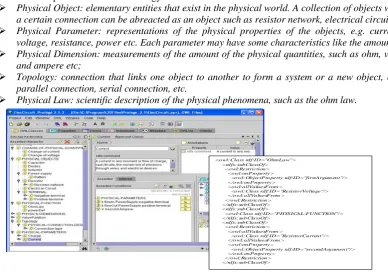
OWL source code for Ohm’s law of the implementation of the electric circuit ontology. The following summarizes the top six levels of the ontology:
¾ Physical Object: elementary entities that exist in the physical world. A collection of objects with a certain connection can be abreacted as an object such as resistor network, electrical circuit.
¾ Physical Parameter: representations of the physical properties of the objects, e.g. current,
voltage, resistance, power etc. Each parameter may have some characteristics like the amount.
¾ Physical Dimension: measurements of the amount of the physical quantities, such as ohm, volt,
and ampere etc;
¾ Topology: connection that links one object to another to form a system or a new object, e.g.
parallel connection, serial connection, etc.
¾ Physical Law: scientific description of the physical phenomena, such as the ohm law.
4.2 The Qualitative Layer
The purpose of qualitative layer is to provide a way to account for the qualitative aspects of the knowledge which people use to explain and reason about a particular situation. Qualitative knowledge encodes information about qualitative principles that govern scientific phenomena such as process, causal relationship and qualitative proportionality between concepts. Qualitative knowledge can be either explicitly or implicitly transferred on the basis of the information expressed in the presentation. Fundamentally, representing qualitative knowledge is concerned with what kinds of change could occur in relation to a particular phenomenon, what effects they cause and how to represent them in an abstract and efficient way. In physics, for example, qualitative representation attempts to answer questions like: how to describe a physical process, what objects or concepts are involved, how it happens and what it affects, etc.
There are several formalisms which can be used to encode qualitative knowledge into a computerized model. A qualitative and quantitative model, for instance, is developed in [8] by taking advantage of if-then rule language in order to build a simulation system which is used to investigate how students acquire qualitative knowledge from text-based training. First-order logic can be used directly to encode qualitative knowledge.
In the domain of physics, qualitative modelling has received detailed attention within the framework of a special discipline called qualitative physics [9]. To express qualitative aspects of the knowledge in our case study, we have adopted qualitative process theory (QPT) [10] as the representation language, which in principle provides ontological primitives for representing and reasoning over continuous parameter and continuous changes of physical process.
<owl:Class rdf:ID="OhmLaw"> <rdfs:subClassOf> <owl:Restriction> <owl:onProperty>
<owl:ObjectProperty rdf:ID="firstArgum ent"/> </owl:onProperty>
<owl:allValuesFrom >
<owl:Class rdf:ID="ResistorVoltage"/> </owl:allValuesFrom >
</owl:Restriction> </rdfs:subClassOf> <rdfs:subClassOf>
<owl:Class rdf:ID="PHYSICAL-FUNCTION"/> </rdfs:subClassOf>
<rdfs:subClassOf> <owl:Restriction> <owl:allValuesFrom >
<owl:Class rdf:ID="ResistorCurrent"/> </owl:allValuesFrom >
<owl:onProperty>
<owl:ObjectProperty rdf:ID="secondArgument"/> </owl:onProperty>
</owl:Restriction> </rdfs:subClassOf>
4.3 The Quantitative Layer
The purpose of a quantitative layer is to construct an abstract model to account for the numerical descriptions and mathematical properties of the physical phenomena. Quantitative knowledge in science is often referred to as information about scientific laws usually formalized by means of mathematical equations. For example, knowledge about ohm’s law may encode information that voltage across an ideal resistor equals the current though the resistor times the resistance of the resistor. We extend this definition to comprise all types of references to quantities presented in the presentation such as the visually expressed description of topology of electric networks. Kleer [11] organizes a collection of quantitative knowledge about mechanics into Frame systems. Following his discussion, we build the quantitative model for the case study being carried out. A frame describes the quantitative dependencies between objects or physical variables and can be invoked during the process of interpreting the presentational content to discover the value of a particular variable. The following shows the representation of Kirchof’s current law.
As shown, the frame mathematically indicates that the current entering the node is equal to the one leaving the same node.
5. Conclusion
In this paper, we described a three-layered ontology-based knowledge model for organizing and representing various types of scientific knowledge needed for knowledge mapping. The paper has also proposed that an ontology layer is developed on the basis of the conceptual understanding of the domain, while the qualitative and the quantitative layers enrich and refine the declarative knowledge represented in the ontology in a comprehensive manner. We exploited this approach on a small domain of an electric circuit in physics. On the basis of the proposed structure, further work will be carried out to develop a prototype system to automate the analysis of AMP contents as part of the proposed mapping process.
Acknowledgements The work reported is funded from the University of Bolton.
References
[1] Ou, WQ; Elsayed, Adel; Hartley, Roger. Knowledge Representation for Active Presentation Technology (ALT). Exeter, England, September 2004
[2] Elsayed. A, An overview of the APT research programme, Technical Note, The University of Bolton, 2003
[3] T. R. Gruber, A Translation Approach to Portable Ontologies, Knowledge Acquisition, 5: 199-220, 1993 [4] Van Heijst G., Schreiber A.Th. & Wielinga B.J., Using Explicit Ontologies in KBS, Development, 1997 [5] M. Uschold, Building Ontologies: Towards a Unified Methodology. In The Proceedings of Experts Systems
96,the 16th Annual Conference. Cambridge, UK September ,1996
[6] Web Ontology Language, W3C recommendation, http://www.w3.org/TR/owl-semantics/.
[7] Friedman-Noy, N., Sintek, M., Decker, S., Crubézy, M., Fergerson, R.W. and Musen, M.A., Creating semantic web contents with Protégé-2000, IEEE Intelligent Systems,2001
[8] Ploetzner, R. & VanLehn, K. ,The acquisition of qualitative physics knowledge during textbook-based physics training. Cognition and Instruction, 1997
[9] Forbus, K., Qualitative Physics: Past, Present and Future. Exploring Artificial Intelligence, H.Shrobe, ed., San Mateo, CA: Morgan Kauffman, 1988.
Fig. 3 Quantitative representation of Kirchof’s current law
(DEFINE-FRAME KIRCHOF’S_CURRENT_LAW(?ELECTRICAL-NODE T) (Iin (ENTERING-CURRENT ?ELECTRICAL-NODE))
[10] Forbus, K.D., Qualitative Reasoning. In A.B. Tucker, editor, The Computer Science and Engineering Handbook, CRC Press, 1996.