Research Journal
Volume 8, No. 22, June 2014, pp. 83–92
DOI: 10.12913/22998624.1105181 Review Article
Received: 2014.02.21 Accepted: 2014.05.20 Published: 2014.06.05
MODERN TECHNOLOGICAL SOLUTIONS USED IN THE PRODUCTION
OF BAKERY PRODUCTS WITH HIGH BIOLOGICAL VALUE
Marta Brodowska1, Dominika Guzek1, Agnieszka Wierzbicka1
1 Division of Engineering in Nutrition, Department of Functional Food and Commodities, Faculty of Human Nutrition and Consumer Sciences, Warsaw University of Life Sciences (WULS-SGGW), 159C Nowoursynowska Str., 02-776 Warsaw, Poland, e-mail: [email protected]; [email protected]; agnieszka_ [email protected]
ABSTRACT
Biological value of the food products is a result of the presence of bioactive sub -stances and the proportions of the components. Technological development allows to optimize and accelerate the processes of bread production and increase value of
food. Bakery industry used whole grains and pseudocereals as additional source of
active compounds, biotechnological techniques as using appropriate yeast strain and encapsulation, which provide protection of substance and their controlled release in production of functional bread. The adding to bread fruits, vegetables and
condi-ments may increase content of vitamin, minerals, dietary fiber and other bioactive
compounds.
Keywords: bread, bakery products, functional food products, bioactive compounds, antioxidants, microcapsulating.
INTRODUCTION
The increased biological value of food prod-ucts is a result of the presence of one or more bio-active substances and the proportions of the com-ponents. Increased biological value food products may be traditional food products with a balanced nutritional value, as a consequence of natural bio-active ingredients or they may include modified food products e.g. enriched in certain biologi-cally active substances [11, 35]. Biologibiologi-cally ac -tive substances are often non-nutrive components characterized by health-promoting properties, positive, documented impact on health. They can act as prophylactic or as an adjunctive factors in the therapy of diseases. Biologically bioactive substances include dietary fibers, oligosaccha -rides (prebiotics), proteins and peptides, polyun-saturated fatty acids (PUFA), minerals, vitamins, polyols, choline, lecithin, phytochemicals includ-ing antioxidative substances (such as polyphe-nols, anthocyanins), phytosterols and probiotics microorganisms [21].
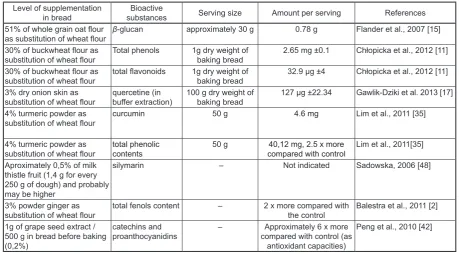
Cereals including breads and other bakery products are frequently purchased and regular-ly consumed food products. As a consequence they may be a perfect carrier for bioactive sub-stances which may provide systematic intake of specified doses [50]. In Europe, consumption of bread enriched with bioactive compounds is constantly increasing because consumers under-stand the role of health-promoting component of such products. Therefore, in the nearest future the bakery products may be increasingly used to deliver specific biologically active compounds to diet and to increase their intake [25], that is pre-sented in Table 1. The other possibility is using bread with increase nutritional value, designed-to use in prevention of some diseases [15].
PSEUDOCERALAS AND WHOLE GRAINS
AS ASOURCE OF BIOACTIVE COMPOUNDS
barley, are rich sources of bioactive compounds
e.g. flavonoids, phenolic acids, unsaturated fatty
acids, trace elements and vitamins characterized by well-known positive effect on human health [7, 17, 26, 45]. The increase of consumption of bread with addition of pseudocereals can
sig-nificantly improve antioxidant potential of diet,
because it is known that the pseudocereal whole grains are rich in various antioxidative
com-pounds [30, 38]. Moreover, in bakery products
with addition of pseudocereal whole grains also general nutritional value e.g. quality and quantity
of protein, dietary fiber content, fatty acid profile may be enhanced [39]. Such products are also good to ensure diversity of diet, what is nowadays a serious problem in Poland, especially in case of individuals with diet-related diseases [58]. The pseudocereals are free of gluten so they can be useful in diet therapy of celiac disease [52]. The sensory value of bread is very important, because
taste and flavour of influence consumer prefer -ences of cereal and other groups of products. The research revealed that the additions of
pseudo-cereal flours improves not only the nutritional
value of bread, but also the bread making prop-erties (chemical, rheological propprop-erties), extends the shelf life of the product, is associated with
more delicate crumb and lower firmness.
Chłopicka et al. [9] analysed the effect of adding 15% and 30% of pseudocereal flours in -cluding buckwheat, amaranth and quinoa, on the
antioxidant capacity and sensory value of breads. In spite of the facts, that the content of total fla -vonoids in flours was about 2–4 times higher than in final product. In the final product it was still significantly higher than in a wheat bread. Buck -wheat flour was characterized by had the highest phenol content approximately 7.25 mg/g of dry weight. The 30% dose was more effective in en -hancing antioxidant activity than the 15% dose. The addition of buckwheat was associated with antioxidant activity is 2 times higher (while mea-sured as a Ferric Reducing Ability of Plasma – FRAP) and 3,64 times higher (while measured as diphenylpicrylhydrazyl – DPPH) in comparison no addition of pseudocereal flours. Simultane -ously, the addition of amaranth and quinoa was associated with antioxidant activity 1.20–1.79 times higher, and 0.60–1.71 higher for FRAP and DPPH respectively. It was concluded, that the addition of buckwheat, amaranth, quinoa flours to wheat flour improved antioxidant status of bread, while buckwheat flour was more effec -tive than other studied pseudocereals. Buckwheat bread had also a highest content of phenolic com-pounds. The analysis of sensory results suggested that the buckwheat bread was characterised by has more positive sensory than amaranth and quinoa bread, especially taste, aroma and colour. The re-sults indicate that bread fortified with pseudocer -eal flours, particularly with buckwheat flour, but depending on the dose, may improve nutritional Level of supplementation
in bread substancesBioactive Serving size Amount per serving References 51% of whole grain oat flour
as substitution of wheat flour β-glucan approximately 30 g 0.78 g Flander et al., 2007 [15] 30% of buckwheat flour as
substitution of wheat flour Total phenols 1g dry weight of baking bread 2.65 mg ±0.1 Chłopicka et al., 2012 [11] 30% of buckwheat flour as
substitution of wheat flour total flavonoids 1g dry weight of baking bread 32.9 µg ±4 Chłopicka et al., 2012 [11] 3% dry onion skin as
substitution of wheat flour quercetine (in buffer extraction) 100 g dry weight of baking bread 127 µg ±22.34 Gawlik-Dziki et al. 2013 [17] 4% turmeric powder as
substitution of wheat flour curcumin 50 g 4.6 mg Lim et al., 2011 [35]
4% turmeric powder as
substitution of wheat flour total phenolic contents 50 g compared with control40,12 mg, 2.5 x more Lim et al., 2011[35] Aproximately 0,5% of milk
thistle fruit (1,4 g for every 250 g of dough) and probably may be higher
silymarin – Not indicated Sadowska, 2006 [48]
3% powder ginger as
substitution of wheat flour total fenols content – 2 x more compared with the control Balestra et al., 2011 [2] 1g of grape seed extract /
500 g in bread before baking (0,2%)
catechins and
proanthocyanidins – compared with control (as Approximately 6 x more antioxidant capacities)
Peng et al., 2010 [42]
value of bread and this bread may be chosen by consumers as preferred.
Many studies indicate that regular intake of whole grains provide a wide range of nutrients, including phytochemicals, that results in serious health benefits. Whole grain products consump -tion is associated with reduced risk of diseases such as cancers [48, 45], cardiovascular diseas-es [24], hypertension [3, 13] and diabetdiseas-es [31]. Therefore, consumption of grain products as the main part of the daily menu, higher than is cur-rently observed in western population, is recom-mended by dieticians, nutritionists and doctors [41, 44]. Miller et. al [34] compared the antioxi -dant capacity of breakfast wholegrain cereals and some fruits and vegetables. Antioxidants content was expressed as Trolox equivalents/ 100 grams (TE). Whole grain breakfast cereals contained from 2200–3500 TE. Fruits generally ranged between 600–1700 TE, with a highest values of 3700 TE for berries. Vegetables ranged averaged 450 TE with a high of 1400 TE for red cabbage. The one serving (41 g) of ready to eat breakfast whole grains cereals provides 1120 TE, while one serving of vegetables and fruits (85 g) provides 380 TE and only 1020 TE respectively. It may be concluded, that whole grain breakfast cereals may be, except fruits and vegetables, the most im-portant source of antioxidants in the diet.
Taking into account, the typical western diet and general lifestyle, dietary fiber is a deficit nu -trient, so new ways to deliver it may be of a great value. There is a trend to seek for new sources of dietary fibre as components for the food in -dustry [8]. Whole oat grain contains significant amounts of dietary fiber, especially water-soluble (1→3), (1→4)-β-D-glucan. The β-glucan con-tent in oat varies from 2.3 to 8.5/100 g [54]. The main problem that appears during using oat as a component of bakery products, is deterioration of baking quality, because oat proteins, which do not possess the visco-elastic properties, as wheat glu-ten possesses, are usually denaturated by a heat treatment [18]. Exceeding 20 g of oat/100 g of products could leads to obtaining moist, gummy bread. Baking technology for bread characterised by high oat whole grain content, acceptable tex-ture and sensory characteristics was developed by Flander et al. [12]. The elaborated baking technol-ogy requires using oat whole grain (51 g/100 g of flour) and white wheat (49 g/100 g of flour). The processing conditions, as baking temperature, time and temperature of proofing had the most es
-sential influence on bread quality. Maximum vol -ume, minimum hardness were achieved by add-ing 15.2 g of gluten/100 g of flour and 91.5 g of water/100 g flour to the dough, after proofing the bread at 40 °C for 75 min and baking it at 210 °C for 4 minutes. The optimum thickness and crisp-ness of the crust as well as optimum flavour, were obtained in the same conditions as the maximum volume and minimum hardness of oat bread. The amount of β-glucan in oat bread was 2.4 g/100 g of bread compared with the amount of β-glucan in the wheat bread (1.3 g/100 g of bread). Therefore, a portion (approximately 30 g) of the bread con -tains 0.78 g of β-glucan. In the mentioned study decrease in molecular weight of β-glucan was also noticed. It may be a result of the β-glucan hydro-lysis caused by endogenous enzymes present in wheat flour. To sum up, it is possible to obtain the bread characterised by high content of bioactive
β-glucan and typical structure, as well as being perceived by consumers as tasty, by optimizing recipe and parameters of processing.
USING OF BIOTECHNOLOGICAL
TECHNIQUES TO INCREASE
HEALTH-PROMOTING PROPERTIES OF BREAD
Except β-glucan, also other ingredients, char-acterised by health-promoting properties may be added to bread and bakery products. Such ingre-dients are either substances, that are not observed in conventional products, or such substances, which exist, but in a small amount – often too small to exert an influence on human health and well-being. In such case, adding additional quan-tity of substances, may be of great value. The ob-vious additives, such as B vitamins, are ingredi -ents, that are naturally observed in the grain and are removed during grinding.
the fermentative phase of growth (respiro). Com-mercial compressed baker’s yeast were bought in local store and was stored in refrigerator until baking. Folate content was 3–5 times higher in the wheat bread with a Saccharomyces cerevisiae CBS7764 strain than in conventional bread. The obtained dough contained 135–139 μg of folate/ 100 g of dry matter, compared to wheat bread with commercial baker›s yeast, containing 27–43 μg of folate/100 g of bread. The practical possibil-ity of application this strategy indicates that using appropriate yeast strain to production of bread is an attractive alternative in comparison with bread fortification of with synthetic folic acid.
Wholegrain bread is generally regarded as characterised by better nutritional value than white bread, because of higher content of dietary fibre, vitamins, especially B vitamins as well as micro- and macronutrients. However, who-legrain bread is also characterised by high level of phytate (myo-inositolhexakisphosphate, InsP-6), which may chelate and bind minerals, result-ing in insoluble complexes generation, that may lead to mineral absorption and bioavailability de-crease. As a result, it may reduce the nutritional value of wholegrain product [27, 5]. Leenhardt et al. [28] analysed changes in phytate hydrolysis caused by sourdough fermentation or exogenous organic acid in vitro addition. This was indicated that lowering pH of the dough to approximately 5.5, caused by adding sourdough or lactic acid, in both cases, was associated with a significant reduction of phytate content (approximately 35% of reduction). Other authors confirm, that both mentioned fermentation methods are useful tech-niques allowing to decrease the amount of phy-tate in wholegrain cereals and as a consequence to maintain potential high nutritional value of the product [32, 43].
ADDING INGREADIENTS SUCH AS FRUITS,
VEGETABLES AND CONDIMENTS, RICH IN
BIOACTIVE SUBSTANCES TO BREAD
Fruits and vegetables intake is associated with reduced risk of some cancers and cardiovascular diseases. While these protective effects have been
inter alia attributed to the content of beta-caro-tene, ascorbic acid and phenolic compounds. The majority of the beneficial health effects of flavo -noids are attributed to their antioxidant and che-lating properties. Polyphenols and dietary fibre
from fruits demonstrate health-promoting proper-ties and may play a key role in health improve-ment and disease prevention in some population groups [37]. This is the reason why using fruits, vegetables or their products in bread production, as an additional source of biologically active compounds that may simultaneously improve sensory properties of bakery products, could be very promising.
Gawlik-Dziki et al. [14] studied the effect of adding ground onion peel on the antioxidative and sensory properties of bread. To determine the
in vitro bioaccessibility and bioavailability the human gastrointestinal tract model was used. On-ion peel contains 4.6 mg masticatOn-ion-extractable quercetin/g of onion. Quercetin was highly bioac-cessible during in vitro experimental conditions, but only about 4% of quercetin was extracted during simulated digestion. The antioxidative potential of bread with onion peel addition was significantly higher than the antioxidative poten -tial in case of the control group. Onion peel as a compound of bread also demonstrated the poten-tial against lipid oxidation and chelating abilities. The addition of 2–3% of onion peel was the opti -mum dose that caused significant improvement of antioxidative properties, while higher supplemen-tation level did not cause any increase of the an-tioxidative potential of bread. Sensory evaluation revealed that the replacement of wheat flour in bread with no more than 3% of onion peel powder was associated with satisfactory consumer results and may comprise a valuable additive enabling development of functional properties of bread.
More-over, except for an acceptable colour change, adding the GSE to bread did not have essential effect on the quality attributes of the bread. The results indicate that grape seed extract added to bread as an enriching compound may be prom-ising additive to create functional food products with reduced CML level, that may be associated with reduced health risks, and high antioxidative activity [36].
Dietary fiber, according as its water solubil -ity is categorized as water-soluble dietary fiber (SDF) and water-insoluble dietary fiber (IDF). SDF such as β-glucan and arabinoxylan can cre -ate viscous solutions leading to increased viscos-ity in the intestine and slowed intestinal transmis-sion, delayed gastric emptying, as well as binding glucose and delaying sterols absorption in the intestine [57]. Consequently, viscous soluble fi -ber can be useful in lowering serum cholesterol, postprandial blood glucose, and insulin levels. IDF such as lignin, celluloses and hemicelluloses are characterised by higher water-holding capac-ity then SDF. IDF causes increasing of the fecal bulk. Lignin is also a lipophilic phenolic polymer absorbing bile acids [57, 40].
To increase the level of dietary fiber in diet, it could be added, as an enrichment of various bak-ery products (not only bread), the preparations obtained from by-products of the fruit, vegetable or cereal industry. The cookies with the addition of raspberry pomace and buckwheat hulls are characterised by higher total dietary fiber content in comparison with the control cookies without such addition (6.65–16.45 g of dietary fiber/ 100 g vs. 2.90 g of dietary fiber/100 g) and were char -acterised by varied composition of the fractions (both SDF and IDF fractions). Sensory analysis revealed that the best sensory profiles were ob -served in case of cookies in which used 10% and 20% dose of raspberry pomace. Cookies with buckwheat hulls addition were also character-ised by higher dietary fiber content in comparison with control, but worse sensory properties [19].
The addition of herbs and condiments to bread improves its flavor, aroma and increases the nutritional value. It also allows to reduce of amount of salt [20]. Herbs in the bakery industry, depending on technological requirements, may be used in a dried form, milled form (0.5–1%), or as the extracts (0.001–0.01%) [5].
Curcumin (being a catechin) is the main bioac-tive compound occurred in the turmeric rhizome (Curcuma longa L.). Curcumin and its derivatives
have strong antioxidative, anti-inflammatory, an -ti-cancer and anti-depressive properties, as well as they regulate the immunological system. Dried turmeric rhizomes are yellow and are used as a condiment [53]. Turmeric powder also may be used as bioactive component added to the func-tional bread. Lim et al. [29] analysed also pos-sibilities of using the turmeric powder as a flour substitute. Wheat bread with addition turmeric powder was developed and analysed to assess the physical characteristics, content of bioactive com-ponents and their properties, as affected by vari-ous substitution levels. The results indicated, that values of a* and b* components of colour, crumb hardness, curcumin and total phenolic contents in bread significantly increased with the addi -tion of turmeric powder. On the other hand, water activity, specific volume of bread and crumb L* component of colour (brightness) simultaneously decreased with the addition of turmeric powder. Bread prepared with 8% of turmeric powder con -tained almost 5 times more total phenols (150.5 mg/100 g of bread), in comparison with conven-tional wheat bread (30.9 mg/100 g). Addition of no more than 4% of turmeric powder was asso-ciated with acceptable sensory properties which were comparable to those observed for control wheat bread. Everyday consumption of 50 g (two slices) of bread with the addition of 4% of tur-meric powder provides about 4,6 mg of curcumin and 40.12 mg of total phenolic compounds. Prob-ably, as a result of increased antioxidant activity and lower content of fat, bread with the addition of turmeric powder may be also characterised by an extended storage time. During the storage, the mould appeared after 3 weeks, while in case of the conventional wheat bread, the mould ap-peared after 1 week. It may be concluded, that us-ing turmeric powder allows to create functional bread with satisfactory sensory properties and improved functional properties.
the doses of 0.16 g, 0.336 g and 0.56 g/100 g. The addition of mentioned doses of milk thistle fruit did not influence sensory and physical properties of wheat dough. Consequently, it may be used to create breads rich in silymarin. The results of the study were the object of the patent-pending and bread with milk thistle fruit is to be called the “bread of the liver”.
The ginger powder addition was also exam-ined due to its antioxidative properties. The rheo-logical properties of dough were analysed using dynamic rheological measurements. The high-est total phenolic content – 0.48 and 0.71 mg of GAE (gallic acid equivalent) per g of dry weight of crumb and crust respectively, and the highest radical scavenging activity – 0.15 and 0,24 µM of DPPH (2,2-diphenyl-1-picrylhydrazyl) per mg of dry weight of crumb and crust respectively were achieved in case of bread with the highest content of ginger powder (6%). Simultaneously, the above-mentioned sample was characterised by worst rheological properties associated with tough structure of the dough and texture of the bread. Furthermore, sensory evaluation revealed, that this ginger bread sample was not accept-able for consumers. Bread with the 3% addition of ginger powder was characterised by better rheological characteristics and higher sensory ac-ceptance, while antioxidant capacity was 2 times higher compared with the control bread. It may be concluded, that the 3% addition is the maximum dose, which allows to obtain satisfying attributes of bread with ginger powder [1].
CHOLESTEROL-LOWERING BREAD
Phytosterols (plant sterols) are one of the compounds building the plant cell membranes. Their chemical structure resembles the struc-ture of cholesterol, so that they can be treated by human body as the cholesterol and, as a conse-quence, their consumption may cause a decrease of blood cholesterol level. In the intestine, phy-tosterols are combined with the same receptors of intestinal cells as the cholesterol is, so the absorp-tion of the cholesterol is blocked and its excre-tion is increased. Except for a decrease of total cholesterol levels, phytosterols may also influ -ence the lipid profile, lowering the level of LDL-cholesterol (low density lipoprotein-LDL-cholesterol), which is called “bad cholesterol’. The therapeutic dose of phytosterols, that lowers
LDL-cholester-ol is 2 g per day. However, the delivering such quantities in a typical diet is not possible, so to obtain beneficial result, it is necessary to incor -porate phytosterols into functional products. De-veloping functional products with phytosterols added, it is necessary to take into account the av-erage amount of enriched product consumed in the diet and added amount should provide a 2 g dose of phytosterols in an average daily serving. The most common food product enriched in phy-tosterols are margarines, but also cheeses, juices, breads, confectionaries and enriched cereals [55]. Clifton et al [10] compared the effectiveness of the same dose of phytosterols (1.6 g) depending on the product to which it was added. In case of bread, LDL-cholesterol level was 6.5% reduced, that was lower reduction in comparison to milk (15.9%) and butter (8.6%), but higher than in case of cereals (5.4%). Moreover, only in case of bread, added phytosterols had also influence on increasing HDL-cholesterol (high density lipoprotein-cholesterol), which may reduce risk of cardiovascular diseases. Other studies also indicate the effectiveness of rye bread with high content of fiber and enriched with phytosterols in lowering blood cholesterol levels. Consuming daily two servings of bread enriched with phy-tosterols, instead of one, had more positive effect (LDL-cholesterol was 10.4% reduced, instead of 8.1%) [49]. The Scientific Committee on Food (SCF) in its opinion “General view on the long-term effects of the intake of elevated levels of phytosterols from multiple dietary sources (...)” indicated that there was no evidence of additional benefits at intakes higher than 3 g/ day and that high intakes might induce undesirable effects and that it was therefore prudent to avoid plant sterol intakes exceeding 3 g/day. Simultaneously, bak -ery products shall be presented in such a manner that they can be easily divided into portions that contain either maximum 3 g (in case of one por -tion per day) or maximum 1 g (in case of three portions per day) of added phytosterols [55].
ENCAPSULATION AS EFFICIENT METHOD
OF ENRICHING FOOD PRODUCTS IN
BIOACTIVE COMPOUNDS
vita-mins, other antioxidants or fatty acids [2]. Encap-sulation assures enhanced food product function-ality and stability of substances including slow or controlled release during storage [33]. Encapsula -tion is a modern technology of packaging solids, liquids or gaseous materials in minuscule, sealed capsules that enables releasing their content un-der specific conditions. As a consequence, en -capsulation protects the core from unfavourable environmental conditions and extends shelf life of a product [46].
Long-chain polyunsaturated omega-3 fatty acids, contained in flax seed oil and fish oil, are not resistant to oxidation during processing and storage. The oxidation of lipids is may be asso-ciated with lower nutritional value and sensory quality of products. Encapsulation can be a good way to protect lipids from oxidation. Borneo et al. [4] indicated that it is possible to obtain shelf-stable fortified food products characterised by high level of long-chain omega-3 fatty acids and acceptable sensory properties. They formulated a cream-filling to sandwich cookies containing 400 mg of eicosapentaenoic acid (EPA) and docosa-hexaenoic acid (DHA), being fish-derived n-3 fatty acids. EPA i DHA were encapsulated in a matrix of starch and gelatin. After 28 days of stor-age under 2 various temperature conditions (18°C and 35°C) and 2 various packaging conditions (modified atmosphere packaging and vacuum packaging), the maximum observed loss was 5%.
Gokmen et al. [16] developed functional bread enriched with omega-3 fatty acids. Corn starch characterised by a high amylase content was used to prepare nanosized complexes with flax seed oil. Then the complex was converted to powder by spray drying. The reaction of prod-ucts of lipid oxidation with amino acids is con-tributing to the formation of potentially harmful products of Maillard reaction, such as acrylamide and hydroxymethyl furfural (HMF), so authors evaluated also encapsulation effect on formation of the above-mentioned products. The study re-vealed that encapsulation significantly decreased lipid oxidation and formation of acrylamide and HMF, in breads during baking. Scanning electron microscopic analysis of functional bread demon-strated that microcapsules added to dough stayed intact in the crumb, but in the crust were partially destroyed. The quality of bread with addition of nanoencapsulated flax seed oil, compared with bread containing free form of flax seed oil, was higher. The bread containing encapsulated
sub-stances was characterised by lower level of fatty acids thermoxidation and of harmful compounds formation during baking. Moreover, the use of encapsulation allows to reduce off flavor and to improve sensory attributes.
In the United States, Canada and some other countries, to reduce the risk of the neural tube de-fects, mandatory fortification of grain products, including flours, with folic acid was introduced. The folic acid is a one of B vitamins, which in a typical Polish diet, is a deficit nutrient. The fo -lic acid is inter alia involved in the metabolism of homocysteine , by regulation of its concentra-tion in blood. Homocysteine is a homologue of the cysteine amino acid that may cause damage of the blood vessels and is associated with ath-erosclerotic and advanced thrombosis. Folic acid, which is used in diet supplements and added to food products, is a synthetic and oxidised form of folate because of its higher stability and bioavail-ability. However, too high levels of synthetic folic acid should not be used, because too high levels of folic acid in blood can mask the hematological symptoms of cobalamin deficiency. It may also foster carcinogenesis, contribute to the develop-ment of anemia and cognitive impairdevelop-ment, as well as to decreased immune function [48]. A reduced form of folic acid, L-5-methyltetrahydrofolic acid (L-5-MTHF), is characterised by similar bioavail-ability as synthetic folic acid, but simultaneously do not mask vitamin B12 deficiency and could be potentially safer while used to fortification com -pared with not reduced form [23, 58]. Tomiuk et. al [51] analysed the L-5-MTHF from during bak-ing and storage of a fortified white bread. They used microencapsulation of L-5-MTHF, with or without addition of sodium ascorbate (ASC), using skimmed milk powder (SMP) as coat. This study proved that skimmed milk powder is an effective microencapsulating agent. More-over, the presence of ASC improved stabilising L-5-MTHF in baked white bread. In addition, skim milk powder, which is also used as an en-riching wheat bread, acted as a bulking agent in baked products and agent improving uniformity of dispersion of L- 5-MTHF.
stable omega-3 encapsulated powders. This en -capsulated power may be used to enhance bak-ery products with a higher amount of unsaturated fatty acids.
CONCLUSION
Similarly, as in other food-related sectors, the bakery industry is undergoing major trans-formations, being inter alia driven by changes in consumer demands. Increasing the nutritional and health-promoting value is becoming a trend, which shapes consumers’ interest in bakery prod -ucts. On the other hand, technological develop-ment allows to optimize and accelerate the pro-cesses of bread production. Using fruits, vegeta-bles or their products as a source of biologically active compounds, exploitation of encapsulation and the use of biotechnological methods are new opportunities to produce functional bakery prod-ucts with increased nutritional value. It could indi-rectly influence consumers’ health and well-being.
REFERENCES
1. Balestra F., Cocci E., Pinnavaia G., Romani S.
Evaluation of antioxidant, rheological and
senso-rial properties of wheat flour dough and bread con -taining ginger powder. LWT - Food Science and
Technology, 2011, 44(3): 700-705.
2. Baeumner A. Nanosensors identify pathogens in
food. Food Technology, 2004, 58(8): 51-55.
3. Behall K.M., Scholfield D.J., Hallfrisch J.
Whole-grain diets reduce blood pressure in mildly hy-percholesterolemic men and women. Journal of the American Dietetic Association, 2006, 106(9): 1445-1449.
4. Borneo R., Kocer, D., Ghai, G. Tepper, B.J. Karwe
M. V. Stability and Consumer Acceptance of
Long-Chain Omega-3 Fatty Acids (Eicosapentaenoic Acid, 20:5, n-3 and Docosahexaenoic Acid, 22:6, n-3) in Cream-Filled Sandwich Cookies. Food Sci -ence, 2007, 72(1): 54-59.
5. Borowy T., Kubiak M.S. Hydrokoloidy w przemyśle spożywczym. Cukiernictwo i Piekarst -wo, 2010, 14(9):76.
6. Buddrick O., Jones O., Cornell H. Small D. The
in-fluence of fermentation processes and cereal grains
in wholegrain bread on reducing phytate content. Journal of Cereal Science, 2013: 1-6.
7. Butt M.S., Tahir-Nadeem M., Khan M.K., Shabir R., Butt M. S. Oat: unique among the cereals. Eu -ropean Journal Nutrition, 2008, 47(2): 68-79.
8. Chau C.F., Huang Y.L. Comparison of the chemi -cal composition and physicochemi-cal properties of
different fiber prepared from de peel of Citrus si-nensis L. Cv. Liucheng. Journal of Agricultural and
Food Chemistry, 2003, 51: 2615-2618.
9. Chłopicka J., Pasko P., Gorinstein S., Jedryas A., Zagrodzki P. Total phenolic and total flavonoid
content, antioxidant activity and sensory evalu-ation of pseudocereal breads. Food Science and Technology, 2012, 46: 548-555.
10. Clifton P.M., Noakes M., Sullivan D., Erichsen N., Ross D., Annison G., Fassoulakis A., Cehun M., Nestel P. Cholesterol-lowering effects of plant ste-rol esters differ in milk, yoghurt, bread and cereal. European Journal of Clinical Nutrition, 2004, 58:
503-509.
11. Diplock, A.T., Aggett, P.J., Ashwell, M., Bornet, F., Fern, E.B., Roberfroid, M.B. Scientific concept of
functional foods in Europe Consensus document,
The British Journal of Nutrition, 1999, 81: 1-27.
12. Flander L., Salmenkallio-Martitila M., Suortti T., Autio K. Optimization of ingredients and baking process for improved wholemeal oat bread quality. Food Science and Technology, 2007, 40(5): 860-870.
13. Flint A.J., Hu F.B., Glynn R.J., Jensen M.K., Franz M., Sampson L., Rimm E.B. Whole grains and in -cident hypertension in men. The American Journal
of Clinical Nutrition, 2009, 90(3): 493-498.
14. Gawlik-Dziki U., Świeca S., Dziki D., Baraniak B., Tomiło J., Czyż J. Quality and antioxidant proper -ties of breads enriched with dry onion (Allium cepa L.) skin. Food Chemistry, 2013, 138: 1621-1628.
15. Gąsiorowski H. Niektóre aspekty żywieniowe pieczywa. Przegląd Piekarski i Cukierniczy, 2004,
52(2): 2-4.
16. Gokmen V., Mongol B.A., Lumaga R.B., Fogliano
V., Kaplun Z., Shimoni E. Development of
func-tional bread containing nanoencapsulated omega-3
fatty acids. Journal of Food Engineering, 2011, 105(4): 585-591.
17. Gorinstein S., Lojek A., Ciz M., Pawelzik E., Del-gado-Licon E., Medina O.J., Moreno M., Goshev I. Comparison of composition and antioxidant capac-ity of some cereals and pseudocereals. Internation-al JournInternation-al of Food Science and Technology, 2008,
43: 629-637.
18. Gormley T.R, Morrissey A. A note on the
evalua-tion of wheaten breads containing oat flour or oat flakes. Irish Journal of Agricultural and Food Re
-search, 1993, 32: 205-209.
19. Górecka D., Pachołek B., Napierała K., Dziedzic K. Ocena możliwości wykorzystania wysokobłon-nikowych odpadów przemysłu owocowego i zbożo-wego w produkcji wyrobów ciastkarskich o cechach
20. Haber T., Haberowa H., Lewczuk J., Siwoszek
K. Zioła jako dodatki do chleba o obniżonej zawartości soli. Przemysł Spożywczy, 1993, 47(1):
17-20.
21. Hawkes C. Nutrition labels and health claims, the global regulatory environment. WHO, 2004, http:// whqlibdoc.who.int/publications/2004/9241591714.
pdf, 28.05.2013.
22. Hjortmo S., Patring S., Jastrebova J., Andlid T. Bi
-ofortification of folates in white wheat bread by selec -tion of yeast strain and process. Interna-tional Journal
of Food Microbiology, 2008, 127(1-2): 32-36.
23. Houghton L.A., Sherwood K.L., Pawlosky R., Ito
S., O’Connor D.L. 6S-5-Methyltetrahydrofolate is at least as effective as folic acid in preventing a decline in blood folate concentrations during lacta-tion. American Journal of Clinical Nutrition, 2006,
83(4): 842-850.
24. Jacobs D., Gallaher D. Whole grain intake and car-diovascular disease: a review. Current
Atheroscle-rosis Reports, 2004, 6: 415-423.
25. Kadam S.U., Prabhasankar P. Marine foods as functional ingredients in bakery and pasta
prod-ucts. Food Research International, 2010, 43(8):
1975-1980.
26. Kalinova J., Dadakova E. Rutin and total querce-tin content in amaranth (Amaranthus spp.). Plant Foods for Human Nutrition, 2009, 64(1): 68-74.
27. Kumar V., Sinha A.K., Makkar H.P.S., Becker K.
Dietary roles of phytate and phytase in human nutri-tion: a review. Food Chemistry, 2010, 120: 945-959. 28. Leenhardt F., Levrat-Verny M.A., Chanliaud E.,
Rémésy C. Moderate decrease of pH by sourdough
fermentation is sufficient to reduce phytate content of whole wheat flour through endogenous phytase
activity. Journal of Agricultural and Food
Chemis-try, 2005, 53: 98-102.
29. Lim H.S, Park S.H, Ghafoor K., Hwang S.Y., Park
J. Quality and antioxidant properties of bread contain-ing turmeric (Curcuma longa L.) cultivated in South Korea. Food Chemistry, 2011, 124(4):1577-1582.
30. Lin, L., Liu, H., Yu, Y., Lin, S., Mau, J. Quality and
antioxidant property of buckwheat enhanced wheat bread. Food Chemistry, 2009, 112: 987-991.
31. Liu S., Manson J.E., Stampfer M.J., Hu F.B.,
Giovannucci E., Colditz G.A., Hennekens C.H., Willett W.C. A prospective study of whole-grain intake and risk of type 2 diabetes mellitus in US women. American Journal of Public Health, 2000, 90(9): 1409-1415.
32. Liukkone, K.H., Katina K., Wilhelmsson A., Myl-lymaki O., Lampi A.M., Kariluoto S., Piironen V., Heinonen S.M., Nurmi T., Adlercreutz H., Pelto-keto A., Pihlava J.M., Hietaniemi V., Poutanen K. Processinduced changes on bioactive compounds
in whole grain rye. Proceedings of the Nutrition Society, 2003, 62: 117-122.
33. McClements D.J., Decker E.A., Park Y., Weiss J.
Structural design principles for delivery of bioac-tive components in nutraceuticals and functional foods. Critical Reviews in Food Science and Nutri-tion, 2009, 49(6): 577-606.
34. Miller G., Whole grain, fiber and antioxidants. In:
Spiller GA, ed. CRC Handbook of Dietary Fiber
in Human Nutrition. Boca Raton, FL: CRC Press; 2001, 453-460.
35. Olmedilla-Alonso B., Jiménez-Colmenero F., Sán -chez-Muniz F. J. Development and assessment of healthy properties of meat and meat products
de-signed as functional foods. Meat Science, 2013, 95: 919-930.
36. Peng X., Ma J., Cheng K-W., Jiang Y., Chen F.,
Wang M. The effects of grape seed extract
forti-fication on the antioxidant activity and quality at -tributes of bread. Food Chemistry, 2010, 119(1):
49-53.
37. Philpott M., Mackay L., Ferguson L. R., Forbes D., Skinner M. Cell culture models in developing
nu-trigenomics foods for inflammatory bowel disease.
Mutation Research, 2007, 622: 94-102.
38. Paśko P., Sajewicz M., Gorinstein S., Zachwieja Z. Analysis of selected phenolic acids and flavonoids
in Amaranthus cruentus and Chenopodium quinoa seeds and sprouts by HPLC. Acta Chromatograph-ica, 2008, 4: 661-672.
39. Raffo A., Pasqualone A., Sinesio F., Paoletti F.,
Quaglia G., Simeone R. Influence of durum wheat cultivar on the sensory profile and staling rate of
Altamura bread. European Food Research and
Technology, 2003, 218: 49-55.
40. Ragaee S., Guzar I., Dhull K., Seetharaman K.
Ef-fects of fiber addition on antioxidant capacity and
nutritional quality of wheat bread. Food Science
and Technology, 2011, 44: 2147-2153.
41. Richardson D.P. Wholegrain health claims in
Eu-rope. Proceedings of the Nutrition Society, 2003,
62(1): 161-169.
42. Sadowska K. Owoce ostropestu plamistego jako prozdrowotny dodatek do pieczywa. Żywność.
Nauka. Technologia. Jakość, 2006, 47(2): 290-296. 43. Sanz-Penella J.M., Wronkowska M.,
Soral-Smi-etana M., Haros M. Effect of whole amaranth flour
on bread properties and nutritive value. Food
Sci-ence and Technology, 2013, 50(2): 679-685.
44. Schatzkin A., Park Y., Leitzman M. F., Hollenbeck A. R., Cross A. J. Prospective study of dietary fi -ber, whole grain foods, and small intestinal cancer.
Gastroenerology, 2008, 135(1): 163-1167.
45. Schoenlechner R., Drausinger J., Ottenschlaeger
-ties of gluten-free pasta produced from amaranth, quinoa and buckwheat. Plant Foods for Human
Nutrition, 2010, 65: 339-349.
46. Shahidi F., Han X.Q. Encapsulation of food ingre-dients. Critical Reviews in Food Science and
Nu-trition, 1993, 33(6): 501-47.
47. Slavin, J. Whole grains and human health. Nutri-tion Research Reviews, 2004, 17(1): 99-110. 48. Smith A.D., Kim Y.I, Refsum H. Is folic acid good
for everyone? The American Journal of Clinical
Nutrition, 2008, 87(3): 517-533.
49. Söderholm P.P., Alfthand G., Koskelae A.H., Adlercreutza H., Tikkanen M. J. The effect of
high-fiber rye bread enriched with nonesterified plant
sterols on major serum lipids and apolipoproteins in normocholesterolemic individuals, Nutrition, Metabolism and Cardiovascular Diseases, 2012, 22(7): 575-582.
50. Taylor Ch., Wilkening V. How the Nutrition Food Label Was Developed, Part 2: The Purpose and Promise of Nutrition Claims, Journal of the
Ameri-can Dietetic Association, 2008, 108 (4): 618-623.
51. Tomiuk S., Liu Y., Green T.J., King M.J., Finglas
P.M., Kitts D.D. Studies on the retention of micro-encapsulated L-5-methyltetrahydrofolic acid in baked bread using skim milk powder. Food
Chem-istry, 2012, 33(2): 249-255.
52. Thompson T. Case problem: questions regarding the acceptability of buckwheat, amaranth, quinoa, and oats from a patient with celiac disease. Jour-nal of the American Dietetic Association, 2001, 101(5): 586-587.
53. Tuba A., Ilhami G., Antioxidant and radical
scav-enging properties of curcumin. Chemico-Biologi
-cal Interactions, 2008, 174(1): 27-37.
54. Welch R, Brown J., Leggett J., Interspecific and in
-traspecific variation in grain and groat characteristics
of wild oat (Avena) species: Very high groat (1→3), (1→4)-β-d-glucan in an Avena atlantica genotype.
Journal of Cereal Science, 2000, 31:273-279.
55. Włodarek D. Pieczywo z dodatkiem fitosteroli i jego potencjalne możliwości obniżania poziomu cholesterolu LDL we krwi. Przegląd Piekarski i
Cukierniczy, 2014, 1: 26-27.
56. Włodarek D., Głąbska D. Zwyczaje żywieniowe osób chorych na cukrzycę typu 2. Diabetologia Praktyczna, 2010, 11(1):17-23.
57. Wood P.J., Braaten J.T., Scott F.W., Riedel K. D.,
Wolynetz M.S., Collins M.W. Effect of dose and
modification of viscous properties of oat gum on
plasma glucose and insulin following an oral glucose
load. British Journal of Nutrition, 1994, 7:731-743.
58. Wright A.J.A., King M.J., Wolfe C.A., Powers H.J., Finglas P.M. Comparison of (6S)-5-methyl-tetrahydrofolic acid v. folic acid as the reference folate in longer-term human dietary intervention studies assessing the relative bioavailability of natural food folates: Comparative changes in fo-late status following a 16-week placebo-controlled
study in healthy adults. British Journal of Nutri
-tion, 2010, 103(5): 724-729.
59. Yan N. Encapsulated agglomeration of microcap