International Journal of Computer Techniques -– Volume 6 Issue 1, Jan – Feb 2019
ISSN :2394-2231 http://www.ijctjournal.org Page 57
Application of Multimedia in Basic English Vocabulary
Learning with the ADDIE Method
Herry Derajad Wijaya
1, Yudo Devianto
21, 2
Mercu buana University, Faculty of Computer Science, Jl. Meruya Selatan 1 No. 1, Kembangan, 11650, Indonesia
1
---
************************
---Abstract:
English is taught at an early age in the hope that students are better prepared and confident so they can communicate fluently at the next level of education. However, the fact is there are still many obstacles in the process of learning English, including teachers facing difficulties in the teaching process because there is no appropriate multimedia to teach English in Schools, so far the teaching and learning process is still fixed on textbooks. This of course makes most students feel bored and bored even to the point of losing motivation to learn English. This study aims to develop an interesting and interactive basic level English vocabulary learning application in addition to English language learning material. This research uses the ADDIE method in making multimedia-based applications. That the application of multimedia is able to develop basic English vocabulary learning to be more interesting and interactive. Nearly 80% of the 26 respondents agreed that multimedia is able to attract students 'attention and anticipate the learning process, encourage active students to understand learning and the images and animations that are presented can increase students' enthusiasm in understanding English vocabulary at the elementary level.
Keywords: Multimedia, English Vocabulary,Elementary Level, ADDIE Method
---
************************
---1. INTRODUCTION
1.1. Background
English is taught at an early age in the hope that students are better prepared and confident so they can communicate fluently at the next level of education. However, the fact is there are still many obstacles in the process of learning English, including teachers facing difficulties in the teaching process because there is no appropriate multimedia to teach English in Schools, so far the teaching and learning process is still fixed on textbooks. This of course makes most students feel bored and bored even to the point of losing motivation to learn English.
The application of multimedia hopes to help improve basic student understanding, especially in mastering English vocabulary by facilitating effective learning experiences as well as fun learning in new ways, making it easy for students to understand material and
topics through different ways, namely computers as a means to learn. Besides that, this gives a good impact on the interaction of teachers and students by giving students the opportunity to be creative in interpreting the information obtained.
According to Ivers and Barron, the advantages of multimedia are: [1]
1. Multimedia allows students to study in groups.
2. Multimedia allows students to express their knowledge in various ways.
3. Multimedia helps students in solving
problems.
4. Multimedia helps students improve the
results of their work.
5. Multimedia helps students build knowledge so students have the opportunity to learn and apply their original abilities.
ISSN :2394-2231 http://www.ijctjournal.org Page 58
Multimedia is the use of several media to convey information. Combinations can include text, graphics, animation, images, videos and sounds. If the various components are combined interactively, it will produce an effective learning. Therefore, students can choose the desired subject matter and the computer can monitor the progress of student learning.[2]
English lessons must be packaged in such a way and must be able to visualize English material that is difficult to understand. Therefore, the role of multimedia is very necessary to generate interest and facilitate student learning. In one of the previous studies concluded that computer-assisted learning was able to attract students' attention and motivate independent learning, despite physical barriers. Electronic learning can also respond to student desires and increase learning satisfaction (Klentien & Kamnungwut, 2014)[3]. Thus, the authors are interested in reviewing the assessment of the application of multimedia in Basic English vocabulary learning.
1.2. Formulation of the problem
The formulation of the problem in this study is whether the application of multimedia is able to develop basic English vocabulary learning to be more interesting and interactive.
1.3. Research purposes
Following up on the formulation of the above problems, this study aims to develop an interesting and interactive basic level English vocabulary learning application in addition to English language learning material.
2. LITERATURE REVIEW
2.1. Multimedia
In general, multimedia is a tool that can create dynamic and interactive presentations by combining text, graphics, animation, audio and video images.[4] In this definition there are 4 important components. First, kompurt interacts with us. Second, there must be a link that connects us with information. Third, there must be a navigation tool that guides us, explaining the information network that is interconnected. Fourth, multimedia to process, collect and communicate our own information and ideas.[5] Multimedia is a change in how
to communicate with each other. For example, in terms of sending and receiving information, it is now more effective and easier to understand. With the presence of multimedia elements has now strengthened the information that will be obtained. Multimedia is the use of various types of media (text, sound, graphics, animation and video) to convey information, then an interactive element or component is added. The following are multiple components:[6]
1. Text. Text is a combination of letters that form one or a sentence that describes a purpose or learning material that can be understood by people who read it. Text cannot be transferred in computer use. Text is the basis of word processing and multimedia-based information. 2. Interactivity. This element is very important in
interactive multimedia. Other elements such as text, sound, video and photos can be delivered on other media such as TV and VCD players, but interactive elements can only be displayed on a computer. This element makes full use of computer capabilities. The interactive aspect of multimedia can be navigation, simulation, games and training. If in a multimedia application, multimedia users are given an ability to control existing elements, then multimedia is called Interactive Mulimedia. 3. Picture. Image is the delivery of information
in visual form. Image elements are used to describe things more clearly. Images are used in multimedia presentations or presentations because they are more interesting and can reduce boredom compared to text.
4. Video. Video is basically a tool or media that can show simulation of real objects. Videos are also a means to convey interesting information.
International Journal of Computer Techniques -– Volume 6 Issue 1, Jan – Feb 2019
ISSN :2394-2231 http://www.ijctjournal.org Page 59
6. Animation.Animation is a display that combines text, graphics and sound media in a movement activity. In multimedia, animation is a computer user to create motion in the layer.
2.2. English learning
Learning English as a foreign language, according to Scot (2006: 1) children need to play with language, try it, test it, receive feedback, and try again. This is the way children test understanding of linguistic rules and adjust to their world and this is a process that applies between language learners. So that the language learning process for children can bring maximum results, must pay attention to the principles of language learning for children.[7]
According to Cameron (2010: 19)[8] there are several principles that must be considered in language learning for children, namely:
1. Children actively try to build meaning.
Children actively try to 'make sense', which is to find and build the meanings and goals that adults say to them and ask them to do so.
2. Children need space for language
development. In language development and cognitive development, children's potential is very important for effective learning. Routines and scaffolding are two types of language use strategies that seem to be very helpful in making room for the growth of children. 3. Language that is used to carry meaning signals
that might not be realized. Children need expert help in seeing and presenting aspects of foreign languages that carry meaning.
4. Development can be seen as an internalization of social interaction. Language can grow like a child takes over the language used in the early days with other children and adults.
5. Children learn foreign languages depending on what they experience. There is an important relationship between what and how children are taught and what they learn.
According to Dale and Bamman (2007: 12) teaching English to children must pay attention to certain conditions. For example, when you teach vocabulary. The choice of vocabulary must be based on consideration, it is simple with emphasis on
communicative vocabulary and not on complex language structures or sentences. Selected vocabulary should be types that are directly related to the world around it. Teaching that relates to abstract and complex concepts will eliminate interest.[9]
3. RESEARCH METHODS
3.1. Analysis and Design
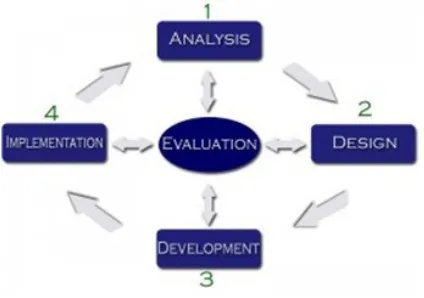
This study uses the ADDIE method in making multimedia-based applications, can be seen in Figure 1[10].
Figure 1 ADDIE Method Cycle
The above research model explains 4 points, namely:
1. Analysis. This stage analyzes for whom this application is used (using a questionnaire), how to present to students and what material will be studied and the constraints on the material.
2. Design. This stage designs the shape and appearance of the application, determines the object and displays the background according to the material, completes the animation, video, audio and image visualization.
3. Development. This stage is where the design that has been arranged is followed up by testing the design - the storyboarding stage. 4. Implementation. This stage tries to run the
learning application and checks whether the components that have been developed are running correctly.
ISSN :2394-2231
focuses on the requirements of software functionality. If the user feels there is a shortage, the development of the learning application will be repeated from the initial stage, namely the analysis stage.
3.2. System Design
The design of this application was made to describe the entire workflow starting from the design of the application to the design of the interface design of the English vocabulary learning application. In the flowchart below, the flow from the main menu is described until it displays the next pages, where the main
menu page consists of menus FOOD, ANIMALS,
FRUITS and THINGS. If the user selects one of these menus, the user will display a vocabulary game page consisting of several levels. In addition, there
EXIT menu if it will exit the application.
Figure 2 Multimedia Application Menu Flow
2231 http://www.ijctjournal.org
focuses on the requirements of software functionality. If the user feels there is a shortage, the development of the learning application will be repeated from the initial
The design of this application was made to describe the entire workflow starting from the design of the application to the design of the interface design of the English vocabulary learning application. In the flowchart below, the flow from the main menu is described until it displays the next pages, where the main
FOOD, ANIMALS,
. If the user selects one of these menus, the user will display a vocabulary game page consisting of several levels. In addition, there is also an
Figure 2 Multimedia Application Menu Flow
Figure 3Flowchart of the Fruits Menu
4. RESULTS AND DISCUSSION
In this study we will discuss the results of using the ADDIE method in the analysis phase.
needed to find out how much multimedia application is needed in basic English vocabulary learning.
Online questionnaires made through Google Docs were distributed to 26 respondents, namely English teachers at the Jabodetabek area Primary School
In this method the researcher gives a list of questions to the respondent according to the learning indicators that are in accordance with the English language learning curriculum at the elementary level.
Calculation of this questionnaire was made Likert scale with the following assessments:
Page 60
Flowchart of the Fruits Menu
RESULTS AND DISCUSSION
In this study we will discuss the results of using the ADDIE method in the analysis phase. Analysis is needed to find out how much multimedia application is needed in basic English vocabulary learning.
Online questionnaires made through Google Docs were distributed to 26 respondents, namely English teachers at the Jabodetabek area Primary School level.
In this method the researcher gives a list of questions to the respondent according to the learning indicators that are in accordance with the English language learning curriculum at the elementary level.
International Journal of Computer Techniques -– Volume 6 Issue 1, Jan – Feb 2019
ISSN :2394-2231 http://www.ijctjournal.org Page 61
Score 1: Strongly Disagree (SD) Score 2: Disagree (D)
Score 3: Neutral (N) Score 4: Agree (A)
Score 5: Strongly Agree (SA)
The questionnaire indicators that are referred to are as follows:
Table 1 The questionnaire indicators
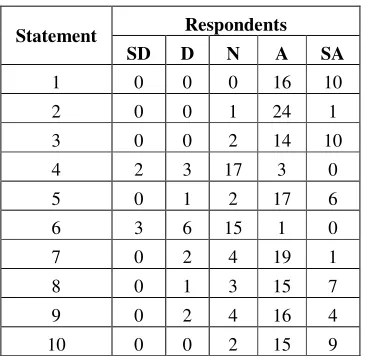
Of the 26 respondents the response was as follows:
Table 2 Respondents Response
Statement Respondents SD D N A SA
1 0 0 0 16 10
2 0 0 1 24 1
3 0 0 2 14 10
4 2 3 17 3 0
5 0 1 2 17 6
6 3 6 15 1 0
7 0 2 4 19 1
8 0 1 3 15 7
9 0 2 4 16 4
10 0 0 2 15 9
The above data is then processed by multiplying each answer point with the specified weight with the value weight table. Then the results of the calculation of respondents' answers are:
Table 3 Then the results of the calculation of respondents
Statement
Respondents Score (Likert Scale) SD D N A SA 1 2 3 4 5 Total
Score
1 0 0 0 16 10 0 0 0 64 50 114 2 0 0 1 24 1 0 0 3 96 5 104 3 0 0 2 14 10 0 0 6 56 50 112 4 2 3 17 3 0 2 6 51 12 0 71 5 0 1 2 17 6 0 2 6 68 30 106 6 3 6 15 1 0 3 12 45 4 0 64 7 0 2 4 19 1 0 4 12 76 5 97 8 0 1 3 15 7 0 2 9 60 35 106 9 0 2 4 16 4 0 4 12 64 20 100 10 0 0 2 15 9 0 0 6 60 45 111
To get the results of the interpretation, the highest score (X) and the lowest number (Y) must be known for the assessment items using the following formula: 1. Y = highest Likert score x number of respondents
(Highest Number 5)
2. X = lowest Likert score x number of respondents (lowest number 1)
The highest number of scores for the Strongly
Agree item is 5 x 26 = 130 while the Disagree item is 1 x 26 = 26. The evaluation of the respondent's interpretation of the learning media is the result of the value produced using the index% formula.
Index Index% = Total Score / Y x 100
After the next percentage is categorized according to the percentage table of values:
Answer Information
0% - 19.99% Very (Disagree, Bad or Less) 20% - 39.99% Disagree or Not Good 40% - 59.99% Enough or Neutral 60% - 79.99% Agree, Good or Like 80% - 100% Very (Agree, Good, Like) Indicator Question
Attract Attention Multimedia is able to make students happy in following the basic level English vocabulary learning process.
Multimedia methods are able to make students enthusiastic in answering lesson questions.
Clarity of meaning Multimedia can facilitate students in adding basic level English vocabulary.
Learning vocabulary through multimedia is considered less useful for students.
Student activity Multimedia learning methods allow students to learn independently.
Learning English vocabulary through multimedia makes students get bored quickly.
Material Presentation
Multimedia is able to help elementary level students in achieving English vocabulary learning competencies.
In your opinion, elementary level students need to be given a multimedia method as an English vocabulary learning tool.
Level of Student Understanding
Students easily learn well about what the teacher explains when using multimedia rather than the lecture method.
Image and Animation
ISSN :2394-2231 http://www.ijctjournal.org Page 62 Statement
Formula Index % =
Total Score / Y x 100 Result Total
Score Y* x100
Percentage
(%) Category**
1 114 130 100 87.69
STRONGLY AGREE
2 104 130 100 80.00
STRONGLY AGREE
3 112 130 100 86.15
STRONGLY AGREE
4 71 130 100 54.62 NEUTRAL
5 106 130 100 81.54
STRONGLY AGREE
6 64 130 100 49.23 NEUTRAL
7 97 130 100 74.62 AGREE
8 106 130 100 81.54
STRONGLY AGREE
9 100 130 100 76.92 AGREE
10 111 130 100 85.38
STRONGLY AGREE
From the results above, it is known that 87.69% of respondents strongly agree that multimedia is able to make students happy in following the basic level English vocabulary learning process and able to facilitate students in answering lesson questions (80%). In addition, 86.15% of respondents strongly agree that the multimedia learning method allows students to learn independently. However, respondents were neutral in that vocabulary learning through multimedia was considered less useful for students (54.62%). On the indicators of student activity, 81.54% of respondents agreed that multimedia learning methods allowed students to study independently but respondents were neutral in learning English vocabulary through multimedia, making students quickly bored (49.23%).
While on the material presentation indicator,
respondents agreed that multimedia was able to help elementary level students in achieving English vocabulary learning competencies (74.62%) and strongly agreed if the elementary level students needed to be given a multimedia method as an English vocabulary learning tool (81.54%). Then on the indicator level of student understanding, 76.92% of respondents agreed that students easily followed the lesson well about what the teacher explained when using multimedia compared to the lecture method only, and 85.38% of respondents strongly agreed that the display of images and colors added to the enthusiasm for learning.
Conclusions
The existence of alternative storage media such as Google Drive will make it easier for students to get material from the subjects taught by their teaching lecturers.
Suggestion
From the conclusions above, we submit the following suggestions and recommendations:
1. So that alternative data storage media such as Google Drive can be further developed for other courses for myself or for other lecturers.
2. This research can continue to be developed using other methods to study other things that are possible from Drive.
Acknowledgment
Our praise and gratitude convey to God for all His grace and grace so that the writing of this scientific article has been successfully completed. We don't forget to thank our family FACULTY OF COMPUTER SCIENCE, MERCU BUANA UNIVERSITY, and especially PUSLIT MERCU BUANA UNIVERSITY which has provided funding support in the writing of this scientific article.
REFERENCE
[1] Ivers, Karen S. & Barron, Ann E. (2002). Multimedia projects in education: designing, producing, and assessing. Westport Connecticut: Greenwood Publishing Group, Inc.
[2] Mayer, Richard E. (2009). Multimedia learning (2nd ed). New York: Cambridge University Press. [3] Klentien, U. & Kamnungwut, W. (2014). The
impact of using electronic media in English teaching for elementary and secondary students in Thailand. International Journal of Information and Education Technology, Vol. 5, No. 8. 582 – 586.
[4] Chomsin S., Widodo dan Jasmadi (2008). Panduan
Menyusun Bahan Ajar Berbasis Multimedia, Jakarta: Elex Media Komputindo, 2008.
[5] Ed.i, (2010). Desain Grafis Profesional dengan Adobe Photoshop CS 4, Yogyakarta: Andi.
[6] M. Suyanto, (2003). Multimedia Alat Untuk
International Journal of Computer Techniques -– Volume 6 Issue 1, Jan – Feb 2019
ISSN :2394-2231 http://www.ijctjournal.org Page 63
[7] Scott, W. A., & Ytreberg, L. H. (2006). Teaching English to Children. Essex: Longman.
[8] Cameron, L. (2001). Teaching Language to Young
Learners. UK: Cambridge University Press.
[9] Dale & Bamman, (2007). Techniques for Teaching Vocabulary. New York: Longman, Inc.
[10]Dewi Salma Prawiradilaga, (2009). Prinsip Desain Pembelajaran, Kencana Prenada Media Group. [11]Anita Ratnasari, Wachyu Hari Haji, "Developing