Copyright © 2012 IJECCE, All right reserved
Effect of Noncooperation in Vehicular Delay Tolerant
Network for Multicopy Routing and its Solution
Nandita Khobragade and Bharati Singh
Abstract—Vehicular Delay Tolerant Network (DTN) is an extended application of Vehicular Adhoc Network (VANET) where small delay can be tolerated. In vehicular DTN, some selfish node may exist who may not want to forward other’s message in order to save their own resources which results into degraded performance of the overall network. VANET is characterised by high mobility and rapidly changing topology, therefore it poses special challenges and high demands for cooperation among individual vehicles to contribute to the network performance. Practical Incentive Protocol is used as its solution to improve the overall performance of the network which is secure, fair and a hybrid protocol. When fair incentive is provided to selfish node, it is motivated to act as intermediate node in order to earn the incentive and use it further to avail the service. In this paper, effect of noncooperation is analysed in terms of delivery ratio and average delay in vehicular DTN for multicopy routing algorithm, specifically for unicast. The effect of Practical Incentive Protocol is analysed using ONE simulator for different level of selfishness and improvement in terms of delivery ratio and average delay is shown for multicopy routing protocol. Also the comparative analysis of Practical Incentive Protocol is done with latest similar technique i.e. A Secure Multilayer Credit based Incentive scheme for Delay Tolerant Networks (SMART)
Keywords — Credit and reputation, Incentive, noncooperation, selfish node, Vehicular adhoc network.
I. I
NTRODUCTIONWhen vehicles communicates to exchange messages with each other or with any stationary node than it is called as vehicular adhoc network[1].Vehicular adhoc network is a network formed by vehicles for security and commercial applications. The origin motive behind VANET is security applications but commercial applications are also important for various reasons [2]. The initial deployment cost of VANET network is very high. Therefore it is unlikely that individual can afford such expensive set up. Also, commercial applications are needed to improve bandwidth efficiency and lots of new feature will be available to user with little increase in the existing cost. If commercial applications are taken into consideration, there are lot of application in which delays can be tolerated, such as traffic information, query regarding weather or any other query from road side unit (RSU). Hence it is called as vehicular delay tolerant network (DTN) [3]. Information such as the available parking spaces in a parking lot, the meeting schedule at a conference room, and the estimated bus arrival time at a bus stop can also be delivered by vehicle delay-tolerant networks. With a vehicular delay-tolerant network, the vehicle can send the query to the broadcast site and get a reply from it. In these applications, the users can tolerate up to a minute of delay as long as the reply eventually returns. The efficient routing algorithm should be used to
achieve reasonable delay for such applications. For vehicular DTN, opportunistic routing is used such as epidemic, spray and wait, Maxprop etc. This type of routing is based on store and forward. When any message is received, the vehicular node will store the message in its buffer and forward it whenever it gets the correct opportunity. Hence buffer utilization is one of the important aspects in this case.
When social characteristic is taken into consideration, there may be some selfish nodes that are reluctant to cooperate in a network to save its own resources like buffer, computational complexity, bandwidth etc [4]-[6]. The presence of selfish node can severely degrade the performance of the network. In this paper, first the effect of selfish node on multicopy routing algorithm i.e. Maxprop is shown in terms of degradation in delivery ratio and average delay. In order to enhance the performance of the network, Practical Incentive Protocol is implemented in ONE simulator and results are analysed thoroughly. The comparative analysis with one of the latest similar technique i.e. A Secure Multilayer Credit based incentive scheme for Delay Tolerant Networks (SMART) is also done.
II. R
ELATEDW
ORKcopy in [17]. In this paper, we have extended the work to analyse it for multicopy routing protocol. In [17], when a node comes into contact with other node, the later has to identify the possible location to which it can carry the message, which is not the case here. In this paper, the message is carried to the location as per the routing algorithm and incentives are allotted accordingly.
III. P
ERFORMANCED
EGRADATIOND
UE TON
ONCOOPERATIVEN
ODEA. System Model
Vehicular adhoc network model is developed as a set of high mobility node N acting as a source node and L stationary destination node. Source node Ni randomly chooses any one destination from L node for uni-cast routing. These N nodes is further divided into selfish (S) and unselfish node (U), hence N = S + U. In case of network fully cooperative, S = 0 and all the nodes are unselfish.
B. Node Model
Each vehicular node in the VANET is equipped with On board unit (OBU), which allows different vehicle to communicate with each other based on 802.11p protocol. The equipped OBU communication device is considered resource-constrained, i.e., buffer and computation power constraints. Therefore, there may be many selfish vehicular nodes in the networks. It is assumed that selfish node is buffer constraint. In order to conserve buffer space, these selfish vehicular nodes may be very reluctant in the cooperation that is not directly beneficial to them. If selfish node is a destination node then only it will accept the message otherwise it will abort the message. Selfishness of a selfish node is measured in terms of selfish factor (α) which is a function of available buffer.
C. Performance Evaluation
In this section we study the impact of selfish node on delivery ratio and average delay for multicopy routing algorithm [19]. Selfishness of network is calculated in terms of selfish ratio i.e. no. of selfish nodes/ total no. of nodes. System model is implemented on a public available delay tolerant network simulator, namely the Opportunistic Network Environment Simulator version 1.5 [18] and performance is evaluated under a practical application scenario, i.e. vehicular DTN. The details of simulation parameters are summarized in Table 1.
Table I Simulation Setting
Simulation Area 4500m x 3400m
Duration 12 hours
Parameter of Vehicular nodes
Number 100
Velocity 35-45Km/h
Data Rate 8Mbps
Transmission range 300 meter
Buffer size 20Mbits
Mobility Model Shortest path map based
Router Maxprop
Selfish ratio [0,40%,60%,90%,100%]
Parameter for Bundle messages
Generation interval 100sec
Size 2Mb
TTL 300 min, 20 min
We compare the delivery ratio and average delay under different selfish ratio. For TTL 300 minute, we can observe from Table II, that there is 2.59% decrease in the delivery ratio when selfish ratio increases from 0 to 60%, however Table III shows that average delay drastically increases by 251%.
Table II Effect of non cooperation on delivery ratio
Selfish ratio Delivery ratio (%)
TTL = 300 min TTL = 20 min
0 98.61 93.52
40 97.69 77.78
60 96.06 50
90 62.27 13.19
100 46.53 7.64
Table III Effect of non cooperation on average delay
Selfish ratio Average delay (sec)
TTL = 300 min TTL = 20 min
0
489
409
40
942
582
60
1716
714
90
5082
655
100
5678
499
Copyright © 2012 IJECCE, All right reserved Fig.1. Effect of noncooperation on delivery ratio
Fig.2. Effect of noncooperation on average delay
In fig. 1 and 2, the graphical analysis of delivery ratio and average delay is shown for all range of selfish ratio. It can be observe from the fig. that performance is severely degraded due to selfish nodes both in terms of delivery ratio and average delay.
IV. P
RACTICALI
NCENTIVEP
ROTOCOLIt is seen in previous sections that performance is severely degraded in vehicular network due to presence of selfish node. Hence, Practical Incentive Protocol [17] is used to address this problem. This protocol is hybrid protocol which takes into account both credit as well as reputation as an incentive mechanism. This leads to fairer protocol to both source as well as intermediate node. Even this protocol allows a node to behave selfishly, when there is resource constraint. There exists a trusted authority (TA) in the system which performs trusted fair credit and reputation clearance for vehicular nodes. Each vehicular node has to register itself to the TA to obtain its personal credit account (PCA) and personal reputation account (PRA) in the initialization phase. Later, when a vehicular node makes contact with some Road Side Units (RSUs), it can report to the TA for credit and/or reputation clearance.
A. Reputation System
When any node participates in the network by forwarding the message bundle, its reputation value is updated as per the distance that particular node has carried the message. Hence more the node cooperate in the network, more will be its reputation value. This reputation value should be time limited else once the reputation value is gained the motivation of a node to cooperate will decrease. Hence in this protocol, the reputation value is decayed with a factor λ.
If a node wants to avail any service such as traffic query or any other query, then node has to keep its reputation value greater than threshold else the query request will be
aborted. Hence the participation of a node in a network benefits it by providing service [17].
B. Credit System
Credit system is just like a virtual currency in which node has to pay to avail the service. It is also fair to source. The source node would not have to pay credits, if the message bundle doesn’t arrive at the destination node. However, those intermediate nodes that helped forward can still get good reputation values from the TA.
Reputation punish selfish node by abducting it from availing service while credit system provide flexibility to a node to behave selfish in case of resource scarcity. Intermediate node makes sure that in case of resource scarcity it should get high incentive else it can behave selfishly once its reputation is higher than threshold value. Incentives are measured in the form of gaining factor (GF) [17].
C. Methodology
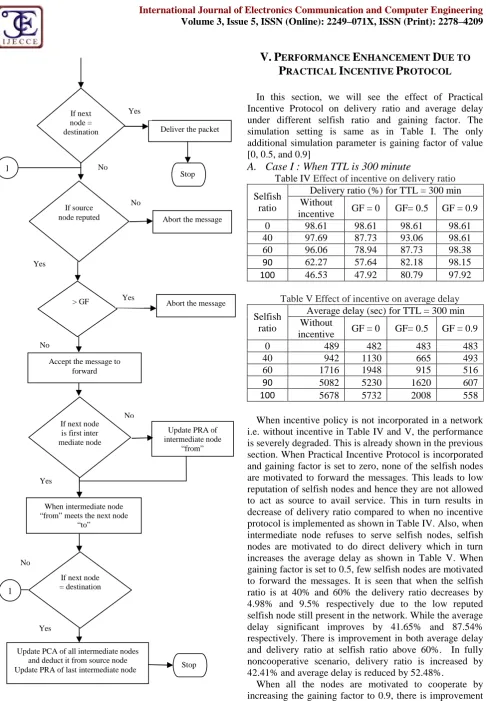
A secure Practical Incentive Protocol is implemented in the ONE simulator as per [17]. Layered coin model is used to guarantee the incentive strategy working well and incentives to be secure. In this protocol when two nodes meet each other, latter has to declare the possible location L1 to which it can carry the message at that instant only. This will be difficult in a vehicular network to decide and there may be a possibility of correct opportunity for a message either before or after location L1. A small modification is done which takes care of this. When two nodes N1 and N2 meet each other at location L1 and node N1 transfers the message to node N2. They will store the location L1 in layered coin structure. Later, when node N2 gets an opportunity to transfer the message to node N3 at location L2 it transfers it as per the routing protocol. This means the node N2 has carried the message from location L1 to location L2 and incentives are allocated accordingly. The flow chart which explains the methodology of practical incentive protocol is given below:
Initialize nodes PCA and PRA. Set the public and private key of all the nodes
Source will encrypt the message and decide for incentive policy as per the availability
of credit
Fig.3. Methodology of Practical Incentive Protocol
V. P
ERFORMANCEE
NHANCEMENTD
UE TOP
RACTICALI
NCENTIVEP
ROTOCOLIn this section, we will see the effect of Practical Incentive Protocol on delivery ratio and average delay under different selfish ratio and gaining factor. The simulation setting is same as in Table I. The only additional simulation parameter is gaining factor of value [0, 0.5, and 0.9]
A. Case I : When TTL is 300 minute
Table IVEffect of incentive on delivery ratio
Selfish ratio
Delivery ratio (%) for TTL = 300 min Without
incentive GF = 0 GF= 0.5 GF = 0.9
0 98.61 98.61 98.61 98.61
40 97.69 87.73 93.06 98.61
60 96.06 78.94 87.73 98.38
90 62.27 57.64 82.18 98.15
100 46.53 47.92 80.79 97.92
Table V Effect of incentive on average delay
Selfish ratio
Average delay (sec) for TTL = 300 min Without
incentive GF = 0 GF= 0.5 GF = 0.9
0 489 482 483 483
40 942 1130 665 493
60 1716 1948 915 516
90 5082 5230 1620 607
100 5678 5732 2008 558
When incentive policy is not incorporated in a network i.e. without incentive in Table IV and V, the performance is severely degraded. This is already shown in the previous section. When Practical Incentive Protocol is incorporated and gaining factor is set to zero, none of the selfish nodes are motivated to forward the messages. This leads to low reputation of selfish nodes and hence they are not allowed to act as source to avail service. This in turn results in decrease of delivery ratio compared to when no incentive protocol is implemented as shown in Table IV. Also, when intermediate node refuses to serve selfish nodes, selfish nodes are motivated to do direct delivery which in turn increases the average delay as shown in Table V. When gaining factor is set to 0.5, few selfish nodes are motivated to forward the messages. It is seen that when the selfish ratio is at 40% and 60% the delivery ratio decreases by 4.98% and 9.5% respectively due to the low reputed selfish node still present in the network. While the average delay significant improves by 41.65% and 87.54% respectively. There is improvement in both average delay and delivery ratio at selfish ratio above 60%. In fully noncooperative scenario, delivery ratio is increased by 42.41% and average delay is reduced by 52.48%.
When all the nodes are motivated to cooperate by increasing the gaining factor to 0.9, there is improvement in delivery ratio and average delay for all range of selfish ratio. When fully non cooperative scenario is considered, there is 52.48% improvement of delivery ratio and average delay reduces from 5678 sec to 558 sec.
Abort the message
Abort the message
Update PRA of intermediate node
“from” Deliver the packet
No
If source node reputed
No Yes
α > GF Yes
Accept the message to forward
No 1
No
If next node is first inter mediate node
No
Yes
Stop
When intermediate node “from”meets the next node
“to”
If next node = destination
Update PCA of all intermediate nodes and deduct it from source node Update PRA of last intermediate node
Yes
Stop If next
node = destination
Yes
Copyright © 2012 IJECCE, All right reserved Fig.4. Effect of incentive on delivery ratio
(TTL=300 min)
Fig.5. Effect of incentive on average delay (TTL=300 min)
The graphical analysis of the same is shown in fig 4 and 5 for delivery ratio and average delay for TTL 300 minute.
B. Case II : When TTL is 20 minute
Table VI
Effect of incentive on delivery ratioSelfish ratio
Delivery ratio (%) for TTL 20 min Without
incentive GF = 0 GF= 0.5 GF = 0.9
0 93.52 93.98 93.75 93.75
40 77.78 68.06 83.56 93.52
60 50 41.67 76.85 93.06
90 13.19 11.11 53.7 91.9
100 7.64 8.56 48.15 91.44
Table VII Effect of incentive on average delay
Selfish ratio
Average delay (sec) for TTL 20 min Without
incentive GF = 0 GF= 0.5 GF = 0.9
0 409 406 412 400
40 582 576 454 416
60 714 684 510 426
90 655 584 576 434
100 499 498 593 436
It is seen that nodes have sufficient time to search for unselfish node when TTL is high, hence TTL is reduced to 20 minutes for further analysis. From Table VI, we can see that when gaining factor is 0, delivery ratio is degraded due to the presence of low reputed node but there is significant increase in delivery ratio for all range of selfish ratio at gaining factor of 0.5 and 0.9. At 100% selfish ratio
there is increase in delivery ratio from 7.64% to 48.15% at gaining factor of 0.5 and 91.44% at gaining factor of 0.9.
When gaining factor is 0, there will be increase in direct delivery by selfish nodes which in turn increases the delay but there will be high drop due to low TTL and average delay will get reduced as shown in Table VII. When gaining factor is 0.5, the average delay is significantly reduced except for 100% selfish ratio. The increase in average delay at 100% is due to low drop. When selfish ratio is 100%, average delay increases by 18.8% at a cost of high delivery ratio achieved. The improvement in average delay is observed for all range of selfish ratio at gaining factor 0.9.
Fig.6. Effect of incentive on delivery ratio (TTL=20 min)
Fig.7. Effect of incentive on average delay (TTL=20 min)
The graphical analysis of the same is shown in fig 6 and 7 for delivery ratio and average delay for TTL 20 minute Hence, it is observed that overall performance is improved using Practical Incentive Protocol both in terms of high delivery ratio and low average delay.
A. Comparative Analysis
The comparative analysis of Practical Incentive Protocol is done with Secure Multilayer Credit based Incentive Scheme (SMART) [16] and are as follows:
1. Security with layered coin model is used in both the scheme.
2. In Practical Incentive Protocol, credit and reputations both are taken as incentive while in SMART only credit is taken as incentive.
3. Both the scheme needs central authority.
5. Practical Incentive Protocol is fair to intermediate node as well, by giving good amount of reputation value to the nodes on unsuccessful delivery path. In SMART scheme, nodes on unsuccessful delivery path get less credit as compared to the nodes on successful delivery path.
6. In Practical Incentive Protocol, the credit needed to avail the service depends upon number of hops. In SMART, source sets the fixed amount of credit given to the entire node in advance.
7. There is problem of the source overspending the credit in Practical Incentive Protocol while this is not the case in SMART.
8. In Practical Incentive Protocol intermediate node will get fixed amount of credit. While in SMART scheme, intermediate node will get credit depending upon number of hops.
9. Incentives are calculated on the basis of distance the message is carried by the node in Practical Incentive Protocol while in SMART fixed amount of credit is given to the node for variable distance.
VI. C
ONCLUSIONS ANDF
UTUREW
ORK In this paper, we have shown the effect of selfish nodes on the performance of vehicular DTN both in terms of delivery ratio and average delay. After analysing the values obtain for high and low TTL, it is concluded that presence of selfish node severely degrade the performance. At high TTL, delivery ratio has little impact for low selfish ratio but average delay is severely degraded for all the values of selfish ratio. At low TTL, delivery ratio is affected significantly for all the values of selfish ratio but average delay is little affected compared to high TTL but still there is significant degradation.
When Practical Incentive Protocol is implemented, the overall network performance
is
improved in terms of delivery ratio and average delay. Practical Incentive Protocol is analysed for multicopy routing protocol Maxprop unlike previous work which was done for single copy. Also, identification of possible location to which the message can be carried is not necessary when two nodes meet each other.
The comparative analysis with SMART scheme is also done and it is seen that Practical Incentive Protocol is fairer protocol.
This work can be extended for more promising routing protocol for vehicular adhoc network for e.g. VADD i.e. Vehicular Assisted Data Delivery routing protocol and also for spray and wait routing which uses limited number of forwarding copy.
This work can be extended to address the social selfishness.
Credit system is to be improvised in such a way that source should know in advance the credit to avail any service.
A
CKNOWLEDGMENTWith great esteem and reverence, I wish to express my deep sense of gratitude to Prof. Bharati Singh, my Guide, for constant supervision, guidance and encouragement. I would like to express my gratitude towards principal and the head of the department for their constant support.
R
EFERENCES[1] S. Zeadally, R. Hunt, Y.-S. Chen, A. Irwin, and A. Hassan, “Vehicular Ad Hoc Networks (VANETs): Status, Results, and Challenges,” Telecommunication Systems, pp. 1-25, December
2010.
[2] Ghassan M. T. Abdalla, Mosa Ali Abu-Rgheff and Sidi Mohammed Senouci, “Current Trends in Vehicular Ad Hoc Networks”, International Workshop on ITS for Ubiquitous Roads (UBIROADS), IEEE GIIS,Marrakech, Morocco, July
2007
[3] Pereira, P.; Casaca, A.; Rodrigues, J.; Soares, V.; Triay, J.; Cervello-Pastor, C., "From Delay-Tolerant Networks to Vehicular Delay-Tolerant Networks," Communications Surveys
& Tutorials, IEEE , vol.PP, no.99, pp.1-17,2011
[4] Rongxing Lu, “Security and Privacy Preservation in Vehicular Social Networks,” Mater’s Thesis,University of WaterLoo, Canada, 2012.
[5] Qinghua Li; Sencun Zhu; Guohong Cao; , "Routing in Socially Selfish Delay Tolerant Networks," INFOCOM, 2010 Proceedings IEEE , pp.1-9, 14-19 March 2010
[6] Zhu, Y.; Xu, B.; Shi, X.; Wang, Y.; , "A Survey of Social-based Routing in Delay Tolerant Networks: Positive and Negative Social Effects," Communications Surveys & Tutorials, IEEE , vol.PP, no.99, pp.1-15, 2012
[7] Panagakis, A.; Vaios, A.; Stavrakakis, I.; , "On the Effects of Cooperation in DTNs," Communication Systems Software and
Middleware, 2007. COMSWARE 2007. 2nd International Conference on, pp.1-6, 7-12 Jan. 2007
[8] Resta, G.; Santi, P.; , "The Effects of Node Cooperation Level on Routing Performance in Delay Tolerant Networks," Sensor,
Mesh and Ad Hoc Communications and Networks, 2009. SECON '09. 6th Annual IEEE Communications Society Conference on,
pp.1-9, 22-26 June 2009
[9] Yong Li; Guolong Su; Wu, D.O.; Depeng Jin; Li Su; Lieguang Zeng; , "The Impact of Node Selfishness on Multicasting in Delay Tolerant Networks," Vehicular Technology, IEEE Transactions on , vol.60, no.5, pp.2224-2238, Jun 2011
[10] Zhou Wang; Chunxiao Chigan; , "Countermeasure Uncooperative Behaviors with Dynamic Trust-Token in VANETs," Communications, 2007. ICC '07. IEEE International
Conference on , pp.3959-3964, June 2007
[11] Z. Wang, and C. Chigan, “ Cooperation Enhancement for Message Transmission in VANETs” Wireless Personal Communications: An International Journal, vol. 43, no.1 pp.
141-156, Oct 2007.
[12] Soyoung Park; Aslam, B.; Zou, C.C.; , "Long-term reputation system for vehicular networking based on vehicle's daily commute routine," Consumer Communications and Networking
Conference (CCNC), 2011 IEEE, pp.436-441, Jan 2011
[13] Lee, S.-B.; Park, J.-S.; Gerla, M.; Lu, S.; , "Secure Incentives for Commercial Ad Dissemination in Vehicular Networks,"
Vehicular Technology, IEEE Transactions on , vol.61, no.6,
pp.2715-2728, July 2012
[14] Shevade, U.; Han Hee Song; Lili Qiu; Yin Zhang; , "Incentive-aware routing in DTNs," Network Protocols, 2008. ICNP 2008.
IEEE International Conference on , pp.238-247,Oct. 2008
[15] Feng Li; Jie Wu, "FRAME: An Innovative Incentive Scheme in Vehicular Networks," Communications, 2009. ICC '09. IEEE
International Conference on, pp.1-6, June 2009
[16] Haojin Zhu; Xiaodong Lin; Rongxing Lu; Yanfei Fan; Xuemin Shen; , "SMART: A Secure Multilayer Credit-Based Incentive Scheme for Delay-Tolerant Networks," Vehicular Technology,
Copyright © 2012 IJECCE, All right reserved
[17] Rongxing Lu; Xiaodong Lin; Haojin Zhu; Xuemin Shen; Preiss, B.; , "Pi: A practical incentive protocol for delay tolerant networks," Wireless Communications, IEEE Transactions on , vol.9, no.4, pp.1483-1493, April 2010
[18] A. Ker¨anen, J. Ott, T. K¨arkk¨ainen, The ONE Simulator for DTN Protocol Evaluation,in: SIMUTools ’09: Proceedings of the 2nd International Conference on Simulation Tools and Techniques, 2009.
[19] Gallagher, B.; Jensen, D.; Levine, B. N.; "MaxProp: Routing for Vehicle-Based Disruption-Tolerant Networks," INFOCOM 2006. 25th IEEE International Conference on Computer Communications.Proceedings,pp.1-11,April 2006.
A
UTHOR’
SP
ROFILENandita Khobragade
currently perusing a Masters in Electronics and Telecommunication from K J Somaiya College of Engineering, Mumbai. She has received the BE (Electronics and Telecom) degree from MACT Bhopal in 1999.
She has an industry experience of 10 years in the field of Telecommunication. She has also been in academics for 1 year covering subjects related to communications and microcontrollers
Bharati Singh
has done her Masters in Electronics and Telecom from VJTI Mumbai in 2007. She has received the B. Tech (Electronics and Telecom) degree from NIT Jaipur in 1992. Currently she is an Associate Professor in Department of Electronics and Telecommunication, K J Somaiya College of Engineering (KJSCE), Mumbai. She is working in KJSCE since 1993.