Greywater Treatment and Optimization of Various
Materials as Bed in Constructed Wetland
D. B. Rana1,
S. B.,
M. K. N. Yenkie2and
N. T. Khaty31Jain Institute of Technology, Management & Research, Nagpur, INDIA.
2Lakshminarayan Institute of Technology, Nagpur, INDIA.
3Priyadarshini Engineering College, Nagpur, INDIA.
(Received on: April 8, 2016)
ABSTRACT
The present communication deals with the treatment of synthetic grey water using constructed wetland and its optimization by varying the bed composition. Constructed wetland is a portable system prepared by vertically pilling of layers like soil, filtering medium, adsorbing medium, sand and gravels from top to bottom respectively. Different combinations of soil (red soil, black cotton soil, sandy soil,), filtering medium (carpentry waste i.e. Bhusa, crop residue i.e. Kadamba, and natural herb i.e. Khas khas) and adsorbing medium (low grade coal coarse, fine powder and waste obtained from thermal power plant i.e. fly ash) were used to construct the wetland bed. Standard Synthetic Grey Water (SGW) was prepared by dissolving shampoo, detergents, cooking oil, paste, bathing soap etc. The extent of treatment was then analyzed by studying the Chemical Oxygen Demand (COD) and pH of SGW before and after the treatment respectively. It is observed that the COD of water reduces to a much significant level at almost entire range of moderate pH (i.e. 6.6 -8.5). Hence, the conclusion is that such wetland beds can be best used for the treatment of gray water efficiently at municipal corporation level.
Keywords: Grey water, Constructed Wetland, Synthetic Grey Water, leaching.
1. INTRODUCTION
Globalization also results in better living standard in cities3. This rise in living standard is endorsed to use of swimming pool, golf and other sport ground, showers, western toilet, wash basin, sink, bathtub, coolers, gardening, vehicle wash, fire extinguisher etc. Fresh water is effectively used for all such purposes which lead to linear increase in demand of fresh water3.
As per the report4 about poor wastewater management and higher living standard due to globalization, serious concern may rise in next coming years. This suggest new methods of water resource management which include waste water treatment and its reuse.
Greywater is a wastewater generated from household work (except sewer or latrine) like laundary, showers, bathing, and kitchen. About 60-80% of residential wastewater comes under this category5. Various previous studies suggested that treatment of grey water and its reuse can be an effective practice to conserve freshwater. For instance treated grey water can replace fresh water in various routine practices like ground water harvesting, gardening, fire extinguisher water, latrine flushing, washing vehicles, etc. which definetly save a major quanitity of available fresh water6. On an average 150 to 200 litres of grey water is generated per house per day1 and generation depends on number of person living in a family, living standard of the family and climatig condition of area8. If grey water is treated and reuse , it will solve fresh water demand issue very effectively. It will also solve major concerns like waste management, poor sanitation, health issue and most important reduce demand of fresh water7. In developing countries like India, a major issue of grey water treatment is observed to be poor grey water management system at a very zero ground level. This is attributing to lack of knowledge about grey water (chemical and microbial composition) and civil structure required to collect grey water8. In India, grey water and black water (sewer or latrine water) are treated equally however; they have different chemical and microbial composition. In some western countries like Euprope, grey water and black water are collected and treated separatly by using blue and black pipe line for grey water and black water respectively9.
Though grey water is low contaminated i.e. chemically and microbial, it needs some treatment before its discharge in water body. Grey water treatment does not haveany objective to provide water for drinking but treated grey water can be used for its application in various other area except for drinking3.
In this study grey water was synthesized and then treated by using Constructed Wetland. Various beds are used as soil bed, filtering medium and adsorbing medium. These beds are piled from top to bottom vertically to form a portable constructed wetland. Since water was allow to recycled vertically though theses beds for number of cycles these constructed wetlands are also termed as “Recycled Vertical Flow constructed wetland”(RVFCW) (10). Objective of present work lies in the treatment of synthetic grey water by using vaious matrials as bed in constructed wetland and its treatment efficiecy (% Chemical Oxygen Demand i.e. COD removal) before and after treatment respectively.
2. EXPERIMENTAL WORK
various combinations of easily available, low cost and easy to handle materials as soil beds, filtering media and adsorbents. COD was taken as main parameter for the comparison to identify treatment of grey water by bed. Treatment of grey water by RVFCW was studied by taking parameters like pH and COD of synthetic greywater (SGW) before and after treatment respectively.
2.1 Experimental set up consist of two parts
A) Water Reservoir with flow adjuster.
B) Recycled Vertical Flow Constructed Wetland (RVFCW).
A) Water Reservoir with flow adjuster
A reservoir was prepared by using transparent plastic bottle of 5 L capacity with a flow adjuster. Drop wise sample was allowed to fall vertically on the horizontal surface RVFCW.
B) Recycled Vertical Flow Constructed Wetland (RVFCW)
Grey water was allowed to fall under the effect of gravity vertically drop wise on the horizontal surface of RVFCW at the centre, so that water could uniformly spread on the RVFCW. It was found that initially grey water takes more time to complete on cycle (completing 3500 ml), but with number of cycle this time decreases. After obtaining complete sample through RVFCW, same volume of the sample was again passed through RVFCW. This recycling was given number of times (8 times).
Dimension different layers of RVFCW:
From Top to Bottom Constituent Height (cm) Radius (cm) Volume (cm3)
1st Layer Soil Bed 3 8.25 641.15
2nd Layer Filtering Bed 3 8.25 641.15
3rd Layer Adsorbing Bed 3 8.25 641.15
4th Layer Fine Sand 3 8.25 641.15
5th Layer Gravel(Small) 3 8.25 641.15
6th Layer. Gravel(Big) 3 8.25 641.15
As per the work of A Gross, Erikson in this work (12) importance is given to soil, filtering media and adsorbing media to study its effect on treatment of SGW. Following are different the types RVFCW prepared for the study of grey water treatment
Different RVFCW (Various soil, filtering media and absorbing media)
Soil Type Filtering Media Adsorbing Media
Fine Sand
Coarse Sand
Gravels
Red Soil Bhusa (Carpentering waste)
Coal (Coarse) Same Same Same
Black Soil Straw (Crop waste)
Fine Coal Same Same Same
Sandy Soil
Khas Khas ( natural herb )
Fly ash Same Same Same
(Common Name - Khas Khas and Botanical name/ Scientific name - Chrysopogon zizanioides)
Different combinations of RVFCW are like follows
RVFCW Soil Filtering Media Adsorbing Media
1 Red Soil Bhusa Coal (Coarse)
2 Black Soil Bhusa Coal (Coarse)
3 Sandy soil Bhusa Coal (Coarse)
4 Red Soil Bhusa Coal (Coarse)
5 Red Soil Straw(crop waste) Coal (Coarse)
6 Red Soil Khas Khas Coal (Coarse)
7 Red Soil Bhusa Coal (Coarse)
8 Red Soil Bhusa Coal (fine)
9 Red Soil Bhusa Fly ash
2.2 Experimental Procedure
2.2.1.Synthetic Grey Water (SGW) Preparation
Synthetic grey water (SGW) is prepared by using various available materials like cloth washing soap, bathing soap, hair oil, cooking oil, tooth paste and shampoo. Since in India there is no such standard for synthetic grey water preparation, in present work grey water is prepared by following taking following standard method suggested by some of the pioneer workers like Diepier et al and other working in same area11.
Following composition of Stock Synthetic Grey Water (SSGW) prepared in 50 lites,
The COD of above Stock Synthetic Grey Water (SSGW) was found to 2200 ppm. Since low grade or moderate grade grey water( which is generated in house), have COD in the range of 150 – 650 ppm, SSGW opted for dilution with tap water first and then used in experiment11.
2.2.2. Recycling SGW through RVFCW
SGW was simultaneously passed through RVFCW many times. Efficiency of treatment by RVFCW was checked by determining pH and % removal COD for every before treatment and after treatment respectively. All analysis methods are performed by following standard method given in USPEA, 2000.
3. RESULT AND DISCUSSION
A) Soil bed in RVFCW
Three soil samples are studied i.e. Red soil, Black cotton soil and Sandy soil. Various soil samples are used and above said parameters are determined. The trends for removal of COD are as follows.
Numbers of cycles
Fig.2 % COD removal with numbers of cycles of RVFCW by taking various soil beds. Sr. No. Constituent Manufacturer Quantity 01 Soap(Cloth washing) Rin 40.0 g 02 Soap (Bathing) Lifeboy 40.0 gm
03 Hair Oil Parachute 40.0 ml
04 Cooking Oil Saffola Gold 30.0 ml 05 Tooth Paste Colgate 21.8 gm
06 Shampoo Sunsilk 30.0 ml
When red soil was used better results were obtained for treatment of % COD removal. Treated water obtained was clear and pH was neutral. % COD removal was more than 96 % by RVFCW. pH was neutral that was again an added advantage. The obtained pH was neutral it is may be due to acidic behavior of Red soil13 . When black cotton soil was used pH of treated water was slightly alkaline and filtration rate was slow due to its loamy nature13. RVFCW with black cotton soil, remove up to 92 % COD. Since pH of water is alkaline and filtration rate is slow, it was less effective bed compared to red soil bed. Sandy soil treated water also neutral, and filtration rate was fast but, COD removal was only up to 91 % (13). So we can conclude that, red soil was better with respective to neutral pH of treated water, speed of filtration and % removal of COD.
B) Filtering medium in RVFCW
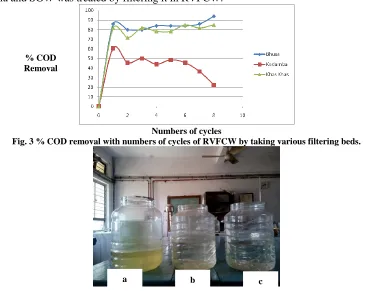
Three easily available filtering medium were studied i.e. Bhusa (carpentering waste), Kadamba (rice crop residue) and Khas Khas (a herb). These filtering material were used as media and SGW was treated by filtering it in RVFCW.
Numbers of cycles
Fig. 3 % COD removal with numbers of cycles of RVFCW by taking various filtering beds.
Fig. 4 RVFCW and AOP treated water of different filtering media. From left to right a) Kadaba treated water, b) Khas treated water, c) Bhusa treated water.
So we concluded that, Bhusa (carpentering waste) was superior as compared to Kadamba (rice crop waste) and Khas Khas (a natural herb).
% COD Removal
The trends for removal of COD was studied as above. When different filtering media was used as filtering bed of Bhusa (i.e. carpentering waste) found to be best medium14. It removes maximum 94 % COD. Rate of filtration was moderate and treated water was clear and transparent. Kadamba (rice crop residue) when used for treatment as filtering media, poor results were obtained. pH of treated water is slightly acidic, filtrate was faint yellow and opaque and filtration rate was slow. COD removal was only 60.60%. That was attributed to leaching of various materials from Kadamba14. A commonly available herb Khas Khas was also used as filtering medium. Khas Khas Treated water obtained was neutral in pH, clear and transparent, and speed of filtration is fast. But COD removal is low i.e. around 85 % 14.
C) Adsorbing medium in RVFCW
Different adsorbing medium were studied i.e. Coal (coarse), Coal (fine) and Fly ash (power plant ash) in RVFCW. SGW is treated by using various adsorbing bed and studied parameters. As we know that adsorption by coal was very common for waste water treatment we also opted low grade coal as adsorbing medium15 along with fly ash (a major waste generated in power plant). Following trends were obtained for % COD removal.
Numbers of cycles
Fig.5 % COD removal with numbers of cycles of RVFCW by taking various adsorbing beds. Most suitable treatment was shown by coal in coarse size(1-2cm)15. The treated water observed to be clear, transparent and filtration rate was good. Maximum % removal of COD was also observed for coal in coarse size (98%), and pH of treated water found to be neutral15. When coal in fine powder was used, treated water becames colored (black/reddish). Filtration rate becomes was also very low. Along with this % removal of COD is less as compared to % removal of COD(i.e.94%) by tine coal as compared to coal used in coarse size15. When fly ash was used as bed, filtrate obtained was opaque and turbid. Filtration rate was medium as compared to coal as coarse size and coal as fine powder. % removal of COD (90.90%was lowest in case of fly ash as adsorbing medium15.
Summary of research work
Following comparison was obtained when various soil bed, filtering bed and adsorbing bed was used in RVFCW and its relation with % COD removal.
A) Comparison of soil bed used in RVFCW
Soil pH of treated water
Color of treated water Rate of filtration
COD removal by RVFCW
Red Soil About neutral Clear & Transparent Medium 95.97 %
Black Soil Slightly alkaline Clear & Transparent Slow 92.35 % Sandy Soil About neutral Clear & Transparent Fast 91.66 % B)Comparison of filtering bed used in RVFCW
Filtering medium pH of treated water
Color of treated water Rate of filtration
COD removal by RVFCW
Bhusa About neutral Clear & Transparent Medium 94.00 %
Kadaba Slightly acidic Opaque & faint yellow Slow 60.60 % KhasKhas About neutral Clear & Transparent Fast 85.00 % C) Comparison of adsorbing media used in RVFCW
Adsorbent medium pH of treated water
Color of treated Water
Rate of filtration
COD removal by RVFCW
Coal (Coarse) About neutral Clear & Transparent Fast 95.01
Coal (Fine) About neutral Clear & reddish Slow 94.11 % Fly ash About neutral Opaque & reddish Medium 90.90 %
4. CONCLUSION
Grey water treatment and reuse play a major role in water resource management. In this work Synthetic Grey water (SGW) is used as a source which is a low contaminated water and it is effectively treated by constructed wetland. Red soil as soil bed shows greater % removal of COD as compared to black cotton soil and sandy soil. pH is also natural. Various available filtering medium like carpentering waste i.e. Bhusa, rice crop waste i.e. kadamba and natural herb i.e.Khas Khas. Optimum results are obtained for carpentering waste i.e. Bhusa. % removal of COD is more compared to Kadamba and Khas Khas treated grey water. pH of Bhusa and Khas Khas treated water is neutral but Kadamba treated water is acidic. Adsorbing material like low grade coal in coarse size, low grade coal in powder form and thermal power plant waste fly ash is used. Coal in coarse size found superior as compared to coal in powder form and fly ash. % COD removal by coal in coarse form as bed is more as compared to coal in fine powder and flyash as beds. Treated water obtained after coal in coarse size as bed is clear and transparent. However filtrate obtained after coal in fine powder and fly ash is colored and opaque in visibility. Hence this work can be concluded with that red soil as soil bed, carpentering waste i.e. Bhusa and coal in coarse size are optimum for a RVFCW as soil , filtering medium and adsorbing medium respectively.
REFERENES
1. Warner, Koko, Perspective on Social Vulnerability.. Germany : UNU-EHS,. ISBN:978-3-939923-00-8 (2007).
2. J.B.Isunju., K. Schwartz, M.A.Schouten, W.P.Johnson, M.P. van Dijk, Socio-economic aspects of improved sanitations in slums: A review. 6, s.l. : Elsvier, Vol. 125, pp. Pages 368-376 (2011).
3. WHO., Ecosysrem and Human Well - Being. s.l. : WHO,. ISBN 9241563095 (2005). 4. C.J. Vorosmarty., P.B. McInttyre., M.O. Gessner, D. Dudgeon, P.B. Prusevich., P. Green.,
Global treats to human security and river biodiversity. s.l., Nature, pp. pp 467, 555 - 561. DOI:10.1038/nature09440 (September 30, 2010).
5. Eva Eriksson, Karina Auffarth, Mogens Henze, Characteristics of grey waste water. 1, s.l.:
Elsvier, Urban Water, Vol. 4, pp. Pages 85-104. DOi:10.1016/S1462-0758(01)00064-4 (2002).
6. H. Al-Hamaiedeh, M. Bino, Effect of greywater reuse in irrigaration on soil and plants.., Israel : Elsvier, Desalination, Vol. 256, 1-3, pp. Pages 115-119 (June 2010).
7. E. Friedler., R. Kovalio and N.I.Galil, (2007).,On-site greywater treatment and reuse in multistorey buildings. . Israel : s.n.
8. Hoekstra, Mesfin M. Mekonnen and Arjen Y, A Global Assesment of the Water Footprint of Farm Products.. 15, s.l. : Ecosystems, Ecosystems, pp. 401-415. DOI:10.1007/s10021-011-9517-8 (2012).
9. Leal, Lucia Hemandez, Characterization and Biological treatments of Greywater. 5, Geldeland, Netherlands : Water Science & Technology, Vol.56, pp. 193-200. DOI:10.2166/wst.2007.572 (Feb 2007).
10. Amit Gross, Drora Kaplan, Katherine Baker, Removal of chemical and microbiological contaminants from domestic greywater using a recycled vertical flow bioreactor (RVFB). 2, s.l. : Elsvier, October 1, Ecological Engineering, Vol. 31, pp. Pages 107-114 (2007). 11. Fanny Houlier., Anthony Masse.,Pascal Jaouen.,Abdel Lakel.,Claire Gerente, Catherine
F. Cloirec., Formulation of Synthetic Greywater as an evalution for wastewater recycling technologies. 2, s.l. : Environmenal Technology, Vol. 31, pp. pages 215-223.
DOI:10.1080/09593330903431547 (Feb 12, 2010).
12. Agu., Water Resources Research. 6, s.l. : Water Resources Research, Vol. 15, pp. pages 1633-1635 (December 1979).
13. C.H.House., B.A. Bergmann.,A.M.Stomp and D.J.Frederick, Combining constructed wetland and aquatic and soil filters for reclamation and reuse of water. 1-2, s.l. : Elsvier,
Ecological Engineering, Vol. 12, pp. Pages 27-38.
DOI:10.1016/S0925-8574(98)00052-4 (January 1999).
14. Mark M. Benjamin, Kim F. Hayes and James O. Leckie, Removal of Toxic Metals from Power Generation Waste Streams by Adsorption and Coprecipitatio.. 11, s.l. : Water Pollution Control Federation, Water Pollution Control Federation, Vol. 54, pp. pp 1472-1481(November 1982).
15. W.I.Friesen, R.J.Mikula, Fractal dimensions of coal particle. 1, s.l.: Elsvier, Journal of