ISSN 2319-7625 (Online)
(An International Research Journal), www.chemistry-journal.org
Synthesis and Characterization of Certain Chalcone Based
Photocrosslinkable Copolyesters
D. Lakshmi Devi, N. Varsha and S. Kothai
PG and Research, Department of Chemistry, Ethiraj College for Women, Chennai-600008, INDIA.
email:[email protected].
(Received on: June 2, Accepted: June 8, 2017)
ABSTRACT
Five novel random copolyesters with chalcone moiety in main chain were synthesized using Polycondensation method. Acid catalyzed Claisen-Schmidt condensation reaction was employed to synthesize three chalcone diols. Three chalcone diols namely (2E)-1-(4-hydroxyphenyl)-3-(4-methoxy-3-hydroxyphenyl) prop-2-ene-1-one (IVAP), (2E)-1-(4-hydroxyphenyl)-3-(4-hydroxy-3-ethoxyphenyl) prop-2-ene-1-one (EVHP), (2E )-1-(4-hydroxy-3-methoxyphenyl)-3-(4-hydroxy-3-ethoxy phenyl)prop-2-ene-1-one (EVMA) and four diacid chlorides namely isophthaloyl chloride, terephthaloyl chloride, succinyl chloride, glutaryl chloride were used for the synthesis of copolyesters by solution polycondensation method. These copolyesters were characterized using UV-Visible, FTIR, 1H-NMR and 13
C-NMR spectroscopy. The molecular weight was determined using MALDI-Mass spectroscopy. The photocrosslinkability of the copolyesters was investigated using UV irradiation and refractive index measurement.
Keywords: Chalcone, Copolyesters, Photocrosslinking, Refractive index.
INTRODUCTION
Photoreactive materials have gained remarkable interest, since the photocrosslinking reactions in organic materials can induce many changes in physiochemical properties such as solubility, optical transparency, dielectric constant and refractive index. Among photoreactions in organic materials, photocrosslinking is considered to be important1. It is
acid or ester units, for example, the cinnamic acid and cinnamic ester derivatives like chalcones were used for the study of phototransformation phenomenon that occurs under UV irradiation. The photosensitivity of these materials is mainly attributed to the π-electron density of the photoreactive chromophores (-CH=CH-CO-). Among many promising photosensitive group, the chalcone derivatives have been well studied for the synthesis of photocrosslinkable polymers due to its high sensitivity to UV irradiation (300-360 nm)1.
Polymers containing pendant α,β unsaturated carbonyl groups have been an active field of research in polymer science and they undergo crosslinking upon irradiation with UV- light and are regarded as negative type photo resists3. The technological applications of photosensitive
polymers are applied in the fields of microlithography, photo conductors, non-linear optical materials4, optical anisotropy, energy exchange materials, liquid crystalline display, tissue
engineering, biosensors, UV- curing adhesives, hole transporting materials and in organic light emitting diodes5,6. These photocrosslinkable polymers have a good liquid crystalline property
and hence can be used in LCD’s. Photosensitive polymers with a combination of properties such as high photosensitivity, good solubility, the ability to form films, good thermal stability, and resistance towards solvents after crosslinking are very important for practical use as commercial negative photo resist materials and can mainly be used in "Solar cells".
EXPERIMENTAL SECTION
AR grade sigma-Aldrich samples of 4-hydroxy acetophenone, 4-hydroxy3-methoxy acetophenone, isovanillin, ethyl vanillin were used for the synthesis of the three chalcone diols. AR grade sigma-Aldrich samples of succinyl chloride, glutaryl chloride, isophthaloyl chloride and terephthaloyl chloride were used for the five copolyesters synthesis. AR grade sample of Dimethyl acetamide (DMAc) was used as a solvent for finding out inherent viscosity and photocrosslinkability using UV irradiation. Spectral grade DMSO-d6 was used as internal
standard for recording NMR spectra.
SYNTHESIS OF CHALCONE DIOLS
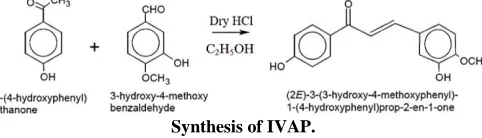
The monomers chalcone diols were synthesized using Claisen-Schmidt Condensation reaction. This involves chalcone production by Aldol Condensation of an aldehyde and a ketone in the presence of the catalyst. The chalcone diols synthesized were (2E )-1-(4-hydroxyphenyl)-3-(4-methoxy-3-hydroxyphenyl) prop-2-ene-1-one (IVAP), (2E )-1-(4-hydroxyphenyl)-3-(4-hydroxy-3-ethoxyphenyl) prop-2-ene-1-one (EVHP), (2E )-1-(4-hydroxy-3-methoxyphenyl)-3-(4-hydroxy-3-ethoxy phenyl)prop-2-ene-1-one (EVMA).
Synthesis of IVAP
Synthesis of IVAP.
The other two chalcone diols (EVHA, EVMA) were already reported7.
The monomer code, reactants, % yield, molecular weight, colour and melting points of the chalcone diols are represented in the Table 1.
Table 1: Monomer code, reactants, % yield, molecular weight, colour and melting points of chalcone diols.
S.No Monomer code
Reactants %
yield
molecular weight
colour melting point ˚C 1 IVAP 4-methoxy-3-hydroxy benzaldehyde
+ 4-hydroxy acetophenone
95 270 red 98
2 EVHA 4-hydroxy-3-ethoxy benzaldehyde + 4-hydroxy acetophenone
76 284 yellow 174
3 EVMA 4-hydroxy-3-ethoxy benzaldehyde + 4-hydroxy-3-methoxy acetophenone
100 314 yellow 194
SYNTHESIS OF COPOLYESTERS
The five copolyesters were synthesized using three chalcone diols and four diacid chlorides by solution Polycondensation.
Synthesis of PIGI
Taken 1g of IVAP in 100 ml R.B flask. Added 10ml of dry DMF stirred till it is dissolved. Then added 0.3759g of isophthaloyl chloride and 0.2ml of glutaryl chloride, raised the temperature to 120˚C. Left the reaction to proceed for 12 hours. After the reaction time, quenched in 50ml of n-hexane, filtered, dried and powdered. It is then reprecipitated from methanol.
The copolyester code, chalcone diols, diacid chlorides I and diacid chloride II of the five copolyesters and their % yield are represented in the Table 2.
Table 2: Synthesized copolyesters and its % yield
S.No Polyester code Diol Diacid chloride 1 Diacid chloride 2 % Yield 1 PIGI IVAP Isophthaloyl chloride Glutaryl chloride 62% 2 PTGI IVAP Terephthaloyl chloride Glutaryl chloride 65% 3 PTSH EVHA Terephthaloyl chloride Succinyl chloride 84% 4 PIGH EVHA Isophthaloyl chloride Glutaryl chloride 95% 5 PSGM EVMA Succinyl chloride Glutaryl chloride 67%
RESULTS AND DISCUSSION
The solubility of all the polymers were tested using various polar and non-polar solvents such as methanol, ethanol, DMF, DMAc, THF, Acetone, DMSO, etc. The inherent viscosities of the monomers and copolyesters are determined in DMAc solution at 30˚C using Ubbelohde viscometer. The refractive indexes of the copolyesters are determined in DMAc solution at 30˚C using Abbe Refractometer. The UV-Visible spectra of the monomers and copolyesters are recorded with UV1650 PC instrument with methanol as the solvent. The polymer samples for quantitative FTIR analysis were used in the form of a pellet containing a mixture of KBr. FTIR spectrum of all the monomers and five polymeric samples are recorded using SHIMADZU FTIR instrument. The NMR spectra of monomers and copolyesters were recorded with BRUKER AV III 500 MHz NMR instrument in DMSO-d6 solvent to identify the structural units present in the copolyester chain. The MALDI-MS spectrum of the polymeric samples was recorded using BRUKER DALTON MICROFLEX ANALYSER. The photocrosslinking studies have been done using Perkin Elmer Lambda 35 UV-Visible Spectrometer. The photocrosslinking studies were carried out to study the changes occurred during UV irradiation in the polymer. The polymer solution was prepared in the concentration range of 10 – 20 mg/L using DMAc as solvent. The polymer samples were irradiated with mercury vapour lamp at various time intervals. UV-Visible spectroscopy was taken after irradiation at various time intervals, which is used for the detection and quantitative measurement of chromophores that undergo n→π* or π→π* transition.
SOLUBILITY
Table 3: Solubility of the copolyesters
S.No Polyester code
DMAc DMF DMSO CH3OH C2H5OH THF (CH3)2CO C6H12 C6H6
1 PIGI ++ ++ ++ ++ +- +- +- -- --
2 PTGI ++ ++ ++ ++ +- +- +- -- --
3 PTSH ++ ++ ++ ++ +- +- +- -- --
4 PIGH ++ ++ ++ ++ +- +- +- -- --
5 PSGM ++ ++ ++ ++ +- +- +- -- --
++ Soluble +- Soluble on warming -- Insoluble
VISCOSITY
The inherent viscosities of the monomers and copolyesters are determined in DMAc solution at 30˚C using Ubbelohde viscometer. 25mg of pure and dry polyester sample was dissolved in 25mL of DMAc, kept aside for some time with occasional shaking. The inherent viscosity of the polymer increases with the length of the aliphatic chains and as the viscosity directly depends on molecular weight, as the molecular weight increases the viscosity also increases. The viscosities of the polymers are presented in the table 4.
Table 4: Inherent viscosities of the copolyesters
Polyester code Inherent viscosity
PIGI 0.8561
PTGI 1.2413
PTSH 1.0279
PIGH 1.0988
PSGM 0.1632
REFRACTIVE INDEX
The refractive index of the copolyesters is determined in DMAc solution at 30˚C using Abbe Refractometer. 25mg of pure and dry polyester sample was dissolved in 25mL of DMAc, kept aside for some time with occasional shaking. The refractive index is the important quantity for characterizing the structure of polymers because it depends on the chemical composition, tacticity and molecular weight. As the concentration or the molecular weight increases the refractive index decreases. The refractive index of copolyesters in DMAc is presented in the table 5.
Table 5: Refractive index of the copolyesters
Polyester code Refractive index
PIGI 1.431
PTGI 1.432
PTSH 1.429
PIGH 1.429
SPECTRAL STUDIES
UV-Visible Spectroscopy
UV-Visible spectroscopy is the measurement of attenuation of the light beam after it passes through the sample or after reflection from the sample surface. The peak of absorption of the curve is mainly due to the n→π*, π→π* transitions and also due to the excitation of C=O group of the molecule. The UV-Visible spectrums of the copolyesters were recorded in methanol solution at room temperature. The absorbance is shown in the figures 1 and 2.
Fig: 1 UV-Visible spectrum of PTGI. Fig: 2 UV-Visible spectrum of PTSH
FTIR Spectroscopy
The FTIR spectra of the copolyesters were recorded in KBr pellet and the spectra are shown in the figures 3 and 4. The C-H stretching appears at the range 2650-3160 cm-1 the
olefinic double bond (-C=C-) stretching appears at 1500 -1532 cm-1, the copolyesters showed
the ester carboxyl stretching band from 1709 to 1759 cm-1. The α,β unsaturated carbonyl
stretching band is from 1583 to 1598 cm-1. The C-O stretching of ester is denoted by 1210 cm-1.
The terminal OH stretching occurs at the range 3300 – 3800 cm-1.
NMR Spectroscopy
The 1H NMR spectra of the random copolymers were recorded in DMSO – d6 solvent
and TMS as internal standard. The aromatic protons were observed in the range of 7.0 – 8.2 ppm. The vinyllic protons attached to carboxyl carbon are observed in the range of 6.6 – 6.9 ppm the vinyllic protons attached to phenyl ring are observed in the range 4.3 – 4.5 ppm. The methoxy protons in the chalcone moiety were observed in the range 3.1 – 3.9 ppm. The methylene protons are observed in the range of 2.2 – 2.9 ppm and the methyl protons in 1.3 – 1.7 ppm. The 1H and 13C NMR spectrum of the random copolymers are shown in the figures
5 and 6 respectively.
Fig: 5 1H NMR spectrum of PIGI.
Fig: 6 13C NMR spectrum of PIGI.
Matrix Assisted Laser Desorption/ Ionization- Mass Spectroscopy
copolyester was found to be 2043.355 experimentally, which is nearly in agreement with the theoretical molecular weight.
Fig: 7 MALDI-MS spectrum of PTSH.
PHOTOCROSSLINKING STUDIES
The photo crosslinking studies were performed to learn the variations that occurred in the polymer when subjected to UV irradiation to establish the photoresist nature of the polymer. Photo responsive polymers possessing chalcone moiety in the main or side chain can behave as negative photo resists subsequent from the photo cycloaddition8.The polymer
which is ascribed to the π-π* transition of the chalcone system for the trans isomer9.The
intensity of this absorption band around 340 – 380nm decreased fast upon exposure to UV light which specifies the disruption of conjugation which may be either due to dimerization or
trans-cis isomerization. All the polymers synthesized were photocrosslinkable and the extent
of photo crosslinking can be shown by UV visible absorption spectra of the copolyesters on irradiation at various time intervals which are shown in the figures 8 and 9.
Fig: 8 UV irradiation on PIGI Fig: 9 UV irradiation on PSGM
As the time of irradiation increases there is a decrease in absorbance which indicates the steady rate of photocrosslinking. The reason behind this is the dimerization of C=C bonds of chalcone moiety, which engages 2π+2π cycloaddition reactions leading to the formation of cyclobutane ring10.At the same time, an increase of absorption is exhibited at the band around
240 – 280nm which is due to the conversion of the trans-isomer to the cis-isomer and only one photochemical product is formed. There is an isosbestic point for all the polymers which indicates the equilibrium between two species demonstrating that only one process occur exclusively and only one photo chemical product is formed. Further irradiation results in deviations from the isosbestic points which reveal that the cis isomer and the dimer overlapping each other. To compare the relative reactivity of theses polymers, a plot (A0
-At/A0) x100 against time was obtained, where A0 is the absorbance before irradiation and At is
D. Lakshmi Devi, et al., J. Chem. & Cheml. Sci. Vol.7(6), 414-424 (2017)
Fig: 10 Rate of photocrosslinking of PIGI Fig: 11 Rate of photocrosslinking of PSGM
There is a change in refractive index after crosslinking due to structural changes taking place during crosslinking. The refractive index of the polyester solution decreases after photocrosslinking because there is a change in the density and its transparency which leads to the decrease in the refractive index, hence these polymers can be used in holography11,12. The
decrease in the refractive index due to photocrosslinking is represented in the table 6.
Table 6: Change in refractive index on UV irradiation Polyester code Refractive index
Before photocrosslinking After photocrosslinking
PIGI 1.431 1.428
PTGI 1.432 1.428
PTSH 1.429 1.427
PIGH 1.429 1.426
PSGM 1.429 1.426
CONCLUSION
The study reports the synthesis of three chalcone diols by acid catalyzed Claisen-Schmidt reaction and five copolyesters by Polycondensation method. The viscosity and refractive index measurements reveal that the polyesters synthesized are of high molecular weight. The synthesized copolyesters were characterized using UV-Visible, FTIR, 1H and 13C
NMR spectroscopic studies. The molecular weight of the copolyester was determined by MALDI Mass spectroscopy. The photocrosslinking behavior of the polymers was studied using UV –Visible spectroscopy. The crosslinking of the polymers proceeded via cyclobutane ring formation on irradiation with light from mercury lamp. The rate of photocrosslinking was studied and the decrease in refractive index on photocrosslinking was also depicted. The photocrosslinked copolyesters have very important practical use such as commercial negative photoresist materials and mainly in SOLAR CELLS.
ACKNOWLEDGEMENT
We express our sincere gratitude to Tamil Nadu State Council for Science and Technology, DOTE Campus, Chennai-600025 for funding this work.
REFERENCES
1. Dong Hoon Choi, Sang Joon Oh, Si Young Ban and Kwng Yong Oh. Effect of photopolymerisation on the rate of photocrosslink in chalcone based oligomeric compounds. Bull. Korean Chem. Soc., vol 22, no 11, 1207-1212 (2001).
2. Jultui Kang, Yong Jeong, Sankug Lee, Kyngtochoi and Gyojic shin. Synthesis of side chain chalcone polymers and their photo alignment capability for film pattered retarder.
IPCBEE Volume 43 (2012).
3. Mador, Marc. (Fundamentals of Microfabrication, Boca Raton, Florida. CRC press P 9 ISBN 0-8493-0826-7 2012).
4. R.Balaji, S.Nanjundan. Synthesis and characterization of photocrosslinkable functional polymers having pendant chalcone moiety. Reactive and Functional Polymers 77-86 (2001).
5. Muthusamy, Tamilvanan, Arumugam, Pandurangan, Boreddy, SR Reddy and Kathavarayan Subramanian. Synthesis, characterization and properties of photoresponsive polymers comprising photocrosslinkable pendant chalcone moieties. Polymer Int 56:104-111 (2007).
6. K. Subramanian. Synthesis, Characterization and Photocrosslinkable properties of polymer containing pendant chalcone group.
7. D.Lakshmi Devi, D.Reuben Jonathan, and S.Kothai. Biocidal efficacy of synthetic copolyesters having chalcone moiety. Journal of Chemical and Pharmaceutical Research, 8(3):1041-1046. ISSN: 0975-7384 (2016).
8. Perundevi, T.S., Reuben Jonathan D and Kothai S. Synthesis and characterization of certain Photocrosslinkable random copolyesters with bischalcone moiety. IJAR, volume 3, Issue 3, 1147-1154 (2015).
9. Perundevi, T.S, Reuben Jonathan. D and Kothai. S. Synthesis and characterization of certain Photocrosslinkable thermotropic random copolyesters containing bischalcone moiety. Journal of Chemistry and Chemical Sciences, Vol 6(4), 320-338, ISSN 2229-760X (April 2016).
10. P Sathish, M Mayavathi, D Ruben Jonathan and D Roopsingh. A Study on the synthesis, characterization and generation of composite polyester nanofibres containing Arylidene moiety. International Journal of ChemTech Research, Vol 7, No.7, pages 2963-2969. 11. Kimiya Marakami and Shinji Ando. Effects of UV, crosslinking under high temperature
on the refractive index and aggregation structure of benzophenone containing polymer.
Journal of photopolymer sciences and technology, Vol 24, No: 3, pages: 277-282 (2011).