14
MULTIDIMENSIONAL POVERTY ANALYSIS: IN CASE OF JIMMA ZONE,
SOUTH WEST ETHIOPIA
Sisay Tolla WHAKESHUM
Jimma University, EthiopiaMinyahil Alemu HAILE
Jimma University, EthiopiaReceived: April 19, 2020 Accepted: May 15, 2020 Published: June 01, 2020
Abstract
:Poverty is acknowledged as multidimensional problem due to the fact that where there is poverty there are various deprivations experienced by poor people in their daily lives such as inadequate living standards, deprived health, and lack of education, among others. Employing the Alkire and Foster method of multidimensional poverty measures and the binary logistic regression model, this study examined determinants, incidence, severity and spatial dimension of multidimensional poverty in Jimma zone of south west Ethiopia. Results showed that multidimensional poverty among rural households is too severe (83.5%) while living standard dimension contributed most to the incidence and severity of multidimensional poverty among the given households. In the study area 82 % of the people are multidimensionally poor and the poor are underprivileged by 49 % of the weighted pointers. Sex of the household head, educational level, household size, working sector and place of resident significantly influenced multidimensional poverty. The study recommends implementation of relevant interventions counter to marginalization of women headed household in access to resource, and strengthening of incentives aimed at inspiring human capital development.
Keywords:
Multidimensional Poverty, Alkire Foster measures, Ethiopia
1.
Introduction
In spite of considerable progress in the past few decades, global poverty in all its diverse dimensions remains an extensive and embedded problem. And how to successfully lessen global poverty remains one of humankind’s most persistent questions. It is also one of the principal questions facing the discipline of economics since its very beginning. The importance of reducing global poverty has been strengthened by the Sustainable Development Goals initiative, which makes of no poverty its first goal to be reached in the year 2030. Additional SDGs target wellbeing interventions that end hunger, achieve food security and improved nutrition and promote sustainable agriculture, ensure healthy lives and promote well-being for all at all ages, ensure availability and sustainable management of water and sanitation for all, among others ( UNRISD, 2017). Considerate the association between different forms of poverty and the economic interventions employed in the least developed countries are among the most challenging yet significant problems faced nowadays.
15
conception of poverty or destitution as an innately multidimensional build that comprehends the complete series of ways in which an individual can partake effectively in the community.
In this context, from the outlooks of multidimensional poverty, conveying education, health, accommodation and other indicators into the assessment scheme to broadly measure and analyze multidimensional poverty considering place of resident has progressively been becoming a hot theme of research (Wang and Alkire 2009; Alkire and Foster 2011; Guedes et al. 2012, among others). Accordingly, in accordance with Ethiopia’s existing growth and transformation program, the aim of this study was to develop multidimensional poverty dealings, taking Jimma zone of south west Ethiopia to accurately measure incidence and severity of multidimensional poverty and its contributing factors under the given socioeconomic and spatial conditions.
While numerous studies have examined the tendency, determinants, incidence and severity of multidimensional poverty, there have been very few studies on the spatial dimension of multidimensional poverty particularly in sub-Saharan Africa. Indeed, to the best of our knowledge, there has been no study on the spatial dimension of multidimensional poverty in the study area, Jimma zone of south west Ethiopia. Using data from sample 383 households collected from Mana, Gomma, Limu Kossa and Sokoru woredas of Jimma zone found in south west Ethiopia , we constructed a multidimensional measure of poverty utilizing the Alkire and Foster method for multidimensional poverty measurement. Apart from contributing to scarce literature on multidimensional poverty in Ethiopia, this study also allows for the identification of the dimensions in which multiple deprivations have impacted more across spatial dimension. In addition to assisting concerned stakeholders in formulating strategies to reduce menace of multidimensional poverty in Ethiopia, this study would lead to better considerate of what interventions have functioned well and what practical applications need to be improved.
2. Methods
2.1. Study Area Discription
This study was conducted in four woredas or districts in Jimma zone of south west Ethiopia; Sokorru woreda, Mana woreda 22 km north east, Limmu Kosa woreda 70 km north west, and Goma woreda 35 km north east from Jimma town. Jimma town is the capital of Jimma zone that is 345 km far away from capital city of Ethiopia, Addis Ababa. Jimma Zone is one of the 20 administrative zones in Oromia Regional State of Ethiopia, is alienated under 18 administrative districts or woredas. Jimma zone is one of the main coffee growing areas of Ethiopia and well gifted with natural resources contributing significantly to the national economy of the country (Jimma Zone Agricultural Bureau report, 2017). The study areas were selected due to the fact that these four districts are predominantly affected by enduring threats such as trypanosomiasis, blackleg and stalk borer which harms cattle and crops. Ad-ditionally, periodic crop pests like stalk borer and cattle diseases such as trypanosomiasis and blackleg affect these four districts every 2-3 years, triggering multidimensional poverty (OLZR, 2007).
2.2. Source and Type of Data
Households are the major units of analysis. This study was accompanied based on mainly primary data using a multipurpose questionnaire that was filled by target groups with the help of trained enumerators who have experience and knowledge about the culture, language and ethics of the study areas’ society. Primary source of data are the most helpful instru¬ments for the researchers since the study was dedicated on the micro-level context of a country. A versatile and structured questionnaire was applied to collect information on household demographic compositions, level of education, health status, and living standard compositions. In addition, qualitative data were gathered via semi-structured interviews and discussions which were prepared with selected stakeholders. Secondary sources were incor-porated unpublished and published materials about features of multidimensional poverty.
2.3.Sampling Procedures
16
households’ wellbeing (Mitiku and Legesse, 2014). Peasant associations or Kebeles and the final respondents were selected randomly at second and third stage correspondingly. To select the appropriate sample size needed from a total of 95, 070 households in the aforementioned districts, the following sample size deter-mination formula (Noel et al., 2012) was used:
𝑛 ≥ 𝑁
1+(𝑁−1)(2𝑑
𝑧)
2 = 383………1
Where, is the total population, is the required sample size, margin of error, is the confidence level. And n=383 for total population (N) =95070.
2.4 Data Analysis
Employing STATA software package version 14.0, coded data were analyzed according to the problem and objective of the study. The analytical techniques used in this study include descriptive statistics, Alkire and Foster multidimensional poverty measures and binary logistic regression. Descriptive statistics such as frequency distribution and percentages were employed to define the socio-economic characteristics of the households while the Alkire and Foster measure of poverty was applied to scrutinize the multidimensional poverty status of households in the study area and the virtual contributions of dimensions to multidimensional poverty. The Alkire Foster technique of multidimensional measurement was developed at OPHI by Sabina Alkire and James Foster. It is a supple method that can integrate numerous different dimensions of poverty. To identify the key factors affecting multidimensional poverty, we computed a dichotomous variable indicating whether the household is multidimensional poor or not. That is,
𝑀𝑃𝐼 = 1, 𝑖𝑓𝑡ℎ𝑒ℎ𝑜𝑢𝑠𝑒ℎ𝑜𝑙𝑑𝑖𝑠𝑚𝑢𝑙𝑡𝑖𝑑𝑖𝑚𝑒𝑛𝑡𝑖𝑜𝑛𝑎𝑙𝑙𝑦𝑝𝑜𝑜𝑟
0, 𝑜𝑡ℎ𝑒𝑟𝑤𝑖𝑠𝑒
ln [ 𝑝
1−𝑝] = 𝛽𝑜 + 𝛽1𝑥1 + 𝛽2𝑥2 + +……… 𝛽n𝑥n …………...……..………2
Where, Xs are the predictor variables including background information, living standard, health, and educations dimensions.
2.5 Overview of the Multidimensional Poverty Index (MPI)
The MPI is an index intended to measure sharp poverty or destitution. Sharp poverty refers to two key characteristics. First, it incorporates people living under conditions where they do not attain the minimum globally agreed standards. Second, it refers to people living under state of affairs where they do not achieve the minimum standards in numerous aspects at the same time. More briefly, the MPI measures those experiencing multiple deprivations, for instance, are both undernourished and do not have clean drinking water, adequate sanitation or better education. The MPI merges two main pieces of information to measure sharp poverty: the incidence of poverty, or the percentage of people who experience multiple deprivations or deficiency, and the intensity of their deprivation - the average proportion or weighted deprivations they experience. The incidence and the intensity of these deprivations are highly pertinent pieces of information for poverty measurments.
2.5.1 Components of the Global MPI
17
Fig1. Composition of the MPI: dimensions and indicators Source: OPHI, 2016
The MPI has ten indicators: two from health dimension, two from educational dimension and six from living standards dimension. The MPI employs two indicators that accompaniment each other within the education dimension: Years of schooling works as a proxy for the level of knowledge and understanding of household members. However, it doesn’t capture the quality of schooling, the level of knowledge attained or skills. Yet it is robust indicators, is widely available, and provides the closest feasible approximation to levels of education for household members. Concerning deprivation cut-offs for educational dimension, the MPI needs that at least one person in the household has completed five years of schooling and that all children of school age are attending grades one to eight of school.
The MPI applies two health indicators for health dimension. The first indicator is nutrition of household members. For children, specially, malnutrition can have enduring effects in terms of cognitive and physical development. Children or adults who are malnourished are also vulnerable to other health turmoil; they are less able to learn and may not perform fine as well at work. The nutritional display employed for a child is relates to being underweight. A child is under-weight if she/he is two or extra standard deviations below the median of the reference population. The nutritional gauge used foradults in the interim is the Body Mass Index (BMI). An adult is well thought-out to be undernourished if he or she has a BMI lower than 18.5. MPI does not regard children or adults that are overweight as deprived in nutrition or diet. The second indicator employs data on child mortality. In the MPI each household member is considered to be deprived or underprivileged if there has been in any case one child death of any age in the household. The MPI takes into account six indicators for standards of living dimension. It includes access to clean drinking water, access to improved sanitation, the use of clean cooking fuel, access to electricity, flooring material and ownership of some consumer goods: television, radio, telephone, bicycle, motorbike, car, refrigerator and truck. A person has way in to clean drinking water if the water source is any
18
A person is to be deprived in cooking fuel if the household cooks or prepares meals with dung wood or charcoal. If a household does not possess more than one radio, TV, bike, telephone, motorbike or refrigerator, and does not have possession of a car or tractor then each person is considered deprived. The deprivation score or mark of each person is calculated by taking a weighted compuation of the number of deprivations, therefore the deprivation score for each person lies between 0 and 1.The score increases as the number of deprivations of the person augments and attains its maximum of 1 when the person is deprived in all constituent indicators. A person, who is not deprived in any indicator, gets a score equal to 0. Formally:
∁𝑖= 𝑤1𝐼1+ 𝑤2𝐼2+ ⋯ + 𝑤𝑑𝐼𝑑………...……….………….3
A second threshold is applied to spot the multidimensionally poor, which in the Alkire Foster methodology is named the poverty cut-off. The poverty cut-off or threshold is the share of (weighted) deprivations a person must have so as to be considered poor, and it notes by k. In this way, one is considered poor if her or his deprivation score is equal or greater than the poverty cut-off or threshold. Properly, someone is poor if . In the MPI, a person is acknowledged as poor if he or she has a deprivation score/mark higher than or equal to 1/3. The MPI contains two vital pieces of information: (1) the proportion or incidence of people (within a given population) who practice several deprivations and (2) the intensity of their deprivation: the average proportion of (weighted) deprivations they experience. The proportion or incidence component is called the multidimensional headcount ratio (H):
𝐻 =𝑞
𝑛……….………..…………..4
Here; is the number or figure of people who are multidimensionally poor and is the total population. The second constituent is called the intensity (or breadth) of poverty (A). It is the average deprivation score of the multidimensionally poor people and can be articulated as:
𝐴 =∑ 𝑐𝑖(𝑘)
𝑛 𝑖=1
𝑞 ………..………....……….…5
Where, is the covered up deprivation score of individual and is the number of people who are multidimensionally poor.
MPI = H × A ...………....…….……..………….………....….……….6
3. Results and Discussion
3.1. Determinants of Multidimensional Poverty
As outlined under methodology part, binary logistic regression technique was used to iden¬tify factor affecting multidimensional poverty where the explanatory variables are qualita¬tive, ordinal, and quantitative, provided that the conditions explained in the part methodology of the study are fulfilled. The variables that envisage multidimensional poverty in the study area include, age, sex, marital status, household size, educational level, principal occupation and place of residence. The estimations appear in the following table.
Table 3.1 Determinants of Multidimensional Poverty
Explanatory Variables Coefficients Marginal Effects
Sex of Household Head
Male 1 1
Female 0.0410**(0.0245) 0.0100**(0.0059)
Age of Household Head
19
21-40 -0.0445***(0.0091) -0.0109***(0.0230)
41-60 -0.0287*** (0.0050) -0.0070*** (0.0231)
>=61 -0.0012 (0.0006) -0.0003 (0.0230)
Household Size
1-5 1 1
6-10 0.0795**(0.0138) 0.0195**(0.0034)
>=11 0.1000**(0.0181) 0.0246**(0.0045)
Marital Status
Married 1 1
Not Married 0.0306(0.0445) 0.0075(0.0108)
Divorced 0.5032(0.5045) 0.0141(0.0130)
Educational level
No Education 1 1
Primary -2.2260**(0.0528) -0.5436**(0.0122)
Secondary -2.1889**(0.0704) -0.8614**(0.0120)
Tertiary -4.1588(0.1120) -0.1046(0.0108)
Principal Occupation
Agriculture related 1 1
Trade -0.3114***(0.0173) -0.0709***(0.0040)
Manufacturing -0.2333(0.0370) -0.0630(0.0045)
Service -0.1217***(0.0134) -0.0315***(0.0022)
Place of Residence
Urban 1 1
Rural 0.1047***(0.0023) 0.0258***(0.0048)
Constant 2.2468**(0.4000)
Numbers of Observation 383
Prob>chi2 0.0000
*** implies significant at 1 %
level ** reflects significant at 5 % level Standard Errors in bracket Source: Authors’ estimations, 2018
The results demonstrated that the marriage status of the household is not a potential deter-mi¬nant variable as the value is not noteworthy at both 1 and 5 percent level of significance. A female headed household increases the probability of being multidimensionally poor by 0.01 and significant at 5 %. And this finding is supported by world development report (2001). Females are less privileged than their male counterpart regarding wealth ownership and accrual. It is obvious that such difference will give birth to wellbeing inequality. Being be¬tween the age of 21 and 60 years diminishes the likelihood of being multidimesionally poor relative to the base age category of 0 to 20 years, whereas being beyond 61 years is insignifi¬cant to explain. The marginal effect of the age cluster 2140 years is -0.0109, imply-ing that a change in age set from the base set (0 to 20 years) to 21 to 40 years set reduce notably mul¬tidimensional poverty by 0.0109. Household size had positive association with the likelihood of the household being multidimesionally poor. And it is significant at 5 per-cent. Therefore, household multidimensional poverty increases with new born. Analogous verdict were re¬ported by kates and dasgupta (2007). The marginal effect of primary educa-tion is -0.5436, entailing that a change in educational level from the base set (no education) to primary set reduce significantly multidimensional poverty by 0.5436. Hence, schooling diminishes mul¬tidimensional poverty significantly. The marginal effects for trade and ser-vice are -0.0709 and – 0.0315, respectively. This reflects that trade activities have the high-est probability of diminishing multidimensional poverty followed by service. Other occupa-tions reduce multi¬dimensional poverty relative to agricultural activities. Most studies confirm this result such as Spencer (2002) and Apata et al. (2006). Living in rural areas results a positive and signifi¬cant effect on the issue of multidimensional poverty relative to living in urban areas. A household living in rural areas uncovered to the probability of being multidi-mensionally poor by 0.0258 and significant at 1 percent
20
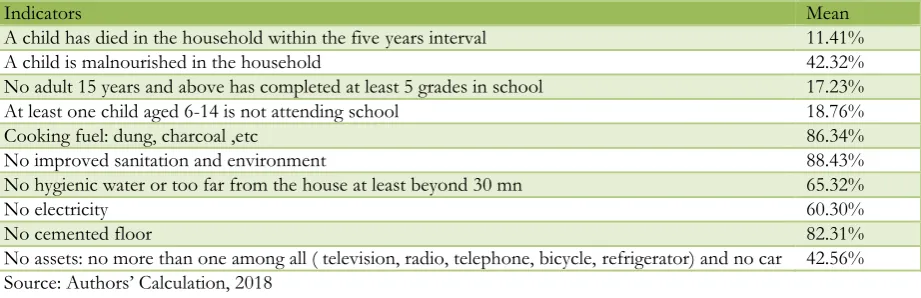
The result of the following table shows that majority of the households are grossly deprived with regards to dignified and improved standard of living.
3.2.1 Multidimensional Headcount ratio, Intensity of poverty and MPI
Table 3.2.1 The MPI: Adjusting the Headcount Ratio by the Intensity Multidimensional Headcount
ratio (H) Intensity of poverty (
A) MPI
0.82 0.49 0.40
Source: Own Computation, 2018
The explanation for the information in table 3.2.1 is clear-cut: in the study area 82 percent of people are MPI poor. According to the MPI, this means that they are in sharp or acute poverty. They are deprived as a minimum either by 1) each and every indicators of a single dimension or 2) a blend across dimensions such as being in a household with a malnourished person, no hygienic water, a dirt floor and poor sanitation, etc. Table 3.2.1 also indicates that on average the poor are deprived in 49 percent of the weighted indicators. The MPI reflects the group of the population that is multidimensionally poor accustomed by the intensity of the deprivation suffered. The average poor person is underprivileged in 49 percent of the weighted indicators, thus the intensity is 49 percent. Since the society of the study area on average deprived in 49 percent of the weighted indicators, the society is deprived in 40 percent of the total potential deprivations it could experience taken as a whole.
3.2.2 Incidence of Deprivation across Multidimensional Poverty Indicators
Table 3.2.2 Occurrence of Basic Deprivation Indicators
Indicators Mean
A child has died in the household within the five years interval 11.41%
A child is malnourished in the household 42.32%
No adult 15 years and above has completed at least 5 grades in school 17.23%
At least one child aged 6-14 is not attending school 18.76%
Cooking fuel: dung, charcoal ,etc 86.34%
No improved sanitation and environment 88.43%
No hygienic water or too far from the house at least beyond 30 mn 65.32%
No electricity 60.30%
No cemented floor 82.31%
No assets: no more than one among all ( television, radio, telephone, bicycle, refrigerator) and no car 42.56% Source: Authors’ Calculation, 2018
21
3.3 Rural –Urban Poverty IncidenceTable 3.3 Measures of Poverty Incidence in Rural and Urban Areas Live on less than $ 1.25 per day Multidimensional Poor
Urban 58.3% 74.3%
Rural 67.1% 83.5%
Source: Authors’ Calculation, 2018
Results from the analysis of monetary and nonmonetary indicators of poverty in the study area showed that: the poverty incidence rate in urban area jumps from 58.3 % (based on monetary poverty) to 74.3% of when multidimensional (non-monetary) indicators or features are taken into account. Area inequalities in deprivation from a multidimensional and a monetary approach are clearly to the disadvantage of rural dwellers that have been found to suffer more harshly from deprivation through non-monetary and monetary indicators. The incidence of multidimensional poverty is very high (83.5%) among rural community, whereas the level of monetary poverty is 67.1 % for this society.
4. Conclusion and Recommendation
The study concludes that multidimensional destitution among households in Jimma zone of south west Ethiopia is principally sweeping. The variables that predicted multidimensional poverty in the study area include age, sex, marital status, household size, educational level, principal occupation and place of residence. Age of the household head, principal occupation and place of residence are significant at 1 percent level, while household size, sex of the household head and education are significant at 5 percent level. The variable marriage is not significant at 5 and 1 percent significance level. The noteworthy factors that increase the probability of being multidimensionally poor are being a female headed household, increased household size, working in agricultural sector and residing in rural areas. The significant variables that reduce the likelihood of being multidimesionally poor are working in trade and service sector, found in productive age, having education and residing in urban areas. In the study area 82 % of the people are multidimensionally poor and the poor are underprivileged by 49 % of the weighted pointers. The incidence of deprivation is very high for sanitation, cooking fuel and floor among the basic indicators. And rural dwellers are disadvantageous over monetary and non- monetary deprivation in the study area.
In the framework of the population under study, it is clear that for anti-multidimensional poverty schemes to be well-targeted and hence more efficient, policy or
program devise and interventions ought to focus on addressing the specific
variables that are found to be most significant in determining the level of household multi-dimensional poverty. In particular, such interventions should clearly target the needs of
rural dwellers, which are relatively more underprivileged in terms of multidimensional fac-tors. Improving wealth of rural household can be achieved by improving access to resource and implementing policies that demarcates the right to these possessions. Education and agriculture must get more attention to bring sustainable change on multidimensional poverty reduction campaign. Furthermore, a comprehensible understanding of the inter-linkages between significant variables or determinants of multidimensional deprivation is also indis-pensable to devise interventions that will be both cost-effective and more competent in
reducing multidimensional poverty. Generally, an integrated approach is necessary for guid-ing interventions to effectively tackle issues of multidimensional deprivation in
22
References
Alkire, S., & Foster, J. (2011). Understandings and misunderstandings of multidimensional poverty measurement. The Journal of Economic Inequality, 9(2), 289-314.
Apata, T. G., Folayan, A., Apata, O. M., & Akinlua, J. (2011). The economic role of Nigeria’s subsistence agriculture in the transition process: Implications for rural development (No. 353-2016-18101).
Batana, Y. M. (2013). Multidimensional measurement of poverty among women in Sub-Saharan Africa. Social Indicators Research, 112(2), 337-362.
Battiston, D., Cruces, G., Lopez-Calva, L. F., Lugo, M. A., & Santos, M. E. (2013). Income and beyond: Multidimensional poverty in six Latin American countries. Social indicators research, 112(2), 291-314.
Guedes, G. R., Brondízio, E. S., Barbieri, A. F., Anne, R., Penna-Firme, R., & D’Antona, Á. O. (2012). Poverty and inequality in the rural Brazilian Amazon: a multidimensional approach. Human ecology, 40(1), 41-57.
Jimma Zone Agricultural Bureau. (2017). Jimma Zone Agricultural performance report of 2017.
Kates, R. W., & Dasgupta, P. (2007). African poverty: A grand challenge for sustainability science. Proceedings of the National Academy of Sciences, 104(43), 16747-16750.
Klasen, S. (2000). Measuring poverty and deprivation in South Africa. Review of income and wealth, 46(1), 33-58. Mitiku, A., & Legesse, W. (2014). The determinants of rural households' vulnerability to food insecurity in Jimma
Zone, South Western Ethiopia. Journal of Biological and Chemical Research, 31(1), 62-72.
Noel, V., Yilma, T., Legesse, N., Zeytun, G., & Belay, B. (2012). Notes for the course Principles of Statistical Inference: North-South project in Biostatistics Series, Belgium.
OLZR. (2007). Oromiya Livelihood Zone Reports, Sokoru and Tiro Afeta woreda, Jimma Administrative Zone. accessed fromwww.feg-consulting.com/feg- shared.../liu/.../jimma/Chora%20Botor.pdf.
Poverty, A. (2001). World Development Report 2000/2001. Ravi Kanbur and Nora Lustig, Eds.
Ravallion, M., Chen, S., & Sangraula, P. (2009). Dollar a day revisited. World Bank Economic Review, 23(2), 163– 184.
Santos, M. E. (2013). Tracking poverty reduction in Bhutan: Income deprivation alongside deprivation in other sources of happiness. Social indicators research, 112(2), 259-290.
Spencer, D. (2002). The features of agriculture in Sub-Saharan Africa and South Asia: In sustainable food security for all.
TRENDS, G. (2017). Challenges and Opportunities in the Implementation of the Sustainable Development Goals. Wang, X., & Alkire, S. (2009). China’s multidimensional poverty measurement: estimation and policy implications.
Rural Econ China,12:4–23.
Whelan, C. T., Layte, R., & Maître, B. (2004). Understanding the mismatch between income poverty and deprivation: a dynamic comparative analysis. European Sociological Review, 20(4), 287-302.