• At the end of this chapter, you should be able to: 1. Define Energy, Work, and Power;
2. Apply the Work-Kinetic Energy Theorem in some dynamics problem;
3. Define and apply the law of conservation of
mechanical energy in some dynamics situations and problems; and
4. Relate Newton’s Laws and the Conservation of
• A quantifiable attribute of a physical system
• Not an object nor any substance
• Physical Properties:
• Dimensions: ML2/T2
– Mass times (Length* Length) Over (Time *Time)
• Type: Derived, Scalar • SI UNIT: Joule (abbr., J)
• Energy is defined as the ability of a system to do work…
• Mechanical work is the amount of ENERGY transferred by a FORCE.
• In the 1830s, the French mathematician Gaspard-Gustave Coriolis coined the term work as the
• Positive and negative signs of work indicate whether the object exerting the force is
transferring energy to some other object, or receiving it.
• Positive sign is assigned to work, if it is done on the system.
• Negative sign is assigned to work, if the system
does it on another system!
Physical Properties: • Dimensions: ML2/T2
– Mass times (Length* Length) Over (Time *Time)
• W = Force*displacement • [J]= [N] *[m]
• 1Joule = 1 Newton-meter
• Why Work is scalar when it is the product of 2 vectors ( F and d)
• Mathematically it's because work energy WE = F dot S and a
so-called dot product gives a scalar result. F is the force vector and S is the distance vector pushed or pulled by the force.
Work and energy have the same units. From the definition of work, we see that those units are based on Force times Distance (F * d). Thus, in SI units, work and energy are measured in newton-meters.
A newton-meter is given the special name joule (J), and 1 J = 1 N ⋅ m = 1 kg ⋅ m²/s² .
One joule is not a large amount of energy; it would lift a small 100-gram apple a distance of about 1 meter.
Work from Joules to Kilocalories(the unit of calories in food)
Person’s average daily intake of 10,000 kJ (or about 2400 kcal ) of food energy.
One calorie (1 cal) of heat is the amount required to warm 1 g of water by 1ºC , and is equivalent to 4.184 J ,
• The work W done by a constant force F whose point of application moves through a distance del x is
defined to be
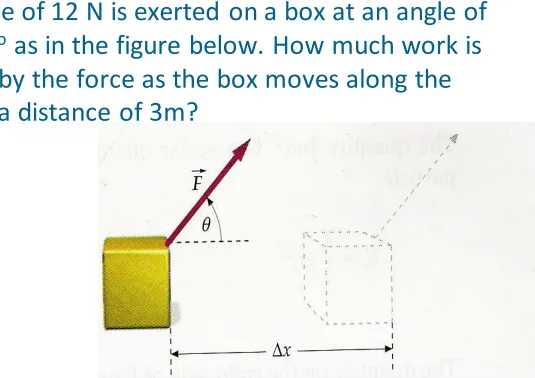
W = F ● Δx = FΔxcosq
• Work is positive when the force has a
• Work is negative when the force has a component
Given: Force = 12 N, angle = 40° and ∆x = 3m Find: Work
Solution:
• Can be carried out using graphical methods! • Find the work done by the force Fx, see figures
• If there are several forces that do work at different
instances, the total work is found by computing the work done by each force and summing:
Wtotal = F1xΔx1 + F2xΔx2 + F3xΔx3 +...
• When the forces do work on a particle all at the same time,
the total work is found by computing the work done by the net force and the total displacement and summing:
Energy Work
Definition Ability to do work -ENERGY transferred by a FORCE -product of force and displacement Dimensions ML2/T2 ML2/T2
Unit Joule (J) Joule (J)
Type Derived, scalar Derived, scalar
Symbol E W
Equation W=Fx∆x=Fcosø∆x
*Note: 1Joule = 1 Newton-meter
True or False?
1. Only the net force acting on an object can do work
2. .– False
2. No work is done on a particle that remains at rest
1. c
– True
3. A force that is always perpendicular to the velocity
of a particle never does work on the particle
1. c
A truck of mass 3000 kg is to be loaded onto a ship by a crane that exerts an upward force of 31kN on the truck. This force, which is just strong
enough to get the truck started upward, is applied over a distance of 2m. Find
a)Work done by crane is based on load being lifted or net force
∑F = ma = m (1.054g) = Fapp – W = Fapp – mg Fapp = 2.054 mg
W = Fapp (d) = 2.054 (3,000Kg *9.8 m/s²) * 2 m = 120, 800 Kg m²/s²
b)Work done by gravity
Wg = - mg (d) = - 3000Kg * 9.8 m/s² (2m)
• Kinetic energy is the energy associated with particles and systems that are moving.
• Symbol and Formula:
K = ½ mv2
Unit Analysis: [K] = [m]*[v]2
• There is an important relation between the total work done on a particle and the initial and final speeds of the particle.
• The total work done on a particle is equal to the change in its kinetic energy:
Wtotal = ΔK = ½ mvf2 - ½ mvi2
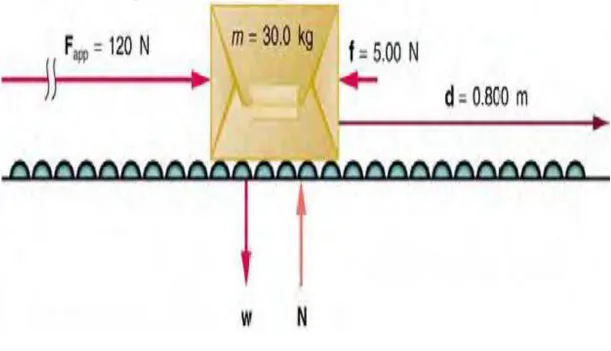
• Net work will be simpler to examine if we consider a one-D situation where a force is used to accelerate an object in a direction parallel to its initial velocity. Such a situation occurs for the package on the roller belt conveyor system shown in Figure 7.4.
• A package on a roller belt is pushed horizontally through a distance
d. The force of gravity and the normal force acting on the package are perpendicular to the displacement and do no work.
• Moreover, they are also equal in magnitude and opposite in direction so they cancel in calculating the net force.
• The net force arises solely from the horizontal applied force Fapp
and the horizontal friction force f . Thus, as expected, the net force is parallel to the displacement, so that q = 0º and cos q = 1 , and the net work is given by
• The effect of the net force Fnet is to accelerate the package from Vo to Vf . The kinetic energy of the package increases, indicating that the net work
• done on the system is positive.
• By using Newton’s second law, and doing some algebra, we find: • Fnet = m*a which gives
• Wnet = m * a * d
• To get a relationship between net work and the speed given to a system by the net force acting on it, we take d = Xf − Xo and use the equation studied in UARM
in One D for the change in speed over a distance d if the acceleration has the constant value a ; namely, Vf² = Vo² + 2ad
• Solving for acceleration gives a = (Vf² - Vo²)/2d
• . When a is substituted into the preceding expression for Wnet , we obtain
• Wnet = mad = m (Vf² - Vo²)/2d (*d) = m (Vf² - Vo²)/2 •
• Combining UARM equation and work kinetic energy theorem
a = (Vf² - Vo²)/2d
W = F * d = m a d = m (Vf² - Vo²)/2d ( *d) = m (Vf² - Vo²)/2 • F * d = m Vf²/2; Vf² = 2 (F) * d / m
1. Find the value of velocity of the Example shown in Fig. 7.4 and the kinetic energy.
2. Solve Example 3 part b) where friction (fk = 0.2) is
included to find the speed of the block and compare with part a)
3.A student enters a dogsled race during the winter break. To get started she pulls the sled (total mass 80 kg) with a force of 180N at 20 degrees from the horizontal for a
distance of 5m. Find: (a) The work she does (b) The final speed of the sled after it moves ∆x=5m, assuming that it starts from rest and there is no friction, and c) the
• The Power P supplied by a force is the rate at which the force does work. It’s also the rate of energy
transformation from chemical/electrical energy to mechanical energy
• PHYSICAL PROPERTIES:
• Dimensions [F*L/T] = [F*V] • Type: Derived, Scalar
• SI unit: Watt (abbr, W) • 1 W = 1 J/s
– *W is Watt, after James Watt (1736-1819), famous for his contributions in electricity and electric power
• A small motor is used to operate a lift that raises a 300 N load of bricks to a height of 20 m in 25s.
• What is the minimum power the motor must produce?
Solution:
Given: Load = 300 N; d = 20 m; t = 25 s • Find: Power (P)
P = Work/time = F * d / t
• A person pulls a block with a force of 25N at an angle of 300 with the horizontal. If the block is moved 6m in the
horizontal direction in 4s, how much power is expended?
• Solution:
• F cos 30 = 25 N cos 30 = 21.5
1. (True or False) A kilowatt-hour is a unit of power
2. Force A does 5J of work in 10s. Force B does 3J of work in 5s. Which force delivers greater power?
• Note the difference between power and work.
• Two motors that move an object the same
distance do the same amount of work, but one that does it in the least amount of time supplies more power!
• Electric companies charge for energy not power, usually by the kilowatt-hour (kW•h)
• A kilowatt-hour of energy is
• Potential energy is the work done by a force (such as
gravitational force or spring force) when the relative
positions of particles are changed within a physical system.
• Loosely, one can think of potential energy:
– as the energy stored in an object as a result of the work done to bring it to that position from a
reference point.
• Potential energy is so named because this stored energy or work has the potential to change the state of other objects when it is released.
• The potential energy reference is a location where the potential energy is made to vanish (made to a value equal to zero)
• The potential reference serves as a benchmark to which all potential energy measurements are
carried out.
• Where is the potential reference placed:
Symbol: U[subscript refers to type]
• Potential Energy associated with gravitational force.
GPE = UG = mgh + UG0
Batman, who weighs 55 Kg, stands on a ledge that is 8m above the ground.
What is the potential energy U in kJ of the Batman-earth system if (a) U is chosen to be zero on the ground
(b) U is chosen to be zero 4m above the ground (c) U is chosen to be zero 10m above the ground?
Solution:
U = mgh = 55Kg *9.8 m/s² * 8 m = 4312 Kg m²/s² = 4312 N m