
Non-spherical source-surface model of the heliosphere:
a scalar formulation
M. Schulz
Space Sciences Department, Lockheed Martin Palo Alto Research Laboratories, 3251 Hanover Street, Palo Alto, California 94304 (USA)
Received: 19 September 1995 / Revised: 24 October 1996 / Accepted: 30 October 1996
Abstract. The source-surface method offers an
alter-native to full MHD simulation of the heliosphere. It entails specification of a surface from which the solar wind flows normally outward along straight lines. Compatibility with MHD results requires this (source) surface to be non-spherical in general and prolate (aligned with the solar dipole axis) in prototypical axisymmetric cases. Mid-latitude features on the source surface thus map to significantly lower latitudes in the heliosphere. The model is usually implemented by deriving the B field (in the region surrounded by the source surface) from a scalar potential formally ex-panded in spherical harmonics, with coefficients chosen so as to minimize the mean-square tangential compo-nent of B over this surface. In the simplified (scalar) version the quantity minimized is instead the variance of the scalar potential over the source surface. The scalar formulation greatly reduces the time required to compute required matrix elements, while imposing essentially the same physical boundary condition as the vector formulation (viz., that the coronal magnetic field be, as nearly as possible, normal to the source surface for continuity with the heliosphere). The source surface proposed for actual application is a surface of constant F~rÿkB, where~ r is the heliocentric distance
and~Bis the scalar magnitude of the B field produced by currents inside the Sun. Comparison with MHD simulations suggests that k1:4 is a good choice for the adjustable exponent. This value has been shown to map the neutral line on the source surface during Carrington Rotation 1869 (May–June 1993) to a range of latitudes that would have just grazed the position of Ulysses during that month in which sector structure disappeared from Ulysses’ magnetometer observations.
1 Background
The magnetic field in the solar corona is traditionally modeled (Schatten et al., 1969; Altschuler and Newkirk, 1969; Hoeksema and Scherrer, 1986; Hoeksema, 1991) as being current-free (and thus derivable from a scalar potential) within a spherically annular volume of inner radius 1r and outer radius r0 1:6ÿ2:5r sur-rounding the Sun. The inner sphere rr
corre-sponds to the photosphere, at which the line-of-sight component of the Sun’s magnetic field B is remotely observed by means of Earth-based Zeeman spectros-copy. The outer sphere rr0 is regarded as a magnetic equipotential surface, to which B is therefore perpendicular and from which the solar wind implicitly flows radially outward into the heliosphere. Schatten
et al. (1969) chose r01:6r for the radius of their source surface. Altschuler and Newkirk (1969) chose r0 2:5r in order to achieve better agreement with dimensions of large coronal helmet structures seen in eclipse photographs.
Hoeksema (1995) currently use a modified version of Schatten’s approach, treating these two radii as adjus-table parameters of their model (see also Wang and Sheeley, 1995).
In a lesser known alternative formulation, Schulz
et al. (1978) gave the source surface of Altschuler and
Newkirk (1969) a non-spherical shape (still enclosing a volume 125pr3=6) but preserved its role as a magnetic equipotential surface from which the solar wind flows normally outward along straight lines. The particular shape of source surface chosen by Schulz et al. (1978) to illustrate the new model was an isogauss of the Sun’s dipole field. The equation of this source surface (of equatorial radiusr0 2:3r) wasr 13 cos2h1=6r0, where hdenotes the magnetic colatitude. The essential feature of this surface was its prolateness along the dipole axis.
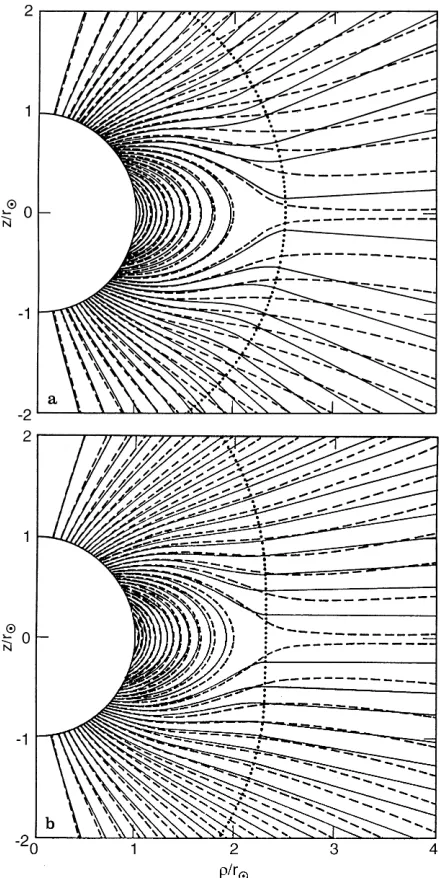
Schulz et al. (1978) found that rectilinear trajectories extending normally outward from such a source surface adequately simulated the field-line directions obtained by Pneuman and Kopp (1971a, b) from their MHD solution (see Fig. 1b) and adequately spread magnetic field lines throughout the heliosphere, so that the meridional ( radial) component of B was virtually independent of magnetic latitude at any specified rJ1 AU. Ulysses observations by Smith and Balogh (1995) have confirmed this (the latitude-independence of r2B
r)
as a desirable result.
Levine et al. (1982) applied the concept of Schulz
et al. (1978) to a more realistic (not purely dipolar)
heliomagnetic field. The magnetic field B ~B B in the
region rrrs h; u) between the photosphere and
the non-spherical source surface was again separated into contributions due to currents at r<r and at
rrs h;u), respectively, so that
~
B ÿrr
XN
n1 Xn
m0
r=rn1gmn cosmuh m
n sinmuP m n h
1a
B ÿ r3=r02rX
N
n1 Xn
m0
r=r0ngmn cosmu
hmn sinmuP m
n h 1b
wherer0is a nominal (e.g., equatorial) radius character-izing the source surface and thus normalcharacter-izing the expansion coefficients gm
n; hmn
8 9
in Eq. (1b). The expansion coefficients gmn; h
m n
8 9
in the work of Levine et al. (1982) were obtained by minimizing (with respect to the gm
n; h m n
8 9
) a bilinear variational quantity equal to the mean-square tangential component of B over the source surface. (The goal of this procedure was to make B as nearly as possible normal to the source surface from the inside.) The value ofrrs h; uon the source surface was implicitly specified by adopting a compromise between a source surface of constantB~2(as in Schulz et al., 1978) and a source surface of constantr (as in Altschuler and Newkirk, 1969). The present work offers a simplified prescription of the source surface and a streamlined determination of the coefficients gm
n; h m n
8 9
,
in the hope that these steps will make the model easier to use in practice.
2 Source surface
The source surface in the present work is regarded (Schulz, 1995) as a surface of constantF~rÿkB, where~
~
B j ~Bj) is the absolute value of the magnetic field B~
produced by currents inside the Sun and k 0 is an
Fig. 1a,b. Representative field lines emanating from selected
photo-spheric latitudes in various coronal magnetic-field models, applied to the case in which the Sun’s field is dipolar. Dashed curves correspond to MHD model of Pneuman and Kopp (1971a,b) in both panels. Solid curves correspond to source-surface models: a with spherical source surface (dotted curve) of radius r2:5r (Altschuler and Newkirk, 1969), corresponding tok 1in present notation; and b with ‘‘dipole-isogauss’’ source surface (dotted curve) of variable radius
r2:3 13 cos21=6r
[image:2.596.307.527.242.681.2]adjustable parameter. The limitk! 1leads back to the usual spherical source surface (Schatten et al., 1969; Altschuler and Newkirk, 1969), which was intended primarily for modeling the corona (not the entire heliosphere). The choice k0 leads back to a source surface of constant B~ (Schulz et al., 1978). For the special (test) case of a dipolarB field (but for general~ k) the equation of a source surface with equatorial radius r0 would be
r 13 cos2h1= 2k6r0; 2 where h is the magnetic colatitude. The unit vector ^n
normal to the source surface would be given in spherical coordinates by
^
n ÿ j r~F jÿ1 r~F
3^hcoshsinh k3^r 13 cos2h 9 cos2hsin2h
k32 13 cos2h21=2 : 3 The direction of ^n is easier to visualize in cylindrical
coordinates (qrsinh; zrcosh), since the value of dz
dq
k3 k4cos2hcosh
k3 3 k4cos2hsinh 4 along ^n at the source surface is equal to the tangent of
the heliomagnetic latitudekto which the corresponding field line would map asymptotically. This dz=dqshould well approximate the value of tankalong the field line at r1:1ÿ5:4 AU (the range spanned by Ulysses). However, the actual equation of a solar-wind stream-line, from the source surface to the boundary of the heliosphere in this model, is
zzs dz=dqs qÿqs; 5 where the subscript s denotes evaluation at the source surface (Schulz et al., 1978).
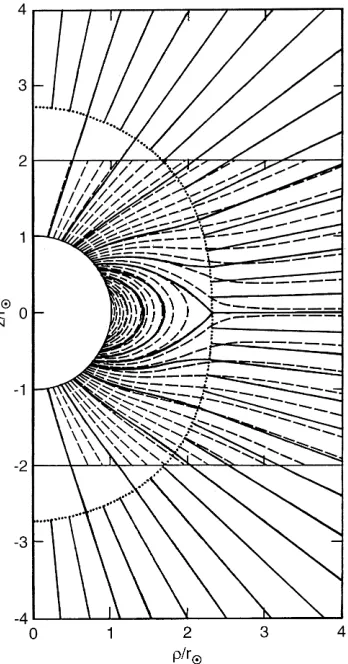
The dotted curve in Fig. 2 corresponds to the source surface specified by Eq. (2) fork1:4, withr0chosen so as to preserve the enclosed volume 125pr3
=6. In this
case a source surface of equatorial radius r02:33r would enclose the same volume as a sphere of radius 2:5r. The solid lines in Fig. 2 extend normally outward from selected latitudes (5 apart) on the source surface, for comparison with the directions of MHD field lines (dashed curves) obtained by Pneuman and Kopp (1971a, b). This comparison confirms that k1:4 is a reasonable choice for the shape parameter k in Eq. (2), at least for the dipolar test case. Moreover, the choice of k1:4 has been found (Schulz, 1995) to account within 1 for the maximum latitude (30S) reached by the heliospheric current sheet (HCS) at r4:7 AU during May 1993, when ‘‘sector structure’’ first disappeared from the Ulysses magnetometer observations (Smith
et al., 1993).
Since the Sun’s B field is predominantly dipolar only during part of the solar cycle, extending for a few years on either side of solar minimum, it may be premature to infer that the same choice for k should apply under solar-maximum conditions also. For now this is just a working hypothesis to be tested against future Ulysses
data. However, Levine et al. (1982) found that a similarly (although parametrically more cumbersome) intermediate shape between k0 and k 1 could account quite well not only for the MHD field configuration obtained by Pneuman and Kopp (1971a,b) in the dipolar test case, but also for a more complicated coronal and interplanetary B-field config-uration encountered not far from solar maximum.
3 Variational principle
The magnetic field B ( ~BB ) specified by Eq. (1) is
[image:3.596.312.486.331.663.2]derivable from a scalar potentialV ~V Vatrr0. The vector B is made everywhere perpendicular to the spherical source surface (of radius r0) employed in the model of Schatten et al. (1969) or Altschuler and Newkirk (1969) by choosing the expansion coefficients
Fig. 2. Dashed curves represent field lines emanating from selected
photospheric latitudes in MHD model of Pneuman and Kopp (1971a, b) for the case in which the Sun’s field is dipolar. Solid curves represent field lines that cross the source surface, specified as
r2:33 13 cos2h5=44
fgm n;h
m
ng in Eq. (1b) so that g m n;h
m n g
m n;h
m n. This
choice offgm n;h
m
ngmakes the source surface (rr0) an equipotential ofV. Indeed, it makesV 0 (regardless of
handu) atrr0.
The magnetic field B ÿrV specified by Eq. (1) is made (as nearly as possible) perpendicular to a prolate source surface in the model of Schulz et al. (1978) and Levine et al. (1982) by minimizing the variational quantity
r I
ss
n2B2dA 6
with respect to the expansion coefficientsfgm n;h
m
ngin Eq.
(1b). This procedure seems simple enough in concept, but its implementation in general has led to page-long equations and correspondingly long computation times (Levine et al., 1982).
The present work offers a simpler procedure for making B (as nearly as possible) normal to the source surface from the inside. The variational quantity minimized here is
r3 I
ss
V ÿ hVi2dA; 7
wherehVidenotes the mean value ofV over the source surface. (It is easy to show that, if the goal is to minimize the mean-square deviation ofV from a constant over the source surface, then that constant must behVi). As long as B is to be derived from a scalar potential in the region surrounded by the source surface, a scalar formulation based on Eq. (7) seems simpler to implement than a vector formulation based on Eq. (6). The results should be equivalent, if not identical.
The coefficientsfgmn;h m
ngare presumed to have been
determined (e.g., Hoeksema and Scherrer, 1986) from the line-of-sight component of B, as measured through Earth-based Zeeman spectroscopy. That deconvolution typically invokes a spherical source surface of radius r2:5r. Better values for the coefficients fgmn;h
m ng
could possibly be deduced through use of a prolate source surface, but this potential refinement (which would seem to require an iterative deconvolution of the solar magnetic-field data) is not addressed here. Only the coefficients fgmn;h
m
ng are evaluated via Eq. (7) in the
present work.
Since r3 is algebraically bilinear in the expansion coefficientsfgmn;h
m
ng, the equations dr3=dgm
0
n0 dr3=dhm
0
n0
0 suffice to determine optimal values for the N N2 coefficientsfgmn;h
m
ng. There are N=2 N3linear
equa-tions of the form
or3 ogm0 n0
2 I
ss
V ÿ hVi oV
ogm0 n0
ÿohVi
ogm0 n0 dA 2 I ss
V ÿ hVioV=gmn00dA0; 8a
corresponding to distinct values of (n0;m0), and N=2 N1 linear equations of the complementary form
or3 ohmn00
2 I
ss
V ÿ hVi oV
ohmn00
ÿohVi
ohmn00
" #
dA
2 I
ss
V ÿ hVioV=ohmn00dA0; 8b
also corresponding to distinct values of (n0;m0). The parenthesized factor in Eq. (8) is linear with respect to thefgmn;h
m
ngin each case; the factors in square brackets
can depend on (n0;m0) but not explicitly on fgmn00;h m0 n0g,
since V itself depends linearly on fgm0 n0;h
m0
n0g in that
factor. The terms ohVi=ognm00 and ohVi=oh m0
n0 can be
removed from the square-bracketed factors in Eqs. (8a) and (8b), respectively, because they are independent of spatial coordinates. Thus, they behave as constants in any integrations over the source surface of whatever shape, which thus reduce to integrals of V ÿ hViwith respect to dA over the source surface. Such integrals vanish by definition:hViis the mean value ofV over the source surface. A further simplification (such that hVi 0) occurs if B (and thus the source surface itself)~
is adequately symmetric between north and south. Otherwise it is necessary to implement Eqs. (8a) and (8b) as they stand, accepting that hVi can depend on fgm0
n ;h m0
n gifhVi 60. 4 Test case
The greatly simplified case of dipolar B illustrates how~
this described variational procedure might work in practice. The source surface in this case reduces to that specified by Eq. (2), and the magnetic field B given by Eq. (1) becomes derivable from the scalar potential V r;h g01 r3=r2cosh
r3=r20X
N
n1
r=r0ng0nPn cosh; 9
with only odd values of n 1;3;5; ::: represented in the summation. Legendre functions
Pn x
1 n!2n
dn dxn
2
x2ÿ1n3 10a
satisfy the differential equation d
dx 2
1ÿx2dPn dx
3
n n1Pn x 0: 10b
It follows from Eq. (9) that dV=dg0
n0 r3=r202
r=r0n0Pn0 x, where xcoshP1 x. Thus, it follows
from Eq. (8a) that XN
n1 g0n
I
ss
r=r0nn0Pn xPn0 xdA
ÿg01 I
ss
r=r0n0ÿ2xPn0 xdA 11a
dA4pr2 1 3x
2 1ÿx2 k32 13x22
" #1=2
dx 11b
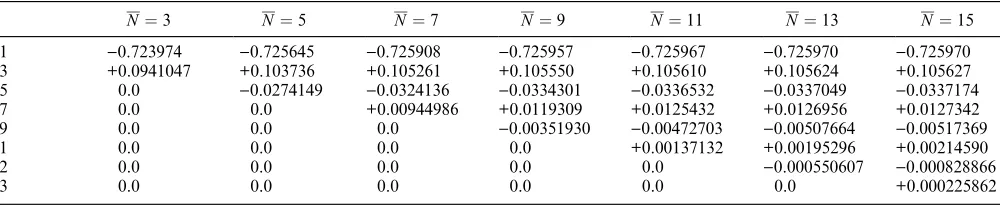
for 0x1. The required integrals have been evaluated numerically with Mathematica (Wolfram, 1992), which has also been programmed to solve the resulting simultaneous linear equations specified by Eq. (11). Results for fg0n=g01g corresponding to selected
values of N 3;5;7; :::;15 are listed in Table 1. Truncation of Eq. (1b) at 1 would be contrary to the spirit of the model but is found to yield g0n=g01 ÿ0:708580.
The values of g0n=g01 in Table 1 represent normalized 2n-pole moments due to azimuthal currents that flow
outside the source surface. These values specify the relative weights that should be assigned to the various P0n hin Eq. (1b) if the Sun’s own magnetic field (B) were~
purely dipolar. The value ofg0n=g01in any row of Table 1 seems to approach a limit asN ! 1, but the values of fg0n=g01g in any column of Table 1 are mutually
optimized for the corresponding N. Strictly speaking, this means that Eq. (1b) is not a uniformly convergent representation of B unless k 1(i.e., unless the source surface is spherical). One cannot just truncate any column in Table 1 at some n<N and expect the resulting representation to be ‘‘good enough.’’ Even so, there is little visible difference between theN 13 model and the N 11 or theN 15 model when representa-tive field lines are plotted for comparison with Pneuman and Kopp (1971a, b).
Magnetic field lines in heliospheric models are usually traced numerically (e.g., by using a fourth-order Runge-Kutta technique) as space curves locally tangential to B. However, the tracing procedure can be greatly simpli-fied, at least for an axisymmetric B field derived from a scalar potential, by formally constructing Euler poten-tials a;b such that bu and B ra2 rb ÿrV (e.g., Stern, 1976, 1994)
1 rsinh
^r
r
oa
ohÿ ^hooar
^roV or
^
h
r
oV
oh 12
This means that
oa=oh ÿr2sinh oV=or 13a and that
oa=orsinh oV=oh 13b
for the case of a current-free axisymmetric B field. (This is admittedly a very special test case, unlikely to be encountered in nature.) Thus, it follows from Eq. (13a) that
a r;h g01 r3=r 1ÿx2 r3=r0X
N
n1
r=r0n1g0n nÿ1!2n
dnÿ1 dxnÿ1 x
2ÿ1n
14a
and from Eq. (13b) that
a r;h g01 r3=r 1ÿx2 ÿ r3=r0 1ÿx2X
N
n1
r=r0n1g0n
n1!2n
dn1 dxn1 2
x2ÿ1n3: 14b
That these two expressions fora r;hare equivalent can be seen by integrating Eq. (10b) with respect to x. The latter form of Eq. (14) is probably the more convenient, however: This form shows sin2h 1ÿx2explicitly as a factor common to all terms in the summation, leaving the derivative (rather than the integral) of Pn x with
respect to x to be generated (as a callable function) by Mathematica (Wolfram, 1992).
The value ofaat any point along a field line must be equal to 1=2p times the magnetic flux enclosed by rotating that field line about the symmetry axis. That a andbremain constant along any field line is well known and obvious, since ra1 ra2 rb rb1 ra2 rb 0. (The cross product between any two vectors is always perpendicular to each.) Thus, it follows from Eq. (14b) that the quantity
1
L 1ÿx 2
r=r 1ÿX
N
n1
r=r0n2 g0
n=g01
n1
dPn
dx
" #
15
should remain constant on the magnetic surface (shell of field lines) that it labels. (The ‘‘L’’ terminology is borrowed from magnetospheric physics. The idea is that a dipolar field line would satisfy the equation rLrsin2h and so would intersect the photosphere
at a magnetic latitude K such that cosKLÿ1=2.) In a field geometry stretched by the heliospheric current sheet, the enclosed magnetic flux remains proportional to 1=L, but the field line intersects the equator atr>Lr
[image:5.596.50.550.119.227.2]and the photosphere at a magnetic latitude slightly higher than cosÿ1 Lÿ1=2. Thus, for example, the last
Table 1. Optimized values ofg0n=g01for selected values ofN
n N3 N5 N7 N9 N11 N13 N15
1 )0.723974 )0.725645 )0.725908 )0.725957 )0.725967 )0.725970 )0.725970
3 +0.0941047 +0.103736 +0.105261 +0.105550 +0.105610 +0.105624 +0.105627
5 0.0 )0.0274149 )0.0324136 )0.0334301 )0.0336532 )0.0337049 )0.0337174
7 0.0 0.0 +0.00944986 +0.0119309 +0.0125432 +0.0126956 +0.0127342
9 0.0 0.0 0.0 )0.00351930 )0.00472703 )0.00507664 )0.00517369
11 0.0 0.0 0.0 0.0 +0.00137132 +0.00195296 +0.00214590
12 0.0 0.0 0.0 0.0 0.0 )0.000550607 )0.000828866
closed field line (which reaches xcosh0 at rr0 2:33r) in the present model bears the label L3 1:6425 and crosses the photosphere at magnetic latitude K339:69. A purely dipolar field line with L1:6425 would cross the photosphere at K38:71. For a spherical source surface of radius r2:5r, the last closed field line would have borne the labelL35=3 and would have intersected the photosphere at
K340:32. These differences are not major. Moreover,
the present source-surface model (withk1:4) and the model with a spherical source surface (k 1) differ only slightly with respect to the field-line configuration atrK0:8r0: Decisive differences in field-line configura-tion appear only in the outer part of the region enclosed by the source surface and (especially) in the mapping of field lines from the source surface into the heliosphere.
The solid curves in Fig. 2 are selected field lines constructed via Eq. (15) from the values ofg0n=g01 shown in Table 1 forN15. These field lines have been chosen so as to intersect the source surface at 15 intervals of magnetic latitude. The superposed dashed curves are field lines from the MHD simulation of Pneuman and Kopp (1971a, b), as in Fig. 1. These had been chosen so as to intersect the photosphere at a convenient set of latitudes (not evenly spaced). Thus, the dashed and solid curves in Fig. 2 do not correspond one-to-one. The noteworthy feature is their ‘‘nested’’ relationship: They tend to interleave rather than intersect.
5 Heliospheric field intensity
The amount of magnetic flux poleward of the magnetic shell that bears the label a g0
1r2=L is equal to 2pa, and so the mean value of jBrj over any heliocentric
sphere of radius rr0 must be equal to jg01r2=r2L3j. Since L3 1:6425 (see earlier), this means that h r=AU2jBrji 1:317210ÿ5jg01j if r=AU is the
helio-centric distance measured in AU 1AU215r: The latitudinal distribution of this field intensity is of interest here for comparison with Ulysses results.
Since the construction of field lines outside the source surface is essentially geometrical, it is easy to calculate the corresponding field intensity geometrically (by invoking magnetic flux conservation). The solid straight lines in Fig. 2 are normal to the source surface, and each can be considered to radiate from a center of curvature in the same meridional plane (Schulz et al., 1978, Fig. 4). The radius of curvature of a magnetic meridian on the source surface is given by
which reduces to rc k3 r0=k 22=7r0 at the
equator hsp=2 and to rc4 k3= 4k152
21= k3r01:000141r0 at the poles h
s0;p) if k7=5. The value of Br along either polar field line
(beyond the source surface) thus varies as
Br 60:135693g012:330329r= rÿ0:397215r2 17
since the surrounding field lines would fill an infinitesi-mal cone with its apex at z 63= 4k1521= k3r0 along the axis of symmetry (see Schulz et al., 1978).
The geometry is a bit more complicated for mappings from other latitudes on the source surface, but the principle is the same: The meridional component of B should vary as the ratio between corresponding infini-tesimal areas (transverse to the solar-wind velocity) on the source surface and (as mapped to the point of interest) in the heliosphere. The ratio of such areas can be expressed (Schulz et al., 1978) as
Bm
Bs
rcqs
frc qÿqs
2
zÿzs21=2gq
rcqs
frc qÿqs1 dz=dq
2
s
1=2
gq; 18
where q;zare the cylindrical coordinates of the point of interest in the heliosphere and qs;zsare the cylindrical
coordinates of the corresponding point on the source surface. The linear mapping of a field line from qs;zsto
q;zis specified by Eq. (5). The meridional component of B (calledBmin the heliosphere and Bs on the source
surface) is simultaneously equal to B2
rB2h
1=2 and B2
qB2z
1=2
. This differs only very slightly from Br,
however, at heliocentric distancesrJ1 AU rc.
It seems most convenient to map from a selected point qs;zs on the source surface to a chosen
heliocentric distance r in the heliosphere. The corre-sponding value of qÿqs, which is needed in Eq. (18),
can be obtained by solving the quadratic equation r2 qÿqsqs
2
zÿzszs2
1 dz=dq2s qÿqs
2 r2s
2qszs dz=dqs qÿqs; 19a
where r2
s q2sz2s. The solution forqqs is
1 dz=dq2s qÿqs fqszs dz=dqs
2
1 dz=dq2s r2ÿr2sg1=2
ÿ qszs dz=dqs 19b
The colatitudehof the heliospheric point to which qs;zs
maps is indicated by Eq. (5). It is not practical to select the heliospheric point q;zfirst and then map back to the source surface, since the value of dz=dqsneeded for
making this mapping is dependent on qs;zsand would
thus remain unknown until the mapping was completed. The limitr!1yields qÿqsq!1 dz=dq
2
sÿ
1 r2 and ctn h! dz=dqs. The asymptotic value of r=r2Bm is thus given by
rc
13 cos2hsÿ 2k5= 2k6r0 13 cos2hs2
k329 cos2h
ssin2hs3=2 k3 13 cos2hs2 k329 cos2h
ssin2hs3 k3 5 cos2hsÿ1
r=r2Bm! rcqs=r21 dz=dq
2
s
1=2
Bs: 20
This quantity is plotted (solid curve) in Fig. 3, but as a function of the heliomagnetic latitude k90ÿh. The latitude k along a field line specified by Eq. (5) approaches tanÿ1 dz=dqs as r! 1. As would be expected, the asymptotic plot of r=r2Bm againstkin
Fig. 3 is almost indistinguishable from a plot of r=r2Bm against k at r1 AU (not shown). The
meridional (asymptotically radial) component of B in this model varies by about 618% from its mean value over about 80% of the unit sphere. A source-surface model with k1:4 thus leads (not surprisingly) to a latitudinal distribution of magnetic flux similar to that found by Pneuman and Kopp (1971a, b).
The dashed step-function in Fig. 3 corresponds to a hypothetically uniform latitudinal distribution of the same amount of magnetic flux, which would be in better agreement with the Ulysses observations (Smith and Balogh, 1995). The meridional component of B atr1 AU actually is almost latitude-independent (varying by less than65% from its mean value over 85% of the unit sphere) in a source surface model with k0 (Schulz
et al., 1978), which corresponds to Fig. 1b here. A
spherical source surface (k 1, corresponding to Fig. 1a here) would have led to a sinusoidal variation of Br with latitude: Br 3g01 r3=r2r0)sink, which is
contrary to all observations.
6 Summary and discussion
If the criterion for a successful heliospheric model were just that r=r2Bm be almost independent of kat rK1
AU, there might be reason to prefer the k0 source
surface (Schulz et al., 1978) over the present k1:4 version. However, a comparison between Figs. 2 and 1b confirms that the present version better accounts for the latitude-dependent direction of B outside the source surface, and Schulz (1995) found that thek1:4 model accounts better (almost perfectly, in fact) for the Ulysses-inferred latitudinal extent (Smith et al., 1993) of the heliospheric current sheet (HCS) during Carring-ton Rotation 1869 (May–June 1993, when sector structure first disappeared from Ulysses’ magnetometer observations).
It seems that only a slightly equatorward redistribu-tion of the normal component of B over the present (k1:4) source surface could preserve the desired directionality and mapping properties achieved here, while also restoring the near-uniformity of r=r2Bm
with magnetic latitude previously achieved with the k0 model. Uniqueness of solutions to Laplace’s equation for the Dirichlet problem (e.g., Jackson, 1962) posed here [and solved via Eq. (7)] precludes such a redistribution of ^n1B within the framework of
potential theory. Thus, further improvements in model-ing the heliosphere by source-surface methods would seem to require that currents be permitted to flow inside the region surrounded by the source surface. This is not a radical requirement, of course: it seems quite reason-able that the corona would contain plasma currents that merge smoothly into the HCS. A source-surface model that precludes such currents is just too naive in the present context.
The dual source-surface model of Schatten (1971) already provides for a current-bearing coronal transition region (1:6rKrK2:5r) and thus partially answers the foregoing objection. Another interesting approach, however, would be to add currents implicitly through a
B-field expansion not based on spherical harmonics
(e.g., Schulz and Eviatar, 1969; Mead and Fairfield, 1975). This approach would, of course, require that Eq. (7) be abandoned in favor of Eq. (6), as a means of enforcing (in the least-squares sense) the usual boundary condition that calls for the tangential component of B preferably to vanish everywhere on the source surface. In other words, the present (scalar) formulation of the heliospheric source-surface model can apply only if the magnetic field B is derivable from a scalar potentialV in the region enclosed by the source surface. If the region surrounded by the source surface were permitted to contain implicit currents, then the assumed volume of this region might reasonably be enlarged so as not to increase the overall amount of open magnetic flux. This step might help bring the solid curves in Fig. 2 into better agreement with the MHD field lines (dashed curves), which do remain significantly curved well beyond the present source surface (dotted curve). (An increase of 20–25% in source-surface volume would, for example, increase the equatorial radius r0 in Eq. (2) from 2:33r to 2:5r).
[image:7.596.47.289.523.701.2]There are several levels of sophistication at which a non-spherical source surface can be used for helio-spheric modeling. The trade-off is between realism and convenience. As has been noted here, the required
Fig. 3. Variation of meridional (asymptotically radial) component of
(r=r2B[component denoted (r=r2Bm] with heliomagnetic latitude
k 90ÿh) in the limit r! 1, in a source-surface model with
k7=5 for the case in which the Sun’s field is dipolar. For comparison (dashed step-function): hypothetical case (quite well approximated (Schulz et al., 1978) by a source-surface model with
algebra and numerical computations can be simplified by adopting a scalar formulation of the variational problem, minimizing Eq. (7) instead of Eq. (6) with respect to the expansion coefficients for B. However, a scalar formulation requires us to assume (as usual) that the region enclosed by the source surface is current-free, whereas comparisons of model results with various Ulysses observations cast serious doubt on this assump-tion. (The modeling of twisted coronal loops has long required field-aligned currents in the same region of space, but it has been hoped that such currents would be of sufficiently small scale not to influence heliospheric mappings.)
Another possible simplification is to use Eq. (2), rather than a surface of truly constantF~rÿkB, as the~ postulated source surface, even when B is not purely~
dipolar (as it never is in reality). This was the simplifying approach used by Schulz (1995) in a seemingly success-ful mapping of the neutral line on the source surface (see Hoeksema, 1991) to a range of heliospheric latitudes just grazed by Ulysses during Carrington Rotation 1869 (May-June 1993). If such a model source surface is Sun-centered and aligned with the heliomagnetic dipole axis, then Eqs. (7) and (8) are automatically simplified through the fact that hVi 0 by symmetry. [It would be possible with any source-surface geometry to make hVi 0 by adding an appropriate constant to an expression such as Eq. (9), but the appropriate constant would then typically depend on the fgmn;h
m
ng. Only
symmetry, such that the mean value of each spherical-harmonic function over the source surface is zero, can remove the attendant complication of Eq. (8) by making hVi 0 without such an additive constant, regardless of what values are assigned to thefgmn;h
m ng.]
However, the use of Eq. (2) as a simplified source surface regardless of the form of B seems likely to be~
successful only near solar minimum, when B is in fact~
most nearly dipolar. The goal in choosing a non-spherical source surface is to arrange for the region(s) of minimal source-surface curvature to straddle the inner edge(s) of any heliospheric current sheet(s). The choice of a surface of constantF~ as source surface shows some promise in this regard (Schulz et al., 1978; Levine et al., 1982; and in the present work) but is not guaranteed to achieve the desired configuration. However, the purpose is likely to be defeated altogether (especially near solar maximum, when B is quite complicated and multiple~
heliospheric current sheets are possible) if some fixed shape is assigned to the source surface, regardless of the form ofB.~
Perhaps, however, it is really unnecessary to perfect the source-surface method as a means of modeling the heliosphere. After all, the source-surface method is only supposed to provide a simplified means of estimating results that a full three-dimensional MHD simulation of the corona and heliosphere would provide. With such MHD models already available (e.g., Usmanov, 1993; Mikic and Linker, 1994), it might make more sense to use simplified versions of source-surface models (1) to identify solar-field configurations that would be inter-esting to extend by MHD simulation into the
helio-sphere, and (2) to set up initial (trial) field configurations that would reduce the computing time required by full MHD simulations.
Acknowledgements. This work was supported in part by JPL Contract 959569 under the Ulysses interdisciplinary scientist (IDS) program and in part by the Independent Research and Develop-ment (IR&D) program of Lockheed Martin Missiles & Space. The work forms part of a continuing effort inspired by scientific discussions at Science Working Team (SWT) meetings held by the Ulysses project under NASA and ESA sponsorship. The present report is based on the author’s week-long poster presentation at the European Geophysical Society (EGS) meeting held 3–7 April 1995 in Hamburg, Germany.
Topical Editor R. Schwenn thanks R. J. Forsyth and another referee for their help in evaluating this paper.
References
Altschuler, M. D., and G. Newkirk, Jr., Magnetic fields and the
structure of the solar corona, Solar Phys., 9, 131–149, 1969.
Hoeksema, J. T., The Solar Magnetic Field – 1985 through 1990,
Report CSSA-ASTRO-91-01, Stanford University, Stanford, Calif., 1991.
Hoeksema, J. T., and P. H. Scherrer, The Solar Magnetic Field
-1976 through 1985, Report UAG-94, World Data Center A for Solar-Terrestrial Physics, Boulder, Colo., 1986.
Jackson, J. D., Classical Electrodynamics, pp. 16–17, Wiley, New
York, 16–17 1962.
Levine, R. H., M. Schulz, and E. N. Frazier, Simulation of the
magnetic structure of the inner heliosphere by means of a non-spherical source surface, Solar Phys., 77, 363–392, 1982.
Mead, G. D., and D. H. Fairfield, A quantitative magnetospheric
model derived from spacecraft magnetometer data, J. Geophys. Res., 80, 523–534, 1975.
Mikic, Z., and J. A. Linker, Disruption of coronal magnetic field
arcades, Astrophys. J., 430, 898–912, 1994.
Pneuman, G. W., and R. A. Kopp, Gas-magnetic field interactions
in the solar corona, Solar Phys., 18, 258–270, 1971a.
Pneuman, G. W., and R. A. Kopp, Interactions of coronal material
with magnetic fields, in Solar Magnetic Fields, ed. R. Howard, pp. 526–533, Reidel, Dordrecht, 1971b.
Schatten, K. H., Current sheet magnetic model for the solar
corona, in Solar Wind, eds. C. P. Sonett, P. J. Coleman, Jr., and J. M. Wilcox, pp. 44–54, NASA SP–308, Washington, D.C., 1971.
Schatten, K. H., J. M. Wilcox, and N. F. Ness, A model of coronal
and interplanetary magnetic fields, Solar Phys., 6, 442–455, 1969.
Schulz, M., Fourier parameters of heliospheric current sheet and
their significance, Space Sci. Rev., 72, 149–152, 1995.
Schulz, M., and A. Eviatar, Diffusion of equatorial particles in the
outer radiation zone, J. Geophys. Res., 74, 2182–2192, 1969.
Schulz, M., E. N. Frazier, and D. J. Boucher, Jr., Coronal
magnetic-field model with non-spherical source surface, Solar Phys., 60, 83–104, 1978.
Smith, E. J., and A. Balogh, Ulysses observations of the radial
magnetic field, Geophys. Res. Lett., 22, 3317–3320, 1995.
Smith, E. J., M. Neugebauer, A. Balogh, S. J. Bame, G. Erdo¨s, R. J. Forsyth, B. E. Goldstein, J. L. Phillips, and B. T. Tsurutani,
Disappearance of the heliospheric sector structure at Ulysses, Geophys. Res. Lett., 20, 2327–2330, 1993.
Stern, D. P., Representation of magnetic fields in space, Rev.
Geophys. Space Phys., 14, 199–214, 1976.
Stern, D. P., The art of mapping the magnetosphere, J. Geophys.
Usmanov, A. V., A global numerical 3-D MHD model of the solar
wind, Solar Phys., 146, 377–396, 1993.
Wang, Y.-M., and N. R. Sheeley, Jr., Solar implications of Ulysses
interplanetary field measurements, Astrophys. J., 447, L143– L146, 1995.
Wolfram Research, Inc., Mathematica, version 2.1, Wolfram
Research, Inc., Champaign, Ill., 1992.
Zhao, X.-P., and J. T. Hoeksema, Modeling the out-of-ecliptic
![Fig. 3. Variation of meridional (asymptotically radial) component of(rr2B [component denoted (rr2B] with heliomagnetic latitude](https://thumb-us.123doks.com/thumbv2/123dok_us/8190882.257872/7.596.47.289.523.701/variation-meridional-asymptotically-component-component-denoted-heliomagnetic-latitude.webp)
