Schneider S. A., Suslova O. V., Tkachenko E. K., Nikolaenko K. V. The selection of the amount of anthracene derivatives from raw materials of plant origin and the study of their influence on the rat periodontal. Journal of Education, Health and Sport. 2019;9(2):532-537. eISNN 2391-8306. DOI http://dx.doi.org/10.5281/zenodo.2620499
http://ojs.ukw.edu.pl/index.php/johs/article/view/6769
The journal has had 7 points in Ministry of Science and Higher Education parametric evaluation. Part B item 1223 (26/01/2017). 1223 Journal of Education, Health and Sport eISSN 2391-8306 7
© The Authors 2019;
This article is published with open access at Licensee Open Journal Systems of Kazimierz Wielki University in Bydgoszcz, Poland
Open Access. This article is distributed under the terms of the Creative Commons Attribution Noncommercial License which permits any noncommercial use, distribution, and reproduction in any medium, provided the original author (s) and source are credited. This is an open access article licensed under the terms of the Crea tive Commons Attribution Non commercial license Share alike.
(http://creativecommons.org/licenses/by-nc-sa/4.0/) which permits unrestricted, non commercial use, distribution and reproduction in any medium, provided the work is properly cited. The authors declare that there is no conflict of interests regarding the publication of this paper.
Received: 05.02.2019. Revised: 11.01.2019. Accepted: 28.02.2019.
UDC 615.32: 547.9 + 543.544
The selection of the amount of anthracene derivatives from raw materials of plant origin
and the study of their influence on the rat periodontal
S. A. Schneider1, O. V. Suslova2, E. K. Tkachenko1, K. V. Nikolaenko1
1SE "Institute of Dentistry and Maxillofacial Surgery" NAMS of Ukraine
2Odessa National Medical University
Аbstract
The article presents a new method of ethanol extraction of anthracene derivatives from
the herb St. John's wort, the total content of which was evaluated using a calibration graph.
The drug improved mineral metabolism, showed anti-inflammatory effects in the bone tissue
of the periodontal rats.
Key words: laboratory technology, anthracene derivatives, Hypericum
perforatum grass, mineral metabolism, ethanol.
Anthracene derivatives - a group of natural compounds of polyphenolic nature, which
are based on the anthracene core of varying degrees of oxidation. They are widely distributed
in nature, found in higher plants: the legume family (senna), lily (aloe), and St. John's wort
(St. John's wort).
The above-ground part of Hypericum contains various classes of biologically active
Hypericum herb (Hypericum perforatum L.) has long been known for its antibacterial,
antiviral, cytotoxic, antidepressant, antitumor properties, but traditionally it is used to treat
inflammation [1]. Hypericin is one of the most powerful natural photodynamic agents. It is
able to generate a superoxide anion radical and a large amount of singlet oxygen [2]. The
pro-oxidant photodynamic properties of hypericin are used in photodynamic therapy of cancer,
since when activated by light, it very effectively causes apoptosis and / or necrosis of cancer
cells [2]. Light-activated pseudohypericin reduces prostaglandin E2 (PG E2) production
caused by lipopolysaccharides [3].
The purpose of the work is to isolate and quantify anthracene derivatives of the herb
St. John's wort, as well as to study its effect on the periodontal bone of experimental animals.
Materials and methods
Experiments on the study of the periodontoprotective properties of the preparation of
anthracene derivatives with the working name AP, obtained under laboratory conditions, were
carried out on 11 white female rats 18 months old. age Group 1 (5 individuals) - intact, in
group 2, 6 rats were given per os a drug at 0.1 ml / 100 g of body weight of rats per 55 days.
At the end of the experiment, the rats were scored by total bleeding from heart vessels under
anesthesia (sodium thiopental 40 mg / kg). All animal experiments were carried out in
accordance with the European Convention for the Protection of Vertebrate Animals. The
object of biochemical studies was the supernatant of the homogenates of the bone of the
alveolar process (50 mg / ml), where the content of malondialdehyde (MDA) was determined
[4]; standardized methods: total protein content, alkaline phosphatase activity, calcium and
phosphorus content, using commercial reagent kits (manufactured by DAC SpectroMed,
Moldova).
The results of the experiments were processed with the determination of the criteria
for the reliability of student differences.
Research results
Obtaining drugs based on the modification of the method [5]. The essence of the
method consists in extracting the amount of anthracene derivatives from the initial air-dry raw
material with 70% ethyl alcohol. According to the method, the optimal conditions for their
production are the extraction with ethanol of a certain concentration and the duration of its
conduct from dry plant materials.
The optimal conditions for obtaining the drug is a double extraction with 70% ethanol
The modification of the method [5] consisted in separating the fraction of lipophilic
substances of non-flavonoid nature with a polar solvent, namely hexane [6]. To this end,
hexane was added to the preparation obtained in the first stage and thoroughly mixed, after
which the mixture was allowed to settle. After spontaneous separation of the phases, the
alcohol phase was separated.
Then ethyl alcohol was distilled off under moderate vacuum conditions using a
water-jet pump at a temperature of 70 ± 5 ºС, as in dental practice it is preferable to use aqueous
solutions. At the final stage, the obtained extract was concentrated in a drying cabinet at a
temperature of 45-50 ºС.
The drug AP, obtained from the herb Hypericum perforatum by the above method,
was characterized by the presence of anthracene derivatives, in particular hypericin [5].
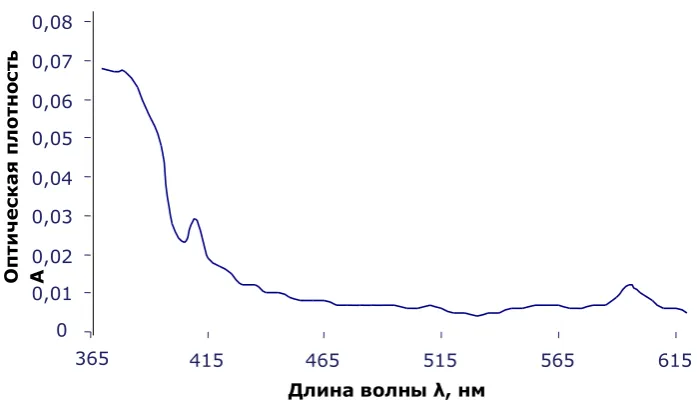
Anthracene derivatives are characterized by a peak with an absorption maximum at a
wavelength of 590 nm. The study of the absorption spectrum of the AP preparation obtained
[image:3.595.123.472.393.601.2]by us showed the presence of a corresponding peak at a given wavelength (Fig. 1).
Fig. 1 - Absorption spectrum of the alcohol solution of the drug AP
Previously, to prove the presence of anthracene derivatives in the resulting
preparation, a qualitative reaction was carried out, the essence of which was to change the
color of the test solution, into which hypericin reversibly enters due to redox processes. So,
after adding a few drops of an alkali solution to the preparation, a change in the initial red
0 0,01 0,02 0,03 0,04 0,05 0,06 0,07 0,08
365 415 465 515 565 615
Длина волны λ, нм
О
п
ти
че
ск
а
я
п
лот
н
о
ст
ь
hydrochloric acid solution led to a shift in equilibrium towards the formation of the original
form of hypericin, and, as a result, to the restoration of the original color of the solution.
Quantitative determination of anthracene derivatives in the resulting preparation was
carried out using direct spectrophotometry at a wavelength of 590 nm. Ethanol served as a
reference solution, and 1% hypericin solution served as a standard comparison solution (Fig.
2).
The amount of anthracene derivatives in terms of dry raw materials was calculated by
the formula:
where A is the optical density of the test solution; 718 - specific
absorption rate of 1% hypericin solution; m is the mass of the
feedstock (g); k is the dilution factor.
Thus, according to the results of the studies, the total content of anthracene derivatives
(AP) from the aerial part of Hypericum perforatum L. was determined, which amounted to
0.25 mg / ml of the extract.
Fig.2. Absorption spectra of the alcohol solution of the drug AP
Later, the effect of anthracene derivative (AP) on the condition of periodontal bone
tissue of rats was studied (table).
Studies have shown that under the influence of the drug in the bones of the alveolar
process, the level of MDA decreased by 25% (p = 0.001) (Table), which indicates the
antioxidant properties of the drug, manifested in the periodontal bone tissue. On the other 0
0,02 0,04 0,06 0,08 0,1 0,12
365 375 385 395 405 415 425
Длина волны λ, нм
О
п
т
и
ч
е
с
к
а
я
п
л
о
т
н
о
с
т
ь
А
hand, a decrease in the content of MDA indirectly indicates a decrease in inflammatory events
in this object of study (see table).
Table
The effect of anthracene derivatives on biochemical parameters in the bone tissue of
periodontal rats (M ± m; p)
Group Animals
Content Activity
protein (mg/g) MDA (nmol/g)
Са (mmol/g)
Р (mmol / g)
АР (mmol / s·g)
Intact 0,97±0,049 2,79±0,12 0,016±0,0012 0,016±0,0010 0,18±0,015
Anthracene
1,16±0,031 р=0,02
2,08±0,15 р=0,001
0,048±0,00026
р<0,001 0,015±0,0021 0,20±0,010
Note. In tab. confidence index p is calculated relative to the intact group.
The preparation of anthracene derivatives from the herb Hypericum perforatum
improved mineral metabolism in periodontal bone. During the 55 days of the experiment, the
drug increased the alkaline phosphatase activity by 11% (p> 0.05); the calcium content at the
same time increased by 3 times (p <0.001); the phosphorus content remained almost
unchanged (Table), i.e. the results of the experiment indicate a positive effect of the drug AP
on the bone tissue of periodontal rats.
Conclusion
Thus, in the laboratory, a preparation of anthracene derivatives from plant materials,
the herb St. John's wort, was obtained. In the course of the research, the anti-inflammatory
effects of the preparation obtained were established. The improvement of mineral metabolism
in the bone of the alveolar process is apparently associated with a decrease in the production
of PGE2 under its influence along the cyclooxygenase pathway during enzymatic membrane
oxidation of polyene acids.
REFERENCE
1. Inhibition of prostaglandin E2 production by anti-inflammatory hypericum
perforatum extracts and constituents in RAW264.7 mouse macrophage cells. [Kimberly D.P.
Hammer, Matthew L. Hillwig, Avery K.S. Solco, Philip M. Dixon, Kathleen Delate , Patricia
A. Murphy, Eve S. Wurtele, Diane F. Birt]. J. Agric.Food Chem.: 2007: 55: 7323-7331.
2. Anastasia Karioti, Anna Rita Bilia. Hypericins as potential leads for new
therapeutics. Int. j. Mol.Sci: 2010:11: 562-594.
pathways by a 4 component system mimicking an Hypericum perforatum fraction [Kimberly
D.P. Hammer, Matthew L. Hillwig, Jeffrey D. Neighbors, Young-Je Sim, Marian L. Kohut,
David F. Wiemer, Eve S. Wurtele, Diane F. Birt]. Phytochemistry.: 2008 (9): 69(12):
2354-2362.
4. Vladimirov Yu.A. , Archakov A. I. Perekisnoe okislenie lipidov v biologicheskix
membranax. M.: Nauka.: 1972: 230. (in Russian)
5. Pravdivtseva O. E. Issledovaniya po obosnovaniyam novyih podhodov k
standartizatsii syirya i preparatov Zveroboya prodyiryavlennogo. Himiya rastitelnogo syirya. :
2008: 1:. 81-86. (in Russian)
6. Tkachenko E. K. SposIb otrimannya vodnogo polIfenolnogo ekstraktu z travi
derevIyu. / E. Tkachenko, S. NosIychuk, N. Novoselska // Patent №55011 vId 11.10.2010 (in