R E S E A R C H
Open Access
A new approach to connect algebra with
analysis: relationships and applications
between presentations and generating
functions
Ismail Naci Cangül
1*, Ahmet Sinan Çevik
2and Yılmaz ¸Sim¸sek
3*Correspondence:
[email protected] 1Department of Mathematics,
Faculty of Arts and Science, Uludag University, Gorukle Campus, Bursa, 16059, Turkey
Full list of author information is available at the end of the article
Abstract
For a minimal group (or monoid) presentationP, let us suppose thatPsatisfies the algebraic property of either being efficient or inefficient. Then one can investigate whether some generating functions can be applied to it and study what kind of new properties can be obtained by considering special generating functions. To establish that, we will use the presentations of infinite group and monoid examples, namely the split extensionsZn ZandZ2 Z, respectively. This study will give an
opportunity to make a new classification of infinite groups and monoids by using generating functions.
MSC: 11B68; 11S40; 12D10; 20M05; 20M50; 26C05; 26C10
Keywords: efficiency;p-Cockcroft property; split extension; generating functions; Stirling numbers; array polynomials
1 Introduction and preliminaries
In the literature, although there are so many studies about figuring out the relationship be-tween rings (or fields) and special generating functions (cf., for instance, [–]), there are no such studies about the relationship between group (or monoid)presentationsand gen-erating functions. In fact, the studies on the efficient and inefficient (but minimal) group and monoid presentations gave very important characterisations for groups and monoids in the branch of combinatorial group theory of mathematics (see, for instance, [–]). It is known that generating functions are still interesting for many mathematicians and physi-cians (see, for instance, [, , ] in addition to above). Thus, it would be quite interesting for future studies to connect these two important areas and then search for possible prop-erties.
In the light of this thought, in this paper, a connection between special (efficient and inefficient) presentations defined on infinite groups (and monoids) and some generating functions related to the special polynomials and numbers will be investigated. (These spe-cial polynomials are chosen by their integer coefficients. Of course, one can choose some other polynomials used in this paper.) Another aim of this paper is to try to make a clas-sification of infinite groups and monoids.
This paper is divided into four sections. Main results are presented specially in Sec-tions and . In the remaining parts of this section, we will present some fundamental
material related to the group or monoid presentations that will be needed in later sections of this paper.
Agroup(or amonoid)presentation
P=x;r ()
is a pair wherexis a set (generating symbols) andris a set of non-empty, cyclically reduced words (relators) onx. In monoids, eachR∈ris actually an ordered pair (R+,R–), whereR+ andR–are distinct, positive (one of them could be empty) words onx. We say thatP is finite ifxandrare both finite. Further, all results in this paper are related to split extensions and their presentations. In [], a split extension is also named a semidirect product and detailed properties of this product can be found in elementary algebra textbooks. Here, we will just remind thepresentationof a semidirect product of arbitrary groups (or monoids). Therefore, for arbitrary groups (or monoids)AandK with presentationsPA=x;rand PK=y;s, the presentation of the group (or monoid)KθAis defined by
PKθA=x,y;r,s,t, ()
wheretis the set of relators of the form
Tyx:yx=x(yθx)
for allx∈xandy∈y(cf.[, ]). We remind that the homomorphismθis defined fromA
toAut(K) for the semidirect product of groups, while it is defined fromAtoEnd(K) for the product of monoids. Further,θxis an isomorphism of the group K and a homomorphism
in a monoid case.
In the next two subsections, we will give some other preliminary material that will be needed for the construction of the results in this paper by considering the presentationP in ().
1.1 Efficiency
The subject under this title will be given over a groupGwith a presentationPas defined in (). But we should note that the following material will be completely the same if the groupGis replaced by a monoidM.
For the presentationP, the Euler characteristic is defined byχ(P) = –|x|+|r|. By [– ], there exists a lower boundδ(G) which is equal to –rkZ(H(G)) +d(H(G)) with the conditionδ(G)≤χ(P), whererk(·) denotes theZ-rank of the torsion-free part andd(·) denotes the minimal number of generators. Depending on these numbers, we define
χ(G) =minχ(P) :Pis a finite presentation forG.
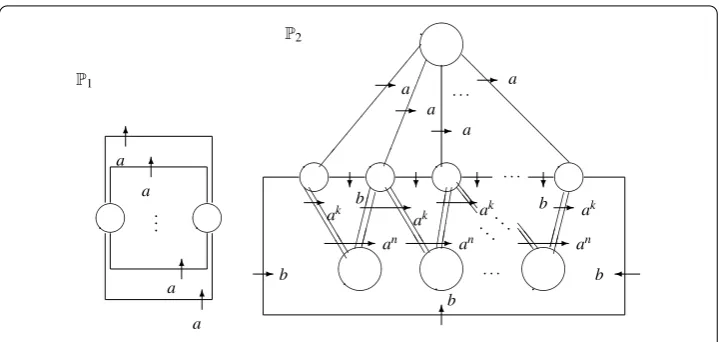
Figure 1 Generating pictures ofPGas given in (6).
Remark In both group and monoid cases, if the presentationP in () is efficient or inefficient while it is minimal, then it always has a minimal number of generators. So, this fact affects positively the use of generating functions for this type of presentations since we have a great advantage to work with quite a limited number of variables in such a generating function.
1.2 Pictures
There exists a geometric method calledspherical group(or monoid)picturesrelated to the presentationP given in (). This method was constructed and first used by Pride [, –] for both groups and monoids, and since then it has still been in use for the solution of many important combinatorial problems such asword problems(cf.[, ]). Here, we will recall a brief description of pictures for groups and monoids in separate cases. Before that, we express the following remark.
Remark Similarly to (undirected) graphs, this geometric configuration has a large appli-cation area, especially in engineering sciences. For example, the plan of electrical network for a city or the behaviour of DNA molecules in a human body can be figured out with pictures (see Figures , and ).
Pictures for groups: As we depicted in Remark , a group picturePoverPis a geometric configuration consisting of the following:
• A discDwith a basepointOon the boundary∂DofD.
• Disjoint discs,, . . . ,nin the interior ofD. Eachihas a basepointOion the boundary∂iofi.
• A finite number of disjoint arcsα,α, . . . ,αm, where each arc lies in the closure of
D–n
i=iand is either a simple closed curve having trivial intersection with
∂D∪∂
∪∂∪ · · · ∪∂n, or is a simple non-closed curve which joins two points of∂D∪∂
∪∂∪ · · · ∪∂n, neither point being a basepoint. Each arc has a normal orientation indicated by a short arrow meeting with the arc transversely and is labelled by an element ofx∪x–which is called the label of the arc.
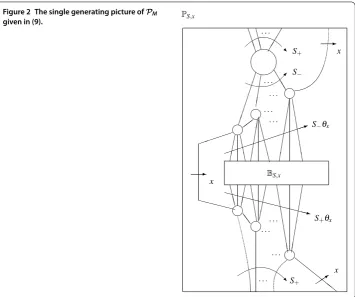
Figure 2 The single generating picture ofPM
given in (9).
normal orientation, then we readx, whereas if we cross the arc in the direction of its opposite orientation, then we readx–), then we obtain a word which belongs to
r∪r–. We call this word the label ofi. Ifsis a subset ofr, then a disc labelled by an element ofs∪s–is called ans-disc.
When we refer to the discs ofP, we in fact mean the discs,, . . . ,n, and not the
ambient discD. A closed arc which encircles neither a disc nor an arc ofPis called a floating circle. We define∂Pto be∂D. The label onP(denoted byW(P)) is the word read
off by travelling around∂Ponce in the clockwise direction starting fromO. (In fact, this fact on pictures implies the fundamentals of solving the word problem [, ].)
Further,Pis calledsphericalif no arcs meet∂P(i.e.ifPis spherical, then∂Pis omitted). Atransverse pathγ in a picturePis a path in the closure ofD–ni=iwhich intersects
the arcs ofPonly finitely many times. Reading off the labels on the arcs encountered while travelling along a transverse path from its initial point to its terminal point gives a word on xdenoted byW(γ). Letγ be a simple closed transverse path inP. The part ofPenclosed byγ is called asubpictureofP. Ifγ intersects no arcs, then the part ofPenclosed byγ is called a spherical subpicture ofP. Acancelling pairinPis a spherical subpicture with exactly two discs whose basepoints lie in the same region.
AsprayforPis a sequenceγ = (γ,γ, . . . ,γn) of simple transverse paths satisfying the
following: fori= , , . . . ,n,γistarts atOand ends at the basepoint ofi, for ≤i<j≤
n,γiandγjintersect only atO; travelling aroundOclockwise inP, we encounter these
transverse pathsγ,γ, . . . ,γn, respectively.
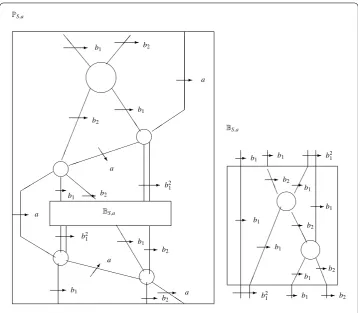
Figure 3 The single generating picture ofPMin (12).
of above operations. These operations imply an equivalence relation and the equivalence class containingPwhich is denoted byP. The set of all equivalence classes of spherical pictures overP forms an abelian group. In addition, for a wordWonx, a new spherical picture overPdenoted byPWcan also be obtained fromWby surroundingPwith a col-lection of concentric arcs with total labelW. Hence, there is a well-definedG(P)-action on equivalence classes of spherical pictures given byW· P=PW(whereW∈G(P)).
We then obtain aZG(P)-moduleπ(P) called thesecond homotopy moduleofP. LetXbe a set of spherical pictures. Then we say thatXgeneratesπ(P) (orXis a set of generating pictures) if the elementsP(whereP∈X) generateπ(P).
For any picturePoverP and for any R∈r, theexponent sum ofRinP, denoted by
expR(P), is the number of discs ofPlabelled byRminus the number of discs labelled by
R–. We remind that if picturesPandPare equivalent, thenexp
R(P) =expR(P) for all
R∈r. Depending on the exponent sum, we have the following definition.
Definition For a non-negative integer n, P is said to be n-Cockcroft if expR(P)≡
(modn) (where congruence (mod) is taken to be equality) for allR∈rand for all spher-ical picturesPoverP. Moreover, a groupGis said to ben-Cockcroft if it admits ann -Cockcroft presentation.
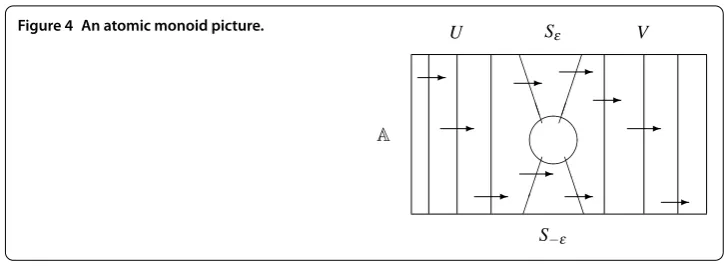
Figure 4 An atomic monoid picture.
the presentationP is efficient if and only if it isp-Cockcroft for some primep. So, this connection between efficiency and p-Cockcroft property will be one of the main ideas during the construction of this paper.
There is an embeddingμofπ(P) into the free module
R∈rZG(P)eRdefined as follows
(see [, ]): LetP ∈π(P) and suppose thatPhas discs,, . . . ,nwith the labels
Rε
,R
ε
, . . . ,Rεnn, respectively (Ri∈r,εi=±,i= , , . . . ,n). Letγ = (γ, . . . ,γn) be a spray
defined previously. Then
μP=
n
i=
εiW(γi)eRi. ()
For simplicity, the notationμ(P) will be preferred instead ofμ(P). For each spherical picturePoverP and for eachR∈r, letλP,Rbe the coefficients ofeRinμ(P). LetI(P) be
the two-sided ideal inZGgenerated by the set{λP,R:Pis a spherical picture,R∈r}. This
ideal is called thesecond Fox idealofP. The concept of Fox ideals has been discussed in []. In fact, we need this concept for our studies in this paper as our main goal in this paper is to establish a relationship between generating functions and presentations. For the group case in Section , the generating functions will be labelled byεiW(γi) defined
in ().
Pictures for monoids. As we pointed out in the beginning of this section, some of the following material may also be found in [, , , ]. For a monoidM, letPbe a monoid presentation as in (); and letF(x) be a free monoid onx. If we have an elementW=USεV
(whereU,V ∈F(x),S∈r,ε=±) ofF(x), then we can replaceSε byS–ε to get a word
W=US–εV. This can be represented by a geometric object called anatomic(monoid)
pictureA= (U,S,ε,V) as depicted in Figure .
We remark that the disc labelled bySin an atomic pictureAis said to bepositiveifε= and is said to benegativeifε= –.
We have a graph(=(P)) associated withP, called theSquier graph, which is defined as follows: Thevertex setisF(x), and theedge setis the collection of all atomic monoid pic-tures. For an orientation of, we will take all edges (U,S, +,V). For an atomic pictureA, as in Figure , the word we read off by travelling along the top of the atomic picture from left to right gives the initial function, denoted byι(A) =USεV, and the word we read off by
travelling along the bottom gives the terminal function, denoted byτ(A) =US–εV. Also,
the mirror image ofAis denoted byA–= (U,S, –ε,V). ApathP=AA· · ·A
n(where
overP. Ifι(A) =τ(An), thenPis called aspherical monoid pictureoverP. Note that we
also have the termsubpictureof monoid pictures.
There is a left action ofF(x) ondefined as follows. LetC∈F(x).
(i) LetW be a vertex of. Then we defineCWto beC·W(product inF(x)). (ii) LetA, as in Figure , be an edge of. ThenC·A= (CU,S,ε,V).
We can define a similar right action ofF(x) on. The left and right actions ofF(x) on extend to actions on pictures. That is, ifPis a picture andW,V∈F(x), thenW·P·V= (W·A·V)(W·A·V)· · ·(W·An·V).
For atomic monoid picturesAandB, one can introduce some operations (deletion and insertion of inverse pairs of atomic pictures and a replacement operation (cf.[, ])) on spherical monoid pictures. These operations imply an equivalence relation on paths. Therefore the graphwith this equivalence relation on paths is called theSquier complex
ofPdenoted byD(P). LetYbe a set of spherical monoid pictures. Two spherical monoid pictures will be said to beequivalent(relative toY) if one can be transformed into the other by a finite number of above operations. By [], the setYis called atrivializerofD(P) if every spherical picture is equivalent to an empty picture (relative toY). Some examples and the details of the trivializer can be found, for instance, in [, ]. Similarly as in the group case, for any monoid picturePoverPand for anyS∈r, theexponent sumofSinP is the number of positive discs labelled bySminus the number of negative discs labelled byS. Then the monoid version of Definition can be obtained in completely the same way by replacing the term group with monoid. To verify that then-Cockcroft (in factnis taken as a primepor ) property holds, it is enough to check it for picturesP∈Y, whereYis a trivializer ofD(P).
LetMbe a monoid with the presentationP as in (). Let
P(l)=
S∈r
ZMeS
be a free leftZM-module with basis{eS:S∈r}. For an atomic pictureA= (U,S,ε,V)
withU,V∈F(x),S∈r,ε=±, we defineeval(l)(A) =εUeS∈P(l), whereU∈M(P) as in
Figure . For any spherical monoid pictureP, we define
eval(l)(P) =
n
i=
eval(l)(Ai)∈P(l). ()
LetλP,Sbe the coefficient ofeSineval(l)(P). So, we can write
eval(l)(P) =
S∈r
λP,SeS∈P(l). ()
LetI(l)(P) be the two-sided ideal ofZMgenerated by the elementsλP,S, wherePis a
spher-ical monoid picture andS∈r. Then this ideal is called thesecond Fox idealofP. More specifically, for a trivializerYofD(P), the setI(l)(P) is generated (as two-sided ideal) by the elementsλP,S, whereP∈YandS∈r. We note that all this above material given with
the consideration ‘left’ can also be applied to ‘right’ for a monoidM.
In Section , the generating functions will be connected to theni=εUipart in () or,
2 The group caseZnθ1Z
Let us consider the split extensionG=ZnθZ, whereZ=bis the a group with rank
one,Zn=ais a cyclic group of ordernandθ:Z→Aut(Zn) is a homomorphism. Then,
by (),Ghas the presentation
PG=
a,b;an,aba–kb–, ()
where k∈Z+,gcd(k,n) = andk<n. In [, Theorem ..], the generating set of the second homotopy moduleπ(PG) has been constructed as drawn in Figure . In this
gen-erating set, there are two spherical picturesP andP. InP, we have twoan-discs (one
of them is positive and the other is negative), and inPwe have a negativean-disc and
k-times positivean-discs. Furthermore, again inP, there is a total ofn-timesaba–kb– -discs. Then, by considering the number of discs in these pictures, Baik [, Theorem ..] proved the following result.
Proposition The presentation PG in()is efficient(equivalently,p-Cockcroft for any
prime p)if and only ifgcd(k– ,n)= .
Therefore, if we supposegcd(k– ,n) = , then we obtain an inefficient presentation. Clearly,nmust be an odd prime and thePGgiven in () be an inefficient presentation.
Otherwise, by settingn= in this inefficient case, we obtain the direct productZn×Z
which is a special case of the semidirect products and will not be considered in this paper. By Remark , it is always true that efficient presentations (even for groups or monoids) are minimal. But to check the minimality of a presentation while it is inefficient is important, because in this case we obtain the inefficiency of the related group that has this presenta-tion (see [–]). For the group case, this important subject is investigated by the following ‘minimality test’ due to Lustig [].
Lemma ([]) For any group G with a presentationP as in(),suppose there is a ring homomorphismψfromZG into the matrix ring of all m×m-matrices(m≥)over some commutative ringRwith.Suppose also thatψ() =Im×m.Ifψmaps the second Fox ideal
I(P)to (in other words,if I(P)is contained in the kernel ofψ),thenPis minimal. By considering Proposition , the first main result of this paper is presented as follows.
Theorem Let us consider the presentationPGas in()for the group G=ZnθZ,where
k<n andgcd(k,n) = butgcd(k– ,n)= .ThenPGhas a set of generating functions
p(a) =a– , p(b) =kb– , p(a) =φn(a),
whereφndenotes the nth cyclotomic polynomial overQdefined by
φn(x) =
xn–
x– ()
Proof We first note that sincePGis presented as in (), the action inAut(Zn) is defined by
a–θ→(b)θ(b) =ak, wherehcf(k,n) = andk<n.
Assume thathcf(k– ,n)= . Then, by Proposition ,PGis an efficient presentation and
so, by Remark , is minimal (i.e.has a minimal number of generators). Let us consider the picturesPandPin Figure . Now, by (), we have
μ(P) = (a– )ean and
μ(P) = (– +b+b+· · ·+b)ean+ +a+a+· · ·+an–e
aba–kb–
= (– +kb)ean+ +a+a+· · ·+an–eaba–kb–,
wherehcf(k,n) = , buthcf(k– ,n)= andk<n. For simplicity, by omitting the overlines on the elements in the above equalities, we obtain that the second Fox ideal is generated by the polynomial elementsa– ,kb– and +a+a+· · ·+an–. Now, we can reformulate these polynomial elements as generating functions. It is clear thatp(a) has the roota= . On the other hand, since we have
p(b) =kb– ≡(modn) ⇒ t(kb– )≡(modn) ⇒ b–t≡(modn) ⇒ b≡t(modn),
p(b) has a roott, wheretis the multiplicative inverse ofk.
Finally,p(a) = +a+a+· · ·+an–≡(modn) has a roota= modulonwhich gives
() directly.
Let us takenas an odd primep. Then, by Proposition and Lemma , we get an ineffi-cient but minimal presentation. Thus we have the following corollary.
Corollary For an odd prime p and a positive integer k<p,the presentationPG in()
has a set of generating functions
p(a) =a– , p(b) =kb– , p(a) =φp(a) =
xp–
x– ,
whereφphas a degree of an even number p– .
Remark Theorem and Corollary imply that by choosing the efficient or inefficient minimal presentations, we can get different constants (i.e.the cases ofkin both results) and different powers (i.e. nto be a positive integer or an odd prime) in the set of generating functions. Therefore, the structure of the presentation (i.e.efficient or inefficient) affects getting different types of generating functions.
The following consequence of Theorem points out another connection between the presentation in () as defined in either Theorem or Corollary and generating functions.
Proof We recall that the family of locally constant functions [] is defined as
f(x) =ζx and ζn= (n∈Z)
for whichf(x) = holds. Moreover, in the meaning of group homomorphisms, each func-tion in this family satisfies
f : (R, +) –→(C,·), f(x+y) =f(x)·f(y). Now, by replacingζxwith
p(ζ) = ζn–
ζ– , ()
it is clear that we get a locally constant function, as required.
After Theorem , Corollary and Corollary , we can express the following connection between the generating functions and (twisted) Bernoulli numbers.
Remark The locally constant function corresponding to the generating functionp(a) of the presentationPG given in () is related to the twisted Bernoulli numbers and
poly-nomials. (We may refer the reader, for example, to [, , , ] for the twisted Bernoulli numbers and polynomials.) In the next paragraph, we give a brief description.
According to [, , ], for each integerN≥,CpN denotes the multiplicative group of the primitivepNth roots of unity inC∗
p=Cp–{}. Let
Tp=
ξ∈Cp:ξp
N
= , forN≥=
N≥
CpN = lim
N→∞CpN.
The dual ofZpin the sense ofp-adic Pontryagin duality isTp=Cp∞, the direct limit (under
inclusion) of cyclic groupsCpNof orderpNwithN≥, with discrete topology. TheTp ad-mits a naturalZp-module structure which is written asξxforξ∈Tpandx∈Zp. Moreover,
Tpcan be embedded discretely inCpas the multiplicativep-torsion subgroup. Ifξ∈Tp,
thenω: (Zp, +) –→(Cp,·),x–→ξx, is a locally constant character which is actually a
lo-cally analytic character ifξ ∈ {ξ∈Cp:vp(ξ– ) > }. Then, by [, , , , ],ωξ has
a continuation to a continuous group homomorphism from (Zp, +) to (Cp,·). We further
remind that ifξ∈C, thenξwill be assumed to have anrth root of unity withr∈Z+.
3 The monoid caseZ2
θ2Z
Before presenting this special case, let us first discuss a more general situation for thep -Cockcroft property of semidirect products of monoids. In [, ], by considering a similar version of the picturePS,x in Figure , the second author investigated thep-Cockcroft
property by using the trivializer for the semidirect productM=KθA, whereK and
Aare arbitrary monoids. (It is seen that there is a single non-spherical subpictureBS,xin
PS,x. In fact,BS,xcontains onlyS-discs. For an illustration, see Figure .) As a special case
of it, let us assume thatK is a one-relator monoid andAis an infinite cyclic monoidZ with presentations
respectively. Supposeψ is an endomorphism ofK. Then the mappingx→ψ induces a homomorphismθ:A→End(K), and we can form the semidirect productM=KθA.
By (), this product has a presentation
PM=y,x;S+=S–,t, ()
where, for ally∈y, the settis the set of relators
Tyx:yx=x(yθx)
such that the relatorSsatisfies the conditionι(S+)=ι(S–) (orτ(S+)=τ(S–)). In [], the necessary and sufficient conditions forPMto be efficient are determined.
In the special case above, let us takeKas a free abelian monoid of rank two (i.e. K=Z) presented byPK=y,y;yy=yy, and letψbe the endomorphismψM, whereMis the
matrixα αβ β
(α,α,β,β∈Z+) given by [y]–→[yαyα] and [y]–→[yβyβ]. As a special case of the presentation in (), we obtain
PM=
y,y,x;yy=yy,yx=xyαyα
,yx=xy
β
y
β
()
for the monoidM=Z
θZ(see []). Again, in the same reference, the second author
figured out the efficiency of the above presentation as in the following proposition.
Proposition ([]) For any prime p,the presentationPMin()is p-Cockcroft if and only
ifdetM≡(modp).
According to Proposition , in particular,PMis not efficient ifdetM= or . Therefore
the following proposition is proved in the same manner.
Proposition ([]) The presentationPMin()is minimal but inefficient ifdetM= .
The proof of Proposition is based on the following Pride result, which is a monoid version of Lemma . Although this result has not been published yet, it has been used in many papers (see, for instance, [–]).
Lemma (Pride) For any monoid M with a presentationP as in(),letψbe a ring ho-momorphism fromZM into the ring of all m×m-matrices(m≥)over some commutative ringRwith,and supposeψ() =Im×m.If the second Fox ideal I(l)(P)is contained in the
kernel ofψ,thenPis minimal.
From now on, by considering Propositions and , we will reach our main aim of this paper for monoids.
Our first result in this section gives the connection between a monoid presentation and array polynomials. In fact thearray polynomials Snk(x) are defined by means of the follow-ing generatfollow-ing function:
(et– )ketx
x! =
∞
n=
Snk(x)t
n
(cf.[–]). According to the same references, array polynomials can also be defined in the form
Snk(x) =
k!
k
j= (–)k–j
k j
(x+j)n. ()
Since the coefficients of array polynomials are integers, these polynomials find a very large application area, especially in engineering. Array polynomials are used, for instance, in system control (cf.[]).
In fact these integer coefficients give us an opportunity to use these polynomials in our case. We should note that there also exist some other polynomials, namely Dickson, Bell, Abel, Mittag-Leffleretc., which have integer coefficients. But, since array polynomials have a larger application area in science, we have preferred them. Hence, by considering Propo-sition , we obtain the following theorem as another main result.
Theorem Let us consider the monoid M=Z
θZwith a presentation PM=
b,b,a;bb=bb,ba=ab,ba=abb
. ()
ThenPMhas a set of generating functions
p(a) =Snn(a) – S(a)
p(b) =Sn
n(b) –S(b)
p(b) =S(b) –Snn(b) ⎫ ⎪ ⎪ ⎬ ⎪ ⎪ ⎭
, ()
where Sn
k(x)is defined as in().
Proof Let us consider the spherical picturePS,awith its non-spherical subpictureBS,aas
drawn in Figure . In fact, by [], this is the only picture in the trivializer ofD(PM).
In presentation (), let us label the relatorsbb=bb,ba=ab andba=abbbyS,
Tb,aandTb,a, respectively. It is clear thatexpS(PS,a) = – = –,expTb,a(PS,a) = – = andexpT
b,a(PS,a) = – = . In the calculation of these exponent sums, we included the exponent sums ofS-discs in the non-spherical pictureBS,a. Actually, a simple calculation
shows thatdetM=expS(BS,a) and so, by our assumption aboutPMthat is not efficient, we
expectexpS(BS,a) to be .
Now, by () and (), the evaluation ofPS,ais determined as follows:
eval(l)(PS,a) = ( – a)eS+ ( –b)eTb,a+ (b– )eTb,a.
Therefore, by the definition, the second Fox idealI(l)(PM) of the presentationPM in ()
is generated by the polynomial elements
– a, –b, b– .
Now, by using () and keeping in our mind that the coefficients of array polynomials are integer, we clearly have
Snk(x) = ⎧ ⎪ ⎪ ⎨ ⎪ ⎪ ⎩
xn; k= ,
x; k= andn= , ; k=norn=k= .
Then, by reformulating the elements of the second Fox ideal I(l)(PM), we arrive at the
functions in () as desired.
By considering Proposition , if we takedetM= , then we get an efficient presentation. So, for an even primep, letdetM= . Then one of the presentations of the similar form
PMas in () can be taken as
PM=
b,b,a;bb=bb,ba=ab,ba=abb
, ()
which will be efficient. The same procedure in the proof of Theorem gives us the set of generating functions of PM in () in the form p(a), p(b) and p(b), where
p(a) =Snn(a) – S(a) and the others are defined in () such thatSnk(x) is given in ().
Nevertheless, by induction steps, we can generalise this last presentation as follows:
PM=
b,b,a;bb=bb,ba=abdet M,ba=abb
. ()
Hence we get the following version of Theorem which deals with efficient presenta-tions.
Theorem Let us consider the presentationPMin()for the monoid M=ZθZ.Then PMhas a set of generating functions
p(a) =Sn
n(a) –detMS(a)
p(b) =Snn(b) –S(b)
p(b) =S
(b) –Snn(b)
⎫ ⎪ ⎪ ⎬ ⎪ ⎪ ⎭
, ()
wheredetM= and Sn
k(x)is defined as in().
Remark According to the expression in Remark , presentations given in (), () or () have a minimal number of generators. But we classified these presentations according to their efficiency status separately in Theorem and Theorem . The aim of this separa-tion is to find a solusepara-tion for a general remark depicted in the final secsepara-tion about obtaining a method for a minimality test by using generating functions (see Section below).
At this point, we should note that fort =t ∈R+, λ∈C, k∈N, generalised array type polynomialsSn
k(x;t,t;λ) which are related to the non-negative real parameters have
Remark One can try to study the generalisation of Theorem by usingSkn(x;t,t;λ). The remaining goal of this section is to establish a connection between the presentation
PMin () or () and Stirling numbers of the second kind (cf.[, , –]). In fact,
Stir-ling numbersof the second kindS(n,k) are defined by means of the following generating function:
(et– )k
k! =
∞
n=
S(n,k)t
n
n!
(see [, ]). According to [, Theorem , Remark ], Stirling numbers can also be defined by
S(n,k) =
k! k j= (–)j k j (k–j)n.
We remind that these numbers satisfy the well-known properties
S(n,k) = ⎧ ⎪ ⎪ ⎨ ⎪ ⎪ ⎩
; k= ork=n, n
; k=n– , δn,; k= ,
whereδn,denotes the Kronecker symbol (see [, ]). It is known that Stirling numbers are used in combinatorics, in number theory, in discrete probability distributions for find-ing higher-order moments,etc.We finally note that sinceS(n,k) is the number of ways to partition a set ofnobjects intokgroups, these numbers find an application area in com-binatorics and in the theory of partitions.
In addition to the above formulas forS(n,k), by [, , ], we have
xn=
n k= x k
k!S(n,k) ()
as a formula for Stirling numbers. Therefore, in equation () by replacingxwitha,band
b, respectively, and takingn= ,n= , the polynomial elements of the second Fox ideal
I(l)(PM) of the presentationPMin () can be restated as follows:
a– a= k= a k
k!S(,k) – k= a k
k!S(,k)
b –b= k= b k
k!S(,k) – k= b k
k!S(,k)
b–b= k= b k
k!S(,k) – k= b k
k!S(,k) ⎫ ⎪ ⎪ ⎪ ⎪ ⎪ ⎪ ⎪ ⎪ ⎪ ⎬ ⎪ ⎪ ⎪ ⎪ ⎪ ⎪ ⎪ ⎪ ⎪ ⎭ . ()
As a different version of Theorem , we express the following corollary.
Corollary The presentationPMin()has a set of generating functions in terms of
We note that the above corollary can also be stated for the presentationPMin ().
Furthermore, in a recent work, Simsek [] has constructed thegeneralisedλ-Stirling numbers of the second kindS(n,v;a,b;λ) related to non-negative real parameters (a,b∈
R+,a=b,λis a complex number andv∈N). In fact, this new generalisation is defined by the generating function
fS,v(t;a,b;λ) =
(λbt–at)v
v! =
∞
n=
S(n,v;a,b;λ)t
n
n!. () By settinga= andb=ein (), one can obtain theλ-Stirling numbers of the second kind
S(n,v;λ) which are defined by the generating function (λet– )v
v! =
∞
n=
S(n,v;λ)t
n
n!
(see [, ]). By substitutingλ= into the above equation, the Stirling numbers of the second kindS(n,v)are obtained.
By considering this new generalisationS(n,v;a,b;λ), in [, Theorem ], it has been obtained that
S(n,v;a,b;λ) =
v!
n
j= (–)j
v j
λv–jjlna+ (v–j)lnbn, ()
forλ-Stirling numbers of the second kind. In fact, by settinga= andb=ein (), one can get the following equality onλ-Stirling numbers:
S(n,v;λ) =
v!
v
j=
v j
λ(v–j)(–)j(v–j)n ()
(see [, ]).
Hence we can present the following notes about this section:
Remark It is clearly seen that in Theorems , and Corollary , only Stirling numbers are considered. However, one can also study theλ-Stirling numbersS(n,v;λ) defined in () and generalisedλ-Stirling numbersS(n,v;a,b;λ) defined in () as stated in these theorems and corollaries.
Remark For a suitableMn×nmatrix, it is possible to define the presentationPM in ()
(or in ()) for the monoidZn
θZ. Thus one can try to transform all studies in Section
to this general case.
4 Final remarks
In this section we will express some other remarks depicted in the previous sections. We hope that the following material will be used as new study areas:
Section ) presentations other than the methods presented in Lemma and Lemma , respectively. Especially for the monoid case, although Lemma has not been
published, the theory of it has been used widely in last ten years. Therefore, by using generating functions, to obtain a new test on the minimality of monoids would be an interesting and important result.
- As we noted in Remark , to study with the minimal presentations has an advantage for our aim in this paper. Conversely, the use of generating functions to obtain a presentation with a minimal number of generators is still an open question.
- Until now, any result to check whether asemigrouppresentation is minimal while it is inefficient has not been published. Therefore the whole idea of this paper can also be used for this case.
- It is known that thechemical energyis one of most important application areas of graph theory (cf.[]). So, as a next step of the expressions in Remark , it is worth studying whether this chemical energy can also be obtained from pictures. - We believe that the same approximation between presentations and generating
functions as done in this paper can also be applied to some other special cases of groups and monoids other thanZnθZandZθZ. Moreover, one can investigate which type of polynomials (other than depicted in here) can be used for the general case.
- Here we used exponent sums of pictures as a method to obtain constants of functions. What other methods other than this geometric way can be used could be studied.
Competing interests
The authors declare that they have no competing interests.
Authors’ contributions
All authors completed the paper together. All authors read and approved the final manuscript.
Author details
1Department of Mathematics, Faculty of Arts and Science, Uludag University, Gorukle Campus, Bursa, 16059, Turkey.
2Department of Mathematics, Faculty of Science, Selçuk University, Campus, Konya, 42075, Turkey.3Department of
Mathematics, Faculty of Art and Science, Akdeniz University, Campus, Antalya, 07058, Turkey.
Acknowledgements
Dedicated to Professor Hari M Srivastava.
All authors are partially supported by Research Project Offices of Uluda ˘g (2012-15 and 2012-19), Selçuk and Akdeniz Universities.
Received: 1 December 2012 Accepted: 14 February 2013 Published: 14 March 2013 References
1. Simsek, Y, Kim, T, Park, DW, Ro, YS, Jang, LJ, Rim, SH: An explicit formula for the multiple Frobenius-Euler numbers and polynomials. JP J. Algebra Number Theory Appl.4, 519-529 (2004)
2. Srivastava, HM, Coi, J: Series Associated with the Zeta and Related Functions. Kluwer Academic, Dordrecht (2001) 3. Srivastava, HM: Some generalizations and basic (orq-) extensions of the Bernoulli, Euler and Genocchi polynomials.
Appl. Math. Inf. Sci.5, 390-444 (2011)
4. Woodcock, CF: Convolutions on the ring ofp-adic integers. J. Lond. Math. Soc.20(2), 101-108 (1979)
5. Adian, SI: Defining Relations and Algorithmic Problems for Groups and Semigroups. Trudy Mat. Inst. Steklov., vol. 85 (1966). English translation: Trans. Amer. Math. Soc., vol. 152 (1967)
6. Bogley, WA, Pride, SJ: Calculating generators ofπ2. In: Hog-Angeloni, C, Metzler, W, Sieradaski, A (eds.) Two Dimensional Homotopy and Combinatorial Group Theory, pp. 157-188. Cambridge University Press, Cambridge (1993)
7. Cevik, AS: The efficiency of standard wreath product. Proc. Edinb. Math. Soc.43(2), 415-423 (2000)
8. Cevik, AS: Thep-Cockcroft property of the semidirect products of monoids. Int. J. Algebra Comput.13(1), 1-16 (2003) 9. Cevik, AS: Minimal but inefficient presentations of the semidirect products of some monoids. Semigroup Forum66,
1-17 (2003)
11. Squier, CC: Word problems and a homological finiteness condition for monoids. J. Pure Appl. Algebra49, 201-216 (1987)
12. Wang, J: Finite derivation type for semi-direct products of monoids. Theor. Comput. Sci.191(1-2), 219-228 (1998) 13. Shiratani, K, Yokoyama, S: An application ofp-adic convolutions. Mem. Fac. Sci., Kyushu Univ., Ser. A, Math.36(1),
73-83 (1982)
14. Simsek, Y: Twistedp-adic (h,q)-L-functions. Comput. Math. Appl.59, 2097-2110 (2010) 15. Brown, KS: Cohomology of Groups. Graduate Text in Mathematics, vol. 87. Springer, Berlin (1982) 16. Epstein, DBA: Finite presentations of groups and 3-manifolds. Q. J. Math.12, 205-212 (1961)
17. Pride, SJ: Geometric methods in combinatorial semigroup theory. In: Fountain, J (ed.) Semigroups, Formal Languages and Groups, pp. 215-232. Kluwer Academic, Norwell (1995)
18. Pride, SJ: Low-dimensional homotopy theory for monoids. Int. J. Algebra Comput.5(6), 631-649 (1995)
19. Pride, SJ: Identities among relations of group presentations. In: Ghys, E, Haefliger, A, Verjovsky, A (eds.) Group Theory from a Geometrical Viewpoint (Trieste, 1990), pp. 687-717. World Scientific, Singapore (1991)
20. Pride, SJ: Low-dimensional homotopy theory for monoids II. Glasg. Math. J.41, 1-11 (1999) 21. Cevik, AS: One dimension higher of the word problem. Math. Scand.95(2), 161-171 (2004)
22. Karpuz, EG, Ates, F, Cevik, AS, Maden, AD, Cangul, IN: The next step of the word problem over monoids. Appl. Math. Comput.218, 794-798 (2011)
23. Lustig, M: Fox ideals,N-torsion and applications to groups and 3-manifolds. In: Hog-Angeloni, C, Metzler, W, Sieradski, AJ (eds.) Two-Dimensional Homotopy and Combinatorial Group Theory, pp. 219-250. Cambridge University Press, Cambridge (1993)
24. Baik, YG: Generators of the second homotopy module of group presentations with applications. Ph.D. thesis, University of Glasgow (1992)
25. Simsek, Y: Twisted (h,q)-Bernoulli numbers and polynomials related to twisted (h,q)-zeta function andL-function. J. Math. Anal. Appl.324, 790-804 (2006)
26. Srivastava, HM, Kim, T, Simsek, S:q-Bernoulli numbers and polynomials associated with multipleq-zeta functions and basicL-series. Russ. J. Math. Phys.12(2), 241-268 (2005)
27. Kim, MS, Son, JW: Analytic properties of theq-Volkenborn integral on the ring ofp-adic integers. Bull. Korean Math. Soc.44(1), 1-12 (2007)
28. Kim, T: An analogue of Bernoulli numbers and their congruences. Rep. Fac. Sci. Eng. Saga Univ., Math.22(2), 21-26 (1994)
29. Chang, CH, Ha, CW: A multiplication theorem for the Lerch zeta function and explicit representations of the Bernoulli and Euler polynomials. J. Math. Anal. Appl.315, 758-767 (2006)
30. Simsek, Y: Generating functions for generalized Stirling type numbers, Array type polynomials, Eulerian type polynomials and their applications. arXiv:1111.3848v2 [math.NT] (2011)
31. Simsek, Y: Interpolation function of generalizedq-Bernstein type polynomials and their application. In: Curve and Surface. Lecture Notes in Computer Science, vol. 6920, pp. 647-662. Springer, Berlin (2011)
32. Mismar, MJ, Abu-Al-Nadi, DI, Ismail, TH: Pattern synthesis with phase-only control using array polynomial technique. In: 2007 IEEE International Conference on Signal Processing and Communications (ICSPC 2007), Dubai, UAE, 24-27 November 2007 (2007)
33. Agoh, T, Dilcher, K: Shortened recurrence relations for Bernoulli numbers. Discrete Math.309, 887-898 (2009) 34. Carlitz, L: Some numbers related to the Stirling numbers of the first and second kind. Publ. Elektroteh. Fak. Univ.
Beogr., Ser. Mat. Fiz.544-576, 49-55 (1976)
35. Kim, T:q-Volkenborn integration. Russ. J. Math. Phys.19, 288-299 (2002)
36. Luo, QM, Srivastava, HM: Some generalizations of the Apostol-Genocchi polynomials and the Stirling numbers of the second kind. Appl. Math. Comput.217, 5702-5728 (2011)
37. Gutman, I: The energy of a graph: old and new results. In: Betten, A, Kohnert, A, Laue, R, Wassermann, A (eds.) Algebraic Combinatorics and Applications. Springer, Berlin (2001)
doi:10.1186/1687-2770-2013-51