Volume 2011, Article ID 829543,16pages doi:10.1155/2011/829543
Research Article
On the Derivatives of Bernstein
Polynomials: An Application for
the Solution of High Even-Order
Differential Equations
E. H. Doha,
1A. H. Bhrawy,
2, 3and M. A. Saker
41Department of Mathematics, Faculty of Science, Cairo University, Giza 12613, Egypt
2Department of Mathematics, Faculty of Science, King Abdulaziz University, Jeddah 21589, Saudi Arabia 3Department of Mathematics, Faculty of Science, Beni-Suef University, Beni-Suef, Egypt
4Department of Basic Science, Institute of Information Technology, Modern Academy, Cairo, Egypt
Correspondence should be addressed to A. H. Bhrawy,[email protected]
Received 31 October 2010; Accepted 6 March 2011
Academic Editor: S. Messaoudi
Copyrightq2011 E. H. Doha et al. This is an open access article distributed under the Creative Commons Attribution License, which permits unrestricted use, distribution, and reproduction in any medium, provided the original work is properly cited.
A new formula expressing explicitly the derivatives of Bernstein polynomials of any degree and for any order in terms of Bernstein polynomials themselves is proved, and a formula expressing the Bernstein coefficients of the general-order derivative of a differentiable function in terms of its Bernstein coefficients is deduced. An application of how to use Bernstein polynomials for solving high even-order differential equations by Bernstein Galerkin and Bernstein Petrov-Galerkin methods is described. These two methods are then tested on examples and compared with other methods. It is shown that the presented methods yield better results.
1. Introduction
Bernstein polynomials1have many useful properties, such as, the positivity, the continuity, and unity partition of the basis set over the interval0,1. The Bernstein polynomial bases vanish except the first polynomial atx 0, which is equal to 1 and the last polynomial at
x 1, which is also equal to 1 over the interval0,1. This provides greater flexibility in imposing boundary conditions at the end points of the interval. The momentsxmis nothing
polynomials. Moreover, Bernstein polynomials have been recently used for the solution of differential equations,see, e.g.,3.
The Bernstein polynomials are not orthogonal; so their uses in the least square approximations are limited. To overcome this difficulty, two approaches are used. The first approach is the basis transformation, for the transformation matrix between Bernstein polynomial basis and Legendre polynomial basis4, between Bernstein polynomial basis and Chebyshev polynomial basis5, and between Bernstein polynomial basis and Jacobi polynomial basis 6. The second approach is the dual basis functions for Bernstein polynomialssee J ¨uttler7. J ¨uttler7derived an explicit formula for the dual basis function of Bernstein polynomials. The construction of the dual basis must be repeated at each time the approximation polynomial increased.
For spectral methods 8, 9, explicit formulae for the expansion coefficients of a general-order derivative of an infinitely differentiable function in terms of those of the original expansion coefficients of the function itself are needed. Such formulae are available for expansions in Chebyshev 10, Legendre 11, ultraspherical 12, Hermite
13, Jacobi 14, and Laguerre 15 polynomials. These polynomials have been used in both the solution of boundary value problems 16–19 and in computational fluid dynamics8. In most of these applications, use is made of formulae relating the expansion coefficients of derivatives appearing in the differential equation to those of the function itself, see, e.g., 16–19. This process results in an algebraic system or a system of differential equations for the expansion coefficients of the solution which then must be solved.
Due to the increasing interest on Bernstein polynomials, the question arises of how to describe their properties in terms of their coefficients when they are given in the Bernstein basis. Up to now, and to the best of our Knowledge, many formulae corresponding to those mentioned previously are unknown and are traceless in the literature for Bernstein polynomials. This partially motivates our interest in such polynomials.
Another motivation is concerned with the direct solution techniques for solving high even-order differential equations, using the Bernstein Galerkin approximation. Also, we use Bernstein Petrov-Galerkin approximation; we choose the trial functions to satisfy the underlying boundary conditions of the differential equations, and the test functions to be dual Bernstein polynomials which satisfy the orthogonality condition. The method leads to linear systems which are sparse for problems with constant coefficients. Numerical results are presented in which the usual exponential convergence behavior of spectral approximations is exhibited.
2. Relevant Properties of Bernstein Polynomials
The Bernstein polynomials of nth degree form a complete basis over 0,1, and they are defined by
Bi,nx
n i
xi1−xn−i, 0≤i≤n, 2.1
where the binomial coefficients are given byni n!/i!n−i!.
The derivatives of thenth degree Bernstein polynomials are polynomials of degree
n−1 and are given by
DBi,nx nBi−1,n−1x−Bi,n−1x, D≡ d
dx. 2.2
The multiplication of two Bernstein basis is
Bi,jxBk,mx
j i
m k
j m i k
Bi k,j mx, 2.3
and the moments of Bernstein basis are
xmBi,nx n i n m i m
Bi m,n mx. 2.4
Like any basis of the spaceΠn, the Bernstein polynomials have a unique dual basis D0,n, D1,n, . . . , Dn,n also called the inverse or reciprocal basiswhich consists of the n 1
dual basis functions
Di,nx n
j0
ci,jBj,nx,
j0,1, . . . , n, 2.5
where
ci,j −1 i j
n i
n j
mini,j
k0
2k 1
n k 1
n−i
n−k n−i
n k 1
n−j
n−k n−j
, i, j0,1, . . . , n.
2.6
J ¨uttler7represented the dual basis function with respect to the Bernstein basis. The dual basis functions must satisfy the relation of duality
1
0
Indefinite integral of Bernstein basis is given by
Bi,nxdx
1
n 1
n 1
ji 1
Bj,n 1x, 2.8
and all Bernstein basis function of the same order have the same definite integral over the interval0,1, namely,
1
0
Bi,nxdx 1
n 1. 2.9
3. Derivatives of Bernstein Polynomials
The main objective of this section is to prove the following two theorems for the derivatives ofBi,nxand Bernstein coefficients of theqth derivative offx.
Theorem 3.1.
DpBi,nx n
!
n−p!
mini,p
kmax0,i p−n −1k p
p k
Bi−k,n−px. 3.1
Proof. Forp1,3.1leads us to go back to2.2.
If we apply induction onp, assuming that3.1holds, we want to show that
Dp 1Bi,nx n!
n−p−1!
mini,p 1
kmax0,i p 1−n
−1k p 1
p 1
k
Bi−k,n−p−1x. 3.2
If we differentiate3.1, then we havewith application of relation2.2
Dp 1Bi,nx DDpBi,nx
D
⎛ ⎝ n!
n−p!
mini,p
kmax0,i p−n
−1k p
p k
Bi−k,n−px ⎞ ⎠
n!
n−p!
mini,p
kmax0,i p−n
−1k p
p k
DBi−k,n−px
n!
n−p
n−p!
mini,p
kmax0,i p−n
−1k p
p k
Bi−k−1,n−p−1x−Bi−k,n−p−1x,
which can be written as
Dp 1Bi,nx n!
n−p−1!
mini,p
kmax0,i p−n
−1k p
p k
Bi−k−1,n−p−1x
− n!
n−p−1!
mini,p
kmax0,i p 1−n
−1k p
p k
Bi−k,n−p−1x.
3.4
Setkk−1 in the first term of the right-hand side of relation3.4to get
Dp 1Bi,nx n
!
n−p−1!
mini,p 1
kmax1,i p 1−n
−1k p 1
p k−1
Bi−k,n−p−1x
n!
n−p−1!
mini,p
kmax0,i p 1−n
−1k p 1
p k
Bi−k,n−p−1x.
3.5
It can be easily shown that
Dp 1Bi,nx n
!
n−p−1!
mini,p 1
kmax0,i p 1−n
−1k p 1
p k−1
p k
Bi−k,n−p−1x
n!
n−p−1!
mini,p 1
kmax0,i p 1−n
−1k p 1
p 1
k
Bi−k,n−p−1x
n!
n−p−1!
mini,p 1
kmax0,i p 1−n
−1k p 1
p 1
k
Bi−k,n−p−1x,
3.6
which completes the induction and proves the theorem.
We can express the Bernstein polynomial of any degreeBk,nxin terms of any higher
degree basisBk,n pxusing the following lemma.
Lemma 3.2.
Bk,nx k p
jk n
k p
j−k n p
j
Bj,n px. 3.7
Letfxbe a differentiable function of degreendefined on the interval0,1, then we can write
fx
n
i0
ai,nBi,nx. 3.8
Further, letai,nqdenote the Bernstein coefficients of theqth derivative offx, that is,
fqx d
qfx
dxq n
i0
ai,nqBi,nx, ai,n0 ai,n. 3.9
Then, we can state and prove the following theorem.
Theorem 3.3.
ai,nq
q
k−q
Ck
i, n, qai−k,n, 3.10
where
Ck
i, n, qq!
q
m0
−1m q
q m
i m k
n−i q−m−k
. 3.11
Proof. Since
fx
n
i0
ai,nBi,nx,
fqx d
qfx
dxq n
i0
ai,nDqBi,nx,
3.12
then making use ofTheorem 3.1formula3.1immediately yields
fqx
n
i0
ai,n n!
n−q!
mini,q
kmax0,i q−n −1k q
q k
Bi−k,n−qx
n i0
ai,n n!
n−q!
q
k0
−1k q
q k
Bi−k,n−qx.
If we change the degree of Bernstein polynomials using3.7, then we can write
fqx n i0
ai,n n
!
n−q!
q
k0
−1k q
q k
q
m0 n−q
i−k
q m n
i−k m
Bi m−k,nx
n i0
ai,n n
!
n−q! q
k0
−1k q
q k
q
m0 n−q
i−k
q m n
i−k m
Bi m−k,nx
n!
n−q!
n
i0
ai,n q
k0
−1k q
q k
n−q i−k
q
m0
q m n
i−k m
Bi m−k,nx
.
3.14
Expanding the two summationqk0qm0and rearranging the coefficients ofBi k,nfrom−q≤
k≤q, we get
fqx n! n−q!
n
i0
ai,n ⎡ ⎣q
k−q
1
n i k
Bi k,nx q
m0
−1m q
q m
n−q i−m
q m k ⎤ ⎦ n!
n−q!
n k
ik
ai−k,n q
k−q
1
n i
Bi,nx q
m0
−1m q
q m
n−q i−k−m
q m k
n!
n−q!
n
i0
ai−k,n q
k−q
1
n i
Bi,nx q
m0
−1m q
q m
n−q i−k−m
q m k
n i0 ⎡ ⎣ n!
n−q!
q
k−q
1
n i
q
m0
−1m q
q m
n−q i−k−m
q m k
ai−k,n ⎤ ⎦Bi,nx
n i0 ⎡ ⎣q!
q
k−q q
m0
−1m q q m i m k
n−i q−m−k
ai−k,n ⎤ ⎦Bi,nx
n i0
ai,nqBi,nx,
3.15
The following two corollaries will be of fundamental importance in what follows.
Corollary 3.4.
1
0
Bi,npxBj,nxdx
n!nj
2n−p 1n−p!
mini,p
kmax0,i p−n
−1k p p
k n−p
i−k 2n−p
i j−k
. 3.16
Proof. We can express explicitly the pth derivatives of Bernstein polynomials from Theorem 3.1to obtain
1
0
Bi,npxBj,nxdx
1
0
n!
n−p!
mini,p
kmax0,i p−n
−1k p
p k
Bi−k,n−pxBj,nxdx
n!
n−p!
mini,p
kmax0,i p−n −1k p
p k
1
0
Bi−k,n−pxBj,nxdx.
3.17
Now,3.16can be easily derived by using2.3. Thanks to2.9, we have
1
0
Bi,npxBj,nxdx n!
n−p!
mini,p
kmax0,i p−n
−1k p
p k
1
0 n−p
i−k n
j
2n−p i j−k
Bi j−k,2n−pxdx
n!
n−p!
mini,p
kmax0,i p−n
−1k p
p k
n−p i−k
n j 2n−p
i j−k
1
0
Bi j−k,2n−pxdx
n!
n−p!
mini,p
kmax0,i p−n −1k p
p k
n−p i−k
n j 2n−p
i j−k
1
2n−p 1.
3.18
Corollary 3.5.
1
0
Bi,npxDj,nxdx n!
n−p!
mini,p
kmax0,i p−n −1k p
p k
n−p i−k
p
j−i k
n j
. 3.19
Proof. UsingTheorem 3.1, we get
1
0
Bi,npxDj,nxdx
1
0
n!
n−p!
mini,p
kmax0,i p−n −1k p
p k
It follows immediately from3.7and2.7that
1
0
Bi,npxDj,nxdx n
!
n−p!
mini,p
kmax0,i p−n
−1k p
p k
i−k p
qi−k n−p
i−k
p
q−i k n
q
× 1
0
Bq,nxDj,nxdx
n!
n−p!
mini,p
kmax0,i p−n
−1k p
p k
i−k p
qi−k n−p
i−k
p
q−i k n
q
δq,j
n!
n−p!
mini,p
kmax0,i p−n
−1k p
p k
n−p i−k
p
j−i k n
j
.
3.21
4. An Application for the Solution of High
Even-Order Differential Equations
4.1. Bernstein Galerkin Method
Consider the solution of the differential equation
u2m 2m−1 i1
γiui γ0ufx, x∈0,1, 4.1
subject to the following boundary conditions
uq0 0, uq1 0, 0≤q≤m−1. 4.2
Let us first introduce some basic notation which will be used in the sequel. We set
SN{B0,Nx, B1,Nx, . . . , BN,Nx},
WN
ν∈SN:νq0 νq1 0; 0≤q≤m−1
,
4.3
then the Bernstein-Galerkin approximation to4.1is to finduN∈WNsuch that
uN2m, vN
2m−1
i1
γi
uNi, vN
γ0uN, vN
f, vN
, ∀vN∈WN, 4.4
whereu, ν Iuxνxdxis the inner product inL2I, and its norm will be denoted by
It is of fundamental importance to note here that the crucial task in applying the Galerkin-spectral Bernstein approximations is how to choose an appropriate basis forWN
such that the linear system resulting from the Bernstein-Galerkin approximation to4.4is as simple as possible.
We can choose the basis functionsφkxto be of the form
φkx Bk,Nx, 4.5
whereφkx ∈WN for allk m, m 1, . . . , N−m. The 2mboundary conditions lead to the
firstmand the lastmexpansion coefficients to be zero. Therefore, forN≥2m, we have
WNspan
φmx, φm 1x, . . . , φN−mx
. 4.6
It is now clear that4.4is equivalent to
uN2m, φkx 2m−1
i1
γi
uNi, φkx
γ0
uN, φkx
f, φkx
, ∀km, m 1, . . . , N−m.
4.7
Let us denote
fk
f, φkx
, ffm, fm 1, . . . , fN−m T
,
uNx N−m
km
akφkx, a am, am 1, . . . , aN−mT,
Aakj
, Bi
bikj, m≤k, j≤N−m.
4.8
Then,4.7is equivalent to the following matrix equation
A
2m−1
i1
γiBi γ0B0
af, 4.9
where the elements of the matricesA,Bi, andB0,i1,2, . . . ,2m−1 are given explicitly using Corollary 3.4, as follows:
akj
Bj,N2m, Bk,N
1
0
Bj,N2mxBk,Nxdx
N!
N k
2N−2m 1N−2m!
minj,2m
rmax0,j−N 2m
−1r 2m
r
N−2m j−r
2N−2m
bikjBj,Ni , Bk,N
1
0
Bj,Ni xBk,Nxdx
N!
N k
2N−i 1N−i!
minj,i
rmax0,j−N i −1r
i r
N−i j−r
2N−i j k−r
,
b0kjBj,N, Bk,N
1
0
Bj,NxBk,Nxdx
1
2N 1
N j
N k
2N j k
.
4.10
4.2. Bernstein Petrov-Galerkin Method
The Petrov-Galerkin method generates a sequence of approximate solutions that satisfy a weak form of the original differential equation as tested against polynomials in a dual space. To describe this method and the full discretization more precisely, we introduce some basic notation. We set
WN
v∈SN:uq0 uq1 0, 0≤q≤m−1
,
WN∗ v∈S∗N.
4.11
Denoting by SN and S∗N the spaces of Bernstein polynomials of degree ≤ N and dual
Bernstein of degree≤ N, then the Bernstein Petrov-Galerkin approximation to4.1 is, to finduN∈WNsuch that
uN2m, vN
2m−1
i1
γi
uNi, vN
γ0uN, vN
f, vN
, ∀vN∈WN∗. 4.12
We choose the trial Bernstein functions to satisfy the underlying boundary conditions of the differential equation, and we choose the test dual Bernstein functions to satisfy the orthogonality condition. Consider the test and trial functions of expansionφkxandψkx
to be of the form
φkx Bk,Nx,
ψkx Dk,Nx,
4.13
where φkx ∈ WN and ψkx ∈ WN∗, for all k m, m 1, . . . , N −m. The 2m boundary
Therefore, forN≥2m, we have
WN span
φmx, φm 1x, . . . , φN−mx
,
WN∗ spanψmx, ψm 1x, . . . , ψN−mx
,
4.14
and, accordingly,4.12is equivalent to
uN2m, ψkx 2m−1
i1
γi
uNi, ψkx
γ0
uN, ψkx
f, ψkx
, ∀km, m 1, . . . , N−m.
4.15
Let us denote
fk
f, ψkx
, ffm,fm 1, . . . ,fN−m T
,
uNx N−m
nm
vnφnx, v vm, vm 1, . . . , vN−mT.
Aakj
, Bi
bikj, m≤k, j ≤N−m, 0≤i≤2m−1.
4.16
Then,4.15is equivalent to the following matrix equation:
A
2m−1
i1
γiBi γ0B0
vf. 4.17
If we takeφkxandψkxas defined in4.13and if we denoteakj φj2mx, ψkxand
bi
kj φ
i
j x, ψkx. Then, the elementsakj,bkji , andb0kjfor m ≤ k, j ≤ N−m,i
1,2, . . . ,2m−1 are given explicitly by usingCorollary 3.5, as follows:
akj
Bj,N2m, Dk,N
1
0
Bj,N2mxDk,Nxdx
N! N−2m!N
k
minj,2m
rmax0,j−N 2m
−1r
2m r
N−2m j−r
2m r−j k
,
bikj
Bj,Ni , Dk,N
1
0
Bj,Ni xDk,Nxdx
N! N−i!N
k
minj,i
rmax0,j−N i
−1r
i r
N−i j−r
i r−j k
,
b0kj Bj,N, Dk,N
δk,j.
4.3. Using Coefficients of Differentiated Expansions
Here, we shall useTheorem 3.3for the solution of the 2mth-order differential4.1-4.2. We approximateuxby an expansion of Bernstein polynomials
uNx N
i0
ai,NBi,Nx. 4.19
We seek to determineai,N,im,1, . . . , N−m, using Petrov-Galerkin method. Note here that
we setai an−i 0, 0≤i≤m−1 to ensure that the boundary conditions4.2are satisfied.
SinceuN2mxanduNixare polynomials of degree at mostN−2mandN−i, respectively, we may write
uNsx
N−m
im
ai,NsBi,Nx, 4.20
where
ai,Ns s!
s
k−s
s
j0
−1j s
s j
i j k
N−i s−j−k
ai−k,N. 4.21
It is to be noted here that4.21is obtained by making use of relation3.11. The coefficients
ai,Nare chosen so thatuNxsatisfies
uN2mx
2m−1
i1
γiuNix γ0uNx fx. 4.22
Substituting 4.19 and 4.20 into 4.22, multiplying by Dm,N, and integrating over the
interval0,1yield
ak,N2m
2m−1
i1
γiak,Ni γ0ak,Nfk, km, m 1, . . . , N−m, 4.23
where
fm
1
0
fxDm,Ndx. 4.24
Thus, there areN−2m 1equations for theN−2m 1unknownsam,N, am 1,N, . . . , aN−m,N,
in order to obtain a solution; it is only necessary to solve4.23with the help of4.21for the
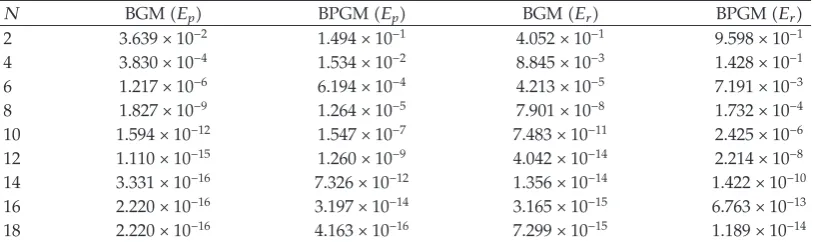
Table 1:EpandErforN2,4, . . . ,18.
N BGMEp BPGMEp BGMEr BPGMEr
2 3.639×10⁻² 1.494×10⁻¹ 4.052×10⁻¹ 9.598×10⁻¹ 4 3.830×10⁻⁴ 1.534×10⁻² 8.845×10⁻³ 1.428×10⁻¹ 6 1.217×10⁻⁶ 6.194×10⁻⁴ 4.213×10⁻⁵ 7.191×10⁻³ 8 1.827×10⁻⁹ 1.264×10⁻⁵ 7.901×10⁻⁸ 1.732×10⁻⁴ 10 1.594×10⁻¹² 1.547×10⁻⁷ 7.483×10⁻¹¹ 2.425×10⁻⁶ 12 1.110×10⁻¹⁵ 1.260×10⁻⁹ 4.042×10⁻¹⁴ 2.214×10⁻⁸ 14 3.331×10⁻¹⁶ 7.326×10⁻¹² 1.356×10⁻¹⁴ 1.422×10⁻¹⁰ 16 2.220×10⁻¹⁶ 3.197×10⁻¹⁴ 3.165×10⁻¹⁵ 6.763×10⁻¹³ 18 2.220×10⁻¹⁶ 4.163×10⁻¹⁶ 7.299×10⁻¹⁵ 1.189×10⁻¹⁴
5. Numerical Results
We solve in this section several numerical examples by using the algorithms presented in the previous section. Comparisons between Bernstein Galerkin methodBGM, Bernstein Petrov-Galerkin methodBPGM, and other methods proposed in21–24are made. We consider the following examples.
Example 5.1. Consider the boundary value problemsee,22
u2x−ux 4−2x2sinx 4xcosx, x∈0,1, 5.1
subject to the boundary conditions u0 u1 0, with the exact solutionux x2 − 1sinx.
Table 1lists the maximum pointwise errorEpand maximum absolute relative error Erof u−uN using the BGM and BPGM with various choices of N. Table 1 shows that
our methods have better accuracy compared with the quintic nonpolynomial spline method developed in22; it is also shown that, in the case of solving linear system of order 14, we obtain a maximum absolute error of order 10−16. It is worthy noting here that the method of
22gives the maximum absolute error 6.5×10⁻¹⁴but by solving a linear system of order 64 instead of order 14 in our case.
Example 5.2. We consider the fourth-order two point boundary value problemsee,21
u4x−3ux −2ex, x∈0,1,
u0 1, u1 e, u0 1, u1 e,
5.2
with the analytical solutionux ex.
Table 2 lists the maximum pointwise error and maximum absolute relative error of
u−uNusing the BGM and BPGM with various choices ofN. InTable 3, a comparison between
Table 2:EpandErforN4,6, . . . ,18.
N BGMEp BPGMEp BGMEr BPGMEr
4 1.259×10⁻⁴ 3.134×10⁻⁴ 9.394×10⁻⁵ 1.684×10⁻⁴ 6 1.575×10⁻⁷ 8.646×10⁻⁶ 1.089×10⁻⁷ 4.477×10⁻⁶ 8 1.256×10⁻¹⁰ 1.246×10⁻⁷ 8.392×10⁻¹¹ 6.341×10⁻⁸ 10 6.817×10⁻¹⁴ 1.121×10⁻⁹ 4.463×10⁻¹⁴ 5.637×10⁻¹⁰ 12 1.332×10⁻¹⁵ 6.944×10⁻¹² 6.563×10⁻¹⁶ 3.465×10⁻¹² 14 1.332×10⁻¹⁵ 3.286×10⁻¹⁴ 6.498×10⁻¹⁶ 1.594×10⁻¹⁴ 16 1.332×10⁻¹⁵ 1.332×10⁻¹⁵ 6.609×10⁻¹⁶ 6.193×10⁻¹⁶ 18 1.776×10⁻¹⁵ 1.776×10⁻¹⁵ 6.849×10⁻¹⁶ 7.707×10⁻¹⁶
Table 3:Comparison between different methods forExample 5.2.
Error BGM BPGM Sinc-Galerkin in21 Decomposition in21
Ep 1.8×10⁻¹⁵ 1.8×10⁻¹⁵ 3.7×10⁻⁹ 2.5×10⁻⁸
Table 4:EpandErforN6,8, . . . ,18.
N BGMEp BPGMEp BGMEr BPGMEr
6 4.037×10⁻⁶ 1.201×10⁻⁵ 6.889×10⁻⁶ 1.723×10⁻⁵ 8 3.314×10⁻⁹ 3.025×10⁻⁷ 4.796×10⁻⁹ 4.591×10⁻⁷ 10 1.973×10⁻¹² 4.086×10⁻⁹ 2.755×10⁻¹² 6.391×10⁻⁹ 12 1.110×10⁻¹⁵ 3.463×10⁻¹¹ 2.104×10⁻¹⁵ 5.528×10⁻¹¹ 14 4.441×10⁻¹⁶ 2.031×10⁻¹³ 7.014×10⁻¹⁶ 3.289×10⁻¹³ 16 4.441×10⁻¹⁶ 1.110×10⁻¹⁵ 1.693×10⁻¹⁵ 1.598×10⁻¹⁵ 18 4.441×10⁻¹⁶ 4.441×10⁻¹⁶ 1.563×10⁻¹⁵ 1.172×10⁻¹⁵
Table 5:Comparison between the errors of different methods inExample 5.3.
Error BGM BPGM Sinc-Galerkin21 Septic spline23 Decomposition24
Ep 4.4×10⁻¹⁶ 4.4×10⁻¹⁶ 9.2×10⁻⁶ 2.1×10⁻⁴ 1.3×10⁻⁴
Er 1.6×10⁻¹⁴ 1.2×10⁻¹⁶ 0.1×10⁻³ 1.8×10⁻³ —
Example 5.3. Consider the sixth-order BVPsee,21,23,24
u6x−ux −6ex, x∈0,1,
u0 1, u0 0, u 0 −1,
u1 0, u1 −e, u 1 −2e,
5.3
with the exact solutionux 1−xex.
Table 4 lists the maximum pointwise error and maximum absolute relative error of
u−uNusing BGM and BPG with various choices ofN.Table 5exhibits a comparison between
References
1 G. G. Lorentz,Bernstein Polynomials, Mathematical Expositions, no. 8, University of Toronto Press, Toronto, Canada, 1953.
2 G. Farin,Curves and Surfaces for Computer Aided Geometric Design, Academic Press, Boston, Mass, USA, 1996.
3 M. I. Bhatti and P. Bracken, “Solutions of differential equations in a Bernstein polynomial basis,”
Journal of Computational and Applied Mathematics, vol. 205, no. 1, pp. 272–280, 2007.
4 J. P. Boyd, “Exploiting parity in converting to and from Bernstein polynomials and orthogonal polynomials,”Applied Mathematics and Computation, vol. 198, no. 2, pp. 925–929, 2008.
5 A. Rababah, “Transformation of Chebyshev-Bernstein polynomial basis,” Computational Methods in Applied Mathematics, vol. 3, no. 4, pp. 608–622, 2003.
6 A. Rababah, “Jacobi-Bernstein basis transformation,”Computational Methods in Applied Mathematics, vol. 4, no. 2, pp. 206–214, 2004.
7 B. J ¨uttler, “The dual basis functions for the Bernstein polynomials,” Advances in Computational Mathematics, vol. 8, no. 4, pp. 345–352, 1998.
8 C. Canuto, M. Y. Hussaini, A. Quarteroni, and T. A. Zang,Spectral Methods in Fluid Mechanics, Scientific Computation, Springer, Berlin, Germany, 1988.
9 P. W. Livermore, “Orthogonal Galerkin polynomials,”Journal of Computational Physics, vol. 229, no. 6, pp. 2046–2060, 2010.
10 A. Karageorghis, “A note on the Chebyshev coefficients of the general order derivative of an infinitely differentiable function,”Journal of Computational and Applied Mathematics, vol. 21, no. 1, pp. 129–132, 1988.
11 T. N. Phillips, “On the Legendre coefficients of a general-order derivative of an infinitely differentiable function,”IMA Journal of Numerical Analysis, vol. 8, no. 4, pp. 455–459, 1988.
12 A. Karageorghis and T. N. Phillips, “On the coefficients of differentiated expansions of ultraspherical polynomials,”Applied Numerical Mathematics, vol. 9, no. 2, pp. 133–141, 1992.
13 E. H. Doha, “On the connection coefficients and recurrence relations arising from expansions in series of Hermite polynomials,”Integral Transforms and Special Functions, vol. 15, no. 1, pp. 13–29, 2004. 14 E. H. Doha, “On the construction of recurrence relations for the expansion and connection coefficients
in series of Jacobi polynomials,”Journal of Physics. A, vol. 37, no. 3, pp. 657–675, 2004.
15 E. H. Doha, “On the connection coefficients and recurrence relations arising from expansions in series of Laguerre polynomials,”Journal of Physics. A, vol. 36, no. 20, pp. 5449–5462, 2003.
16 E. H. Doha and A. H. Bhrawy, “Efficient spectral-Galerkin algorithms for direct solution for second-order differential equations using Jacobi polynomials,”Numerical Algorithms, vol. 42, no. 2, pp. 137– 164, 2006.
17 E. H. Doha and A. H. Bhrawy, “Efficient spectral-Galerkin algorithms for direct solution of fourth-order differential equations using Jacobi polynomials,”Applied Numerical Mathematics, vol. 58, no. 8, pp. 1224–1244, 2008.
18 E. H. Doha and A. H. Bhrawy, “A Jacobi spectral Galerkin method for the integrated forms of fourth-order elliptic differential equations,”Numerical Methods for Partial Differential Equations, vol. 25, no. 3, pp. 712–739, 2009.
19 E. H. Doha, A. H. Bhrawy, and W. M. Abd-Elhameed, “Jacobi spectral Galerkin method for elliptic Neumann problems,”Numerical Algorithms, vol. 50, no. 1, pp. 67–91, 2009.
20 R. T. Farouki and V. T. Rajan, “Algorithms for polynomials in Bernstein form,” Computer Aided Geometric Design, vol. 5, no. 1, pp. 1–26, 1988.
21 M. El-gamel, “A comparison between the sinc-Galerkin and the modified decomposition methods for solving two-point boundary-value problems,”Journal of Computational Physics, vol. 223, no. 1, pp. 369– 383, 2007.
22 M. A. Ramadan, I. F. Lashien, and W. K. Zahra, “High order accuracy nonpolynomial spline solutions for 2μthorder two point boundary value problems,”Applied Mathematics and Computation, vol. 204, no. 2, pp. 920–927, 2008.
23 S. S. Siddiqi and G. Akram, “Septic spline solutions of sixth-order boundary value problems,”Journal of Computational and Applied Mathematics, vol. 215, no. 1, pp. 288–301, 2008.