Decision-making impairment in
patients with multiple sclerosis:
a case
–
control study
Mauricio F Farez, Lucía Crivelli, Ramón Leiguarda, Jorge Correale
To cite:Farez MF, Crivelli L, Leiguarda R,et al. Decision-making impairment in patients with multiple sclerosis: a case–control study.BMJ Open2014;4: e004918. doi:10.1136/ bmjopen-2014-004918 ▸ Prepublication history for this paper is available online. To view these files please visit the journal online (http://dx.doi.org/10.1136/ bmjopen-2014-004918).
MFF and LC contributed equally.
Received 27 January 2014 Revised 6 June 2014 Accepted 10 June 2014
Department of Neurology, Raúl Carrea Institute for Neurological Research (FLENI), Buenos Aires, Argentina
Correspondence to Dr Mauricio F Farez; [email protected]
ABSTRACT
Objectives:To assess decision-making under explicit risk conditions in relapsing–remitting multiple sclerosis patients and its relationship to decisions made under conditions of ambiguity. To assess cognitive functions related to decision-making performance in patients with multiple sclerosis (MS).
Setting:MS center in Buenos Aires, Argentina. Participants:27 patients with relapsing–remitting multiple sclerosis and 27 sex-matched, age-matched and education-matched healthy controls.
Intervention:Neuropsychological assessment and decision-making evaluation using the Game of Dice Task and the Iowa Gambling Task.
Outcomes:Game of Dice Task and the Iowa Gambling Task scores.
Results:Patients with MS showed significantly poorer performance on the Game of Dice Task, choosing disadvantageous dice more often ( p=0.019), as well as significantly lower overall scores in the Iowa Gambling Task ( p=0.007). Block analysis showed that patients with MS and controls had scores that were comparable for blocks 1 and 2 ( p=0.15 and p=0.24, respectively). Conversely, patients with MS scored poorly on blocks 4 ( p=0.003) and 5 ( p=0.023), the last two of the test, corresponding to decision-making under conditions of risk. Finally, the Game of Dice Task performance together with the last three blocks of the Iowa Gambling Task were correlated with visuospatial learning, processing speed and working memory but not with executive functioning.
Conclusions:Patients with MS showed deficits in decision-making under risk conditions, which might be related to deficits in visuospatial learning, processing speed and working memory.
INTRODUCTION
Multiple sclerosis (MS) is an inflammatory demyelinating disease of the central nervous system that affects white matter, predominantly in the form of demyelinated plaques or lesions.1It is nowadays being recognised more and more that, in addition to white matter damage, grey matter involvement also plays an important role in MS symptomatology and
progression.2 Although some areas of the brain are affected more often than others, lesional distribution is thought to be random, with symptoms reflecting affected areas and patients presenting sensory, motor or cognitive disturbances.1Up to 70% of patients with MS may present cognitive disturbances at some point during disease development.3Cognitive areas affected in MS include executive func-tioning,4 attention,5 information processing6 and memory,3of which processing speed and visual memory are most commonly affected (52 and 54%, respectively).3 7Information pro-cessing efficiency is measured both by the brain’s capacity to manipulate information during short periods (working memory) and by the time required to access necessary infor-mation for the task undertaken ( processing speed). Impairment in processing speed can also affect other domains, such as executive function or working memory.8 Interestingly, increased demand for working memory is also associated with decreased processing speed.1 9
Strengths and limitations of this study
▪ Patients with multiple sclerosis (MS) showed significantly poorer performance on the Game of Dice Task and the Iowa Gambling Task. This may be related to deficits in visuospatial learn-ing, processing speed and working memory.
▪ Disturbances in decision-making (DM) may affect quality of life as well as social environment interaction. The detection and characterisation of cognitive deficits in MS will therefore both help patients and improve rehabilitation therapies for these cases.
▪ The limitations of this study include the unblinded observational design and small cohort size; our findings need further validation in a larger cohort. Moreover, association is not caus-ation, and the correlations observed between working memory, speed processing and DM may reflect associations between domains that are equally affected by an unmeasured and unre-lated cognitive deficit.
on September 22, 2020 by guest. Protected by copyright.
The Paced Auditory Serial Addition (PASAT) test, which measures working memory with high processing speed requirements, is one of the most sensitive tests available to detect cognitive impairment in patients with MS and it shows good correlation with deficit progression.2 10
As mentioned, impairment in the executive capabil-ities needed to successfully complete complex tasks and to adapt to shifting environments or demands has also been described in patients with MS, but less frequently than processing speed or visual memory.1 4
Regardless of impairment frequency, both executive function and working memory are key components in decision-making (DM).11–13 DM, the ability to choose between different options, is a key component of every-day functioning. When altered, it can have important negative consequences for the affected individuals, both socially and personally.14
DM can be assessed using the Game of Dice Task (GDT), which evaluates decisions made under explicit risk conditions in a task providing specific probabilities for positive and negative outcomes and foreseeable gains or losses resulting from each decision.15 16 In this test, individuals have to guess, during 18 throws of a single dice, which number will appear, choosing either one, two, three or four numbers. Safe options are three-or four-number combinations, whereas single- or double-number combinations are considered risky. Executive function plays an important role in categoris-ing and handlcategoris-ing winncategoris-ing probabilities durcategoris-ing the GDT. As previous studies have shown in healthy controls, GDT performance correlates with executive function as mea-sured by the Modified Card Sorting Test (MCST) and individuals with reduced executive functioning take dis-advantageous decisions in explicit risk situations.17
Feedback processing has also been shown to influence performance since individuals with impaired executive function can still perform adequately by learning from feedback provided after each throw.17 Finally, visual learning cues and working memory are other important factors that influence DM performance, and response to feedback or DM processing sometimes relies on the use of these capabilities.14 The relationship between DM and working memory was demonstrated by Bechara and colleagues by analysing participants with brain lesions in different locations and the impact on working memory and DM. Individuals having lesions affecting working memory have also poorer performance in DM tasks.11In addition to this, working memory impairment underlies at least partly the deficits observed in DM under risk conditions in individuals with substance addiction.12
This study investigates DM under explicit risk condi-tions as measured by the GDT, a task previously tested in healthy controls,14as well as under several disease condi-tions, such as Alzheimer’s18and Parkinson’s.19The main goal was to investigate the correlation between DM cap-abilities, executive function and working memory in patients with MS. An additional objective was to assess performance in GDT and compare the results to
performance in the Iowa Gambling Task (IGT), a test evaluating learning and DM under ambiguous condi-tions, where risk is not explicitly explained to the indi-vidual, and learning which options are more advantageous is required.20 Briefly, participants have to choose among four decks of cards in 100 trials and win or lose certain amounts of fictitious money. Two decks are disadvantageous in the long term, as they are asso-ciated with immediate high gain but higher unpredict-able future losses, and two decks are advantageous in the long term because they provide low immediate gain but lower unpredictable future losses. Since these con-tingencies are not explained to the participants, they have to learn to choose among the more advantageous decks.
DM under ambiguous conditions—as evaluated by the IGT—has been reported to be affected in many condi-tions such as Parkinson’s disease,19 substance abuse,21 pathological gambling,22anorexia nervosa23and MS.24–27 In the latter, several studies have reported impaired DM under ambiguous conditions even in the absence of major mood, cognitive or physical impairment. Moreover, Simioni and colleagues showed that a decline in DM capacity under ambiguity can appear as an early deficit in patients with MS, and when retested after 2 years, individuals can show significant deterioration in IGT scores independently of other markers of cognitive, emotional or disability worsening.27 The study by Nagy and colleagues also reports that DM impairment in patients with MS can appear as an isolated deficit without the presence of generalised cognitive impairment and that this deficit is unrelated to executive function, as they did not detect a significant correlation between IGT scores and the Wisconsin Card Sorting Test.25
However, it remains unclear whether patients with MS show impairment when executing tasks with explicit rules that require strategy and feedback processing, nor is it clear whether DM performance under risk condi-tions is correlated with feedback processing, working memory and information processing speed. We hypothe-sise that DM under explicit risk conditions is altered in patients with MS (ie, they favour riskier option choices), in relationship with executive and/or memory impair-ment, and we tested for a correlation between these domains and DM capabilities in the study patients.
METHODS Patients
Patients were recruited from the MS clinic at the Raúl Carrea Institute for Neurological Research (FLENI) by attending neurologists. Twenty-seven relapsing–remitting patients with MS fulfilling the 2005 McDonald criteria28 with less than 2 years of disease duration and scores <2 on the Expanded Disability Status Scale (EDSS) under-went a complete neuropsychological evaluation. Patients presenting upper limb impairment, visual acuity or visualfield deficits, a personal history of alcohol or drug
on September 22, 2020 by guest. Protected by copyright.
abuse, head trauma, major psychiatric disorders or other neurological disorders or systemic illnesses were excluded from the study. All tests were conducted at least 90 days after full recovery from the most recent relapse or the discontinuation of steroid treatment. Twenty-seven participants matched for age, gender and educational level served as the controls. The study proto-col was approved by the hospital Ethics Committee and all participants signed an informed consent form.
Neuropsychological evaluation
All participants completed Rao’s Brief Repeatable Battery (BRB).29 This battery includes tests for the assessment of cognitive components typically affected in MS such as processing speed (digit symbol test), working memory (PASAT), verbal memory (selective reminding test, SRT), visuospatial learning (7/24 spatial recall test) and verbal fluency (word list generation). Executive functions were studied using the MCST,30 and depres-sion was assessed using the Fast Screen verdepres-sion of the Beck Depression Inventory.31
Game of Dice Task
The GDT is used to evaluate DM in a gambling situation under explicit rules16 because rules for gains and losses as well as success probabilities are explicit and stable. Participants have to guess, during 18 throws of a single dice, which number will appear before selecting a single number ( probability of winning $1000 was 1:6=16.7%) or a combination of two ( probability of winning $500 was 2:6=33.3%), three ( probability of winning $200 was 3:6=50%) or four numbers ( probability of winning $100 was 4:6=66.6%). Safe options are three-number or four-number combinations, whereas single-number or double-number combinations are considered risky. The participants were aware of the duration of the test, affording the application of a long-term strategy to increase the outcome. The GDT net score was calculated by subtracting the number of risky selections from the number of safe selections. Additionally, selection propor-tions were also calculated for each round. Finally, feed-back processing was assessed to determine whether receiving negative feedback influenced future throws. Iowa Gambling Task
The IGT was designed to simulate real-life DM under ambiguity; this means that the outcome probabilities are unknown. The task consists of choosing a card from one of four decks: decks A and B are disadvantageous in the long term, as they are associated with immediate high gain but higher unpredictable future losses, whereas decks C and D are advantageous in the long term because they provide low immediate gain but lower unpredictable future losses. Moreover, the disadvanta-geous decks differ from each other since losses are more frequent but of a lower value for deck A than for deck B, which, in contrast, is associated with higher gains but overall higher losses than deck A. Likewise, among the
advantageous decks, losses are more frequent for deck C but of a lower value than for deck D, which is associated with higher overall gain. The participants were unaware of gain/loss probabilities when beginning the task. It was expected that, over the course of 100 card selec-tions, optimal performers would progressively develop the strategy of choosing more often from advantageous decks. The IGT net score was calculated by subtracting the number of disadvantageous deck selections from the number of advantageous deck selections. Additionally, all 100-card selections were subdivided into five blocks of 20 selections each, and scores for these blocks were also calculated. It has been argued that thefirst two IGT blocks are those that actually measure DM under ambi-guity, as, once participants learn which decks are more disadvantageous, decisions are made under risk condi-tions (blocks 3–5).13 14 Blocks 1 and 2 combined were considered the ambiguous IGT score block, and the former blocks 3–5 were combined and considered to be explicit-risk blocks.
Statistical analysis
Unless otherwise mentioned, the data are expressed as the mean±SEM. Normal distribution was assessed using a Kurtosis test; if variables were not normally distributed, a non-parametric Mann-Whitney test was applied. Otherwise, a t test was performed to evaluate the differ-ences between patients with MS and controls. Bonferroni correction was applied to adjust for multiple testing on the BRB tests, and p values ≤0.004 were con-sidered significant.
Changes during GDT performance were assessed by applying a proportional odds regression model. For feedback analysis, participants were considered to respond to feedback when they switched to an advanta-geous option after selecting a disadvantaadvanta-geous one and losing money. The proportion of participants switching to an advantageous option after receiving negative feed-back was analysed by applying a mixed-effects logistic regression model.
Forward stepwise linear regression analysis was used to determine which cognitive areas correlated with GDT performance. Univariate analysis was performed for each test included in the BRB and the MCST; tests with p values <0.15 were ranked and kept for the next step. We then added as a first variable the one having the highest correlation with the dependent variable (GDT score) and, if it was significant, we continued with the next variable until no more were available. Partial F tests were conducted at every step, and non-significant vari-ables were removed.
To construct a longitudinal model able to detect IGT changes during the five blocks of the test, a mixed-effects regression approach was used. The model included the IGT score as the dependent variable and diagnosis, block, and interaction as independent vari-ables. The systematic part of the model included diagno-sis and block-specific intercepts and slopes and, for the
on September 22, 2020 by guest. Protected by copyright.
random analysis, a random shift in the intercept and slope was added for each participant. p Values below 0.05 (two-tailed) were considered significant. Mediational analyses were performed using the Preacher and Hayes bootstrapped test of mediation. All statistical analyses were performed using Stata V.12 (Statacorp LP, Texas, USA).
RESULTS
Clinical, demographic and neuropsychological characteristics of study participants
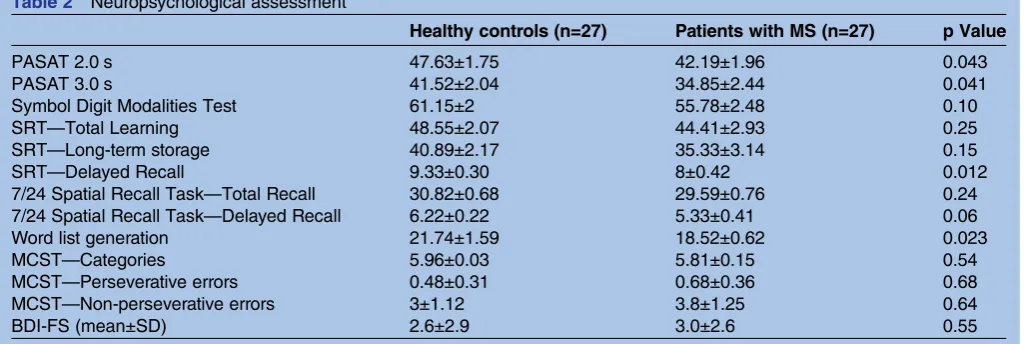
Clinical and demographic characteristics of the study participants are presented intable 1. The results of the BRB as well as of other tests performed by patients and healthy controls (HC) are reported in table 2. Patients with MS showed deficits in selective reminding tests, the Spatial Recall Test and the PASAT, but, after Bonferroni correction for multiple testing, none of the differences was statistically significant.
DM under risk is impaired in patients with MS
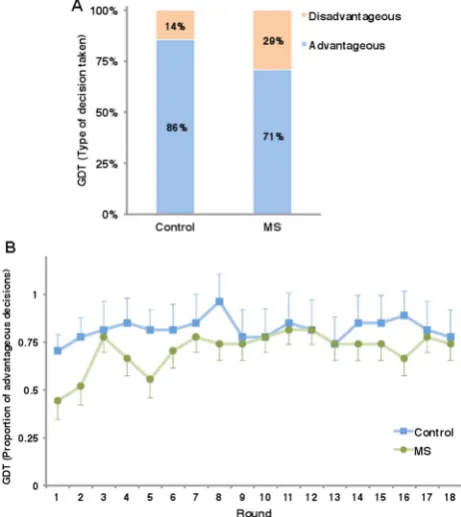
Results of DM assessment are presented in table 3. During the GDT, patients with MS made disadvantageous
choices (single and pair dice) more frequently than HC (29.9%±5.6 vs 14.4%±2.4, p=0.019; seefigure 1A).
These deficits could be caused by alterations in the ability to incorporate feedback ( patients fail to learn after losing money using disadvantageous dice) or by impairment in executive functions ( patients fail to elab-orate the right decisions correctly).
If participants were able to successfully use feedback received during task execution, the frequency of advanta-geous dice choice would be expected to increase progres-sively over rounds. To assess whether this was the case, we tested whether the proportion of each of the four deci-sions shifted with successive rounds and whether this change differed between patients and controls. No sig-nificant use of feedback was detected as the rounds pro-gressed (OR 1.03, 95% CI 0.99 to 1.06), nor was there significant interaction between rounds and diagnosis (OR 1.03, 95% CI 0.98 to 1.07). Thus, neither patients nor controls modified choices significantly during the task (see figure 1B). Owing to the fact that some indivi-duals never chose a disadvantageous option or, if they did, they may still not have received negative feedback, we further investigated whether choosing the disadvanta-geous dice and getting negative feedback (ie, losing money) influenced the shift to an advantageous option in either group. No significant difference in the propor-tion of individuals using negative feedback to modify decisions was observed (36% for healthy controls vs 33% in patients with MS, p=0.48). Thus, deficits in DM under risk observed in patients with MS did not seem to be caused by deficiencies in feedback processing.
Effect of visuospatial learning, processing speed and working memory on DM under risk
Since feedback processing deficit was not the reason for the underlying DM deficits observed in patients with MS and since it has been proposed that decisions made under explicit risk are correlated with executive func-tioning and memory,12 32 we also investigated whether
Table 2 Neuropsychological assessment
Healthy controls (n=27) Patients with MS (n=27) p Value
PASAT 2.0 s 47.63±1.75 42.19±1.96 0.043
PASAT 3.0 s 41.52±2.04 34.85±2.44 0.041
Symbol Digit Modalities Test 61.15±2 55.78±2.48 0.10
SRT—Total Learning 48.55±2.07 44.41±2.93 0.25
SRT—Long-term storage 40.89±2.17 35.33±3.14 0.15
SRT—Delayed Recall 9.33±0.30 8±0.42 0.012
7/24 Spatial Recall Task—Total Recall 30.82±0.68 29.59±0.76 0.24 7/24 Spatial Recall Task—Delayed Recall 6.22±0.22 5.33±0.41 0.06
Word list generation 21.74±1.59 18.52±0.62 0.023
MCST—Categories 5.96±0.03 5.81±0.15 0.54
MCST—Perseverative errors 0.48±0.31 0.68±0.36 0.68 MCST—Non-perseverative errors 3±1.12 3.8±1.25 0.64
BDI-FS (mean±SD) 2.6±2.9 3.0±2.6 0.55
BDI-FS, Beck Depression Inventory-Fast Screen; PASAT, Paced Auditory Serial Addition; MCST, Modified Card Sorting Test; SRT, selective reminding test.
Table 1 Participants’clinical characteristics and demographics
Healthy controls (n=27)
Patients with MS (n=27)
Age (years, mean±SD) 33.86±13.51 33.3±9.7 Gender (M:F) 10:17 10:17 Education (years, mean±SD) 14.06±2.3 15.33±2.21 Duration of disease (months,
mean±SD)
NA 7.9±8.1
EDSS (mean±SD) NA 1.03±0.80 EDSS, Expanded Disability Status Scale.
on September 22, 2020 by guest. Protected by copyright.
an association existed between these domains and GDT performance.
No significant correlation was detected between execu-tive function—as measured by the MCST—and DM in patients with MS ( p=0.29). We then evaluated whether working and visual memory—two traits frequently affected in MS—correlated with DM abilities. A signifi -cant correlation was detected between disadvantageous choices and both the 7/24 Spatial Recall Test (a test of visuospatial memory, p=0.021) and PASAT 2″
performance (a working memory test requiring a high processing speed, p=0.025). As performance on both tests decreased, participants tended to choose higher risk options in the GDT. Thus, DM performance under risk seems, in patients with MS, to be related to visuo-spatial learning and working memory/speed processing but not to executive function. Finally, we assessed whether the effect of visual memory on DM is mediated by working memory and we found that the relationship between visual memory and DM was partially mediated by working memory (27%) and that the direct effect remained significant ( p=0.01). Thus, although some of the effect of visuospatial memory is mediated by working memory, the majority of the effect is direct.
DM assessed by IGT in patients with MS is affected only in blocks involving decisions made under risk
IGT differs from GDT essentially in that outcome prob-abilities are unknown and participants have to learn which options are advantageous. Throughout the 100 test trials, patients with MS chose less advantageous decks significantly more often, as reflected by lower total IGT scores (32.9±4.1 for HC vs 14.9±4.9 for patients with MS, p=0.007; see figure 2A). It has been argued that IGT actually assesses DM in a dual fashion.13 The first two blocks truly correspond to decisions made under ambiguity, as individuals follow their guesses and hunches to choose between decks. However, once parti-cipantsfigure out which decks are associated with worse outcomes, they learn to choose the better decks so that, for the last three blocks, decisions are made based on relatively known risks,13 33 in which executive control is thought to play a more important role.14
We then assessed whether IGT scores changed over blocks (meaning that participants learned to avoid disad-vantageous decks over time and perform better) and whether the slope of this change was different between patients and controls in each block. As shown infigure 2B and table 3, no significant differences were detected between patients and controls during the first two blocks ( p=0.15 and p=0.24 for blocks 1 and 2, respectively). Table 3 Decision-making assessment
Healthy controls (mean±SEM)
Patients with MS
(mean±SEM) p Value
Assessment of decisions under risk (GDT results)
Frequency of disadvantageous choices 14.4%±2.4% 29.9%±5.6% 0.019 Money balance at the end of the game* 500±1991 −100±3007 0.45 Assessment of decisions under ambiguity (IGT results)
Total IGT score (C+D)−(A+B) 32.9±4.1 14.9±4.9 0.007
IGT score Block 1 −1.04±0.94 −2.82±0.79 0.15
IGT score Block 2 3.56±1.16 1.78±0.94 0.24
IGT score Block 3 7.78±1.15 4.81±1.15 0.08
IGT score Block 4 11.63±1.3 5.70±1.4 0.003
IGT score Block 5 10.97±1.5 5.41±1.8 0.023
*Median±SD.
GDT, Game of Dice Task; IGT, Iowa Gambling Task.
Figure 1 Game of dice task results. (A) Total percentage of advantageous or disadvantageous choices for patients with multiple sclerosis (MS) and healthy controls. Choosing one or two dice was considered a disadvantageous choice. See table 3for SEM and associated p values. (B) Proportion of advantageous decisions for patients with MS and healthy controls for each of the 18 rounds. Mean±SEM is shown.
on September 22, 2020 by guest. Protected by copyright.
Interestingly, starting from block 3 and reaching sig-nificance in blocks 4 ( p=0.003) and 5 ( p=0.023), patients with MS differed from HC, as they stopped pro-gressing in their scores. Patients with MS responded nor-mally when making decisions under purely ambiguous conditions but started failing once decisions had to be made under risky ones (not formally tested, assumed to be this way based on prior evidence).
We then hypothesised that impaired DM observed during the last IGT blocks responded to the same cause as impaired performance in the GDT and, therefore, that a correlation between scores as well as an associ-ation between visuospatial learning and working memory should be present. Indeed, GDT performance correlated positively to scores in the last three IGT blocks ( p=0.021), and correlations between visuospatial learning and working memory performance were also found for the last three IGT blocks (risk blocks, p=0.05 and p=0.023, respectively), but not for the first two (ambiguous blocks, p=0.33 and p=0.49, respectively).
DISCUSSION
We observed impaired DM in patients with MS under stable and explicit rules for gain and loss. The study results also suggested that deficits correlated with visuo-spatial and working memory performance, but not with feedback processing or executive function.
Studies in primates34 as well as humans35 have shown that the dorsolateral prefrontal cortex is key in working memory function, as measured by a variety of tasks. The claim that working memory is necessary for DM comes from studies showing that individuals with lesions in this area and low performance in working memory are also affected in their DM capacity.11 Working memory defi -cits are also commonly observed in patients with MS.29 The nature of this particular deficit is beyond the scope of this manuscript, but the accumulation of white and grey matter lesions in a random fashion over time seems to be the most likely underlying mechanism.3However, our results highlight the fact that memory deficits are not only important per se, but can also affect other equally or even more important areas, such as DM.
Even though visuospatial impairment has been consist-ently observed in patients with MS,29 36 its relation to DM has not been addressed. Visuospatial memory is closely linked to working memory, and pre-existing defi -cits in visuospatial memory in patients with MS have been found to affect working memory function.36 Quantification of the contribution of visuospatial and working memory to DM in MS is an interesting question to be addressed in future studies and until then these
findings should be interpreted with caution.
DM under ambiguous and risky conditions and the rela-tionship between them were also studied. No significant deficit in ambiguous decisions was detected, as measured by the first two blocks of the IGT, whereas significant impairment in learning and performance in the last three blocks was observed. DM (as measured by the IGT) has been previously shown to be impaired in patients with MS,24–27 37 but no distinction has been made regarding the type of DM affected. Overall, previous studies have found poorer performance in later IGT blocks, with pre-served DM during the initial blocks.24–27 37
Little is known about the natural history of DM distur-bances in MS; as mentioned, the study population com-prised mostly recently diagnosed patients with MS. One longitudinal study reassessing IGT scores at 2-year inter-vals showed that DM deficits could progress over time.27 Interestingly, IGT performance in primary progressive MS (PPMS) seems to be significantly affected compared to HC and secondary progressive MS (SPMS),38 high-lighting the heterogeneous nature of DM impairments.
The limitations of this study include the unblinded observational design and small cohort size. Moreover, association is not causation, and the correlations observed between working memory, speed processing and DM may reflect associations between domains that are equally affected by an unmeasured and unrelated cognitive deficit. Several factors that could have affected Figure 2 Iowa gambling task results. (A) Total IGT scores
((C+D)−(A+B)) for patients with MS and healthy controls. Mean±SEM is shown. (B) Total IGT scores ((C+D)−(A+B)) by block for patients with MS and healthy controls. Mean±SEM is shown.
on September 22, 2020 by guest. Protected by copyright.
DM performance of patients with MS, such as depres-sion, physical impairment (eg, decreased visual acuity or motor dysfunction) or limited processing speed (the most common cognitive deficit in MS), were each addressed.39 Given the inclusion criteria applied, patients were mostly recently diagnosed and without physical handicaps. No significant differences in depres-sion scale scores were observed, nor was physical disabil-ity an issue; all individuals had EDSS scores below or equal to 2. Finally, GDT is not a timed test; therefore, it is unlikely that processing speed affected patient per-formance. Nevertheless, our findings needs further val-idation in a larger cohort of patients with MS.
CONCLUSIONS
Our study shows specific DM deficits in patients with MS. Disturbances in DM may affect quality of life24 as well as social environment interaction.40 The detection and characterisation of cognitive deficits in MS will therefore both help patients and improve rehabilitation therapies for these cases.
Contributors MFF, LC, RL and JC were involved in conception and design,
acquisition of data, or analysis and interpretation of data; (2) drafting the article or revising it critically for important intellectual content; and (3) final approval of the version to be published.
Funding This study was supported by funding from the Raúl Carrea Institute
for Neurological Research (FLENI) and by Merck-Serono Argentina.
Competing interests MFF received honoraria and professional travel/
accommodations stipends from Merck-Serono Argentina and Novartis Argentina. JC is a board member of Merck-Serono Argentina, Novartis Argentina, Biogen-Idec LATAM and Merck-Serono LATAM. JC received reimbursement to develop educational presentations for Merck-Serono Argentina, Merck-Serono LATAM, Biogen-Idec Argentina, Novartis Argentina, Novartis LATAM, Genzyme Argentina and TEVA-Tuteur Argentina as well as professional travel/accommodation stipends.
Patient consent Obtained.
Ethics approval Ethics committee.
Provenance and peer review Not commissioned; externally peer reviewed.
Data sharing statement No additional data are available.
Open Access This is an Open Access article distributed in accordance with
the Creative Commons Attribution Non Commercial (CC BY-NC 3.0) license, which permits others to distribute, remix, adapt, build upon this work non-commercially, and license their derivative works on different terms, provided the original work is properly cited and the use is non-commercial. See: http:// creativecommons.org/licenses/by-nc/3.0/
REFERENCES
1. Noseworthy JH, Lucchinetti C, Rodriguez M,et al. Multiple sclerosis. N Engl J Med2000;343:938–52.
2. Bø L. The histopathology of grey matter demyelination in multiple sclerosis.Acta Neurol Scand Suppl2009(189):51–7.
3. Chiaravalloti ND, DeLuca J. Cognitive impairment in multiple sclerosis.Lancet Neurol2008;7:1139–51.
4. Drew M, Tippett LJ, Starkey NJ,et al. Executive dysfunction and cognitive impairment in a large community-based sample with multiple sclerosis from New Zealand: a descriptive study.Arch Clin Neuropsychol2008;23:1–19.
5. Crivelli L, Farez MF, González CD,et al. Alerting network dysfunction in early multiple sclerosis.J Int Neuropsychol Soc 2012;18:757–63.
6. De Sonneville LMJ, Boringa JB, Reuling IEW,et al. Information processing characteristics in subtypes of multiple sclerosis. Neuropsychologia2002;40:1751–65.
7. Benedict RHB, Cookfair D, Gavett R,et al. Validity of the minimal assessment of cognitive function in multiple sclerosis (MACFIMS). J Int Neuropsychol Soc2006;12:549–58.
8. Kalmar JH, Gaudino EA, Moore NB,et al. The relationship between cognitive deficits and everyday functional activities in multiple sclerosis.Neuropsychology2008;22:442–9.
9. Lengenfelder J, Bryant D, Diamond BJ,et al. Processing speed interacts with working memory efficiency in multiple sclerosis.Arch Clin Neuropsychol2006;21:229–38.
10. Fischer JS, Rudick RA, Cutter GR,et al. The multiple sclerosis functional composite measure (MSFC): an integrated approach to MS clinical outcome assessment.Mult Scler1999;5:244–50. 11. Bechara A, Damasio H, Tranel D,et al. Dissociation of working
memory from decision making within the human prefrontal cortex. J Neurosci1998;18:428–37.
12. Bechara A, Martin EM. Impaired decision making related to working memory deficits in individuals with substance addictions.
Neuropsychology2004;18:152–62.
13. Brand M, Recknor EC, Grabenhorst F,et al. Decisions under ambiguity and decisions under risk: correlations with executive functions and comparisons of two different gambling tasks with implicit and explicit rules.J Clin Exp Neuropsychol 2007;29:86–99.
14. Brand M, Labudda K, Markowitsch HJ. Neuropsychological correlates of decision-making in ambiguous and risky situations. Neural Netw2006;19:1266–76.
15. Bechara A, Tranel D, Damasio H. Characterization of the decision-making deficit of patients with ventromedial prefrontal cortex lesions.Brain2000;123(Pt 11):2189–202.
16. Brand M, Fujiwara E, Borsutzky S,et al. Decision-making deficits of korsakoff patients in a new gambling task with explicit rules: associations with executive functions.Neuropsychology 2005;19:267–77.
17. Schiebener J, Zamarian L, Delazer M,et al. Executive functions, categorization of probabilities, and learning from feedback: what does really matter for decision making under explicit risk conditions? J Clin Exp Neuropsychol2011;33:1025–39.
18. Delazer M, Sinz H, Zamarian L,et al. Decision-making with explicit and stable rules in mild Alzheimer’s disease.Neuropsychologia 2007;45:1632–41.
19. Rossi M, Gerschcovich ER, de Achaval D,et al. Decision-making in Parkinson’s disease patients with and without pathological gambling. Euro J Neurol2010;17:97–102.
20. Bechara A, Damasio AR, Damasio H,et al. Insensitivity to future consequences following damage to human prefrontal cortex. Cognition1994;50:7–15.
21. Bechara A, Damasio H. Decision-making and addiction ( part I): impaired activation of somatic states in substance dependent individuals when pondering decisions with negative future consequences.Neuropsychologia2002;40:1675–89.
22. Cavedini P, Riboldi G, Keller R,et al. Frontal lobe dysfunction in pathological gambling patients.Biol Psychiatry2002;51:334–41. 23. Cavedini P, Bassi T, Ubbiali A,et al. Neuropsychological
investigation of decision-making in anorexia nervosa.Psychiatry Res 2004;127:259–66.
24. Kleeberg J, Bruggimann L, Annoni J-M,et al. Altered
decision-making in multiple sclerosis: a sign of impaired emotional reactivity?Ann Neurol2004;56:787–95.
25. Nagy H, Bencsik K, Rajda C,et al. The effects of reward and punishment contingencies on decision-making in multiple sclerosis. J Int Neuropsychol Soc2006;12:559–65.
26. Roca M, Torralva T, Meli F,et al. Cognitive deficits in multiple sclerosis correlate with changes in fronto-subcortical tracts.Mult Scler2008;14:364–9.
27. Simioni S, Ruffieux C, Kleeberg J,et al. Progressive decline of decision-making performances during multiple sclerosis.J Int Neuropsychol Soc2009;15:291–5.
28. Polman CH, Reingold SC, Edan G,et al. Diagnostic criteria for multiple sclerosis: 2005 revisions to the‘McDonald Criteria’.Ann Neurol2005;58:840–6.
29. Rao SM, Leo GJ, Bernardin L,et al. Cognitive dysfunction in multiple sclerosis. I. Frequency, patterns, and prediction.Am Acad Neurol1991;41:685–91.
30. Nelson HE. A modified card sorting test sensitive to frontal lobe defects.Cortex1976;12:313–24.
31. Benedict RHB, Fishman I, McClellan MM,et al. Validity of the Beck Depression Inventory-fast screen in multiple sclerosis.Mult Scler 2003;9:393–6.
on September 22, 2020 by guest. Protected by copyright.
32. Brand M, Labudda K, Kalbe E,et al. Decision-making impairments in patients with Parkinson’s disease.Behav Neurol2004;15:77–85. 33. Maia TV, McClelland JL. A reexamination of the evidence for
the somatic marker hypothesis: what participants really know in the Iowa gambling task.Proc Natl Acad Sci USA2004;101:16075–80. 34. Goldman-Rakic PS. Working memory and the mind.Sci Am
1992;267:110–17.
35. Courtney SM, Ungerleider LG, Keil K,et al. Transient and sustained activity in a distributed neural system for human working memory. Nature1997;386:608–11.
36. Foong J, Rozewicz L, Quaghebeur G,et al. Executive function in multiple sclerosis. The role of frontal lobe pathology.Brain1997; 120(Pt 1):15–26.
37. García-Molina A, Rodríguez Rajo P, Vendrell Gómez P,et al. [Orbitofrontal dysfunction in multiple sclerosis: Iowa Gambling Task]. Psicothema2008;20:445–9.
38. García-Molina A, Enseñat-Cantallops A, Sánchez-Carrión R,et al. [Assessment of decision-making capacity in primary and secondary progressive multiple sclerosis].Neurologia2009;24:94–7.
39. DeLuca J, Chelune GJ, Tulsky DS,et al. Is speed of processing or working memory the primary information processing deficit in multiple sclerosis?J Clin Exp Neuropsychol2004;26: 550–62.
40. Bar-On R, Tranel D, Denburg NL,et al. Exploring the neurological substrate of emotional and social intelligence.Brain2003;126: 1790–800.
on September 22, 2020 by guest. Protected by copyright.