74
Energy Efficient VM Migration in Cloud for Load Balancing
Shweta Teckchandani, Kailash Patidar
Sri Satya Sai Institute of Science & Technology, Sehore Bhopal, MP, India
Abstract:
Cloud computing has brought a revolutionin high performance computing these days. In cloud Computing energy and load balancing is been a concerned domain for all the researchers. In this paper a Max-Min ACS based approach is applied for load balancing is cloud. The results show considerable reduction in VM Migration and energy consumption.
Keywords: Ant colony system (ACS), Cloud, Energy in
cloud, VM Migration.
I.
INTRODUCTION
Some decades ago when Internet was not introduced,
companies ran e-mail as an application where data was
stored in the hardware or in a secure place only. All the
files, documents, messages and other important
information were stored in a protection on the company’s
premises only [1]. However, it was not possible to store the
huge amount of data due to lack of storage space. By
moving forward into the 20th century, when companies
like Google started showing up and email system has been
started [1]. Then it became easy, it would have been a great
invention of Google, that cause more subscribers, however
these companies choose to open their own servers to store
e-mail information for customers. However, to access that
data, user has to adopt their applications like Gmail, Yahoo
Mail and so many others. Further to open own servers and
access all these applications to store the information of
customers, Internet arrived. Moving further, if describe
practically about cloud computing, adopting other people’s
servers to run applications for the organization, remotely is
called as cloud computing system. For example, with cloud
computing, different applications and services can be
accessed without ever buying an extra piece of hardware or
software. Whenever user required any changes to the cloud
data, there needs an Internet connection [1]. The cloud
computing nature is shared resource, identity management,
privacy and access control; these all parameters are the
area of concern in cloud computing. Organizations are
increasing day by day for computation of applications in
the cloud, this is necessary to deal with cloud computing
security issues.
II.
RELATED WORK
In [12] an admission control and scheduling mechanism
proposes which not only maximizes the resource utilization
and profit, but also ensures that the QoS requirement is
proposed. Mixed Workload Aware Policy (MWAP) is
implemented to consider the workload of different types of
application such transactional and non-interactive batch
jobs. The proposed mechanism provides substantial
improvement over static server consolidation and reduces
SLA violations. In [13] VM consolidation problem which
is a NP Hard problem is solved by applying meta-heuristic
algorithm ACO. The objective is to lower down the energy
consumption of the overall algorithm. And the algorithm
also reduces VM migrations. In [6] a novel allocation and
selection policy for the dynamic virtual machine (VM)
consolidation in virtualized data centers to reduce energy
consumption and SLA violation. Firstly, it detects
overloading hosts in virtual environments and then applies
a method to select VMs from those overloading hosts for
migration. VM Provisioning Method to Improve the Profit
75
authors proposed a Threshold based algorithm for VM
provisioning among multiple service providers that reduces
SLA Violation. It uses two threshold values and two type
of VMs (on-demand and reserved),These threshold values
will be decided by the cloud federation depending on the
environmental conditions like current workload, idle
capacity of each cloud provider, etc. In [11] a power
friendly algorithm is proposed. This paper compared live
and non live VM migration in terms of power
consumption. In [16] authors developed an objective
method to facilitate the comparison of different virtual
machine placement algorithms in the cloud. In [17]stable
matching framework to decouple policies from
mechanisms when mapping virtual machines to physical
servers are presented and a general resource management
architecture called Anchor is proposed. In [18] the resource
allocation problem to be a convex optimization problem
and proposed a self-organizing cloud architecture is
discussed. Speitkamp and Bichler [20] studied the static
consolidation problem with a mathematical programming
approach. In [19] they modeled the consolidation as a
modified bin-packing problem. These works focus on the
initial VM deployment or static consolidation problem
based on resource utilization and do not consider VM
migration overhead.
III.
MAX-MIN APPROACH
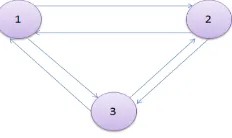
Consider each physical machine is represented by a node
in graph and each edge defines VM migration from one
physical machine (PM) to another. The generated graph
will be directed and completely connected having positive
edge weights. Consider 3 physical machines having one,
two, three VMs respectively.
Figure 1 virtual machine
The above situation can be converted into graph as shown
below.In AS ants concurrently build the solution for the
Cloud VM. Initially ants are put on randomly chosen nodes
which represent PM. In each iteration construction step, ant
k applies probabilistic action choice rule, called random
proportional rule, to decide to which PM given VM should
be migrated. Pij is the probability of migrating VM to j
which is currently at i is:
Where ηij = 1/dij is a heuristic. There are two (α , β)
parameters which determine the relative influence of the
pheromone trail and the heuristic information, and where
is the nodes which are available.
Figure 2 graphical presentation of VM
Update of Pheromone Trail
When ants have constructed their tours, pheromone trails
are updated. This is done by first lowering the pheromone
value on all the edges by a constant factor called ρ. And
then adding the pheromone content on the edges visited by
the ants in their tours. Pheromone evaporation is done as:
Where ρ is the pheromone evaporation rate lies between 0<ρ<=1. The parameter ρ is used to avoid unlimited
pheromone deposition and it enables the algorithm to not
to choose the bad path that were chosen by earlier ants.
The pheromone evaporation decreases the pheromone
content exponentially with the number of iterations. In first
76
available but in second iteration pheromone available is ρ2
times the pheromone available initially. After evaporation,
all ants deposit pheromone in their tour constructed in tour
construction phase. Pheromone is updated as:
Where is the amount of pheromone deposited by ant k
on the arcs it has visited. It is defined as:
Where is the number of VMs running on kth PM. With
this less the number of VMs on PM more is the amount of
the pheromone deposit on the edges of its tour. Therefore
more likely they will be chosen by ants in their future
iterations of the algorithm and relatively less difference in
pheromone trail levels.
IV.
RESULTS & ANALYSIS
In this paper standard VM migration approach using ant
colony optimization as done in the base paper is simulated
using CloudSim and the proposed algorithm based on
Max-Min ant system is also simulated for same
environment. And the results are as follows:
Here all the VMs are created on the basis of MIPS which is
as follows: {250, 500, 750, 1000} And PMs are created on
77
V.
CONCLUSION
Cloud computing is getting attention of the researchers
these days. Large number of users are attached with cloud
computing. But as there are several merits of cloud
computing some demerits are also there. The one of the
greatest issue in cloud computing is energy consumption
and VM Migration problem. In this paper an Ant colony
approach is proposed for VM migration in cloud. As
described VM Migration is a NP-Hard problem and this
problem can be solved in less time using some
meta-heuristic algorithm. All such implementations can be
effectively simulated using a tool called CloudSim. In
future the algorithm proposed in this paper can be
implemented. And ACO has many variants; different
variants may be applied on VM migration problem.
Performance of all these variants may be compared with
each other in terms of No. of VM Migrations, Energy
consumption and SLA Violations.
REFERENCES
[1] Komal Singh Patel and A. K. Sarje, “VM Provisioning
Method to Improve the Profit and SLA Violation of
Cloud Service Providers,” IEEE International
Conference, Cloud Computing in Emerging Markets
(CCEM) 11-12 Oct. 2012.
[2] K. S. Patel and A.K. Sarje, “VM Provisioning Policies
to Improve the Profit of Cloud Infrastructure Service
Providers,” ICCCNT-12, July.2012.
[3] Gundeep Singh Bindra, Prashant Kumar Singh, Seema
Khanna, Krishen Kant Kandwal, “Cloud Security:
Analysis and Risk Management of VM Images,”
Proceeding of IEEE International Conference on
Information and Automation Shenyang, China, 2012.
[4] Eeraj Jan Qaisar, “Introduction to Cloud Computing for
Developers,” In IEEE ©2012.
[5] A. Beloglazov, R. Buyya, “Optimal Online
Deterministic Algorithms and Adaptive Heuristics for
Energy and Performance Efficient Dynamic
Consolidation of Virtual Machines in Cloud Data
Centers,” Concurrency and Computation: Practice and
Experience (CCPE), Wiley Press, New York, USA, pp.
1397–1420, SEP-2012.
[6] Zhibo Cao and Shoubin Dong, “Dynamic VM
consolidation for energy-aware and SLA violation
reduction in cloud computing,” 13th International
Conference on Parallel and Distributed Computing,
Applications and Technologies 2012.
[7] Yonggen Gu, Wei Zhang, Jie Tao, “A Study of SLA
Violation Compensation Mechanism in Complex Cloud
Computing Environment,” In IEEE, 2012.
[8] C. Belady, “In the data center, power and cooling costs more than the equipment it supports,” 2007.
[9] http://en.wikipedia.org.
[10] http://www.sciencedirect.com/science/article/pii/S1877.
[11] David Aikema, Andrey Mirtchovski, Cameron Kiddle,
and Rob Simmonds "Green Cloud VM Migration:
Power Use Analysis" in IEEE 2012.
[12] Saurabh Kumar Garg, Adel Nadjaran Toosi, Srinivasa
K. Gopalaiyengar, Rajkumar Buyya, “SLA-based
virtual machine management for heterogeneous
workloads in a cloud datacenter,” Journal of Network
and Computer Applications 1 August 2014.
[13] Rafid Sagban, Ku Ruhana Ku Mahamud, Muhamad
Shahbani Abu Bakar "Reactive Memory Model for Ant
Colony Optimization and Its Application to TSP" in
2014 IEEE International Conference on Control
System, Computing and Engineering, 28 - 30
November 2014, Penang, Malaysia.
[14] M. Veluscek, T. Kalganova, P. Broomhead "Improving
Ant Colony Optimization Performance through
Prediction of Best Termination Condition" in IEEE
2015.
[15] Fahimeh Farahnakian, Adnan Ashraf, Tapio Pahikkala,
78
Tenhunen "Using Ant Colony System to Consolidate
VMs for Green Cloud Computing" in IEEE
TRANSACTIONS ON SERVICES COMPUTING,
VOL. 8, NO. 2, MARCH/APRIL 2015.
[16] C. C. Basics, “Cloud Computing basics for
non-experts”, cloud weeks, pp. 1–8, May, 2015.
[17] Huth and J. Cebula, “The Basics of Cloud Computing”,
Carnegie Mellon University, Pp.1–4, February, 2011.
[18] M. Armbrust, A. D. Joseph, R. H. Katz and D. A. Patterson, “Above the Clouds: A Berkeley View of Cloud Computing,” University of California at
Berkeley, pp. 14-19, February, 2009.
[19] T. Cloud and C. Stack, “The Cloud Computing Stack”
Diversity Limited, pp. 1-9, October, 2013.
[20] S. Home, “Rackspace Support Network Understanding
the Cloud Computing Stack”, Rackspace Support