37(4), Winter 2019, pp. 141-165- ISSN: 2008-8191
DOI: 10.22099/jtls.2019.33711.2694
Exploring EFL Learners’ Use of Formulaic Sequences in Pragmatically Focused Role-play Tasks
AbdullahSarani ∗ RasoolNajjarbaghseyah **
Abstract
Communicative language use largely entails regular patterns consisting of pre-constructed phrases or sequences. These sequences have been examined by many researchers to find the situation-based formulas which may help L2 learners follow a possibly more target-like speaking system. This study, therefore, explored two categories of formulaic expressions including speech formulas and situation-bound utterances used by EFL learners. The randomly selective participants included 30 intermediate and 30 advanced learners, who performed a total number of 120 role-play tasks focused on the situations which required the use of thanking, requesting, offering, and apology speech acts. Audio-recorded data from role-plays were transcribed and analyzed based on existing lists of speech formulas. Results showed that the participants produced more than 102 types of formulaic sequences that could be called “a list of pragmatic routines for thanking, requesting, offering, and apologizing speech acts in the EFL context”. This list includes 44 and 58 speech formulas and situation-bound utterances, respectively. Results further indicated that advanced language learners used more diverse situation-bound utterances in terms of its internal and contextual complexity than their counterparts in the intermediate group due to expert judgments. Because these formulas can increase coherence in speaking, and enhance effective and natural communication, their instruction could be part of the language teaching curriculum.
Keywords: Formulaic Expressions, Language Formula, Pragmatic Routines, Teaching English as a Foreign Language
Received: 22/05/2019 Accepted: 01/10/2019
∗ Associate Professor, University of Sistan and Baluchestan - Email:
Socialization theory stresses that language learning is not separated from the setting in which it is used (Kanagy, 1999). That is, the setting has particular presupposition, implicatures, and conversational structures (Soler & Martinez-Flor, 2008) which impose specific use of forms. This means that at the surface level, language is composed of those icons signifying the environment and setting of language use. These icons can be interpreted through “formula”. While the notion of formula in language has recently received the greatest attention, it dates back to the studies in the 1970s (Nekrasova, 2009). “Formulaic language” (Bardovi-Harlig, 2012; Kecskes, 2007; McGuire, 2009; Wary, 2002) covers various terms used in different studies such as conversational routines (Aijmer, 1996), routines and formulaic devices (Jung, 2002), idiom principle (Sinclair, cited in Bhatia, Flowerdew & Jones, 2008), language sequences (Kecskes, 2007), and conventional expressions (Bardovi-Harlig, 2012) to cite just a few. In a comprehensive work, Wary (2002) listed more than 50 terms or names for formulaicity cited in different works and stressed that among others “formulaic language (FL)” is the most general and commonly used term. He, then, operationalized FL with “formulaic sequence (FS)” which is common in the most existing literature on formulaicity. In the present work, therefore, the working definition for FSs is based on Wary which is a sequence, continuous or discontinuous, of words or other elements, which is, or appears to be, prefabricated: that is, stored and retrieved whole from memory at the time of use, rather than being subject to generation or analysis by the language grammar. (p. 9)
speech acts, conversational gambits and connectives routines, and attitudinal routines. At the psycholinguistic view to FSs, some scholars (Weinert, 2010; Wood, 2010) explored the psychological aspect of formulas such as alternation in FSs and how such sequences were stored and retrieved in the mental lexicon (Bardovi-Harlig, 2013). The most recent attention, however, has given a pragmatic view to formulaic speech. This view has also been stressed by Aijmer (1996) and Kecskes (2007) who classified routines or FSs under the functional side of routines.
Methodologically, an important impetus for this kind of view has been the appearance of corpus-based discourse analysis. According to Bhatia et al. (2008), “work with large corpora has demonstrated that language follows to a large extent very regular patterns consisting of pre-constructed phrases” (p. 7). Based on this view, language speakers adhere to the idiom principle (i.e. select from a close-ended linguistic resource) while they are speaking and when there is no constraint (Sinclair, cited in Bhatia et al., 2008). Generally, an all-in-one method for classification of different perspectives on formulas is the “formulaic continuum” (p. 193) proposed by Kecskes (2007). According to this classification, formulas can be distributed along with a continuum from grammar units on the left (e.g. be going to, have to) to the situation-bound utterance (e.g. welcome abroad) and idioms (e.g. spill the beans) on the right.
The present study focuses on the social and pragmatic value of FSs. The formula, pragmatically, “refers to recurrent strings or expressions used for specific pragmatic purposes” (Bardovi-Harligh, 2012, p. 207) which could contribute to pragmatic development.
the context in which they occur is part of sociopragmatic competence” (Bardovi-Harligh, 2013, p. 1).
Accordingly, the study of FSs in an EFL context could indicate the process of EFL learners’ interlanguage pragmatic development (Tajeddin & Malmir, 2015) on the one hand and represent some pragmatic features of the EFL context on the other hand. This study, therefore, tends to study the discourse of FSs production from an EFL perspective. It aims to show the variety of FSs in an EFL context as well as how this variety could represent EFL learners’ characteristics. The latter aim could signify the interlanguage pragmatic (socio and linguistic) development of EFL learners through studying how advanced/intermediate treat FSs variously.
Literature Review
A central issue in the current theme, therefore, has been the examination of “relationships between FL and analysis/rules in L2 developments (Weinert, 1995, p. 181). This recurrent theme in many studies has caused the exploration of both the identification and function of FSs. Weinert claimed that “there is………no reason to assume that all formulaic chunks are organized in the same way” (p. 197) indicating language formulas are retained and retrieved on the whole without any analysis. He proposed “the view of language as a formulaic-creative continuum” (p. 185).
Functions of FSs were also reviewed by Wray (2000), albeit in a more teaching-oriented manner. Accordingly, FSs have two salient functions in the classroom: reducing processing effort and satisfying social interaction (Wray, 2000). Along with the social interaction functions of FSs, Bardovi-Harlig (2012, 2013) stressed the pragmatic values of the sequences by introducing speech formula as a social contract.
Kanagy (1999) introduced interactional routines such as greeting, attendance, and personal introduction into the area of research. Wray (2002) tried to propose a coherent model of FL as well as introducing criteria for the identification of FSs.
The findings of Wray, then, were used by many scholars (Giammarresi, 2010; Kecskes, 2007; Nekrasova, 2009; Tremblay & Baayen, 2010). Nekrasova (2009), for example, conducted an experiment on holistic and analytic knowledge of language learners with the lexical bundles as the unit of analysis and found that the use of lexical bundles or routines depends on the knowledge which has to share among participants. This shared knowledge is, even, necessary among language speakers from non-English speech communities (Abdou, 2010; Kecskes, 2007). Abdou (2010) and Kecskes (2007) concluded that because the shared knowledge of the formulaic language is very little in lingua franca communication, lingua franca communicators use formulaic language less than other communicators.
that there has also been a functional approach to the study of FSs. Accordingly, cultural variations (Abdou, 2010), corpus-based studies (Simpson-Vlach & Ellis, 2010), comparative studies (Forsberg & Fant, 2010; Giammarresi, 2010), experimental researches (Coklin & Schmitt, 2008), techniques for teaching routines (Kanagy, 1999) and formulas in ESP (Chen, 2008; Jones & Haywood, 2004) are some orientations within the functional approach. Simpson-Vlach (2010) provided the area of FL research with a list of FSs for academic speech and writing called the Academic Formulas List (AFL).
In contrast, Kirner-Ludwig (2018) focused on the function of only one specific formula, i.e. “that's what she said”, to find a notionally neat category for this pragmatic idiom. His study implies that each FE worth to be studied individually from its contextual and internal complexities.
Through a comparative study, Dörnyei, Durow, and Zahran (2004) examined individual differences and their effects on FSs among 7 participants from Asian culture. They claimed that acquiring language sequences were deeply related to active involvement in the target speech community. Cultural effects were also viewed by Abdou (2010) and Adolphs and Durow (2004). They noticed that there is a relationship between social integration and the acquisition of FSs. The acquisition of FSs was also investigated through the development of collocation use (Li & Schmitt, 2010; Schmitt, 2004) and the acquisition of idioms (Forsberg & Fant, 2010) that are realizations of language sequences.
learners were generally receptive to first language awareness-raising tasks while acquiring request speech act.
The role of proficiency in FEs formation was also explored in English as a Second Language (ESL) context. Taguchi (2013), for example, found that there was a significant effect of proficiency combined with study abroad experience on appropriateness, planning time, and speech rate of learners’ FEs productions. Li (2014) examined the effects of linguistic proficiency on pragmatic routines development in L2 Chinese abroad context. He explored the development of pragmatically appropriate requests among participants and found that advanced and intermediate language learners showed a similar pattern of change in their production of speech rate although the advanced group treated request speech act differently in terms of planning time of speech production.
In terms of FSs acquisition techniques, there was some material in Dia and Ding (2010) who tried to examine the effect of text memorization on FSs and, if yes, whether this effect might be different in terms of proficiency. This work which studied Chinese language learners showed that while text memorization improved language proficiency, it facilitated the acquisition of FSs.
The above-mentioned studies revealed that FSs had to be explored from various discourses. Studies showed that the EFL context lacks the rich data on the variety of FSs as well as EFL learners’ behaviors from the perspective of FSs. Furthermore, there is no enough information about the production of Speech Formula (SF) and Situation-Bound Utterances (SBU) as two important components of FS.
language use of all communities (Bardovi-Harlig, 2012), the current study would fill the gap of FSs knowledge in EFL contexts pragmatically.
Research Questions
The challenge of this study is represented in the following questions: 1) What formulaic sequences are used by Iranian EFL learners in pragmatic role-play tasks?
2) How do advanced/intermediate EFL learners use formulaic sequences variously in pragmatic role-play tasks?
Method Participants
Participants of the study were 60 Iranian EFL learners including 30 intermediate (19 females and 11 males) and 30 advanced (18 females 12 males) learners selected through randomly selective sampling from local institutes in Kerman, Qom, and Tehran cities. These participants were classified into two-member groups in the way that advanced learners (15 groups) and intermediate learners cooperated with each other (15 groups). They participated in role-plays at different times.
Instrumentation
Because oral production is where FSs occur naturally (Bardovi-Harlig, 2013), the present study was primarily focused on spoken English gathered through role-plays that were recorded in MP3 format. Role-plays included four speech acts asked participants to thank, request, offer, and apologize. These speech acts were selected from related literature (Bardovi-Harlig & Griffin, 2004; Ishihara, 2010) and, finally, four scenarios (see Appendix 1) were modified to use in the Iranian EFL context.
Procedures
classes in the institutes randomly. They were assigned to intermediate and advanced language learning classes by the administrators in language learning institutes which used Michigan proficiency test for their language learners’ proficiency assessment. To take ethical considerations, teachers told the students that they would have been in a research project for two weeks and their role-plays might be recorded and then used for research data analysis anonymously. Participants in each group took part in four scenarios. Each scenario was played 2 times, i.e. each group of advanced/intermediate EFL learners played scenarios. Accordingly, there were 120 recorded scenarios for further analysis (Appendix 1).
Data Analysis
Recorded scenarios were transformed into a textual form. The transcription of the words and sequences was with the aim of creating the feel of the oral communication in writing through using punctuation marks and dividing the speeches into sequences to facilitate getting the intended message of the FSs as well as placing individual words as sequences. Accordingly, those sequences and utterances produced for thanking, requesting, and apologizing were colored. Then the colored codes were matched against the formulaic continuum proposed by Kecskes (2007). The identification was based on the speech formula and situation-bound utterances extracted from the continuum. That is, new patterns that were likely considered as SFs and SBUs were tested against the identified lists of formulas. Sometimes, new patterns were also identified which were not seen in the existing proposed lists. Finally, the SFs and SBUs produced by advanced learners and intermediate learners compared qualitatively due to their both structure and pragmatic discourse. The validity of comparison was checked by 6 expert judgments.
Results
Thanking: Results of the study (Table 1) showed that EFL Learners used 37 types of FSs including speech formulas (SF) and Situation-Bound Utterances (SBU) for thanking. In terms of the speech formulas, this study identified 12 types of SF and 25 types of SBU that might be used in an EFL context for thanking speech act. Accordingly, “thanking” lexical bundles show more diversity in terms of using SBUs than SFs. Results showed that EFL learners construe the “thanking” speech act in terms of both informal and formal relationships between interlocutors, i.e. friend-friend, although, in the suggested thanking scenario, friends of the study were considered as classmates.
Table 1. Thanking
Speech formula Frequency Situation-bound
utterances frequency
Intermediate EFL Learners
Thanks. 2 Thank you for your idea. 2
Thank you. 15 Thanks for your
compliment.
2
You were actually too.
1 That’s very kind… 2
It’s nice of you. 4 I was as good as you? 1
Thanks a lot. 2 That’s very kind of you. 1
You’re welcome. 1 That’s kind of you. 1
Thank you very
much. 1 I really appreciate it. 1
I don’t think so! 2 I’m very happy that you
enjoy it.
1
Thank you so
much. 4 I hope it was informative. 1
You are kidding! 1 You are
complementing…
4
Thank you! 8 It’s kind of you. 1
Thanks! 3 Your idea is very
important …
1
…thank you so
much. 2 That’s kind of you. 3
Thank you very much.
3 Joking! 1
I don’t think so! 2 Really? 4
Thank you for that…
1 Sure? 1
Thanks very much indeed.
2 But I don’t think so! 1
That’s very kind of you. 3
You made me happy. 1
…don't pull my leg. 1
Oh! Don’t say that. 1
…I messed up… 1
It’s very kind of you. 1
It was not so great! 1
Get out of your mind. 1 … you are a good person. 1 That’s really nice of you. 2 That’s really kind of you. 1
Note: The FSs starting with the capital letter were produced as a complete sentence. Others used within a sentence.
which could be an avoidance strategy for ending conversation between teacher and learner in front of the class.
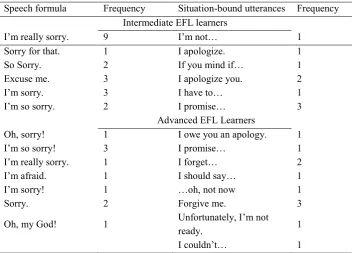
Table 2. Apologizing
Speech formula Frequency Situation-bound utterances Frequency
Intermediate EFL learners
I’m really sorry. 9 I’m not… 1
Sorry for that. 1 I apologize. 1
So Sorry. 2 If you mind if… 1
Excuse me. 3 I apologize you. 2
I’m sorry. 3 I have to… 1
I’m so sorry. 2 I promise… 3
Advanced EFL Learners
Oh, sorry! 1 I owe you an apology. 1
I’m so sorry! 3 I promise… 1
I’m really sorry. 1 I forget… 2
I’m afraid. 1 I should say… 1
I’m sorry! 1 …oh, not now 1
Sorry. 2 Forgive me. 3
Oh, my God! 1 Unfortunately, I’m not
ready. 1
I couldn’t… 1
Note: the FSs starts with capital letter were produced as a complete sentence. Others were used within a sentence.
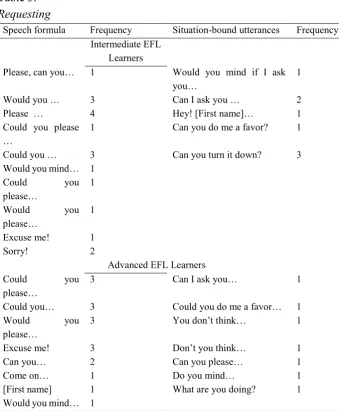
Table 3. Requesting
Speech formula Frequency Situation-bound utterances Frequency
Intermediate EFL Learners
Please, can you… 1 Would you mind if I ask
you… 1
Would you … 3 Can I ask you … 2
Please … 4 Hey! [First name]… 1
Could you please …
1 Can you do me a favor? 1
Could you … 3 Can you turn it down? 3
Would you mind… 1 Could you please…
1
Would you
please… 1
Excuse me! 1
Sorry! 2
Advanced EFL Learners Could you
please…
3 Can I ask you… 1
Could you… 3 Could you do me a favor… 1
Would you please…
3 You don’t think… 1
Excuse me! 3 Don’t you think… 1
Can you… 2 Can you please… 1
Come on… 1 Do you mind… 1
[First name] 1 What are you doing? 1
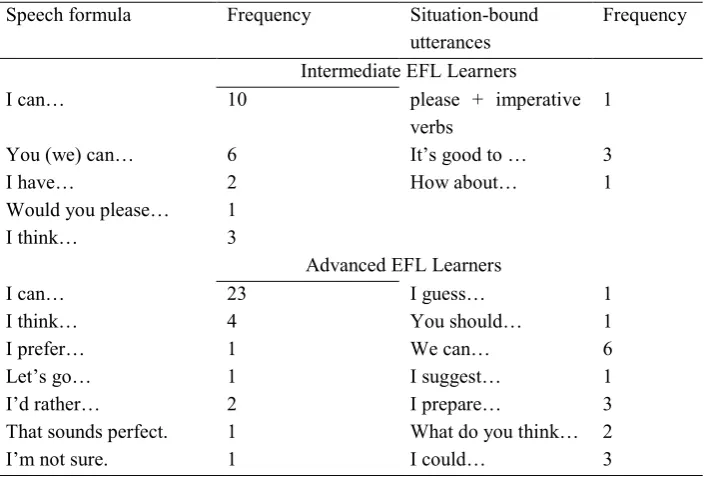
Offering: results of the study (Table 4) showed that EFL learners used 19 types of FSs including SFs and SBUs for offering speech act. The study identified 10 types of SF and 9 types of SBU that might be used in an EFL context for offering speech act. Results for the “offering” speech act, which was a teacher-student relationship scenario, showed that SFs was more diverse than SBUs. It seems that SFs were produced from unanalyzed and memorized lists. Accordingly, they were unable to use pragmatic utterances in the situations, i.e. SBUs. EFL learners also used “I + X” SF to state their offering, X was replaced with verbs such as can, could, should, think, etc. According to the results, EFL learners used direct meaning of offering expressions to state their intentions.
Table 4. Offering
Speech formula Frequency Situation-bound
utterances
Frequency
Intermediate EFL Learners
I can… 10 please + imperative
verbs 1
You (we) can… 6 It’s good to … 3
I have… 2 How about… 1
Would you please… 1
I think… 3
Advanced EFL Learners
I can… 23 I guess… 1
I think… 4 You should… 1
I prefer… 1 We can… 6
Let’s go… 1 I suggest… 1
I’d rather… 2 I prepare… 3
That sounds perfect. 1 What do you think… 2
I’m not sure. 1 I could… 3
Research Question 2: How do advanced/intermediate EFL learners use formulaic sequences variously in pragmatic role-play tasks?
FEs and SBUs, results showed that advanced EFL learners used more types of SBUs than FEs with the exception of “offering” scenarios. They also used more complicated structures expressions in various scenarios while intermediate EFL learners selected among fixed expressions. The frequency of fixed expression or lexical bundles supported this finding although it needs more corpora for further analysis. Intermediate EFL learners repeated same expressions in both FEs and SBUs. The contents of the FSs (i.e. FEs and SBUs) also showed that advanced EFL learners construe the pragmatic perspective of the formulas more than intermediate EFL learners. For example they used more “one-word sentences” such as “really?”, “Hey, “Joking, Sure?” in related contexts than intermediate learners.
Discussion
One aim of the study was to explore a list of FEs in the context of EFL learning/teaching. The study showed that 102 types of FSs were used by Iranian EFL learners when they, orally, wanted to express their thanking, requesting, offering, and apologizing speech acts pragmatically. According to Li (2014) and Tajeddin and Hosseinpur (2014), this list could be called a “list of pragmatic routines” since it was explored by its pragmatic functions in semi-structured role-play tasks. As mentioned in the literature, this list could add another strategy to the strategies that Weinert (1995) introduced as a function of language sequences; that is, pragmatic strategies.
The identified list could also be discussed in terms of specific speech acts. “Thank you” speech act, for example, occurred with an adverbial intensifier in most of the cases (e.g. thank you very much). Furthermore, the diversity of fixed expressions indicated that thanking utterances seemed to be more diverse than others (Table 1). This diversity has also been referred to by Aijmer (1996). He stressed that “thank you” expressions were among the early formulas EFL learners were taught to say in English and “thank you” then turned to a stem from which most of the expressions emerged (such as thank you very much, thank you so much, thanks, etc.). Accordingly, the very nature of the speech acts is also important in acquiring FEs pragmatically.
Based on the Kanagy (1999), some of the findings of the identified list might also be less interactional routines because there is less evidence that the EFL learners used them in the context of speech act as a mechanism of the socialization process. For example, pragmatically, in some cases of produced FSs, Iranian EFL learners could not understand the social status between interlocutors while speaking. Some of the speech formulas and SBU used for “offering” were not appropriately produced (e.g. “You can…”, “I think”). Because, as stated, while the relationship between interlocutors in the offering speech act was formal and in such a situation offering expressions are produced indirectly (Aijmer, 1996), EFL learners uttered them directly.
As far as the second research question is concerned, it could be claimed that the identified list could show the process of interlanguage pragmatics development (Tajeddin & Malmir, 2015) among EFL learners because diversity of SF and SBUs among advanced learners were, in general, higher than intermediate learners although it needs more explorations to be convincingly enough.
supports this idea is that when talking in a situation-bound context, intermediate language learners produce speech formulas more than advanced learners. In other words, this may be as a result of compensation language learning strategies, i.e. a lack of pragmatic knowledge required in conventionalized situations, used by EFL learners (Tajeddin & Malmir, 2015).
Conclusion and Implication
Analysis of the language of discourse in the classroom is central to find the ways in which language learning occurs or not (Hammond, 2011). Classroom discourse is full of structured activities, rules, routines, and patterns required to be analyzed (Hammond, 2011). One aim of the analysis of language in the classroom may be to find those routines which likely improve effective language teaching and learning. Understanding routines or formulaic expressions can help language learners to acquire Classroom Interactional Competence (CIC) (Walsh, 2011) and interlanguage pragmatics knowledge (Tajeddin & Hosseinpur, 2014).
functional approach to teaching/learning language sequences in the classroom. In other words, explicit teaching or noticing (see Tajeddin & Hosseinpur, 2014) within the classroom context may enhance language learners’ interlanguage pragmatic system in terms of FSs. It can be said that because of lack of enough instruction, intermediate language learners use speech formulas instead of SBUs. Accordingly, the identified list of pragmatic routines of the current study could be suggested as a teaching manual in the Iranian EFL context through which EFL teachers could create functions or notions for teaching pragmatic knowledge of speech acts. Another implication might be that EFL learners suffer from lack of enough social interaction since, as Abdou (2010) and Adolphs and Durow (2004) refer, there is a relationship between social interaction and acquisition of FEs.
The findings of the study showed that advanced EFL learners could use more types of pragmatic routines in general and SBUs in particular. It might imply that advanced EFL learners are more professional in terms of using lexical bundles in the situation although it needs more exploration through using discourse analysis of the individual language learners. It also implies that advanced learners could better recognize the pragmatic perspectives of interlocutors’ roles in the speech acts. Although this evidence indicates a more developed interlanguage pragmatic system of advanced learners, such a system needs further research from various perspectives of the discourse. It is necessary to evaluate the pragmatic values of the identified pragmatic routines and strategies of intermediate/advanced EFL learners in further studies. Here this question remains unanswered: whether the identified list could distinguish between advanced interlanguage pragmatic learner and the intermediate one?
then adapt them in the situations. This might have many implications for language teaching in an EFL context.
References
Abdou, A. (2010). The semantic structure of Arabic idioms. In D. Wood
(Ed.), Perspectives on formulaic language: acquisition and
communication (234-256). New York: Continuum International Publishing Group.
Adolphs, S. & Durow, V., (2004). Social-cultural integration and the development of formulaic sequences. In N. Schmitt (Ed.), Formulaic sequences: Acquisition, processing and use (107-126). Amsterdam, Netherlands: John Benjamins.
Aijmer, K. (1996). Conversational routines in English. London: Longman. Bardovi-Harlig, K. (2012). Formulas, routines, and conventional
expressions in pragmatics research. Annual Review of Applied Linguistics, 32, 206–227.
Bardovi-Harlig, K. (2013). Pragmatic routines. The encyclopedia of applied linguistics. Blackwell Publishing Ltd.
Bardovi-Harlig, K., & Griffin, R. (2005). L2 pragmatic awareness: Evidence from the ESL classroom. System, 33, 401-415.
Bhatia, V. K., Flowerdew, J., & Jones, R. H. (2008). Approaches to discourse analysis. In V. K. Bhatia, J. Flowerdew, and R. H. Jones (Eds.) Advances in discourse studies. Oxon: Routledge.
Chen, L. (2008). An investigation of lexical bundles in electrical engineering introductory textbooks and ESP textbooks. Unpublished master’s thesis, Carleton University, Ottawa, Ontario.
Coklin, K., & Schmitt, N. (2008). Formulaic sequences: Are they processed more quickly than nonformulaic language by native and nonnative speakers? Applied Linguistics, 29(1), 72–89.
Dörnyei, Z., Durow, V., & Zahran, K. (2004). Individual differences and their effects on formulaic sequence acquisition. In N. Schmitt (Ed.), Formulaic sequences: Acquisition, processing and use (87-106). Amsterdam, Netherlands: John Benjamins.
Forsberg, F., & Fant, L. (2010). Idiomatically speaking: Effects of task variation on formulaic language in highly proficient users of L2 French and Spanish. In D. Wood (Ed.), Perspectives on formulaic language: Acquisition and communication (257-274). New York: Continuum International Publishing Group.
Giammarresi, S. (2010). Formulaicity and translation: A cross-corpora analysis of English formulaic binomials and their Italian translations. In D. Wood (Ed.), Perspectives on formulaic language: Acquisition and communication (257-274). New York: Continuum International Publishing Group.
Hammod, J. (2011). Classroom discourse. In K. Hyland and B. Paltridge (eds.), the continuum companion to discourse analysis (pp. 22–38). London: continuum.
Ishihara, N. (2010). Maintaining an optimal distance: Nonnative speakers’ pragmatic choice. In A. Mahboob (Ed.), Non-native speakers of English in TESOL: Identity, politics, and perceptions (pp. 35–53). Newcastle upon Tyne, UK: Cambridge Scholars.
Jones, M., & Haywood, S. (2004). Facilitating the acquisition of formulaic sequences: An exploratory study in an EAP context. In N. Schmitt (Ed.), Formulaic sequences: Acquisition, processing and use (269-300). Amsterdam, Netherlands: John Benjamins.
Jung, J., Y. (2002). Issues in acquisitional pragmatics. Teachers College, Columbia University Working Papers in TESOL & Applied Linguistics, 2(3), Retrieved August 25, 2019, from http://journal.tc-ibrary.org/ojs/index.php/tesol/article/download/21/26
Kecskes, I. (2007). Formulaic language in English Lingua Franca. In I. Kecskes and L. R. Horn (Eds.), Explorations in pragmatics: Linguistic, cognitive, and intercultural aspects (191-218). New York: Mouton de Gruyter.
Kirner-Ludwig, M. (2018). Trying to make it fit…That's what she said: An argument for a new category on the formulaic continuum. Journal of
Pragmatics, 137, 76-91. doi: https://doi.org/10.1016/j.pragma.2018.08.001
Li, S. (2014).The effects of different levels of linguistic proficiency on the development of L2 Chinese request production during study abroad.
System 45, 103-116. Doi: https://doi.org/10.1016/j.system.2014.05.001Get rights and content
Li, J., & Schmitt, N. (2010). The development of collocation use in academic texts by advanced L2 learners: A multiple case study approach. In D. Wood (Ed.), Perspectives on formulaic language: Acquisition and communication (257-274). New York: Continuum International Publishing Group.
McGuire, M. (2009). Formulaic sequences in English conversation: Improving spoken fluency in non-native speakers. Unpublished master’s thesis, University of North Texas, US.
Nekrasova, T., M. (2009). English L1 and L2 speakers’ knowledge of lexical bundles. Language Learning, 59(3), 647-686.
Schmitt, N. (Ed.). (2004). Formulaic sequences: Acquisition, processing and use. Amsterdam, Netherlands: John Benjamins.
Simpson-Vlach, R., & Ellis, N. C. (2010). An academic formulas list: New methods in phraseology research. Applied Linguistics, 31(4), 487-512.
Solar, E. A., & Martinez-Flor, A. (2008). Pragmatics in foreign language contexts. In E. A. Solar and A. Martinez-Flor (eds.), Investigating pragmatics in foreign language learning, teaching and testing. Bristol: Multilingual Matters.
Taguchi, N. (2013). Production of routines in L2 English: Effect of proficiency and study-abroad experience. System, 41(1), 109-121. doi: https://doi.org/10.1016/j.system.2013.01.003Get rights and content
Tajeddin, Z., & Hosseinpur, R. (2014). The impact of deductive, inductive, and L1-based consciousness-raising tasks on EFL learners' acquisition of the request speech act. JTLS, 33(1), 73-92. doi: 10.22099/jtls.2014.2022
Tajeddin, Z., & Malmir, A. (2015). The construct of interlanguage pragmatic learning strategies: investigating preferences of high vs. low pragmatic performers. JTLS, 33(4), 153-180. doi: 10.22099/jtls.2015.301
Tremblay, A., & Baayen, H. (2010). Holistic processing of regular four-word sequences: A behavioral and ERP study of the effects of structure, frequency, and Probability on Immediate Free Recall. In D. Wood (Ed.), Perspectives on formulaic language: Acquisition and communication (151-173). New York: Continuum International Publishing Group.
Walsh, S. (2011). Exploring classroom discourse language in action. New York: Routledge.
Weinert, R. (1995). The role of formulaic language in second language acquisition: A review. Applied Linguistics, 16(2), 180-205.
Wood, D. (2010). Lexical clusters in an EAP textbook corpus. In D. Wood
(Ed.), Perspectives on formulaic language: Acquisition and
communication (88-106). New York: Continuum International Publishing Group.
Wray, A. (2000). Formulaic sequences in second language teaching: Principle and practice. Applied Linguistics, 21, 463–89.
Appendix 1
Dear teachers: please ask the students to perform (role-play) each scenario as per group (two members in one group). The participants have to be at the same level of intermediate or advanced in each group. The role-plays have to be recorded without any distractions in the communication process. It is not necessary to inform the student that they are being observed or recorded. Elicited data will be analyzed anonymously.
Speech act: Thanking (Scenario 1)
Situation: Your friend (classmate) is complimenting you on your class presentation. Play roles your response as if you were talking to him (Noriko Ishihara, 2010).
Speech act: Requesting (Scenario 2)
Situation: You are trying to do some homework but your roommate is watching TV and has the volume up so loud that it is distracting you and making it hard to concentrate (Noriko Ishihara, 2010).
Speech act: Offering (Scenario 3)
Situation: The teacher offers a student to help with the plans for the class trip (Bardovi-Harlig & Griffin, 2004).
Speech act: Apologizing (Scenario 4)