Original Article
Journal of Advances in Medical Education & Professionalism
Exploration of faculty members’ perceptions about virtual education
challenges in medical sciences: a qualitative study
MOHAMMAD HASAN KESHAVARZI1, SEYED KAMRAN SOLTANI ARABSHAHI1*,
BANAFSHEH GHARRAHEE2, ZOHREH SOHRABI1, MARJAN
MARDANI-HAMOOLEH3
1Medical Education Department, Faculty of Medicine, CERMS (Center of Educational Research in Medical Sciences), Iran University of Medical Sciences, Tehran, Iran; 2Department of Clinical Psychology, School of Behavioral Sciences and Mental Health (Tehran Institute of psychiatry), Iran University of Medical Sciences, Tehran, Iran; 3Department of Psychiatric Nursing, Faculty of Nursing and Midwifery, Iran University of Medical Sciences, Tehran, Iran
Introduction: Virtual education is among the important factors improving the learning of medical students. This study aimed to explain the perceptions of faculty members towards the challenges of virtual education.
Methods: The present study was carried out with a qualitative approach and using a conventional content analysis method. The participants included 28 faculty members working in Medical universities in Iran who were purposefully recruited and interviewed face to face practicing semi-structured interviews. All interviews were conducted and reviewed; then, the results were extracted. For this purpose, semantic similarities were
first measured and subcategories identified. Subsequently, going
through the re-review, we grouped the associated subcategories into wider categories.
Results: From the analysis of the participants’ narratives, two wide categories including organizational barriers and legal-ethical challenges were obtained. The organizational barriers included two subcategories of defective organizational culture and disproportionate infrastructure. The legal-ethical challenges also included subcategories of neglecting intellectual property
rights and ignoring ethical actual instances in the field of virtual
education.
Conclusion: Understanding the challenges to which virtual education implementation is faced leads to their elimination
which, in turn, develops the application of e-learning in the field
of medical sciences. These challenges can be addressed through putting the emphasis on promoting the organizational culture of medical universities, improving the infrastructures of virtual
education, and considering the legal and ethical concepts specific
to virtual education.
*Corresponding author:
Seyed Kamran Soltani Arabshahi,
Medical Education Department, Faculty of Medicine, CERMS (Center of Educational Research in Medical Sciences), Iran University of Medical Sciences, Tehran, Iran Tel: +98-21-88622607 Email: soltarab.43@tak. iums.ac.ir
Please cite this paper as: Keshavarzi MH, Soltani Arabshahi SK, Gharrahee B, Sohrabi Z,
Mardani-Hamooleh M. Exploration of faculty members’ perceptions about virtual education challenges in medical sciences: a qualitative study. J Adv Med Educ Prof. 2019;7(1):27-34. DOI: 10.30476/JAMP.2019.41042. Received: 30 May 2018 Accepted: 28 October 2018
Keywords: Education, Learning, Technology, Medical education
Introduction
I
n the late twentieth century, the digital revolution arose in the world and brought the globe into a new era of informationtechnology. In the meantime, the rise of social media created virtual learning environments (1). Along with this period, the non-responsive nature of traditional educational approach
A
bs
tr
ac
towards the new learning needs of students has brought the necessity of changes in the medical education curriculum and emerging new educational approaches including, but not limited to, virtual education (2). To add more, although traditional methods of teaching such as lectures are able to convey a large amount of
information to students, they lack sufficient time
for deeper learning activities (3). Accordingly, virtual education, as a complement to traditional educational approaches, has evolved (4). This educational approach is a process in which the educational contents are produced and become accessible to virtual learners (5).
Virtual education is one of the important factors in promoting the learning of medical students (2). This kind of education facilitates the presentation of educational discussions by the faculty members (3) and has features such as high availability and up-to-date evidence acquisition (1). In the meantime, virtual journal clubs promote learning by providing students with learning opportunities through evidence-based discussions (6). Virtual education enhances self-directed learning among medical students (7) and helps them increase their motivation and
self-efficacy (8). Also, it increases the digital literacy
of medical students and informs them about the wider issues of health in the community (9). The virtual education system improves the critical thinking ability of medical students (10) and, in addition to positive effects on the provision of theoretical courses, it improves the students’ clinical learning abilities, so that the students manage virtual patients, practice their problem solving skills, and, thus, improve their clinical competence (11).
Learning under the virtual education system is not restricted by time and space and provides quick feedback. Virtual learning also develops independent and participatory learning (12). This method of education can identify the students who have not learned the lessons well before evaluating them at the end of the course (4). However, fears and anxieties caused by confrontation with the complexities and unknowns of virtual education are one of the most important barriers that prevent the faculty members from being engaged in e-learning initiatives (13).
Researches in the field of virtual education
have been carried out globally. A study in the UK reveals that the use of virtual education
to support learning of difficult and worrisome
module of neuroanatomy has a positive impact on the medical sciences students and reduces their anxiety (14). Virtual training for medical students in Egypt has played a role in creating a supportive
environment, and this type of education has had a high degree of transparency (3). According to a study in Colombia, using virtual learning environment for medical students has led to better learning outcomes for the module of social determinants of health (15). A research in Pittsburgh showed that virtual education passes geographical boundaries, enables the students to access different cultures, and promotes their cultural competence (16).
However, the results of a qualitative study in Iran showed that learning in virtual environments
faces challenges in the field of medical science;
these challenges include cognitive barriers (information overload and lack of focus on learning), communication barriers (inadequate writing skills), and barriers related to learning environments (heavy workload and role ambiguity) (7).
Literature review suggests that the use of virtual education in medical sciences faces challenges despite the fact that it provides
instructors and learners with benefits. Therefore,
considering that the use of this technique in
education has many benefits, it is worthwhile
to identify and resolve the challenges of its evolution in order to promote the application of virtual education in medical sciences. With this description, the researcher sought the use of a qualitative approach methodology that explained the perceptions of faculty members about the challenges of using virtual education, based on their narratives. The advantage of this approach is gaining direct information from the study participants without imposing preconceived theoretical viewpoints. Knowledge created from this approach is based on the participants’ unique perspectives and grounded in the actual data. The authors are keen to explore the faculty members' perception of challenges of virtual education. Methods
The present study is a qualitative research conducted using a content analysis approach which is a widely-used technique for analyzing the written, spoken or visual communications in which raw data is divided into categories based on the inferences and then summarized. This study has incorporated a conventional content analysis approach wherein codes and categories are derived from the text data (17).
This study was done in 2017. It was conducted with the participation of 28 faculty members
(18 females and 10 males) affiliated to Medical
maximum variation of educational fields and
academic ranks using purposive sampling method. The selected participants were the faculty members who had previous teaching experience in virtual education and their tendency to be in
touch with the researcher. Six of the participants
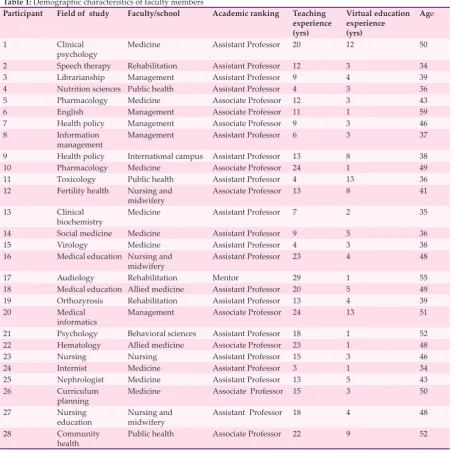
were associate professor; the rest were assistant professor. The participants' age ranged from 32 to 59 years–old. Their total teaching experience varied from 3 to 29 years. Also, the participants’ virtual education experience varied from 1 to 8
years (See Table 1).
Each faculty member was interviewed once and a total of 28 interviews were conducted. Interviews were semi-structured and face-to-face, each lasting 45-55 minutes. The interviews continued until data saturation was reached, a point where no new data from transcripts was
obtained. The participants’ voices were recorded using voice recorder. Interviews were conducted at the faculty of their work and by the researcher.
In the interview, first a general question
stating “In your opinion, what challenges is virtual medicine faced with in medical sciences
in general and in your field in particular?”
was asked and it continued by asking probing questions such as “How do you think these
challenges are happening?”, “Why shouldn’t it be like this?”, “What do you mean by saying so?” or phrases such as “Please explain in more details”.
The Graneheim and Lundman’s methods were used to analyze the data (17). Similar to other
qualitative researches, this study also compiled and analyzed data simultaneously, which lasted 4 months. To that end, the audiotaped interviews
were verbatim transcribed with field notes
Table 1: Demographic characteristics of faculty members
Age Virtual education experience (yrs) Teaching experience (yrs) Academic ranking Faculty/school
which were then typed using computer. The transcriptions, after being reviewed several times, were condensed into the meaning units and codes. Then, the codes were reread to be categorized
into subcategories; finally, the main categories
according to the degree of their semantic similarity were broken into subcategories. Also, attempts were made by the researcher not to interfere his own presuppositions, as far as possible, in the process of data analysis. An example of data coding and categorizing is presented in Table 2.
Rigor
To assess data accuracy, the authors have used credibility, dependability, conformability, and transferability criterion (18). To determine the credibility of data, there was a constant link between the subject and data. The opinions of the research team regarding the process of interviews and data analysis were considered. The interview
transcripts and findings were also shared with
some of the participants. In order to determine the dependability of the data, an external observer out of the research team, who was familiar with the virtual education and methodology of qualitative research, was consulted who had a consensus about the results. To determine the
conformability of the findings, all activities were
recorded and a report of the research process was
prepared. The transferability was confirmed by
sharing the results with two faculty members out of the study who were in a similar situation as that of the participants of the present study who
confirmed the findings. Ethical approval
In order to comply with ethical considerations, we obtained the approval from the Ethics
Committee of IUMS (Code no. IR.IUMS.FMD.
REC1396.9221486204). Also, while providing information to the participants about the research objectives and obtaining permission for recording of the interviews, they were assured that their
information would remain confidential. They
were also informed that they could leave the study at any time, but none of them left the study. Results
From the analysis of participants’ narratives, two categories including organizational barriers and legal-ethical challenges were obtained. The organizational barriers included subcategories defective organizational culture and disproportionate infrastructure. The legal-ethical challenges also included subcategories of neglecting intellectual property rights and
ignoring ethical actual instances in the field of
virtual education (Table 3).
A. Organizational barriers
A.1. Defective organizational culture
Participants declared that issues such as lack of the culture of working with the necessary tools for e-learning and lack of training in this regard by the organization, i.e. the university,
have created challenges in the field of virtual
education.
“Some of instructors do not have the capabilities for this educational approach, which makes it hard for them to work with computers and advanced systems, and do not communicate with these devices…..in fact they are not familiar with the culture of using this approach”(P18).
“Our academic system has not designed proper and necessary training for the faculty members; therefore, they don’t show willingness
Table 3: Categories and subcategories obtained from the analysis
Categories Subcategories
Organizational barriers Defective organizational culture Disproportionate infrastructure Legal-ethical challenges Neglecting intellectual property rights
Ignoring ethical actual instances
Table 2: An example of coding and categorizing
Meaning units Codes Subcategory Category
“The most important problem with our traditional instructors is that they are accustomed to that old system and basically do not like to undergo a change because of the energy carried in this way, so they resist to that. I think the university should monitor these instructors.”
Resistance to
change Defective organizational
culture
Organizational barriers
“In a situation when we do not have the right equipment and there is no
proper acoustic space, we can’t afford a qualified virtual training.” Lack of proper equipment Disproportionate infrastructure “Suppose that I launch my slides to be accessible for viewing and
downloading by everybody there is the possibility of misusing my content or copying it by my colleagues.”
Instructors’ lack of security in virtual education
Neglecting intellectual property rights
Legal-ethical challenges
“People are all seen in one batch. It does not matter if you work with
to use virtual education” (P 14).
According to the faculty members, one of the missions of the organization should be to identify the faculty members who resist the use of virtual education. Also, the organizational culture of the university should be amended in such a way
to demonstrate the beneficial effects of virtual
training to academic members.
“The most important problem with our traditional instructors is that they are accustomed to that old system and basically do not like to undergo a change because of the energy carried in this way, so they resist it. I think the university should monitor these instructors” (P 7).
“Some academic staff do not have a good attitude toward this new approach, which is a deterrent ... as long as the university does not differ the faculty members’ attitude towards
e-learning to make them believe that the benefits
of virtual education are more than the traditional ones, we would face challenges using this method” (P9).
A further point of concern is that organizational culture at universities should be led in a way that the female academic members are not disturbed when their voice is recorded and uploaded on the cyberspace.
“Gender is an important factor; for example,
it’s difficult for a female faculty member to have
her voice heard or her picture watched! It’s a barrier that needs to be resolved by the education system” (P10).
A.2. Disproportionate infrastructure
According to the participants, disproportionate infrastructures that focus less on virtual education have created some organizational barriers. Participants mentioned the low speed of the Internet, which makes uploading and
downloading difficult. In addition, lack of
acoustic space and its related problems has added
to the difficulty of using the virtual education
system.
“The speed of the Internet is very poor; I spent 2 hours yesterday to record the contents of 4 sessions. I did everything to upload them, but I couldn’t although I had divided them into short pieces to have less volume... I thought when
it is so hard for me to upload a file, what a about
downloading it for another person” (P22).
“In a situation when we do not have the proper equipment and there is no proper acoustic space,
we can’t afford a qualified virtual training... The
current process is to record the sound in the acoustic room of the university in a limited time period -one day a week” (P3).
The shortage of equipment is so much that
some faculty members have to use their own personal equipment.
“I have to work with my own laptop and no one provides the equipment and all I am using for this purpose is my personal belongings... . Unfortunately, the necessary infrastructure is not provided for the faculty members” (P8).
The faculties in the study believed that virtual education was time consuming and costly, and it is not perceived as merely uploading some contents.
“This type of training is time-consuming; for example, content creation requires a lot of time and energy. Nowadays, academics upload the content and do not care about its quality, while providing contents that lead to better learning is very costly” (P21).
B. Legal-ethical challenges
B- 1- Ignoring the intellectual property rights
Faculty members mentioned one of the legal
challenges in the field of virtual education rooted
in the ignorance of the intellectual property rights of the content presented through e-learning. Academic members were complaining about the lack of clarity of the intellectual property rights of educational content that they uploaded in the form of either video or slideshows in the cyberspace. They believe that legal challenges are an obstacle, restricting their engagement in virtual training.
“If the content is produced by a professor, how can this be preserved? for example, if I create a movie and someone else can manipulate it or even what if they remove my logo and put their own voice on it and present it as theirs?” (P20).
“Suppose that I launch my slides to be accessible for viewing and downloading by everybody; there is the possibility of misusing my content or copying it by my colleagues” (P1).
“It’s not clear whether the content I produce is in my property or the university? If the university succeeded in e-learning and asked for tuition from students, how would I be reimbursed? How
is the financial profit shared? For how many years
do they pay me? What about my ethical rights? Suppose I leave this university; what happens to me? Such ambiguities do not allow me to be engaged in virtual education because everything is unclear” (P19).
B- 2. Ignoring ethical actual instances
According to the participants in the research, there are a number of ethical challenges in the
field of virtual education. For example, they face
“There are a number of inequalities on the part of the academic system; they do not reward us according to our contributions; for example, when I have to spend 6 hours to produce a content of about 20 minutes length for a 2 hour class, is the university aware of this issue? Does it care about it?” (P4).
“People are all seen in one batch. It does not
matter if you work with PowerPoint, PDF file or
Storyline software!” (P24).
In addition, participants referred to some of the unethical actual instances associated with virtualization such as hackers that threaten their information security.
“There are challenges in the realm of virtual education, hackers, virus, information losses…
all are inevitable” (P15).
“If the active participants in the process of e-learning fell neglected, they would withdraw ….. When the faculty member generates a rich educational product which is not in turn well rewarded, it is actually insulted and will never be engaged again in virtual learning” (P2).
The academic members believed that virtual education is neglected and disrespected and is not well valued. Therefore, these will discourage them to use virtual training.
“The art of virtual education has not still obtained valuation; it’s important since when something is valued, people are encouraged to move toward it.. the reverse is also true,” (P18).
Discussion
The aim of this study was to explain the perceptions of faculty members of Medical Universities in Iran about the challenges of
virtual education. The findings showed that these
challenges include organizational barriers and legal-ethical challenges.
The organizational barriers in our study are the challenges associated with defective organizational culture and disproportionate
infrastructure in the field of virtual education.
In line with the results of this study, other
study findings in Iran showed that in addition
to infrastructure-related issues, cultural issues are also barriers hindering the use of virtual education (19).
The faculty members participating in the present study stated that the resistance to changing the traditional approach to modern education had led to a challenge in using virtual education. Another study in Iran revealed that the resistance of academic members to entering into the age of technology was an obstacle in the way of using virtual education (20). According to the participants, this resistance is rooted in the lack
of beliefs of academics in modern approaches to education. In addition, faculty members claimed that improper organizational culture regarding
virtual learning and lack of sufficient knowledge
on e-learning tools, which are generally ignored by the organization, are challenges of virtual education. According to the results of a study in Iran, the most important problems of virtual education were lack of knowledge about technology and weakness in the organizational culture (21).
In order to develop the best virtual education
in the field of medical sciences, the organizational
culture of medical universities should be changed. In addition, the participants stated that organizational culture should grow in a direction so that the resilience of the academics’ attitudes, which hinders the use of modern technology in education, is broken; measures should be taken so that female academic members have no problem
uploading their audio files. Also, the executive
organization can take steps toward developing virtual education through organizing faculty empowerment workshops, so that the faculty members could be acquainted with the tools needed for e-learning.
According to the participants, the virtual education infrastructure is not appropriate and some disruptive factors hamper its application, including slow internet connection, lack of equipment, the time needed and costly nature of virtual training. The results of other studies
confirm these findings. For example, a body of
research conducted in Iran and Nigeria reported that weaknesses in infrastructure are an obstacle to using virtual education (20, 22). Also, the results of a study in Egypt showed that the poor internet connection was an obstacle in the way of incorporating virtual education system (3).
In addition, the results of studies conducted in Nigeria and Tanzania demonstrated that one of the major challenges faced by academic members in using the virtual education system was the high cost of using the system (22, 23). In fact, the cost of virtual education hampers the application of new technologies in education. As claimed by some participants in the present study, nowadays the academics upload some content on the web and ask the learners to download and read them. Probably, this method is cost-effective and does not demand a high cost, but it has given rise to a widespread debate regarding the standard implementation of virtual education that aims to promote the student learning.
rights and ignoring ethical actual instances. Some
legal issues, such as the lack of strict rules on the intellectual property of materials uploaded by instructors, prohibit them from being engaged in virtual education. The authors’ experiences also indicate that unauthorized copying of uploaded materials and copyright violations occur in the virtual learning environment, and this is an obvious instance of the legal challenges in
the field of virtual education, which causes the
professors not to use it.
One of the underlying causes of this legal challenge is the lack of rules and regulations that will inform the users of what is allowed and what is prohibited and require them to comply with their intellectual property rights. The growing trend of the use of virtual education in Iran’s medical sciences as well as the claims of intellectual property violations concerning the unauthorized copying of materials uploaded in
cyberspace necessitates identification of the legal
challenges in this regard and subsequently the adoption of regulations and adherence to these regulations by the authorities of the medical education system in Iran.
Ignoring ethical actual instances were highlighted by the participants as one of the ethical challenges involved in using virtual education. These included issues such as injustice and inequalities, and the lack of attention to the efforts
of academic staff active in the field of virtual
education. Faculty members also complained that they would not be respected if they used virtual education. In addition, they believed that virtual
education has not obtained sufficient valuation.
Also, the participants asserted that there was no information security for their documents which
could be subject to attacks by hackers. Similarly,
the results of another study conducted in Iran showed that ethical issues such as lack of security regarding uploaded information are an obstacle to the use of virtual education (20).
The findings of the present study reveal the
utmost importance of organizing workshops on the themes of virtual education so that the organizations in charge recognize the ethical challenges that prevent the effective use of e-learning. In addition, the academic staff
active in the field of virtual education system
should be rewarded, so that they are encouraged to practice virtual education, and do not think that they are disgraced and treated unjustly.
Given that virtual education is one of the new approaches to education and has many benefits, it is essential to find its place in the medical
education system. Having this in mind, the policies of medical universities should be set
such that the use of this kind of education does
not encounter serious challenges identified in
this study. Our study explained challenges of virtual education in medical universities. These challenges include organizational barriers and legal-ethical challenges. Recognizing these
challenges and finding techniques to eliminate
them can lead to successful virtual education, especially in faculty members who use this type of education, and ultimately improve the quality of virtual education.
Conclusion
Virtual education in medical sciences is a novel approach in Iran that faces major challenges. This study presented a deep understanding of the perceptions of the faculty members, especially in medical sciences regarding the challenges of implementing virtual education. Understanding the challenges of implementing virtual education leads to solving these barriers in order to develop its application in the education of medical sciences. These challenges can be addressed with emphasis on promoting the organizational culture of medical universities, improving the infrastructure for virtual education, and addressing the legal and ethical issues associated with this educational approach. In addition, the
findings of the current study can provide an
applicable plan for the reduction of challenges in virtual education. Attention to the perceptions of faculty members regarding virtual education challenges can help educational managers in developing more effective plans to reduce these challenges. This study also had some limitations, including the lack of taking note of the perceptions of other people involved in virtual education (e.g. medical students). Therefore, given the important role of other players in virtual education, it is recommended that similar qualitative studies should be conducted.
Acknowledgments
The authors are grateful to all of the participants in this study. The work reported in this article was
conducted as part of the first author’s doctoral thesis which was supported by IUMS (Code no. IR. IUMS. FMD.REC1396.9221486204).
Conflict of Interest: None declared. References
1. De Wet C, Yelland M. The challenges and opportunities in medical education for digital ‘natives’ and
‘immigrants’ in Scotland and abroad.Scott Med J.
2015; 60(4):152-4.
2. Bazrafcan L, Haghani F, Shokrpour N. The summer
in learning, Shiraz University of Medical Sciences. J
Adv Med Educ Prof. 2014; 2(2):77-81.
3. Al-Neklawy AF. Online Embryology teaching using learning management systems appears to be a successful additional learning tool among Egyptian medical students. Ann Anat. 2017; 214:9-14. 4. Holland J, Clarke E, Glynn M. Out of sight, out of
mind: Do repeating students overlook online course
components? Anat Sci Educ. 2016; 9(6):555-64.
5. Rezaee R, Shokrpour N, Boroumand M. Evaluation of
Medical Education virtual Program: P3 model. J Adv Med Educ Prof. 2016; 4(4):202-5.
6. Chetlen AL, Dell CM, Solberg AO, Otero HJ, Burton KR, Heller MT, et al. Another Time, Another Space:
The Evolution of the Virtual Journal Club. Acad Radiol. 2017;24(3):273-85.
7. Kohan N, Soltani Arabshahi K, Mojtahedzadeh R, Abbaszadeh A, Rakhshani T, Emami A. Self- directed
learning barriers in a virtual environment: a qualitative study. J Adv Med Educ Prof. 2017; 5(3):116-23. 8. Makransky G, Bonde MT, Wulff JS, Wandall J,
Hood M, Creed PA, et al. Simulation based virtual
learning environment in medical genetics counseling: an example of bridging the gap between theory and practice in medical education. BMC Med Educ. 2016; 16:98.
9. Cole D, Rengasamy E, Batchelor S, Pope C, Riley S, Cunningham AM. Using social media to support
small group learning. BMC Med Educ. 2017; 17(1):201. 10. Gharib M, Zolfaghari M, Mojtahedzadeh R, Mohammadi A, Gharib A. Promotion of critical
thinking in e-learning: a qualitative study on the experiences of instructors and students. Adv Med Educ Pract. 2016;7:271-9.
11. Reis PJ, Faser K, Davis M. A Framework for Web-Based Interprofessional Education for Midwifery and
Medical Students. J Midwifery Womens Health. 2015;
60(6):713-7.
12. Saffari Z, Takmil F, Arabzadeh R. The role of
educational technology in medical education. J Adv Med Educ Prof. 2014; 2(4):183.
13. Becker KL, Newton CJ, Sawang S. A Learner
Perspective on Barriers to e-learning. Australian Journal of Adult Learning. 2013; 53(2): 211-33. 14. Hennessy CM, Kirkpatrick E, Smith CF, Border S.
Social media and anatomy education: Using twitter to
enhance the student learning experience in anatomy.
Anat Sci Educ. 2016; 9(6):505-15.
15. Restrepo-Palacio S, Amaya-Guio J. Learning about
social determinants of health through chronicles, using
a virtual learning environment. Rev Salud Publica
(Bogota). 2016;18(5):756-67.
16. Weideman YL, Young L, Lockhart JS, Grund FJ, Fridline MM, Panas M. Strengthening Cultural Competence in
Prenatal Care With a Virtual Community: Building Capacity Through Collaboration. J Prof Nurs. 2016;
32(5S):S48-S53.
17. Graneheim UH, Lundman B. Qualitative content
analysis in nursing research: Concepts, procedures and measures to achieve trustworthiness. Nurse Educ Today. 2004; 24(2): 105–12.
18. Lincoln YS, Guba EG. Naturalistic Inquiry. London: Sage Publications Inc.; 1985.
19. Khadivar S, Rahmani Y. Virtual University obstacles
and challenges in the electronic city. Bimonthly
Artificial Intelligence and Instrumentation. 2014;
8(4): 186-205.
20. Zamani B, Parhizi R, Kaviani H. Identify challenges
and performance assessment of students’ e-courses. Educational Technology. 2015; 9(3): 199-206. 21. Kiyan M. Virtual learning challenges, narrating what
the virtual university is not taught. Media. 2014; 5(3): 11-22.
22. Owolabi TO, Oyewole BK, Oke JO. Teacher education, information and communication technology: Prospects and challenges of e-teaching profession in Nigeria.
American Journal of Humanities and Social Sciences.
2013; 1(2): 87-91.
23. Kisanga D, Ireson G. Barriers and Strategies on