Statistical and
deterministic approaches
for multimedia forensics
Cecilia Pasquini
Advisor:
Prof. Giulia Boato,
Universit`a degli Studi di Trento
The increasing availability and pervasiveness of multimedia data in our society is be-fore our very eyes. As a result of globalization and worldwide connectivity, people from all over the planet are exchanging constantly increasing amounts of images, videos, audio recordings on a daily basis. Coupled with the easy access to user-friendly editing soft-ware, this poses a number of problems related to the reliability and trustworthiness of such content, as well as its potential malevolent use. For this reason, the research field of multi-media forensics focuses on the development of forensic tools for verifying the authenticity of multimedia data. The hypothesis of pristine status of images, videos or audio tracks is called into question and can be rejected if traces of manipulation are detected with a certain degree of confidence. In this framework, studying traces left by any operation that could have been employed to process the data, either for malicious purposes or simply to improve their content or presentation, turns out to be of interest for a comprehensive forensic analysis.
The goal of this doctoral study is to contribute to the field of multimedia forensics by ex-ploiting intrinsic statistical and deterministic properties of multimedia data.
With this respect, much work has been devoted to the study of JPEG compression traces in digital images, resulting in the development of several innovative approaches. Indeed, some of the main related research problems have been addressed and solution based on statistical properties of digital images have been proposed. In particular, the problem of identifying traces of JPEG compressions in images that have been decompressed and saved in uncompressed formats has been extensively studied, resulting in the design of novel sta-tistical detectors. Given the enormous practical relevance, digital images in JPEG formats have also been considered. A novel method aimed at discriminating images compressed only once and more than once has been developed, and tested on a variety of images and forensic scenarios. Being the potential presence of intelligent counterfeiters ever increas-ingly studied, innovative counterforensic techniques to JPEG compression based on smart reconstruction strategies are proposed.
Finally, we explore the possibility of defining and exploiting deterministic properties re-lated to a certain processing operation in the forensic analysis. With this respect, we present a first approach targeted to the detection in one-dimensional data of a common data smoothing operation, the median filter. A peculiarity of this method is the ability of providing a deterministic response on the presence of median filtering traces in the data under investigation.
Keywords
1 Introduction 3
1.1 Novel solutions and innovative aspects . . . 7
1.2 Outline . . . 9
2 Multimedia forensics and JPEG compression forensics 13 2.1 Digital multimedia forensics: advances and limitations . . . 13
2.1.1 Open problems and research directions . . . 15
2.2 JPEG image forensics . . . 18
2.2.1 Detection of compression traces in uncompressed image formats . . 19
2.2.2 Detection of multiple compression traces in JPEG images . . . 20
2.2.3 JPEG counterforensics and adversarial perspectives . . . 21
2.3 Benchmarking . . . 22
3 Single compression traces in uncompressed format images 25 3.1 Benford–Fourier coefficients . . . 27
3.2 Statistical analysis of Benford–Fourier coefficients . . . 29
3.2.1 Uncompressed image model . . . 29
3.2.2 Compressed image model . . . 31
3.3 Hypothesis tests . . . 36
3.3.1 Single-frequency simple alternative hypothesis: the R-test . . . 36
3.3.2 Multiple-frequency simple alternative hypothesis: the logL0-test . . 37
3.3.3 Multiple-frequency composite alternative hypothesis: the λ-test . . 39
3.4 Experimental results . . . 41
3.4.1 Uncompressed vs Compressed discrimination . . . 41
3.4.2 Localization of forged areas . . . 43
3.5 Discussion . . . 44
4 Multiple compression traces in JPEG format images 47 4.1 Background . . . 47
4.2 Benford-Fourier coefficients in JPEG images . . . 48
4.2.1 Prediction of BF coefficients . . . 49
4.2.2 Prediction error . . . 51
4.3 Hypothesis test . . . 52
4.3.1 Computation of the likelihood function . . . 53
4.4.3 Comparison with existing tools . . . 57
4.4.4 Single vs Double vs Triple compression . . . 58
4.5 Discussion . . . 60
5 Double compression traces in high quality JPEG format images 63 5.1 Background . . . 63
5.2 HQ-DC scenario . . . 64
5.3 Improved approach . . . 65
5.4 Combined approach . . . 69
5.4.1 Block convergence in the HQ-DC scenario . . . 70
5.4.2 Decision tree induction . . . 73
5.5 Experimental results . . . 74
5.5.1 Overall decision tree . . . 75
5.5.2 QFc-specific decision trees . . . 76
5.6 Discussion . . . 77
6 Counterforensics of JPEG compression 81 6.1 Background . . . 81
6.2 Reconstruction of the modular logarithmic domain statistics . . . 82
6.2.1 Visual distortion measure . . . 84
6.2.2 Single versus double compression classification . . . 86
6.2.3 Forgery localization via DCT analysis . . . 86
6.3 Reconstruction of FSD domain statistics . . . 88
6.3.1 Problem formulation . . . 89
6.3.2 Proposed method . . . 90
6.3.3 Observations and related work . . . 91
6.3.4 Experimental results . . . 92
6.4 Discussion . . . 94
7 1D median filtering: an example of deterministic forensics 97 7.1 Background . . . 97
7.2 Median filter detection and unfeasible sequences . . . 99
7.2.1 Theoretical background . . . 99
7.2.2 Algorithmic checking procedure . . . 102
7.3 Unfeasible classes and N-detectors . . . 104
7.3.1 Identification of feasible and unfeasible classes . . . 105
7.3.2 N-detectors . . . 108
7.4 Experimental results . . . 109
7.4.1 False alarm probability analysis . . . 110
7.4.2 Filter detection . . . 111
7.4.3 Comparison with state-of-the-art techniques . . . 112
7.4.4 Tampering localization . . . 114
7.4.5 Robustness analysis . . . 115 7.5 Discussion . . . 117
8 Conclusion 119
Bibliography 123
A Derivation of σ2
Wr,i 135
B Results for full decision trees 137
Introduction
“What is essential is invisible to the eye” A. de Saint-Exup´ery
Multimedia objects have become more and more pervasive in our society. This is mainly due to the increasing number of devices able to take pictures and record audio-video tracks, such as low-cost digital cameras, smartphones or tablets. At the same time, modifications and manipulations of such multimedia content can nowadays be performed by non-expert users, thanks to the availability of user-friendly software tools. Finally, the easy access to sharing platforms offered by the web and the cloud technologies (such as social networks, blogs, online newspapers) allows users to instantaneously broadcast multimedia objects that might be significantly modified.
As a result, the trustworthiness of media contents is strongly compromised, with effects that span in many practical scenarios. Considering also the more intuitive and immedi-ate impact of visual data with respect to textual documents, the potential diffusion of distorted or completely fake multimedia content on websites, information media, adver-tisement and legal proceedings seriously represents an issue to be addressed. It appears evident that the authenticity of multimedia data can no longer be taken from granted, and their fidelity to reality should be called into question. In other words, the develop-ment of media-related technologies has to be combined with effective techniques for their protection and verification. This would help in avoiding an illegitimate exploitation, be it malicious or not, of the semantic message they may convey. Indeed, the role of visual con-tent manipulation is currently under debate, questioning how manipulated images impact users’ perceptions and opinions on topics and people [37, 143].
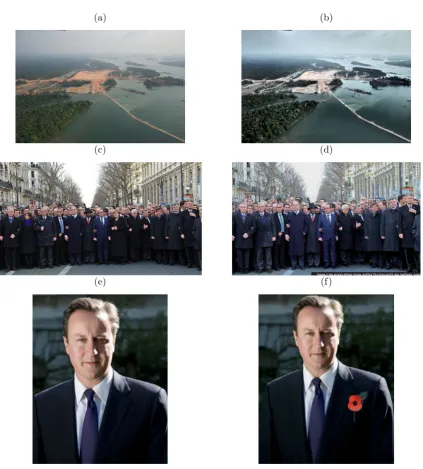
We report in Fig. 1.1 some edited images, serving as examples of the implications that superimposed visual changes can have when shared on a large scale. Fig. 1.1a contains the original image of the construction site of the hydroelectric dam of Belo Monte in Brazil, while Fig. 1.1b contains its digitally modified version, published on The Spiegel newspaper in 2013 in an article evaluating the environmental impact of the structure1. The visual impact of the image is clearly altered, as the site looks more degraded due to
1
www.spiegel.de/international/world/growing-concern-that-
news-photos-are-being-excessively-manipulated-a-898509.html
(c) (d)
(e) (f)
Figure 1.1: Example of modified images on the web.
the social and environmental consequences of the construction of the dam. An example involving international politics concerns the march featuring state leaders from all over the world that was organized in Paris after the Charlie Hebdo terroristic attack in January 2015. An orthodox paper published a modified image (Fig. 1.1d) where female leaders were deliberately edited out from the original image (Fig. 1.1c)2. A further example is
reported in Fig. 1.1e and 1.1f: the modified picture on the right was published on Twit-ter by the 10 Downing Street profile, revealing the superimposition of a Remembrance Sunday poppy (traditionally exposed at the day of publication to commemorate fallen
2
soldiers during World War I) onto David Cameron’s lapel. After this was spotted in the first place, the episode went viral on the web and social networks3.
As a matter of fact, the verification and authentication of information, including mul-timedia content, in web and social media is drawing increasing attention from a journal-istic and enterprise perspective [1]. Moreover, nowadays multimedia objects are strongly present in modern digital investigations, where digital images, audio tracks and video se-quences more and more frequently represent potential digital evidences to the court [119]. In this scenario, in addition to the analysis of physical machines (i.e., computer forensics [23]), it is necessary to perform a forensic analysis of the multimedia data itself, in order to assess the reliability of the content.
Driven by such motivations, in the last decade the scientific community has been de-veloping a constantly increasing amount of techniques targeted to the authentication of multimedia objects, under the name ofdigital multimedia forensics [125]. Differently from active techniques like digital watermarking, where an imperceptible digital code (a wa-termark) is inserted into a multimedia object before its delivering/sharing, in multimedia forensics we do not assume such a priori information. Indeed, this would imply the use of special equipped devices when creating the multimedia content, whereas in a general scenario data generated by a large number of different devices need to be analyzed. For this reason, forensic methods are said to be passive and they are generally based on the following principle: manipulations of the multimedia signal may be visually unperceivable but leave traces that can be detected by means of proper forensic methodologies.
In particular, great attention has been paid to digital image forensics for which a wide variety of different processing have been studied [51]. In this framework, the traces left by JPEG compression, the most popular coding scheme for images, have been widely analyzed and exploited in different forensic scenarios. Indeed, there are methods aimed at detecting traces of previous compression in uncompressed images, double compression in compressed images, inconsistencies within the same image. As other kind of process-ing, a single or repeated JPEG compression performed with reasonably high quality level generally does not leave evident traces from a perceptual perspective (especially in high resolution images), thus excluding the possibility of a preliminary visual inspection. In Fig. 1.2, we report the same image processed according to different compression chains, as a demonstration of the generally unperceivable visual effect of one or more compres-sions. Thus, in absence ofa priori information or metadata, the only way to determine whether previous compressions occurred is to analyze theunderlying statistics of the two-dimensional signal, from which potential anomalies can be revealed. With this respect, a number of notable approaches have been proposed in the literature, although most of the them still present significant limitations in terms of detection capabilities and robustness to diverse kind of images.
In addition, as it happened to digital watermarking and steganography, the need of an adversary-aware perspective recently emerged also in multimedia forensics. Indeed, while forensic methods are quite effective in case of unrefined manipulations, the
poten-3
(c) Single compression with quality factor 90. (d) Double compression with quality factors 90 and 70.
Figure 1.2: Different chains of compression are applied to the same image.
tial presence of a smart adversary compromises the reliability of current techniques: recent research has shown that they can be deceived if the forger is aware of the forensic tools and adopts specific countermeasures, namely counter-forensic (or anti-forensic) attacks [76].
1.1
Novel solutions and innovative aspects
In this doctoral study, we propose contributions to the forensic task of detecting certain processing operations in multimedia data, with particular attention to digital images. The general rationale behind our work is to leverage statistical and deterministic properties that are common to the kind of data under investigation. As it will be explored in detail, this helps the forensic analysis in several directions, like assessing the confidence of a certain decision or avoiding preliminary training phases by exploiting closed-form theoretical derivations.
The main contributions of our work is detailed as follows:
• Detection of JPEG compression traces in uncompressed format images.
Intrinsic statistical properties of natural uncompressed images are used in image forensics for detecting traces of previous processing operations. We perform a the-oretical analysis of Benford–Fourier coefficients (BF) computed on the 8×8 block-DCT domain, originally proposed in [109]. The distribution of such coefficients is derived theoretically both under the hypotheses of no compression and previous compression with a certain quality factor, allowing also for the computation of the respective likelihood functions. Then, three classification tests based on different statistics are proposed, relying on discriminative thresholds that can be determined automatically, without the need of any training phase. The statistical analysis is based on the assumption of Generalized Gaussian distribution of DCT coefficients, which generally holds for any uncompressed image. As a result, the method proves to be suitable for images of different size and source camera. Experiments on real im-ages and comparisons with state-of-art techniques show that the proposed approach outperforms existing ones and overcomes issues due to dataset-dependency.
• Detection of multiple JPEG compression traces in JPEG images. The analysis of BF coefficients is extended to the case of JPEG images, resulting in a forensic method for the identification of multiple aligned JPEG compressions and the estimation of the corresponding quality factors. It is based on the computation of likelihood function values for the null hypothesis of single compression and the al-ternative hypothesis of multiple compression with a certain sequence of quantization tables. In principle, the technique allows for the detection of an arbitrary number of compressions, depending on the pool of the tested alternative hypotheses. Experi-mental results show that the performance of the proposed technique is good also in the case of last compression heavier than the previous ones, where existing meth-ods usually lead to high false negative rates. Moreover, the entire chain of JPEG compression is reconstructed also in case of triple compressed images, while existing methods generally estimate only one previous quality factor applied.
• Counterforensics of JPEG images. Two counterforensic techniques are pro-posed for the reconstruction of statistical properties of natural and JPEG images. They both target the modification of the First Significant Digit (FSD) histogram of the DCT coefficients, in order to conceal traces of single and, in some cases, multiple compression. The first one operates in the FSD modular logarithmic domain, from which FSD and DCT coefficients distribution typical of uncompressed images are consequently reconstructed. It is applied to single compressed JPEG images and restores the Gaussian-like statistical distribution of DCT coefficients and the Ben-ford’s law distribution of the FSD randomization strategy in a specific domain, the method is compared with a well-established existing anti-forensic attack in terms of quality of the resulting image. In addition, the effectiveness of our approach as counter-forensics processing is assessed by measuring its impact on the performance of two different forensic tools.
On the other hand, the second one directly targets the reconstruction of a given FSD histogram and can be seen as universal to detectors based on FSD first-order histogram. Based on heuristic criteria, the technique provides a close-to-optimal solution for the problem of FSD histogram modification with minimal distortion in terms of Mean Square Error (MSE) distortion. The problem is expressed as a two-step optimization process and the proposed solution is tested in a more gen-eral forensic scenario where statistics after an arbitrary number of compressions is targeted, including comparison with state-of-the-art similar techniques.
1.2
Outline
The remaining part of the thesis is structured as follows.
In Chapters 2, we introduce the field of multimedia forensics and an overview of the existing techniques based on JPEG compression traces.
The first contribution on the detection of JPEG compression traces in uncompressed format images is presented in Chapter 3.
The analysis of JPEG format images and the detection scheme of multiple compression traces are reported in Chapter 4, while we deal with the case of high quality repeated compression in Chapter 5.
In Chapter 6, novel counterforensic techniques for JPEG compression are presented. Chapter 7 proposes the methodology designed to detect median filter in one-dimensional data sequences based on deterministic properties of the filter.
Publications
The research presented in this dissertation resulted in the following publications: Chapter 3:
C. Pasquini, F. P`erez-Gonz`alez, and G. Boato. A Benford-Fourier JPEG compression detector. In IEEE International Conference on Image Processing (ICIP), pages 5322-5326, 2014. [106]
C. Pasquini, G. Boato and F. P`erez-Gonz`alez. Statistical detection of JPEG traces in digital images in uncompressed formats. Submitted toIEEE Transactions on Information Forensics and Security. [103]
Chapter 4:
C. Pasquini, G. Boato, and F. P`erez-Gonz`alez. Multiple JPEG compression detection by means of Benford-Fourier coefficients. In IEEE Workshop on Informations Forensics and Security (WIFS), pages 113-118, 2014. [102]
Chapter 5:
C. Pasquini, P. Sch¨ottle, R. B¨ohme, G. Boato, F. P`erez-Gonz`alez. Forensics of high quality and nearly identical JPEG image recompression. Accepted to appear in ACM Conference in Information Hiding & Multimedia Security (IH&MMSec), 2016. [107]
Chapter 6:
C. Pasquiniand G. Boato. JPEG compression anti-forensics based on first significant digit distribution. In IEEE Workshop on Multimedia Signal Processing (MMSP), pages 500-505, 2013. Top 10% paper award. [100]
C. Pasquini, P. Comesa˜na-Alfaro, F. P`erez-Gonz`alez, G. Boato. Transportation-theoretic image counterforensics to First Significant Digit histogram forensics. In IEEE International Conference on Acoustics, Speech and Signal Processing (ICASSP), pages 2718-2722, 2014. [105]
Chapter 7:
The following papers were published during the course of the PhD but not included in this thesis:
C. Pasquini, C. Brunetta, A. Vinci, V. Conotter and G. Boato. Towards the verifica-tion of image integrity in online news. InIEEE International Conference on Multimedia & Expo Workshops (ICMEW), pp. 1-6, 2015. [104]
Multimedia forensics and JPEG
compression forensics
In this chapter, we present a brief overview of the field of multimedia forensics, illustrating the different kind of problems arising and methodologies proposed, as well as highlighting the main open research directions. Then, we report a review of forensic and counterforen-sic techniques devoted to JPEG images and the analysis of their digital history. In partic-ular, existing methods are divided according to the forensic task they target and their main limitations are discussed, thus representing the starting point for the novel approaches de-veloped in this doctoral study. Finally, the benchmarking datasets used throughout the thesis are presented.
2.1
Digital multimedia forensics: advances and limitations
Multimedia forensics focuses on verifying the authenticity of audio-visual content, by determining its processing history and origin. Differently from approaches as digital wa-termarking, no a priori knowledge on the object under investigation is assumed, meaning that the forensic analyst does not look for a specific signature. On the other hand, she should consider a variety of potential manipulations occurred.
We can trace back the origins of multimedia forensics to the seminal work reported in [49], where the idea of detecting manipulations in digital multimedia objects by means of mathematical models was introduced. Since then, a variety of forensic scenarios have been targeted and methods facing specific tasks have been developed. Moreover, a fascinating aspect of multimedia forensics is its strongly interdisciplinary nature. Indeed, application requirements has brought researchers to connect and jointly exploit methodologies typ-ically used in different research fields, like signal processing, computer science, machine learning, game theory. This results in a wide variety of existing tools, for which rigorous classifications and boundaries are hard to determine.
A number of survey papers and books are available and propose different ways of grouping the methods available [51, 122, 121, 117, 65, 125, 111]. We choose to consider as a first distinction the following four main research areas [121] [125]: tampering detection, coun-terforensics, source identification anddiscrimination between CG and natural content. In
the following, we give an overview of the main goals and approaches for each of them. The list of contributions mentioned is by no means exhaustive, but we address the reader to the overview papers mentioned above and the references therein for a comprehensive review. Moreover, since the research activity within this doctoral study mainly focused on the tampering detection and counterforensics areas, a special attention is devoted to them.
• Tampering detection: the goal is to determine the presence or the absence of forgery traces in the content under investigation, thus gathering information on its authenticity. Given the diverse kinds of processing a multimedia object can undergo, many methods have been proposed to detect different types of forgeries, by exploit-ing various features of the analyzed object.
In order to give an overview of the existing tools, we refer to the classification pre-sented in [51] for images, keeping in mind that it can be extended to techniques for audio-visual content in general [90]. A very wide class is represented by the pixel-based methods, designed for specific forensic problems. This group of techniques study the statistical behaviour of pixel values and identify anomalies or unexpected periodicities produced when the image is altered. They can be applied to detect dif-ferent forgeries and are particularly efficient in case of copy-move [83, 8, 40, 5] (por-tion of an image is copy and pasted in the same scene) and splicing [96, 41, 41, 142] (portion of an image is inserted in another one), or resampling [133, 130, 52], a very common process occurring anytime an image is resized. Camera-based techniques rely on the assumption that any recording device leaves an intrinsic signature in a image and any forgery generates inconsistencies in chromatic aberration phenomena, color filter array patterns or sensor noise (PRNU) statistical patterns. Such methods are often used for source identification problem [87], as described below.
Unfortunately, the traces used by the classes described above are strongly compro-mised when a lossy coding scheme is applied to the image, like in the case of JPEG, and only few methods are robust enough to be reliable also after a compression. Being the most commonly used image format, the analysis of JPEG images plays a key role in the forensic analysis and many efforts have been addressed to the study of statistical traces left by such coding scheme. This leads to another class of methods, theformat-based ones, where unique properties of coding schemes are used in different forensic decision problems. Finally, physics-based and geometric-based techniques are proposed. In these approaches, the image is decomposed by means of 2D or 3D models and potential forgeries are exposed by detecting inconsistencies in the distribution of light [28] or in the object projection geometry with respect to the camera [38, 73, 68].
active topic.
Counter-forensic techniques have been proposed for defeating specific pixel-based, camera-based and format-based forensic methods by concealing the traces of pre-vious manipulations, and prove to have a very strong impact on the performance of the forensic detectors they target. For instance, methodologies have been pro-posed for defeating resampling detectors [74], median filtering detectors [55], camera-based methods [63], lossy compression detectors [124], CFA-camera-based techniques [75], histogram-based methods [11, 43].
• Source identification. Such branch of multimedia forensics aims at establishing a link between an object and the device it was acquired with (e.g., camera, mobile phone, scanner). This is done by characterizing noise-like patterns overlaid onto the object during the acquisition process. A number of effective methodologies has been proposed in the literature, exploiting chromatic aberration phenomena [69], demosaicing artifacts [26], sensor defections [45], photo-response non-uniformity noise (PRNU) [29, 82]. An overview of related approaches can be found in [87].
• Discrimination between CG and natural content
Modern computer graphics technologies are nowadays able to produce extremely realistic content, forcing researchers to develop methods to passively distinguish natural scenes from computer generated (CG) ones. Techniques targeting the iden-tification of CG characters and faces have been proposed, exploiting different features of the content under investigation. In addition to geometrical and statistical prop-erties of natural scenes [46, 97], motion and lighting patterns have been used to discriminate faces of CG characters [42], as well as physiological signals [35].
2.1.1 Open problems and research directions
Although a wide literature is available for different multimedia forensic scenarios, the available methodologies still present relevant open issues. In the following, we enumerate some of the general limitations of the current state-of-the-art in multimedia forensics tam-pering detection. Besides currently compromising the actual applicability of existing tools in real situations, such flaws represent stimulating challenges for the scientific community, which is intensively working towards these directions.
a closed-form statistical model of the quantities involved would help in assessing the confidence of the results obtained. It would also allow to design hypothesis tests with confidence intervals determined theoretically, instead of relying on dataset-dependent thresholds.
As an example, we consider the class of format-based methods for JPEG images based on the distribution of First Significant Digits (FSD) of DCT coefficients. In [59], a generalized version of Benford’s law is proposed and in [81] the distance with respect to such distribution is exploited for discriminating single and double compressed images. In [91], the histogram of FSDs is also used for identifying the number of previous compressions by means of a combination of binary SVM classifiers. However, at the current state there is no theoretical explanation for the behavior of FSDs at different compression stages and how it depends on the quantization steps used, which is clearly crucial for the final distribution. As a consequence, in realistic situations where a blind analysis is performed and no clue on the quantization steps used is available, it would be hard to quantify the confidence of the outcome, thus limiting the reliability of the method.
• Chain of processing operations: when forensic detectors are targeted to the de-tection of a specific processing, they are rarely robust to changes in the forgery pro-cess. This is an intrinsic problem in the forensic analysis, since the traces left in the object are in any case due to a specific operation and may be more or less sensitive to pre- and post-processing, even if their mathematical model is accurate and complete. Indeed, in a realistic scenario, an object most likely undergoes a chain of oper-ators, for instance blurring/compression, or compression/resampling/compression, and so on. The problem of modeling completely the traces left by a cascade of operations is rather demanding. First attempts in this direction have been pro-posed, addressing certain operations like linear filter/compression [36], compres-sion/resizing/compression [20], compression-contrast enhancement-compression [53]. Moreover, the related problem of multimedia phylogeny [98, 39] is currently inten-sively investigated and nowadays represents one of the main challenges of multimedia forensics.
• General adversarial framework: counter-forensic techniques significantly com-promise the performance of traditional forensic methods, but they typically intro-duce a distortion that can lead to a visual degradation of the image and depends on the strength of the attack. A strongest action guarantees a good recovery of the statistical properties considered but decreases the visual quality; a lightest one pre-serves the visual features but might be not effective in defeating the forensic tools. With this respect, we can notice that the optimality of anti-forensics techniques is rarely discussed, and a specific forensic detector is usually targeted [12]. Moreover, a strong distortion would make the counterforensic action detectable [131] and useless in practical scenarios.
other words, the optimal attack (in the MSE sense) against histogram-based forensic detectors is obtained.
A promising direction that is currently investigated, is to study the interplay be-tween the forensic analyst and the adversary by means of game theory, as it has been done in [123] and [13]. In this framework, a number of theoretical results on the asymptotic game equilibrium under different hypotheses [14, 15] have been obtained, going toward a general theory in adversarial multimedia forensics.
• Fusion of the outcomes from different techniques: in addition to the optimal design of single detectors, another problem arising in the forensic analysis is how to fuse and exploit multiple responses from the forensic tools.
Indeed, as the current literature offers different methods for facing a wide range of manipulations, an analyst would likely exploit a set of detectors in analyzing an image. This can lead to inconsistencies in the different results and, hence, to uncertainty in the final decision. How to deal with this variety and embed the different results in a fusion system remains an open problem. However, research is quite active in this directions and some approaches have been presented [56, 54, 10], relying on statistical theories. Moreover, attention has been devoted to adversary-aware settings [13, 57].
2.2
JPEG image forensics
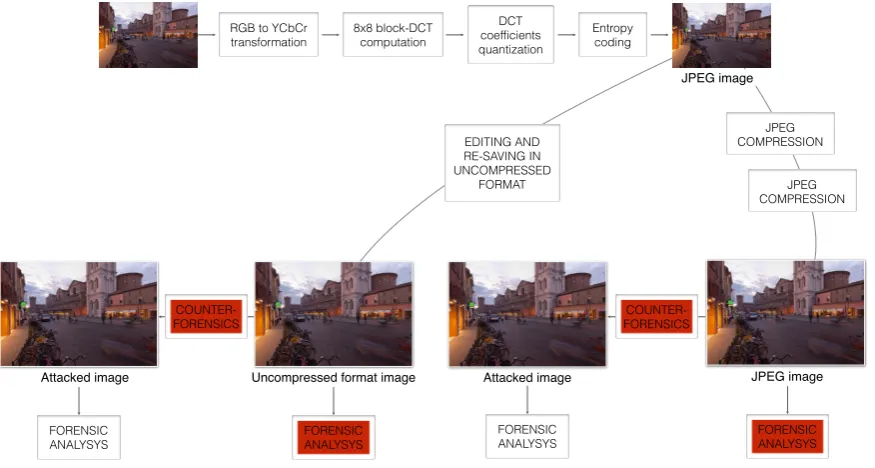
The JPEG compression scheme consists in the steps depicted in Fig.2.1. The core of the compression algorithm is the quantization of 8×8-block DCT coefficients at a certain frequency with a quantization step q, depending on the chosen quality level. Thus, being
x the value of a generic DCT coefficient, during the compression it is transformed into
xq =sign(x)·round
|x| q
·q,
where sign(·) is the sign function and round(·) is the rounding function to the nearest integer. Such quantization, together with the partition in 8 ×8 blocks, leaves typical artifacts both in the pixel and DCT domain, that are widely studied and used for forensic purposes.
Fig. 2.1 also represent the two possible paths in the digital history of the image, both studied in the literature: it can be decompressed (potentially manipulated) and then re-saved in uncompressed format (TIFF, PNG, BMP, GIF, ecc...); it can be decompressed (potentially manipulated) and recompressed in JPEG format a number of times. More-over, the presence of a smart counterfeiter might imply a counterforensic phase before the forensic analysis.
In the following, we review the main approaches presented in the literature and identify the more relevant limitations of existing tools to the forensic problems highlighted in red in Fig. 2.1, for which novel contributions are proposed in the following chapters.
RGB to YCbCr transformation
8x8 block-DCT computation
DCT coefficients quantization
Entropy coding
Uncompressed format image JPEG image
Attacked image Attacked image
JPEG image
JPEG COMPRESSION
JPEG COMPRESSION EDITING AND
RE-SAVING IN UNCOMPRESSED
FORMAT
COUNTER- FORENSICS COUNTER-
FORENSICS
FORENSIC ANALYSYS
FORENSIC ANALYSYS FORENSIC
ANALYSYS
FORENSIC ANALYSYS
2.2.1 Detection of compression traces in uncompressed image formats
In several scenarios, a digital image is available in an uncompressed format (for instance, photographic images delivered in TIFF format), while it potentially underwent prior pro-cessing or coding. In these cases, we might be interested in deciding whether that image had been previously compressed and which were the compression parameters being used. One of the first approaches was proposed in [48]: there, the blocking artifacts left by a JPEG compression in the pixel domain are exploited, and a detector based on inter- and intra-block pixel differences is designed. Such values are combined in a final statistic K, expressing the strength of blocking artifacts, and images presenting a value ofK higher than a certain threshold are classified as compressed. In the same paper, a procedure based on ML estimation of the used quantization table is proposed. An improved version is presented in [95], where the joint detection of both the quantization table and the used color space transformation is achieved.
As the quantization of the 8×8-block DCT coefficient represents the core of the JPEG compression procedure and leaves characteristic footprints, several methods on JPEG images focus on the analysis of the DCT domain for extracting information on the com-pression history. In [88], the distribution of DCT coefficients after quantization and reprojection on the pixel domain is studied: in particular, the authors observe how the DCT coefficients behave differently around 0 when the image is pristine or previously compressed. Such different behaviours are captured in a 1D feature, discriminating be-tween original and compressed images; for the latter case, a simple procedure is proposed for estimating the quantization steps.
Both previous methods are characterized by a low complexity and good performance, also in case of small images; on the other hand, the used statistics present a quite different behaviour when varying the size of the image and therefore the performance is strongly dependent on the initial set of images used for determining the optimal threshold. Another statistic that has been explored in image forensics is the distribution of the First Significant Digits (FSD) of the DCT coefficients. Indeed, when the DCT coeffi-cients are quantized, their FSDs change together with their distribution. In particular, for uncompressed images we have that the FSDs follow a logarithmic distribution, known as Benford’s law, which is perturbed when a quantization occurs. Driven by this ob-servation, the authors in [59] proposed a JPEG compression detector based on an SVM classifier which uses as feature the empirical frequencies of the nine FSDs on all the DCT coefficients in the image. The method achieves good results on the considered dataset and requires a relatively low computational complexity; however, it does not provide an estimate of the quality factor or quantization table used, since no theoretical model for the FSD distribution is available, and the results are strongly dependent on the dataset. Recently, a first approach based of Benford–Fourier coefficients has been proposed in [109], inspiring the design of our novel approaches (see Section 3.1).
MAIN CURRENT LIMITATIONS:
• a training phase on a preliminary set of images is needed, being prone to dataset-dependency issues
2.2.2 Detection of multiple compression traces in JPEG images
Since the JPEG format is adopted in most of the digital cameras and image processing tools, we can expect that a forger will open a JPEG image, modify it and re-compress it a number of times, probably with a different quality factor. Hence, the traces of multiple compression, or inconsistencies of such traces between areas in the same image, can represent a proof of tampering.
In addition, the second compression might not respect the 8×8 grid of the previous one, thus leading to two cases: aligned and non-aligned double JPEG compression.
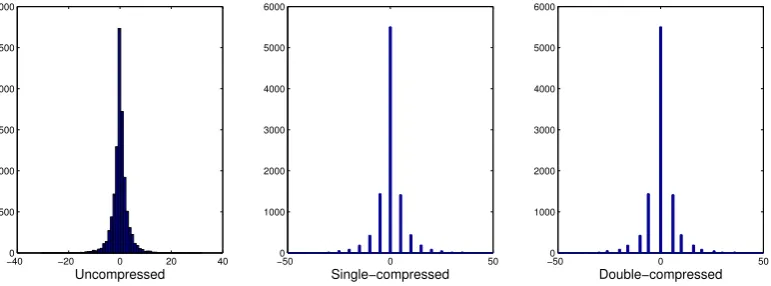
For the former one, a great number of methods rely on the analysis of DCT coefficient first-order statistics, i.e., the histogram. An effective approach was proposed in [86], and later improved in [110]. Here, it is observed that consecutive quantizations introduce periodic artifacts and shifted peaks into the histogram of DCT coefficients: this behavior is called double quantization effect and represents a significant trace of aligned double JPEG compression (see example in Figure 2.2). Clearly, it is related to the values of the two quantization steps used and, in addition, it helps estimating the primary quality factor. The double quantization effect was also analyzed in detail by authors in [112],
−400 −20 0 20 40
500 1000 1500 2000 2500 3000
Uncompressed
−500 0 50
1000 2000 3000 4000 5000 6000
Single−compressed
−500 0 50
1000 2000 3000 4000 5000 6000
Double−compressed
Figure 2.2: Histogram of DCT coefficients at a certain frequency; quantization steps are 5 and 2.
that propose a new statistical model for the artifacts of double compression.
After these two important approaches, a number of refinements based on different anal-yses of DCT histogram have been proposed, leading to higher accuracy in the forensic classification and in the estimation of the primary quality factor.
In [50], a different perspective is adopted: exploting the idempotency of the coding op-eration, JPEG images are recompressed with different quality factors and if at least one of them presents a high correlation with the starting one, it was likely previously com-pressed.
single and double compressed images [81], or even images compressed different number of times [92].
Regarding non-aligned double compression, the analysis of blocking artifacts in the pixel domain can once again provide useful information. Indeed, in [89] a Blocking Arti-fact Characteristics Map (BACM) is computed, starting from the approach in [48]. An asymmetric BACM will reveal the presence of misaligned double compression; some fea-tures are then extracted from the BACM and fed to a classifier in order to understand whether a portion of the image underwent non-aligned quantization or not.
A similar method is presented in [30], where the blocking artifacts are measured by means of first-order derivative and fitted to a linear model. Features related to the probability map of each pixel following this model are fed to an SVM.
A different approach is adopted in [18], where the main idea is to detect non-aligned double compression by measuring how DCT coefficients cluster around a given lattice, defined from the JPEG quantization table, for any possible grid shift. In addition, the parameters of the lattice also give an estimation of the primary quantization table. Such method outperforms results obtained with methods based on blocking artifacts and is more robust to quantization parameters. In [17], the same authors present a tampering localization procedure, so that the suspect region does not need to be manually selected. Finally, few methods aim at detecting either block-aligned or misaligned recompression at the same time have recently been proposed. In [31], a set of features is computed to measure the periodicity of blocking artifacts, perturbed in presence of non-aligned double compression, and another set to measure the periodicity of DCT coefficients, perturbed when an aligned double compression is applied. By combining the two groups, nine features are used to train a classifier, detecting whether an image has undergone double JPEG compression. Moreover, authors in [19] present an improved unified statistical model and an algorithm that aumatically computed a likelihood map, indicating for each 8×8 block the probability of being double compressed.
MAIN CURRENT LIMITATIONS:
• a lighter primary compression is hardly detected
• method typically address double compression
• detection of high quality compression is rarely assessed
2.2.3 JPEG counterforensics and adversarial perspectives
where a cost function expressing the distortion is minimized by means of a variational approach.
In response to this kind of attacks, techniques aimed at detecting the anti-forensic action in [124] has been developed [80] [132], based on peculiar effects introduced in the image by that specific algorithm.
MAIN CURRENT LIMITATIONS:
• optimality of the methods in terms of distortion introduced is rarely addressed
• lack of a general adversarial framework
2.3
Benchmarking
Before moving to the presentation of the novel contributions in the field, we briefly discuss some aspects of the experimental setting we adopted in our validation tests.
First, experiments on JPEG images have generally been performed in Matlab environ-ment, using built-in functions to read and write images. When specified, libjpeg and
libtiff libraries, released by the Independent JPEG Group (IJG) and used in common software, are also used. Throughout the thesis, we refer to the IJG standard quantization tables computed as function of a quality factor QF ∈ {1,2, . . . ,100}, as done by both the
libjpeg library and the Matlab built-in encoder.
Moreover, a common benchmarking of algorithm performance is still an open issue in image forensics [44]. Despite the number of general image datasets available online (e.g., MIRFlickr [67]), only few of them are suitable for our purposes due to the uncontrolled nature of the provided images in terms of compression history and kind of processing applied. Indeed, in order to assess the performance of our models, we need images that are uncompressed and not post-processed, as their pristine condition is an essential starting point for building the testing sets needed. Because of that, we selected the following four datasets of uncompressed format images:
• LIU: subset of the database used in [84], composed of 1000 bitmap images (256×256).
• UCID: database proposed in [120], composed of 1338 TIFF images 512×384. Orig-inally proposed for image retrieval validation, it is probably the most used bench-marking dataset in image forensics.
• DRESDEN: database proposed in [62], particularly oriented to camera-based source identification techniques. We used the 1488 images in TIFF format, whose size ranges from 3072×2304 to 4352×3264.
• RAISE: database proposed by our research group in [44] as a benchmarking tool for image forensics. We used subset packages of the original database, composed of 8156 images available both in TIFF and NEF format.
RAISE2K 2848x4288 DRESDEN
3008x2000
UCID 512x384
LIU 256x256
Figure 2.3: Image size proportions among different datasets.
Single compression traces in
uncompressed format images
In this chapter, we present the novel solutions proposed for the forensic problem of de-tecting traces of JPEG compression in images that are stored in uncompressed formats. We first introduce and define the Benford-Fourier coefficients, a mathematical tool that we extensively exploit in our analysis. Then, the statistical characterization of never com-pressed and previously comcom-pressed images is illustrated. Finally, the design of the final detectors is presented, together with results on the benchmarking datasets.
Acknowledgement
I would like to thank Prof. Fernando P`erez-Gonz`alez for the wise co-supervision of this research, which was partially conducted during my visiting internship within the Signal Processing in Communications Group of the University of Vigo.
NEVER COMPRESSED
Uncompressed format image
JPEG image Original uncompressed
image
EDITING AND RE-SAVING IN UNCOMPRESSED
FORMAT
PREVIOUSLY
COMPRESSED
Figure 3.1: Forensic scenario considered in this Chapter.
We stressed in Chapter 2 the importance of having a solid theoretical backround behind the design of forensic detectors. For this reason, we tackle from a theoretical perspective the problem of detecting the traces of a previous JPEG compression in images that are stored in uncompressed formats. Such issue appears when the forensic analysis is performed on images supposedly taken by a device set to provide raw images (like professional or semi-professional cameras) or, in general, in every situation where the subject image is supposed to be never compressed, and the presence of JPEG compression traces would suggest that the image has been taken from a different camera or it has been already processed by someone. Indeed, although the JPEG standard represents the most used format for digital images, the need for analyzing uncompressed formats arises, for instance, when professional photographic images are involved. In this case, it is common to deliver images also in uncompressed format (mostly TIFF) to preserve quality.
The closed-form statistical analysis of Benford–Fourier coefficients allows us to define a hypothesis testing framework where the null hypothesis is the pristine condition of the image, and the alternative hypothesis is represented by a previous compression. Here, we propose three novel tests based on different statistical schemes, namely theR-test, logL0
-test and the λ-test, with the aim of discriminating images that have never compressed from images previously compressed, as depicted in Fig. 3.1.
3.1
Benford–Fourier coefficients
Benford–Fourier coefficients have been originally introduced in [108] and have a precise mathematical meaning which makes them extremely suitable for the forensic problem considered.
For the sake of clarity, in the following we will indicate univariate real or complex random variables with capital letters, whose realization will be represented by the corre-sponding lower case letters.
Then, let X be a random variable representing the non-zero DCT coefficients andfX
its probability density function; we supposefX is symmetric with respect to 0. Then, we
define the random variable Z whose values are in R+0 such that
fZ(z) = 2·fX(z), ∀z ∈R+0
By doing so, Z models the behavior of |X| in R+0 (fX is symmetric), i.e. discarding the
value 0 as possible outcome. Then, we define the random variables
Z0 = log. 10Z
˜
Z = log. 10Z mod 1,
representing the absolute valued positive DCT coefficients in the logarithmic and mod-ular logarithmic domain, respectively. The r.v. Z˜ is particularly relevant because of its relationship with the pdf of the FSD of X [109] and it has been exploited in image counter-forensic techniques [100] [34].
Now, theBenford-Fourier (BF) coefficients inn ∈Nare defined as the Fourier trans-form offZ0(z0) evaluated in 2πn, i.e.,
an=
+∞
Z
−∞
fZ0(z0)e−j2πnz 0
dz0 =
+∞
Z
−∞
fZ(z)e−j2πnlog10zdz. (3.1)
Such coefficients turn out to be particularly suitable for characterizing the DCT coefficient behaviour since they have a key role in the statistical description of ˜Z: in fact, in [108] it has been showed that, for a generic continuous r.v. Z, we have
fZ˜(˜z) = 1 + 2 +∞
X
n=1
|an|cos(2πnz˜+φn), z˜∈[0,1). (3.2)
Moreover, in [108] the authors show that if X is a Generalized Gaussian (GG) r.v. with standard deviationσ and shaping factor ν, i.e.,
fX(x) = Ae−|βx|
ν
, x∈R,
β = 1
σ
s
Γ(3/ν)
Γ(1/ν), A=
βν
the theoretical expression of an,n ∈N, and its magnitude can be derived as functions of
the GG parameters:
an =
+∞
Z
−∞
fZ0(z0)e−j2πnz 0
dz0
= 2A
βνe
j2πnlog 10logβ
Γ
−j2πn+ log 10
νlog 10
,
|an|2 =
∞
Y
k=0
1 + (2πn)
2
log210(νk+ 1)2
−1
. (3.3)
As seen in (3.3), the magnitude of the coefficients increases withνand does not depend on the variance of the GG. In Table 3.1, we report the values of |an|computed as in (3.3)
(where k ranges from 0 to 105) for different values of n and ν, as it is well-known that
the DCT coefficients of uncompressed images can be modeled by a Generalized Gaussian r.v. with a shaping factor generally ranging from 0.5 to 1.2 [22]. We can notice that, in particular, when n ≥3, these values are always lower than 10−4.
n 1 2 3 4 5 6 7 8
ν= 0.5 6.1·10−3 3.2·10−6 1.1·10−9 3.3·10−13 9.0·10−17 2.2·10−20 5.5·10−24 1.3·10−27 ν= 0.75 2.7·10−2 1.6·10−4 7.4·10−7 3.1·10−9 1.2·10−11 4.8·10−14 1.8·10−16 6.7·10−19 ν= 1 5.6·10−2 1.1·10−3 1.8·10−5 2.9·10−7 4.6·10−9 6.9·10−11 1.0·10−12 1.5·10−14
ν= 1.25 8.8·10−2 3.5·10−3 1.2·10−4 4.5·10−6 1.5·10−7 5.4·10−9 1.8·10−10 6.2·10−12
Table 3.1: Magnitude of|an|for different values ofν and n.
This represents a useful information in JPEG image forensics and suggests that the behavior of the BF coefficients can be used to characterize uncompressed images. Indeed, a first approach in this direction was proposed in [109], where the BF coefficients from the DCT coefficients of the whole image are estimated by computing the FFT of the empirical distribution of ˜Z. Then, the first five coefficients (i.e., n = 1, . . . ,5) are used as feature to train an SVM discriminating between natural uncompressed images and images that underwent a JPEG compression, obtaining promising results.
Although the Benford-Fourier coefficients defined as in (3.1) have a precise meaning given by the expression (3.2), we can extend such definition to the entire real line and, in the following, we will consider as BF coefficient at ω∈R the complex number given by
aω =
+∞
Z
−∞
fZ0(z0)e−jωz 0
dz0 =
+∞
Z
−∞
3.2
Statistical analysis of Benford–Fourier coefficients
In light of what has been obtained in [109], we address the problem of discriminating compressed images saved in uncompressed format from images that underwent a JPEG compression. Accordingly, for each DCT frequency we want to quantify the probabil-ity that the DCT coefficients have never been quantized or they have been previously quantized with a generic step q. To this aim, we consider the BF coefficients at a fixed DCT frequency and develop a statistical model for each of these two cases. Such models will then be exploited for the design of novel hypothesis tests, where the hypotheses of no compression and compression with a quality factor among a predetermined pool are considered. Whereas the hypothesis testing scheme will be described in detail in Section 4.3, in the following we present the statistical models derived for the BF coefficient of a single DCT frequency.
3.2.1 Uncompressed image model
In order to use BF coefficients for analyzing an image, we need a numerical procedure to estimate such coefficients given the subject image.
By looking at (3.4), we can notice thataω is the expected value of the complex random
variablegω(Z) =e−jωlog10Z, whose values lie on the unit circle. Thus, as it is usually done
in statistics, we can obtain an estimate ofaω =E{gω(Z)}by considering the sample mean
ofgω(Z) provided by the DCT coefficients of the image through the different 8×8 blocks.
In other words, if we denote as Zm the r.v.’s representing the DCT coefficients at the chosen frequency in the m-th block (that we suppose to be independent and identically distributed), we can consider the r.v.
ˆ
Aω
.
=
M
P
m=1
e−jωlog10Zm
M , m= 1, . . . , M (3.5)
and define the estimator of aω as the realization of ˆAω
ˆ
aω
.
=
M
P
m=1
e−jωlog10zm
M , m = 1, . . . , M (3.6)
whereM is the total number of 8×8 blocks in the image.
Although the sample mean is a minimum variance unbiased estimator of the expected value (i.e., E{Aˆω} = aω), we should consider the fact that the actual accuracy of ˆaω in
the estimation ofaω depends on the size of the sample considered. For this reason, we are
interested in studying the distribution of ˆAω as a function of the number of samples M.
To this end, we can observe that ˆAω is a sum of M independent and identically
dis-tributed random variablesgω(Zm). Then, by applying the Central Limit Theorem (CLT)
Image size 64x64, M=64 Image size 256x256, M=1024 Image size 1024x1024, M=16384
0 0.1 0.2 0.3 0.4 0.5 0 10 20 30 40 50 60 70 80
0 0.1 0.2 0.3 0.4 0.5 0 1 2 3 4 5 6 7 8
0 0.05 0.1 0.15 0.2 0 20 40 60 80 100 120 140
0 0.05 0.1 0.15 0 5 10 15 20 25 30
0 0.01 0.02 0.03 0 20 40 60 80 100 120
0 0.01 0.02 0.03 0 20 40 60 80 100 120
×10-3
0 2 4 6 8
0 10 20 30 40 50 60 70 80 90
×10-3
0 2 4 6 8
0 50 100 150 200 250 300 350 400 450 Image size 4096x4096, M=262144
-10 -5 0 5 10
0 0.05 0.1 0.15 0.2 0.25 0.3 0.35 0.4 Generalized Gaussian pdf, =1 BF coefficient computation
2= 7.1·10 3
2= 6.3·10 3
2= 5.0·10 3
2= 2.1·10 3
⌫
Figure 3.2: The figure depicts the behaviour of BF coefficients when varying the number M of samples used in the sum (4.1). For M = 64,1024,16384,262144, we generated 1000 sets of M elements distributed according to a zero-mean Generalized Gaussian pdf with ν = 1 (which is common for DCT coefficients of natural images) and varying standard deviation. Then, the estimate of BF coefficient magnitude |ˆaω|(with ω = 8π) have been computed on each set and
their histograms for the different values of M are plotted (blue bars). The red curves are the Rayleigh pdfs (3.8) determined by the corresponding value of M in each case. The goodness of fit of the proposed model is confirmed by the values of theχ2 statistics (computed on 10 equally
spaced bins from 0 to the highest magnitude value obtained in each case).
Gaussian with expected values <(aω) and =(aω), respectively [16]. In other words,
ˆ
Aω =aω+W0,
where W0 is a zero-mean complex normal random variable.
A necessary and sufficient condition for W0 to be circularly symmetric (i.e., with real
and imaginary parts independent and identically distributed [16]) is that E{W2
0} = 0.
Starting from the definition of ˆAω, it is easy to prove that
E{W02}=E{( ˆAω−aω)2}=
1
M(a2ω−a
2
ω). (3.7)
Hence, |E{W2
0}| ≤ (|a2ω|+|a2ω|)/M and, by looking at Table 3.1, we can conclude that
the value of (3.7) will be very close to 0 (for instance, when ν = 1 and ω = 6π its order of magnitude is 10−11). Therefore, ˆAω is approximately a circular bivariate normal r.v.
with non-zero mean.
It is well known that the r.v. R =. |Aˆω| follows the Rice distribution with mean
parameter |aω| and scale parameter σ, whereσ is the standard deviation of both its real
fact that for a Rice distribution
σ2 = E{|Aˆω|
2} − |a
ω|2
2 =
1
2M(1− |aω|
2).
As we observed, |aω| is lower than 10−4 when ω ≥ 6π and we can reasonably assume
|aω| ≈ 0, thus considering the special case of Rice distribution with mean parameter 0,
i.e., the Rayleigh distribution with scale parameter σ = 1/√2M. According to this, we can define p(ˆaω|N Q) (N Q means “never quantized”) as the probability density function
of obtaining a BF coefficient ˆaω under the hypothesis of no previous quantization and
compute it as follows:
p(ˆaω|N Q) = 2M|aˆω|e−M|ˆaω| 2
, (3.8)
where the expression on the right is the Rayleigh pdf with σ = 1/√2M. By considering its properties, we have that|ˆaω|is in any case an overestimate of |aω|= 0, where its mean
is given by √1
M ·
√
π
2 (the expected accuracy increases linearly with
√
M) and its variance is given by 1
M ·
4−π
4 (the expected accuracy variance decreases linearly with M).
An example of the model is showed in Fig. 3.2.
3.2.2 Compressed image model
When computing the DCT from an image stored in uncompressed format that was pre-viously compressed, the DCT coefficients at a certain frequency have a distribution like in Fig. 3.3a. The error affecting the histogram is due to the quantization in the pixel domain after the block-DCT quantization and the rounding/truncation errors in the DCT computation, and has been modeled in the literature as a Gaussian r.v. [19].
We propose here an alternative statistical description whose accuracy has been assessed
Absolute values of DCT coefficients
0 10 20 30 40 50 60 70 80 90 100
Number of coefficients
0 100 200 300 400 500 600 700
Absolute values of DCT coefficients
8 10 12 14 16 18 20 22 24 26
0 0.1 0.2 0.3 0.4 0.5 0.6 0.7 0.8
(a)
(b)
Figure 3.3: In panel (a), histogram of DCT coefficients at a single frequency after quantization withq = 17. In panel (b), the coefficients corresponding to the r.v. Z17 are reported and the
by extensive numerical tests. We can restrict our analysis to a single quantization interval [kq−q/2, kq+q/2[, k≥1 (q is the quantization step) and consider the DCT coefficients contained in such interval. Without any loss of generality, we can suppose k = 1 (which is the most natural choice, since the first “bell” in Fig. 3.3a is certainly the one containing more elements and providing more reliable statistics), although the following analysis can easily be extended to any value of k.
If we denote asIq the interval [q−q/2, q+q/2[ and Zq the r.v. representing the DCT
coefficients falling in Iq, we can approximate its distribution with a Laplacian truncated
outside the quantization interval, as in Fig. 3.3b. Then, the pdf of Zq is given by
fZq(z) =
L(z;q, σ)
Nσ,q ·
1Iq(z), (3.9)
where L(·;q, σ) is a Laplacian pdf with mean q and standard deviation σ (which is un-known and needs to be estimated), Nσ,q is the integral of L(z;q, σ) over Iq (so that
expression (3.9) is a pdf) and 1I(·) is the indicator function of Iq
1Iq(z) =
(
1 z∈Iq
0 z /∈Iq.
Starting from this hypothesis, we can define aω,q as the Benford-Fourier coefficients ofZq,
and derive its theoretical value as follows:
aω,q . = +∞ Z −∞
fZq(z)e
−jωlog10zdz (3.10)
= 1
Nσ,q
Z
Iq 1
σ√2e
−
√
2
σ |z−q|e−jωlog10zdz (3.11)
= 1
Nσ,qσ
√ 2 e− √ 2 σ kq q Z
q−q/2
e
√
2 σ zz−j
ω
ln 10dz+e
√
2 σ q
qZ+q/2
q
e−
√
2 σ zz−j
ω ln 10dz
. (3.12)
In other words, assuming a Laplacian distribution ofZqand given an estimate ofσ, we can
obtain the theoretical value of aω,q from the previous expression in (3.12) by numerically
computing the integrals.
Now, we can adopt the same approach as the uncompressed case: consider the sample mean
ˆ
Aω,q = Mq
P
m=1
e−jωlog10Zqm
Mq
and the estimate ofaω,q
ˆ
aω,q = Mq
P
m=1
e−jωlog10zqm
Mq
, m= 1, . . . , Mq (3.14)
where Mq is the number of DCT coefficients falling in the interval Iq at the chosen
fre-quency. Then, study its distribution in order to obtain an expression of p(ˆaω,q|q), the
probability of obtaining ˆaω,q under the hypothesis that the DCT coefficients at the chosen
frequency underwent a quantization with stepq.
We can partially exploit the logical steps of the uncompressed case reported in Section 3.2.1. Indeed, exactly in the same way, we can conclude that
ˆ
Aω,q =aω,q+W0,q,
whereW0,q is a complex zero-mean Gaussian random variable. In addition
E{W02,q}= 1
Mq
(a2ω,q−(aω,q)2).
Differently from the N Q case, we have no clue on the magnitude of a2ω,q, aω,q, thus we
cannot claim thatE{W2
0,q} ≈0 and W0,q is circularly symmetric.
Because of that, we consider the distribution of ˆAω,q in the complex plane and we
study the real and imaginary parts of W0,q. For the sake of simplicity, we will denote
them as Wr and Wi, respectively, (i.e., dropping the dependence on ω and q) and treat
their joint pdf fWr,Wi(wr, wi) as a zero-mean real bivariate Gaussian
1, so that
p(ˆaω,q|q) = fWr,Wi(<(ˆaω,q−aω,q),=(ˆaω,q−aω,q)). (3.15) The analysis is slightly harder than theN Qcase, since here we need to determine the parameters of a real bivariate Gaussian whose pdf is given by
fWr,Wi(wr, wi) = 1
2πp|Σ|exp
− 1
2
wr wi
Σ−1
wr
wi
,
Σ =
σW2r Cov(Wr, Wi)
Cov(Wr, Wi) σ2Wi
.
In other words, we need the three different entries of the covariance matrix, necessary for computing fWr,Wi(wr, wi). All of them have been theoretically derived in order to obtain closed form expressions and are reported in the following:
• σ2
Wr, σ
2 Wi:
1In particular, we treatW
0,qas a real bivariate r.v. instead of a complex normal r.v., i.e., in terms of variance
8 101214161820 222426 0 0.1 0.2 0.3 0.4 0.5 0.6 0.7 Laplacian centered in , = 1 q= 17
2= 6.8 ·102
Mq= 500
2= 5.5 ·102
Mq= 5000
2= 4.6·102
Mq= 50000
Figure 3.4: The figure depicts the behaviour of BF coefficients in case of compression when varying the number of samples belonging to the interval Iq considered. We considered the case
of q = 17 and, for M = 500,5000,50000, we generated 1000 sets of M elements distributed according to a Laplacian pdf with mean 17 and standard deviation σ = 1. Then, the estimate of the complex BF coefficient ˆaω,17 (with ω = 8π) have been computed on each set and its
histograms (for the complex values, the real and imaginary parts) for the different values of Mq
are plotted (pale blue bars). The blue curves beside are the theoretical pdf for the complex r.v. and the marginal pdfs of the real and imaginary parts, determined as in Section 3.2.2. The match between the histograms obtained and the pdfs derived theoretically is confirmed by the value of the χ2 statistics, computed on 25 two-dimensional bins (5 along the real part and 5
along the imaginary part).
We have that σW2r and σW2i are given by the variances of the r.v.’s <(e−jωlog10Zq) and =(e−jωlog10Zq), respectively, divided by the number of summands in the sample mean (3.14). The exact expressions are:
σW2r =
1 Mq 1 Z −1 X
z00∈Dc
e−
√
2
σ |10 z00
ω−q|10z00 ω
σ√2Nσ,qω
c2ln 10 √
1−c2dc− <(aω,q) (3.16)
σW2i =
1 Mq 1 Z −1 X
z00∈Ds
e−
√2
σ |10 z00
ω−q|10z00 ω
σ√2Nσ,qω
s2ln 10
√
1−s2ds− =(aω,q) (3.17)
where Dc and Ds are discrete finite set of points that can be determined from the
values of cand s. A complete derivation can be found in the Appendix A.
Note that an estimate ofσ (the parameter of the Laplacian) is necessary and can be obtained from the data by means of an unbiased sample variance.
We have that
E{W0,q}=E{Wr2} −E{W
2
i }+ 2jE{WrWi} (3.18)
= a2ω,q−(aω,q)
2
Mq
(3.19)
and Cov(Wr, Wi) =E{WrWi}. Then, we can obtain
Cov(Wr, Wi) =
= 1
Mq(a2ω,q−(aω,q)
2)
2 (3.20)
Fig. 3.4 depicts an example of the pdfs obtained by fixing a Laplacian distribution and generating sample vectors with varying length Mq. It can be noticed that derived
statistical models fit the data very accurately.
Finally, we can summarize the necessary steps to obtain p(ˆaω,q|q) as follows:
• identify the set of DCT coefficients falling in Iq,
• estimate the parameter σ of the Laplacian distribution by means of an unbiased sample variance,
• compute the theoretical value of aω,q by means of (3.12) (in this phase numerical
integration will be used),
• compute σ2Wr,σW2i and Cov(Wr, Wi), by means of (3.16), (3.17) and (3.20),
• compute the estimate ˆaω,q from the DCT coefficients as in (3.14) obtain its
3.3
Hypothesis tests
Given the statistical characterization of BF coefficients under both the hypotheses of no previous quantization and quantization with a generic step, we can now exploit such statistical descriptions for JPEG compression detection.
The statistical models derived allow us to formulate different hypothesis tests and use different discriminatory statistics. In particular, the null hypothesis is always given by
H0: the image has never been compressed
and we will differentiate the tests according to the alternative hypothesisH1considered (simple or composite) and the set F of DCT frequencies considered in the analysis. For the sake of clarity, we will indicate the BF coefficients at a certain DCT frequency f ∈F
as ˆaf ω.
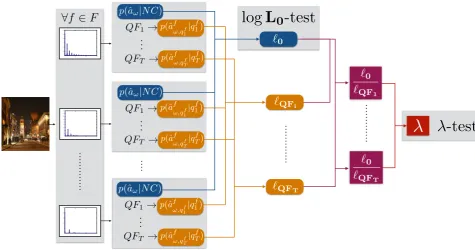
In the following, we propose three tests involving different amount of information from the image under investigation, together with experimental validation on the benchmarking datasets.
3.3.1 Single-frequency simple alternative hypothesis: the R-test
In this first test, the alternative hypothesis is given by the fact that the image underwent a JPEG compression. Thus, H0 is as in 3.3, while
H1: the image has been previously compressed
Moreover, the DCT frequency considered is only one:
F ={f}, f ∈ {1, . . . ,64}
Then, the statistics used is the magnitude of the BF coefficients R = |Aˆf
ω| at a certain
DCT frequency f and some ω ≥ 6π. We know from Section 3.2.1 that the probability density function of obtaining a BF coefficient ˆaω under the hypothesis of no previous
quantization is the following:
p(ˆaω|N Q) = 2M|aˆω|e−M|ˆaω| 2
. (3.21)
Then, we can design a test with an upper threshold, that can be derived by fixing a significance level and using the cdf of the Rayleigh distribution in (3.21), given by
FR(r) = 1−e−M r 2
.
As a general approach, once a significance levelαis fixed, we can reject the null hypothesis when the value of r obtained from the image is such that r ≥ τα where τα is computed
such that
3.3.2 Multiple-frequency simple alternative hypothesis: the logL0-test
The null and alternative hypothesis are the same as before, but in this case we consider a set F of DCT coefficients with cardinality |F|>1.
Thus a number|F|of BF coefficients are available ˆaf
ω and their value can be combined
to obtain a likelihood function value. Indeed, assuming statistical independence between DCT frequencies [19]) we ca