Synthesis and Characterization of Iron
II
, Cobalt
II
,
Nickel
II
, Copper
II
, and Zinc
II
Complexes Using
Diphenylmethyl Xanthate Ligand
Aeed S. Al-Fahdawi
1and Eman I. Alsalihi
21Department of Chemistry, College of Education for Women, University of Anbar, Ramadi, Anbar - F.R. Iraq
2Department of Chemistry, Faculty of Science and Health, Koya University, Kurdistan Region - F.R. Iraq
Abstract–Potassium diphenylmethyl xanthate and its monomeric complexes were synthesized at room temperature under inert gas and stirring condition. The ligand and its complexes of the general formula [M(L)2] (where, M = FeII, CoII, NiII, CuII, ZnII,
and CdII) were characterized by spectroscopic methods (IR,
UV-Vis, 1H-,13C-, DEPT-, HQMC-, and COSY-NMR), elemental
analysis, metal content, magnetic susceptibility measurement, and molar conductance. These studies revealed the formation of four-coordinate complexes.
Index Terms—Four-coordinate complexes, Potassium diphenylmethyl xanthate ligand, Structural study, Xanthate complexes.
I. Introduction
Xanthates are an important class of organic species that have shown a range of applications have attracted chemists. This based on their industry applications, analytical, and coordination chemistry. They have been
used in industry as flotation agents for nonferrous metal sulfide ore (Coucouvanis, 1979; Rao, 1971). Further, their role as additives lubricating oils is well documented (Rao, 1971). Based on their coordination behavior, xanthates as
reagents have been used in analytical determination and
separation of a large numbers of metal ions (Exarchos,
et al., 2001; Cox, et al., 1996; and Vastag, et al., 1990).
Some of xanthates species and their metal complexes are
used as pharmaceuticals for HIV infections. Furthermore,
xanthate-based gold(I) complexes have played a key role in
the design and fabrication of electronic and sensor devices.
Recently, the preparation of monomeric five-coordinate
Cu-xanthates adducts with pyridine derivatives have been
reported (Gurpreet, et al., 2013). The introduction of
pyridyl moiety was to overcome the instability of the
four-coordinate Cu-xanthates complexes (Kour, et al., 2013).
In this paper, we describe the synthesis and physical characterization of potassium diphenylmethyl xanthate ligand and its monomeric metal complexes with some of
divalent transition metal ions (FeII, CoII, NiII, CuII, ZnII,
and CdII).
II. Experimental
A. Materials
Chemical reagents were commercially available and used
without purification (Diphenyl Benzophenone - Sigma-Aldrich 99%, Sodium Borohydrate - Merck 99%, Potassium hydroxide - Sigma-Aldrich 85%, Carbon Disulfide - Aldrich 99%, Metal chloride salt - Fluka 98%, and Methanol - Sigma-Aldrich 99%).
B. Physical measurements
Elemental analyses (C, H, N, and S) were carried out on a Heraeus instrument (vario EL). Melting points were obtained by a Buchi SMP-20 capillary melting point
apparatus. IR spectra were recorded as ATR uses a smart diamond ATR attachment on a Thermo-Nicolet Fourier
transform-infrared (FTIR) spectrometer (AVATAR 320) in the
range of 4000–500/cm, and as CsI discs using a Shimadzu
8300 FTIR spectrophotometer in the range of 600–300/cm.
Electronic spectra were measured between 200 and 1000 nm with 10−3 M solutions in dimethylsulfoxide (DMSO) spectroscopic grade solvent at 25°C using a Perkin-Elmer
spectrophotometer Lambda. NMR spectra (1H, 13C, DEPT,
1H-1H COSY, and 13C-1H HMQC NMR) were acquired
in DMSO-d6 solutions using a Jeol Lambda 400 MHz
spectrometer with tetramethylsilane for 1H NMR. Metals were determined using a Shimadzu (A.A) 680 G atomic
absorption spectrophotometer. Conductivity measurements
were made with DMSO solutions using a Jenway 4071
digital conductivity meter, and room temperature magnetic moments were measured with a magnetic susceptibility
balance (Johnson Matthey Catalytic System Division).
ARO-The Scientific Journal of Koya University Volume VI, No 1(2018), Article ID: ARO.10243, 5 pages DOI: 10.14500/aro.10243
Received 11 May 2017; Accepted: 03 May 2018 Regular research paper: Published 25 May 2018
III. Synthesis
A. Preparation of diphenylmethanol (Fahdawi and Al-Salihi, 2015)
The ligand has prepared by dissolving (1 g, 5.51 mmol) of diphenyl benzophenone (1.0417 g, 27.55 mmol) of sodium
borohydride with continues stirring in 50 ml of methanol for 1 h and then the mixture was treated with microwave for 3 min. The solvent was removed under reduced
pressure and the residue was purified using unplait silica
gel chromatography with eluent (9.5:0.5 dichloromethane/
methanol) at Rf=0.8. Yield: 1.28 g, (98.1%), m.p. 63–64°C.
IR (ATR cm−1) characterization was as follows: 3270
ν(O-H-O), 3084 νar(C-H), 1493 and1454 νar(C=C). NMR data
(ppm), δH (400 MHz, chloroform-D): 7.39–7.25 (m, 10H), 5.83 (s, 1H, OH), 2.35 (s, 1H, C-H); δC (100.63 MHz,
CDCl3): 76.07, 126.36, 127.47, 128.46, 144.25. X-ray
crystallography shows H-atoms were placed in calculated
positions [O1-C1=1.4348(16), O1-H1=0.91(2), 1.4348(16), O1B-C1B=1.4352(15), and O1B-H1B=0.923(19)] and were included in the refinement in the riding model approximation. The yield was 1.28 g (98.1%) of m.p. 63–64°C.
B. Preparation of xanthate salt
Xanthate salt was prepared by a conventional method
(Seleem, et al., 2011) as in the following: To a suspension of
finely powdered (1.1 g, 20 mmol), potassium hydroxide was dissolved in 20 ml of dioxane and a solution (10 mmol) of diphenylmethanol and (1.8 g, 24 mmol) of carbon disulfide in
10 ml of dioxane was add. The mixture was stirred overnight
at room temperature, then 7 ml from diethyl ether was added,
and the mixture was stirred for an additional 1 h. A
pale-yellow solid was collected by filtration, washed with ether, and dried under vacuum. Yield: 1.28 g, (98.1%) of m.p.=
93–94°C, IR (ATR cm−1) characterization was as follows:
3049 νar(C-H), 1618–1488 νar(C=C). NMR data (ppm), δH
(400 MHz, Chloroform-Dme): 7.79–7.47 (m, 10H), 1.62 (s,
1H, C-H); δC (100.63 MHz, CDCl3): 116.33, 128.29, 129.97,
132.40, 137.65, 196.40.
C. General synthesis of the complexes
A general method was used to obtain the required metallic xanthate complexes as follows:
Metal chloride salt (1 mmole) was dissolved in 10 ml of
ethanol and mixed with methanolic solution of the potassium
xanthate ligand (2 mmol) in methanol (15 mL). The mixture
was allowed to stir overnight at room temperature, then distilled water was added for precipitating the product. The
resulted solid was filtered off, washed by methanol, and dried
at room temperature to give the required xanthate complex. Elemental analysis data, colors, and yields for the complexes are given in Table I.
IV. Results and Discussion
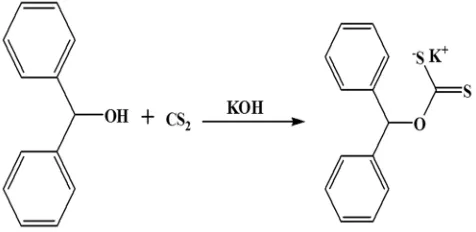
Free xanthate ligand was obtained from the reaction of
diphenyl methanol with carbon disulfide in alkaline medium (KOH). The general synthetic method involves the reaction
of some transition metals with alkali metal salt of the
corresponding thioacid (exothermic behavior) as shown in
Fig. 1.
Xanthate ligand complexes with FeII, CoII, NiII, CuII,
ZnII, and CdII ions were obtained in a moderate yields.
The compounds were characterized by 1H- and 13C-NMR, elemental analysis, IR, UV-Vis, magnetic susceptibility, and
conductivity measurements. Diphenylmethanol compound was characterized by IR, thin-layer chromatography (TLC),
X-RD powder, 1H- and 13C-NMR spectra, elemental analysis, and X-ray single crystal diffraction analysis (Al-Fahdawi and Al-Salihi, 2015) (see experimental section).
IR (ATR) spectrum of the ligand shows characteristic
bands due to the ν(O–H) and ν(C=C) at 3270 cm-1 and (1493,
1454) cm-1, respectively, as functional groups (Seleem,
et al., 2011). 1H-NMR spectrum for the ligand shows
characteristic single peak at δ = 5.83 ppm, which attributed to O-H protons. The spectrum displays single resonances at
δ = 2.35 ppm assigned to methanolic group (C-H). These
signals in diphenylmethanol compound are appeared at
down filed when they are attached withdrawing groups
CS2 to the xanthate salt (Srinivasan, et al., 2012). Whereas
IR (ATR) spectrum bands of the xanthate salt ligand show
bands at 1618–1488 cm−1 due to ν(C=C) assigned to the
aromatic groups, also the spectrum shows band at 1073 cm−1
due to ν (C=S). The disappearance of ν(O-H) band due to
the replacement of the hydrogen atom by CS2. The 1H-NMR spectrum for xanthate salt appears as expected downfield at δ = 1.62 ppm due to (C-H) methanolic group and 7.79–7.49, which assigned to aromatic protons (Al-Fahdawi, et al., 2013). The absence of O-H group signal assigned that
the CS2 is in attach with oxygen atom. 13C-NMR shows
important peaks at CS2 which detected at 196.40 ppm, which
is disappeared in DEPT 13C-NMR, because it is quaternary
carbon (Al-Fahdawi, et al., 2014; Beer, et al., 2003). That is
the metal directed to the desired xanthate complexes. These new complexes were characterized by many techniques such as ATR. The infrared spectra ATR show characteristic bands of ligand and its complexes as shown in Table II.
The important bands of these complexes are ranged about 1230 ± 15 cm−1 and 1050 ± 10 cm−1 which are due
to the υ(C-O-C) and υ(C=S) for FeII, CoII, NiII, CuII, ZnII,
and CdII metal ion complexes, respectively (Al-Fahdawi and Al-Salihi, 2015). After complexation, the frequency of
O-C) and υ(C=S) bands was shifted to higher and lower
frequencies, respectively, for FeII, CoII, NiII, CuII, ZnII, and
CdII metal ion complexes indicating that the complexation was carried out through sulfur, which has been confirmed
by the frequency of υ(M-S) 360 ± 10 cm−1 (Al-Fahdawi,
et al., 2014; Beer, et al., 2003). The analytical data as shown
in Table I agree with the suggested formulae C14H11KOS2
(Fig. 1). Molar conductance of the complexes in DMSO
solutions is indicative of their nonelectrolytic nature (Yu,
et al., 2009). UV-Vis spectra of the FeII, CoII, NiII, CuII, ZnII,
and CdII complexes exhibited different extents of red shift
of bands related to the ligand field π → π* and n → π*
transitions, bands in the range of 321–450 nm are related to
the charge transfer transition (C.T) (Griffith, et al., 2011; Ma
et al., 2011) (Table III).
Magnetic moment value of the FeII complex is in
accordance of tetrahedral geometry (Aly, et al., 1985). This has been confirmed by its UV-Vis in DMSO, which displays
band in the d-d region at 626 nm, due to5T
2→5E, indicating a tetrahedral structure (Batten and Robson, 1998). The
cocomplex displays additional bands in the d-d region at
474 and 670 nm, related to 4A
2(F) →4T2(F) and 4T1(F) →4T2 (F),
characteristic for tetrahedral geometry around CoII atom (Aly, et al., 1985). Magnetic moment of this complex is typical for tetrahedral structure (Carlucci, et al., 2003). The spectrum
of the NiII complex displays band in the d-d region, which
is characteristic of square planar complexes. The magnetic moment value of the NiII complex, as well as the other
analytical data, is in agreement with its square planar
structures (Batten, 2001; Zelenak and Gyoryov, 2002). The
CuII complex exhibited electronic spectrum and magnetic moment confirming tetrahedral structure. The electronic
spectra of the ZnII and CdII complexes exhibited bands
related to ligand field and (L→M) charge transfer (Lever,
1984). These complexes are diamagnetic as expected (d10
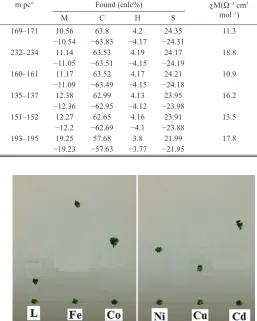
system) and normally prefer tetrahedral coordination. TLC
measurement for the derivative ligands [L], and its complexes
were performed with FeII, CoII, NiII, CuII, and CdII are showed
in Fig. 2.
The appearance of new spots with different Rf of FeII, CoII,
NiII, CuII, and CdII indicated the formation of the complexes
by comparison with the Rf of the ligand (Table IV).
X-ray powder diffraction (XRD) pattern of Coп complex shows well-defined crystalline peaks indicating that the sample is 20% crystalline in nature (Dokken, et al., 2009),
and the XRD powder diffraction pattern of copper complex has been given in Fig. 3.
In Fig. 3, The XRD of CoII metal complex of different
scale particles is well coincident with each other, and it means that different forms of complexes have the same structure
(Guillemet-Fritsch, et al., 2006). The sample has been dried and then scanned in the 2θ range of 10–80° confirming four coordination around Co ion complex (Kavitha and Lakshm, 2017; Zheng, et al., 2017).
TABLE I
Colors, yields, melting points, (M, C, H, S) analysis, and molar conductance values complexes
Molecular formula M.Wt Weight of yield g Yield% Color m.pc° Found (calc%) ƹM(Ω−1 cm2
mol−1)
M C H S
C24H22O2S4Fe 526.37 0.107 54 Red 169–171 10.56 63.8 4.2 24.35 11.3
−10.54 −63.83 −4.17 −24.31
C24H22O2S4 Co 528.99 0,086 43 Dark 232–234 11.14 63.53 4.19 24.17 18.8
blue −11.05 −63.51 −4.15 −24.19
C24H22O2S4 Ni 529.21 0,126 63 Green 160–161 11.17 63.52 4.17 24.21 10.9
−11.09 −63.49 −4.15 −24.18
C24H22O2S4Cu 533.72 0.114 59 Dark green 135–137 12.38 62.99 4.13 23.95 16.2
−12.36 −62.95 −4.12 −23.98
C24H22O2S4Zn 535.91 0.083 41 White 151–152 12.27 62.65 4.16 23.91 13.5
−12.2 −62.69 −4.1 −23.88
C24H22O2S4Cd 582.93 0,114 52 White 193–195 19.25 57.68 3.8 21.99 17.8
−19.23 −57.63 −3.77 −21.95
Table II
FTIR bands for xanthate complexes
Compound ν(Χ–
Ο−Χ) ν(Χ−Ο) ν(Χ=Σ) ν(Μ−Σ)
Xanthate 1235 1156 1073
[Fe-Xanthate] 1223 1192 1032 370
[Co-Xanthate] 1237 1185 1038 360
[Ni-Xanthate] 1220 1191 1050 365
[Cu-Xanthate] 1233 1176 1068 350
[Zn-Xanthate] 1231 1181 1059 355
[Cd-Xanthate] 1240 1201 1061 360
FTIR=Fourier transform-infrared
V. Conclusion
In recent years, considerable attention has been devoted to the formation of stable four-coordinate xanthate complexes that consist with CS2 group which have numerous important applications. The reaction of diphenyl methanol with CS2 in alkaline solution gives the required xanthate ligand. It is observed from research data in this study existence of four-coordinated complexes with FeII, CoII, NiII, CuII, ZnII, and CdII metal ions.
References
Al-Fahdawi, A.S. and Al-Salihi, I.I., 2015. Preparation of Tris (diphenyl. methanol) binding by hydrogen bonds through the application of microwave.
techniques. International Journal of Current Research in Biosciences and Plant Biology, 2(7), pp.1-9.
Al-Fahdawi, A.S., Al-Kafajy, H.A., Al-Jeboori, M.J. and Potgieter, H., 2014. New bimetallic bisdithiocarbameta-based macrocyclic complex; Preparation and spectral characterization. ChemXpress, 4(3), pp.262-267.
Al-Fahdawi, A.S., Al-Kafajy, H.A., Al-Jeboori, M.J. and Potgieter, H., 2013. Synthesis, spectral and structural studies of neutral co(II), Ni(II) and Cu(II) macrocyclic dithiocarbamate- based complexes formed via one pot reaction.
Iraq National Journal of Chemistry, 52, pp.414-429.
Aly, M.M., Baghlaf, A.O. and Ganji, N.S., 1985. Linkage isomerism of the oximato group: The characterization of some mono- and binuclear square planar
nickel(II) complexes of vicinal oxime-imine ligands. Polyhedron, 4, pp.1301.
Batten, S.R. and Robson, R., 1998. Interpenetrating nets: Ordered, periodic entanglement. Angewandte Chemie International Edition, 37, pp.1460-1494.
Batten, S.R., 2001. Topology of interpenetration. Cryst Eng Commy, 22,
pp.67-72.
Beer, P.D., Cowley, A.R., Jeffery, J.C., Paul, R.L. and Wong, W.W. H., 2003. Self-assembled xanthate-transition metal polyether macrocycles and cryptands.
Polyhedron, 22(5), pp.795-801.
Carlucci, L., Ciani, G. and Proserpio, D.M., 2003. Polycatenation, polythreading and polyknotting in coordination network chemistry. Coordination Chemistry Reviews, 246, pp.246-247.
Coucouvanis, D., 1979. Progress in Inorganic Chemistry. Vol. 26. John Wiley,
New York. pp.302.
Cox, M.J. and Tiekink, E.R.T. 1996. Stnthises and characterization of aryl xanthates of group 12th elements. Kristallog. 211, 111-113.
Dokken, K.M., Parsons, J.G., McClure, J. and Gardea-Torresdey, J.L., 2009.
Synthesis and structural analysis of copper(II) cysteine complexes. Inorganica
Chimica Acta, 362, pp.395-401.
Exarchos, G., Robinson, S. and Steed, J., 2001. Should solid-state molecular packing have to obey the rules of crystallographic symmetry. Polyhedron, 20, pp.2951.
Griffith, D.M., Szocs, B., Keogh, T., Suponitsky, K.Y., Farkas, E., Buglyo, P. and Marmion, C.J., 2011. Suberoylanilide hydroxamic acid, a potent histonedeacetylase inhibitor: Its X-ray crystal structure and solid state and
solution studies of its Zn(II), Ni(II), Cu(II) and Fe(III) complexes. Journal of
Inorganic Biochemistry, 105, pp.763-769. TABLE III
UV-Vis measurements and magnetic moment for xanthate complexes
Compound Band Wave number ɛmax Assignment Magnetic
Position
λnm
(cm−1)
(dm3.mol−1.cm−1) moment (B.M)
[Xanthate] 261 38314 1680 л→л*
365 27395 36
[Fe-Xanthate] 270 37037 983 Intra ligand 4.5
315 31746 381 C.T
436 22936 283 C.T
626 15974 21 5T
2→5E
[Co-Xanthate] 257 38911 1339 π→π* 4.2
474 21097 57 4A
2(F)→4T1(p)
670 14925 18 4T
1(F)→4T2(F)
[Ni-Xanthate] 266 37594 880 π →π* Diemagnetic
450 22222 165 3A
2g→1T1g (P)
632 15823 47 3A
2g→3T1g (F)
[Cu-Xanthate] 259 38616 1739 π→π* 1.6
505 19802 300 2T
2→2E
[Zn-Xanthate] 263 38023 1127 π→π* Diemagnetic
[Cd-Xanthate] 259 38616 1659 π→π* Diemagnetic
TABLE IV
The TLC measurements for the [L] ligand and its FeII, CoII, NiII, CuII,
and CdII complexes
Compound Range of Rf (mm)
Xanthate 1.2
[Fe-Xanthate] 4.5
[Co-Xanthate] 3.1
[Ni-Xanthate] 2.4
[Cu-Xanthate] 1.7
[Cd-Xanthate] 4.0
Guillemet-Fritsch, S., Lebey, T., Boulos, M. and Durand, B., 2006. Dielectric
properties of CaCu3Ti4O12 based multiphased ceramics. Journal of the
European Ceramic Society, 26, pp.1245-1257.
Gurpreet, K., Inderjeet, K. and Renu, S., 2013. Synthesis and characterization of the adducts of bis(O-ethyldithiocarbonato)copper(II) with substituted pyridines.
International Journal of Inorganic Chemistry, 2013, pp.502856.
Kavitha, N. and Lakshm, P.V.A., 2017. Synthesis, characterization and thermogravimetric analysis of Co(II), Ni(II), Cu(II) and Zn(II) complexes supported by ONNO tetradentdate Schiff base ligand derived from hydrazine benzoxazine. Journal of Saudi Chemical Society, 21, pp.S457-S466.
Kour, G. Kour, I. and Sachar, R. 2013. Synthesis and characterization of the adducts of bis(O-ethyldithiocarbonato)copper(II) with substituted pyridines.
International Journal of Inorganic Chemistry, 2013, pp.502856.
Lever, A.B.P., 1984. Inorganic Electronic Spectroscopy. Elsevier Publishing, New York.
Ma, Q., Zhu, M., Lu, L., Feng, S. and Ya, J., 2011. Preparation of molecularly imprinted polymer and its recognition property for salvianolic acid A. Chimica Acta, 370, pp.102-107.
Rao, S.R., 1971. Xanthates and related compounds. Marcel Dekker,
New York.
Seleem, H.S., El-Inany, G.A., El-Shetary, B.A. and Mousa, M.A., 2011. The ligational behavior of a phenolic quinolyl hydrazone towards copper (II)-ions.
Chemistry Central Journal, 5, pp.2.
Srinivasan, S., Ramalingam, K. and Rizzoli, C., 2012. Synthesis, NMR and single crystal X-ray structural studies on planar NiS4 and NiS2PN chromophores: Steric and electronic effects. Polyhedron, 33, pp.60-66.
Vastag, S., Marko, L., Rheingold, A.L.J. 1990. Pentacoordinate cobalt(III) thiolate and nitrosyl tropocoronand compounds. Organometallic Chemistry,
397, pp.231.
Yu, K., Gu, Z., Ji, R. and Lou, L.S., 2009. Mild oxidation of alkanes and toluene by tert-butylhydroperoxide catalyzed by an homogeneous and immobilized
Mn(salen) complex. Tetrahedron, 65, pp.305-311.
Zelenak, V. and Gyoryov, K.D., 2002. Correlation of infrared spectra of zinc (II) carboxylates with their structures. Spectrochim Acta, 8, pp.269.
Zheng, Z., Junwei, X., Sisi, Y., Yangli, C., Yan, W., Zhuo, C. and Chunlin, N., 2017. Two organic cation salts containing tetra(isothiocyanate)cobaltate(II): Synthesis, crystal structures, spectroscopic, optical and magnetic properties.