
O R I G I N A L A R T I C L E
Open Access
Comparison of DTI analysis methods
for clinical research: influence of
pre-processing and tract selection methods
Volker Ressel
1,2,3*, Hubertus J. A. van Hedel
2,3, Ianina Scheer
3,4and Ruth O
’
Gorman Tuura
1,3Abstract
Background:The primary aim was to compare fractional anisotropy (FA) values derived with different diffusion tensor imaging (DTI) analysis approaches (atlas-based, streamline tractography, and combined). A secondary aim was to compare FA values and number of tracts (NT) with the clinical motor outcome quantified by the functional independence measure for children (WeeFIM).
Methods:Thirty-nine DTI datasets of children with acquired brain injury were analysed. Regions of interest for the ipsilesional corticospinal tract were defined and mean FA and NT were calculated. We evaluated FA values with Spearman correlation, the Friedman and Wilcoxon tests, and Bland-Altman analysis. DTI values were compared to WeeFIM values by non-parametric partial correlation and accuracy was assessed by receiver operating characteristics analysis.
Results:The FA values from all approaches correlated significantly with each other (p< 0.001). However, the FA values from streamline tractography were significantly higher (mean ± standard deviation (SD), 0.52 ± 0.08) than those from the atlas-based (0.42 ± 0.11) or the combined approach (0.41 ± 0.11) (p< 0.001 for both). FA and NT values correlated significantly with WeeFIM values (atlas-based FA, partial correlation coefficient (ρ) = 0.545, p= 0.001; streamline FA,ρ= 0.505,p= 0.002; NT,ρ= 0.434,p= 0.008; combined FA,ρ= 0.611,p< 0.001). FA of the atlas-based approach (sensitivity 90%, specificity 67%, area under the curve 0.82) and the combined approach (87%, 67%, 0.82), provided the highest predictive accuracy for outcome compared to FA (70%, 67%, 0.67) and NT (50%, 100%, 0.79, respectively) of the streamline approach.
Conclusion:FA values from streamline tractography were higher than those from the atlas-based and combined approach. The atlas-based and combined approach offer the best predictive accuracy for motor outcome, although both atlas-based and streamline tractography approaches provide significant predictors of clinical outcome.
Keywords:Anisotropy, Brain injuries, Diffusion tensor imaging, Image processing (computer-assisted), Paediatrics
Key points
Ipsilesional FA values differed according to the approach used for tract selection
However, FA derived using both atlas-based and streamline approaches correlated with outcome Atlas-based and combined approach provide better
prediction for outcome than streamline tractography
A combined approach with additional motion correction could improve prediction of rehabilitation outcome
Background
Diffusion tensor imaging (DTI) is a noninvasive method for investigating cerebral microstructure in vivo in both research and clinical settings. Based on the principle that the motion of water along the axis of a bipolar magnetic field gradient will induce a phase change causing signal attenuation in magnetic resonance imaging (MRI), diffusion-weighted images can be collected. These images are sensitised to microscopic, orientation-dependent
* Correspondence:[email protected]
1Centre MR-Research, University Children’s Hospital, Zurich, Switzerland 2Rehabilitation Centre, University Children’s Hospital, Mühlebergstrasse 104, CH-8910 Affoltern am Albis, Switzerland
Full list of author information is available at the end of the article
motion of water molecules. Since water diffusion occurs within and outside cellular structures, the degree of water diffusion in the brain depends on the local cellular micro-structure. By collecting multiple diffusion-weighted im-ages with different encoding gradient directions, it is possible to characterise the three-dimensional pattern of water diffusion with a diffusion tensor model, incorporat-ing information about the directionality and the magni-tude of diffusion at each point in the brain [1, 2]. The orientation dependence of water diffusion measured with DTI can be quantified with diffusion anisotropy measures calculated from the diffusion tensor such as the fractional anisotropy (FA), which varies in magnitude from a value of 0 (indicating that proton spins in water can diffuse ran-domly in any direction) to a value of 1 (indicating that water diffusion is restricted only to one direction). DTI metrics can also be used to characterise the structural connectivity between brain regions, and are sensitive to developmental (e.g., myelination) and pathological (e.g., is-chaemic, inflammatory) processes affecting the micro-structure of white matter tracts. DTI is, therefore, widely used for many clinical applications [3] and has previously been used to predict motor outcome in children with ac-quired brain injuries (ABI) [4].
Different analysis approaches have been developed to analyse DTI data. The standard analysis steps include pre-processing of the data (e.g., eddy current correction), tensor estimation, definition of regions of interest (ROI), and tractography. Optionally, for group analyses, a nor-malisation step can be applied followed by statistical in-ference testing, as implemented in the tract-based spatial statistics pipeline [5]. Soares et al. [6] published a hitch-hiker’s guide of relevant software and approaches used in clinical and research studies, suggesting a possible pipe-line for DTI data analysis. A list of common pitfalls has been reported by Jones and Cercignani [7]. However, only a few studies have compared the test-retest reproducibility of DTI metrics derived with different analysis approaches, like tract-based and cross-sectional methods [8], or pro-vided practical guidance for the application of different techniques (ROI, tractography, voxel-based analysis) [9]. Comparisons of clinical or research DTI data and results between analysis approaches remain scarce.
In this study, we selected two commonly used analysis approaches, namely an atlas-based approach and a streamline tractography approach, implemented in two popular analysis packages (FMRIB software library [FSL] and ExploreDTI). Both methods are freely available and perform all the basic steps necessary to analyse DTI data, but differ on many technical points. Therefore, the first aim of this study was to compare FA values derived with different DTI analysis approaches taking the pre-processing pipelines, tract selection methods, and the sensitivity of analysis approaches into account in
their standard implementation. The second aim was to compare the accuracy of different approaches for pre-dicting motor outcome in a clinical-research DTI dataset of children and adolescents with ABI, where the clinical motor outcome was quantified by the functional inde-pendence measure for children (WeeFIM). The advan-tages and disadvanadvan-tages of each method, the relative merits of a combined approach, and the relevance of each method for clinical application are also discussed.
Methods
Patient population
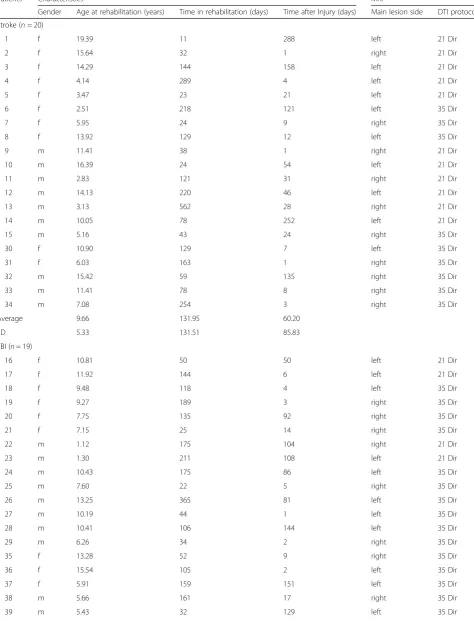
Thirty-nine DTI datasets of children (20 male, 19 fe-male) with ABI were used for this study (Table 1). The patients ranged in age from 1.1 to 19.4 years (mean 9.1 years, standard deviation [SD] 4.6 years) and were re-ferred for MRI at the University Children’s Hospital (Zurich) in 2010–2016 for stroke (n= 20) or traumatic brain injury (TBI) (n= 19). All patients completed a standard clinical 3 T MRI examination (Signa HD.xt/MR750, General Electric Healthcare, Milwaukee, WI, USA) in-cluding DTI at 1–288 days after injury (median = 28 days), before admission to the rehabilitation centre. Ethical approval was received from the local ethical committee and written informed consent was obtained from all participants and/or their parents for the inclu-sion of their data in this retrospective study.
MRI measurement
The MRI protocol included anatomical T1-weighted images (echo time (TE) 18 ms, repetition time (TR) 600 ms, slice thickness 4 mm, voxel resolution 1 × 1 × 4 mm3) and T2-weighted fast spin-echo images (TE 112 ms, TR 5000–6000 ms, slice thickness 3 mm, voxel resolution 0.5 × 0.5 × 3 mm3). DTI images were collected with a pulsed gradient-spin-echo sequence with an echo-planar imaging (EPI) readout (field of view, 240 mm, mean TE 89.5 ms, TE from 76.5 to 98.4 ms, TR 5975 ms, slice thickness 3 mm, acquisition matrix 128 × 128, reconstructed matrix size 256 × 256, reconstructed voxel resolution 0.94 × 0.94 × 3 mm3). Patients studied from 2010 to 2012 (n= 15) were scanned with a DTI protocol incorporating 21 gradient directions, while patients scanned from 2013 to 2016 (n= 24) were scanned with a protocol incorporating 35 gradient directions (see Table1).
Pre-processing
Table 1Patients and diffusion tensor imaging characteristics
Patients Characteristics MRI
Gender Age at rehabilitation (years) Time in rehabilitation (days) Time after Injury (days) Main lesion side DTI protocol
Stroke (n= 20)
1 f 19.39 11 288 left 21 Dir
2 f 15.64 32 1 right 21 Dir
3 f 14.29 144 158 left 21 Dir
4 f 4.14 289 4 left 21 Dir
5 f 3.47 23 21 left 21 Dir
6 f 2.51 218 121 left 35 Dir
7 f 5.95 24 9 right 35 Dir
8 f 13.92 129 12 left 35 Dir
9 m 11.41 38 1 right 21 Dir
10 m 16.39 24 54 left 21 Dir
11 m 2.83 121 31 right 21 Dir
12 m 14.13 220 46 left 21 Dir
13 m 3.13 562 28 right 21 Dir
14 m 10.05 78 252 left 21 Dir
15 m 5.16 43 24 right 35 Dir
30 f 10.90 129 7 left 35 Dir
31 f 6.03 163 1 right 35 Dir
32 m 15.42 59 135 right 35 Dir
33 m 11.41 78 8 right 35 Dir
34 m 7.08 254 3 right 35 Dir
Average 9.66 131.95 60.20
SD 5.33 131.51 85.83
TBI (n= 19)
16 f 10.81 50 50 left 21 Dir
17 f 11.92 144 6 left 21 Dir
18 f 9.48 118 4 left 35 Dir
19 f 9.27 189 3 right 35 Dir
20 f 7.75 135 92 right 35 Dir
21 f 7.15 25 14 right 35 Dir
22 m 1.12 175 104 right 21 Dir
23 m 1.30 211 108 left 21 Dir
24 m 10.43 175 86 left 35 Dir
25 m 7.60 22 5 right 35 Dir
26 m 13.25 365 81 left 35 Dir
27 m 10.19 44 1 left 35 Dir
28 m 10.41 106 144 left 35 Dir
29 m 6.26 34 2 right 35 Dir
35 f 13.28 52 9 right 35 Dir
36 f 15.54 105 2 left 35 Dir
37 f 5.91 159 151 left 35 Dir
38 m 5.66 161 17 right 35 Dir
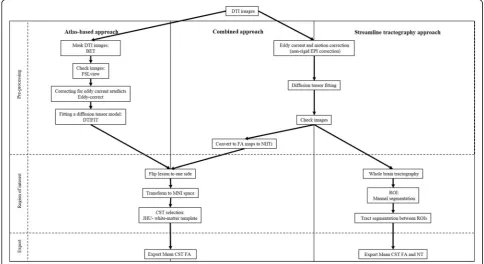
For the atlas-based analysis the preprocessing followed the methods described in a previous study [4]. In sum-mary, the pre-processing included skull stripping and masking the DTI images with the brain extraction tool, correcting for eddy current artefacts with eddy-correct, and fitting a diffusion tensor model at each voxel with DTIFIT toolbox. Images from patients with right-sided lesions were flipped (n= 18) so that all lesions were located on the left side for subsequent analysis steps. The fractional anisotropy (FA) maps for each patient were then normalised to Montreal Neurological Institute (MNI) space using FMRIB’s Linear Image Registration Tool [12]. For the analysis of the motor tracts the ipsilesional corticospinal tracts (CST) were defined using the Johns Hopkins University white-matter template. Data for the mean FA were exported for further statistical analysis.
For the streamline tractography, pre-processing in-cluded eddy current and motion correction (non-rigid EPI correction), and whole brain tractography (standard settings). Subsequently, the CST was segmented by manually defining seed and target ROIs according to Nagae et al. [13]. The superior ROI was defined on an axial slice to include the superior corona radiata, and the inferior ROI was defined on an axial slice to include the cerebral peduncles. CST were then calculated from the whole-brain tractography, using a tract segment de-fined by the manually dede-fined ROIs (Fig.2). Data on the mean FA and number of tracts (NT) were then exported for further statistical analysis.
Additionally, to compare the effect of differences in pre-processing on the sensitivity to predict motor out-come, pre-processed FA maps from the whole-brain Table 1Patients and diffusion tensor imaging characteristics(Continued)
Patients Characteristics MRI
Gender Age at rehabilitation (years) Time in rehabilitation (days) Time after Injury (days) Main lesion side DTI protocol
Average 8.57 121.16 53.05
SD 3.82 85.83 55.16
Total (n= 39)
Average 9.13 126.69 56.72
SD 4.63 110.30 71.67
Dirdirections,DTIdiffusion tensor imaging,ffemale,mmale,SDstandard deviation,TBItraumatic brain injury
streamline tractography analysis were transformed into the MNI space where the mean FA of the CST were cal-culated using the Johns Hopkins University white-matter template for tract selection. The mean FA for each tract was then exported for further statistical analysis. We re-ferred to this combination of methods as the“combined approach”(see Fig.1).
Functional outcome
Functional outcome was assessed as previously described [4]. In summary, the functional independence measure for children (WeeFIM) is a standard measurement used at the rehabilitation centre and was evaluated at discharge from the rehabilitation centre by professional caregivers and nurses [14]. Due to the multidimensionality of the WeeFIM and the focus of this retrospective study on func-tional motor outcome, we performed analyses only for the functional “motor” items in the self-care domain (i.e., without the items bladder and bowel, because these are also under autonomic control), and the mobility domain, excluding the cognition domain (Table2).
Patients were classified as having a good outcome if their age-normalised WeeFIM scores at discharge were greater than 85% of the age-normalised maximum value. This threshold was based on the scores of each WeeFIM item. A healthy 7 year-old-child should score the max-imal score of 7 on each of the 18 items. As only scores of 6 and 7 indicate independence (6/7 ≈85%), 85% of the maximal score should indicate independence, and “good” versus “poor” outcome would, therefore, reflect independent versus dependent outcome. Since children
younger than 7 years were included in the sample, we used the 85% threshold for the age-normalised reference values. This threshold was used to compare the sensitiv-ity of each approach to predict the motor outcome in patients after rehabilitation.
Statistical analysis
Statistical analyses were performed using the SPSS software (version 20, IBM Corp., Armonk, NY, USA). A Shapiro-Wilk test was performed to test for nor-mality of the FA and NT values and WeeFIM motor outcome scores.
For the first aim, we compared the FA values derived from the ipsilesional CST between the three methods (atlas-based, streamline tractography, and the combined ap-proach). Specifically, we calculated non-parametric Spear-man rank correlation and determined differences between the three approaches using the Friedman test, followed by pairwise comparisons using the Wilcoxon signed-rank test. While theαerror was generally set at 0.05, for these latter pairwise comparisons, we corrected for multiple compari-sons using the Bonferroni correction. Additionally, Bland-Altman analysis was performed to define whether differences in approaches are clinically relevant.
For the second aim, we compared the relationship be-tween the FA values and the NT with functional out-come at discharge of rehabilitation, by calculating the partial nonparametric correlation coefficient (ρ) between mean FA or NT and the WeeFIM motor scores, includ-ing age, rehabilitation time, and time of MRI scan after injury as covariates. The size of the correlation
coefficient was defined for 0–0.25 as no or little relation-ship; 0.25–0.50 as a fair degree of relationrelation-ship; 0.50–0.75 as a moderate to good relationship; and 0.75–1.00 as very good to excellent relationship [15]. Sub-analyses for each DTI protocol group (21 and 35 gradient directions) were performed. Since a range of TEs were used across the participant group, the relationship between FA and outcome was also tested after covarying for the TE (and for age, rehabilitation time, and the time of the MRI scan after injury). To test the regional specificity of the findings, an additional analysis using data from the con-tralesional and the ipsilesional CST was performed. This subgroup analysis was performed only in the patients who had experienced stroke (n= 20), since some of the patients with TBI demonstrated bilateral injuries.
Finally, for the tracts that were significantly associated with outcome in the non-parametric partial correlation analysis, we investigated the ability of the FA and NT pa-rameters to differentiate between children with dependent versus independent functional outcome. We calculated the sensitivity, specificity, and area under the curve (AUC) of the DTI measures (mean FA and NT) using receiver operating characteristic (ROC) analyses. Additionally, the Youden index (J = sensitivity + specificity - 1) was calcu-lated to determine the cut-off value of the DTI measures that could differentiate between the groups with the best combined sensitivity and specificity.
Results
Descriptive statistics
The Shapiro-Wilk test showed that the mean FA values for the atlas-based approach (p= 0.255; skewness -0.473, standard error (SE) = 0.378; and kurtosis -0.427, SE 0.741), the mean FA values for the combined ap-proach (p= 0.061; skewness -0.626, SE = 0.378; and kurtosis -0.260, SE = 0.741), and the NT values for the streamline tractography approach (p= 0.237; skewness -0.075, SE = 0.378; and kurtosis -0.354, SE = 0.741) were normally distributed. The mean FA values from the streamline tractography approach (p= 0.004; skew-ness -0.968, SE = 0.378; and kurtosis 0.394, SE = 0.741), and the WeeFIM motor scores after rehabilitation were not normally distributed (p< 0.001; skewness -1.178, SE = 0.378).
Comparison of FA values between the three approaches
Table 3 includes the results of FA and NT values ob-tained using the three different approaches for each pa-tient. Spearman rank correlation between mean FA values using the atlas-based and the streamline tracto-graphy approach was moderate (ρ= 0.572, p< 0.001; Fig. 3). Spearman rank correlation comparing the mean FA of the atlas-based and the combined approach was very good (ρ= 0.791, p< 0.001). Spearman rank Table 2Motor functional independence measure for children
scores for each patient
Patient WeeFIM at discharge of rehabiitation
Self-care Mobility Total
1 42 35 77
2 42 35 77
3 37 35 72
4 6 5 11
5 23 32 55
6 8 5 13
7 12 14 26
8 42 35 77
9 40 35 75
10 41 35 76
11 11 18 29
12 39 35 74
13 9 8 17
14 15 22 37
15 12 6 18
16 42 35 77
17 42 31 73
18 41 34 75
19 39 34 73
20 42 33 75
21 38 33 71
22 8 7 15
23 8 10 18
24 42 35 77
25 38 35 73
26 42 35 77
27 42 35 77
28 40 35 75
29 36 35 71
30 41 35 76
31 29 32 61
32 30 27 57
33 42 35 77
34 40 35 75
35 42 35 77
36 42 35 77
37 31 32 63
38 21 27 48
39 32 34 66
Average 35.51 28.43 59.95
SD 13.09 10.49 23.22
Please note, self-care values without the items bladder and bowel
correlation between mean FA values using the stream-line tractography approach and the combined approach was good (ρ= 0.695,p< 0.001).
The group analysis for different DTI protocols produced the following results. Spearman rank correlation in patients whose MRI scans were acquired using 21 gradient direc-tions (n= 15) was very good between the atlas-based ap-proach and the streamline apap-proach (ρ= 0.782,p= 0.001), excellent between the atlas-based approach and the com-bined approach (ρ= 0.907, p< 0.001), and good between the streamline approach and the combined approach (ρ= 0.711, p= 0.003).
Spearman rank correlation in patients whose MRI scans were acquired using 35 gradient directions (n= 24) was fair but non-significant (ρ= 0.334, p= 0.111) be-tween the atlas-based approach and the streamline ap-proach, good between the atlas-based approach and the combined approach (ρ= 0.691, p< 0.001), and fair be-tween the streamline approach and the combined ap-proach (ρ= 0.411,p= 0.046).
The Friedman test showed a significant difference in FA values between different approaches (χ2 57.282,
p< 0.001). When performing pairwise comparisons
(adjusted α level of 0.0167), we found that the
streamline tractography approach had a significantly higher mean FA value (mean ± SD, 0.52 ± 0.08, range 0.32–0.65) than the atlas-based approach (0.42 ± 0.11, 0.16–0.58), and the combined approach (0.41 ± 0.11, 0.15–0.58). The Wilcoxon test showed significant dif-ferences between all approaches (p< 0.001).
On Bland-Altman analysis (Fig. 4), the one-sample t test comparing FA values between atlas-based and streamline tractography, and between streamline tracto-graphy and the combined approach, showed significant differences (p< 0.001). The one-samplettest comparing FA values between the atlas-based and the combined ap-proach was non-significant (p= 0.672). The linear re-gression coefficient for the difference in FA as the dependent variable and the mean as the independent variable using the atlas-based and the combined ap-proach was non-significant (mean B -0.75,p= 0.424).
Correlation with functional outcome
The nonparametric partial correlation analysis covarying for age, rehabilitation time, and timing of the MRI scan after injury showed significant moderate correlation be-tween the WeeFIM motor outcome after rehabilitation and the mean FA from the ipsilesional CST for the atlas-based approach (ρ= 0.545,p= 0.001), the streamline approach (ρ= 0.505, p= 0.002), and the combined ap-proach (ρ= 0.611, p< 0.001). These results were un-changed after including the TE as an additional covariate (e.g., with the combined approach covarying Table 3Mean fractional anisotropy and number of tracts within
the corticospinal tract in each patient derived from all approaches (atlas-based, streamline tractography, and combined)
Patients Atlas-based Streamline tractography Combined
mean FA mean FA NT mean FA
1 .46 .57 1541 .41
2 .51 .54 1470 .50
3 .43 .48 1138 .42
4 .33 .51 1316 .27
5 .46 .46 482 .42
6 .48 .55 1231 .43
7 .44 .59 897 .42
8 .55 .58 1094 .53
9 .40 .53 1520 .42
10 .39 .46 886 .38
11 .38 .50 467 .35
12 .31 .39 53 .29
13 .31 .46 116 .28
14 .25 .36 5 .24
15 .30 .60 1182 .45
16 .54 .55 1379 .52
17 .47 .47 977 .37
18 .55 .57 740 .52
19 .54 .57 1490 .52
20 .58 .58 2154 .56
21 .49 .53 727 .45
22 .27 .36 440 .22
23 .20 .32 261 .17
24 .45 .49 1647 .42
25 .54 .57 1513 .53
26 .39 .59 1142 .33
27 .52 .59 2187 .45
28 .51 .57 2163 .46
29 .43 .58 1448 .40
30 .54 .54 814 .57
31 .35 .55 1105 .40
32 .29 .42 1299 .25
33 .57 .60 1442 .58
34 .44 .55 1407 .55
35 .37 .65 2109 .57
36 .37 .57 1334 .50
37 .35 .49 798 .38
38 .16 .40 190 .15
39 .42 .55 1010 .47
for TE, ρ= 0.603, p< 0.001). Similarly, the analysis of nonparametric partial correlation revealed significant fair association (ρ= 0.434, p= 0.008; Fig. 5) between NT in the ipsilesional CST and WeeFIM motor out-come after rehabilitation.
The nonparametric partial correlation between the ipsi-lesional mean FA and the WeeFIM motor outcome in pa-tients whose MRI scans were acquired using 21 gradient directions (n= 15) showed non-significant association for the atlas-based approach (ρ= 0.404, p= 0.192), the streamline approach (ρ= 0.199, p= 0.535), and the com-bined approach (ρ= 0.438,p= 0.155).
The non-parametric partial correlation between the ipsi-lesional mean FA and the WeeFIM motor outcome in pa-tients whose MRI scans were acquired using 35 gradient directions (n= 24) showed significant fair to moderate cor-relation for the atlas-based approach (ρ= 0.488,p= 0.040), and the streamline approach (ρ= 0.583, p= 0.011). The
combined approach showed a tendency towards positive correlation between FA and outcome (ρ= 0.466,p= 0.051).
The non-parametric partial correlation when
calculated only in patients who had experienced stroke (n= 20) showed significant correlation between the WeeFIM motor outcome and the ipsilesional FA (ρ= 0.643, p= 0.005) and non-significant correlation between the WeeFIM motor outcome and the con-tralesional FA (ρ= 0.260, p= 0.313), derived using the combined approach.
ROC analysis
Applying the threshold of 85% to classify clinical outcome scores into independent and dependent groups (good out-come,n= 30; poor outcome,n= 9), the ROC analysis dem-onstrated that the mean FA of the ipsilesional CST from the atlas-based analysis (sensitivity 90%, specificity 67%, Youden index 0.57, AUC 0.82), and the mean FA of the combined
Fig. 3Scatterplot depicting the mean fractional anisotropy values measured with atlas-based, streamline tractography, and combined approach. Spearman rank correlation and injury (stroke and traumatic brain injury [TBI] included)
approach (87%, 67%, 0.53, 0.82) provided the highest com-bined sensitivity and specificity for outcome, in comparison to the NT from the streamline tractography method (50%, 100%, 0.50, 0.79), and the mean FA of the streamline tracto-graphy method (70%, 67%, 0.37, 0.67, respectively).
Discussion
In the present study, we compared an atlas-based ap-proach, a streamline tractography analysis apap-proach, and a combined approach applied to the same DTI data to examine the relative accuracy of each method for pre-dicting outcome in children with ABI, and to evaluate the advantages and disadvantages of each method (and their pre-processing approaches) for possible clinical use. We investigated the agreement between each method and the accuracy of each method for predicting clinical outcome using FA data from the CST.
For the primary aim of this study, we found differences between the FA values derived using the different ap-proaches. For the second aim of this study, we found that the FA values from the ipsilesional CST calculated using both approaches (and the NT from streamline tractography) are significantly associated with the motor
outcome after rehabilitation, but the atlas-based ap-proach and combined apap-proach incorporating an extra motion correction step had higher predictive accuracy for motor outcome, as assessed by ROC analysis.
One advantage of both streamline tractography and probabilistic tractography methods over atlas-based ap-proaches is that they can be applied in native space, without registration to a template. While image registra-tion and normalisaregistra-tion methods have demonstrated high reliability and accuracy in healthy brains [16], registra-tion methods can provide inappropriate soluregistra-tions when applied to images from patients with stroke or other brain injuries, where lesioned brains are matched to a template with no brain lesions [17, 18]. However, while atlas-based analyses can be automated to a large extent, streamline tractography results are dependent on man-ual delineations of the seed and target regions, so the re-sults are arguably more operator-dependent than those from atlas-based analyses. In addition, streamline tracto-graphy methods are less accurate in cases where the raw DTI images were collected with a non-isotropic voxel resolution. Clinical DTI protocols like those utilised in the present study with a slice thickness (3 mm)
Fig. 5Scatterplots showing the relationship between the mean fractional anisotropy (FA) or the number of tracts and motor scores of the functional independence measure for children at discharge of rehabilitation for the different software methods for the corticospinal tracts. Nonparametric partial correlation analysis included age, rehabilitation time, and timing of magnetic resonance imaging after injury as covariates.
considerably greater than the reconstructed in-plane resolution (0.94 × 0.94 mm) may, therefore, be less suited to streamline tractography analyses than protocols with an isotropic voxel resolution [19].
Operator dependence is also an important consider-ation for (non-tractographic) ROI analyses of DTI data. For example, Lilja et al. [20] showed that in quantitative DTI analyses of the optical tracts, results differ accord-ing to which ROI method (manual or semi-automatic) is applied. Similarly, Foeling et al. [21] reported high oper-ator dependence associated with ROI analyses, after con-sidering the importance of various factors like the ROI definition, atlas-based analyses, effects of motion, regis-tration, and spatial normalisation. In a comparison of voxel-based and manual ROI-based analyses of DTI data in children and young adults, Snook et al. [22] observed good correlation between the FA values derived with au-tomated and manual methods. However, they noted dif-ferences between the two methods in sensitivity to age effects in certain brain regions, thought to be due to the effects of spatial normalisation and smoothing in the voxel-based analyses. Based on the apparent differences in results between the methods they concluded that both manual (ROI-based) and voxel-based analyses offer com-plementary insight into neurodevelopment.
In the present study, the FA values derived with the streamline tractography analysis were significantly higher than those from the atlas-based analysis, despite moderate correlation between these two measures. The lower FA values measured with the atlas-based approach may be due to the inclusion of parts of the CST where degener-ation reduced the FA beneath the tracking threshold for streamline tractography. Alternatively, these lower FA values may be due to partial volume effects. In the case of ABI, it is difficult to separate between these two effects (of degeneration and partial volume), as degeneration of the tract would be expected to cause a loss of white matter volume and a reduction in the “number of tracts”in the region previously occupied by the tract prior to the injury. However, the higher predictive accuracy for outcome ob-served with the FA values from the atlas-based approach suggests that the atlas-based FA values are clinically rele-vant, even if the atlas region includes parts of the tract that have undergone degeneration, or where the FA falls below the tracking threshold.
Our data also showed a link between the NT from streamline tractography and the motor outcome after rehabilitation. However, since the NT is vulnerable to bias from both experimental and biological factors [23], the FA may be a more robust indicator of white matter integrity, particularly in the clinical setting where the signal-to-noise ratio may be suboptimal and experimental parameters (including the voxel
resolution) may vary. The FA values from the
atlas-based method also seem to capture both aspects of degeneration (loss of volume/tracts and a reduction of FA in the remaining tracts) in a single measure, while these aspects are quantified separately with the NT and FA from the streamline tractography ap-proach. While some previous studies have reported dependence of FA on the TE of the DTI acquisition [24], in the present study the link between FA and outcome remained unchanged after controlling for TE, suggesting that TE variations are unlikely to bias the apparent link between FA and outcome.
The combined approach (which used identical
pre-processing to the streamline tractography method, including a motion correction step and eddy current correction, tensor fitting, and calculation of the FA maps) improved the prediction and was comparably or slightly more accurate for outcome in comparison to the atlas-based approach. Motion correction could most likely bring additional improvement to the accuracy of DTI for outcome prediction in datasets demonstrating significant motion during the scan.
Although the FA in the ipsilesional CST seems to pro-vide a robust predictor of motor outcome, by consider-ing only a sconsider-ingle tract it is not possible to confirm the specificity of these findings, or whether, for example, FA values in other tracts also might predict motor outcome. Therefore, in order to test the regional specificity of the findings, we also exported the mean FA for the contrale-sional CST using the combined approach, and repeated the nonparametric partial correlation testing of the con-tralesional FA versus outcome. This additional analysis was performed just in the subgroup of patients with
stroke, since some of the patients with TBI
demonstrated bilateral injuries, potentially affecting both the contralesional and ipsilesional motor tracts.
We found significant correlation between the
WeeFIM motor outcome and the ipsilesional FA in the stroke subgroup, which was not present in the contrale-sional CST, providing some support for the regional spe-cificity of the ipsilesional CST for motor outcome.
axial diffusivity, and radial diffusivity [25], which were not
considered. Further comparisons between analysis
methods and software implementations and across DTI metrics would be needed to establish the relative advan-tages and disadvanadvan-tages of each approach, and the relative sensitivity of each DTI metric to outcome.
Another limiting factor is the heterogeneity of the pa-tient group and the relatively small sample size, which made it difficult to perform an analysis like the ROC analysis for each subgroup (stroke versus TBI) or each DTI protocol (21 versus 35 directions). For example, in the group of patients in whom the DTI was acquired with 35 directions, only three patients had a poor out-come, and within the TBI group only three patients had a poor outcome. The timing of the MRI measurement after the injury also varied across the patient group. Some patients were measured first in another hospital using another MRI scanner (1.5-T field strength, not used in this study), or with computed tomography. Nevertheless, all MRI data included in the present study were acquired before the rehabilitation therapy and the time period between injury and MRI was included as a covariate in the correlation analysis. This group variabil-ity could not be corrected due to the retrospective na-ture of this study, but funa-ture studies incorporating larger patient group sizes, or with a prospective design may be able to account for variability in outcome arising from differences in the type or timing of acquired brain injury, or in the scanning protocol.
In conclusion, for the primary aim of this study, we found differences between the FA values derived using the different approaches. For the second aim, in a clin-ical DTI sample of children with ABI, FA values from streamline tractography were higher than those from the atlas-based and the combined approach. FA values for the CST derived from an atlas-based approach and com-bined approach provide better predictive accuracy for clin-ical outcome than those derived from streamline tractography. Nevertheless, FA values from both methods provide significant predictors for clinical motor outcome. The combined approach utilising an additional motion correction step seems to improve the accuracy of DTI as a predictor of the rehabilitation outcome.
Abbreviations
ABI:Acquired brain injuries; AUC: Area under the curve; CST: Corticospinal tracts; DTI: Diffusion tensor imaging; EPI: Echo-planar imaging; FA: Fractional anisotropy; FSL: FMRIB software library; MNI: Montreal Neurological Institute; MRI: Magnetic resonance imaging; NT: Number of tracts; ROC: Receiver operating characteristic; ROI: Region of interest; SD: Standard deviation; SE: Standard error; TBI: Traumatic brain injury; TE: Echo time; TR: Repetition time; WeeFIM: Functional independence measure for children
Availability of data and materials
Access restrictions apply to the data underlying the findings, as consent was not obtained for the sharing of data outside of the research team.
Funding
This work was funded by the OPO Foundation (Zurich, Switzerland), Anna Müller Grocholski Foundation (Zurich, Switzerland), the Mäxi Foundation (Zurich, Switzerland), and the Clinical Research Priority Programme Neurorehabilitation of the Medical Faculty of the University of Zurich (Switzerland).
Acknowledgements
The authors would like to thank the participants and their parents for providing written consent for this retrospective study. We would also like to thank the anonymous reviewers for their helpful comments.
Authors’contributions
Protocol/project development: VR, HvH, RT; data collection or management: VR, IS; data analysis: VR, HvH, RT; manuscript preparation: VR; critical feedback on the manuscript: HvH, RT. All authors read and approved the final version of the manuscript for submission.
Ethics approval and consent to participate
All procedures performed in studies involving human participants were in accordance with the ethical standards of the institutional and/or national research committee and with the 1964 Helsinki declaration and its later amendments or comparable ethical standards. Ethics Committee approval of Canton Zurich was obtained (KEK-ZH-Nr. 2013–0436).
Consent for publication
All participants or their parents provided written consent for this retrospective study.
Competing interests
The authors declare that they have no competing interests.
Publisher’s Note
Springer Nature remains neutral with regard to jurisdictional claims in published maps and institutional affiliations.
Author details
1Centre MR-Research, University Children’s Hospital, Zurich, Switzerland. 2Rehabilitation Centre, University Children’s Hospital, Mühlebergstrasse 104, CH-8910 Affoltern am Albis, Switzerland.3Children’s Research Center, University Children’s Hospital, Zurich, Switzerland.4Diagnostic Imaging, University Children’s Hospital, Zurich, Switzerland.
Received: 20 February 2018 Accepted: 28 August 2018
References
1. Basser PJ, Mattiello J, LeBihan D (1994) Estimation of the effective self-diffusion tensor from the NMR spin echo. J Magn Reson B 103:247–254 2. Le Bihan D, Mangin JF, Poupon C et al (2001) Diffusion tensor imaging:
concepts and applications. J Magn Reson Imaging 13:534–546 3. Lerner A, Mogensen MA, Kim PE, Shiroishi MS, Hwang DH, Law M (2014)
Clinical applications of diffusion tensor imaging. World Neurosurg 82:96–109 4. Ressel V, O'Gorman Tuura RL, Scherer I, van Hedel HJA (2017) Diffusion
tensor imaging predicts motor outcome in children with acquired brain injury. Brain Imaging Behav 11:1373–1384
5. Smith SM, Jenkinson M, Johansen-Berg H et al (2006) Tract-based spatial statistics: voxelwise analysis of multi-subject diffusion data. Neuroimage 31: 1487–1505
6. Soares JM, Marques P, Alves V, Sousa N (2013) A hitchhiker’s guide to diffusion tensor imaging. Front Neurosci 7:31
7. Jones DK, Cercignani M (2010) Twenty-five pitfalls in the analysis of diffusion MRI data. NMR Biomed 23:803–820
8. Borich MR, Wadden KP, Boyd LA (2012) Establishing the reproducibility of two approaches to quantify white matter tract integrity in stroke. Neuroimage 59:2393–2400
9. Van Hecke W, Emsell L (2016) Strategies and challenges in DTI analysis. In: Van Hecke W, Emsell L, Sunaert S (eds) Diffusion tensor imaging: a practical handbook. Springer, New York, pp 153–173
11. Leemans A, Jeurissen B, Sijbers J, Jones DK (2009) ExploreDTI: a graphical toolbox for processing, analyzing, and visualizing diffusion MR data. In: Proceedings of the 17th scientific meeting. International Society for Magnetic Resonance in Medicine, Honolulu, p 3537
12. Jenkinson M, Bannister P, Brady JM, Smith SM (2002) Improved optimisation for the robust and accurate linear registration and motion correction of brain images. Neuroimage 17:825–841
13. Nagae LM, Hoon AH Jr, Stashinko E et al (2007) Diffusion tensor imaging in children with periventricular leukomalacia: variability of injuries to white matter tracts. AJNR Am J Neuroradiol 28:1213–1222
14. Msall ME, DiGaudio K, Rogers BT et al (1994) The functional independence measure for children (WeeFIM). Conceptual basis and pilot use in children with developmental disabilities. Clin Pediatr (Phila) 33:421–430
15. Dawson-Saunders B, Trapp RG (1994) Basic clinical biostatistics, 2nd edn. McGraw-Hill, New York
16. Crivello F, Schormann T, Tzourio-Mazoyer N, Roland PE, Zilles K, Mazoyer BM (2002) Comparison of spatial normalization procedures and their impact on functional maps. Hum Brain Mapp 16:228–250
17. Brett M, Leff AP, Rorden C, Ashburner J (2001) Spatial normalization of brain images with focal lesions using cost function masking. Neuroimage 14:486–500 18. Crinion J, Ashburner J, Leff A, Brett M, Price C, Friston K (2007) Spatial
normalization of lesioned brains: performance evaluation and impact on fMRI analyses. Neuroimage 37:866–875
19. Mukherjee P, Chung SW, Berman JI, Hess CP, Henry RG (2008) Diffusion tensor MR imaging and fiber tractography: technical considerations. AJNR Am J Neuroradiol 29:843–852
20. Lilja Y, Gustafsson O, Ljungberg M, Nilsson D, Starck G (2016) Impact of region-of-interest method on quantitative analysis of DTI data in the optic tracts. BMC Med Imaging 16:42
21. Froeling M, Pullens P, Leemans A (2016) DTI analysis methods: region of interest analysis. In: Van Hecke W, Emsell L, Sunaert S (eds) Diffusion tensor imaging: a practical handbook. Springer, New York, pp 175–182 22. Snook L, Plewes C, Beaulieu C (2007) Voxel based versus region of interest
analysis in diffusion tensor imaging of neurodevelopment. Neuroimage 34: 243–252
23. Jones DK, Knösche TR, Turner R (2013) White matter integrity, fiber count, and other fallacies: the do’s and don’ts of diffusion MRI. Neuroimage 73: 239–254
24. Qin W, Yu CS, Zhang F et al (2009) Effects of echo time on diffusion quantification of brain white matter at 1.5 T and 3.0 T. Magn Reson Med 61: 755–760
![Fig. 2 Example of regions of interest used for the atlas-based (FMRIB software library [FSL] software) and streamline tractography (ExploreDTIsoftware) approach](https://thumb-us.123doks.com/thumbv2/123dok_us/443769.2042233/5.595.56.539.88.294/example-regions-software-software-streamline-tractography-exploredtisoftware-approach.webp)


![Fig. 3 Scatterplot depicting the mean fractional anisotropy values measured with atlas-based, streamline tractography, and combined approach.Spearman rank correlation and injury (stroke and traumatic brain injury [TBI] included)](https://thumb-us.123doks.com/thumbv2/123dok_us/443769.2042233/8.595.57.540.571.713/scatterplot-depicting-fractional-anisotropy-streamline-tractography-correlation-traumatic.webp)
