
R E S E A R C H A R T I C L E
Open Access
Practical considerations for sensitivity analysis
after multiple imputation applied to
epidemiological studies with incomplete data
Vanina Héraud-Bousquet
1*, Christine Larsen
2, James Carpenter
3, Jean-Claude Desenclos
4and Yann Le Strat
2Abstract
Background:Multiple Imputation as usually implemented assumes that data are Missing At Random (MAR), meaning that the underlying missing data mechanism, given the observed data, is independent of the unobserved data. To explore the sensitivity of the inferences to departures from the MAR assumption, we applied the method proposed by Carpenteret al.(2007).
This approach aims to approximate inferences under a Missing Not At random (MNAR) mechanism by reweighting estimates obtained after multiple imputation where the weights depend on the assumed degree of departure from the MAR assumption.
Methods:The method is illustrated with epidemiological data from a surveillance system of hepatitis C virus (HCV) infection in France during the 2001–2007 period. The subpopulation studied included 4343 HCV infected patients who reported drug use. Risk factors for severe liver disease were assessed. After performing complete-case and multiple imputation analyses, we applied the sensitivity analysis to 3 risk factors of severe liver disease: past excessive alcohol consumption, HIV co-infection and infection with HCV genotype 3.
Results:In these data, the association between severe liver disease and HIV was underestimated, if given the observed data the chance of observing HIV status is high when this is positive. Inference for two other risk factors were robust to plausible local departures from the MAR assumption.
Conclusions:We have demonstrated the practical utility of, and advocate, a pragmatic widely applicable approach to exploring plausible departures from the MAR assumption post multiple imputation. We have developed
guidelines for applying this approach to epidemiological studies.
Background
Missing data are ubiquitous in epidemiological and clinical research, and in consequence there is increasing interest in appropriate statistical methods, principally multiple imputation (MI) [1,2]. Multiple imputation techniques available in standard statistical software [3,4] enable par-ameter estimation under the assumption that missing data are missing at random (MAR), meaning that the missing-ness mechanism depends on observed data only, and given these no longer on the missing data [5].
Incomplete datasets are usually addressed by a complete-case (CC) analysis restricted to individuals that have no
missing data in any of the variables required for the ana-lysis. For etiologic analyses, a complete-case approach leads to a loss in power, but gives valid results if the probability of being a complete-case is independent of the outcome, given the covariates in the model [5,6]. However, if the missingness mechanism depends on the outcome, given the covariates, a complete-case analysis can be biased, even under the MAR assumption [7,8]. Conversely, MI allows individuals with incomplete data to be included in the analysis. It yields valid and efficient inferences under the MAR assumption, even if the miss-ingness mechanism is related to the outcome, provided the imputation model is appropriate [5].
Missing data may also be due to a Missing Not At Random (MNAR) mechanism, also termed non-ignorable, meaning that, given the observed data (including the * Correspondence:[email protected]
1
Département des maladies infectieuses, Institut de Veille Sanitaire, 12 rue du Val d’Osne94415, St Maurice, France
Full list of author information is available at the end of the article
outcome), the missingness mechanism depends on unob-served data. In practice, it is impossible to distinguish between MAR and MNAR data [9]. When perform-ing multiple imputation under MAR, the estimate of the regression coefficient of a covariate with missing values can be subject to bias when the missingness mechanism of the covariate is MNAR, whether this MNAR mechanism depends on the outcome variable or not [6,7]. The extend of this bias is often greater the stronger the dependence of the missingness mechanism on the outcome [10]. Sensitivity analysis is useful in such cases.
Specifically, where the missingness mechanism for one or more of the covariates depends on the response in the model of interest, a MI analysis assuming MAR is preferable to a CC analysis, especially if additional vari-ables, not in the model of interest, can be included in the imputation model to increase the plausibility of the MAR assumption [11-14]. Nevertheless, the missingness mechanism may additionally depend on unseen values of a covariate, and the estimates of the coefficient of this covariate may be sensitive to this. Knowledge of the dir-ection and extent of this sensitivity is important when drawing conclusions from an analysis. The method we present here allows such sensitivity analysis to be per-formed rapidly after MI under MAR.
In the statistical literature, both selection models [15] and pattern-mixture models [16] have been proposed for the analysis of data under MNAR assumptions [17,18]. Here, our focus is on selection models, which describe assumptions about the mechanisms causing the missing data and then work through the consequences for infer-ence from the model of interest. Unfortunately, methods for such sensitivity analysis are not implemented in standard statistical software and in their full generality are computationally complex. Thus they are little used in practice [1].
However, a computationally much more straightfor-ward approach to local sensitivity analysis, following MI under MAR, has been proposed by Carpenter et al. [19,20]. This ‘selection-based’ approach explores the robustness of inference under local departures from the MAR assumption, meaning that the sensitivity to departure from the MAR assumption can be calculated from the observed data without estimating a full non-ignorable model [21]. Parameter estimates obtained from the imputed datasets assuming MAR are reweighted to represent the distribution of imputations under a MNAR mechanism. Consequently, inferences obtained under the MAR and MNAR assumptions can be compared to assess the robustness of inferences to local departures from the MAR hypothesis.
This method is attractive as it is easy to implement after performing MI, and it has not been reported for
observational data to our knowledge. We have therefore applied this method to surveillance data for hepatitis C viral infection collected in France [22]. As a result of this, we further propose guidelines on the use of the method for observational data.
Methods
The hepatitis C virus (HCV) surveillance system is based on 26 participating hepatology reference centers out of the 31 located in university hospitals throughout France [23]. Since 2000, it has enrolled patients at first referral with HCV chronic infection to monitor changes in char-acteristics of HCV infection. Here, ‘first referral’ is defined as a patient’s first consultation at the clinic with no prior histologic evaluation of their liver disease [22]. A standardized questionnaire is used to collect epi-demiological (date of first referral and last HCV negative test, circumstance of HCV antibody testing, and risk factors), clinical, biological (HCV RNA serum status, HIV and HBV co-infection), and history of excessive alcohol consumption data.
For this study we considered the 4,343 cases that reported having injected or snorted drugs at least once in their whole life. We investigated risk factors predictive of severe liver disease (SLD) at first referral by multivari-ate logistic regression. SLD was defined as cirrhosis or hepatocellular carcinoma at first referral, as assessed by biochemical tests and morphological evaluation [24]. Note that the risk factor data were collected independ-ently of the outcome of interest.
Preliminary analyses
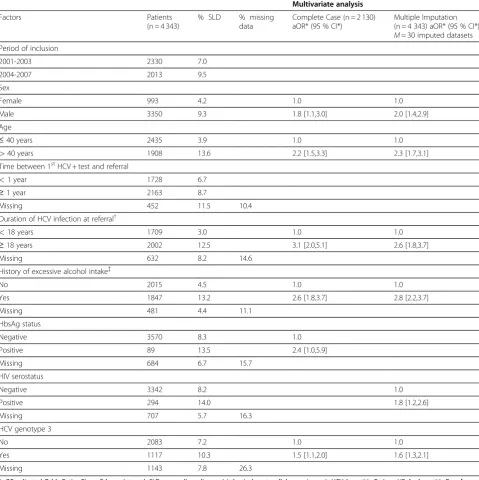
Details of the study design and the initial analyses have already been described [22,23]. Six out of the 9 variables retained for the multivariate analysis were incomplete, with a range of missing values from 10 to 26 % (Table 1). In the CC analysis, multivariate logistic analysis was reduced to 1,858 individuals (43 % of total cases) having no missing data in any of the 9 variables of the analysis. Consequently, we estimated missing values through multiple imputation by chained equations using Stata's user written program ice [4] (STATA W 9.2, Stata Corporation, College Station, Texas, USA). This computationally convenient method is being increasingly used in epidemiology, and does not require any direct assumption on the joint distribution of the variables [25,26]. The imputation algorithm is based on a set of univariate imputation models which, in turn, regress one variable on all the other covariates and the out-come [27].
related to the missingness mechanism. A total of 30 imputed datasets were generated. The initial study exploring the risk factors of SLD was performed using a joint analysis of these 30 imputed datasets [22]. Further imputations were performed subsequently for the sensi-tivity analysis.
Sensitivity analysis method
Consider a variable (covariate or response) Ywith miss-ing values. We denote byYithe value of Yfor the
indi-viduali. LetRibe an observation indicator variable equal
to 1 if Yi is observed and 0 if otherwise. We assume a logistic model relating the probability of observing Yto
Table 1 Multivariate logistic regression of factors associated with severe liver disease
Multivariate analysis
Factors Patients
(n = 4 343)
% SLD % missing
data
Complete Case (n = 2 130) aOR* (95 % CI*)
Multiple Imputation (n = 4 343) aOR* (95 % CI*)
M= 30 imputed datasets
Period of inclusion
2001-2003 2330 7.0
2004-2007 2013 9.5
Sex
Female 993 4.2 1.0 1.0
Male 3350 9.3 1.8 [1.1,3.0] 2.0 [1.4,2.9]
Age
≤40 years 2435 3.9 1.0 1.0
>40 years 1908 13.6 2.2 [1.5,3.3] 2.3 [1.7,3.1]
Time between 1stHCV + test and referral
<1 year 1728 6.7
≥1 year 2163 8.7
Missing 452 11.5 10.4
Duration of HCV infection at referral†
<18 years 1709 3.0 1.0 1.0
≥18 years 2002 12.5 3.1 [2.0,5.1] 2.6 [1.8,3.7]
Missing 632 8.2 14.6
History of excessive alcohol intake{
No 2015 4.5 1.0 1.0
Yes 1847 13.2 2.6 [1.8,3.7] 2.8 [2.2,3.7]
Missing 481 4.4 11.1
HbsAg status
Negative 3570 8.3 1.0
Positive 89 13.5 2.4 [1.0,5.9]
Missing 684 6.7 15.7
HIV serostatus
Negative 3342 8.2 1.0
Positive 294 14.0 1.8 [1.2,2.6]
Missing 707 5.7 16.3
HCV genotype 3
No 2083 7.2 1.0 1.0
Yes 1117 10.3 1.5 [1.1,2.0] 1.6 [1.3,2.1]
Missing 1143 7.8 26.3
*aOR, adjusted Odds Ratio;CI, confidence interval;SLD, severe liver disease (cirrhosis, hepatocellular carcinoma);HCV, hepatitis C virus;HBsAg, hepatitis B surface antigen;HIV, human immunodeficiency virus.
†Time from suspected year of infection to year of referral to the reference centre. Suspected year of HCV infection is defined as year of the last HCV negative test performed during the drug-use period or year of first drug injection.
{>210 g/week for women and>280 g/week for men.
the underlying (but potentially unseen) value ofY itself, adjusted for a vectorXof covariates:
logitPrðRi¼1Þ ¼αþβXiþδYi: ð1Þ
Under this parametric form assumption, ifδ= 0, given the fully observed data, the mechanism causing the missing data of Y does not depend on Y, so that the missing data are MAR. On the contrary, if δ6¼0, the missingness mechanism depends on the potentially missing Y, even taking into account the information in the observed data. Thus the data are MNAR.
In practice, the above logistic regression cannot be performed since, by definition, we do not observe Yi
when Ri=0. This implies that a value for δ must be
chosen, and its effect on inferences from the model of interest explored. With the method we investigate, this can be done using weights which are a simple function ofδand the imputed data. We next give an intuitive ex-planation of the approach.
Suppose M datasets are created by a MI method as-suming MAR. For each dataset, we denote by^θm the
es-timate of the parameter of interest (e.g. a regression coefficient). Multiple imputation assuming MAR results in several point estimates which, under Rubin’s rules, are simply averaged for final inference. Thus, the usual MI estimate ofθis expressed by:
^
θMAR ¼M1
PM m¼1
^
θm: (see Appendix for its estimated
variance).
Carpenter’s approach works by replacing this simple average by a weighted average, where estimates arising from imputations that are more likely under MNAR are upweighted relative to the others. Under the logistic model for the missingness mechanism described in (1), Carpenter et al.show the weights take a particularly simple form [20]. The model (1) hypothesises that, after adjusting for other observed variables, the chance of observing Y per unit change in Y has log-odds ratio δ. Then the weight, noted w~mð Þδ for imputation m, (m = 1,. . .,M),is equal to
exp δP
i2IY Ym
i
" #
;, whereYim(i2IY) is the imputed value
of Y for the individual i in the dataset m, and IYis the
set of individuals with Y unobserved. The exponential form of the weights comes from the logistic link in equa-tion (1).
Normalized weights calculated for each imputed data-set are expressed bywmð Þ ¼δ PMw~mð Þδ
k¼1
~ wkð Þδ
.
The MNAR estimate of θ is defined by ^θMNARð Þ ¼δ
PM m¼1
wmð Þ δ ^θm (see Appendix for its estimated variance).
Note that if data are MAR, thenδ= 0, and all imputa-tions are equally weighted as in Rubin’s original rules.
To gain an intuition for these weights, if δ is positive the chance of observingYis greater for more positiveY. Thus in the data after imputation under MAR, imputa-tions with small Y will be under-represented. The weights correct this by up-weighting (relative to the other imputed data sets) estimates from imputed data sets where the sum of the imputed values ofYis small.
Below, we present MAR estimates for the HCV dataset and explore their robustness to MNAR asδmoves away from zero. We further propose practical guidelines for selecting aδvalue where possible (or at least a plausible range of values forδ).
Framework for sensitivity analysis
Among variables retained in the multivariate analysis (Table 1), we focused on the missingness mechanisms of 3 binary variables. We now discuss epidemiological hypo-theses about these mechanisms for each variable in turn.
Alcohol consumption
Reporting alcohol consumption may be prone to a social desirability effect, even when past consumption is accounted for. We hypothesized that former heavy drinkers were less likely to report their past alcohol consumption.
HIV infection
HIV serostatus could be assessed either by a previous HIV test, where available, or by a test at first referral. Since the prevalence of HCV-HIV co-infection in hepa-tology reference centers is ~8 % and HIV testing is quite systematic, the physician may consider that patients are mainly HCV mono-infected when no positive HIV test is available. We hypothesized that HIV testing is less often reported when patients are HIV negative.
HCV genotype 3
HCV genotypes are tested by the referral laboratories of the participating centers. Genotyping might depend on the physicians’attitudes, but probably not on the unob-served values of the genotype. We nevertheless explored the MNAR assumption.
Consequently, we focused the sensitivity analysis on these 3 variables to assess the robustness of estimates obtained after MI using Carpenter’s method [20]. The sensitivity analysis was applied to each variable separ-ately in turn.
Practical considerations for sensitivity analysis
in a simulation study to test the method; although impu-tations are computationally cheap, beyond 1000 the gain, in terms of increased range of the imputation estimates ^
θm, is small.
One way to select a value for δ is to formally elicit plausible values from experts [28]. An alternative is to explore a range of values consistent with hypotheses concerning the missing data mechanism, such as those outlined above.
We propose the following 4-step approach for choos-ing an appropriate value for δ, and illustrate this using the HCV genotype 3 variable, before applying it to the other variables. Our focus is sensitivity analysis for the parameter of interest i.e. the coefficient of genotype 3 in the post MI multivariate logistic regression explaining SLD (Table 1, rightmost column). Using previous nota-tion,^θm is the MAR estimated logistic regression
coeffi-cient of genotype 3 in the imputed datasetm = 1,. . .,M.
Procedure for choosing delta
Step 1: Logistic regression to explore the missingness mechanism
Generate an indicator variable for the covariate in ques-tion being missing, and use logistic regression to assess association with the outcome and other covariates.
Illustrating with genotype 3, we generate a missing indicator equal to 1 if genotype 3 is observed and 0 otherwise. Using imputed values, we then fit a multivari-ate logistic regression model to explain the genotype 3 missing indicator; in this model we include the outcome (SLD) and all the covariates included in the initial anal-ysis model, genotype 3 excepted.
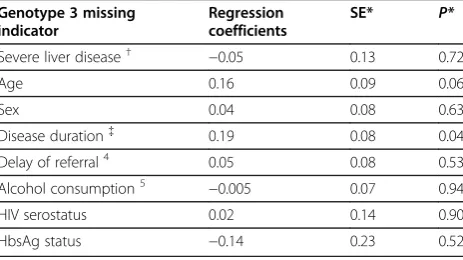
The results, shown in Table 2, suggest the missingness mechanism for genotype 3 depends on age and disease
duration, but given these is independent of SLD, the out-come in the analysis model.
Step 2: Graphical determination of a delta value
The theoretical justification of the method rests on im-portance sampling [29]. When using imim-portance sam-pling, it is not recommended to put all the weight on one, or very few values. The implication is that we should re-strict the range ofδ. Consistent with this, we recommend the following criteria: values ofδshould be such that the maximum normalized weight is around 0.5, and at least 5 normalized weights are above 1/M (the weight when δ= 0)[20]. Thus our MNAR estimate will draw on infor-mation from at least 5 imputations, the minimum typically advised in practice. It also reflects practically relevant, yet appropriately local, departures from MAR.
In practice, we recommend presenting this informa-tion in a graph such as Figure 1. The left panel shows a histogram of the sum of the imputed values for genotype 3. Extreme values are 340 in imputed dataset n°921 and 480 in dataset n°771. The right panel indicates normal-ized weights for each of the M = 1000 datasets byδvalue. The maximum normalized weight corresponds to the dataset(s) in which the sum of imputed values of Y is minimal (dataset n°921) when δ>0 or maximal (dataset n°771) when δ<0. When δ=0, the normalized weight is equal to 1/M because all thew~mð Þ0 are equal to 1.
Figure 2 shows the central part of the right panel of Figure 1. Following our recommendation above, we retain positive or negativeδ values that correspond to a maximum normalized weight of ~0.5. This gives a range of [−0.2 to 0.15]. Even at the end of this range, more than 5 normalized weights are>0.001. The central part of the hatched zone (defined subjectively, although an objective criteria could be set down a-priori if desired) corresponds to departures from MAR for which the weights are still approximately equal, so that MAR and MNAR inferences are essentially the same.
Step 3: Choice of sign of delta
Here, we choose δ to be either the upper or lower end of the range identified in step 2.
For HCV genotype, equation (1) shows the relation between the sign of δ and the assumed missingness mechanism: for positiveδ, the adjusted odds for observ-ing genotype increases if a person’s HCV is of genotype 3; for negativeδthe converse. In this instance, consistent with the results from step 1 (Table 2), we selected δ= 0.15. This means that the adjusted odds of missing data for genotype 3 is 1.2 (exp(0.15)) times greater for individuals infected by a genotype 3 strain than for those infected by other genotypes. For this variable, experience does not strongly suggest a positive or negative δ, and results for both are presented below.
Table 2 Multivariate regression to explain the missing indicator of genotype 3 using covariates
Genotype 3 missing indicator
Regression coefficients
SE* P*
Severe liver disease† −0.05 0.13 0.72
Age 0.16 0.09 0.06
Sex 0.04 0.08 0.63
Disease duration{ 0.19 0.08 0.04
Delay of referral4 0.05 0.08 0.53
Alcohol consumption5 −0.005 0.07 0.94
HIV serostatus 0.02 0.14 0.90
HbsAg status −0.14 0.23 0.52
*P, pvalue; SE, standard error. †Cirrhosis or hepatocellular carcinoma.
{Time from suspected year of infection to year of referral to the reference centre. Suspected year of HCV infection is defined as year of the last HCV negative test performed during the drug-use period or year of first drug injection.
4
Time between testing and first referral. 5
Step 4: Graphical diagnostic
The re-weighting method is for local sensitivity analysis, because the underlying theory requires the probability distribution of the estimator of the parameter of interest
under MAR and MNAR to share the same support (al-beit they have different means). This will not generally hold for non-local sensitivity analysis. The ‘range’ of such local sensitivity analyses will depend on the Imputed
data set n°921
Imputed data set n°771
wm
Imputed data set n°771
Imputed data set n°921
340 360 380 400 420 440 460 480
0
5
10
15
20
25
30
-1.0 -0.5 0.0 0.5 1.0
0.0
0
.2
0.4
0.6
0.8
1.0
Figure 1Graphical determination of a delta value for the variable genotype 3.Left panel: histogram of the sum of genotype 3 imputed values for each data set and for M = 1000 bases ; extreme values of this sum are 340 in imputed dataset n°921 and 480 in imputed dataset n°771. Right panel: normalized weights (wm) for each imputed dataset according toδ.
wm
-0.4 -0.3 -0.2 -0.1 0.0 0.1 0.2
0.0
0
.1
0.2
0.3
0.4
0.5
between imputation variance of the estimator, which is indirectly related to the proportion of missing observa-tions. To assess whether, at the chosen value of δ, this holds we propose (i) a plot of normalized weight wm
against ^θm, m = 1,. . .,M and (ii) a plot of the estimate
under MNAR as the number of imputations increases. In both plots, if the method is to give reliable results, the MNAR estimator should be supported within the distribution ofθ^m obtained by MI under MAR. If all the
weight is accruing to estimates at the end of the range of ^
θm, this is consistent with the MNAR estimator having a
distribution lying outside the range of MAR estimates, i. e. a‘non-local’departure from MAR. Under such a non-local MNAR mechanism the estimate ofθ is most likely beyond the smallest (largest) of the MAR imputation estimates.
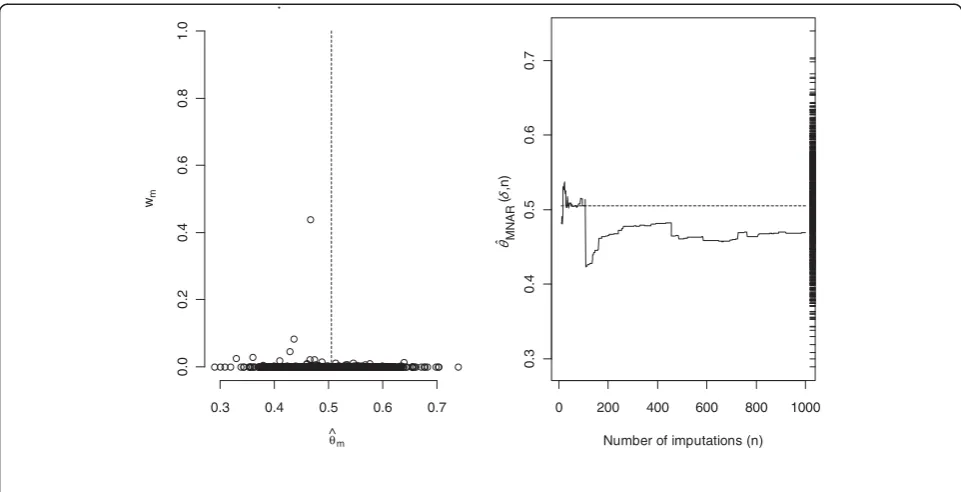
For the HCV genotype variable the results are shown in Figure 3. The left-hand panel plots the normalized weights versus ^θm for each imputed data, using δ=0.15
(recall ^θmis the regression coefficient estimate obtained
under the MAR assumption for each imputed dataset). The right panel plots the MNAR estimate calculated using n imputations against the number of imputed datasets notedn(n = 10,. . .,M) and
defined by:
In this case we see that (i) the MNAR estimate appears to settle down as the number of imputations increases
and (ii) the MNAR distribution of ^θseems comfortably supported within the MAR distribution (indicated by the ‘rug’on the right side of the plot).
Results
The complete-case and MI (assuming MAR) analysis are shown in Table 3. Here we also give the results of sensi-tivity analysis for the following three variables: HCV genotype 3, HIV serostatus and history of excessive alco-hol consumption.
For HCV genotype 3, we derived the value of the sensitivity parameter δ above, to illustrate our four step approach. We applied the same approach to HIV seros-tatus and alcohol consumption.
For alcohol consumption, step 1 showed the probabil-ity of observing this depends on the outcome (SLD sta-tus). Step 2 identified the range for δ of [−0.4;0.4] (left panel of Figure 4). Consistent with step 1 and experi-ence, the odds of observing alcohol intake is higher if it is not excessive, we chose δ= −0.4. The interpretation
^
m wm
0.3 0.4 0.5 0.6 0.7
0.0
0
.2
0.4
0.6
0.8
1.0
0 200 400 600 800 1000
0.3
0
.4
0.5
0.6
0.7
Number of imputations (n) θ
()
n
MN
AR
,
ˆ
Figure 3Analysis of the variable genotype 3 withδ= 0.15.Left panel: normalized weights (wm) versus^θm(estimated logistic regression coefficient of genotype 3 in the imputed datasetm), for each imputed data set. The dash line represents^θMAR(mean of^θmover the 1000 imputed datasets). Right panel: running estimate, calculated as the moving average of the^θMNARaccording to the number of imputed datasets. On the right axis is plotted the‘rug’of the 1000 estimates^θmfor each imputed dataset. The dash line represents^θMAR(mean of^θmover the 1000 imputed datasets).
^
θMNARðδ;nÞ ¼ P n
m¼1
wmð Þ δ ^θm
is that, after adjustment for other variables, the odds of observing alcohol history is reduced among those with a history of excessive intake by 0.7 = exp(−0.4).
For HIV serostatus, step 1 showed the probability of observing this depends on the outcome (SLD status). Step 2 identified a range of [−0.4;0.7] (right panel of Figure 4). Taking the results from step 1, and given that in similar contexts the chance of observing HIV infection is higher for HIV positive individuals, we choseδ = 0.7. The interpretation is that, after adjustment for other
variables, the odds of observing HIV serostatus is 2.0 = exp(0.7) times higher if HIV serostatus is positive.
For these three variables, the diagnostic in step 4 was ac-ceptable. Adjusted odds ratios (OR) are shown in Table 3. Note the same multivariate model including sex, age, dur-ation of HCV infection, alcohol consumption, genotype 3, and HIV serostatus, was applied for each analysis. The sensi-tivity analysis was applied to each of the 3 variables in turn.
Two criteria are useful to interpret the adjusted odds ratios in the 3 analyses:
Table 3 Multivariate analysis for the complete case, multiple imputation and sensitivity analysis, withM= 1000 imputed data sets
Complete Case (CC) Multiple Imputation (MI) Sensitivity Analysis (SA)
Missing values %
aOR 95 % CI SE CV
(%)
aOR 95 % CI SE CV
(%) VRMI (MIvsCC) (%)
δ aOR*95 % CI SE CV
(%) VRSA (SAvsMI) (%)
Alcohol consumption
11.1 2.32 0.39 17 2.82 0.37 13 21.86 -0.40 2.86 0.37 13 1.29
[1.66,3.23] [2.18,3.66] [2.21,3.70]
Genotype3 26.3 1.51 0.24 16 1.66 0.23 14 9.70 0.15 1.60 0.21 13 3.56
[1.10,2.07] [1.27,2.16] [1.23,2.06]
HIV 16.3 1.56 0.41 27 1.80 0.34 19 15.52 0.70 1.91 0.36 19 6.12
serostatus [0.92,2.62] [1.24,2.61] [1.32,2.76]
Note. aOR, odds ratio adjusted on sex, age, duration of HCV infection, alcohol consumption and HIV serostatus; aOR*
, odds ratio obtained from the MI adjusted odds ratio estimates.
CI, confidence interval;CV, coefficient of variation of the aOR;VRMI, variation rate of the aOR for CC and MI analyses;VRSA, variation rate of the aOR for MI and senstitivity analyses.
Covariates included in the model were: sex, age, duration of HCV infection, alcohol consumption, genotype 3 and HIV serostatus. Sensitivity analysis: the weighting process was applied to alcohol consumption, genotype 3 and HIV serostatus indepedently.
Alcohol
wm
HIV
wm
-1.0 -0.5 0.0 0.5 1.0
0.0
0
.2
0.4
0.6
0.8
1.0
-1.0 -0.5 0.0 0.5 1.0
0.0
0
.2
0.4
0.6 0.8
1.0
1 The coefficient of variation (CV) of the OR gives its normalized measure of dispersion. For the 3 variables, it is clearly reduced after MI and remains stable after reweighting.
2 The variation rate (VR) assesses the relative change between theOR^MNAR and theOR^MAR;and is defined
byVRSA¼100OR^MNAROR^MAR=O^RMAR.
Similarly, we define a variation rate namedVRMI
that displays the relative variation of the OR obtained after CC and MI analyses. VRMIvaries
from 9.7 % for genotype 3 to 15.5 % for HIV and 22 % for alcohol. VRSAis given for the value ofδ
selected for each variable. Its value is relatively small for alcohol (1.3 %) and genotype 3 (3.5 %) but larger for HIV at 6.6 %. The VRSAis relatively stable asδ
varies in [−1;1] for alcohol and genotype 3, but continues to increase for HIV (Figure5).
Discussion
With missing data, all analyses and corresponding infer-ences rest on inherently untestable assumptions about the missingness mechanism. Therefore, sensitivity ana-lyses, where we explore the robustness of inferences as assumptions change, are important.
The method presented here enables rapid local sensi-tivity analysis to inferences obtained via MI under MAR. It works by upweighting imputations which are more plausible under MNAR; under a logistic model for the missingness mechanism, these weights take a particularly simple form.
While the sensitivity analysis is local, it nevertheless provides important information on the duration and impact of departures from MAR on inference, while avoiding the computational complexity of full joint modeling. Its accuracy for local sensitivity analysis has been confirmed elsewhere[20,30].
Here, we have developed and illustrated the practical utility of the approach, proposing a 4-step process for choosing a value for the sensitivity parameter. We now discuss the results. Note that all three variables are binary, so the scale for delta is the same.
For genotype 3, step 1 of our process shows that among individual with complete records on variables apart from genotype 3, the probability of observing this variable does not appear to be related to the outcome in the model of interest (severe liver disease) (Table 2). The sensitivity analysis allows this probability addition-ally to depend on the underlying value of genotype 3 (present or absent). Table 3 and Figure 5 show inference is insensitive to this, indeed for plausible delta the esti-mate moves back towards the complete case estiesti-mate, consistent with what would be expected if the additional MNAR dependence does not materially change the lack of dependence of the chance of observing genotype 3 on severe liver disease.
Regarding alcohol consumption, our hypothesis was that patients will be less willing to report past excessive alcohol consumption because of the associated social stigma. However, the literature is not unanimous on this [31-34]. Reporting alcohol consumption is strongly
1.0 0.5
0.0 -5.0
-0.1
-5
0
5
VR
SA
(%
)
HIV Alcohol
Genotype 3
HIV
Alcohol
Genotype 3
related to the sociodemographic characteristics [35] that can be included in the imputation model in order to reduce non-response bias. We only included age and sex in the imputation model because other sociodemo-graphic variables were not related to the missingness mechanism. Our step 1 showed that the probability of observing alcohol does depend on the outcome, after taking into account other covariates. This is consistent with the relatively large change in the alcohol covariate under MAR (Table 3). The sensitivity analysis allows this probability additionally to depend on the alcohol value. Table 3 and Figure 5 show inference is relatively insensi-tive to this, which is consistent with what would be expected if the additional MNAR dependence does not materially change the dependence of the chance of observing alcohol consumption on severe liver disease.
For HIV co-infection, hepatologists in reference cen-ters tend to consider their patients as being HCV mono-infected because HCV-HIV co-mono-infected patients are usually referred to infectious diseases departments in France. Under the default assumption of mono-infection, there would thus usually be less impetus to test for or record HIV status. Thus we felt it was more likely to be observed if it was present, i.e. serostatus was positive, hence our positive value for δ. Step 1 showed that the probability of observing HIV status does depend on out-come, after taking into account other covariates. This is consistent with the relatively large change in the coeffi-cient under MAR. The sensitivity analysis allows this probability additionally to depend on the HIV status. Table 3 and Figure 5 show inference is sensitive to this, suggesting that if the mechanism is MNAR with increased chance of observing HIV status for those who are positive, the association in the model of interest is stronger and more significant than analysis under MAR would suggest.
In summary, for these data collected from a French surveillance system for hepatitis C infection, CC analysis is plausibly biased, as the data suggest dependence of the chance of observing values on the outcome, even given the covariates. Thus analysis under MAR, via MI, is preferable. Our sensitivity analysis shows that for local departures from MAR, inference for the genotype 3 and alcohol consumption is little changed, while the effect of HIV status is underestimated if, given the observed data, the chance of observing HIV status is higher when this is positive.
The approach we have described here can also be applied to explore the situation when there is an inter-action between, say, the response (disease status) and the chance of a risk factor being observed. In this case we may have two sensitivity parameters, one for each group (dis-ease status), or possibly a single parameter representing the difference between these. Since some evidence for this has been found [36] this is a natural area for future work.
Conclusion
This sensitivity analysis provides a fast, albeit approxi-mate, way to assess the robustness of inferences to the MAR assumption, avoiding the need for further imput-ation and model fitting to the imputed datasets. In this paper we have proposed a 4-step process for using this method in practice. We have demonstrated the application of this method and the interpretation of the results. Faced with non-trivial proportions of missing data, we encourage readers to apply the method in their own analyses.
Appendix
LetMthe number of imputed datasets,θ^mthe estimated
parameter of interest in the imputed dataset m, m = 1,. . .,M, and σ^m2 its associated variance estimate. The estimated MAR variance of^θMARis:
^
VMAR ^θMAR
¼V^W ^θMAR
þ1þM1V^B ^θMAR
,
where V^W ^θMAR
¼ 1
M
PM m¼1^σm
2 and V^B ^θMAR
¼
1
M1 PM m¼1
^
θm^θMAR
2
.
The estimated MNAR variance of ^θMNAR for a chosen
δvalue is: V^MNAR θ^MNARð Þδ
V^W ^θMNARð Þδ
þ
1þ 1
M
V^B ^θMNARð Þδ
, where V^W ^θMNARð Þδ
¼ PM
m¼1
wmð Þ δ ^σm2 and V^B ^θMNARð Þδ
¼ PM
m¼1 wmð Þ δ
^
θmθ^MNARð Þδ
2
.
Competing interests
The authors declare that they have no competing interests.
Authors' contributions
VHB implemented the method, performed analyses and interpretation of data, and drafted the manuscript. CL participated to the data gathering, contributed to interpretation of the study and revised the manuscript. JC contributed to the application of the method, and helped to draft the manuscript. JCD helped conduct the epidemiological discussion, and critically revised the manuscript. YLS directed the implementation of the method, contributed to the statistical supervision, and revised the manuscript. All authors read and approved the final manuscript.
Acknowledgements
The authors thank the clinicians and patients from all the participating hepatology reference centres. The French Institute for Public Health Surveillance conducted this study as part of his surveillance activities and is funded by the French Ministry of Health. Vanina Héraud-Bousquet is funded by a doctoral grant by the French National Agency for AIDS Research [n° NM/DF/1754 ].
Author details
1Département des maladies infectieuses, Institut de Veille Sanitaire, 12 rue du
Received: 15 June 2011 Accepted: 9 May 2012 Published: 8 June 2012
References
1. Sterne JA, White IR, Carlin JB, Spratt M, Royston P, Kenward MG, Wood AM, Carpenter JR:Multiple imputation for missing data in epidemiological and clinical research: potential and pitfalls.BMJ2009,338:b2393. 2. Kenward MG, Carpenter J:Multiple imputation: current perspectives.Stat
Methods Med Res2007,16:199–218.
3. Horton NJ, Kleinman KP:Much ado about nothing: A comparison of missing data methods and software to fit incomplete data regression models.Am Stat2007,61:79–90.
4. Royston P:Multiple imputation of missing values: furter update of ice, with an emphasis on categorical variables.Stata J2009,9:466–477. 5. Little RJA, Rubin DB:Statistical analysis with missing data. Wiley series in
Probability and Statistics. 2nd edition. New York: Wiley; 2002.
6. Spratt M, Carpenter J, Sterne JA, Carlin JB, Heron J, Henderson J, Tilling K:
Strategies for multiple imputation in longitudinal studies.Am J Epidemiol 2010,172:478–487.
7. Allison PD:Missing data. Iowa City: Sage Publication; 2002.
8. Vach W, Blettner M:Biased estimation of the odds ratio in case–control studies due to the use of ad hoc methods of correcting for missing values for confounding variables.Am J Epidemiol1991,134:895–907. 9. Potthoff RF, Tudor GE, Pieper KS, Hasselblad V:Can one assess whether
missing data are missing at random in medical studies?Stat Methods Med Res2006,15:213–234.
10. White IR, Carlin JB:Bias and efficiency of multiple imputation compared with complete-case analysis for missing covariate values.Stat Med2010,
29:2920–2931.
11. Collins LM, Schafer JL, Kam CM:A comparison of inclusive and restrictive strategies in modern missing data procedures.Psychol Methods2001,
6:330–351.
12. Raghunathan TE:What do we do with missing data? Some options for analysis of incomplete data.Annu Rev Public Health2004,25:99–117. 13. Schafer JL:Multiple imputation in multivariate problems when the
imputation and analysis model differ.Stat Neer2003,57:19–35. 14. Wood AM, White IR, Royston P:How should variable selection be
performed with multiply imputed data?Stat Med2008,27:3227–3246. 15. Diggle MG, Kenward MG:Informative drop-out in longitudinal data
analysis.Appl Statist1994,43:49–93.
16. Hogan JW, Laird NM:Mixture models for the joint distribution of repeated measures and event times.Stat Med1997,16:239–257. 17. Curran D, Molenberghs G, Thijs H, Verbeke G:Sensitivity analysis for
pattern mixture models.J Biopharm Stat2004,14:125–143.
18. Molenberghs G, Verbeke G:Models for discrete longitudinal data. New York: Springer; 2005.
19. Carpenter J, Rucker G, Schwarzer G:Assessing the Sensitivity of Meta-analysis to Selection Bias: A Multiple Imputation Approach.Biometrics 2011,67:1066–1072.
20. Carpenter JR, Kenward MG, White IR:Sensitivity analysis after multiple imputation under missing at random: a weighting approach.Stat Methods Med Res2007,16:259–275.
21. Troxel AB, Ma G, Heitjan DF:An index of local sensitivity to nonignorability.Stat Sin2004,14:1221–1237.
22. Larsen C, Bousquet V, Delarocque-Astagneau E, Pioche C, Roudot-Thoraval F, Desenclos JC:Hepatitis C virus genotype 3 and the risk of severe liver disease in a large population of drug users in France.J Med Virol2010,
82:1647–1654.
23. Delarocque-Astagneau E, Roudot-Thoraval F, Campese C, Desenclos JC, The Hepatitis CSSS:Past excessive alcohol consumption: a major determinant of severe liver disease among newly referred hepatitis C virus infected patients in hepatology reference centers, France, 2001.Ann Epidemiol 2005,15:551–557.
24. Schuppan D:Afdhal NH: Liver cirrhosis. Lancet2008,371:838–851. 25. Lee KJ, Carlin JB:Multiple imputation for missing data: fully conditional
specification versus multivariate normal imputation.Am J Epidemiol2010,
171:624–632.
26. Van Buuren S, Boshuizen HC, Knook DL:Multiple imputation of missing blood pressure covariates in survival analysis.Stat Med1999,18:681–694. 27. Van Buuren S:Multiple imputation of discrete and continuous data by
fully conditional specification.Stat Methods Med Res2007,16:219–242.
28. White IR, Carpenter J, Evans S, Schroter S:Eliciting and using expert opinions about dropout bias in randomized controlled trials.Clin Trials 2007,4:125–139.
29. Rubin DB:The calculation of posterior distributions by data
augmentation (in discussion of Tanner MA, Wong WH).J Am Stat Assoc 1987,82:543–546.
30. Carpenter JR, Kenward MG:Missing data in randomised clinical trials-a practical guide. Methodology Portfolio, Public Health, Epidemiology & Biostatistics, University of Birmingham, Edgbaston, Birmingham, UK.: ; 2007. 31. Pernanen K:Validity of survey data on alcohol use. New York: Wiley; 1974. 32. Knibbe R:Measuring drinking context.Alcohol Clin Exp Res1998,
22:15S–20S.
33. Lemmens PH, Tan ES, Knibbe RA:Bias due to non-response in a Dutch survey on alcohol consumption.Br J Addict1988,83:1069–1077. 34. Lahaut VM, Jansen HA, de MD Van, Garretsen HF:Non-response bias in a
sample survey on alcohol consumption.Alcohol Alcohol2002,37:256–260. 35. Van Oers JA, Bongers IM, van de Goor LA, Garretsen HF:Alcohol
consumption, alcohol-related problems, problem drinking, and socioeconomic status.Alcohol Alcohol1999,34:78–88.
36. Lewden C, Jacqmin-Gadda H, Vilde JL, Bricaire F, Waldner-Combernoux A, May T, Cuzin L, Lang JM, Leport C, Chene G:An example of nonrandom missing data for hepatitis C virus status in a prognostic study among HIV-infected patients.HIV Clin Trials2004,5:224–231.
doi:10.1186/1471-2288-12-73
Cite this article as:Héraud-Bousquetet al.:Practical considerations for sensitivity analysis after multiple imputation applied to epidemiological studies with incomplete data.BMC Medical Research Methodology2012 12:73.
Submit your next manuscript to BioMed Central and take full advantage of:
• Convenient online submission • Thorough peer review
• No space constraints or color figure charges
• Immediate publication on acceptance
• Inclusion in PubMed, CAS, Scopus and Google Scholar
• Research which is freely available for redistribution

![Figure 4 Normalized weights (wm) for each imputed dataset according to δ for the variables alcohol consumption and HIV serostatus.Left panel: the interval for δ is restrained to [−0.4;0.4]](https://thumb-us.123doks.com/thumbv2/123dok_us/9352895.1922413/8.595.61.538.461.696/figure-normalized-according-variables-consumption-serostatus-interval-restrained.webp)

