R E S E A R C H A R T I C L E
Open Access
A comparison of early versus late initiation
of renal replacement therapy for acute
kidney injury in critically ill patients: an
updated systematic review and
meta-analysis of randomized controlled trials
Xiao-mei Yang
1†, Guo-wei Tu
1†, Ji-li Zheng
2, Bo Shen
3, Guo-guang Ma
1, Guang-wei Hao
1, Jian Gao
4,5*and Zhe Luo
1*Abstract
Background:To investigate the impact of timing the initiation of renal replacement therapy (RRT) on clinical outcomes in critically ill patients with acute kidney injury (AKI), focusing on the randomized controlled trials (RCTs) in this field.
Methods:The PubMed, EMBASE and Cochrane databases were searched between January 1, 1985, and June
30, 2016, to identify randomized trials that assessed the timing of initiation of RRT in patients with AKI.
Results:Nine RCTs, with a total of 1636 patients, were enrolled in this meta-analysis. A pooled analysis of the studies indicated no mortality benefit with“early”RRT, with an RR of 0.98 (95% CI 0.78 to 1.23,P= 0.84). There was no significant difference in intensive care unit (ICU) length of stay (LOS) or hospital LOS between the early and late RRT groups for survivors or nonsurvivors. Pooled analysis also demonstrated no significant change in renal function recovery (RR 1.02, 95% CI 0.88 to 1.19, I2 = 59%), RRT dependence (RR 0.76, 95% CI 0.42 to 1.37, I2 = 0%), duration of RRT (Mean difference 1.43, 95% CI -1.75 to 4.61, I2 = 78%), renal recovery time (Mean difference 0.73, 95% CI -2.09 to 3.56, I2 = 70%) or mechanical ventilation time (Mean difference−0.95, 95% CI -3.54 to 1.64, I2 = 64%) between the early and late RRT groups. We found no significant differences in complications between the groups.
Conclusions:Our meta-analysis revealed that the“early”initiation of RRT in critically ill patients did not result in reduced mortality. Pooled analysis of secondary outcomes also showed no significant difference between the early and late RRT groups. More well-designed and large-scale trials are expected to confirm the result of this meta-analysis.
Keywords:Renal replacement therapy, Timing, Acute kidney injury
Background
Acute kidney injury (AKI) is a common complication of critical illness that carries high morbidity and mortality rates. Among patients with AKI, approximately 20% require renal replacement therapy (RRT) [1, 2]. Apart from the
modality, dialysis dose and anticoagulation, the optimal time to start RRT is considered an important determinant of the outcome of critically ill patients receiving RRT [3].
There are huge variations in the timing of RRT initi-ation in critically ill patients in the real world, based on the data from large randomized controlled trials (RCTs) [4, 5]. Although the early initiation of RRT was reported to be beneficial in critically ill patients with AKI [6, 7], this might expose patients to unnecessary RRT. Several meta-analyses have been published regarding the opti-mal timing of RRT initiation that achieved conflicting
* Correspondence:[email protected];[email protected] †Equal contributors
4
Department of Nutrition, Zhongshan Hospital, Fudan University, Shanghai 200032, People’s Republic of China
1Department of Critical Care Medicine, Zhongshan Hospital, Fudan University,
Shanghai 200032, People’s Republic of China
Full list of author information is available at the end of the article
conclusions [8–11]. The paucity of RCTs involved in the meta-analysis precluded the establishment of definitive conclusions because non-RCTs may exaggerate the mag-nitude of the effect due to intrinsic and external factors. Moreover, the secondary outcomes, including renal function recovery, RRT dependence and mechanical ventilation time, have not been carefully studied in previous meta-analyses.
Recently, two well-designed RCTs were issued to evalu-ate the outcome of different strevalu-ategies for RRT [12, 13]. The Artificial Kidney Initiation in Kidney Injury (AKIKI) trial demonstrated that mortality at 60 days was compar-able between the groups (48.5% in the early-strategy group and 49.7% in the delayed-strategy group) [12]. In contrast, the ELAIN randomized clinical trial revealed that the early initiation of RRT significantly reduced the 90-day mortality compared with the delayed initiation of RRT [13]. These findings added further uncertainty about the efficacy of “early”RRT in critically ill patients. Despite numerous low-quality studies in this field, a definitive conclusion is still yet to be elucidated. Therefore, we aimed to conduct an updated systematic review and meta-analysis to evaluate the efficacy and safety of “early” initiation of RRT com-pared to “late” RRT in critically ill patients by collecting data from RCTs only because these represent the highest standard of evidence to support the optimal timing of RRT initiation.
Methods Search strategy
We screened PubMed, EMBASE and Cochrane data-bases between January 1, 1985, and June 30, 2016, to identify randomized trials that assessed the timing of ini-tiation of RRT in patients with AKI. The search strat-egies were restricted to human RCTs and English language. Studies published before 1985 were excluded because there has been great progress in RRT technol-ogy and critical care practices in recent years.
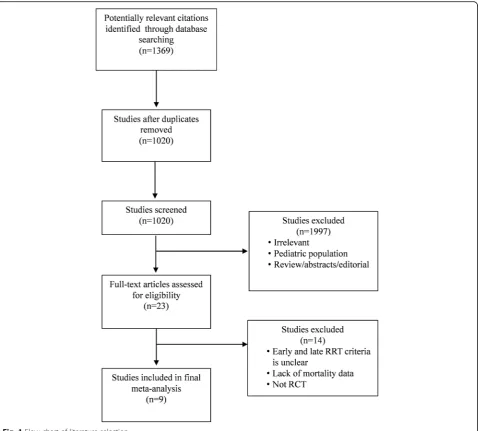
The following keywords or medical subject headings were used:“acute kidney injury”, “acute kidney”,“acute renal”, “renal replacement therapy”, “renal replacement”, “hemodialysis”, “hemofiltration”, “dialysis”, “dialyzed”, “dialyzing”, “time to treatment”, “time”, “timing”, “ initi-ation”, “start”, “accelerate”, “accelerated”, “accelerating”, “acceleration”, “early”, “earlier”, “late”. The search was slightly adjusted according to the requirements of the dif-ferent databases. The authors’personal files and reference lists of relevant review articles were also reviewed. The flow chart of the search strategies is summarized in Fig. 1.
Study selection
Studies reporting the timing of RRT initiation in patients with AKI were selected for further review. The inclusion criteria were as follows: (1) randomized controlled trials; (2) adult critically ill population; and (3) clearly comparing
early versus late RRT initiation with effect on mortality and/or clinically relevant secondary outcomes. We ex-cluded studies without clear comparisons of the outcomes. A cursory review of titles and abstracts was independently performed by two reviewers (Xiao-mei Yang and Guo-wei Tu). Disagreement on the inclusion/exclusion of RCTs was resolved through consensus and, if necessary, consult-ation with a senior investigator (Zhe Luo). Retained RCTs were reviewed in detail.
Data extraction
Data extracted included basic characteristics (author’s name, publication year, country of study, study period, study design, patient population, duration of follow-up, total number of patients, mean age, percentage of male), definition of “early” and “late” RRT, main characteristics at the time of RRT initiation (modality, creatinine, urine output, acute physiology and chronic health evaluation [APACHE II] score, sequential organ failure assessment [SOFA] score). The primary outcome was mortality, including 14-day mortality, 28-day mortality, 30-day mortality, 60-day mortality, 90-day mortality, ICU mortality, and in-hospital mortality. The longest follow-up mortality reported in the individual studies was extracted for the pool-ing analysis. Secondary outcomes included the ICU length of stay (LOS), hospital LOS, recovery of renal function, RRT dependence, duration of RRT, renal recovery time and mechanical ventilation time.
Assessment of evidence quality
The quality of evidence of each study was assessed (Xiao-mei Yang and Jian Gao) according to the guidelines of the GRADE Working Group (http://www.gradeworking-group.org/index.html), using the GRADE profiler (ver-sion 3.6.1, http://ims.cochrane.org/revman/gradepro) and GRADE handbook to determine the quality of evidence and strength of recommendation.
Statistical analysis
Corp, College Station, TX, USA). AP-value < 0.05 was set as the threshold of statistical significance. Neither ethics board approval nor patient consent was required due to the nature of a systematic review.
Sensitivity analyses were conducted by excluding or sub-grouping studies to reduce the potential confounding effects of patient population, RRT modality, study design, study sample size, duration of follow-up, urine output and creatin-ine. The log of the estimate of the study effect was set as the dependent variable in a general linear model, and the I2 and P-value were recalculated. Differences in the slopes of the linear regression models for the original and subgrouped data were used to predict the contributions of these poten-tial confounding factors to the measured outcomes.
Risk of bias was assessed independently by 2 reviewers (Xiao-mei Yang and Guo-wei Tu) as recommended in
the Cochrane Handbook, which includes 6 domains: selection bias, performance bias, detection bias, attrition bias, reporting bias, and other potential sources of bias. When there was insufficient information to allocate a high or low score, an “unclear” risk score was allocated. Disagreements in score allocations were resolved through group discussion. Publication bias was assessed using fun-nel plots, Begg’s test and Egger’s test [15], withP< 0.1 in-dicative of reporting biases.
Results Study selection
eligibility criteria. Nine RCTs fulfilled all criteria for the final meta-analysis (Fig. 1). All studies were writ-ten in English.
Characteristics of the studies
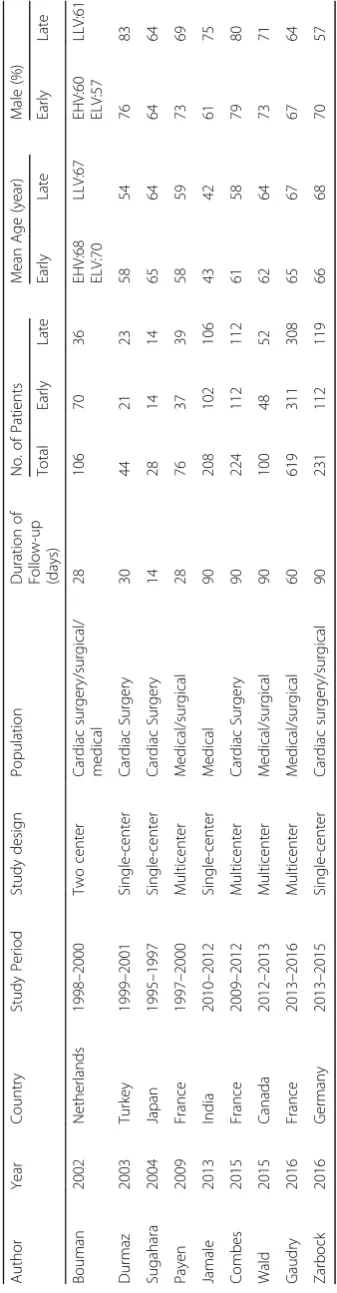
The basic characteristics of the studies selected are shown in Table 1. A total of 1636 patients were enrolled. Of these studies, four of the studies were multi-center studies [12, 16–18], four were single-center studies [13, 19–21], and one was a two-center study [22]. Three studies examined only patients following car-diac surgery [17, 19, 20], whereas the remaining six
studies were mixed with medical or surgical patients [12, 13, 16, 18, 21, 22]. The follow-up time reported in these studies ranged from 14 to 90 days.
The definition of early and late initiation of RRT for each specific study is outlined in Table 2. Five studies used urine output and/or serum creatinine or serum urea nitrogen or creatinine clearance for defining early and late RRT [18–22], two studies started early RRT when with diagnosis of severe sepsis or post-cardiac surgery shock [16, 17], and the latest two studies in 2016 used Kidney Disease: Improving Global Outcomes (KIDGO) stage 2 or stage 3 to define early RRT [12, 13]. In most of the studies, late RRT was defined as a classic Table 2Definition of Early and Late RRT in Studies Included in the Meta-analysis
Author Year Early RRT Criteria Late RRT Criteria Bouman 2002 RRT within 12 h if urine output <30 ml/h,
Cr clearance <20 ml/min, and mechanical ventilation
Urea > 40 mmol/L or K > 6.5 mmol/L or severe pulmonary edema
Durmaz 2003 Preoperative prophylactic RRT in all patients and postoperative sCr increased >10%
Postoperative sCr increased >50% or urine output <400 ml/24 h Sugahara 2004 Urine output <30 ml/h for 3 h or urine
output <750 ml/day
Urine output <20 ml/h for 2 h or urine output <500 ml/day Payen 2009 RRT for 96-h period within 24 h of diagnosis
of severe sepsis
Classic indications for RRT Jamale 2013 Serum urea nitrogen >70 mg/dL and/or
creatinine >7 mg/dL
Classic indications for RRT or Uremic nausea and anorexia Combes 2015 RRT within 24 h of diagnosis of post-cardiac
surgery shock
Creatinine >4 mg/dL or preoperative creatinine × 3 or urine output <0.3 ml/kg/h /24 h or urea >36 mmol/L or life-threatening hyperkalemia
Wald 2015 sCr increased >200%, urine output <6 ml/kg within 12 h, or NGAL≥400 ng/ml
K > 6.0 mmol/L or serum bicarbonate <10 mmol/L or pulmonary edema
Gaudry 2016 RRT within 6 h of diagnosis of KDIGO stage 3 K > 6.0 mmol/L or PH < 7.15 or pulmonary edema or blood urea nitrogen >112 mg/dL or oliguria >72 h
Zarbock 2016 RRT within 8 h of diagnosis of KDIGO stage 2 RRT within 12 h of KDIGO stage 3 or no RRT
Abbreviations:RRTrenal replacement therapy,Crcreatinine,sCrserum creatinine,Kpotassium,KDIGOkidney disease: improving global outcomes,NGALneutrophil gelatinase-associated lipocalin
Table 3The Characteristics at the time of renal replacement therapy initiation in studies included in Meta-analysis
Author Modality Creatinine (mg/d L) Urine output (ml/24 h) APACHE II score SOFA score Early Late Early Late Early Late Early Late Bouman CVVH NR NR NR NR EHV:23.5 (8.4)
ELV:21.7 (5.5)
LLV:23.6 (8.3) EHV:10.3 (2.8) ELV:10.1 (2.2)
LLV:10.6 (1.9) Durmaz IHD 3.1 (1.0) 4.3 (1.1) NR NR NR NR NR NR Sugahara CVVH 2.9 (0.2) 3.0 (0.2) 29 (1)a 18 (1)a 19 (2) 18 (3) NR NR
Payen CVVH 2.1 (1.1) 2.1 (1.3) 1543 (209) 1491 (242) NR NR NR NR Jamale IHD 7.4 (5.3) 10.4 (3.3) 429 (388) 376 (350) NR NR 7.6 (3.3) 8.2 (3.1) Combes CVVH 1.7 (0.9) 1.8 (0.9) NR NR NR NR 11.5 (2.8) 12 (2.9) Wald IHD/CVVH/SLED 3.7 (1.4) 4.6 (2.2) 400 (211–568) 265 (80–755) NR NR 12 (3.3) 11.9 (2) Gaudry IHD/CVVH 3.3 (1.4) 5.3 (2.3) NR 150 (50–600) NR NR 10.9 (3.2) 10.8 (3.1) Zarbock CVVH 1.9 (0.6) 2.4 (1) 445 (175–807.5) 270 (112.5–670) 30.6 (7.5) 32.7 (8.8) 15.6 (2.3) 16 (2.3)
Abbreviations:NRnot reported,APACHEacute physiology and chronic health evaluation,SOFAsequential organ failure assessment,EHVearly high volume,ELV
early low volume,LLVlate low volume,CVVHcontinuous venovenous hemofiltration,IHDintermittent hemodialysis,SLEDsustained low-efficiency dialysis a
Table 4Subgroup Meta-analyses and Meta regression Analyses
Subgroup No. of Studies No. of Patients Random-Effects Model RR (95% CI)
Test for EffectP I2(%) Test for HeterogeneityP Meta regressionP All Studies 9 1636 0.98 (0.78, 1.23) 0.84 60 0.01
Study Design 0.216
Single-center 4 511 0.58 (0.25, 1.36) 0.21 78 0.003 Multicenter 5 1125 1.03 (0.91, 1.17) 0.61 0 0.75
Sample Size 0.362
< 100 3 148 0.37 (0.07, 1.90) 0.23 82 0.004
≥100 6 1488 1.00 (0.83, 1.21) 0.98 44 0.11 Patient Population
Multisystem 6 1340 1.00 (0.82, 1.22) 0.99 42 0.120 Post cardiac surgery 3 296 0.37 (0.07, 1.81) 0.22 83 0.003
RRT Modality 0.838
CVVH 5 665 0.91 (0.63, 1.32) 0.62 71 0.007 IHD 2 252 0.63 (0.06, 6.19) 0.69 79 0.03 CVVH/IHD 2 719 0.98 (0.84, 1.14) 0.75 0 0.84
Days of Follow up 0.681
< 60 4 254 0.65 (0.30, 1.43) 0.29 74 0.009
≥60 5 1382 0.99 (0.80, 1.23) 0.95 53 0.07
Creatinine Difference 0.632
Significant 4 583 0.92 (0.55, 1.53) 0.74 67 0.03 Nonsignificant 5 1053 1.02 (0.78, 1.33) 0.87 57 0.05
UO Difference 0.079
Significant 2 259 0.40 (0.10, 1.63) 0.20 78 0.03 Nonsignificant 5 1227 1.05 (0.92, 1.19) 0.48 0 0.42
KDIGO 0.334
stage 1–2 5 627 0.74 (0.47, 1.17) 0.20 72 0.01 stage 3 3 933 1.08 (0.84, 1.40) 0.54 31 0.23
Abbreviations:RRTrenal replacement therapy,EHVearly high volume,ELVearly low volume,LLVlate low volume,CVVHcontinuous venovenous hemoflitration,
IHDintermittent hemodialysis,UOurinary output,KDIGOkidney disease: improving global outcomes
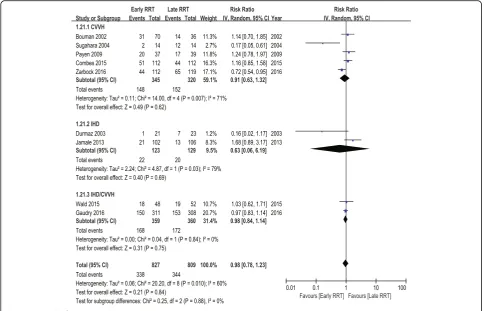
Fig. 3Forest plot for RRT modality
indication, including azotemia, oliguria, pulmonary edema, hyperkalemia and metabolic acidosis. The individual studies defined early and late RRT by using variable cutoff values in serum creatinine or urine output.
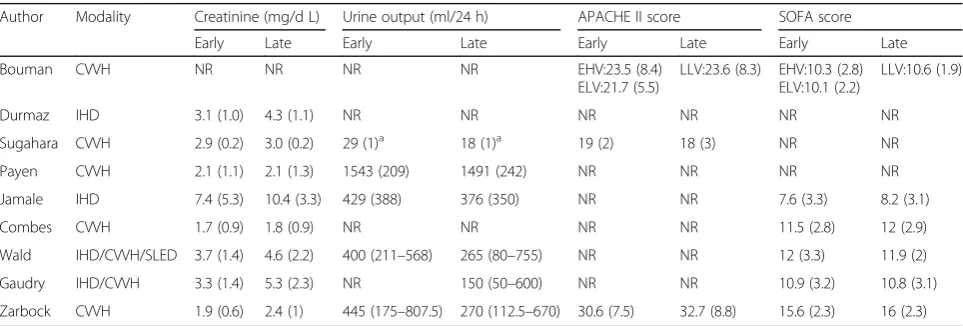
The modality of RRT varied significantly among the individual studies (Table 3). The modality of continuous vena-venous hemofiltration (CVVH) was used in five studies [13, 16, 17, 20, 22] and intermittent hemodialysis (IHD) was used in two studies [19, 21]. In the remaining two studies, some of the patients received CVVH modality, and the others received IHD or sustained low-efficiency dialysis (SLED) modality [12, 18]. At the time of initiation of RRT, the early group had serum creatinine ranging from 1.7 to 7.4 mg/dL and urine output from 400 to 1543 ml/ day while the late group had serum creatinine ranging from 1.8 to 10.4 mg/dL and urine output ranging from 150 to
1491 ml/day (Table 3). Several studies reported illness severity measured by APACHE II score and SOFA score before RRT initiation. The APACHE II score ranged from 19 to 30.6 in the early group and 18 to 32.7 in the late group, whereas the SOFA score ranged from 7.6 to 15.6 in the early group and 8.2 to 16 in the late group (Table 3).
Primary outcome
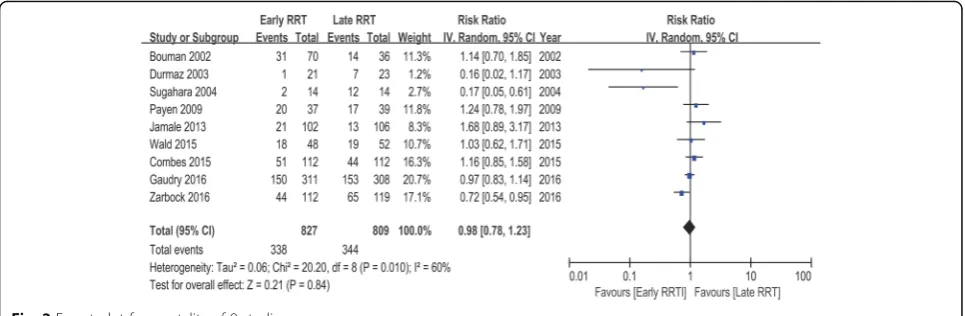
The definition of mortality reported in these studies differed considerably, including 14-day mortality [20], 28-day mortality [12, 13, 16, 22], 30-day mortality [17], 60-day mortality [12, 13, 17], 90-day mortality [13, 17, 18], ICU mortality [17, 18, 22], and in-hospital mortality [17–19, 21, 22]. We selected the longest follow-up mortality of each study as the pri-mary end point. Figure 2 showed the mortalities of Fig. 5Forest plot for ICU Length of stay
individual studies and pooled analysis. The total number of participants was 827 in the early group, with 338 deaths, and 809 in the late group, with 344 deaths. Pooled analysis of the studies indicated no mortality benefit with “early” RRT, with an RR of 0.98 (95% CI 0.78 to 1.23, P = 0.84). However, there was relatively high statistical heterogeneity with an I2value of 60% (P= 0.01).
Subgroup analysis
To explore the factors that may result in heterogeneity, several subgroup analyses were performed. Analyses grouped by patient population (post cardiac surgery versus multisystem), by RRT modality (CVVH versus IHD or IHD/CVVH), by study design (single center versus multicenter), by study sample size (≥100 versus <100), by duration of follow-up (≥100 days versus <100 days), by urine output (significant difference versus no sig-nificant difference between early and late RRT group), by creatinine (significant difference versus no signifi-cant difference between early and late RRT group), or by KDIGO classification of early RRT group (stage 1– 2 versus stage 3) demonstrated no significant differ-ence in the overall effect estimates. Meta-regression analyses showed no statistically significant association between RR and patient population, RRT modality, study design, study sample size, duration of follow-up,
urine output, creatinine, and KDIGO classification (Table 4, Figs. 3 and 4).
Secondary outcomes
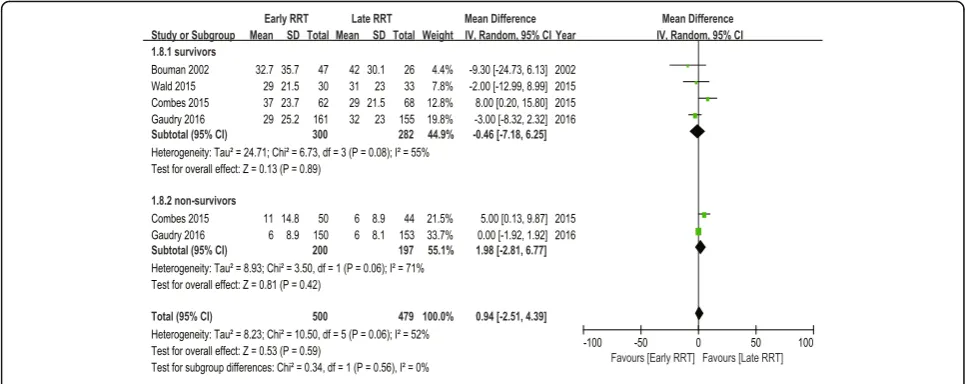
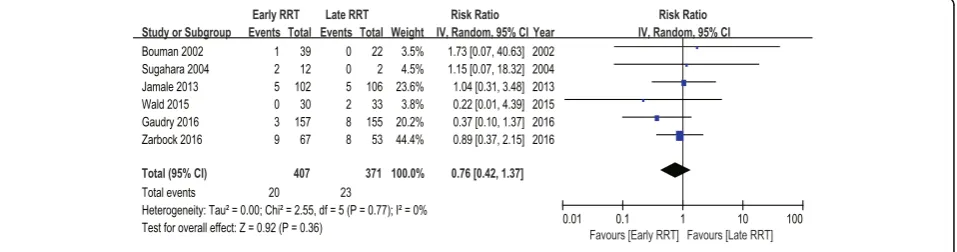
The analysis of secondary outcomes included the ICU LOS, hospital LOS, recovery of renal function, RRT dependence, duration of RRT, renal recovery time and mechanical ventilation time. Due to the variability in the reporting of ICU LOS and hospital LOS, we performed a pooled analysis for subgroups, including ICU LOS/hospital LOS in survivors and nonsurvivors. There was no signifi-cant difference in ICU LOS and heterogeneity between early and late RRT group for survivors or nonsurvivors (Fig. 5). A similar subgroup analysis performed on hos-pital LOS also showed no significant difference (Fig. 6). Seven of the nine studies reported recovery of renal function and RRT dependence. Pooled analysis also demonstrated no significant change in renal function recovery (RR 1.02, 95% CI 0.88 to 1.19, I2= 59%; Fig. 7) or RRT dependence (RR 0.76, 95% CI 0.42 to 1.37, I2= 0%; Fig. 8) between the early and late RRT groups. Three studies reported the duration of RRT [13, 17, 21], two studies reported renal recovery time [21, 22] and three studies reported mechanical ventilation time [13, 17, 22]. Pooled analysis of these studies showed no significant in-crease in duration of RRT in early RRT (Mean difference
1.43, 95% CI -1.75 to 4.61, I2= 78%; Fig. 9), renal recovery time (Mean difference 0.73, 95% CI -2.09 to 3.56, I2= 70%; Fig. 10) or mechanical ventilation time (Mean differ-ence−0.95, 95% CI -3.54 to 1.64, I2= 64%; Fig. 11).
Assessment of evidence quality
One critical outcome (the overall mortality of patients) and 7 important outcomes, including ICU LOS of survi-vors, hospital LOS of survisurvi-vors, renal function recovery, renal recovery time, duration of RRT, RRT dependence and mechanical ventilation time, were evaluated using the GRADE system. The level of evidence quality was moderate for overall mortality and low for other second-ary outcomes (Table 5).
RRT-related complications
Several RRT-related complications were reported in the studies, including hemorrhage, thrombocytopenia, throm-bosis, hypokalemia, hypophosphatemia, hyperkalemia, RRT-associated arrhythmia, RRT-RRT-associated seizure, hypothermia, catheter infection and hypotension during RRT (Table 6). We found no significant differences in complications between the early and late RRT groups, with no heterogen-eity between trials, except for hypophosphatemia (I2= 92%; P <0.0001).
Risk of bias and publication bias
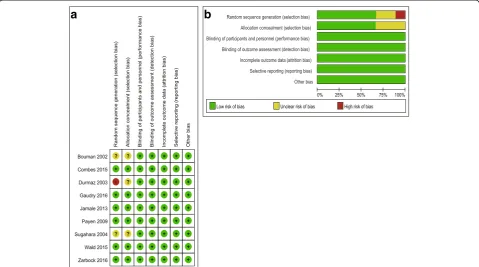
Risk of bias is shown in Fig. 12. Of the nine studies, two studies did not report random sequence generation, and three studies did not report allocation concealment and were thus considered to have an unclear risk of bias. Overall, the included RCTs had a low risk of bias. The funnel plot was symmetrical (Fig. 13), which indicated the absence of publication bias between the trials
included in our meta-analysis (P = 0.832, Egger’s test; P= 0.917, Begg’s test).
Discussion
Although the need to initiate RRT is unequivocal in AKI patients with traditional indications, the advantages of commencing RRT in the absence of life-threatening complications are still under controversial [18]. Despite numerous low-quality studies in this field, the definitive conclusion is still yet to be elucidated. There is insuffi-cient evidence to suggest that early initiation of RRT is related to reduced mortality or other patient-centered outcomes in critically ill patients. It should be men-tioned that the spontaneous recovery of renal function may occur in certain patients with AKI. In the AKIKI study, up to 49% of the patients in the delayed-strategy group avoided receiving RRT [12]. However, we cannot accurately predict the needs for RRT or opportunity of renal recovery in critically ill patients in the retrospective studies. One may even argue that patients in the early RRT group might have less severe conditions or more opportunity to have a spontaneous recovery of renal function, both of which might account for the improved outcomes. Therefore, the optimal timing of initiation of RRT cannot be accurately gained from retrospective studies. Four meta-analyses indicated that “early” initi-ation of RRT might reduce the mortality of patients with AKI compared with “late”RRT, but most of the enrolled trials were retrospective cohort studies which could affect the facticity of the final conclusion [9, 11, 23, 24].
We enrolled 9 RCTs with a total of 1636 patients in this meta-analysis and found that“early”RRT had no beneficial effect on mortality of patients with AKI compared with “late” RRT. Furthermore, pooled analysis of these studies also showed no significant benefit of early RRT in renal Fig. 9Forest plot for duration of renal replacement therapy
function recovery, renal recovery time, RRT dependence, duration of RRT or mechanical ventilation time. It has been known that there are many differences between post-cardiac surgery patients and those with nonpost-cardiac surgery, especially on the perioperative hemodynamic management. However, subgroup analysis of the studies concerning the patients post cardiac surgery or those with noncardiac surgery did not reveal a survival benefit of early RRT inter-vention. In addition, the conclusion remained the same, regardless of whether early was defined by AKI stages according to the KDIGO classification or on the basis of urine output or serum creatinine.
One highlight of this meta-analysis was that we included two new large RCTs published recently [12, 13], which made our results more convincing. Second, RRT-related complications were evaluated in the meta-analysis, and no significant differences in complications between the early
and late RRT groups were found. Third, survivors and nonsurvivors were analyzed separately in the secondary outcome analysis, and the same conclusion was reached. Fourth, this meta-analysis was performed under the re-quirements of Preferred Reporting Items for Systematic reviews and Meta-Analyses (PRISMA), which enhances the reliability of the conclusion. The quality of evidence and strength of recommendations were rated according to the guidelines of the GRADE Working Group.
However, facing the results we got, we could not con-firm the conclusion definitively. There was relatively high heterogeneity with an I2value of 60%, which might be explained by the significant variation in study design, population characteristics, baseline AKI severity, initiation time of RRT, modality used, and duration of follow-up among studies. The most fundamental differences among the trials were the huge differences concerning the timing Fig. 11Forest plot for mechanical ventilation time
Table 5Rating the Quality of Evidences by GRADE
Outcomes Studies No. of Participants Effect Quality Importance Recommendation grade
Early RRT Late RRT RR/RD (95% CI) Absolute Overall mortality 9 338/827
(40.9%)
344/809 (42.5%)
RR 0.98 (0.78 to 1.23)
9 fewer per 1000 (from 94 fewer to 98 more)
⊕ ⊕ ⊕Ο
Moderate
Critical Weak
ICU LOS of survivors 4 301 283 - MD 0.52 lower (2.6 lower to 1.56 higher)
⊕ ⊕ΟΟ
low
Important Weak
Hospital LOS of survivors 4 300 282 - MD 0.46 lower (7.18 lower to 6.25 higher)
⊕ ⊕ΟΟ
low
Important Weak
Renal function recovery 7 430/769 (55.9%)
405/747 (54.2%)
RR 1.02 (0.88 to 1.19)
11 more per 1000 (from 65 fewer to 103 more)
⊕ ⊕ΟΟ
low
Important Weak
Renal recovery time 2 163 124 - MD 0.73 higher (2.09 lower to 3.56 higher)
⊕ ⊕ΟΟ
low
Important Weak
Duration of RRT 3 316 260 - MD 1.43 higher (1.75 lower to 4.61 higher)
⊕ ⊕ΟΟ
low
Important Weak
RRT dependence 7 19/447 (4.3%)
23/427 (5.4%)
RR 0.76 (0.42 to 1.37)
13 fewer per 1000 (from 31 fewer to 20 more)
⊕ ⊕ΟΟ
low
Important Weak
Mechanical ventilation time 3 294 267 - MD 0.95 lower (3.54 lower to 1.64 higher)
⊕ ⊕ΟΟ
low
Important Weak
of RRT initiation among studies. Urine output, serum cre-atinine, serum urea nitrogen and AKI stages were not used unified in the individual studies to define the early and late RRT strategies. In extreme cases, patients in the early RRT group in one study might be enrolled as late RRT in other studies. The high heterogeneity of defini-tions of “early” and “late” RRT between RCTs precluded the establishment of definitive conclusions. Second, most studies enrolled AKI patients with a mixed population; whereas the optimal timing of RRT initiation might be associated with the primary diseases. Moreover, the
severity of the primary disease, presence of comorbid conditions, complications after surgery and fluid balance before RRT initiation could also be the possible confounders related to study outcome. Third, although the included 9 studies were all RCTs, the quality of many of them was not very high. There was a trend of publication bias towards a survival benefit from early initiation of RRT in studies with small sample sizes. In addition, different randomized methods were adopted in the individual studies, some of which were not sufficiently rigorous.
a
b
l
Fig. 12aRisk of bias summary: review authors’judgments about each risk of bias item for each included study.bRisk of bias graph: review authors’judgments about each risk of bias item presented as percentages across all included studies
Outcomes Study No. No of patients Risk Difference (95% CI) Pfor Effect I2 Pfor Model hemorrhage 6 1458 0.00(−0.02, 0.01) 0.89 0% 0.73 thrombocytopenia 3 949 0.05(−0.04, 0.14) 0.25 60% 0.08 thrombosis 2 700 −0.01(−0.04, 0.02) 0.40 0% 0.58 hypokalemia 3 924 0.00(−0.08, 0.07) 0.89 61% 0.08 hypophosphatemia 3 924 0.11(−0.09, 0.31) 0.28 92% <0.0001 hyperkalemia 2 843 −0.01(−0.04, 0.02) 0.41 0% 0.56 RRT-associated arrhythmia 3 920 −0.02(−0.08, 0.04) 0.48 58% 0.09 RRT-associated seizure 3 525 0.00(−0.01, 0.01) 0.85 0% 0.55 hypothermia 2 843 0.01(−0.01, 0.04) 0.28 0% 0.62 catheter infection 4 1014 0.01(−0.02, 0.04) 0.36 31% 0.23 hypotension during RRT 3 652 0.02(−0.02, 0.06) 0.37 37% 0.21
Additionally, we cannot omit the progression of the crit-ical care medicine during the past decade. In the study conducted in patients with acute renal failure following coronary bypass surgery in 2004, the mortality was as high as 86% in the “late” group [20]. However, the HEROICS study, conducted in post-cardiac surgery shock patients in 2015, showed that the 30-day mortality of the“early” and “late” group was only 36% [17]. We found that 5/6 of the RCTs published over the past decade failed to prove the benefit of early initiation of RRT. Great progress in hemodynamic monitoring, mechanical ventilation, nutri-tion support and even RRT technology development has been achieved in critical care medicine in the past decade. This may also partially explain the negative results of large RCTs in recent years regarding the early goal-directed therapy in the treatment of severe sepsis and septic shock [25–27]. Therefore, studies published before 1985 were excluded in this meta-analysis.
Based on these limitations, there is no established evi-dence of the association between timing of RRT initiation and outcomes. Due to the relatively high heterogeneity among enrolled studies, the conclusion of the meta-analysis should be interpreted with great caution. Although we could not reach the definite conclusion in our meta-analysis, we raise several suggestions for upcoming studies: (1) enrolled patients might be in a specified population, such as sepsis or post cardiovascular surgery, avoiding mixed populations; (2) using a unified definition of the timing of early and late RRT could facilitate reaching reliable conclusions; and (3) the
endpoint outcome of studies and choice of modalities of RRT should also be uniform if possible.
Conclusions
Our meta-analysis revealed that the“early” initiation of RRT in critically ill patients did not result in a reduced mortality. A pooled analysis of secondary outcomes showed no significant difference in ICU LOS or hospital LOS between early and late RRT group for survivors or nonsurvivors. A pooled analysis also demonstrated no significant change in renal function recovery, RRT de-pendence, renal recovery time or mechanical ventilation time. No significant differences in complications between the early and late RRT groups were found. Due to the rela-tively high heterogeneity among enrolled studies in this meta-analysis, the conclusion of the meta-analysis should be interpreted with great caution. More well-designed and large-scale trials are expected to confirm the result of this meta-analysis.
Additional file
Additional file 1: Table S1.Search strategy terms and results. (RTF 81 kb)
Abbreviations
AKI:Acute kidney injury; CRRT: Continues renal replacement therapy; CVVH: Continuous veno-venous hemofiltration; ICU: Intensive care unit; IHD: Intermittent hemodialysis; LOS: Length of stay; RCTs: Randomized controlled trials; RRT: Renal replacement therapy
Not applicable.
Funding
This article was supported by grants from the research funding of Zhongshan hospital (2015ZSYXGG-01), National Natural Science Foundation of China (81500067) and Shanghai Municipal Commission of Health and Family Planning (20154Y011 and 201440333).
Availability of data and materials
All data generated or analysed during this study are included in the published articles (Additional file 1: Table S1).
Authors’contributions
XY and GT performed the literature search, extracted date and drafted the manuscript. JZ, BS, GM and GH reviewed studies for inclusion and extracted data. JG performed the analysis of pooled data and helped draft the manuscript. ZL conceived the idea, participated in manuscript writing and revision. All authors have read and approved the final manuscript.
Ethics approval and consent to participate
Ethics approval and consent waived. All the data presented in this review is from previously published studies.
Consent for publication
Not applicable.
Competing interests
The authors declare that they have no competing interests.
Publisher’s Note
Springer Nature remains neutral with regard to jurisdictional claims in published maps and institutional affiliations.
Author details
1
Department of Critical Care Medicine, Zhongshan Hospital, Fudan University, Shanghai 200032, People’s Republic of China.2Department of Nursing,
Zhongshan Hospital, Fudan University, Shanghai, People’s Republic of China.
3Department of Nephrology, Zhongshan Hospital, Fudan University,
Shanghai, People’s Republic of China.4Department of Nutrition, Zhongshan Hospital, Fudan University, Shanghai 200032, People’s Republic of China.
5
Center of Clinical Epidemiology and Evidence-based Medicine, Fudan University, Shanghai, People’s Republic of China.
Received: 9 February 2017 Accepted: 14 July 2017
References
1. Clec'h C, Gonzalez F, Lautrette A, Nguile-Makao M, Garrouste-Orgeas M, Jamali S, Golgran-Toledano D, Descorps-Declere A, Chemouni F, Hamidfar-Roy R, et al. Multiple-center evaluation of mortality associated with acute kidney injury in critically ill patients: a competing risks analysis. Crit Care. 2011;15(3):R128. 2. Ea H, Sm B, Bellomo R, Cm C, Colman R, Dn C, Edipidis K, Lg F, Cd G, Govil
D, et al. Epidemiology of acute kidney injury in critically ill patients: the multinational Aki-epi study. Intensive Care Med. 2015;41(8):1411–23. 3. Vinsonneau C, Allain-Launay E, Blayau C, Darmon M, Ducheyron D, Gaillot T,
Pm H, Javouhey E, Krummel T, Lahoche A, et al. Renal replacement therapy in adult and pediatric intensive care: recommendations by an expert panel from the French Intensive Care Society (Srlf) with the French society of anesthesia intensive care (Sfar) French group for pediatric intensive care emergencies (Gfrup) the French dialysis society (Sfd). Ann Intensive Care. 2015;5(1):58. 4. Dm Y, Ja K, Huang D, Ae B, La W, Pike F, Terndrup T, He W, Pc H, Lovecchio
F, et al. A randomized trial of protocol-based care for early septic shock. N Engl J Med. 2014;370(18):1683–93.
5. Pr M, Tm O, Gs P, Da H, Mz S, Rd G, Jahan R, Se H, Bell D, Jf B, et al. Trial of early, goal-directed resuscitation for septic shock. N Engl J Med. 2015;372(14): 1301–11.
6. Yang X, Tu G, Gao J, Wang C, Zhu D, Shen B, Liu L, Luo Z. A comparison of preemptive versus standard renal replacement therapy for acute kidney injury after cardiac surgery. J Surg Res. 2016;204(1):205–12.
Bouman C, Macedo E, Gibney N, et al. Timing of renal replacement therapy and clinical outcomes in critically ill patients with severe acute kidney injury. J Crit Care. 2009;24(1):129–40.
8. Wierstra B, Kadri S, Alomar S, Burbano X, Gw B, Rl K. The impact of "early" versus "late" initiation of renal replacement therapy in critical care patients with acute kidney injury: a systematic review and evidence synthesis. Crit Care. 2016;20(1):122.
9. Liu Y, Davari-Farid S, Arora P, Porhomayon J, Nd N. Early versus late initiation of renal replacement therapy in critically ill patients with acute kidney injury after cardiac surgery: a systematic review and meta-analysis. J Cardiothorac Vasc Anesth. 2014;28(3):557–63.
10. Wang X, Yw J. Timing of initiation of renal replacement therapy in acute kidney injury: a systematic review and meta-analysis. Ren Fail. 2012;34(3): 396–402.
11. Cj K, Mr F, Sajjad I, Ss M, Aa L, Wald R, Sm B. A comparison of early versus late initiation of renal replacement therapy in critically ill patients with acute kidney injury: a systematic review and meta-analysis. Crit Care. 2011;15(1):R72. 12. Gaudry S, Hajage D, Schortgen F, Martin-Lefevre L, Pons B, Boulet E, Boyer A,
Chevrel G, Lerolle N, Carpentier D, et al. Initiation strategies for renal-replacement therapy in the intensive care unit. N Engl J Med. 2016;375(2):122–33.
13. Zarbock A, Kellum JA, Schmidt C, van Aken H, Wempe C, Pavenstadt H, Boanta A, Gerss J, Meersch M. Effect of early vs delayed initiation of renal replacement therapy on mortality in critically ill patients with acute kidney injury: the Elain randomized clinical trial. JAMA. 2016;315(20):2190–9. 14. Bj B, Jackson D. The exact distribution of Cochran's heterogeneity statistic in
one-way random effects meta-analysis. Stat Med. 2008;27(29):6093–110. 15. Egger M, Davey SG, Schneider M, Minder C. Bias in meta-analysis detected
by a simple. Graphical Test Bmj. 1997;315(7109):629–34.
16. Payen D, Mateo J, Cavaillon JM, Fraisse F, Floriot C, Vicaut E. Impact of continuous Venovenous hemofiltration on organ failure during the early phase of severe sepsis: a randomized controlled trial. Crit Care Med. 2009; 37(3):803–10.
17. Combes A, Brechot N, Amour J, Cozic N, Lebreton G, Guidon C, Zogheib E, Thiranos JC, Rigal JC, Bastien O, et al. Early high-volume hemofiltration versus standard care for post-cardiac surgery shock. The Heroics study. Am J Respir Crit Care Med. 2015;192(10):1179–90.
18. Wald R, Adhikari NK, Om S, Ma W, Pope K, Cohen A, Thorpe K, Mcintyre L, Lamontagne F, Soth M, et al. Comparison of standard and accelerated initiation of renal replacement therapy in acute kidney injury. Kidney Int. 2015;88(4):897–904.
19. Durmaz I, Yagdi T, Calkavur T, Mahmudov R, Apaydin AZ, Posacioglu H, Atay Y, Engin C. Prophylactic dialysis in patients with renal dysfunction undergoing on-pump coronary artery bypass surgery. Ann Thorac Surg. 2003;75(3):859–64.
20. Sugahara S, Suzuki H. Early start on continuous hemodialysis therapy improves survival rate in patients with acute renal failure following coronary bypass surgery. Hemodial Int. 2004;8(4):320–5.
21. Te J, Nk H, Kulkarni M, Pradeep KJ, Keskar V, Jawale S, Mahajan D. Earlier-start versus usual-start dialysis in patients with community-acquired acute kidney injury: a randomized controlled trial. Am J Kidney Dis. 2013;62(6):1116–21. 22. Cs B, Oudemans-Van S, Jg T, Df Z, Kesecioglu J. Effects of early high-volume
continuous Venovenous hemofiltration on survival and recovery of renal function in intensive care patients with acute renal failure: a prospective. Randomized Trial Crit Care Med. 2002;30(10):2205–11.
23. Vf S, Em B, Liangos O, Sosa MA, Cendoroglo M, Bl J. Timing of renal replacement therapy initiation in acute renal failure: a meta-analysis. Am J Kidney Dis. 2008; 52(2):272–84.
24. Wang X, Jie YW. Timing of initiation of renal replacement therapy in acute kidney injury: a systematic review and meta-analysis. Ren Fail. 2012;34(3): 396–402.
25. Sl P, Delaney A, Bailey M, Bellomo R, Cameron PA, Cooper DJ, Higgins AM, Holdgate A, Howe BD, Webb SA, et al. Goal-directed resuscitation for patients with early septic shock. N Engl J Med. 2014;371(16):1496–506. 26. Dm Y, Ja K, Huang D, Ae B, La W, Pike F, Terndrup T, Wang HE, Hou PC,
Lovecchio F, et al. A randomized trial of protocol-based care for early septic shock. N Engl J Med. 2014;370(18):1683–93.