A New Hybrid Decision Making Method for
Selecting Roller Concrete Road Pavement
Technology Transfer Method
Mohammad Ali Beheshtinia1, Mehdi Ahangareian 2 Received: 2016.09.16 Accepted:2017.06.24
Abstract
In today's competitive market, technology transfer is an important problem for firms, organizations and governments. Therefore, making right decisions on selecting a suitable technology and designing an appropriate process to transfer it may have significant influence on the performance of organizations. In this paper, we present a new method to obtain a suitable technology transfer strategy for roller concrete road pavement using Modified Digital Logic (MDL) and Technique for Order Preference by Similarity to Ideal Solution (TOPSIS). Concrete pavements have been used extensively for paving highways and airports as well as business and residential streets. First, we determine the criteria and alternatives which affect technology transfer using Delphi method. Then, the attribute relative importance is calculated by MDL. Eventually, the priority of all alternatives are achieved using TOPSIS. As the result, 8 criteria (transfer cost, transfer time, technology absorbency, accessibility to market, being up-to-date along with other technologies, human resource capability, ability of providing required equipment and special political and legal conditions) and 10 available alternatives (purchasing its technical knowledge, joint venture, importing capital goods, buy back contracts, licensing, turnkey project respectively, reverse engineering, recruiting scientific and technical personnel, technical and engineering aids contracts and foreign direct investment) were identified for roller concrete road pavement technology transfer.
Results show that human resource capability, being up-to-date along with other technologies, and the ability to provide required equipment have the greatest weight, respectively. Moreover, purchasing its technical knowledge, Joint venture and importing capital goods are the best approach for roller concrete road pavement technology transfer, respectively.
Keywords: Transportation, concrete road pavement, technology transfer, Multi-Criteria Decision Making, TOPSIS
Corresponding author E-mail: [email protected]
1 Assistant Professor, Department of Industrial Engineering , Semnan University, Semnan, Iran
A New Hybrid Decision Making Method for Selecting Roller Concrete …
1. Introduction
One of most important challenges for organizations in today's competitive market is the selection and transfer of technology. The processes of technology transfer (TT) is one of the most significant activities in innovation management of products, processes and services [Kumar et al. 2015].
A good technology transfer enables a firm to improve manufacturing productivity, alliance efficiency and adaptability, international expansion, and sustainable advantages. There are various kinds of technology transfer methods. In this study, a framework for selecting the best roller concrete road pavement technology transfer method based on Multi-Criteria Decision Making (MCDM) techniques is presented. In a MCDM problem there are some alternatives which should be ranked considering multiple criteria. There are various MCDM techniques and in this paper a combination of Modified Digital Logic (MDL) and Technique for Order of Preference by Similarity to Ideal Solution (TOPSIS) is used to select the best roller concrete road pavement technology transfer method.
Constructing concrete pavements with a long service life has always been an interesting subject for engineers [Sharif Tehrani and Hosseini Lavasani, 2017]. There are various methods for roller concrete road pavement technology transfer, each having their own advantages and disadvantages. Concentrating on only one aspect of these methods, such as cost, does not lead to a comprehensive solution. For example, one method may have better cost than another, while its time or technology absorbance is worse. In this study, a comprehensive solution is selected, considering all related criteria. In the process of technology transfer, organizations are faced with a complicated procedure. First of all, they need to gather information about suppliers and their abilities and capabilities. Then, they have to
consider internal resources and limitations. Therefore, it is necessary to find the criteria and alternatives for this issue.
Plain and reinforced concrete plates are widely used in transportation engineering, highway construction and airport pavements and bridge decks, and in construction of industrial pavements for parking and commercial centers; due to their mechanical strength, good surface finish, durability and economy [Giussani and Mola, 2012].
Roller concrete road pavement is commonly used for the following reasons: (1) Less amount of cement is used in comparison with other concrete road pavements, therefore, it is considered more environmentally friendly, (2) No special tools are needed, and (3) Cheaper rock particles with lower degrees of equality may be used compared to other concrete pavements [Lamond and Pielert, 2006]. This type of concrete road pavement is considered as unarmed seamy concrete road pavements. In order to form the structure of roller concrete road pavements, asphalt road pavement techniques and tools are required which result in lower costs as well as faster implementation [Lamond and Pielert, 2006]. Moreover, compared to other forms of pavements, these pavements need less complex structuring operations, higher rates in production, and fewer man-power. Furthermore, the road becomes usable faster than other types of concrete pavements [Lamond and Pielert, 2006].
Mohammad Ali Beheshtinia, Mehdi Ahangareian
due to vehicle brakes, and (9) industrial zones [Harrington et al. 2010].
Roller concrete road pavement is considered more beneficial than its asphalt analogue because of (1) economic advantages, and (2) technical advantages [Harrington et al. 2010]. Economic advantages [Harrington et al. 2010]:
1. Roller concrete road pavements are 30 percent more economical compared to other types of concrete or asphalt, due to the fact that it is faster and cheaper in structuring.
2. In terms of travelling time, cost of energy and fuel, exhaustion of tires and consequently vehicles; it is cheaper to use and fewer car accidents occur due to better performance in upper layers. 3. Less structuring costs; including
planning and designing roller concrete road pavements, building the road and quality control and repairs.
4. As mentioned before, costs of maintenance and repairing of roller concrete road pavements are less than those in asphalts.
5. Fewer man-power is required by concrete road pavement.
Technical advantages [Harrington et al. 2010]: 1. In low resistance substrate and busy
roads, concrete road pavements are more practical than asphalt road pavements.
2. Concrete road pavements are more resistant to oils such as gasoline and other corrosive materials.
3. Concrete road pavements have an effective lifetime of 40 to 50 years, while asphalt road pavements only have 15 to 20.
4. Concrete road pavements provide a better vision at night for drivers; therefore, are considered safer.
5. Since the thickness required for concrete road pavements is less than the one required asphalt; not only they use less material, but also are more compatible with thickness limitations. 6. In areas with busy roads where heavy
vehicles drive, especially highlands and steep roads, concrete road pavements are more efficient than asphalt road pavements.
7. In higher temperatures concrete road pavements show better performance than others.
8. There are fewer problems created due to land's secondary settling when concrete road pavements are used. The main research question and sub-questions of this paper are as follows:
Main question:
What are the ranks of technology transfer methods for producing concrete road pavement?
Sub questions:
1. What alternatives are available for roller concrete road pavement technology transfer?
2. What criteria are important in technology transfer of roller concrete road pavement? 3. What is the score of each alternative in each criterion?
4. What are the importance of each of these criteria?
A New Hybrid Decision Making Method for Selecting Roller Concrete …
The rest of this paper is organized as follows: Section 2 summarizes previous work on technology transfer. In Section 3, the research method is presented. Prioritization of alternatives using MCDM is presented in Section 4. Section 5 provides conclusion remarks and recommends areas for future research.
2. Literature Review
One of the most widely researched areas in technology management is technology transfer (TT). Technology transfer has various aspects and approaches. Moreover, there are wide ranges of studies about it from conceptual to empirical model. [Branstetter and Chen, 2006] presented a comparative empirical analysis of the impact of R&D spending and purchases of foreign technology on output and productivity in Taiwan industry. [Phaal, Farrukh and Probert, 2006] studied the technology management tools and its principles, as well as the development of technology management applications. [Belderbos, Ito and Wakasugi, 2008] examined intra-firm technology transfer and R&D in foreign affiliates. Their study indicated that both affiliation R&D and intra-firm technology transfer contribute to productivity growth, while technology transfer exhibits decreasing marginal returns. [Y.-J. Lee and Lee, 2008] studied on the technology strategy for enhancing public-to-private technology transfer. They characterize the patents along different dimensions captured by the renewal and application data, i.e. collaboration, scope, competitiveness and attractiveness. Their results shows that long lived patents are characterized by being more focused, having more competitiveness, and being more collaborative. [Fukugawa, 2009] examined the factors facilitating efficient transfer of technology by local public technology centers. Local public technology centers, administrated by prefectural and municipal governments of Japan, play important roles in a regional innovation system. [Henry, Kneller, and Milner, 2009] studied the importance of technology transfer in developing countries and their efficiency in using available resources and technology. Their
findings state that technology and efficiency development play a key role in the economy of developing countries. [Sung, 2009] considered technology transfer in IT industry in Korea. This paper identified factors influencing technology transfer and examined the contribution of these factors to technology transfer in Korean IT industry. His regression analysis states that the five major factors: communication channels, management support, concreteness of technology, sense of common purpose and awareness of technology transfer have significant influence on the success of technology transfer process.
[ Lee, 2010] identified the technology transfer options based on technological characteristics. He built a theoretical framework to match the mode of technology transfer with two key conditions: (1) absorptive capacity of recipient firms and (2) dependence on complementary assets. [A. H. I. Lee, Wang, and Lin, 2010] presented an evaluation framework for technology transfer of new equipment in high technology industry. At the first step, they collected factors which can influence the technology transfer of new equipment. Then, they used the Fuzzy Delphi method to select most critical factors. After that interpretive structural modeling (ISM) and fuzzy analytic network process (FANP) were applied to analysis information. [Caldera and Debande, 2010] investigated Spanish universities’ role in technology transfer. Their study points out those universities with established policies and procedures are better than other ones. Moreover, it shows universities with a science park are more successful in technology transfer than universities without one. [J. Lee et al., 2010] considered how regulated automakers and upstream component suppliers comply with “technology-forcing” regulations, or laws that set performance standards beyond their usual technological capabilities. Their results elucidate the fact that the role of forcing technological innovations and determining subsequent direction of technological change is related to high regulatory standards under the technology-forcing regulation.
Mohammad Ali Beheshtinia, Mehdi Ahangareian
government sector to industry between the developed country, the US, and the developing country, Vietnam. This paper presents three significant comparative points: first, the US Federal research system is more flat and distributed than Vietnam’s system. Second, there is a well-understood separation between scientific works, basic research, applied research and development works in the US. On the other hand, in Vietnam there is not a clear understanding of separation between those areas. [Gilsing et al. 2011] studied the differences in technology transfer between science-based and development-based industries. Furthermore, they showed the transmission mechanism and barriers in these two systems. [Minutolo and Potter, 2011] discussed about the concept of Entrepreneurial Separation to Transfer Technology (ESTT) and elucidated how inventor characteristics can influence the success of ESTT.
[Rampersad, Plewa, and Troshani, 2012] presented a contribution to innovation and technology management. This research is based on case study. [Mohamed et al., 2012] considered some factors that influence technology transfer and then presented a conceptual model for technology transfer based on them. [Theodorakopoulos, Sánchez Preciado, and Bennett, 2012] considered the ways which may be effective for technology transfer between universities and rural industries in developing countries. [Murphy et al., 2015] analyzed the prevalence of technology transfer in Clean Development Technology (CDM). They discovered factors affecting the success of this process. [Appiah-Adu, Okpattah, and Djokoto, 2016] presented two pathways, which lead to the elevation of the corporate performance of companies in Ghana by outsourcing and technology transfer. Results suggest that outsourcing and technology transfer affect the capability and consequently the corporate performance. [Enrique, Lorena, and Cynthia, 2016] indicated the negative and positive impacts of the technology transfer system, based on a case study in the jungle community of Santa Rita-Ecuador. The differences are mentioned in terms of a product versus a process.
A New Hybrid Decision Making Method for Selecting Roller Concrete …
faced by R&D organizations. They categorized the technology transfer barriers to: (1) technical, (2) organizational-economic, and (3) system barriers. [Novickis, Mitasiunas, and Ponomarenko, 2017] considered the relation between science and business sector using innovation, knowledge and technology transfer model in Riga Technical University.
According to literature review, there is not any study in technology transfer using a hybrid MCDM technique. This paper uses a combination of MDL and TOPSIS for selecting the best method for roller concrete road pavement technology transfer.
3. Research Method
Technology transfer is a complicated process. Therefore, it is important to have a framework for the selection and prioritization procedure. As mentioned, this paper presents a model to prosper in this way. The steps performed in this paper to answer research questions are as follows:
Step 1: Determine the available alternatives for roller concrete road pavement technology transfer (To answer sub question 1)
Step 2: Identify the required criteria for roller concrete road pavement technology transfer (To answer sub question 2)
Step 3: Determine the score of each alternative in each criterion (To answer sub question 3) Step 4: Calculate the weights of criteria, using the MDL method (To answer sub question 4) Step 5: Rank the alternatives, using TOPSIS (To answer main research question).
The required criteria and available alternatives are obtained by literature study and the opinions of 8 experts. Two questionnaires are used in this paper. The first is a pairwise comparisons between the criteria, in which each decision maker should determine a score from the three scores of 1, 2, and 3 in each comparison. After the questionnaires are completed by the experts and the MDL calculations are applied, the
average of the weights of criteria are considered as final result.
To determine the score of each alternative in each criterion (shown decision matrix in Table 2) the related questionnaires are completed by experts, using Delphi method. The Delphi method is a structured communication technique or method, originally developed as a systematic, interactive method which relies on a panel of experts. The experts complete the questionnaires in two or more rounds (In this paper the two rounds version is used). After each round, a facilitator or change agent provides an anonymised summary of the experts’ forecasts from the previous round, as well as the reasons they provided for their judgments. Thus, experts are encouraged to revise their earlier answers in light of replies of other members of their panel. It is believed that during this process, the range of the answers will decrease and the group will converge towards the "correct" answer. Finally, the process is stopped after a predefined stop criterion (e.g. number of rounds, achievement of consensus, stability of results) and the mean or the median scores of the final rounds determines the results [Rowe and Wright, 1999].
Some explanation about the used techniques in this paper are mentioned bellow:
3.1 Modified Digital Logic (MDL)
Mohammad Ali Beheshtinia, Mehdi Ahangareian
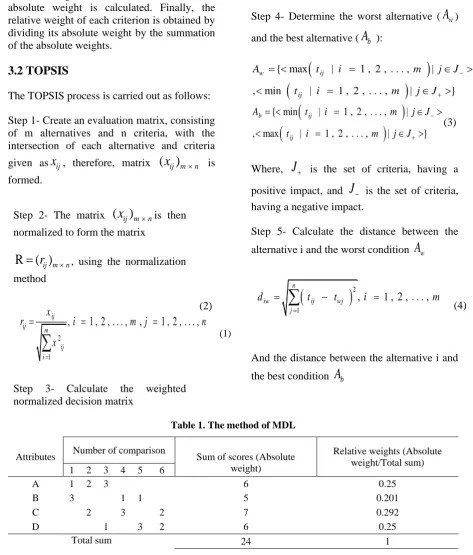
The procedure of this method is shown in an example with four properties in Table 1. To calculate the relative weights in this table, first, the summation of the scores, obtained by each criterion in the related pairwise comparison matrix, is calculated and considered as the absolute weight. Then, the summation of the absolute weight is calculated. Finally, the relative weight of each criterion is obtained by dividing its absolute weight by the summation of the absolute weights.
3.2 TOPSIS
The TOPSIS process is carried out as follows: Step 1- Create an evaluation matrix, consisting of m alternatives and n criteria, with the intersection of each alternative and criteria given as
x
ij, therefore, matrix(
x
ij m)
n is formed.Step 2- The matrix
(
x
ij m)
nis thennormalized to form the matrix
)
R (
r
ij mn, using the normalization method2
1
1 , 2 , . . . ,
,
, 1 , 2 , . . . ,
ij ij
ij m
i
x
i
m j
n
x
r
(1)Step 3- Calculate the weighted normalized decision matrix
(2)
1 , 2 , . . . , , 1 , 2 , . . .
.
,
,
ij ij j
i
m j
t
r w
n
Where
w
j is the original weight, given to the criterion jStep 4- Determine the worst alternative (
A
w)and the best alternative (
A
b ):
max 1 , 2 , . . . , , min
{ | |
| |
1 , 2 , . . . , }
w ij
ij
A t i m j J
t i m j J
{ min 1 , 2 , . . . , | |
| | }
, max 1 , 2 , . . . ,
b ij
ij
A t i m j J
t i m j J
(3)
Where,
J
is the set of criteria, having a positive impact, andJ
is the set of criteria, having a negative impact.Step 5- Calculate the distance between the alternative i and the worst condition
A
w
21
, 1 , 2 , . . . ,
iw ij
n
j
wj
t t i m
d
(4)
And the distance between the alternative i and the best condition
A
bTable 1. The method of MDL
Attributes Number of comparison Sum of scores (Absolute weight)
Relative weights (Absolute weight/Total sum)
1 2 3 4 5 6
A 1 2 3 6 0.25
B 3 1 1 5 0.201
C 2 3 2 7 0.292
D 1 3 2 6 0.25
A New Hybrid Decision Making Method for Selecting Roller Concrete …
21
, 1 , 2 , . . . ,
ib ij bj
n
j
t i
d t m
(5)
Where
d
iw andd
ib are distances from the alternative i to the worst and best conditions, respectively.Step 6- Calculate the closeness coefficient:
, 1 , 2 , . . . , iw
iw ib
d
CL i m
d d
(6)
Step 7- Rank the alternatives in ascending order of CL. A favorable alternative is one that have a small value for dib and a large value for diw.
A small value for dib and a large value for diw
result in a low value of CL. Hence, the alternative with the smallest value for CL is preferable than others.
4. Results
In this section the results, obtained by the implementation of the research steps are presented.
4.1 Available Alternatives
By use of expert opinions 10 available alternatives for roller concrete road pavement technology transfer were identified as follows: Purchasing its technical knowledge (A1), Joint venture (A2), Importing capital goods (A3), Buy back contracts (A4), Licensing (A5), Turnkey project respectively (A6), Reverse engineering (A7), Recruiting scientific and technical personnel (A8), Technical and engineering aids contracts (A9) and Foreign direct investment (A10).
4.2 Required Criteria
Based on expert opinions, 8 required criteria were suggested as follows:
Transfer cost (X1), transfer time (X2), technology absorbency (X3), accessibility to market (X4), being up-to-date along with other technologies (X5), human resource capability (X6), ability of providing required equipment (X7) and special political and legal conditions (X8).
4.3 Determining the Score of Each
Alternative in Each Criterion
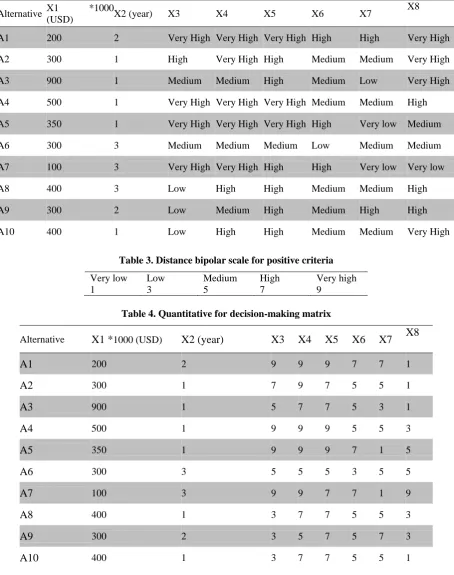
The score of each alternative in each criterion was determined using Delphi method. The results are shown in Table 2.
Two of these criteria -cost and time- are quantitative and the others are qualitative. The qualitative criteria are converted to digit using distance bipolar scale as shown in Table 3. This converting scale for qualitative attributes is used for positive ones, when a criterion is negative, the reverse of this table is used. Table 5 shows the decision matrix.
4.4 Calculating the Criteria Weights
using MDL Method
One of the most important issues in decision making is about relative importance of criteria. In this section, MDL is used to obtain the rate of each criterion from decision makers and then their normalized weights are calculated.
4.5 Rank the Alternatives using TOPSIS
TOPSIS is a repute method in multi attribute decision making. In this method, the positive ideal and the negative ideal solutions are determined and then the distances of each alternative from these two points are calculated. Finally, the alternatives are ranked by their relative distance.
Mohammad Ali Beheshtinia, Mehdi Ahangareian
Table 2. The attributes and options for the roller concrete road pavement technology transfer X8 X7 X6 X5 X4 X3 X2 (year)
X1 *1000
(USD) Alternative Very High High High Very High Very High Very High 2 200 A1 Very High Medium Medium High Very High High 1 300 A2 Very High Low Medium High Medium Medium 1 900 A3 High Medium Medium Very High Very High Very High 1 500 A4 Medium Very low High Very High Very High Very High 1 350 A5 Medium Medium Low Medium Medium Medium 3 300 A6 Very low Very low High High Very High Very High 3 100 A7 High Medium Medium High High Low 3 400 A8 High High Medium High Medium Low 2 300 A9 Very High Medium Medium High High Low 1 400 A10
Table 3. Distance bipolar scale for positive criteria
Very low Low Medium High Very high
1 3 5 7 9
Table 4. Quantitative for decision-making matrix
X8 X7 X6 X5 X4 X3 X2 (year)
X1 *1000 (USD) Alternative 1 7 7 9 9 9 2 200 A1 1 5 5 7 9 7 1 300 A2 1 3 5 7 7 5 1 900 A3 3 5 5 9 9 9 1 500 A4 5 1 7 9 9 9 1 350 A5 5 5 3 5 5 5 3 300 A6 9 1 7 7 9 9 3 100 A7 3 5 5 7 7 3 1 400 A8 3 7 5 7 5 3 2 300 A9 1 5 5 7 7 3 1 400 A10
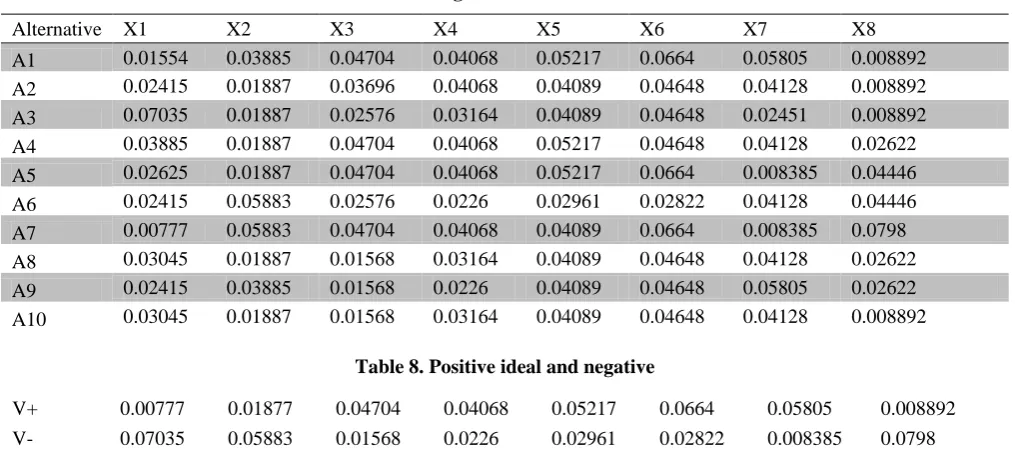
Now, it's time to determine the positive ideal and negative ideal solutions. Table 8 shows
A New Hybrid Decision Making Method for Selecting Roller Concrete …
Table 9 and 10. Consequently, the relative distance of each alternative is presented in Table 11.
Now, we are able to sort the alternatives using the information of tables 9 and 10. This sequence is presented in Table 11.
Table 5. Obtained weights by decision makers
Alternative D1 D2 D3 D4 D5 D6 SUM Normalized
weight
X1 9 12 11 13 13 13 71 0.10503
X2 11 11 12 10 19 12 75 0.110947
X3 14 12 13 11 14 12 76 0.112426
X4 11 14 15 14 14 15 83 0.122781
X5 14 15 15 16 18 17 95 0.140533
X6 21 19 19 18 17 19 112 0.16568
X7 19 13 13 15 13 12 87 0.128698
X8 13 14 14 15 11 9 77 0.113905
Table 6. Normalized decision making matrix
Table 7. Weighted normalized matrix
Alternative X1 X2 X3 X4 X5 X6 X7 X8
A1 0.01554 0.03885 0.04704 0.04068 0.05217 0.0664 0.05805 0.008892
A2 0.02415 0.01887 0.03696 0.04068 0.04089 0.04648 0.04128 0.008892
A3 0.07035 0.01887 0.02576 0.03164 0.04089 0.04648 0.02451 0.008892
A4 0.03885 0.01887 0.04704 0.04068 0.05217 0.04648 0.04128 0.02622
A5 0.02625 0.01887 0.04704 0.04068 0.05217 0.0664 0.008385 0.04446
A6 0.02415 0.05883 0.02576 0.0226 0.02961 0.02822 0.04128 0.04446
A7 0.00777 0.05883 0.04704 0.04068 0.04089 0.0664 0.008385 0.0798
A8 0.03045 0.01887 0.01568 0.03164 0.04089 0.04648 0.04128 0.02622
A9 0.02415 0.03885 0.01568 0.0226 0.04089 0.04648 0.05805 0.02622
A10 0.03045 0.01887 0.01568 0.03164 0.04089 0.04648 0.04128 0.008892
Table 8. Positive ideal and negative
V+ 0.00777 0.01877 0.04704 0.04068 0.05217 0.0664 0.05805 0.008892
V- 0.07035 0.05883 0.01568 0.0226 0.02961 0.02822 0.008385 0.0798
X8 X7
X6 X5
X4 X3
X2 (year) X1 *1000
(USD) Alternative
0.078 0.45
0.40 0.37
0.36 0.42
0.35 0.148
A1
0.078 0.32
0.28 0.29
0.36 0.33
0.17 0.23
A2
0.078 0.19
0.28 0.29
0.28 0.23
0.17 0.67
A3
0.23 0.32
0.28 0.37
0.36 0.42
0.17 0.37
A4
0.39 0.065
0.40 0.37
0.36 0.42
0.17 0.25
A5
0.39 0.32
0.17 0.21
0.20 0.23
0.53 0.23
A6
0.70 0.065
0.40 0.29
0.36 0.42
0.53 0.074
A7
0.23 0.32
0.28 0.29
0.28 0.14
0.17 0.29
A8
0.23 0.45
0.28 0.29
0.20 0.14
0.35 0.23
A9
0.078 0.32
0.28 0.29
0.28 0.14
0.17 0.29
Mohammad Ali Beheshtinia, Mehdi Ahangareian
Table 9. Distance from positive points
d1+ d2+ d3+ d4+ d5+ d6+ d7+ d8+ d9+ d10+
0.02153 0.03428 0.0781 0.04409 0.06382 0.07852 0.09606 0.05182 0.05297 0.04883
Table 10. Distance from negative points
d1- d2- d3- d4- d5- d6- d7- d8- d9- d10-
0.11906 0.10527 0.08677 0.09325 0.08982 0.06758 0.08253 0.08766 0.09128 0.09025
Table 11. The rank of options
Alternatives Rank CL
Purchasing its technical knowledge(A1) 1 0.84685
Joint venture(A2) 2 0.75435
Importing capital goods(A3) 4 0.52628
Buy back contracts(A4) 10 0.67894
Licensing(A5) 9 0.58461
Turnkey project respectively (A6) 8 0.46255
Reverse engineering(A7) 5 0.46214
Recruiting scientific and technical personnel(A8) 3 0.62848
Technical and engineering aids contracts(A9) 6 0.63277
Foreign direct investment(A10) 7 0.64889
4.6 Results
The results show “being up-to-date along with other technologies (X5)”, “human resource capability (X6)” are the most important criteria which may affect the success of technology transfer process. Moreover, the decision matrix shows the situation of each alternative in each criterion. The final result shows the best way to transfer concrete technology is by purchasing its technical knowledge. The second most suitable solution is joint venture, the third one is recruiting scientific and technical personnel and similarly, the sequences of other options are illustrated in table 11.
5. Conclusion and Future Research
Suggestions
Transfer of technology may happen from the laboratory of a firm to its marketing program, between firms and between countries and governments. Therefore, it is an important process for the receiver to get sustainable competitive advantages. Thus, it is necessary to study this process for each technology specifically and separately, and find out the
A New Hybrid Decision Making Method for Selecting Roller Concrete …
The results of this paper could be useful for construction companies, based on various viewpoints. First, the paper provides a set of criteria that should be considered in the concert road pavement technology transfer. The weights of criteria determine the amount of their concentration on each criterion. Finally, the rank of alternatives help them choose the best method for road pavement technology transfer.
As the result, 8 criteria and 10 available alternatives were identified for roller concrete road pavement technology transfer. Moreover, the results show that “being up-to-date along with other technologies (X5)”and “human resource capability (X6)” are the most important criteria in this MCDM problem. Results, obtained from the decision matrix, show that. from the aspect of “transportation cost”, “Reverse engineering” has the lowest cost, while “Importing capital goods “ has the highest cost. “Turnkey project respectively “and “Licensing” have the longest “transfer time”. “Buy back contracts “, “Licensing” and “Turnkey project respectively “have the highest “technology absorbency”. “Turnkey project respectively “and “Technical and engineering aids contracts” have the highest level of “accessibility to market”. According to “being up-to-date along with other technologies” criterion, “Purchasing its technical knowledge”, “Buy back contracts “ and “Licensing” have better situations than others. “Purchasing its technical knowledge”, “Licensing” and “Reverse engineering” have more consistency with “human resource capability”. From the aspect of “ability of providing required equipment” “Purchasing its technical knowledge” and “Technical and engineering aids contracts” have better condition than others. Finally, “Purchasing its technical knowledge”, “Joint venture”, “Importing capital goods “ and “Foreign direct investment” have more consistency with “special political and legal conditions”. Eventually, results of this research suggest that the best way of doing this process for this technology is to purchase its technical knowledge.
In future studies, the method presented in this paper may be used for other technologies. Using another MCDM techniques may also be another scope for future research.
6. References
-Alexander, K. A. and Hughes, A. D. (2017) "A problem shared: Technology transfer and development in European integrated multi-trophic aquaculture (IMTA)", Aquaculture,
Vol. 473, pp. 13-19.
-Appiah-Adu, K., Okpattah, B. K. and Djokoto, J. G. (2016). "Technology transfer, outsourcing, capability and performance: A comparison of foreign and local firms in Ghana", Technology in Society,Vol. 47, pp. 31-39.
Battaglia, D., Landoni, P. and Rizzitelli, F. (2017) "Organizational structures for external growth of University Technology Transfer Offices: An explorative analysis", Technological Forecasting and Social Change, Vol. x, No. x, pp. xx-xx.
http://www.sciencedirect.com/science/article/p ii/S0040162516305522
-Belderbos, R., Ito, B. and Wakasugi, R. (2008). "Intra-firm technology transfer and R& D in foreign affiliates: Substitutes or complements? Evidence from Japanese multinational firms", Journal of the Japanese and International Economies, Vol. 22, No. 3, pp. 310-319.
-Bolatan, G. I. S., Gozlu, S., Alpkan, L. and Zaim, S. (2016) "The Impact of technology transfer performance on total quality management and quality performance", Procedia - Social and Behavioral Sciences, Vol. 235, pp. 746-755.
Mohammad Ali Beheshtinia, Mehdi Ahangareian
-Caldera, A. and Debande, O. (2010) "Performance of Spanish universities in technology transfer: An empirical analysis", Research Policy, Vol. 39, No. 9, pp. 1160-1173. -Caramihai, M., Tănase, N. M. and Purcărea, A. A. (2017) "Proposals for Improving Innovation and Technology Transfer Policies in Romania", Procedia Engineering, Vol. 181, pp. 984-990. -Enrique, V., Lorena, R. and Cynthia, A. (2016) "The technology transfer systems in communities, product versus processes", Procedia Engineering, Vol. 145, pp. 364-371. -Fukugawa, N. (2009) "Determinants of licensing activities of local public technology centers in Japan", Technovation, Vol. 29, No. 12, pp. 885-892.
-Ghebrihiwet, N. and Motchenkova, E. (2017) "Relationship between FDI, foreign ownership restrictions, and technology transfer in the resources sector: A derivation approach", Resources Policy, Vol. 52, pp. 320-326. -Gilsing, V., Bekkers, R., Bodas Freitas, I. M. and van der Steen, M. (2011) "Differences in technology transfer between science-based and development-based industries: Transfer mechanisms and barriers", Tecnovation, Vol. 31, No. 12, pp. 638-647.
-Giussani, F. and Mola, F. (2012) "Durable concrete pavements: The reconstruction of runway head 36R of Milano Linate International Airport", Construction and Building Materials,Vol. 34, pp. 352-361. -Harrington, D., Abdo, F., Adaska, W. and Hazaree, C. (2010) "Guide for Roller-compacted concrete pavements", Iowa: National Concrete Pavement Technology Center.
-Henry, M., Kneller, R. and Milner, C. (2009) "Trade, technology transfer and national efficiency in developing countries", European Economic Review,Vol. 53, No. 2, pp. 237-254. -Kumar, S., Luthra, S., Haleem, A., Mangla, S. K. and Garg, D. (2015) "Identification and
evaluation of critical factors to technology transfer using AHP approach", International Strategic Management Review,Vol. 3, No. 1–2, pp. 24-42.
-Lamond, J. F. and Pielert, J. H. (2006) "Significance of tests and properties of concrete and concrete-making materials", USA: ASTM International. West Conshohocken
-Lee, A. H. I., Wang, W.-M. And Lin, T.-Y. (2010) "An evaluation framework for technology transfer of new equipment in high technology industry", Technological Forecasting and Social Change, Vol. 77, No. 1, pp. 135-150.
-Lee, J., Veloso, F. M., Hounshell, D. A. and Rubin, E. S. (2010) "Forcing technological change: A case of automobile emissions control technology development in the US", Tecnovation, Vol. 30, No. 4, pp. 249-264. -Lee, Y.-J. And Lee, J.-D. (2008) "Technology strategy for enhancing the public-to-private technology transfer: evidence from the duration of patent", Applied Economics, Vol. 40, No. 2, pp. 229-240.
-Lee, Y. J. (2010) "Identification of technology transfer options based on technological characteristics", Asian Journal of Technology Innovation, Vol. 18, No. 1, pp. 1-21.
-Mazurkiewicz, A. and Poteralska, B. (2017) "Technology Transfer barriers and challenges faced by R& D organisations", Procedia Engineering, Vol. 182, pp. 457-465.
-Minutolo, M. and Potter, J. (2011) "An introduction to entrepreneurial separation to transfer technology programs", The Journal of High Technology Management Research,Vol. 22, No. 2, pp. 114-120.
A New Hybrid Decision Making Method for Selecting Roller Concrete …
-Murphy, K., Kirkman, G. A., Seres, S. and Haites, E. (2015) "Technology transfer in the CDM: an updated analysis", Climate Policy,
Vol. 15, No. 1, pp. 127-145.
-Novickis, L., Mitasiunas, A. and Ponomarenko, V. (2017) "Information technology transfer model as a bridge between science and business sector", Procedia Computer Science,Vol. 104, pp. 120-126. -Phaal, R., Farrukh, C. J. P. and Probert, D. R. (2006) "Technology management tools: Concept, development and application", Technovation,Vol. 26, No. 3, pp. 336-344. -Rampersad, G., Plewa, C. and Troshani, I. (2012) "Investigating the use of information technology in managing innovation: A case study from a university technology transfer office", Journal of Engineering and Technology Management,Vol. 29, No. 1, pp. 3-21.
-Rosenzweig, S. (2017) "The effects of diversified technology and country knowledge on the impact of technological innovation", The Journal of Technology Transfer,Vol. 42, No. 3, pp. 564-584.
-Rowe, G. and Wright, G. (1999) "The Delphi technique as a forecasting tool: Issues and analysis", International Journal of Forecasting,
Vol. 15, No. 4, pp. 353-375.
-Sharif Tehrani, S. and Hosseini Lavasani, S. H. (2017) "The effects of concrete pavement mix design parameters on durability under freeze and thaw condition", International Journal of Transportation Engineering,Vol. 4, No. 3, pp. 211-224.
-Sung, T. K. (2009) "Technology transfer in the IT industry: A Korean perspective", Technological Forecasting and Social Change,Vol. 76, No. 5, pp. 700-708.
-Theodorakopoulos, N., Sánchez Preciado, D. J. and Bennett, D. (2012) "Transferring technology from university to rural industry within a developing economy context: The case for nurturing communities of practice", Technovation,Vol. 32, No. 9–10, pp. 550-559. -Tran, T., Daim, T. and Kocaoglu, D. (2011) "Comparison of technology transfer from government labs in the US and Vietnam", Technology in Society,Vol. 33, No. 1–2, pp. 84-93.