Evaluation of Different Genotypes at Codons 11, 72 and 248
of p53 Gene in Samples of Endometriosis
Hajar Dahim 1, Kahin Shahanipour 2 *, Ahmad Shabanizadeh Darehdori 3
1. MSc in Biochemistry, Department of Biochemistry, Falavarjan Branch, Islamic Azad University, Flavarjan, Iran. 2. PhD in Biochemistry, Department of Biochemistry, Falavarjan Branch, Islamic Azad University, Flavarjan, Iran. 3. PhD in Anatomy, Department of Anatomy, RafsanjanUniversity of Medical Sciences, Rafsanjan, Iran
* Corresponding Author: Kahin Shahani, PhD
Department of Biochemistry, Falavarjan Branch, Islamic Azad university, Flavarjan, Iran. Tel: +98 (913)1267418
E-mail: [email protected]
Introduction: Endometriosis is a prevalent gynecological disorder among women which is diagnosed by the growth of endometrial tissue outside of uterus and is mainly accompanied by severe pelvic pain and infertility. P53 also known as cellular tumor antigen P53 inside codons 11, 72 and 248 are contained with single nucleotide changes in which tends to be nearly rampant.This will probably be increasing the chances of endometriosis infection to some great extent.
Our aim was to evaluate the connection between endometriosis and polymorphism inside the codons 11, 72 and 248 of P53 gene.
Methods: In this study, single nucleotide changes in codons 11, 72 and 284 of TP53 gene among 44 persons infected with endometriosis and the same studying population for non-infected group have been examined. After primer design and amplification of polymorphic sequences by PCR, the polymorphisms of related codons have been evaluated by the digestion method (RFLP).
Results: In this study on the codon 72, there were seen differences in the distribution of genotype frequencies of normal polymorphic subjects and control subjects with endometriosis. At codons 11 and 248, there were observed no significant correlations between polymorphic and normal genotypes of endometriosis and non-endometriosis groups.
Conclusion: According to the results, we can say that probably polymorphism of codon 72 of p53 gene is one of the predisposing factors of endometriosis.
A B S T R A C T
Article info:
Received: 19 Jul 2013 Accepted: 18 Dec 2013
Key Words:
Polymorphisms, Gene P53, Endometriosis.
1. Introduction
ndometriosis is a prevalent gynecological and multi-factorial disease that is due to the interactions of variant genes and environ-mental factors. In this disease, endometri-um is seen outside of uterus. Endometriosis is diagnosed first time by Baron Carl Von Rokitansky in 1860. There are more infected Asian and European women in numbers compared to what have been observed among African and American women.
The symptoms of disease are varied but it is usually associated with pelvic pain, painful menstruation, and reduced fertility. The most common symptom is referral pelvic pain [1-3].
Pathologic findings associated with this disease are fibrosis, peritonitis, adhesion, and ovarian cysts [4, 5].
Several reasons expressed as the reason of disease including menstrual reflux hypothesis (peritoneal mac -rophages cannot phagocyte ectopic endometrial), and being mullerianic (the cells with the potential of be-coming endometrial from their path along their evo-lutional course and logged organogenesis are located somewhere else).There are also some genetic defects which are heritable [6-8].
Endometriosis could occur for all women from the beginning of menstruation to menopause stage despite of their race, type and whether they have given birth to any child or not. However, this particular type of disease is associated with pregnant women. However, the contributing factors to endometriosis such as race, age, their child birth experience, uterine abnormalities, and diet could be affective to its cause [5].
The prevalence of this particular type of illness varies between 6 to 10 percent among infected women ap-proximately. Furthermore, infertile women and wom-en suffering from chronic pelvic pain are considered to be more under the risk [9].
Endometriosis cannot be only diagnosed with the given symptoms, but rather requires a set of results and examinations. Health background and physical ex-amination help the physician to a better diagnosis for a large number of patients. The best diagnostic method of endometriosis is the direct observation of implanted tissue. Laparoscopy is known to be a golden method and the superior technique in diagnosing the disorder. The main aim of the treatment is to reduce the pain,
limit the disease progression, and lastly to maintain the fertility.
In general, the endometriosis treatment is divided into medical and surgical treatments. At both methods, infertility and pain can be cured [10]. First-degree relatives of women with endometriosis have an in-creased risk of receiving endometriosis by 7 percent more. Such figure is comparatively 7 times higher than women without this particular disorder [10]. There-fore, it is apparent that genetic changes play a crucial role in endometriosis. It has been shown that disrup-tion in suppressor gene tumors might be relative to the root cause of endometriosis [11].
One of the most well-known suppressor gene tumors called P53 is located in the region P13-1, chromo-some number 17. Codons'numbers 11, 72 and 248 of this particular gene contains approximately common polymorphisms. These polymorphisms depends on geographical and racial features and the occurrence of endometriosis has turned out to be reported differ-ently in various world populations [4, 5]. The aim of this study was to evaluate these polymorphisms among women with endometriosis and comparing them with healthy women subsequently.
2. Materials and Methods
At this case-control study, the samples are all collect-ed in form of paraffin blocks in pathology archives. As far as the research and statistical consulting are con-cerned, 44 endometrial samples were entitled as case group and the other 44 samples which are non-endo-metrial tissue were selected to be the instance. After the samples collection, DNA was extracted from kit. At the next step, the consecutive polymorphic of codons number 11, 72 and 284 belonged to gene 53TP by PCR and the implementation of designed specific primer pairs were augmented. The consecutive specific prim -er pairs to achieve consecutive polymorphic augmen-tation include as such : Codon 11 F: ACTTTTCCTT-GCAGCAGC and R:TTTCGGCTTCCCAGGTCTC
Codon 72 F: ATGATTTGATGCTGTCCCC and R: GGAAGGGACAGAAGATGACAG, Codon 248F: TGCTTGCCACAGGTCTCCC and R: CAGGGTG-GCAAGTGGCTCC to augment the consecutive poly-morphic for each codon. PCR conditions are as listed below:
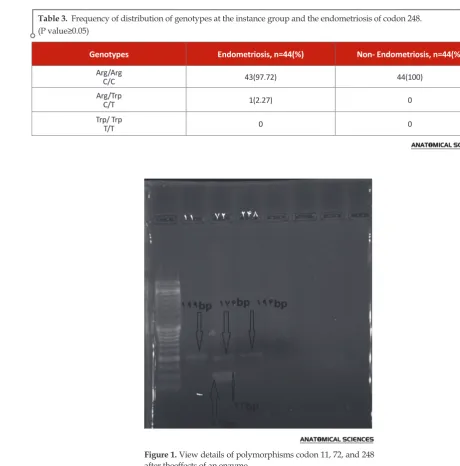
dCTP, dTTP, dGTP. First stage: A - Denatuation 94 ْc to 30 seconds for codon 11, 95 ْc to 30 seconds for codon 72, 94 ْc to 30 seconds for the codon 248. B - Anneal -ing temperature, 55 ْc to 30 seconds for codon 11, 58 ْc for codon 72 to 30 seconds and 30 seconds to codon 248.C - Extension, 72 ْc to30 seconds for codon 11, 72 ْc to 45 seconds for codon 72, 72 ْc to30 seconds for codon 248. Then, PCR has been affected by the restriction enzymes and the related polymorphic have been evaluated through gel electrophoresis study. One unit of restriction enzyme, BstuI at the temperature of 37° Celsius for a period of 30 minutes was used to evaluate the polymorphic of codon number 72. At genotype of normal homozygous (Arginine - Arginine) (GG), one piece of bp 279, at heterozygous (Arginine - Proline) (GC), three pieces of 279 bp and 60R and 119 and at polymorphic heterozygous (Proline - Proline) (CC), two pieces of 160 bp and 119 are produced. To evaluate polymorphic of codon number 11, one unit of restriction enzyme of IqTa for a period of 30 minutes atthe temperature of 65°Celsius was used[4, 5].
At genotype of normal homozygous (Glutamine - Glutamine) (GG) one piece of 379 bp, at heterozygous (Glutamine – Lysine) (GC), three pieces of 379 bp and 239 and 140, and at polymorphic heterozygous (Lysine – Lysine) (CC), two pieces of 239 and 140 are pro-duced. To evaluate the polymorphism of codon num-ber of 248, one unit of restriction enzyme of IIHap for
a period of 30minutes at the temperature of 65°Celsius was used. At genotype of normal homozygous (Argi-nine - Argi(Argi-nine) (GG) one piece of 379 bp, at heterozy-gous (Arginine–Tryptophan) (CT) three pieces of 379 bp and 239 and 140, and at polymorphic heterozygous (Tryptophan – Tryptophan) (TT), two pieces of 239 and 140 are produced. The acquired information was statistically analyzed by SPSS software [4, 5].
To compare frequency distribution of three different genotypes of each codon at the samples of endometrio-sis, Chi-square-test was performed. It turned out that P value was perceived to be less than 0.05.
3. Results
According to table 1, genotype of Arg/Arg was 21 of 44 cases (47/72%) in endometriotic samples and 31 of 44 cases(70/45%) in nonendometriotic samples. Genotype of Arg/Pro was 22 of 44 cases (50%) in en-dometriotic samples and13 of 44 cases (29/54%) in nonendometriotic samples. Genotype of Pro/Pro was 1 of 46 cases in endometriotic samples and there was not found cases in nonendometriotic samples. To compare frequency distribution of polymorphic and nonpoly-morphic genotypes between two endometriotic and nonendometriotic group there was found significance differences (Pvalue <0/05) indicated polymorphic varia-tion in codon 72 of endometriotic samples.
Genotypes Endometriosis, n=44(%) Non- Endometriosis, n=44(%) Arg/Arg
G/G 21(47.72) 31(70.45)
Arg/Pro
G/C 22(50) 13(29.54)
Pro/Pro
C/C 1(2.27) 0
Table 1. Frequency of distribution of genotypes at the instance group and the endometriosis of codon 72.
(P value≤0.05)
Genotypes Endometriosis, n=44(%) Non- Endometriosis, n=44(%) Gln/Gln
G/G 42(95.45) 44(100)
Gln /Lys
G/C 2(4.55) 0
Lys/ Lys
C/C 0 0
Table 2. Frequency of distribution of genotypes at the instance group and the endometriosis of codon11.
To compare frequency distribution of polymorphic and non polymorphic genotype of codon 11 and 248 be-tween two groups of endometriotic and non endometri-otic samples, there was not found significant differences that indicated these codons not polymorphic variation in endometriotic samples.
4. Discussion
Endometriosis can be seen as one of the most common disorders in women who has similar characteristics of malignant tumors. Infertility is a major complication of the disease. Symptoms of this disorder including dys-pareunia, pelvic and menstrual pain. Genetic changes
including significant events that occur during the cre -ation of endometriosis. Single nucleotide change in the gene sequence in the lower of a percentage of the popu-lation is called polymorphism that is inherent. Certain genetic defects heritable may cause endometriosis. These changes in genes of tumor suppressor including p53 can cause the more affect of certain disorders and diseases. Defective gene to some 17, which is 53p can affect gene function and thus may cause promotional endometriosis offers[12]. In polymorphisms 72CG P53, replacement of Cytosine (C) instead of guanine (G) lead to amino acid Arg conversion to proline. So, this process is a polymorphism that is single nucleo-tide. Arginine (Arg) with CGC sequence and the pro-Genotypes Endometriosis, n=44(%) Non- Endometriosis, n=44(%)
Arg/Arg
C/C 43(97.72) 44(100)
Arg/Trp
C/T 1(2.27) 0
Trp/ Trp
T/T 0 0
Table 3. Frequency of distribution of genotypes at the instance group and the endometriosis of codon 248.
(P value≥0.05)
Figure 1. View details of polymorphisms codon 11, 72, and 248
line (Pro) with the sequence CCC.Given that genotypes may occur include: Arg / Arg (G / G) that is naturally homozygous , Arg / Pro (G / C) are heterozygous and Pro / Pro (C / C) that is polymorphic homozygous. In polymorphism C248TP53, replacement of nucleotides cytosine (C) by thymine (T) causes the conversion of the aminoacid arginine, Arg to proline. Therefore, two allele of arginine (Arg) with sequence (CGG) and another Tryptophan Trp with sequence (TGG) and three genotypes Arg / Arg (C / C) that normal homo-zygous, Arg / Trp (C / T)which is heterohomo-zygous, and Trp / Trp(T / T).The polymorphic homozygous found in polymorphism codon 11GP53C, cytosine substituted guanine and thus two allele- glutamine (Gln) with se-quence GAG) and a lysine (Lys) with sese-quence (CAG) and three genotypes Gln / Gln (G / G), which is nor-mal homozygous, also Gln / Lys (G / C), which is het-erozygous and Lys / Lys (C / C)that are polymorphic homozygous. This polymorphism and its genotypes indifferent geographic and ethnic populations may have different effects on the risk of the disease [12]. The Role of single nucleotide changes in codons listed in susceptibility to endometriosis in previous studies, results of the anti- conflicting provided. Therefore, single nucleotide changes in codon P 53 genes listed in different geographic and ethnic populations may have different effects on endometriosis. This polymorphism is associated with geographic location and race [12]. In a study on codon 72, Change has reported an asso-ciation between alleles in a Chinese population proline and endometriosis. Two type of homozygote including the (Pro / Pro) and heterozygous for it (Arg / Pro) with the occurrence of endometriosis is associated while the Arg / Arg genotype is not a relationship with endome-triosis. They has said that there is a defensive role of homozygous genotype Arg / Arg against the disease and if someone have this genotype who will have a more immunity against infection with endometriosis. According to researches, Homozygotous genotype Arg / Arg of codon 72have low risk of endometriosis while the heterozygous allele and homozygous of proline (Pro) has a higher chance of suffering from this dis-ease [13].This study was conducted in a Japanese pop-ulation in Northern Italy and results have shown that the genotype Arg / Arg in comparison with the Arg / Pro and Pro / Pro is associated with an increasedrisk of endometriosis[14].In this study,dissimilarity was seen in the frequency of codon 72between normal controls and patients with endometriosis.Frequency of Allele Arg / Pro (G / C) in the patient group 50 % and innon- endometriosis was 29.54 %. Allele Pro / Pro (C / C) in the case group was 2.27% , compared
with zero percent in Group endometriosis and al-lele Arg / Arg group with 47.72 % was compared with 70.45 % in non- endometriosis. Therefore, the results of this study indicate that the most likely geno-type of GC (Arg / Pro) and genogeno-type of CC (Pro / Pro)which has an proline allele, can be considered as a potential risk for developing endometriosis. These findings match with the results provided by the change on a Chinese population as well as on an Italian popu-lation closely. According to the results, we can say that probably polymorphism of codon 72 of P 53genes isa predisposing factor for endometriosis and it is consid-erable and useful indicator for predicting endometrio-sis and at least we can say people with this genotype are more susceptible to endometriosis .It can serves as a marker for identifying people with endometriosis. About codons 11 and284,we found no significant cor -relations between polymorphic genotypes(polymorphic heterozygous and homozygous) and normal (normal homozygous) between groups of endometriosis and nonendometriosis .Therefore, by having this informa-tion, peoplewith susceptible genotype can be identi-fied, and preventive measures can be carried out before treatment.
References
1. Bedaiwy, M.A., et al., Prediction of endometriosis with se-rum and peritoneal fluid markers: a prospective controlled trial. Human Reproduction, 2002. 17(2): p. 426-431.
2. Tempfer, C., et al., Functional genetic polymorphisms and female reproductive disorders: part II—endometriosis. Hu-man reproduction update, 2009. 15(1): p. 97-118.
3. Seaman, H., et al., Endometriosis and its coexistence with irritable bowel syndrome and pelvic inflammatory disease: findings from a national case–control study—Part 2. BJOG: An International Journal of Obstetrics & Gynaecology, 2008. 115(11): p. 1392-1396.
4. Batt, R., A history of endometriosis. 2011: Springer.
5. Hsieh, Y.-Y. and C.-S. Lin, P53 codon 11, 72, and 248 gene polymorphisms in endometriosis. Int J Biol Sci, 2006. 2(4): p. 188-193.
7. Rogers, P.A., et al., Defining Future Directions for Endo-metriosis Research Workshop Report From the 2011 World Congress of Endometriosis in Montpellier, France. Repro-ductive Sciences, 2013. 20(5): p. 483-499.
8. Signorile, P.G., et al., Journal of Experimental & Clinical Can-cer Research. Journal of Experimental & Clinical CanCan-cer Re-search, 2009. 28: p. 49.
9. Acién, P., et al., Is a bowel resection necessary for deep endo-metriosis with rectovaginal or colorectal involvement? Inter-national journal of women's health, 2013. 5: p. 449.
10. Bulletti, C., et al., Endometriosis and infertility. Journal of assisted reproduction and genetics, 2010. 27(8): p. 441-447.
11. Chapron, C., et al., Deeply infiltrating endometriosis: patho-genetic implications of the anatomical distribution. Human Reproduction, 2006. 21(7): p. 1839-1845.
12. Martin, J. and J.-F. Dufour, Tumor suppressor and hepato-cellular carcinoma. World journal of gastroenterology: WJG, 2008. 14(11): p. 1720.
13. Jin, W., et al., Multiple biomarkers of colorectal tumor in a differential diagnosis model: a quantitative study. WORLD JOURNAL OF GASTROENTEROLOGY, 2004. 10(3): p. 439-442.