Please cite this article as: A. M. Mosa, I.T. Jawad, L.A. Salem, Modification of the Properties of Warm Mix Asphalt Using Recycled Plastic Bottles, International Journal of Engineering (IJE), IJE TRANSACTIONS C: Aspects Vol. 31, No. 9, (September 2018) 1514-1520
International Journal of Engineering
J o u r n a l H o m e p a g e : w w w . i j e . i rModification of the Properties of Warm Mix Asphalt Using Recycled Plastic Bottles
A. M. Mosa*a, I. T. Jawadb, L. A. Salema
a Civil Engineering Department, AL Mansour University College, Baghdad, Iraq
b Department of Civil Engineering, College of Engineering, University of Babylon, Hilla, Iraq
P A P E R I N F O
Paper history: Received 13 March 2018
Received in revised form 21 April 2018 Accepted 26 April 2018
Keywords:
Polyethylene Terephthalate Waste Marshall Properties
Rutting Susceptibility Warm Mix Asphalt
A B S T R A C T
The construction of flexible pavements with hot mix asphalt (HMA) consumes considerable energy, which impacts global resources and environment. Warm mix asphalt (WMA) is an effective alternative because it is produced with mixing and compaction temperatures lower than those used in HMA production. This technology decreases energy consumption, saves money and reduces the environmental pollution. Moreover, this technology can generate a revolution in sustainable construction if combined with the use of waste materials to improve the properties of WMA. Polyethylene terephthalate (PET) wastes are increasingly accumulated over the world. However, to the best of knowledge of authors, no research has adopted using PET wastes in combination with improving WMA properties. Therefore, the present study covers the usage of PET waste bottles to modify the properties of WMA. Ground PET waste bottles with a maximum particle size of 2.36 mm with different contents (0.1, 0.3, 0.5, 0.7, 0.9 and 1.1% by the weight of aggregate) were used to replace an equivalent portion of fine aggregate. Laboratory tests were conducted to investigate the effects of different PET contents on the properties of WMA. The testing programme included Marshall, rutting susceptibility and indirect tensile strength (ITS) tests. Results exhibited significant improvements in the engineering properties of the mixtures modified with the optimum PET content (which was found to be 0.5%) in terms of increase in stability, stiffness, ITS and moisture damage resistance and decrease in rutting susceptibility, without adverse effects on the other desirable properties of the mixtures.
doi: 10.5829/ije.2018.31.09c.06
1. INTRODUCTION1
Highways can be considered main facilities of transportation [1-7]. Most highways are paved with hot mix asphalt (HMA) [8]. However, the production of HMA consumes considerable energy and causes emissions, which increase pollution. Warm mix asphalt (WMA) has recently been proposed as an alternative to HMA because it decreases the temperatures of mixing and compaction of asphalt mixtures without significant unscrupulous effects on their engineering properties; in addition to consider enhancements in their workability and durability. Decrease in mixing and compaction temperatures can significantly reduce energy consumption, which leads to money saving and pollution reduction. The employment of waste materials
*Corresponding Author’s Email: [email protected] (A. M. Mosa)
[9-12] in modifying asphalt mixtures as part of waste utilization in sustainable development [13-15] and environment protection [9, 16-22] has underwent recent revolution. Polyethylene terephthalate (PET) waste material is widely used to improve the properties of construction materials. PET is a semi-crystalline polymer with high tensile strength [18], high chemical resistance and melting point of 260±10 °C [23]. Therefore, using this waste material (PET) in modified asphalt mixtures can promote sustainable construction. Several studies examined the effects of using PET waste on properties of HMA [24-26]. However, to the best of authors' knowledge, no research has implemented such a technique in the domain of WMA. Thus, the implementation of this approach is an essential objective. The present study selected PET waste bottles due to their great availability. A laboratory-oriented study was conducted to investigate the effects of using different PET contents (0.1, 0.3, 0.5, 0.7, 0.9 and 1.1%
by the weight of aggregate) on the engineering properties of WMA. PET content was considered to replace an equivalent amount of fine aggregates; given the particle size of PET used in this study was within the size range of fine aggregate. This approach (equivalent replacement) ensured constant asphalt contents in prepared samples. WMA was produced by adding aspha-min, which is the widespread commercial form of zeolite in this domain [27], to reduce mixing and compaction temperatures. The testing procedure included a number of tests to specify the properties of materials used and viscosity tests to determine mixing and compaction temperatures related to predetermined asphalt viscosities. The testing programme applied to unmodified and modified samples comprised Marshall, rutting susceptibility and indirect tensile tests. The results exhibited significant improvements in the engineering properties of modified samples compared with those of control (unmodified) samples.
2. MATERIALS
A number of tests were performed to investigate the properties of materials used (aggregate, asphalt and PET). The properties of aspha-min were obtained from the manufacturer’s manual. Commercial aspha-min was purchased from Xiangsong Chemical Co.(China). Aspha-min was added to the mixture at a rate of 0.3% by the total weight of the mixture. PET waste bottles used in this study were collected from local trash and mechanically ground into fine particles (not more than 2.36 mm) to replace an equivalent portion of fine aggregate of WMA.
3. TESTING PROGRAMME
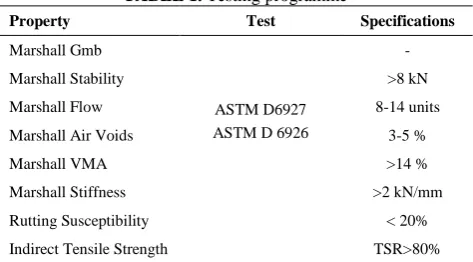
In addition to the tests performed to study the properties of materials used, a number of tests were implemented to determine the mixing and compaction temperatures and the optimum asphalt content (OAC) and investigate the effects of PET on the properties of WMA. These tests are shown in Table 1. The details of these tests are described in the following subsections.
3. 1. Viscosity Tests The viscosity values of asphalt were determined with different temperatures (120 °C, 135 °C, 150 °C and 165 °C) in accordance with ASTM D2170 to specify suitable mixing and compaction temperatures. These temperatures were adopted to prepare Marshall specimens.
3. 2. Marshall Test This part of the testing programme involved preparation of a number of control asphalt mixture samples (each involved three
TABLE 1. Testing programme
Property Test Specifications
Marshall Gmb
ASTM D6927 ASTM D 6926
-
Marshall Stability >8 kN
Marshall Flow 8-14 units
Marshall Air Voids 3-5 %
Marshall VMA >14 %
Marshall Stiffness >2 kN/mm
Rutting Susceptibility < 20%
Indirect Tensile Strength TSR>80%
specimens) at the determined mixing and compaction temperatures using Marshall method. The prepared samples were tested using the Marshall method to specify the OAC and investigate the properties of control mixture. The investigation covered bulk specific gravity, stability, flow, air voids, total voids in mineral aggregate (VMA) and stiffness. On the basis of the OAC, the Marshall method was repeated for samples modified with the predetermined contents of PET, in order to investigate their effects on the properties of WMA.
3. 3. Rutting Susceptibility Test Unmodified samples and samples modified by PET with different contents were prepared and tested according to AASHTO T324 to evaluate the rutting susceptibility of the mixtures under this study. Each sample involved two specimens with dimensions of 600 mm × 200 mm × 75 mm. The prepared samples were tested using a wheel-tracking apparatus under full-immersion conditions with a temperature of 50 °C. The applied pressure was approximately 730 kPa, which is simulated the contact tire pressure. Rut depth was recorded up to 20000 wheel passes.
4. RESULTS AND DISCUSSION
4. 1. Results of Viscosity Tests From the viscosity test for asphalt cement foamed by aspha-min, the temperature ranges of mixing and compaction were determined at 148 °C to 136 °C and 128 °C to 122 °C, respectively. These temperatures were related to the predetermined viscosities required for mixing (150 centistokes to 190 centistokes) and compaction (250 centistokes to 310 centistokes). Figure 1 illustrates the tests results. These temperatures were adopted for preparing Marshall specimens.
Figure 1. Viscosity test results of asphalt with Aspha-min
OAC of the control WMA and determine its properties. OAC was determined at 5% based on the weight of the mix. This content was adopted to produce the modified mixtures. The results of Marshall tests showed that all properties of control WMA related to the OAC
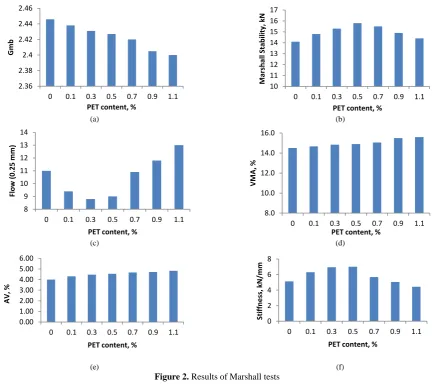
conformed to the standard requirements. The Marshall testing procedure was repeated on a number of samples modified by different contents of PET. Figure 2 illustrates the effects of different PET contents on the mixture properties. The results showed that the mixture bulk specific gravity values of modified samples decreased with the increase in PET content, as shown in Figure 2a. This behaviour could be attributed to the decrease in overall specific gravity of aggregate as a result of the decrease in overall specific gravity of fine aggregate with the increase in PET content because the specific gravity of PET is less than that of fine aggregates. The decrease in bulk specific gravity values with the increase in PET content could also be a result of the decrease in mixture compressibility. The decrease in WMA compressibility might be attributed to the inconsistent structure of PET and the reduction in lubrication by warm asphalt during compaction due to the absorption of an amount of asphalt by PET.
(a) (b)
(c) (d)
(e) (f)
Figure 2. Results of Marshall tests
50 100 150 200 250 300 350
115 125 135 145 155 165 175
V
e
scos
it
y,
cS
t
Tempreture, °C
Asphalt+Aspha-min Vescosity 150 cSt
Vescosity 190 cSt Vescosity 250 cSt
Vescosity 310 cSt
2.36 2.38 2.4 2.42 2.44 2.46
0 0.1 0.3 0.5 0.7 0.9 1.1
G
m
b
PET content, %
10 11 12 13 14 15 16 17
0 0.1 0.3 0.5 0.7 0.9 1.1
M
ars
hal
l S
tabi
lit
y,
k
N
PET content, %
8 9 10 11 12 13 14
0 0.1 0.3 0.5 0.7 0.9 1.1
Fl
ow (
0.25
m
m
)
PET content, %
8.0 10.0 12.0 14.0 16.0
0 0.1 0.3 0.5 0.7 0.9 1.1
V
M
A
, %
PET content, %
0.00 1.00 2.00 3.00 4.00 5.00 6.00
0 0.1 0.3 0.5 0.7 0.9 1.1
A
V
, %
PET content, %
0 2 4 6 8
0 0.1 0.3 0.5 0.7 0.9 1.1
St
iff
ne
ss
, kN
/m
m
Figure 2b shows that the stability values firstly increased with the increase in PET contents up to 0.5% and then decreased with the further increase in PET contents. Moderate contents of PET produced stiffer mixtures, which caused them to be more stable than the unmodified ones [25]. This behaviour could be attributed to the additional bonds generated by PET within the mixture. The generated bonds might consist of friction and adhesion. The additional friction generated by PET was a result of the rougher surfaces of PET particles than those of aggregates. Adhesion might occur due to fluxing (partial melting) of PET particles under the heat of mixing and compaction. In this stage, PET particles might adhere to the aggregates with the aid of compaction forces. PET particles might also absorb a small amount of asphalt due to the nature of the PET surfaces, which were relatively more porous than those of aggregate particles. This behaviour consequently led to a stiff mixture without a significant decrease in adhesion. However, an excessive PET content possibly absorbed a high amount of asphalt. This outcome decreased adhesion among the particles attained by asphalt, increased mixture heterogeneity and reduced compressibility and stability. Figure 2c shows that Marshall flow values firstly decreased with the increase in PET contents up to 0.5% and then increased with the further increase in PET contents. As mentioned, adding PET produced stiff mixtures which decreased flow. However, an excessive PET content decreased stability, and it increased flow consequently. The values of Marshall stiffness followed a trend similar to that obtained for Marshall stability, as shown in Figure 2d. These results were expected given that stiffness value pertains to stability divided by flow. Figure 2e shows that the air void values increased with the increase in PET content. This behaviour might be attributed to three possible reasons, namely, PET absorbed an amount of asphalt, decreased mixture homogeneity and reduced compressibility. These factors increased air voids. Figure 2f shows the VMA values changed by the increase in PET contents with a trend similar to that for air voids (Figure 2e). The justification of this trend was similar to that stated in case of air void trend. However, the differences amongst VMA values related to the addition of different PET contents were smaller than those of air void ones.
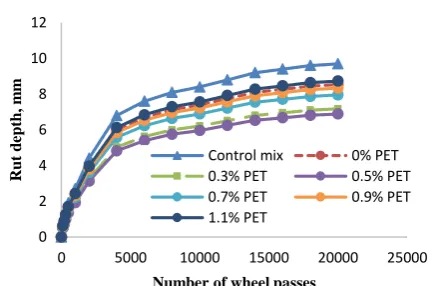
4. 3. Results of Rutting Tests This test was performed to investigate the effect of traffic loading on the serviceability of pavements in terms of capability to resist rutting. Figure 3 illustrates the results of this test for unmodified samples and those modified with different PET contents. The results showed that the rutting susceptibility of the modified samples was less than that of the control samples. The values of rut depth
after 20000 wheel passes for the samples modified by PET contents of 0.1, 0.3, 0.5, 0.7, 0.9 and 1.1% were 8.5, 7.2, 6.9, 8.0, 8.3 and 8.7 mm, respectively. These values were less than that of the control WMA which is 9.7 mm. The rut depth values in all samples were less than 20% of the samples’ thickness, which was acceptable in pavement technology [28]. However, rut depth values firstly decreased with an increase in PET content up to 0.5% and then increased with the further increase in PET contents. This behaviour could be attributed to the generation of a stiff mixture using a moderate PET content [24] and the decrease in its compressibility, as previously described. PET materials exhibited strain more than that exhibited by aggregates under equivalent stresses, but its value could be neglected as the strain value under a pressure of 730 kPa (wheel pressure) is not more than 0.0002, especially if PET particle size and content were considered; hence, a portion of strain was recoverable after unloading. PET had low transportability within the mixture due to the irregular shape of the particles and their surface texture and roughness, which reduced overall consolidability and, consequently, rutting. By contrast, aggregates had high transportability as a result of their relatively more regular shapes than those of PET particles, and they might degrade under wheel loading which caused rutting. Nevertheless, using excessive PET contents decreased stability and increased air voids, which increased rutting susceptibility. Mixtures with low rutting susceptibility typically exhibit low resistance to cracking [29], which causes them to be suitable for hot regions, but not for cold regions where cracking is probable [30]. The modified WMA (especially those modified with the optimum PET content), exhibited properties suitable even for cold regions, given the flow values were within the acceptable range. WMA is generally less susceptible to cracking than HMA because it has softer consistency than HMA [29].
Figure 3. Results of wheel track rut depth
0 2 4 6 8 10 12
0 5000 10000 15000 20000 25000
R
u
t
d
ep
th
,
m
m
Number of wheel passes
Control mix 0% PET
0.3% PET 0.5% PET
0.7% PET 0.9% PET
The modified WMA could be applied to cold regions with some adjustments, including increasing asphalt content and using soft asphalt cement initially. Precautions must be adopted when applying these adjustments to cover all the engineering properties required in the mixture.
5. DISCUSSION
The test results indicate that addition of PET to WMA improves engineering properties in terms of increased stability, stiffness and ITS values and decreased rutting susceptibility. PET content of 0.5% can be considered the optimum because it produces the highest stability and the lowest rutting susceptibility and fulfils the requirements of the other parameters. The role of optimum PET content can be abstracted in the following points. Firstly, the macro and micro roughness of PET surfaces increase the friction within the mixture. Secondly, partial melting of PET particles during the mixing and compaction stages increases the adhesion amongst aggregates with the aid of compaction efforts. Thirdly, PET particles absorb a small amount of asphalt, which leads to decrease in mixture softness as a result of the increase in friction and the decrease in lubrication. This justification is supported by the decrease in bulk specific gravity value as a result of the decrease in compressibility due to similar reasons. Fourthly, PET particles work as reinforcing fibres that resist tensile stresses. Fifthly, PET exhibits negligible strain under wheel pressure. However, PET particles exhibit low transportability due to their irregular shapes, which justifies the decrease in rutting under wheel passes. Improvement of the engineering properties of WMA can produce strong asphalt pavement layers, which reduces thickness with equivalent structural properties. This process can lead to a significant reduction in initial (construction) cost. In addition, improvement of the structural properties of asphalt pavement layers enhances their performance, increases their serviceability and decreases the maintenance cost. Therefore, this study recommends using PET waste material as an effective additive in WMA technology.
6. CONCLUSIONS
WMAs exhibit advantages over HMAs in terms of reducing mixing and compaction temperatures by decreasing predetermined related viscosities using additives. This technology decreases energy consumption, saves money and reduces the environmental pollution. However, more studies were conducted to improve the properties of HMAs than those explored the domain of WMAs, especially using
waste materials, such as PET waste. Therefore, the present study adopted a laboratory-oriented approach to investigate the effects of different contents of PET waste bottles on the engineering properties of WMAs. The results exhibited significant improvements in the engineering properties of modified mixtures in terms of increases in stability, stiffness, ITS and moisture damage resistance and decrease in rutting susceptibility under moist conditions without adverse effects on other properties. On the basis of these results, the present study recommends PET content of 0.5% by weight of aggregate as the optimum content. Using these waste materials decreases corresponding costs and supports sustainable construction.
7. REFERENCES
1. Bargegol, I., Gilani, V.N.M. and Jamshidpour, F., "Relationship between pedestrians’ speed, density and flow rate of crossings through urban intersections (case study: Rasht metropolis)",
International Journal of Engineering-Transactions C:
Aspects, Vol. 30, No. 12, (2017), 1814-1821.
2. Gandomi, M. and Hassanpour, H., "Behavioral analysis of traffic flow for an effective network traffic identification",
International Journal of Engineering-Transactions B:
Applications, Vol. 30, No. 11, (2017), 1740-1745.
3. Mosa, A.M., Taha, M.R., Ismail, A. and Rahmat, R.A.O.K., "A diagnostic expert system to overcome construction problems in rigid highway pavement", Journal of Civil Engineering and
Management, Vol. 19, No. 6, (2013), 846-861.
4. Mosa, A.M., Rahmat, R.A.O.K., Ismail, A. and Taha, M.R., "Expert system to control construction problems in flexible pavements", Computer-Aided Civil and Infrastructure
Engineering, Vol. 28, No. 4, (2013), 307-323.
5. Mosa, A.M., Atiq, R., Raihantaha, M. and Ismail, A., "A knowledge base system to control construction problems in rigid highway pavements", Australian Journal of Basic and Applied
Sciences, Vol. 5, No. 6, (2011), 1126-1136.
6. Mosa, A.M., Atiq, R., Raihantaha, M. and Ismail, A., "Classification of construction problems in rigid highway pavements", Australian Journal of Basic and Applied Sciences, Vol. 5, No. 3, (2011), 378-395.
7. Xiao-ping, B. and Wei-Hua, S., "Research on safety risk of dangerous chemicals road transportation based on dynamic fault tree and bayesian network hybrid method", International
Journal of Engineering-Transactions B: Applications, Vol.
30, No. 8, (2017), 1144-1151.
8. Hamzah, M. O., W. C. Von, and N. H. Abdullah. "Effects of compactor types on aggregate orientation of asphalt mixtures." International Journal of Engineering-Transactions
A: Basics, Vol. 26, No. 7 (2013): 677-684.
9. Reddy, V.S.G. and Rao, V.R., "Eco-friendly blocks by blended materials", International Journal of Engineering-Transactions
B: Applications, Vol. 30, No. 5, (2017), 636-642.
10. Mostari, M.S., Zaman, T., Sen, A. and Al Hassan, M.R., "Synthesis and characterization of porcelain body developed from rice husk ash", International Journal of
Engineering-Transactions A: Basics, Vol. 31, No. 1, (2018), 25-31.
Journal of Engineering-Transactions A: Basics, Vol. 30, No. 7, (2017), 1038-1047.
12. Sharma, S.K., Kumarb, P. and Roya, A.K., "Comparison of permeability and drying shrinkage of self compacting concrete admixed with wollastonite micro fiber and flyash",
International Journal of Engineering-Transactions B:
Applications, Vol. 30, No. 11, (2017), 1681-1690.
13. Mosa, A.M., Taher, A.H. and Al-Jaberi, L.A., "Improvement of poor subgrade soils using cement kiln dust", Case Studies in
Construction Materials, Vol. 7, No., (2017), 138-143.
14. Mosa, A.M., "Modification of hot mix asphalt using polyethylene therephthalate (pet) waste bottles", Journal of
Science and Technology, Vol. 18, No., (2017), 62-73.
15. Mosa, A.M., "Modification of subgrade properties using waste material", Vol., No., (2017).
16. Shafabakhsh, G. and Ahmadi, S., "Evaluation of coal waste ash and rice husk ash on properties of pervious concrete pavement",
International Journal of Engineering-Transactions B:
Applications, Vol. 29, No. 2, (2016), 192-201.
17. Ghasemi, M. and Marandi, S., "Laboratory studies of the effect of recycled glass powder additive on the properties of polymer modified asphalt binders", Vol., No., (2013).
18. Shahba, S., Ghasemi, M. and Marandi, S., "Effects of partial substitution of styrene-butadiene-styrene with granulated blast-furnace slag on the strength properties of porous asphalt",
International Journal of Engineering-Transactions A: Basics,
Vol. 30, No. 1, (2017), 40-47.
19. Choudhari, C.S. and Sapali, S.N., "Testing of environment friendly refrigerant r290 for water cooler application",
International Journal of Engineering-Transactions A: Basics,
Vol. 31, No. 1, (2018), 157-163.
20. Karimipour-Fard, P. and Beheshti, H., "Performance enhancement and environmental impact analysis of a solar chimney power plant: Twenty-four-hour simulation in climate condition of isfahan province, iran", International Journal of
Engineering-Transactions B: Applications, Vol. 30, No. 8,
(2017), 1260-1269.
21. Khalkhali, A. and Daghighi, S., "Optimum design of a coir fiber biocomposite tube reinforced with nano silica and nano clay powder", International Journal of Engineering-Transactions
C: Aspects, Vol. 30, No. 12, (2017), 1894-1902.
22. Syaichurrozi, I. and Jayanudin, J., "Effect of tofu waste water addition on the growth and carbohydrate-protein-lipid content of spirulina platensis", International Journal of
Engineering-Transactions B: Applications, Vol. 30, No.11,
(2017),1631-1638.
23. Rahmani, E., Dehestani, M., Beygi, M.H.A., Allahyari, H. and Nikbin, I.M., "On the mechanical properties of concrete containing waste pet particles", Construction and Building
Materials, Vol. 47, No., (2013), 1302-1308.
24. Ahmadinia, E., Zargar, M., Karim, M.R., Abdelaziz, M. and Ahmadinia, E., "Performance evaluation of utilization of waste polyethylene terephthalate (pet) in stone mastic asphalt",
Construction and Building Materials, Vol. 36, No., (2012),
984-989.
25. Ahmadinia, E., Zargar, M., Karim, M.R., Abdelaziz, M. and Shafigh, P., "Using waste plastic bottles as additive for stone mastic asphalt", Materials & Design, Vol. 32, No. 10, (2011), 4844-4849.
26. Baghaee Moghaddam, T., Karim, M.R. and Syammaun, T., "Dynamic properties of stone mastic asphalt mixtures containing waste plastic bottles", Construction and Building Materials, Vol. 34, No., (2012), 236-242.
27. Fallah Tafti, M., Khabiri, M.M. and Khani Sanij, H., "Experimental investigation of the effect of using different aggregate types on wma mixtures", International Journal of
Pavement Research and Technology, Vol. 9, No. 5, (2016),
376-386.
28. Khodaii, A., Kazemi Tehrani, H. and Haghshenas, H.F., "Hydrated lime effect on moisture susceptibility of warm mix asphalt", Construction and Building Materials, Vol. 36, No., (2012), 165-170.
29. Geng, L., Wang, X. and Xu, Q., "Thermal stress of asphalt pavement based on dynamic characteristics of asphalt mixtures",
International Journal of Pavement Research and Technology,
Vol. 9, No. 5, (2016), 363-367.
30. Biswas, S., Hashemian, L. and Bayat, A., "Investigation on seasonal variation of thermal-induced strain in flexible pavements based on field and laboratory measurements",
International Journal of Pavement Research and Technology,
Modification of the Properties of Warm Mix Asphalt Using Recycled
Plastic Bottles
TECHNICAL NOTE
A. M. Mosaa, I. T. Jawadb, L. A. Salema
a Civil Engineering Department, AL Mansour University College, Baghdad, Iraq
b Department of Civil Engineering, College of Engineering, University of Babylon, Hilla, Iraq
P A P E R I N F O
Paper history: Received 13 March 2018
Received in revised form 21 April 2018 Accepted 26 April 2018
Keywords:
Polyethylene Terephthalate Waste Marshall Properties
Rutting Susceptibility Warm Mix Asphalt
هديكچ
هژورپ رد رما نیا هک دیامنیم فرص ار یدایز یژرنا غاد تلافسآ طولخم اب ریذپفاطعنا یاهشکور تخاس یزاسهار یاه
و رثوم نیزگیاج کی دناوتیمطولخم تلافسآ شور اذل .تشاد دهاوخ ناهج تسیز طيحم و عبانم یور رب ییازسب ريثات
تروص رتنيیاپ ًاتبسن یامد اب تلافسآ ندرک طولخم و ديلوت ،غاد تلافسآ شورب تبسن شور نیا رد هک ارچ دشاب بولطم
و هنیزه رد ییوجهفرص ،یژرنا فرصم شهاک ثعاب )یژولونكت( شور نیا .دریذپیم تروص بسانم مکارت و هتفرگ
تلافسآ صاوخ دوبهب یارب دئاز داوم زا هدافتسا اب هارمه رگا طولخم تلافسآ شور .ددرگیم تسیز طيحم یگدولآ شهاک
روطب نيلاتفارتت نليتا یلپ تاعیاض .دیامن داجیا یزاسهار رد رادیاپ زاس و تخاس رد یبلاقنا دناوتیم دشاب طولخم
داوم زا هدافتسا صوصخرد یبسانم قيقحت نونکات هک تسا حيضوت هب مزلا .تسا هدش هتشابنا ناهج رسارس رد یاهدنیآزف
یلپ تاعیاض زا هدافتسا ،رضاح هعلاطم نیاربانب .تسا هتفریذپن تروص طولخم تلافسآ صاوخ دوبهب یاتسار رد زیر رود
یطولخم تلافسآ صاوخ دوبهب یسررب یارب .دهدیم ششوپ ار یطولخم تلافسآ صاوخ رييغت یارب نيلاتفارتت نليتا
دصرد 1/1 و 0/9 ،0/7 ،0/۵ ،0/3 ،0/1( فلتخم ینزو یاهدصرد اب رتمیليم 2/3 تارذ هزادنا رثکادح اب تاعیاض زا هدافتسا
رب فلتخم یاوتحم تارثا یسررب یارب یهاگشیامزآ یاهتست یدادعت لماش هعلاطم نیا .دیدرگ هدافتسا )دماج داوم ینزو
هدنهدناشن هدمآ تسد هب جیاتن .دوب شخرچ هب تيساسح شیامزآ و لاشرام شیامزآ لماش تاشیامزآ نیا هک دوب صاوخ
یبناج ضراوع نودب شخرچ تيساسح شهاک و یتخس و یرادیاپ شیازفا لماش یسدنهم صاوخ رد یهجوت لباق دوبهب