An Investigation into the Effect of Foreign
Language Learning on the Use of Taboo Words
in the Learners' First Language Discourse
Mohammad Saber Khaghaninejad
1Department of foreign languages and linguistics, Shiraz University, Iran
Alireza Ahmadi
Department of foreign languages and linguistics, Shiraz University, Iran
Tanaz Shegeft
M.A. graduate of TEFL, Shiraz University, Iran Abstract
This study investigated if learning a foreign language like English, French or Arabic was effective on the learners' use of first language (Persian) taboos in their daily written and spoken discourse. More than the possible effect of learning a foreign language, the gender of learners, the language they were learning and the semantic domain to which the employed taboos belonged were scrutinized. To this end, a control group (46 Iranians unfamiliar with foreign languages) and three experimental groups (advanced learners of English, French & Arabic) were selected randomly and recruited for a researcher-made questionnaire and a set of Persian speaking and formal/informal writing tasks. Participants believed that language learning affects L1 taboo words usage; this was attested in their oral and written productions. It was found that control participants and Arabic learners had the highest and the lowest rate of taboo words usage, respectively. Moreover, participants used more taboos in their written than spoken productions. The absolute forbidden words and neutral taboo words were the most common semantic domains for English/French and Arabic learners, respectively. Male participants used more taboos compared with females while English and Arabic learners had the highest and the lowest taboo usage rates, respectively.
Keywords: Advanced foreign language learners, First language discourse, Semantic domains, Taboo words
Received on February 1, 2019 Accepted on February 10, 2020
1. Introduction
Taboo words exist in all cultures and despite the censorship they will persist in the community's lexicon. Their usages are controlled by certain circumstances or reasons such as religion, culture or social norms. Taboos are considered as very important features of each society members because they can be used to make the members of the society distinct from other members in other societies. Considering taboos as the cause and motivation of emergence or destruction of language forms in many cases, Arlato (1972) argued that "language taboo can be considered as the avoidance of application of special words because of different social reasons" (p. 227). Similarly, Wardhaugh (1986) pointed out that taboo is considered as a reflection of a society’s disapproval towards a certain kind of behavior. The way people articulate language, what they say, and how they say something provide a window for others to evaluate their cultures, customs, beliefs, attitudes, education and social background.
Considering the fact that language and culture are interwoven, this study has tried to see if foreign language learning plays a role in the use of first language taboos. Moreover, gender effect has been focused and productive skills of speaking and writing have been compared in this regard. Further, the nature of the language and literature to which the learners have been familiarized was also of concern. This study has recruited the learners of three languages at the same time and has sought to answer the following questions:
1.What are the participants' attitudes towards using taboo words in the first language?
2. How does foreign language learning affect the learners' use of taboos on their first language speech?
3. How does foreign language learning affect the learners' use of taboos on their first language written productions?
4. How do the semantic domains of the used Persian taboo words differ in the spoken and written productions of the foreign language learners?
5. How does the gender of language learners affect their use of Persian taboo words?
6. How do advanced learners of English, French and Arabic language and literature differ in terms of using Persian taboo words as the result of the language they have learnt?
2. Literature Review
feeling of shame or provokes a sense of shock, and it is offending to the hearer's sensibilities or his beliefs" (p. 88).
Societies play a determining role in defining what is acceptable or not acceptable. In this regards, Akindele and Adegbite (1999) argued that taboo is one aspect of the social structure of that community. In fact, a taboo as a practice is reflected both in language and action. Taboos can include the social customs, religious and metaphysical beliefs and also the political system of a society. Humphries (1999) believed that peoples' reactions to particular taboo words can be change over time. For instance, some taboo words may lose their original force and acquire a more diminutive meaning or vice versa.
2.1 Factors Influencing Taboo Words Use
Lakoff (1975) considered gender as an important factor in using taboo words. According to Samadi (2014), "in most societies, women tend to use more polished words than men do" (p. 33). This ideology is prevalent in different societies: Women should act as femininely as possible. Based on this ideology, women should not use "vulgar language that is considered rough or crude" (Samadi, 2014, p. 33). Coates (1986) also argued that cultural or religious rules impose such restrictions on women. In fact, from the early times, it was accepted by the society members that women's language should be more polite than that of men.
that "the poor and those living in degraded housing conditions are more inclined to use taboo words due to their style of living" (p. 97). In fact, children learn the use of taboos from their parents.
The formality level of a situation is the other factor which influences the use of taboo words. In this regards, some scholars (Trudgill, 1983; Wardhaugh, 1986) defined the linguistic forms associated with formality of a situation as styles. They indicated that styles can be assumed as a continuum with scales ranging from formal to informal. Allan and Burridge (2006) argued that "the source of stylistic variations can be found in the connotative meaning of words which give rise to cross-varietal synonymy, that is, words with the same denotative meaning but different connotative meanings" (p.47). Therefore, "connotations attached to the words give rise to x-phemisms (euphemism, orthophemism & dysphemism) which in turn function as "stylistic indicators' in particular contexts of use" (p. 29).
2.2 Classification of Taboo words
Several scholars attempted to categorize the taboo words of different societies. For instance, Wardhaugh (1986) categorized taboo words and phrases into seven categories of 1) Copulative Terms, 2) Human Genitals Terms, 3) Sexual Irregularities Terms, 4) Excretory Terms, 5) Animal terms and 6) death. Allan and Burridge (2006) believed that taboos can be divided into several categories: 1) Liquids which secrete from body (such as sweat, snot, etc.). 2) Sexual organs and actions, urine and defecate actions. 3) Diseases, death and murdering. 4) The name of holy and supreme people and actions. 5) Collecting, saving and consuming food.
taboo words, the researchers indicated that in Pakistan, talking about face, ankle, breast or whatever is immodest is considered as a taboo.
One of the most known classifications of taboo words is presented by Qanbar (2011) that categorizes taboo words in Islamic countries. He divided taboo words into two broad categories of Context-specific and general. These two categories also branch out into other subcategories. Context-specific
category includes words which are "neutral words which get tabooed in particular contexts" (p. 91). 1) Nontaboo words are neutral in meaning in everyday speech. These words are not offensive by nature but become taboos in certain contexts when used as swear words. Religion has also played a role in tabooing these words, for example, the words such as (pig, dog, etc.) are neutral by nature but as these animals are associated with impurity and uncleanness in Islamic perspective they can become taboos in some contexts. 2) Words related to the hearer's physical or social defects: "like mentioning
divorce in front of a divorced woman, or blindness in front of a blind man" (Qanbar, 2011, p. 29).
The second main category, General taboos, is also divided into two categories of Unmentionable terms and mentionable with minimizers. Unmentionable terms are divided into the following subcategories: 1) Words or terms referring to the private organs of the human body and their functions, and body effluvia, 2) Words or terms referring to religion (blasphemy) or words against religious figures and symbols, 3) Words or terms referring to national or historical or the present political figures or political system, 4) The first names of one’s female members of the family mentioned in public or before an outsider and 5) Words referring to things that you give away to the poor and the needy, or friends on social occasions.
these fixed phrases minimizethe offensive effect of the taboo word and make it acceptable. Qanbar (2011) divided this category into three groups: 1) Words or phrases referring to unclean places or objects (For example: sewages, bathrooms, footwear, etc.), 2) Words or phrases referring to metaphysical things that go beyond the control of the human being (For example: supernatural creatures like jennies, ghosts; certain diseases, accidents resulting in deformation of human body like getting burned), 3) Words or phrases referring to the expressions of admiration for things or objects we admire and like (p. 95). Due to its recency, detailed descriptions and comprehensiveness and inclusion of Iran in the Islamic culture, Qanbar's (2011) conceptual classification of taboos has been employed for the determining the semantic domains of the used taboos by the participants of this study.
2.3 Taboo Words and Foreign Language Learning
The results of the studies on multilingualism and language acquisition revealed that taboo language is rarely included as part of the foreign language curriculum (Dewaele, 2004). However several scholars (e.g., Jay, 1992; Mercury, 1995) believed that some taboos such as cursing and/or swearing are an important part of our communicative repertoire as speakers of a language. On the contrary, there is "a prevailing attitude in many societies and cultures that taboo words are linguistically impoverished and even morally repugnant utterances, and should be avoided at all costs" (Horan, 2013, p. 284). Many scholars (e.g., Dewaele, 2004, 2010; Horan, 2011; Mugford, 2008) also identified the lack of reference to taboo words in formal education.
argued that verbal taboos include a limited number of categories such as sex and bodily functions, which are generally spread throughout different cultures. He also claimed that recent events in the media provide more freedom for Americans than before in terms of the use of taboo words. In fact, as the researcher indicated because of the freedom in using taboo words, shadings of euphemisms are hardly needed anymore to express words which have become part of everyday life.
Van Oudenhoven et al. (2008) investigated different taboos in eleven cultures. 3000 participants from Spain, Germany, France, Italy, Croatia, Poland, Great Britain, United States, Norway, Greece and Netherland constituted the sample of the study. The researchers asked the participants to write swear and taboo words they use in provocative situations. Based on the participants' notes, 12000 phrases were gathered. The researchers categorized the phrases into various groups and concluded that taboos vary greatly in different cultures and hearing taboo for some people lead to very intense reaction. These phrases should be of great concern for policy makers and curriculum developers of foreign language teaching and learning because indifference to them might destroy the whole process of language learning and establishing sound social interactions. The review of literature suggests that taboos are inseparable parts of a language. Even though research on taboos has flourished over the recent years, the role of learning foreign language on the use of first language taboo words has only recently been recognized as an area that needs significant empirical evidence to move the field forward and addresses the major gaps in this field.
3. Method
3.1 Participants
and Arabic at advanced levels; 46 Iranians, unfamiliar with foreign languages as the control and 138 foreign language learners (46 English learners, 46 French learners & 46 Arabic learners (23 males and 23 females in each group) as the experimental participants were chosen through convenience sampling procedure and recruited for the study. Experimental participants were selected from graduate students of English language departments of Shiraz university (N=49), Shiraz Islamic Azad university (N=9), Tehran University (N=36), Fordowsi University of Mashhad (N=12), Isfahan University (N=11) and some private language Institutes (N=21). The participants were informed about the study and their consents were gained. All were adults with the age range of 22 to 35 and native speakers of Persian from the more or less similar socio-economic background. Indeed, the researchers made an effort to consider a single stratum of the society to keep the socio-economic parameters constant for both the control and the experimental participants.
3.2 Instruments
The following instruments were employed to gather the required data: •Persian taboo words usage questionnaire_ To investigate the learners' use
five-points Likert scale items. To make sure about the reliability of the questionnaire, after the experts' validation, the researcher ran a Cronbach's alpha analysis through which the questionnaire's reliability (r = 0.91) was attested.
•Persian speaking task_To explore the first language taboo words used in learners' daily speech, a Persian speaking task was conducted. For conducting this speaking task, 15 participants of each group were selected randomly and were asked to talk about foreign language learning at school-time in ten minutes. The main rationale behind the selection of this topic was the assumption that all participants had the experience of learning English and Arabic at school time. The speaking tasks took place as face-to-face interviews held in classroom or at university campus, depending on the participants' preferences. Ethical issues were also considered by the researcher. To provide a natural context in which the participants feel free to use taboos, the researcher first tried to make friends with the interviewees and then guaranteed the anonymity of the gathered data. The participants' speech were recorded, transcribed and then codified. Intra-rater reliability coefficient was calculated to check its reliability (r=0.94).
3.3 Data Collection Procedure
was also assessed based on Qanbar's (2011) classification on both Persian speaking and writing tasks.
4. Results and Discussion
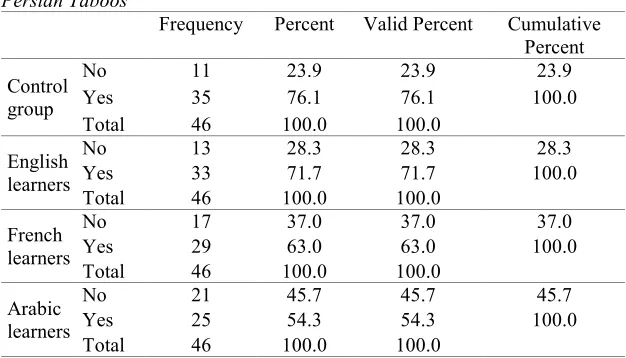
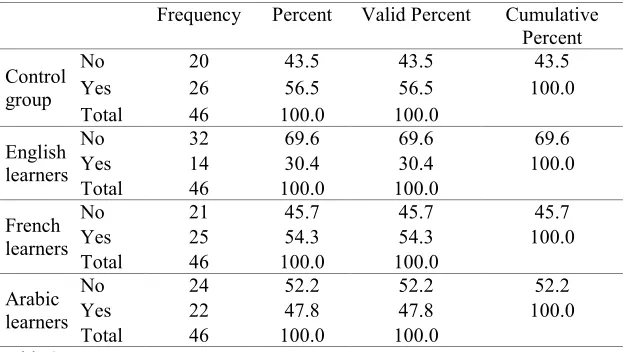
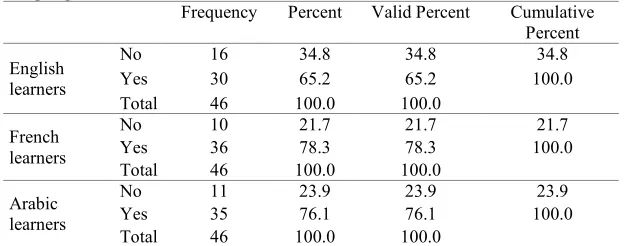
This section focuses on the statistical analyses carried out on the obtained data. The first research question aimed at determining the attitude of foreign language learners regarding the possible effect of learning a foreign language on the use of taboos in their first language. In order to achieve this, the participants answered a researcher-made questionnaire with five items which made the researcher able to compare the responses of the control and the experimental groups. The first item of the questionnaire asked whether the participants use taboo words in their Persian interactions. Tables 1 to 5 present the descriptive statistics of the participants responses regarding the use of Persian taboos in their daily conversations, their feelings when hearing Persian taboos, the reasons of using taboos (among three categories of anger, insult & better relations), selecting the most offensive category of taboos and the effect of learning a foreign language on Persian taboo words use, respectively. Table 1
Descriptive Statistics of the Participants’ Responses Regarding Using Persian Taboos
Frequency Percent Valid Percent Cumulative Percent Control
group
No 11 23.9 23.9 23.9
Yes 35 76.1 76.1 100.0
Total 46 100.0 100.0
English learners
No 13 28.3 28.3 28.3
Yes 33 71.7 71.7 100.0
Total 46 100.0 100.0
French learners
No 17 37.0 37.0 37.0
Yes 29 63.0 63.0 100.0
Total 46 100.0 100.0
Arabic learners
No 21 45.7 45.7 45.7
Yes 25 54.3 54.3 100.0
Table 2
Descriptive Statistics Regarding Participants’ Feelings about Hearing Persian Taboos
Frequency Percent Valid Percent Cumulative Percent Control
group
No 20 43.5 43.5 43.5
Yes 26 56.5 56.5 100.0
Total 46 100.0 100.0
English learners
No 32 69.6 69.6 69.6
Yes 14 30.4 30.4 100.0
Total 46 100.0 100.0
French learners
No 21 45.7 45.7 45.7
Yes 25 54.3 54.3 100.0
Total 46 100.0 100.0
Arabic learners
No 24 52.2 52.2 52.2
Yes 22 47.8 47.8 100.0
Total 46 100.0 100.0
Table 3
Participants' Responses Regarding the Reasons of Using Persian Taboos
Reasons Total
Anger Insult Relation
Language
Control
group 15 17 14 46
English
learners 11 13 22 46
French
learners 11 12 23 46
Arabic
learners 9 14 23 46
Total 46 56 82 184
Table 4
Participants' Responses Regarding the Most Offensive Category of Persian Taboos
Non-tabo o word s Words related to the hearer’s physical or social defects Unmention
able Mentionable with minimizers
al
Langu age
Control
group 9 22 7 8 46
English
learners 6 4 33 3 46
French
learners 5 5 34 2 46
Arabic
learners 3 9 34 0 46
Total 23 25 123 13 184
Table 5
Experimental Participants’ Views on the Effect of Learning a Foreign Language on Persian Taboos Use
Frequency Percent Valid Percent Cumulative
Percent English
learners
No 16 34.8 34.8 34.8
Yes 30 65.2 65.2 100.0
Total 46 100.0 100.0
French learners
No 10 21.7 21.7 21.7
Yes 36 78.3 78.3 100.0
Total 46 100.0 100.0
Arabic learners
No 11 23.9 23.9 23.9
Yes 35 76.1 76.1 100.0
Total 46 100.0 100.0
interactions. To ensure that the groups had statistically different frequencies, another Chi-square was run which showed that there was not any significant difference between the groups in terms of their feelings towards hearing taboo words in daily interactions (Asymp Sig.= 0.256). As suggested by Table 3, control participants ranked Insult (N=17) as the first reason of using taboos while, majority of the experimental participants considered the Type of the relationship with interlocutor as the main reason of using L1 taboos in their conversations. Another Chi-square indicated that there was not any significant difference between the groups in terms of ranking the reasons of using taboo words (Asymp Sig.= 0.496). Table 4 revealed that majority of the experimental participants considered the unmentionable taboo words as the most offensive category of L1 taboos while control participants knew words related to the hearer’s defects as the most offensive. Another Chi-square certified a significant difference between the groups in terms of selecting the most offensive taboo words (Asymp Sig.=.021). Table 5 showed that most participants of the experimental groups (English=65.2%, French=78.3%, and Arabic=76.1%) believed that foreign language learning can affect the use of taboos in first language. Another Chi-square revealed that there was not any significant difference between the learners of different foreign languages attitudes towards the effect of foreign language learning on using first language taboos (Asymp Sig.=0.732) meaning that foreign language learners unanimously believe that familiarity with a foreign language affects the use of the first language taboo words.
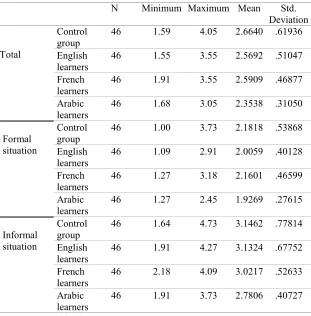
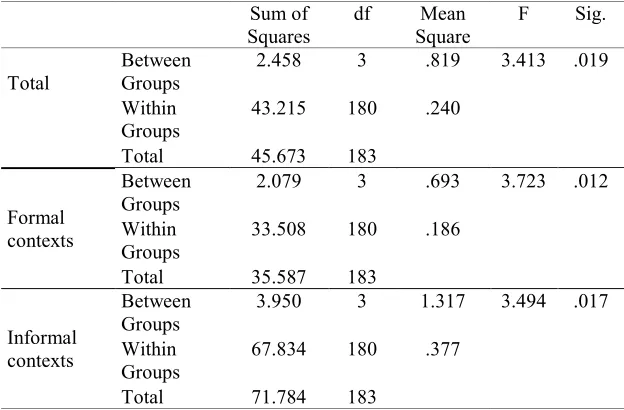
an ANOVA was employed. Tables 6 and 7 report the descriptive statistics of the participants' responses and the ANOVA analysis, respectively.
Table 6
Descriptive Statistics of the Participants' Responses Regarding the Use of Persian Taboos in Formal and Informal Interactions
N Minimum Maximum Mean Std. Deviation
Total
Control
group 46 1.59 4.05 2.6640 .61936
English
learners 46 1.55 3.55 2.5692 .51047 French
learners 46 1.91 3.55 2.5909 .46877 Arabic
learners 46 1.68 3.05 2.3538 .31050 Formal
situation
Control
group 46 1.00 3.73 2.1818 .53868
English
learners 46 1.09 2.91 2.0059 .40128 French
learners 46 1.27 3.18 2.1601 .46599 Arabic
learners 46 1.27 2.45 1.9269 .27615 Informal
situation
Control
group 46 1.64 4.73 3.1462 .77814
English
learners 46 1.91 4.27 3.1324 .67752 French
learners 46 2.18 4.09 3.0217 .52633 Arabic
Table 7
Comparing the Participants Regarding the Use of Persian Taboos in Formal and Informal Interactions
Sum of
Squares df Square Mean F Sig. Total Between Groups 2.458 3 .819 3.413 .019
Within
Groups 43.215 180 .240
Total 45.673 183
Formal contexts
Between
Groups 2.079 3 .693 3.723 .012
Within
Groups 33.508 180 .186
Total 35.587 183
Informal contexts
Between
Groups 3.950 3 1.317 3.494 .017
Within
Groups 67.834 180 .377
Total 71.784 183
As Table 7 depicts, there was a statistically significant difference between the groups in terms of using Persian taboos in their daily interactions (sig. = .019), formal contexts (sig.=.012), and informal contexts (sig. = .013). A Post hoc test showed that the control participants significantly used more taboo words in their daily conversations (sig.=.020), as well as in formal (sig.=.041), and informal contexts (sig.=.024) than the language learners.
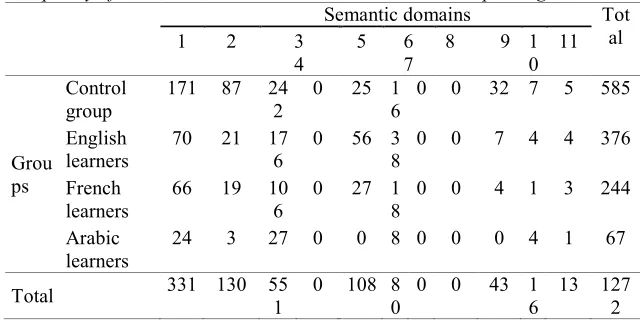
words or terms referring to the private organs of the human body and their functions, 5) words or terms referring to religion (blasphemy) or words against religious figures and symbols, 6) words or terms referring to national or historical or the present political figures or political systems, 7) words referring to the first name of one’s female members of the family mentioned in public or before an outsider, 8) words referring to things that people give away to the poor and the needy, or friends on social occasions, 9) words or phrase referring to unclean places or objects, 10) words or phrase referring to metaphysical things that go beyond the control of the human being, and 11) words or phrase referring to expressions of admiration for things or objects people admire or like. Tables 8 and 9 show the frequency and the participants' comparison, respectively.
Table 8
Frequency of Taboos in 11 Semantic Domains in Persian Speaking Task
Semantic domains Tot
al 1 2 3
4 5 6 7 8 9 10 11
Grou ps
Control
group 171 87 242 0 25 16 0 0 32 7 5 585 English
learners 70 21 176 0 56 38 0 0 7 4 4 376 French
learners 66 19 106 0 27 18 0 0 4 1 3 244 Arabic
needy, or friends on social occasions. In addition, the participants used the absolute forbidden words or terms more than the other semantic domains. Table 9
Comparing the Semantic Domains of the Used Taboos in the Persian Speaking Task Value df Asymp. Sig.
(2-sided)
Pearson Chi-Square 129.054a 21 .000
Likelihood Ratio 133.196 21 .000
Linear-by-Linear Association 2.180 1 .140
N of Valid Cases 1272
As it is discernible, there was a significant difference among the four groups in terms of using Persian taboos in speaking task (sig. =.000). Table 9 revealed that the participants of the control group (F=585) and Arabic learners (F=67) had the highest and the lowest frequency of taboo words usage in their speech, respectively. To answer the third research question, the frequencies of taboo words used by the participants in informal and formal contexts were compared in Persian writing task. Table 10 and 11 depict the frequencies of Persian taboos and their comparison report.
Table 10
Frequency of Taboos in 11 Semantic Domains in Formal Persian Writing Task
Semantic domains Total
1 2 3 4 5 6 7 8
9 10 11
Grou ps
Control
group 53 11 36 0 69 52 0 0 11 4 0 236
English
learners 51 7 28 0 24 49 0 0 9 0 3 171
French
learners 37 4 17 0 20 24 0 0 8 2 0 112
Arabic
learners 22 1 15 0 3 9 0 0 5 4 1 60
Total 163 23 96 0 116 134 0 0 33 10 4 579
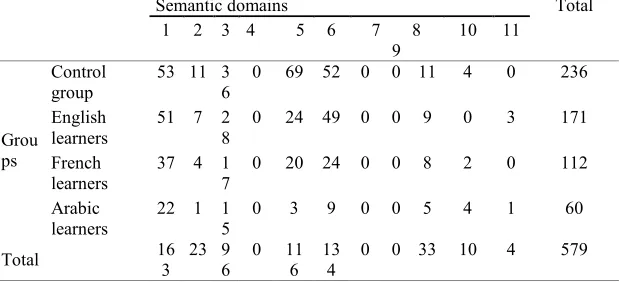
family mentioned in public or before an outsider, and words referring to things that people give away to the poor and the needy, or friends on social occasions. The control participants used the words referring to religion or words against religious figures or symbols more than the other taboo semantic domains, however, the foreign language learners used the nontaboo words which are neutral in meaning in everyday speech but become taboos in particular context more than the other domains in their formal writing tasks. Table 11
Comparing the Semantic Domains of the Used Taboos in the Persian Formal Writing Task
Value df Asymp. Sig. (2-sided)
Pearson Chi-Square 52.893b 21 .000
Likelihood Ratio 55.528 21 .000
Linear-by-Linear Association 1.057 1 .304
N of Valid Cases 579
According to the results, the difference among the frequencies of the taboo words used by the participants of different groups in their formal writing tasks was significant (sig.=.000) meaning that the control participants used more Persian taboo words in the formal writing tasks (F=236). The results also revealed that Arabic learners used the lowest frequency of the taboos in their formal writing tasks. Tables 12 and 13 depict the frequency and the mean comparison for the informal writing task, respectively.
Table 12
Frequency of Taboos in 11 Semantic Domains in Informal Persian Writing Task
Semantic domains Total
1 2 3 4 5 6 7 8 9 10 11
Groups Control
group 112 26 238 7 94 91 0 0 44 13 9 634 English
learners 95 20 215 9 67 84 0 0 71 13 7 581 French
learners 55 19 183 3 53 51 0 0 29 5 3 401 Arabic
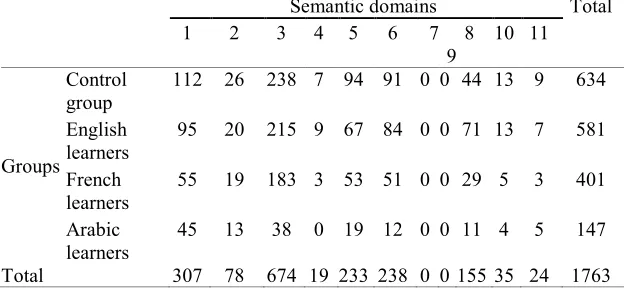
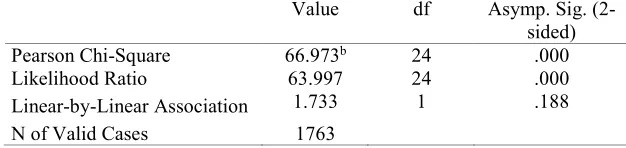
As presented by the Table 12, the participants did not use words referring to the first name of one's female members of the family mentioned in public or before an outsider and "words referring to things that you give away to the poor and the needy, or friends on social occasions. The results also revealed that the participants of the control group like the English and the French learners used the absolute forbidden words which are considered as the unmentionable words more than the other semantic domains. Arabic learners used the nontaboo words in their informal writing tasks more than other taboos.
Table 13
Comparing the Semantic Domains of the Used Taboos in the Persian Informal Writing Task
Value df Asymp. Sig. (2-sided)
Pearson Chi-Square 66.973b 24 .000
Likelihood Ratio 63.997 24 .000
Linear-by-Linear Association 1.733 1 .188
N of Valid Cases 1763
Table 14
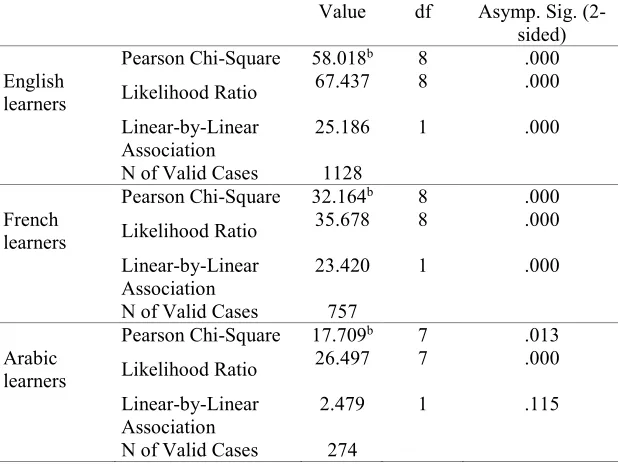
Comparing the Semantic Domains of Persian Taboos Used in Speaking and Writing Tasks by Learners of Different Languages
Value df Asymp. Sig. (2-sided) Pearson Chi-Square 58.018b 8 .000 English
learners Likelihood Ratio 67.437 8 .000 Linear-by-Linear
Association 25.186 1 .000
N of Valid Cases 1128
Pearson Chi-Square 32.164b 8 .000 French
learners Likelihood Ratio 35.678 8 .000 Linear-by-Linear
Association 23.420 1 .000
N of Valid Cases 757
Pearson Chi-Square 17.709b 7 .013 Arabic
learners Likelihood Ratio 26.497 7 .000 Linear-by-Linear
Association 2.479 1 .115
N of Valid Cases 274
context. To probe the effect of gender on language learners' use of Persian taboos another Chi-square was run. According to Table 15 there was a significant difference between males and females in using first language taboos in their verbal productions (sig.= .000). As discernible, the male language learners used more taboo words than the female learners.
Table 15
Persian Taboos Used by Male and Female Foreign Language Learners
Frequency Chi-square df Asymp.
Sig.
Males 2265 232.168a 1 .000
Females 1349
Total 3614
The last objective of the study was to determine if learners of English, French and Arabic literature differ in terms of using Persian taboos as the result of the language they learnt. To this end, the researcher compared the three foreign language learners' groups based on their performances on both speaking and writing tasks. As Table 16 suggests, this difference was statistically significant (sig.=.000); English learners significantly used more taboo words compared with the learners of French who in their own turns used more Persian taboos than Arabic learners.
Table 16
Persian Taboos Used by Learners of Different Languages
Frequency Chi-square df Asymp. Sig. English
learners 1128 509.609
a 2 .000
French
learners 757 Arabic
learners 247
Total 2159
4.1 Discussion
based on the language they were learning in this regard. Moreover, it was found that male foreign language learners used more taboos then their female peers. Participants used more taboos in their speech than the formal written tasks while the rate of using taboos in informal written tasks was the highest; the formality of the context lessened the rate of using taboos for foreign language learner however it was not the case for the control participants.
When it comes to possible explanations and speculations, it can be argued that monolingual and bilingual people experience different emotional intensity when hearing or using their first language taboo words. As Dewaele (2004) argued, "bilingual speakers report usually experiencing greater emotional intensity when using swear words or taboo words in their first (or dominant) language compared to their second language" (p. 87). The results are also in line with Ayçiçegi and Harris (2004) who indicated that "second language users commonly acknowledge that obscene and taboo words generate less anxiety when pronounced in a foreign language" (p. 3). In other words, Ayçiçegi and Harris (2004) believed that first language taboo words evoke greater emotional arousal than their second language counterparts. Therefore, the emotional factors may prevent foreign language learners from using first language taboo words.
which revealed that males used more taboo words in their conversations than females. Moreover, Gao (2013) indicated "women are more polite, indirect and collaborative in conversation, while men are more direct and competitive" (p. 11). Jay (1999) also believed that "women are more expected to exhibit control over their thoughts, while men are more free to exhibit hostile and aggressive speech habits" (p. 181).
The researchers also compared advanced learners of English, French and Arabic literature differ in terms of using Persian taboos. English and Arabic learners had the highest and the lowest rate of Persian taboo words usage in their speaking and writing than the Arabic learners, respectively. This may suggest that familiarity with different languages and consequently literatures may bring about different attitudes towards L1 usage in general and L1 taboos in particular.
5. Conclusion
demonstrated that English learners significantly used more Persian taboo words than the other two groups of language learners. In other words, it seems that Arabic language and literature has made its learners more polite in their daily L1 interactions; this may be rooted in the religious functions of this language. In fact, this study indicated that foreign language learning can have conscious and unconscious effects on the discourse of the first language speaking and writing.
Although the research has reached its aims, there were unavoidable limitations in its conduction. For instance, although the sample was fairly large, it may not be fully representative of all Iranian language learners and this may restrict the generalizability of the findings. Therefore, the findings need to be interpreted with caution and should be further explored in more representative samples.
References
Akindele, F., & Adegbite, W. (1999). The sociology and politics of English in Nigeria. Ile-Ife: Obafemi Awolowo University Press.
Allen, K., & Burridge, K. (2006). Forbidden words: Taboo and the censoring of language. Cambridge: Cambridge University Press.
Arlato, A. (1972). Introduction to historical linguistics. Houghton: Mifflin. Asefi, N. (2015). Bilinguals' reaction to taboos: A case study on Persian
speaking Azari natives. International Journal of English Language Literature and Humanities, 3, 1-12.
Ayçiçegi, A. & Harris, C. L. (2004). Bilinguals' recall and recognition of emotion words. Cognition and Emotion, 18, 977–987.
Coates, J. (1986). Women, men and language. Harlow, Essex: Longman. Dewaele, J. M. (2004). The emotional force of swearwords and taboo words
in the speech of multilinguals. Journal of Multilingual and Multicultural Development, 25, 204-222.
Dewaele, J. M. (2010). Emotions in multiple languages. Houndmills: Palgrave McMillan.
Gao, Ch. (2013). A sociolinguistic study of English taboo language. Theory and Practice in Language Studies, 3(12), 2310-2314.
Horan, G. (2011). What does the Schimpfworuter tell us about the role of swearing in modern German? German as a Foreign Language, 1, 14-39. Horan, G. (2013). You taught me language; and I know how to curse:
Cursing and swearing in foreign language learning. Language and Intercultural Communication, 13(3), 283-297.
Humphries, L. A. (1999). The way of the heavenly sword. California: Stanford University Press.
Jay, T. (1992). Cursing in America: A pschycolinguistic study of dirty language in the courts, in the movies, in the schoolyard, and on the streets. Amsterdam: John Benjamins.
Jay, T. (1999). Why we curse. Philadelphia: John Benjamins.
Lakoff, R. (1975). Language and woman's place. New York: Harper and Row.
Mercury, R. E. (1995). Swearing: A bad part of language; a good part of language learning. TESL Canada Journal, 13(1), 28-36.
Mugford, G. (2008). How rude! Teaching impoliteness in the second-language classroom. ELT Journal, 62(4), 375-384.
Qanbar, N. (2011). A sociolinguistic study of the linguistic taboos in the Yemeni society. Modern Journal of Applied Linguistics, 3(2), 86-104. Samadi, Z. (2014). Macro and micro contextual taboo words in Iranian pre
and post revolution movies. Unpublished master's thesis, University of Malaya, Kualalumper.
Seifried, B. (2006). Taboo: Cultural phenomenon headed for extinction?
Unpublished M.A. thesis, Georgia State University, Sociolinguistics. Trudgill, P. (1972). Sex, covert prestige, and linguistic change in the urban
British English of Norwich. Language in Society, 1, 79-95.
Trudgill, P. (1983). Sociolinguistics: An introduction to language and society. England: Penguin Books.
Van Oudenhoven, J. P., de Raad, B., Askevis-Leherpeux, F., Boski, P.,
Brunborg, G. S., Carmona, C., Barelds, D., Hill, Ch. T., Mlačić, B., &
Motti, F. (2008). Terms of abuse as expression and reinforcement of cultures. International Journal of Intercultural Relations, 32, 74-85. Wardhaugh, R. (1986). An introduction to sociolinguistics. New York: