AUT J. Civil Eng., 1(1) (2017) 23-30 DOI: 10.22060/ceej.2017.12240.5156
The Laboratory Study of the Effect of Using Liquid Anti-Stripping Materials on
Reducing Moisture Damage of HMA
GH. H. Hamedi*
Faculty of Engineering, University of Guilan, Rasht, Iran
ABSTRACT: Liquid anti-stripping materials are the most popular materials used to improve moisture resistance of hot mix asphalt (HMA). In this study, the effect of two types of liquid anti-stripping materials (Wetfix N422 and Wetfix 312) with different percentages on the moisture susceptibility of HMA have been studied. HMA specimens with three types of aggregates (limestone, granite and quartzite) and two types of liquid anti-stripping materials are used in different percentages that are studied by modified Lottman test. In order to evaluate the effect of additive more accurately, 1, 3 and 5 freeze-thaw cycles are applied to the specimens. The results of this study indicate that the impact of additives used leads to the increased proportion of indirect tensile strength (ITS) in dry and wet conditions of HMA. The results of this study indicate that the additives used in this study increase tensile strength ratio (TSR) and the asphalt mixes’ resistance against moisture damage. In this study, the effect of anti-stripping additives in specimens under the wet conditions is more evident at higher freeze-thaw cycles compared to control specimens. In addition, the results show that the specimens prepared with limestone aggregate and Wetfix 312 additives have the highest TSR values.
Review History:
Received: 10 December 2016
Revised: 16 January 2017 Accepted: 24 April 2017 Available Online: 26 April 2017
Keywords:
Hot mix asphalt Moisture damage
Liquid anti-stripping additives
Modified Lottman test
Tensile strength ratio
1- Introduction
In recent years, one of the concerns for researchers has been the reduced lifespan of the asphalt pavements. Moisture induced damage is one of the most complex types of failure in HMA because this type of failure can be in different forms such as rutting, potholes, and different types of cracking. The moisture entered from the surface or the underlying layers of asphalt pavement causes the detachment of aggregates or asphalt smoothness through the emulation process. The result of moisture induced damage is usually called stripping because the asphalt binder is separated from the aggregates and aggregates remain without coverage [1].
There are two methods to improve adhesion and reduce moisture sensitivity in asphalt mixes. The first method suggests covering the surface with aggregates or an appropriate material to reverse the charge in the aggregate and reduce the surface free energy of the aggregates. The second method, somehow, is to change the surface energy to convert the asphalt binder charge into the reverse charge of the aggregate surface. For this purpose, the liquid anti-stripping additives to the asphalt are usually applied. There is a wide range of anti-stripping additives that can be used as a modifier of the asphalt or when mixing the asphalt binder and aggregate into the mixing vessel [2-4]. There are a wide range of chemicals to reduce the moisture induced damage that the most important of which include alkyl amines. These chemical materials are usually called the liquid anti-stripping materials [5]. There are many tests to evaluate the moisture sensitivity of asphalt mix. These tests are usually divided into two general categories: 1) tests that are performed on uncondensed
asphalt mixes, 2) tests that are performed on compacted asphalt mixes. Tests that performed on uncondensed asphalt mixes have advantages such as easiness, fastness and lack of need for specific laboratory equipment. Of course, these tests suffer from defects such as the need for experienced people’s detection and the lack of discussing the characteristics of the pavement engineer. The most common tests include boiling, modified Lottman (AASHTO T283), static immersion, and Root-Tunnicliff tests [4, 6]. Extensive studies are conducted by Lottman and then by Root-Tunnicliff whose study results are finally presented as AASHTO T283 and AStM D4867 standards [7-9]. At present, the most commonly used method is AASHTO T283 test which is applied in the present study. Given that there are large areas that have a high average of rainfall in the country and there is less access to moisture resistant materials, this study is conducted to provide asphalt mix resistant to moisture induced damage to reduce maintenance costs and increase the useful life of the pavement structure. Two types of anti-stripping materials are applied in this study as the asphalt modifier. One of the available concerns is that the long-term performance of anti-stripping additives has not been investigated. Hence, for more detailed analysis of the results and the effect of using these materials 1, 3 and 5 freeze-thaw cycles are applied in AASHTO T283 test.
1- 1- Literature review
warm asphalt mix is 1-2 % by weight of the aggregates [10-12]. It is observed that this polymer can improve the engineering features of asphalt mixes such as permanent deformation and moisture induced damage [13]. Hamedi [14] has investigated the role of polymer coating of the surface of aggregates in reducing moisture damage of asphalt mixtures by applying the SFE method and dynamic modulus. In this research, they have applied the measurement of SFE of the asphalt binder and aggregates to determine free energy cohesion of the asphalt binder and free energy adhesion of asphalt binder and aggregates. In another study, Arabani and Hamedi [15] have evaluated an index to determine the moisture sensitivity based on the method of SFE and repetitive loading. In this study, the amount of surface of the aggregates which is imposed on stripping has been applied as an index to evaluate the compatibility between asphalt binder and aggregates in terms of strength against moisture sensitivity. The results show that applying anti-stripping additives has caused increasing SFE in the asphalt binder and has given rise to a decrease in the stripping of the asphalt binder on the surface of aggregates in the presence of water.
Since the area under study and extensive areas of our country have wet weather conditions and since the vast majority of construction capitals are spent on development and overlay of asphalt mix, providing solutions to increase the life of asphalt pavements in the country can be a great help to maintain the national capital.
2- Materials
2- 1- Aggregate and asphalt binder
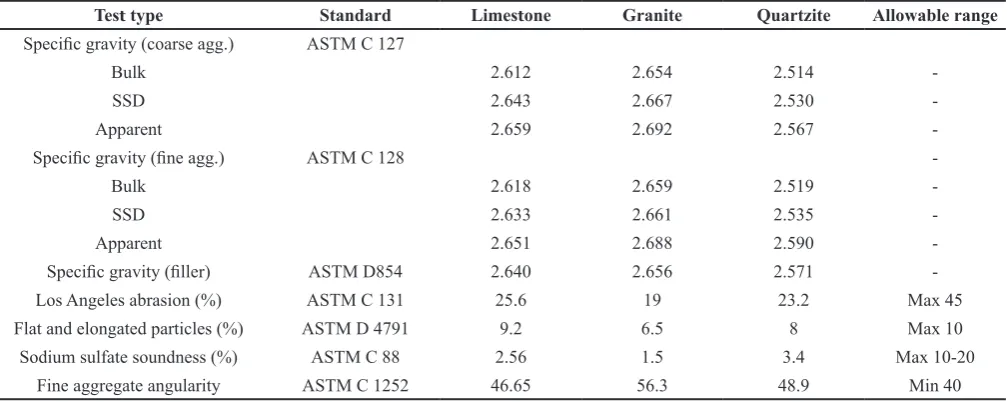
Three types of aggregates are examined in this study. Two types of aggregates (Limestone and granite) indicate a considerable variety of different minerals and the potential of stripping in them. The chemical compositions of these aggregates are given in Table 1. The physical properties of the two types of aggregates are shown in Table 2. The gradation of these aggregates (medium grading standard of AStM for dense gradation of the aggregates) is presented in Table 3. Asphalt binder with penetration grade of 60-70 is applied. Engineering properties of the asphalt binder are presented in Table 4.
2- 2- Additives
Wetfix N422 and Wetfix 312 are the anti-stripping materials with thermal stability used to improve the adhesion between asphalt binder and the aggregates. Thermal stability of these materials increases the possibility of keeping them in the tanks for a long time. The percentage of using liquid anti-stripping materials is about 1 to 8% by weight of asphalt that the values of 2, 4 and 6% are studied. These materials are provided by the Swedish AkzoNobel chemical company. The characteristics of these materials are provided in Table 5.
3- Tests
3- 1- Mix design method
Asphalt mix design used in this study is done by Marshal Method with 75 blows on the cylindrical specimens. Marshall
Table 1. Chemical composition of the aggregates
Aggregate type Limestone Granite Quartzite
pH 8.8 7.1 6.4
Silicon dioxide, SiO2 (%) 3.8 68.1 74
R2O3 (Al2O3+Fe2O3) (%) 18 16.2 18.1
Aluminum oxide, Al2O3 (%) 1 14.8 10.6
Ferric oxide, Fe2O3 (%) 0.4 1.4 7.5
Magnesium oxide, MgO (%) 1.2 0.8 1.5
Calcium oxide, CaO (%) 51.3 2.4 0.6
Test type Standard Limestone Granite Quartzite Allowable range
Specific gravity (coarse agg.) ASTM C 127
Bulk 2.612 2.654 2.514
-SSD 2.643 2.667 2.530
-Apparent 2.659 2.692 2.567
-Specific gravity (fine agg.) ASTM C 128
-Bulk 2.618 2.659 2.519
-SSD 2.633 2.661 2.535
-Apparent 2.651 2.688 2.590
-Specific gravity (filler) ASTM D854 2.640 2.656 2.571
-Los Angeles abrasion (%) ASTM C 131 25.6 19 23.2 Max 45
Flat and elongated particles (%) ASTM D 4791 9.2 6.5 8 Max 10
Sodium sulfate soundness (%) ASTM C 88 2.56 1.5 3.4 Max 10-20
Fine aggregate angularity ASTM C 1252 46.65 56.3 48.9 Min 40
specimens are designed by mix design method AStM D1559 and used. The optimum asphalt binder is obtained for the control specimens made of limestone, granite, and quartzite and this optimum asphalt binder is used for the specimens, including the anti-stripping additives. The optimum asphalt binder for the made of limestone, granite, and quartzite is obtained as 5.6, 5.1 and 5.4%, respectively.
In this study, the specimens are divided into two groups: 1) control specimens (with aggregates and pure asphalt binder) and 2) modified specimens in which 2, 4 and 6% Wetfix N422 and Wetfix 312 are used and presented as N6, N4, N2 and 312-2, 312-4, 312-6, respectively.
3- 2- AASHTO T283 test method
AASHTO T283 is a test method that can be used to analyze the effects of anti-stripping material. The sufficient materials to produce at least six specimens of HMA within the specified asphalt binder identified in the previous section are mixed together. More specimens are required when one of the specimens is damaged or the maximum weight of the specimens is not specified. Before performing the main test, some tests are needed to carry out to find the number of blows required to reach the air void 7±1%. The percentage of the air void is determined in accordance with AASHTO T269 standard. When the number of blows is specified and the specimens are compacted, the specimens are divided into two groups that are subject to dry and wet conditions. Then, the specimens that should be subject to wet conditions are put in vacuum conditions to reach the saturation level of 55-80%.
The saturated specimens are kept in the fridge for 16 h at -18 °C and then kept at 60 °C for 24 h. The remaining specimens are kept in dry conditions. All specimens are brought to the laboratory under the same temperature of 25 °C and ITS test is conducted on them. The test method and loading are presented in Figure 1. The loading rate in this test is 2 inches per minute (50.8 mm per minute). ITS of all six samples is obtained through the following equation and the mean ITS of the dry and wet samples is calculated.
2F
ITS= t dπ (1)
In this equation, ITS is ITS (kPa), F is fracture load (kN), t is the thickness of the asphalt sample (m), and d is asphalt sample diameter (m). Tensile strength ratio (TSR) is obtained from the following relation:
100 wet
dry
ITS
TSR= ITS ×
(2)
In this equation, TSR is indirect tensile strength ratio (%), ITSwet is mean values of ITS of the wet samples and ITSdry is the mean value of ITS of the dry samples.
In this study, to clearly investigate the effect of additives 1, 3 and 5 freeze-thaw cycles were applied to specimens in the AASHTO T283 test.
4- Results
The results of ITS of specimens in different freeze–thaw cycles are presented in Figures 1, 2 and 3. Reduction in ITS of specimens by increasing the freeze–thaw cycles can be related to the loss of adhesion of the mix or the continuity
Sieve (mm) 19 12.5 4.75 2.36 0.3 0.075 0.177 0.075
High-low range 100 90-100 44-74 28-58 5.21 2-10 7-18 4-10
Passing percent 100 88 75 56 40 20 9 6
Table 3. Gradation of the aggregates used in the study
Test Standard Result
Penetration (100 g, 5 s, 25 ºC), 0.1 mm ASTM D5-73 64
Penetration (200 g, 60 s, 4 ºC), 0.1 mm ASTM D5-73 23
Penetration ratio ASTM D5-73 0.36
Ductility (25 ºC, 5 cm/min), cm ASTM D113-79 112
Solubility in trichloroethylene, % ASTM D2042-76 98.9
Softening point, ºC ASTM D36-76 51
Flash point, ºC ASTM D92-78 262
Loss of heating, % ASTM D1754-78 0.75
Properties of the RTFO Residue
Penetration (100 g, 5 s, 25 ºC), 0.1 mm ASTM D5-73 60
Specific gravity at 25 ºC, g/cm3 ASTM D70-76 1.020
Table 4. Results of the experiments conducted on 60-70 penetration asphalt binder
Characteristics Wetfix N422 Wetfix 312
Appearance Brown liquid Dark crown liquid
Density at 27 °C, kg/m³ 950 960
Flash point °C 160≤ 200≤
viscosity, cP (10 °C) 2250 660
viscosity, cP (20 °C) 300 1500
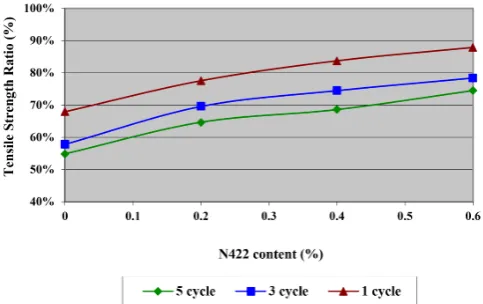
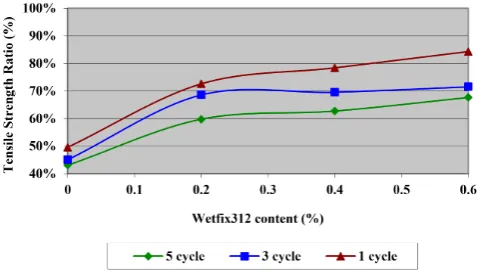
of the asphalt binder. It can be concluded from the Figures 2, 3 and 4 that adding anti-stripping materials increase the adhesion and continuity in the mix and do not allow fast separation of asphalt binder on the aggregates and this causes the mixes to have a higher strength than that of the specimens without additives after the freeze–thaw cycles. Figures 5-10 indicate TSR values for various asphalt mixtures used in this study. It is clear that by increasing the number of freeze– thaw cycles, TSR rate is reduced. The specimens made with limestone and Wetfix 312 have the highest TSR value (98%) in the first cycle which reaches 17% at the end of the fifth cycle.
4- 1- The effect of aggregate types
The chemical properties of aggregate affect the moisture sensitivity in asphalt mixes. The chemical composition of all types of aggregates used in this test is presented in
Table 1. This Table shows that limestone mainly includes CaO while granite and quartzite are mainly composed of SiO2 and Al2O3. The classification of the aggregates is that the limestone aggregates are hydrophobic and granite and quartzite aggregates are mainly considered hydrophilic. By using Figures 4-9, it can be understood that limestone provides more resistant mixes against moisture.
4- 2- The effect of additive types
Figures 1 to 3 show clearly ITS of dry specimens is higher than the wet condition specimens which indicate the moisture induced damage. This reduction is more observed in the
Fig. 1. Test method and loading in ITS test
Fig. 2. The relationship between ITS and the type and
percentage of additives in different freeze–thaw cycles (granite
aggregate)
Fig. 3. The relationship between ITS and the type and
percentage of additives in different freeze–thaw cycles (limestone aggregate)
Fig. 4. The relationship between ITS and the type and
percentage of additives in different freeze–thaw cycles (quartzite aggregate)
Fig. 5. The effect of freeze–thaw cycles and N422 percentage on the TSR (granite aggregates)
control specimens than the modified specimens. Different additives have different effects on the performance of asphalt mix. The results of adding N422 and Wetfix 312 show that adding these materials have positive effects on TSR. Adding 2% of these materials have led to a significant increase in TSR value. However, this increase by adding 4% is not as significant as adding 2% additives. In fact, the slope of TSR Figure in 0-2% is more than 2-4% of the additive. In addition, the difference in the specimens containing 4-6% of Wetfix 312 is negative which means that increasing the additive from 4 to 6% has not led to an increase in TSR that means that adding more than 4% Wetfix 312 is irrational.
4- 3- The effect of freeze–thaw cycles
For a closer evaluation of the additives used in this study on the resistance to moisture induced damage to asphalt mixes 1, 3 and 5 freeze–thaw cycles are applied on the specimens based on AASHTO T283. It can be seen that a reduction in modified ITS of the mixes modified by additives is not as high as the control mixes. Reduction in TSR values in the specimens containing Wetfix 312 in cycles 1 to 3 is larger than the reduction in TSR values of cycles 3 to 5. This trend was reversed in the specimens containing Wetfix N422. In general, specimens containing Wetfix 312 in cycles 1 to 5 present a lower reduction in TSR values. The specimens prepared with Limestone show the lowest changes in the amount of TSR in cycles 1 to 5.
4- 4- Comparison with other studies
A number of researchers have studied the effectiveness of anti-stripping agents on the adhesion of asphalt to different types of rock surfaces. Dybalski [17] explained the role of cationic surfactants in asphalt adhesion. Two major types of surfactants are used as anti-stripping agents: fatty diamine/ fatty acid salt and fatty amido-diamine/fatty acid salt. The adhesion of asphalt to aggregate was improved by Hellsten et al. [18] by the addition of alkyloxyalkyleneamines and alkanolamines. Gilmore and Kugele [19] prepared adhesion promoting additives for asphalt for formaldehyde condensation with polyamines. Formaldehyde adducts with amines, polyamines, and amides to yield the additives. Other studies have shown that comparatively between the HL and liquid anti-stripping materials, HL has had a similar performance in reducing moisture induced damage but due to the ease of using liquid anti-stripping materials and their low cost, they are usually used in different areas. Among the polymers styrene–butadiene–styrene are the most common applied polymer [20, 21]. In another study, Khodaii et al. [22] have examined the effect of a material named Zycosoil on moisture sensitivity in asphalt mixtures. The material has turned the Silanol surface of acidic aggregate to Siloxane surface and decreased moisture sensitivity of the asphalt mixture under cyclic loading. The results of the SFE method have shown that the use of this coating reduces the acidic properties of aggregate and asphalt binder and improves aggregate adhesion.
4- 5- Economic analysis
The MEPDG designs have recommended the required thickness of the asphalt layer for the un-treated and treated
Fig. 7. The effect of freeze–thaw cycles and N422 percentage on the TSR (quartzite aggregates)
Fig. 8. The effect of freeze–thaw cycles and wefix312 percentage on the TSR (granite aggregates)
Fig. 9. The effect of freeze–thaw cycles and wefix312 percentage on the TSR (limestone aggregates)
pavements for a constant design life of 20 years. This converts the change in initial construction costs into equivalent life cycle costs. The following figures were used in the cost analysis:
• Unit cost of un-treated asphalt mix: US$32.5/ton of mix • Unit cost of liquid-treated asphalt mix: US$32.75/ton of
mix
• Unit cost of lime-treated asphalt mix: US$34.2/ton of mix
The above unit costs are based on the cost of asphalt binder of US$325 per ton at the hot mix plant and the cost of the aggregate of US$7.5 per ton at the hot mix plant. The unit cost of the liquid-treated asphalt mix was calculated based on the cost of the liquid additive of US$0.35/ton of the mix without any additional cost for the production of the liquid-treated asphalt mix. The unit cost of the lime-treated asphalt mix was calculated based on the cost of lime of US$0.625/ ton of mix and the additional costs of plant modifications and equipment of US$1.875/ton of the mix.
5- Conclusion
The most important purpose of this study was to evaluate the effect of anti-stripping additives on reducing the moisture induced damage of the asphalt mixes. The following results are the summary of the conclusions regarding this purpose. • The effect of the use of liquid anti-stripping in reducing
the moisture sensitivity of asphalt mixes depends on the asphalt binder and aggregates as well as the type and percentage of the additive.
• Asphalt specimens made by limestone aggregate and Wetfix 312 have the highest resistance to moisture induced damage.
• The test conducted on multiple freeze–thaw cycles indicated that the specimens modified with anti- stripping additives have a significant higher resistance against moisture induced damage than the control specimens. • The study of tensile strength characteristics of the
specimens indicates that Wetfix 312 improves the ITS of the mixes made with Limestone in both dry and wet conditions.
• Both types of additives improved moisture sensitivity of the asphalt mixes but the specimens made by Wetfix 312 had a superior performance in reducing moisture induced damage than Wetfix N422.
References
[1] R. Hicks, L. Santucci, T. Aschenbrener, Moisture sensitivity of asphalt pavements: a national seminar, San Diego, California: Transportation Research Board, (2003).
[2] G.H. Hamedi, F. Moghadas Nejad, Evaluating the Effect of Mix Design and Thermodynamic Parameters on Moisture Sensitivity of Hot Mix Asphalt, Journal of Materials in Civil Engineering, 29(2) (2016) 04016207. [3] G.H. Hamedi, Evaluating the effect of asphalt binder
modification using nanomaterials on the moisture damage of hot mix asphalt, Road Materials and Pavement Design, (2016) 1-20.
[4] M. Solaimanian, J. Harvey, M. Tahmoressi, V. Tandon, Test methods to predict moisture sensitivity of hot-mix asphalt pavements, in: Moisture Sensitivity of Asphalt Pavements-A National Seminar, 2003.
[5] M. Arabani, G.H. Hamedi, Using the surface free energy method to evaluate the effects of liquid antistrip additives on moisture sensitivity in hot mix asphalt, International Journal of Pavement Engineering, 15(1) (2014) 66-78. [6] M. Solaimanian, R.F. Bonaquist, V. Tandon, Improved
conditioning and testing procedures for HMA moisture susceptibility, Transportation Research Board, 2007. [7] J.A. Epps, Compatibility of a test for moisture-induced
damage with superpave volumetric mix design, Transportation Research Board, 2000.
[8] M.S. Buchanan, V.M. Moore, Laboratory accelerated stripping simulator for hot mix asphalt, 2005.
[9] B. Birgisson, R. Roque, G.C. Page, Evaluation of water damage using hot mix asphalt fracture mechanics (with discussion), Journal of the association of asphalt paving technologists, 72 (2003).
[10] R. Roque, B. Birgisson, C. Drakos, G. Sholar, Guidelines for use of modified binders, 2005.
[11] S. Hesami, H. Roshani, G.H. Hamedi, A. Azarhoosh, Evaluate the mechanism of the effect of hydrated lime on moisture damage of warm mix asphalt, Construction and Building Materials, 47 (2013) 935-941.
[12] L.N. Mohammad, S. Cooper Jr, A. Raghavendra, Evaluation of Superpave Mixtures Containing Hydrated Lime, 2013.
[13] S. Tayfur, H. Ozen, A. Aksoy, Investigation of rutting performance of asphalt mixtures containing polymer modifiers, Construction and Building Materials, 21(2) (2007) 328-337.
[14] G.H. Hamedi, Moisture Damage of Asphalt Mixture Modeling Based on Surface Free Energy, Amirkabir Universit of Engineering, 2015.
[15] M. Arabani, G.H. Hamedi, Using the surface free energy method to evaluate the effects of polymeric aggregate treatment on moisture damage in hot-mix asphalt, Journal of Materials in Civil Engineering, 23(6) (2010) 802-811.
[16] G.M. Elphingstone, Adhesion and Cohesion in Asphalt-Aggregate Systems, Texas A&M University, 1997. [17] J.N. Dybalski, Cationic surfactants in asphalt adhesion,
in: Association of Asphalt Paving Technologists Proceedings, 1982.
[18] M.E. Hellsten, A.W. Klingberg, S.E. Svennberg, Asphalt compositions having improved adhesion to aggregate, in, Google Patents, 1975.
[19] D.W. Gilmore, T.G. Kugele, Asphalt-adhesion improving additives prepared by formaldehyde condensation with polyamines, in, Google Patents, 1987.
[20] G. Jones, The effect of hydrated lime on asphalt in bituminous pavements, in: NLA Meeting, Utah DOT, 1997.
[21] S. Abo-Qudais, H. Al-Shweily, Effect of antistripping additives on environmental damage of bituminous mixtures, Building and Environment, 42(8) (2007) 2929-2938.
Journal of Materials in Civil Engineering, (2013).
Pleasecitethisarticleusing:
GH. H. Hamedi, “The Laboratory Study of the Effect of Using Liquid Anti-Stripping Materials on Reducing Moisture Damage of HMA”, AUT J. Civil Eng., 1(1) (2017): 23-30.